
Dermot Cantillon - What it takes to breed winners and run a racecourse

Article by Daragh Ó Conchúir
“My philosophy is if you’re in something and you can get into a position where you can bring change about for the common good, that’s a thing to aim for. I’m not one for being a hurler on the ditch, give out and not try and do anything about it.”
Dermot Cantillon, The Irish Field (February 24, 2018)
Living true to his motto, Dermot Cantillon ran for election to Seanad Éireann—the upper house of the Irish Legislature (the Oireachtas)—two years ago. He was prompted to do so, even though he had no political background or experience, by a firm belief that horse racing and the bloodstock industry lacked representation despite their significance to national and local economies.
As an independent candidate, the Co Waterford native was up against the powerful party machines with their established lobbies and financial clout, so it did not come as a big surprise he did not make the cut. But he would not have been true to himself and his ideals had he not had a go.
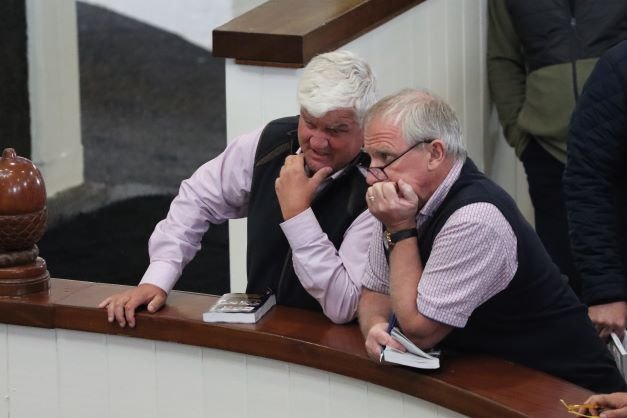
Proactivity is a default setting for Cantillon, who along with his equally industry-immersed wife Meta Osborne, owns and runs Tinnakill House Stud in the Laois village of Coolrain. As a man who has walked the walk and continues to do so, he is always worth listening to on matters pertaining to the sport and business of thoroughbred racing.
Apart from being a breeder of multiple Gp. 1 winners and overseeing a flourishing enterprise for two decades, Cantillon has also helped steward the massive strides made by Naas Racecourse in 13 years as chairman.
In addition, the 62-year-old is chairman of Irish Thoroughbred Marketing, a director of Goffs and board member of the Irish Equine Centre. Previously, he has served as chairman and president of the Irish Thoroughbred Breeders’ Association, chairman of Tote Ireland and director of Horse Racing Ireland.
He also served as manager of the Smurfit family’s Forenaghts Stud outside Naas for 32 years until standing down two years ago. This is a polymath on breeding, selling and running racehorses.
Osborne is the daughter of Michael, the late Irish Turf Club (IHRB) senior steward and Irish National Stud managing director. He was also the creator of Dubai as an international racing venue and of Sheikh Mohammed’s stud operations in Ireland. Meta would follow in her father’s footsteps by becoming the first woman—and still the only one—to be Turf Club/IHRB senior steward and is a current HRI director.
She is Kildangan Stud’s chief vet, having worked there for 34 years, while her family has been inextricably linked with Naas Racecourse since its foundation.
She and Cantillon make a good couple and that they don’t agree on everything is a positive. Among the many things they shared a page on was the desire to own their own stud. They bought Tinnakill in 2002 when it was a sheep farm, and the fecundity of the land and broodmares that have inhabited it since has propagated substantial success. Among the stellar cast of those bred there are Alexander Goldrun, Red Evie (dam of Arc-winning Breeders’ Cup heroine Found) and Casamento.
As a four-time Gp. 1 winner in four countries and three continents before injury brought his career to a premature conclusion last month, State Of Rest is the best though.

Due to the colt’s astounding feats in adding the Prix Ganay and Prince of Wales’ Stakes this year to last season’s Saratoga Derby and Cox Plate triumphs, Juddmonte made a bid for the son of Starspangledbanner’s 10-year-old Quiet American homebred dam Repose, who is in foal to Frankel.
“To be perfectly honest, like most Irish people in the industry, I’m a trader at heart,” Cantillon relates. “By definition then, if a big enough offer comes along, you’re gonna sell. Legacy is important but at the same time being able to meet your commitments for a long period of time and the security of that is also very important; and that won it over for me. She became too valuable a mare nearly to hold on to in proportion to the other mares I had. She was worth nearly more than everything else put together. That’s a total imbalance.
“We have a philosophy to buy taproot-type females in outstanding American and European families, and she was the embodiment of that in that her dam Monaassabaat, who we bought initially, was out of It’s In The Air, who was one of the best mares in America ever (five of her 16 triumphs were Gr. 1’s) and also a fabulous producer. So it was an overnight success that took 15 years.”
Despite the windfall, Cantillon will not be splurging unnecessarily, though he will look to improve the lowest bar. With around 40 mares, Tinnakill focuses on quantity; and thanks to their canny approach and eye for a bargain, that tends to produce some quality along the way.
“We don’t spend a lot at the sales. We buy mares from one grand to maybe seventy five. That’s the comfort zone for us, and that’s where we intend to stay. To be successful at that level, you need a lot of mares; and you hope some will make it big for you. The philosophy is probably to throw enough at the wall and some of it will stick.”
They are willing to sell their homebreds at any stage up to and including as a racehorse but will not be forced into accepting a price that doesn’t match their value.
“I see five different opportunities to sell along the way. The first one is in utero, the second one is the foal, the third is yearlings, the fourth is breeze-ups and the fifth one—the ultimate one—is in training. So within the philosophy of business, all five operate—and I’d say more so now, the fifth one. To show confidence in our own yearlings especially, we’ll keep 25 percent in them in partnership if whoever buys them asks us to do so. We’ll go to the next level on the understanding that if they prove themselves on the racetrack, they will get sold in a commercial way.
“We’d predominantly be known as foal sellers, and we sell a lot of foals in England and Ireland. People want foals that they can bring to the Orby and so on, and we sell those sort of foals. If they make money, so be it.
“We tend to keep any foal after the 15th of April. People have an idea of what a foal should look like—it’s a good, strong foal. As they head towards a May foal, the discount that you’re expected to take can be fairly big, so we don’t tend to bring the later foals to the foal sales; they tend to go on to the yearling sales. At the yearling sales, we bring mostly foals we failed to sell because we didn’t get what we thought the foal should’ve made, and also later foals.”
The demand for precocity and immediate results has inflated that specific market, but that means there is value for discerning buyers.

“What happens at yearling and foal sales is that people have a certain view of what a good foal or a good yearling should look like, and most people have exactly the same view. So if you have that particular product, you get a big premium. But for people buying horses, I think the value is slightly to either side and for a deviation of 10 percent, you might get a discount of 50.
“So if you can forgive some slight physical flaws, these are going to be discounted significantly; and I think there’s great value if people can get away from perfection to look upon the foal and yearling more as an athlete with slight imperfections but at the same time, an athlete.
“I think for that reason trainers probably make the best buyers because they’ve seen it all, whereas often, agents are under pressure to buy the horse that ticks all the boxes.”
Fashion also applies to stallions and again, Cantillon is imaginative when it comes to where he sends his mares. He has said previously that he likes to go against the tide when selecting stallions.
“I like to breed to middle-distance horses. Last year, I bred five mares to Australia. I think he’s a very good stallion. He can get you a two-year-old, he can get you a good three-year-old, he can get you a horse you can sell to Australia for a lot of money if it shows some form. The demand for middle-distance horses is enormous and very lucrative.
“The only time I would be breeding to ‘expensive stallions’ would be a foal share. I wouldn’t be putting more than 30 or 40 grand into any mare, barring we owned a nomination. I do invest in a lot of stallion shares, and to a large extent, that dictates what my mare is going to.
“I think it’s a great business move. It’s not without risk, but you can buy a stallion share; and in most cases, you’ll get most of your money back within three or four years. And if it hits, you’ll get many multiples of it. So, I think, if you’re in the industry, you have a nucleus of mares that you can use these nominations on, it makes huge sense economically to invest in stallion shares.”

He sees the economics of horse breeding as being cyclical and thus predicts a significant downturn in two or three years, with the thoroughbred industry tending to “have a significant correction” within a couple of years of a societal recession.
There is no hint of doom in these utterances, given that he has always cut his cloth to measure, and he expects any shrewd operator to insulate themselves in preparation for what’s down the tracks. Indeed while he has expressed concern for the smaller breeders in the past, he believes the environment is more conducive to them getting a positive return for their investment now.
“I think it’s a bit healthier than it was. The top end was very lucrative and is still very lucrative, but maybe there aren’t as many players at the very top end where there’s a lot of players in the middle tier now.
“I think that ITM and the sales companies in Ireland have done a great job in attracting American buyers. There was a significant increase in yearlings going to America from the Orby Sale last year. That’s a tremendous result. To some extent, the American market is replacing the Maktoum market in Ireland. And when you look at history, you always see that major players come and go; but the industry always survives, and I think now the American market is going to get better and better.
“There’s a couple of factors there. The injuries in turf racing are less, the number of participants in turf races are more, and that’s good from a gambling point of view. And the fact we’ve sent a lot of horses over to America now, they’re acting as advertisements for the next bunch, and they’re doing exceptionally well. So as night follows day, I think that at the upcoming yearling sales, the American influence will be huge.
“I think Charles O’Neill (ITM CEO) has done an outstanding job. To see him in action internationally is a joy to behold. That’s a role that takes a long time to get people’s trust. Our industry is based on trust, but he has it now; and a lot of markets have been opened up year-in, year-out by him visiting these places with his team. Over time there’ve been very lucrative transactions, especially for horses in training, as a result of that.”
Back at home the evolution continues, and Cantillon’s entrepreneurial son, Jack, has become a key part of a team in which manager Ian Thompson is also a vital cog.
“I think Jack is a good catalyst because he pushes you. A lot of the accolades have to go to him because I’d be at the sales sometimes and he’d be after buying a mare without me knowing. He’d never buy a mare I wouldn’t have bought myself, but he pushes the boat out more than I would and that keeps me on my toes.”
Among Cantillon Jnr’s interests is Syndicates.Racing, which focuses on the fractional ownership model and has been a resounding success on both codes in a very short span of time. The founder’s proud parents have shared the journey, and Dermot emphasises the importance placed on having a positive race-day experience. This is a central tenet of all the improvements that have taken place at Naas during his tenure.
“In terms of building the new stand, the whole concept of it was to bring the horse into the main focus. You look to your right, and you have the horses in the parade ring along with the actors—the jockeys, the trainers—you have that whole environment there. Then you look to the left, and you see where the horses will be participating. So the whole philosophy of that stand was to bring the horse more into focus.”
Osborne calls Naas her husband’s “fifth child,” and it has certainly flourished in an atmosphere that promotes and encourages imaginative thinking. Former manager Tom Ryan oversaw much of the improvement, and Eamonn McEvoy continues in a similar vein.
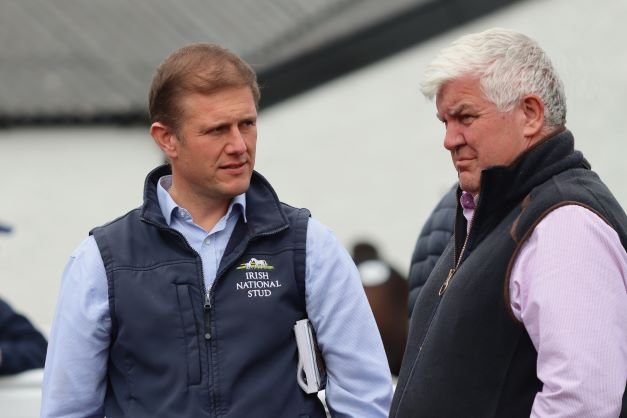
“The philosophy is ‘never stop.’ What’s next? Eamonn has done a super job. He’s a very progressive, inclusive person. He tries to bring everybody with him.”
Rewards have come in the form of the upgrading of the Lawlor’s of Naas Novice Hurdle to Gr. 1 status and being asked to take up the slack during The Curragh’s redevelopment. But there is clear impatience about the difficulty in climbing further up the ladder. Not yet having a Gp. 1 race on the flat is especially annoying.
“My big frustration is that within the whole structure of Irish racing there’s no pathway in how you can get better. How do you go from being classed as a second-grade track to being one of the elite tracks? I’ve asked this question five years, six years now, and nobody has been able to tell me. How do we change it so that the 13 Gp. 1 races in Ireland are not divvied out every year to two tracks? Why can’t other tracks that have a good proposition get one of those races? Why don’t we challenge the status quo for the benefit of Irish racing? Nobody’s been able to tell me why not except that they won’t rock the boat.
“Convention is an easy way of management, but it’s not the progressive way.”
In any high performance network, the existence of a clear pathway provides an incentive for improvement and as a consequence, raises standards. Why do more than trouser the media money if it doesn’t matter what you do?
“That’s exactly it. That’s what we’ve been told for generations, more or less. There are little tweaks where they give progressive tracks like Naas additional fixtures; and also, we’ve been able to increase our black-type races. But at the same time, there’s a glass ceiling there, and we need to break that for the good of Irish racing. We need to be progressive. We’re not progressive. We just maintain the status quo.
“There’s two ways we can get a Gp. 1. The first is to have an existing Gp. 1 transferred from another racecourse. The other way would be one of our races, over time because of the ratings, would qualify as a Gp. 1. At this point in time, there are one or two races that we would think could be due to be upgraded, but it hasn’t happened yet and that’s frustrating.”
There are some “outside the box” plans that are being considered at the moment that include some potential ground-breaking global partnerships. Further enhancements for the course are also in the pipeline.
As for the racing product itself, he believes maintaining quality is critical.
“My view of Ireland: we’re like what the All Blacks tend to be in rugby. If a horse wins a good two-year-old race in Naas, then he’s marketable to the whole world as that’s as good as you can get in terms of a young horse and where he’s performing. I have a lot of sympathy that everybody gets a run because I have some bad horses myself that can’t get into races, but I think it’s very important that we maintain the brand.”
He believes that the betting tax should be limited to winnings for off-course bookies but be increased to three percent. This would lead to a likely increase in funding for racing, he argues. It would also go some way to arresting the decline of the on-course betting ring that used to be central to the race-day experience.
“We need to give an advantage to bookies on track. There needs to be something which makes you go racing if you want to bet and a differentiation between off-track and on-track in terms of the three per cent could be a big help.
“When I was on the board at Naas first around 25 years ago, a very good race meeting could turn over a million pounds on-track. Now we’re looking at 150 (thousand). There’s a crisis. We need to do something radical about the crisis. My solution would be to have no tax on-course and increase the tax off-course on winnings.”
This might also help increase attendances, which despite what some industry leaders suggest, has to be a cause for concern with racing’s supporters getting older by the year.

“We’re nearly totally dependent on media rights money to operate the racecourse. You could do a strength-and-weakness analysis, and a massive weakness is its dependence on the media rights. Because of the media rights, we’ve maybe neglected the attendance.
“We now have a new audience, which is the digital audience and… people don’t travel to race meetings like they used to, so the emphasis has to be on the local audience, and we have identified that at Naas. We have taken a number of steps, and we’re going to take more to be more and more part of the Naas community. If we’re going to get people back racing, we see our growth within Naas and its environs.”
It is a recipe that has worked for a number of regional venues but has not yet been utilised, successfully at least, by too many. And as Cantillon has already suggested, media rights income has removed much of the incentive to bother doing so.
That said, he understands the disappointment of some of the smaller racecourses that feel the distribution of the media rights income has been inequitable.
“Something like an extra seven-to-nine percent went back to central funds when the last agreement was made. I was in the room when the thing was voted on, and people were looking at how much extra they were getting; and they were so happy about how much extra they were getting, they didn’t really think of the implications of giving an extra seven or eight per cent to Horse Racing Ireland. Horse Racing Ireland said, ‘Oh that’ll all come back in grants.’ And as a totality, it came back in grants. But for certain racecourses, it didn’t come back proportionally because if a track couldn’t come up with 60 percent of the cost, they wouldn’t get the 40 percent grant; and I understand their frustration.”
The current deal concludes next year, and he yearns for a “unified approach” towards negotiating the next one. But whatever unfolds, positive or negative, Dermot Cantillon will be putting his best foot forward. He knows no other way.
How will new HISA regulations affect Europeans sending horses to the US this autumn?
Article by Annie Lambert
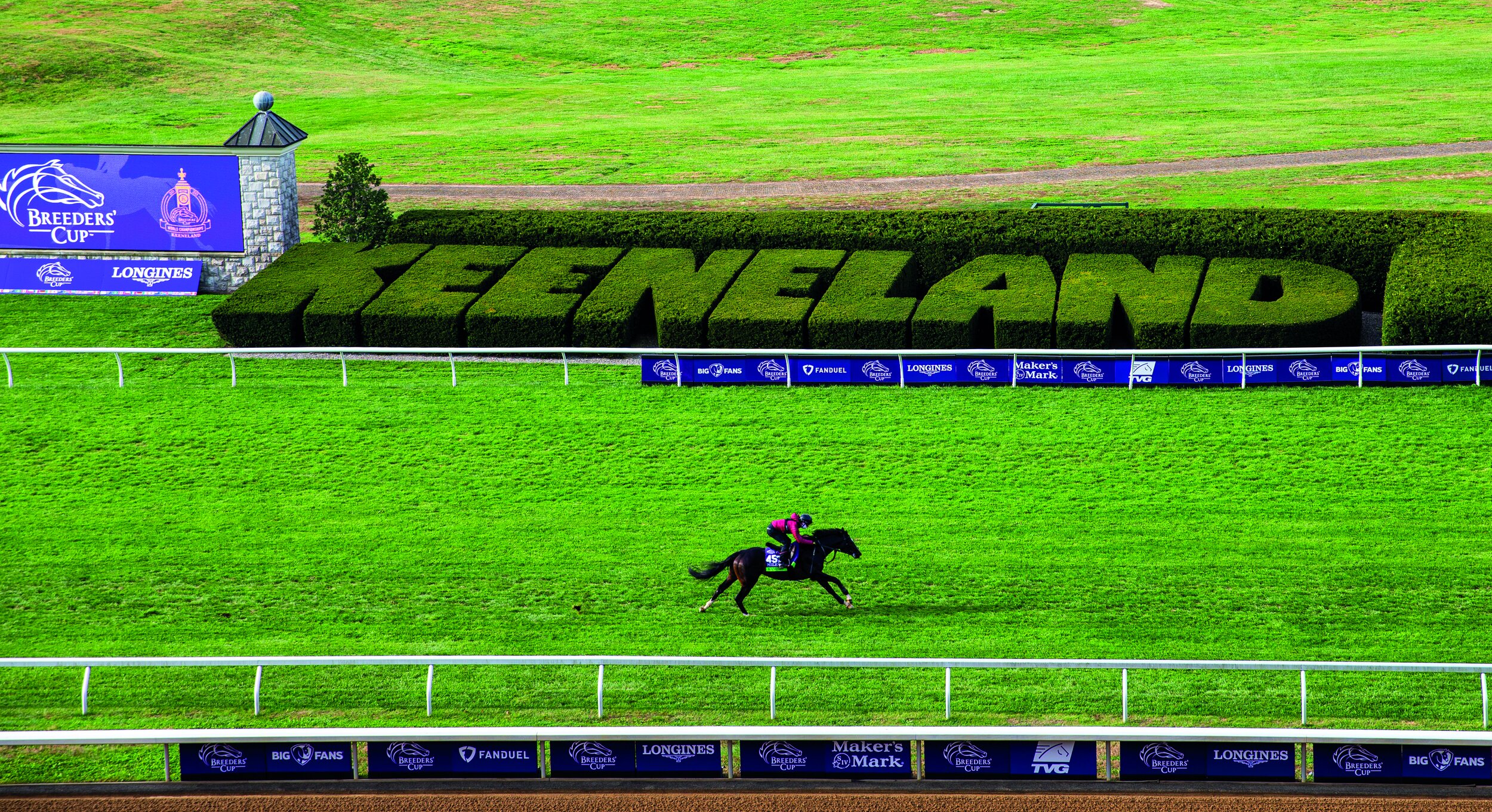
Breeders’ Cup contestants travelling to Kentucky this fall will have more to worry about than flight delays and shipping reservations. Owners, trainers and jockeys will need to bone up on new racing regulations now enforced across America. It appears they are well into that task.
The new rules and regulations became United States federal law in December 2020. The Horseracing Integrity and Safety Authority (HISA) is responsible for drafting and enforcing safety and integrity rules in thoroughbred racing across the U.S. Overseen by the government’s Federal Trade Commission (FTC), HISA is implementing a national, uniform set of rules applicable to all thoroughbred racing participants and racetrack facilities.
HISA comprises the Racetrack Safety Program, which went into effect 1 July 2022, as well as the Anti-Doping and Medication Control (ADMC) program, which will be implemented in January 2023. The ADMC will impact next year’s Breeders’ Cup.
According to Lisa Lazarus, chief executive officer of HISA, the Racetrack Safety Program includes operational safety rules and national racetrack accreditation standards, seeking to enhance equine welfare and minimise horse and jockey injuries. This program expands veterinary oversight and imposes track surface maintenance and testing requirements. It also enhances jockey (and exercise rider) safety, regulates riding crop use and implements voided claim rules, in addition to other measures.
The ADMC program will create a centralised testing and results management process while applying uniform penalties for integrity violations across the country. The rules and enforcement protocols will be administered by a new independent agency, the Horseracing Integrity and Welfare Unit (HIWU), which was established by Drug Free Sport International (DFS).
HIWU will oversee testing, educate stakeholders on the new system, accredit laboratories, investigate potential integrity violations and prosecute those breaking rules and protocols.
HISA completed and pending rules and regulations can be found at https://www.hisaus.org/.
Shifting protocols

Not everyone required to opt into the Horseracing Integrity & Safety Act is pleased to oblige. The confusing regulations have left many with less than a clear understanding of what the new rules actually mean. Those details have constantly been modified and most likely will continue to fluctuate as flaws in the statute are arbitrated.
The legislation timeline—a very rapid implementation—did not leave an abundance of time for the busy and independent members of the racing community to thoroughly digest the new rules and oversights: In a hurry, they are being asked/required to become obligated by registering themselves and their horses. Horsemen felt left in the dust.
HISA is now, however, in the process of adding a means for horsemen to have a bigger voice in forming regulations and protocols—a complaint horsemen have had since the onset is being excluded from the process. Lazarus announced her executive team would be selecting 10–12 horsemen to participate on the Horsemen’s Advisory Group.
Barry Irwin, founder and chief executive officer of Team Valor International, has been promoting additional integrity in the racing industry for two decades or longer. As a turf writer, breeder, owner and bloodstock agent for over 50 years, Irwin looks forward to implementation of the ADMC. He might have hoped for a smoother execution of HISA, but he is glad things are progressing.
“The safety element is so big and all encompassing, some people may think overreaching, that it stalled the implementation of the integrity piece,” Irwin opined. “There is a lot of good in it; there is a lot of confusion in it. Part of the confusion stems from the perceived lack of input and influence of the people to whom these rules apply.
“A lot of trainers are [unhappy] because there are a bunch of [changed] procedures that they have been using for years, such as blistering horses, pin-firing horses—things like that. There are growing pains, so they have invited horsemen to join an advisory committee for input now and in the future, which I found to be a good thing. It’s just a little late.”
People responsible for registering horses, usually the trainer, are required to keep precise records for each animal. Most horsemen have a vivid aversion to bookkeeping; they’d much rather concentrate on training horses and keeping owners happy and informed.
Most countries require medical and procedural records be kept on their equine competitors. HISA also requires trainers and veterinarians to maintain detailed, daily health and treatment records for equines in their care. This also applies to international trainers temporarily in town for major races. Those records must be made available to regulatory veterinarians, stewards and HISA upon request. Imagine the daily hours to keep up with a barn full of trainees. There is a solution—a software program—to ease the struggle.
Solution for keeping records
Equine MediRecord became operational in 2018. It was the brainstorm of Pierce Dargan in County Kildare, Ireland. Dargan, a fifth generation horseman, is the company’s CEO. Dargan’s system was created for his family’s training operation in Ireland, to help keep current with racing regulations they faced at the time.

Trainers can sign up for Dargan’s company platform, which allows them to keep the tedious records required by HISA. Those with multiple stables and facilities can add assistant trainers and veterinarians to assist with inputting information.
“What our system then does is notify the trainer when a record has been put in by someone else for them to sign off, ensuring they know at all times what is being given to their horses,” Dargan explained. “Any horse with an open treatment on our system will [be marked] to remind the trainer to check this horse before entering into any races, as there is still a treatment in the horse’s profile; this ensures the withdrawal period is completed before they race.”
Presently, the cost is $1.50 per horse, per month for the initial year, increasing to $3.00 per horse/month the second year. “We wanted to make sure this was a tool that all trainers, big and small, could afford,” Dargan said. “One of the benefits of having clients globally is we can spread the costs, making it cheaper for all.”
“We have done the Breeders’ Cup World Championships for the last two years, as well as the Pegasus World Cup, Saudi Cup and Preakness in 2022,” Dargan pointed out.
Coming to America
International Breeders’ Cup entries and connections appear prepared to take on HISA, although there could be a few speed bumps on the road to America.

Not registering for HISA—no matter what continent you hail from—means a person or horse may not participate in U.S. racing. Once signed up, however, being misinformed or not following the rules can land people and equines severe punishments, large monetary fines and/or disqualification from industry participation.
Early in the process, HISA’s website was not particularly user friendly, but those issues have been worked out for the most part. International connections preparing to run in major U.S. races initially registered with HISA prior to entering or declaring to run. However, to register for HISA, one needs to be licensed in the state where they will be running. Some states, like New York, require digital fingerprinting of the licensee by track personnel, causing problems for horsemen in far away corners of the world.
“HISA has made it impossible to do things on race day,” explained Adrian Beaumont, director of Racecourse Services for the International Racing Bureau in Newmarket, England. “Therefore, we had to be proactive and get connections licensed beforehand. This often means having to get connections fingerprinted in advance of the meeting. This was especially true of connections, like owners, who would not be going to the races but still needed a HISA registration. New York Racing Association made their cut-off time for HISA as 10 a.m., scratch time, on the day of the race.”
According to Beaumont, HISA’s Lisa Lazarus organised a Zoom call, for Breeders’ Cup principles, including Japan, on 16 September. “I will be interested to know the timeframe they will require all HISA registrations to be completed by, especially as declarations to run are due on Monday, October 31,” added Beaumont.
While the Lazarus Zoom call may flatten some organisational speed bumps, the initial dismay for HISA created a flurry of ongoing legal actions by several state racing commissions, jockey organisations, different Horsemen’s Benevolent and Protective associations and other groups. North American Trainer magazine contributor and equine attorney Peter J. Sacopulos expressed the issue in the magazine’s Issue #65 - Summer 2022, on page 48. In the article, Sacopulos questions how HISA affects international trainers and owners.
“In registering, the foreign national trainer is responsible for and obligated to fully and completely understand and comply with all HISA requirements. Once properly registered and deemed a ‘covered person,’ the foreign national trainer has certain ongoing obligations. For example, Thoroughbred trainers are required to complete four (4) hours of training annually pursuant to Section 2182(b)(5) of the rules governing the Racetrack Safety Program. Additionally, there are requirements for filing records relative to the medical care and treatment of horses. Also, the licensing and ongoing requirements for covered persons apply to owners of Thoroughbred horses. Therefore, it is recommended that the Thoroughbred trainer who is going through the registration process informs his or her owner of those requirements and sees that the owner(s) are properly registered as covered persons.”
It gets complicated.
Riders, whips, rules & penalties
Beaumont was somewhat surprised by the requirement for jockeys to have an annual baseline concussion test as part of the HISA registration. Riders in England and Ireland have concussion baselines done every two years. French jockeys are not required to have annual baseline concussion tests.
The chief medical officers at the main European Jockey Clubs and the Jockeys’ Associations are now aware of this test requirement. Beaumont recommended their website as informative and helpful.
https://jockeyclub.com/pdfs/HISA/HISA_Jockey.pdf
“It is the jockeys [who] require the extra briefing about all the rules,” Beaumont said, “but we will do that with them all before race day. “At the last two Breeders’ Cups, the stewards have also briefed all the jockeys about their rules on the mornings of the races. This will obviously now include any extra regulations brought in by HISA.”
Jockeys with Breeders’ Cup mounts will need to study HISA restrictions for use of the whip, which in some cases are similar to, yet vary from, European rules.


Until the limitations on use of the whip become muscle memory, riders are finding themselves punished for extra strikes or improper handling of the whip. Numerous penalties have been dished out to even the best of the American riding colony thus far. One costly example occurred last month.
Jockey Luis Rodriguez-Castro was fined $500 and suspended three days for his ride on Drafted (Field Commission) while finishing fifth in the Forego (Gr. 1) at Saratoga in New York. The rider’s violation was striking Drafted with the whip ten times during the race. HISA rules allow only six strikes during a race; Rodriguez-Castro’s four strike overage cost the horse’s connections $26,000 in purse money.
But Germany and other European nations are also inflicting stringent rules on riders who are overly aggressive with crop use.
German-bred Torquator Tasso, winner of last year’s Qatar Prix de l'Arc de Triomphe (Gp. 1), finished a near second to Mendocino in Baden-Baden, Germany. Jockey Frankie Dettori felt the sting of striking his mount one time too many with a 14-day suspension.
Strict German whip rules permit for the crop to be used only five times during a race, with the use of it down the shoulder with hands on the reins still considered as one strike.
Team Valor International races horses in Germany, and Barry Irwin voiced respect for their programs in general and regard for their accomplishments with smaller thoroughbred crops of 750 to 800 foals; Torquator Tasso is an example.
“[Germany] has a lot of rules, and they are different from England, Ireland and France,” Irwin said. “You can’t use a tongue tie, for example. I don’t know any other jurisdiction that does that. They are very good at testing, and they have a lot of rules about bleeders.”
Handling and properly holding the whip have become strict and exacting in many racing nations. A BHA steering group has proposed 20 changes to their current whip rules in four areas—how the whip is used, changes to regulation, changes to enforcement, plus other recommendations. (See sidebar)
“Most of our jurisdictions are run as tightly, if not more tightly, than your new HISA rules over in the states,” Beaumont pointed out. In some countries, such as Denmark, Norway and Sweden, whips are banned. Most other countries have strict rules on the use of the whip in terms of how many times a horse can be hit and where they can be hit.”
“The new rules, which are likely to come into force with BHA, include using [the whip] in the backhand position only,” he added. “There are examples every week of jockeys getting fined and banned for use of the whip, and generally longer suspensions than in the states.”
Nation-to-nation compatibility?

HISA regulations overall are not so dissimilar from other international edicts. There are so many variables, geographically for one, that synchronising worldwide regulations may never come to fruition. But, it’s a thought for the future.
When the ADMC portion of HISA kicks into gear the first of next year, there will likely be even more details to be digested by horsemen and other stakeholders. After all, that was the initial consideration when seeking reforms.
Irwin has “great hope” that those marring the integrity of thoroughbred racing will be prosecuted and severely penalised, and that the punishments will be severe enough to stop the cheating.
“As for the Anti-Doping and Medication Control regulations for 2023, I await their details,” said Beaumont. “Of course, we are already subject to strict restrictions over here, so this should not be an issue. Every horse shipping to run at Breeders’ Cup, for example, will already have done an out-of-competition test sanctioned by the state governing body and carried out by the likes of BHA on their behalf.
“They have a tough task,” Irwin said of HISA. “There are so many elements, groups to try to appeal to—it is a tough job.”
HOW THE WHIP SHOULD BE USED
Use of the whip for safety purposes should continue to be a fundamental principle of regulation.
The Rule requiring the whip to be carried (though not necessarily used) should be retained.
Use of the ProCush whip should continue to be permitted for encouragement, with strong and appropriate regulation for its use.
The whip rules will be amended to restrict use for encouragement to the backhand position only.
Harmonisation of whip rules and penalties is a positive aspiration. The BHA should continue to play a leading role in discussions about harmonisation with its international counterparts, particularly Ireland and France.
CHANGES TO REGULATION
The regulatory approach to the whip should be reframed to drive continuous improvement, both in standards of whip use and in the consistency of stewarding.
Official guidance notes relating to some aspects of the whip rules should be refined and improved, so they are less ambiguous and open to interpretation, and to ensure greater consistency in the enforcement of the rules.
A review panel will be established, which will assess all potential whip offences and apply sanctions or remedial actions where appropriate. The panel will deal with referrals from the Stewards, as well as having the power to initiate its own review.
CHANGES TO ENFORCEMENT
The threshold for the application of some whip penalties will be lowered, to increase the deterrent effect and ensure earlier intervention.
Penalties will be increased for some specific offences where the current penalty is considered inadequate.
Financial penalties applied to amateur riders for whip offences will be increased.
The penalty structure for use of the whip above the permitted level, which are the most frequently committed offences, will be revised to increase the deterrent effect.
Penalty structure for use of the whip above the permitted level in major races to be revised as a doubling of the suspensions for the same offence in standard races.
Repeat whip offences should be addressed at an earlier stage, and the penalties for repeat offences increased to deter further repetition.
Disqualification of the horse will be introduced into the penalty framework for particularly serious use of the whip above the permitted level, where there has been a clear and flagrant disregard for the rules.
OTHER RECOMMENDATIONS
The BHA, on behalf of the racing industry, should commission and support further objective research into the effects of the whip, using any relevant scientific advances to inform policy.
The BHA should regularly consider the design and specifications of the approved whip, with a view to incorporating any technological innovations or advances that could further improve equine welfare and safety.
Reasonable efforts should be made by British racing to explain the design, use and regulation of the whip to key audiences.
While changing the name of the whip is not a direct, formal proposal, racing participants and media should be encouraged and supported to speak about the whip using appropriate and responsible language.
The BHA and racecourses should agree a standard rider contract for charity and legends races, to ensure riders in such races are clear on their obligations in relation to use of the whip.
The effect of whip use on stride parameters and the racehorse
Article by Rhi Lee-Jones
Katie Walker, a recent graduate of the Thoroughbred and Horseracing Industries MBA, presented her research project findings regarding the effect of the whip at the 2022 Horseracing Industry Conference. The project explored how sectional time/stride data could be used to analyse the impact of the whip in the closing stages of races. The project, supported by the HBLB, made use of the data provided by Total Performance Data to determine what insights could be gained regarding both the performance and health of equine athletes. The use of the whip is a prevalent topic in British horse racing, with the British Horseracing Authority’s Whip Consultation Report released in July 2022 recommending research into “the effects of the whip, using any relevant scientific advances to inform policy.”

For this study, data was collected from two match sets: hands and heels races and whip permitted races. Both sets were drawn from races post-2017, when stride data became available; and a limiting factor must be noted regarding the small quantity of hands and heels races, and therefore, data available.
Stride length and stride frequency in the final three furlongs of each race were extracted, controlling for trip, ground, number of runners, quality of horse and racecourse as far as possible. No significant difference in stride frequency was found; however, a small but significant difference in stride length was found, with horses in whip permitted races having marginally longer strides. This was recorded as follows. 3f – 2f = 0.09m, 2f – 1f = 0.12m and 1f to finish = 0.05m. However, the reasons that trainers run horses in hands and heels races may lead to selection bias, which makes further analysis necessary.
This analysis was performed with both sets of data. In the final three furlongs, it was found that the stride length of whip permitted horses decreased by 0.4m (5.7%), whereas hands and heels horses’ stride length decreased by 0.36m (5.2%).
Horses placed 1st, 2nd and 3rd in all races were then subtracted to find the stride length declines in the final three furlongs, hence disregarding the horses out of contention. Data showed a similar pattern of a reduced decrease in stride length for horses in hands and heels races. Hence as the table below shows, horses in races with the whip permitted show a larger decrease than hands and heels-ridden horses—a surprising finding.

No firm conclusions can be made here due to the limitations of the data, but it raises the question of the impact of the whip. The use of stride parameters per second, as opposed to averages over a furlong, and adding whip counts, could produce studies where hands and heels races are not required for analysis. This would allow for a larger data set and more detailed analysis.
Sensors on the whip could count both the strikes and the force to give an enhanced picture of how the horse is responding and performing, bringing into focus how jockey training would also be influential on these factors. Cardiac monitoring is advised for this deeper analysis to monitor for signs of distress in the horse. Interference between participants is a major safety concern during the running of a race and could be monitored with use of this data and guide future rule reviews. In short, funding for this analysis could be revolutionary in a range of welfare and integrity concerns.
VETERINARY IMMUNOGENICS ARE BACK!
Article sponsored by veterinaryImmunogenics.com - WE'RE PLEASED TO MEET YOU!

Photography by Drew Stoecklein
An Exciting New Chapter for Hyperimmunised Plasma Therapy
After 30 years of providing the United Kingdom, Ireland and Europe with high-quality hyperimmunised equine plasma under the helm of Thomas and Eileen Barr, Veterinary Immunogenics has been acquired by Plasvacc UK Ltd.
The company has officially transitioned to day-to-day management under General Manager Fergus Macarthur, who has overseen significant capital investment intended to bolster production capabilities of Veterinary Immunogenics’ Hypermune™ and Hypermune™-RE plasma treatments while still maintaining Veterinary Immunogenics' steadfast commitment to safety and quality. Both Veterinary Immunogenics’ Hypermune™ and Hypermune™-RE products are once again currently available, providing vets, trainers, and breeders with an important tool in treating Failure of Passive Transfer (FPT) in foals and Rhodococcus Equi infections as well as reducing hospitalisation and recovery times for other conditions.

All products are thoroughly tested for IgG levels.
Additional investments have also been made to bolster Veterinary Immunogenics’ technical and customer support operations to provide a seamless customer experience.
“With an impressive track record spanning three decades, we’re grateful for the tireless efforts of Dr Thomas Barr BVMS MRCVS and Eileen Barr to advance plasma-based equine veterinary medicine in the United Kingdom,” said Andrew Macarthur, CEO of Plasvacc UK Ltd.
“A sure sign that Veterinary Immunogenics was a great fit for the Plasvacc Group of Companies was their unwavering commitment to product quality and exceptional customer service that closely mirrors our own. We’re very pleased to be adding the first-rate Veterinary Immunogenics employees to the Plasvacc Team,” continued Macarthur.
As always, Veterinary Immunogenics’ 100% traceable, single-source, cell-free plasma is collected exclusively from our donor herd in the United Kingdom. All Veterinary Immunogenics products are thoroughly tested to accurately measure IgG levels, total protein, sterility and freedom from virus, providing unparalleled peace of mind.

Founded in 1996 as Plasvacc Pty Ltd in Australia and expanded through Plasvacc USA Inc. in 2005. Plasvacc’s global companies manufacture and distribute high-quality hyperimmunised blood plasma products used to supplement the immune response system in animals. Firmly committed to animal ethics, and active in the communities it serves, Plasvacc prides itself in delivering the highest quality product possible while delivering unmatched customer service and technical support.
To learn more about Plasvacc or Veterinary Immunogenics, please visit:
plasvacc.com (AUS) | plasvaccUSA.com (USA) | veterinaryimmunogenics.com (UK)
What we learnt at the Horseracing Industry Conference

Article by Rhi Lee-Jones
The Racing Foundation was delighted to welcome more than 200 delegates to the fifth annual Horseracing Industry Conference at Newbury Racecourse.
Held on 30 June in partnership with the University of Liverpool Management School, the event was attended by leading figures from across the horseracing industry.
The conference’s headline topic was titled: “A healthy balance: balancing economic, environmental and social health to ensure a sustainable racing industry.”
The conference gave keynote speakers the opportunity to address the challenges affecting the horseracing industry in Britain.
Rob Hezel, chief executive at the Racing Foundation, said: “When developing the agenda for this year’s Horseracing Industry Conference, we did so with the belief that the long-term sustainability of the sport depends on three things: economic, social and environmental health.
“The growth in the event and its popularity demonstrates to me the real need for a forum for the multitude of organisations and businesses that make up British horseracing to meet regularly and to challenge and support each other.
“We had a vast range of talent in the room from a great variety of organisations. If the Racing Foundation can assist in aligning and coordinating them, then we are adding real value to the industry."
Joe Saumarez-Smith, chair of the British Horseracing Authority, kicked off the conference with his first keynote address since taking on the position earlier in the year.
The importance of data collection and how the British racing industry understands and uses that data was cited by Saumarez-Smith as crucial to the sport’s future.
The economic section of the conference commenced with Peter Hawkings, strategy consultant at Portas Consulting, analysing the funding structure of British racing.
Hawkings warned that the British racing industry would have a low growth rate over the next five years should intervention not take place. Seven potential levers to improve British racing’s financial position were subsequently offered:
· Build relationships with fans and make the sport more relevant
· Create new, exciting racing formats and greater narratives across the year
· Convert more fans to becoming fractional owners (syndicates)
· Secure owners in new geographies
· Optimise racing as a betting product
· Achieve meaningful levy reform
· Diversify racecourse revenue streams (e.g., becoming more of a 365-day event destination)

Continuing on the theme of the economic challenges of racing, “How People Bet on Horseracing and the Implications for the Sport'' was the title of University of Liverpool’s Professor of Economics David Forrest’s keynote talk. He took delegates through the findings of the Patterns of Play project, initiated by the Gambling Commission and GambleAware.
The project was intended to yield a description of how people gamble online, primarily with the intention of informing policy for harm reduction and analysed data from 14,000 online betting accounts.
The University of Liverpool professor explained that the Patterns of Play data revealed risks to racing’s implicit business model.
Even relative to the other gambling activities that were studied as part of the project, spending on race betting was found to be very concentrated indeed with its revenue stream very dependent on a small number of the population.
Indeed, the study found that the top one percent of gamblers on horse racing provided 59 percent of total stakes. One risk highlighted by Forrest was the possibility that the activities of these high-spending gamblers may generate regulatory interventions which could curtail their levels of activity.
Forrest then explored the age range of participants in online horse race betting, finding it relatively high in all age groups. Horse race betting was found to attract only a relatively small share of betting spend in younger age groups, with more than 55 percent of horseracing gross gambling yield generated by those aged 45 or above.
If the younger half of the population maintains these preferences as they age, Forrest warned, there is likely to be a secular decline in racing’s revenue stream. This data illustrates a medium and long-term threat to the sustainability of British racing at its current scale of activity because those who are currently in younger cohorts clearly have a stronger preference for sports betting (predominantly football) than for horse betting.
A fundamental issue for British racing, Forrest warned, is that the senior age range for all British racing’s customer groups, including racegoers, television viewers, gamblers and owners, poses a threat to the future prospects for the sport.

Crucial to the health of British racing is the sport’s social licence. Next on the agenda, conference delegates heard an analysis on the impact of equality, diversity and inclusion (ED&I) in British racing in a talk that explored whether it was making progress in British racing or was merely ticking boxes.
The talk was hosted by Lee Mottershead, Racing Post senior writer and member of the sport’s Diversity in Racing Steering Group. Mottershead quizzed industry leaders including Chief Executive of the British Horseracing Authority Julie Harrington on the sport’s responsibility towards ED&I. Mottershead was also joined onstage by Urban Equestrian Academy founder Freedom (a.k.a. “FR33DOM”) Zampaladus, who offered honest insight into his experiences in horse racing as an individual from a historically underrepresented background.
Two members of the recently appointed project team at the Horse Welfare Board were next to present and sparked heated debate amongst the delegates present.
Mike Etherington-Smith, equine safety advisor, and Francesca Compostella, aftercare lead, explored racing’s aftercare responsibility towards its equine athletes.
A number of horse welfare projects were also discussed, including the Racing Foundation-funded Orange to White project.
Currently being phased into British racing, the Orange to White project has seen an estimated 368 fences and 2,132 hurdle panels across 40 racecourses change markings from the traditional orange to white.
The project, which Etherington-Smith and Compostella explained as being delivered by the Horse Welfare Board as part of the ‘Life Well Lived’ strategy, followed intensive research carried out by Exeter University into equine vision between 2017 and 2018.
The study found that changing the wood and vinyl padding of take-off boards, guard rails and top boards to white provided increased contrast and visibility for horses, leading to improved jumping performance.
Rhi Lee-Jones, communications and events manager for the Racing Foundation, said: “The 2022 Horseracing Industry Conference was the biggest yet with 227 tickets allocated.
“I’d like to thank our speakers and panel experts for delivering such thoughtful and challenging dialogue and contributing to insightful debate, which I hope engaged and ignited action in our delegates.
“At the Racing Foundation, our aim is to drive industry improvement. We plan for the conference to keep developing in the years to come as an important means of achieving that end.
“That process of alignment and coordination is crucial, and it needs to be informed by racing’s leaders. They need to be visible and articulate the direction of travel but also be prepared to listen, reflect and respond to what they hear.
"I would like to reiterate our thanks to all those who attended."
Horseracing and Thoroughbred Industries MBA graduate Katie Walker also presented her research on the effect of whip use on stride parameters of the racehorse—more details of which can be found on the insert.

The final keynote address of the day came from Sustainability Consultant Ruth Dancer, who has recently completed a scoping exercise into British racing’s environmental sustainability practices. The White Griffing consultant examined with delegates the findings of the recently published report, looking into the way in which environmental sustainability impacts the British horse racing industry. From water shortages to the potential for biodiversity, Dancer detailed the risks, challenges and opportunities for the sport in this area. The importance of a whole industry approach was emphasised along with how horse racing might move towards Britain’s net zero goal on carbon emissions by 2050. Social licence was again mentioned and was a common theme throughout the day, with Dancer highlighting the importance of environmental sustainability for the next generation. The carbon footprint of delegates’ travel to the conference was also offset by the Racing Foundation through the process of carbon sequestration, reinforcing the Foundation’s commitment to environmental sustainability and its belief that the issue has to be at the heart of not only racing’s future, but its present too.
To conclude the 2022 conference, racing’s leaders formed a leadership panel in which they took questions from attending delegates.
Among the leadership panel was Chief Executive of the National Trainers Federation Paul Johnson, Chief Executive of the Thoroughbred Breeders’ Association Claire Sheppard, and Chief Executive of the Racecourse Association David Armstrong.
Chief Executive of the Racehorse Owners Association Charlie Liverton and Tim Naylor, the director of Integrity and Regulation for the British Horseracing authority, completed the expert panel.
Neil Coster, director of studies for the Thoroughbred Horseracing Industries MBA at University of Liverpool Management School, said: "It has been fantastic to see the conference evolve since it started in 2018—more than doubling in size and this year attracting a record number of delegates.
“The University is delighted the event continues to showcase the graduates’ research projects, and this highlights one of the philosophies of the conference—that of better informed decision making.
“It is now seven years since the launch of the MBA, and we are pleased to see a number of our graduates progressing to senior positions in the industry."
To be the first to hear about the 2023 Horseracing Industry Conference, sign up to the Racing Foundation newsletter at www.racingfoundation.co.uk/news
Small wounds leading to synovial infections

Article by Peter Milner
Most experienced trainers will know from bitter experience that a seemingly tiny wound can have a big impact if a horse is unlucky enough to sustain a penetrating injury right over a critical structure like a joint capsule or tendon sheath. Collectively, joints and tendon sheaths are called synovial structures, and synovial infection is a serious, potentially career-ending and sometimes life-threatening problem.
A team of veterinary researchers from Liverpool University Veterinary School, published a study in Equine Veterinary Journal that examined factors influencing outcome and survival. This article was first published in European Trainer (issue 50 - summer 2015) but is being republished due to popular demand.
What is synovial infection?
Infection involving a synovial cavity, such as a joint or tendon sheath, is a common and potentially serious injury for the horse. The most prevalent cause is a wound, although a smaller proportion of cases result following an injection into a joint or tendon sheath, or after elective orthopaedic surgery to the area. Additionally, infection can occur via the bloodstream, particularly in foals that have not received enough colostrum. Left untreated, the horse will remain in pain, and ongoing infection and inflammation can result in permanent damage. This can ultimately result in euthanasia on welfare grounds.
What factors are important for horse survival?

When a synovial infection occurs there is a huge inflammatory response, leading to swelling and pain. The horse usually shows severe lameness but following a good clinical examination, the cause is often quickly identified. Prompt veterinary recognition of involvement of a joint or tendon sheath and aggressive treatment (involving flushing the affected synovial cavity and the correct use of systemic and local antibiotics) will often result in a good outcome for the horse. Flushing removes inflammatory debris including destructive enzymes and free radicals, and it eliminates contaminating bacteria in most cases. This is performed most effectively by arthroscopic guidance (“keyhole” surgery) under general anaesthesia. Using a “scope” to do this is considered superior to flushing through needles because arthroscopy allows the inside of the problem area to be inspected, foreign material (for example, dirt or splinters of wood) to be removed, and any concurrent damage (such as damage to the cartilage or a cut into a tendon) to be evaluated. In addition, targeted high volume lavage is best achieved via arthroscopy.
Survival following arthroscopic treatment of synovial sepsis is good – approximately 80-90% of adult horses undergoing a flush are discharged from hospital. In foals, however, the figure is much lower, at around 55%, and this likely due to complicating factors such as concurrent sepsis involving multiple organs. Our study, recently published in Equine Veterinary Journal, investigated what factors might be involved in determining survival to hospital discharge in 214 horses undergoing arthroscopic treatment for synovial sepsis. We used statistical modelling to evaluate the interactions with different factors at three key time points during the management of the condition at Liverpool Veterinary School, one of the leading UK referral veterinary hospitals. Information collected on admission to the hospital included when the horse was last seen to be normal, the cause of the infection, the degree of lameness present, and the level of white blood cells and protein in synovial fluid collected from the infected joint or tendon sheath. These lab tests are an important method which veterinarians use to determine how severe the infection is. Additional data collected included whether the surgery was performed out-of-normal working hours, if foreign material was present, the amount of inflammation present in the area, and whether any additional cartilage or tendon damage was found at surgery. Post-operative information gathered included what the levels of white blood cells and protein were in the synovial fluid after surgery and whether the horse needed further surgical treatment.
All horses in this study were greater than six months old and the majority had sustained a wound that communicated with a joint or tendon sheath. Eighty-six per cent of the 214 horses admitted to the hospital survived to hospital discharge. Of the 31 horses that did not survive, 27 were euthanised due to persistent infection or lameness.
An angry, protein-soup
A high level of protein in the synovial fluid of the affected joint or tendon sheath on admission and levels that remained high after surgery were strongly associated with a poor outcome and loss of the horse. Protein concentrations are normally fairly low in a normal joint or tendon sheath, but protein leaks into the synovial cavity from surrounding blood vessels when inflamed. Protein is also produced by cells in the synovial cavity when they are activated in response to a severe insult such as infection. Protein clots trap bacteria in the joint, making it harder to remove infection. The protein soup also includes lots of inflammatory mediators such as enzymes and signalling molecules, and these cause further inflammation, tissue damage, and sensitise pain receptors in the synovial cavity magnifying the inflammatory response and increasing the pain experienced by the horse. Unchecked, this angry, inflamed environment can result in cartilage degeneration, bone damage, and adhesion (scar) formation. This fits well with another observation from this study linking the presence of moderate or severe synovial inflammation at surgery as a negative factor for survival.
Small wounds can lead to big trouble
Interestingly, horses presenting with an obvious wound (as opposed to a small penetrating injury or no visible wound) were more likely to survive to hospital discharge. This may be due to the injury being noticed earlier and hence prompting earlier veterinary intervention. Alternatively, open wounds may allow drainage of inflammatory synovial fluid and lessen the detrimental effects of increased pressure within the joint as well as reducing ongoing exposure to inflammatory mediators. This finding highlights the fact that trainers should act promptly when faced with a wound – it is easy to underestimate just how much damage may be going on under the surface.

Horses undergoing surgical treatment of a joint or tendon sheath infection out-of-hours (for example in the middle of the night) were three times less likely to survive to hospital. Often, horses with a synovial infection arrive stressed and painful and not in an ideal state for having an anaesthetic. Early identification of an infection and appropriate management is important but stabilisation of the horse and preparation for surgery appear to outweigh any perceived benefits of undertaking immediate surgery. This is borne out by the finding that time from initial injury to treatment was not associated with outcome and is in agreement with previous findings from other researchers. It is important to reiterate that prompt recognition and treatment of a horse with an infection in a synovial cavity is essential but that surgical management within 12-24 hours of diagnosis, so that the horse is in the best condition for undergoing anaesthesia, does not affect outcome.
Do horses return to work after a synovial infection?

The big question that owners and trainers want to know is whether the horse will regain full function of the joint or tendon sheath after having an infection. Figures for return to function following surgical (arthroscopic) treatment for a synovial infection vary between 54-81%. Various factors appear to relate to outcome but when looking at a predominately thoroughbred racing population, the statistic for return to training appears to be at the higher end of this range. Factors associated with failure to return to athletic performance include the presence of thickened inflammatory tissue (known as pannus) at the time of surgery and that may relate to the development of fibrous adhesions and scar tissue within joint or tendon sheath longer-term. Some structures are particularly likely to compromise future function, and horses with an infection of the navicular bursa in the foot following a nail penetration generally do worse.
Take home message
Horses sustaining an infection to a joint or tendon sheath have a good chance of the infection clearing up and surviving the injury, with the likelihood of racing as high as around 80%. Our key message for trainers from this study is that it is essential that they recognise early when an infection involves one of these structures and have a veterinarian fully evaluate the injury. Aggressive treatment is important and involves flushing the synovial cavity using a “scope” under anaesthesia to remove as much inflammatory and infective debris as possible.

International racing returns to Morocco
Article by Paull Khan
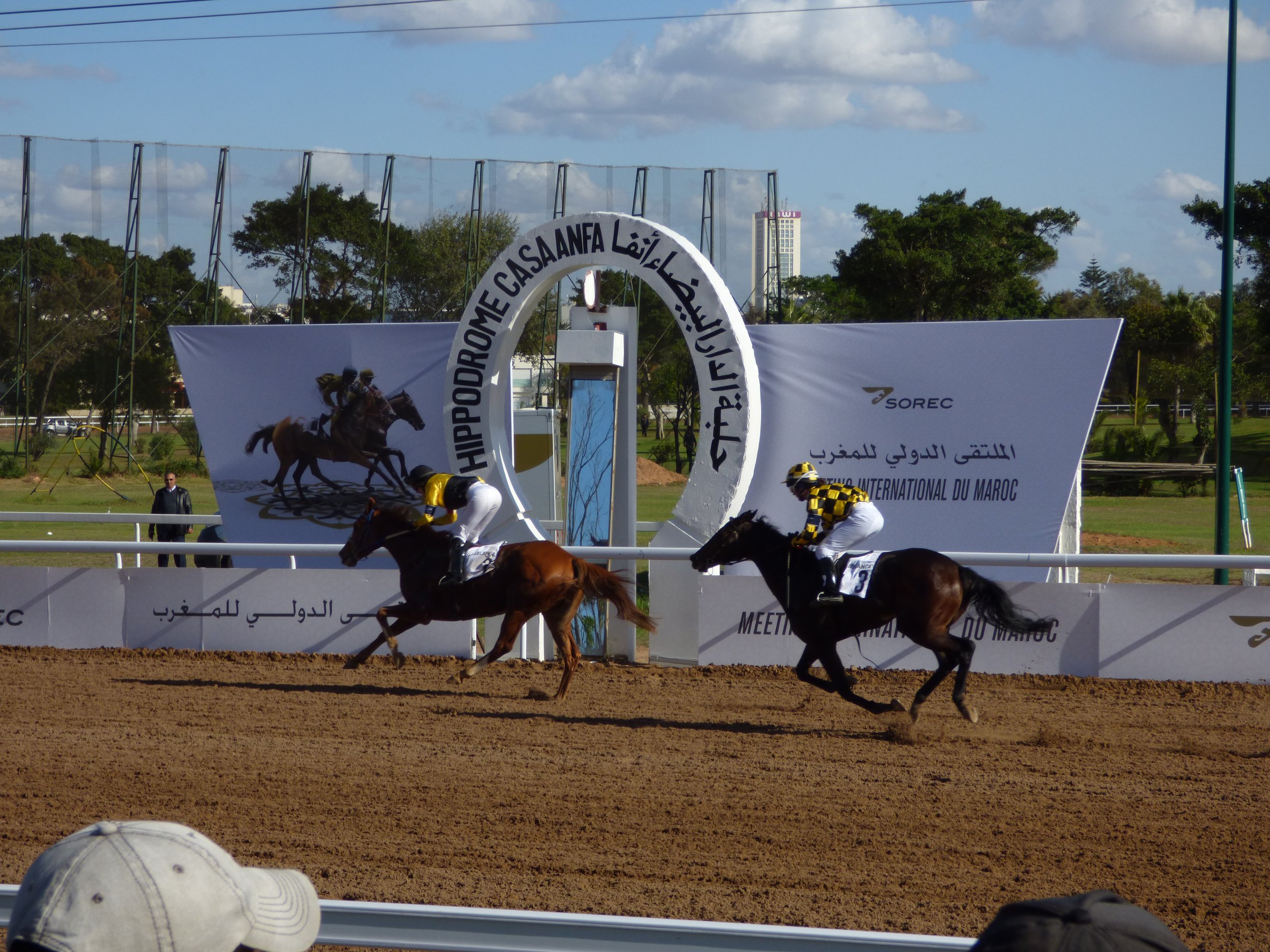
Casablanca will host the latest of its well-established and handsomely endowed International Thoroughbred Race Days. Entries for the four races, which are run on Saturday the 19th of November, close at the end of October.
Headlining is the €110,200 Grand Prix de la SOREC, one of the international Defi du Galop series of events, run over 2400m/12f for 3yo’s and up. The support card comprises a 1750m/8.75f event for 3yo fillies (€64,300), a race for the 3yo colts over 1900m/9.5f (€55,100) and a 1750m/8.75f for the staying 2yo (€25,700). All races are run on the dirt track. Entry fees are around one percent of the race fund.
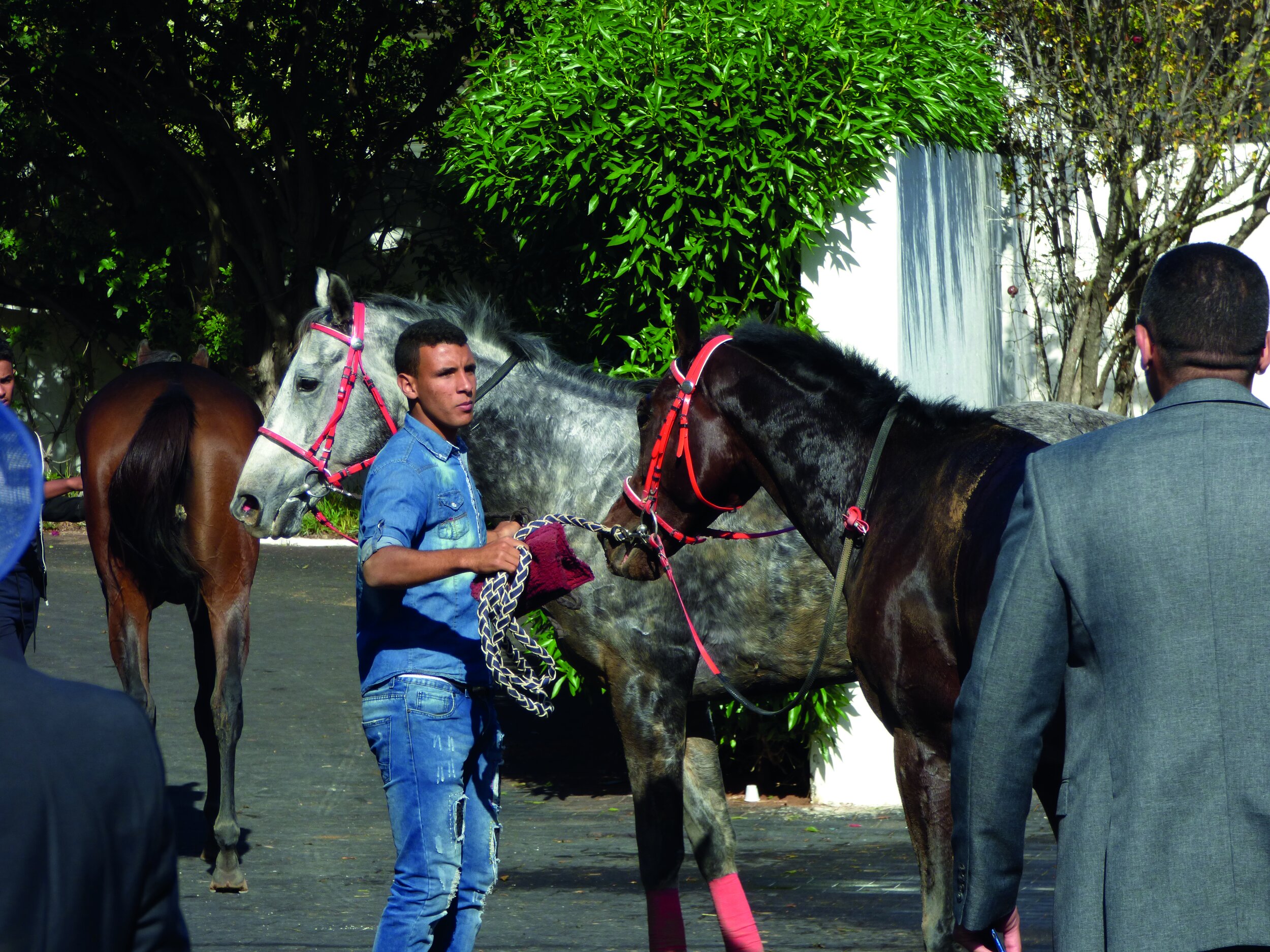
SOREC (the Moroccan racing authority) is eager to see the festival get fresh impetus after the sad interruption due to COVID. Keen to encourage international participation, it will be putting on a plane to transport runners from a central European location (exact departure point to be determined), awarding travel allowances of up to €3,000 per horse, meeting the costs of flights and accommodation for the owner, trainer and jockey and hosting a gala dinner. Stable staff will be put up at the nearby training centre, where the visiting horses will be stabled.
“Since 2015,” explains Hicham Debbagh, SOREC’s deputy general manager in charge of horse racing, “our objective was to install the Morocco International Meeting in the international calendar, through attractive prize money and free air transport, in order to guarantee the best reception conditions for horses and professionals. Prior to COVID, things were progressing nicely, and we were attracting good horses from England, France, Libya, Netherlands, Oman, Poland, Qatar, Spain, Syria and UAE. Now that travel has opened up again, we look forward to building our festival back up as an international destination. Welcome to Morocco!”
Anfa Racecourse is an oasis of calm and beauty in the sprawling metropolis that is Casablanca. Trainers might well consider a Moroccan raid. Prize money extends down to fifth place, and the average field size for the four races in (pre-COVID) 2019 was 11. At the same time, it provides connections with the chance to experience racing in a nearby country with a fascinatingly distinct culture, and it will be helping inject the necessary quality of the runners to enable Morocco to achieve its dream of acquiring its first Black Type race.
New Spanish beach race festival unveiled at meeting in Germany
Article by Paull Khan
There will be a spanking new venue for official beach racing in Spain this year when the Andalucian village of Zahara de los Atunes opens its doors to thoroughbred racing on Saturday October 29th, the middle day of an attraction-packed three-day beach festival, bookended by jazz concerts and polo. Long known for its beach-bar music scene, horseracing will now be used in Zahara in an attempt to prolong the tourist season in this southernmost part of Spain until the end of October.
The Costa de la Luz now boasts two beach tracks, with the venerable Sanlucar de Barrameda an hour-and-a-half drive up the coast.
Zahara’s stunning straight beach will accommodate races between 1400m/7f and 1800m/9f.

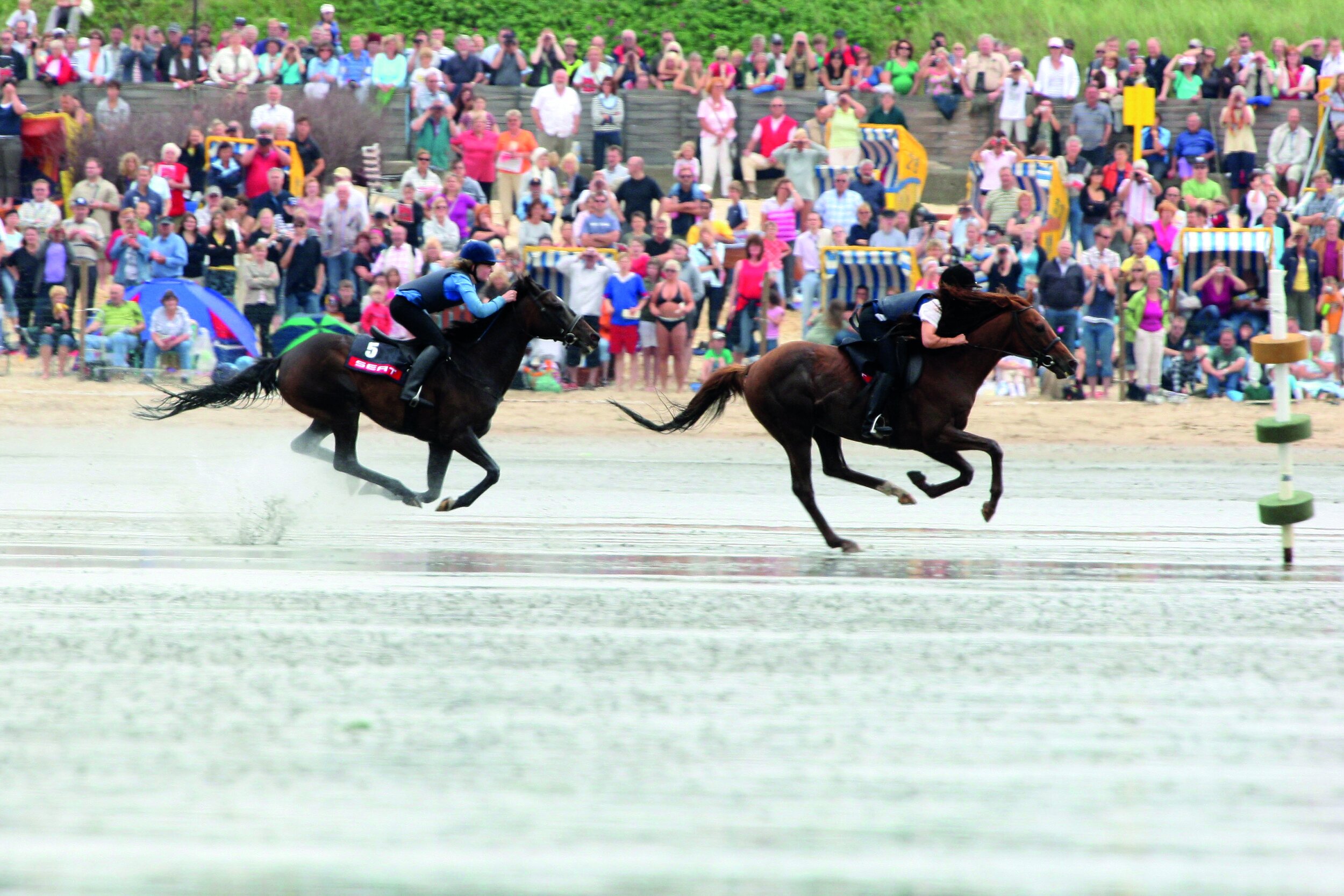
Plans for the Zahara festival were unveiled at this year’s annual meeting of the European Beach Racing Association, which took place in Cuxhaven, on Germany’s north seacoast. Delegates had been privileged to witness the famed Duhner-Wattrennen races, which have been staged on the vast beach for the past 120 years. An attentive and happy-paying crowd of 13,000 attended this year’s renewal, despite poor weather. The programme was varied, with trotting (mounted and sulky) and gallop races for warmbloods in addition to thoroughbred racing.
Cuxhaven is unique among beach racetracks in that the horses race through a shallow covering of standing water. The resultant spray, from the horses’ hooves and the wheels of the patrol vehicle, creates its own spectacle. The races are recognised as a powerful tourist attraction—a national minister attended and addressed the launch party before proceedings began.
First European Pony Racing Association meeting in Budapest

Article by Paull Khan
Those in charge of pony racing travelled to Budapest from all over Europe to attend the inaugural annual meeting of the European Pony Racing Association (EPRA) on September 11th. Representatives from Belgium, Czech Republic, France, Great Britain, Hungary, Norway, Slovakia and Sweden had, the previous day, witnessed three pony races that kick-started the quality thoroughbred card at Hungary’s sole track, Kincsem Park. They were universally impressed at the professionalism of the pony racing, the hospitality and the great strides which Kincsem Park has made in recent years. It is a very different racecourse from the one that hosted an early EMHF meeting in 2013 and as striking an example of diversity as one can find. Today, every square metre of the track’s footprint is put to productive use. In addition to the flagship thoroughbred racing, there is greyhound racing, trotting, a training centre, show jumping, four-in-hand driving and more. There is even a rugby pitch inside the greyhound track!
Increased internationalisation of pony racing, with the best young riders having the opportunity to experience race-riding in other countries, is an aim of the EPRA, and it was pleasing to witness history being made. Czech youngster Sophy Bodlakova became the first foreign-based winner of a Hungarian pony race when she scored on her pony Saman!
While for some EPRA member countries, such as France, Sweden and Britain, pony racing is a well-established pursuit; for some, it is a very new endeavour, and for others yet, it is something to be established in the near future. The imparting of knowledge and identification of best practice will therefore be central to the fledgling association.
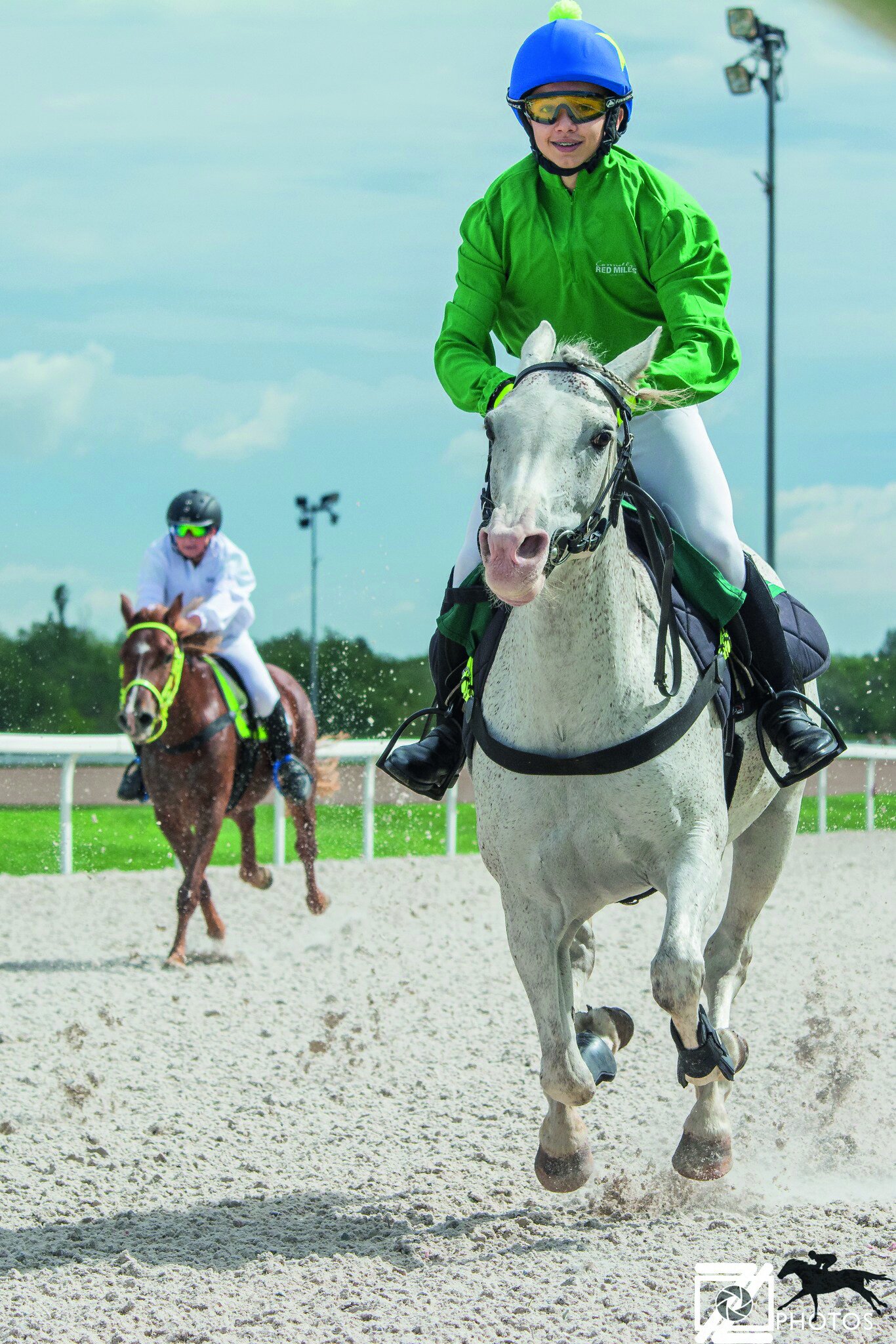
Slovakia’s experience bears witness to the fact that countries need not wait for long, after setting up a pony racing structure, to see the benefits begin to flow, in the shape of new jockeys. It was only last year that the first pony races took place at Bratislava racetrack, but from the alumni of that first cohort, there are this year no fewer than four amateur riders licence-holders. For those many countries experiencing difficulties in sourcing competent race riders, a pony racing structure is a must-have.
At the EPRA meeting, a minute’s silence was observed in honour of Jack de Bromhead, who tragically lost his life in a pony racing incident in Ireland.
For many delegates, it was the first experience of pony racing outside their own countries. Next year, the EPRA has accepted a kind invitation from France to host.
Botond Kovacs, head of pony racing in this year’s host country, commented: “We have been thrilled to host the first European Pony Racing Association meeting. The rise in profile of pony racing is very refreshing to see. The European Pony Racing community is taking shape and it feels like we’ve been put on the map—a map that the world of racing has a keen eye on.”
Racing in Switzerland - it's not just about racing on snow!
Article by Paull Khan
Think of racing in Switzerland, and the fabulous White Turf meeting on Lake St. Moritz probably comes to mind. This is no surprise, of course. The EMHF was fortunate to hold its General Assembly there in 2015, and for many of our delegates, including your columnist, it remains among the most memorable racing adventures of all. But there is so much more to racing in that country.
Sadly, St Moritz’s little sister track, which provided racing on the frozen lake at Arosa, is no longer with us. Weather conditions in recent years meant that there had become a worse than even-money chance of abandonment—a situation that was just not financially sustainable.
But the full roster of Swiss thoroughbred tracks still extends to seven. (Although one of the tracks, at Fehraltorf, which had upheld a 75-year tradition of racing over the Easter holiday, remains in a state of hiatus following an altercation last year with a neighbour farmer, who took the dramatic and disruptive decision to plough up the racing surface.)
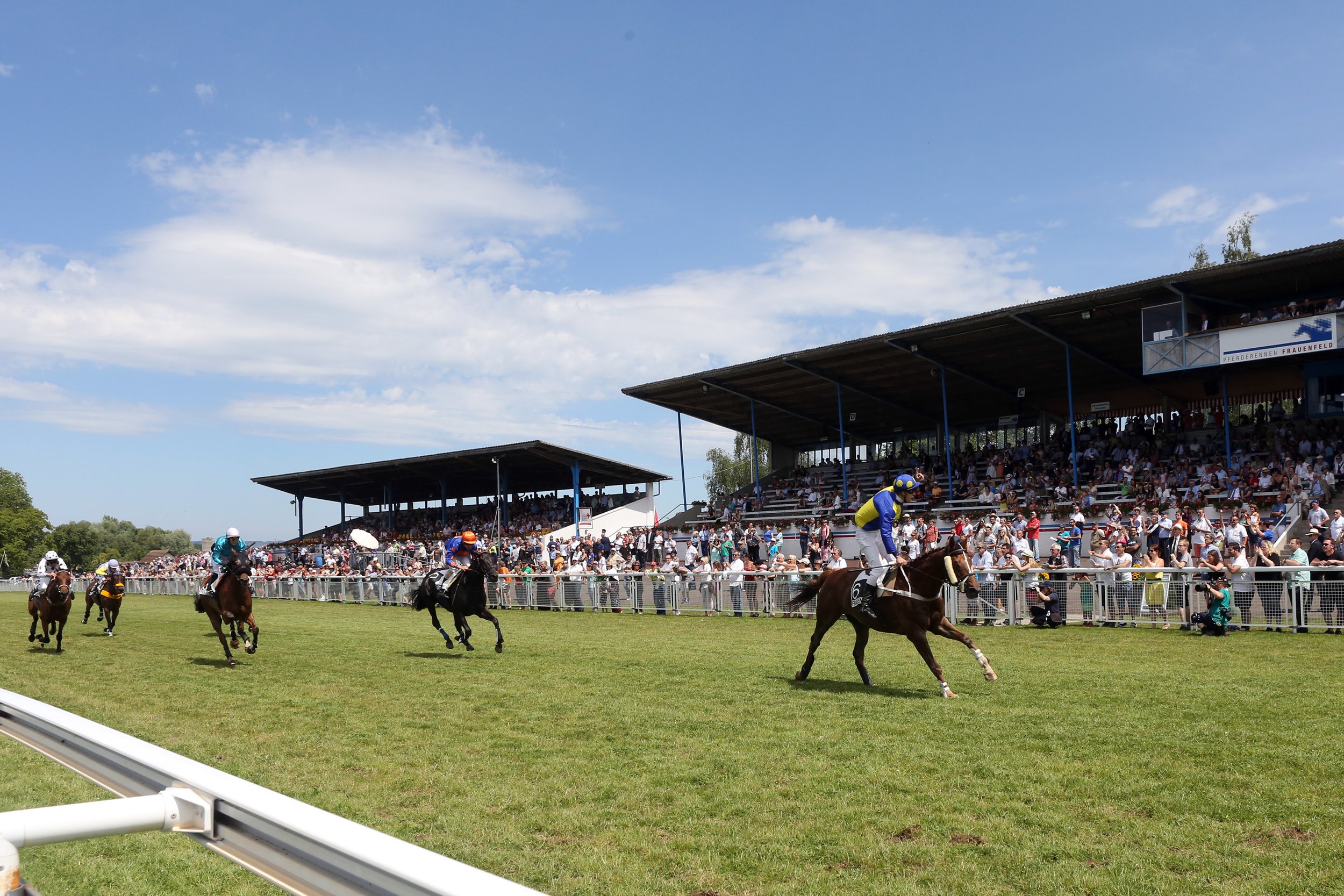
Jump racing is the primary focus at Aarau and Maienfeld, while the flat dominates at Zurich-Dielsdorf, Frauenfeld (home of the Swiss Derby) and at the track that is the financial powerhouse of Swiss racing, Avenches.
This August saw celebrations for the 150th year of the Zurich race club, which coincided with 50 years of its current racecourse, at the small nearby town of Dielsdorf. A two-day festival was crafted, during which the 1500-metre, pancake-flat turf track staged 14 races: nine thoroughbred flat, two trotting and three pony. This left-hand track also boasts a jump course, but this is used infrequently these days.
Interwoven with the races, there was an appearance of the 250-year-old Bernese Dragoons, a mesmeric display from world-renowned Jean-Francois Pignon’s ‘free dressage’ horses, after-racing musical acts and, notably, a parade of former equine stars of Swiss racing showing off their expertise in new-found careers. Aftercare has long been a feature of Swiss racing. Horses tend to stay in training for longer than the norm on the flat, allowing the public to build up the kind of rapport with them normally associated with jump racing. In addition, they tend to race more frequently than in most countries, averaging nearly eight starts annually and this helps to buoy field sizes and makes for attractive, competitive racing generally.
The substantial crowds were engaged and relaxed, and it all made for a wonderfully rewarding racing experience.

When it comes to funding, Swiss racing is swimming against the tide, in many ways akin to the experience in Belgium, described in the last issue of Trainer. This is because, with one principal exception, there is no opportunity for people within or outside the country to place bets on Swiss races unless they are on-track. The twin State-installed institutions (one French-language, the other German), which between them enjoy a betting monopoly, decline to include domestic racing within their product mix. The exception is Avenches, where the bulk of the races has been taken on by the French betting giant PMU, are shown on the Equidia channel, and are available to Swiss and French citizens to bet on, in cafes, bars and kiosks and online. (In 2022, a few PMU races were also held in Frauenfeld and Dielsdorf). The commission from this betting activity is vital to Avenches and also helps support Swiss racing generally, but the other Swiss tracks rely critically on donations and sponsor contributions.
Unsurprisingly, the scale of the industry has suffered a worrying contraction. What had been a slow but steady reduction in the numbers of owners, horses, races and prize money between 2015 and 2019 accelerated dramatically in the COVID year of 2020. Over the past seven years, prize money has halved, and the numbers of horses and owners have reduced by 51 percent and 48 percent, respectively.
The Swiss race programme is heavily weighted towards staying races. While Handicaps are out of bounds to foreign-trained runners, they only constitute a modest proportion of the race programme and all conditions races are open. Average prize money per race remains very respectable, at nearly €10,000. The Grand Prix von St Moritz is, at €100K, clearly the nation’s richest race. Other significant prizes include the Grand Prix d’Avenches (€20k for 3yo+, weight-for-ages, 2400m/12f), Zurich’s Grand Prix Jockey Club (€50k for 3yo+, weight-for-age, 2475m/12f+), and the Swiss Derby (€50K). The country’s main jump race is the €35K Grand Prix of Switzerland, run over (4200m/21f) in beautiful surroundings at Aarau in September with a limited weight range of just 3kgs.
For five years, between 2014 and 2018, both the Grand Prix d’Avenches and the Grand Prix Jockey Club boasted Black Type. Regrettably, neither managed to maintain the strict ratings threshold required of such races in Europe. Fresh hope has been generated by the new scheme, agreed this year, whereby EMHF member countries without a Black Type race can apply for such recognition for a single, flagship event which is allowed a rating 5lbs lower than normal. There is a real desire that one or another of these races can clear this lowered bar but, as is normally the case, this is likely to hinge on their attracting foreign-trained runners rated 95+ on the international scale. And, considering the decent prizes, foreign-trained runners are relatively thin on the ground, accounting for under five percent of starters. British and German raiders are attracted to the snow, Czech runners to some of the jumps races, but foreign runners on the flat have been in single figures over the past two years.

There was, in fact, a third milestone included within the Zurich celebrations: the tenth anniversary of Horse Park Dielsdorf. The Horse Park brings together the racing and equestrian worlds in a way which could surely be gainfully replicated in many more parts of Europe. Alongside the racetrack and training barns housing 150 horses, there are FEI-standard facilities for show jumping and dressage. A recent addition, completed within the past year, is a large stylish building which, in its restaurant configuration, comfortably seats 250 with a fine view of the racing. Various facilities around the complex are available year-round to the general public for hire. In investing some €8M into this project, Race Club President Anton Kraeuliger has demonstrated both a recognition of the importance of sweating the asset that is the racecourse and an enduring belief in Swiss racing. Let us hope that this confidence is well-placed and that racing in this most beautiful of European countries, can look forward to a thriving future.
Michael O'Callaghan - an up and coming Irish Trainer with a plan
Words - Daragh Ó Conchúir

More melodious than cacophonous, the chirp from the lush foliage enveloping the drive into Crotanstown Stud on a spring morning is louder than anything emanating from the yard itself.
The horses, though fed, are shaking off the influence of Morpheus as first lot is tacked up, dreams of carrots and zoomies, crystallised while immersed in deep beds of Willie Fennin’s winter barley straw, still lingering.
Michael O’Callaghan emerges to proffer a greeting. The canines, Samhain and three-legged Liath bound over to add their greetings. Samhain is everybody’s friend and has no problem with Twilight Jet having a friendly nibble on his ear.
The pace is brisk but at the same time unhurried; relaxed O’Callaghan won’t be 34 until September, but despite growing up in a housing estate in Tralee without any exposure to equines until the Damascene conversion that occurred when he first sat on a pony as a 12-year-old, he has been involved in the industry long enough to experience plenty of slings and arrows.
He knows what he wants though, in horse and human. The latter is a key element of any successful operation—his wife Siobhain setting the tone with her level of graft and care for the horses. In a time when staffing is a huge problem throughout the industry, from office to rider to yardmen, he has a team he is very happy with. He knows the truth in the old proverb, If you want to go fast, go alone. If you want to go far, go together.
“Everyone that’s in the yard now is an asset,” O’Callaghan notes.
Success attracted significant owners very quickly and among those, past and present to link up with the Curragh-based Kerryman include Michael Iavarone, Qatar Racing, Chantal Regalado-Gonzalez and Sheikh Mohammed bin Khalifa al Maktoum. Kia Joorabchian’s Amo Racing has lived up to its name by providing significant ammunition this term—Malex and Crispy Cat winning early maidens. One of Joorabchian’s famous clients, the Aston Villa and former Barcelona and Liverpool star Philippe Coutinho, is a part owner of Olivia Maralda.
Twilight Jet—or TJ as he is known in the yard—is the apple of the Crotanstown eye. Kentucky Derby and Breeders’ Cup-winning owner, Iavarone bought half of the Twilight Son colt prior to his Breeders’ Cup run last year, while O’Callaghan and his partners, who include his father of the same name, retain the other half.
A £210,000 purchase at Goffs UK Breeze-Up in April 2021—an outlay that would a fair bit north of O’Callaghan’s average outlay—TJ ran a remarkable 11 times in his juvenile campaign from five furlongs to seven, winning twice at the shortest trip, including a Gp. 3 and finishing third twice more at group level.
Despite not being anywhere near peak fitness, he pulverised the field in the Gp. 3 Lacken Stakes at Naas on his seasonal reappearance over six furlongs last month; and Leigh Roche had to be at his strongest, not to win, but to pull his charge up. Jet has a season of Gp. 1 targets now. That Jet isn’t the only Crotanstown resident for which this may be the case is a testament to the genius of the man who has selected the vast majority of the 40 horses in the yard—and trains them.

The string leaves on the dot of 7.30am, riders hi-vis jacketed though it is a clear, bright morning. They must cross at least two, sometimes three, main roads however, depending on what gallops O’Callaghan chooses to use on the vast training grounds. This morning, it’s the Old Vic.
“The first thing I do is I’m watching them as they’re jogging over, to make sure they’re not lame or not abnormally so. Some of them have their own way or take a little while to warm up. And this is a very good warm-up. None of them were on a walker beforehand as they jog a mile to the gallop.”
Anyone from the outside world looking for one magic secret to training racehorses is on a fool’s errand because obviously, there is a conglomeration of factors. What is certain is that while you may have a system, dependent on the facilities available to you, a one-fits-all approach can never work. As far as O’Callaghan himself is concerned, observation is one watchword. Having people that understand horses and their individuality is another integral element.
“Good horsemen, I think, would make good psychologists... [because] what you’re trying to do is think the way horses think. That’s why I say to young people who ask what would make good horse people, ‘Start thinking the way the horses think.’
“They might say, ‘How [do] you do that?’ Quite simple. Put yourself in its head space. Why is he after jumping there or acting the fool? Then you learn very quickly and you become a better horse person for it, instead of just fighting them all the time. You can’t rule with an iron fist.”
It must be difficult though, and frustrating, when the horse cannot talk to you or you to it.
“But no animal can talk, and yet they can understand each other. So maybe the talking complicates things. Some people talk for the sake of talking.”
An articulate communicator, he prefers to look and listen. Interestingly, as he gathers information, he doesn’t take notes, even at the end of the day, for the purposes of refreshing the mind when attempting to solve a puzzle.
“Everything’s in my head. If I wrote it down, I’d forget it straight away. If you want to remember it, you’ll remember it, I think. They say if you said something to Michael Stoute after work, and commented that the horse gave two coughs, he’d write it on his hand with his finger.
“Two coughs,” he verbalises, as he traces the words on the palm of his hand, reconstructing how he imagines the most famous non-cricketing Barbadian doing it.
First lot is headed by Twilight Jet and the returning Steel Bull. Also included are three two-year-olds and an unraced three-year-old. We pause as they cross the bridge to the gallop.
“It’s a simple routine. They ride out six days a week and walk on a Sunday. If they’re running next week or need it, they’ll ride out on a Sunday. They do their regular two seven-furlong canters every day—nice pace. And then they work twice a week. Some horses work three times a week, some only once a week. And some fillies, you might only work them every second week.”
He breaks off to draw your attention to his main man.
“Look at Jet. Some boy, isn’t he? Well behaved. Stands there. On the way back now, he will power walk. You wanna see him. He’s power-walking and the others are jogging just to keep up. He’s just so happy with himself, he knows he’s good. And you see him there heading over now, he’s so laid back, with a bed head still on him.”
We move ahead of the string, to be at the top of the rising track. Willie McCreery is ahead of us.
“You’re looking that they’re going the pace you want them to go so you’re bringing them forward,” says O’Callaghan, when asked what he wants to see. “Ultimately, you’re building, trying to get them fitter from the last day to the next day.”
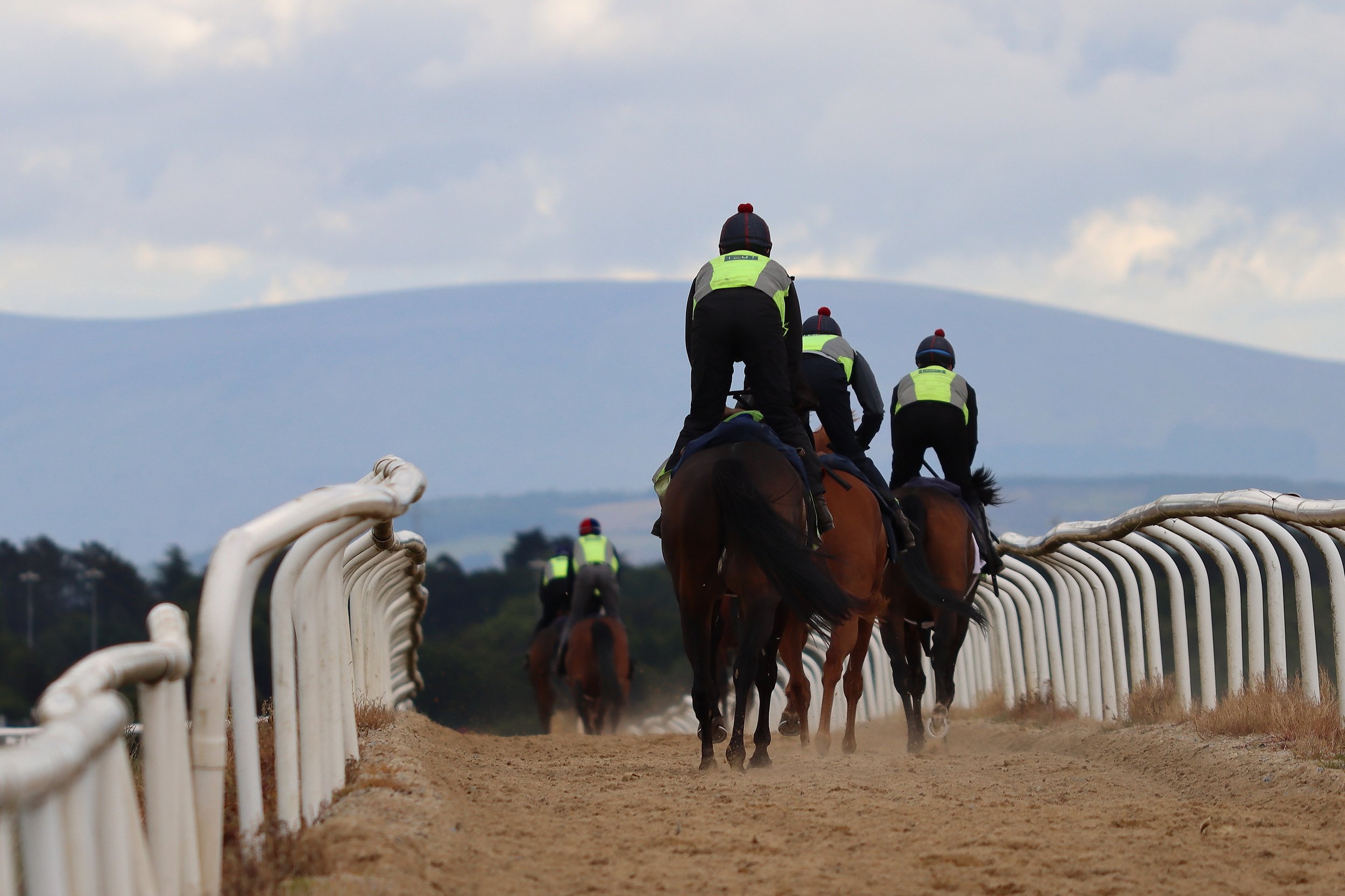
The horses approach and gallop past—nostrils flaring, hooves rhythmically pounding. The next lot comprises O’Callaghan’s four acquisitions from the previous week’s Tattersalls Goresbridge breeze-up.
“It’s the first time I watched them stretch their legs. And they weren’t hanging around.”
The feedback is positive, too. Potential starting points are discussed. There are some tracks he likes to kick off on more than others, including Cork (“The new straight course in Cork is the closest thing you’ll get to a perfect flat track.”), Navan, Leopardstown and of course, the home turf at HQ; but wherever you go, the opposition will be fierce.
“It’s mad when you think about it. We were disappointed when Crispy Cat was beaten by Blackbeard, but then he wins a Gp. 3 by six lengths and becomes [the] favourite for the Coventry. I would say the standard of two-year-olds this year in Ireland is red hot. With Ger Lyons and Jessie Harrington having so many well-bred horses; and then you have obviously Aidan and Joseph and Donnacha (O’Brien)—it has never been as competitive.
“There’s no hiding place in Ireland. None whatsoever.”
That makes winning difficult, but it is upon the resultant demand and market for Irish racehorses that can show promise in such an environment that the trainer’s business model is rooted.
The love of racing came first from picking up the Evening Echo newspaper for his granddad, also Michael, to select a few bets on a Saturday, and then waiting for the results to come up on Teletext.
Once he joined a friend at the nearby riding school, he was hooked. Gradually, he dragged his parents, and particularly his father—another Michael but with no clue about horses—into the web. Junior got a holiday job working for Tom Cooper. His dad, who after retiring from ESB set up a utility infrastructural development company (TLI Group) with his partner Thomas Fitzmaurice that was now booming, decided to buy a mare and some land so he could dabble a bit in breeding and share the journey of a new interest.
He is still doing it now, long since sold on his son’s gift. It is in Michael Sr’s now very recognisable silks of dark blue jacket with red epaulettes and red cap with dark blue star that most of the horses run in.
O’Callaghan prepped yearlings and worked with stallions at Kilsheelan and Castlehyde Studs, where Paul Shanahan was a valued mentor.

When his father sold a Galileo foal for €200,000, a plan was hatched to embark on a pinhooking enterprise together. He took the Irish National Stud management course in 2008, which is where he met Siobhain, and rented Millgrove Stud in Rathangan as a 20-year-old, when determining that he needed to be more central to continue his trading operation.
“It was a little bit stupid maybe, but for someone that comes from a background that’s not in horse racing, that hasn’t got a yard to walk into when the father retires, or a farm, or any of that crack, you have to kick on.”
O’Callaghan took out a restricted licence in 2012 and Bogini, bought out of Tracey Collins’ yard to breed from, won in Bath, Sandown and Leopardstown. She produced three winners, including Twitter sensation Caribbean Spring, or Bean, as he is known to his near 7,000 followers.
Bogini sadly died as a nine-year-old, but she sent O’Callaghan on his way. When five of the colts he sold at the breeze-ups the following season won on debut, it dawned on him that he could just move a step further down the line, use his breeze-up knowledge to buy at the sales and increase his profits by trading horses with form. For the most part, it has been a phenomenal success.
He began renting Crotanstown in 2013; and Blue De Vega, Now Or Never and Letters Of Note were early stakes winners, having been bought cheaply—the first two bought by Qatar Racing. More recently, Steel Bull won a maiden three weeks after being bought and the Gp. 3 Molecomb Stakes seven days after that. Twilight Jet is the latest to shine a light on O’Callaghan’s talents.
“I don’t look at the catalogue before I go to the sale,” O’Callaghan reveals. “I can’t let the catalogue taint what I’m seeing. You can’t train a piece of paper… when you can’t afford the pedigree, what comes first is a physical.
“I generally don’t look at a horse before I see them breeze. I watch them all breeze first, pick out by eye what I like the look of by the way they breeze. Generally the times aren’t out in time, so I head down the yard and look at 50 horses that I liked the look of breezing. It’s funny how often it works out that the horses I like the look of breezing; and then you get the team sheet and most of them are there in the top. You get a few ones that are there you didn’t like the look of and a few that you liked the look of that are down further, so you just have to weigh it up.”
So, time isn’t the be-all.
“It’s a big jigsaw, and you’re trying to put all the pieces together. There’s lads trying to make it scientific, analysing strides and this and that. My thought is if you can’t see it with your eye… you have to be able to recognise it.”
Physically, he places a good deal of store in the head, the eye and the ears. It was good enough for Vincent O’Brien, after all. After that, there is a physical make-up he relishes, and his description includes geometric lines from back and front that intersect in the middle of the back. It is easier for him to recognise it, than describe it; but you get the picture.
He deals primarily in mature, fast horses that will hopefully make into milers.
“You’ve a quicker result,” he reasons. “You’ve a quicker debt if they’re no good.”
It is a balancing act around the business model because as a sportsman, he wants to be in the parade ring on the big days, as he was with Malex in the Irish 2000 Guineas earlier this season. Blue De Vega finished third in the Classic six years ago, Now Or Never filling the same slot in the fillies’ Guineas, 24 hours later.
“The whole world recognises that Irish racing is the most competitive racing there is. You run well in any maiden in Ireland, your horse is sellable; and that’s essentially what I’m doing. Now, I’m training horses for other people as well, and you’re still trying to get the best out of everything; but for the ones we own ourselves, we’re training to trade them.
“That doesn’t mean the first day they turn up at the racecourse, it’s their Derby. They still have to progress. People don’t belong copping on if the horses don’t improve. Part of what I pride myself in is in horses going on and being good horses elsewhere, that I haven’t emptied them. You have to do the right thing by the horse because at the end of the day, if you don’t get to sell them, you still want them progressing. This quick flash is no good to anyone.
“And that doesn’t mean that you don’t go and try and win [the] first time with horses, if they’re good enough. If they’re good enough, the way you train them up to that point, they’ll still progress.

“Look at Twilight Jet last year.”
He is quick to point out that you would not run too many two-year-olds as often as Twilight Jet bounced out, but this rare type has “an unbelievable constitution” and only failed to fire in the final engagement at Del Mar. He doesn’t believe in wrapping up good horses in cotton wool either. If they are fit, they should run.
The relationship with Sheikh Mohammed bin Khalifa al Maktoum was founded on winning maidens with three breezers O’Callaghan had obtained for the Dubai royal. He was subsequently sent eight homebreds with fantastic pages, but they weren’t up to the mark. Lesson learned.
“It was a case in point of being sent horses and not having control in buying them, and what you’re given. If José Mourinho put a pair of football boots on me, he wouldn’t turn me into a footballer. It set me back a couple of years because I wasn’t buying as many horses because I hadn’t the space. I quickly realised that you need to control your own destiny. I had to go back to doing what got me there in the first place: buying horses.
“It takes a lot of funding—takes a lot of balls. It creates a lot of stress [and] takes a lot of support. At the end of the day, you have to make up your mind in what you’re going to do. You have to commit and believe in it. You have to put enough thought into it that it’s not a shot in the dark.
“It seems to be working and bringing me in the direction I want to go.”
And that is to a thriving, self-sustaining operation.
“I don’t want to just train horses for a wage. We’re building a new yard at the minute, on the far side of Gilltown Stud between Craddockstown and Dunlavin. Like anyone in business, I like making money, but it’s not all about that. There’s the competitor in me as well that wants to win races. There’s the person that wants to train these good horses and get to these big meetings.
“What I really love is going to the breeze-ups, finding the horses and then bringing them home, getting them into our system and getting to the track. That’s where I get a lot of satisfaction from… It’s not just about money, but you need to turn them into money because they cost a lot of money; and they don’t all work out.”
A new premise means a modern, clean building made from concrete and steel, full of air, non-porous and conducive to healthy animals. One of his primary focuses is on the storage barn for feed and bedding, which he says cost as much as building another 40 boxes. He places a lot of store in that element of training horses, recalling the words of Mark Johnston: “If we feed them more, we can train them harder.” And bad bedding can wipe out an entire season.
While he will continue to use The Curragh, he is installing a five-furlong uphill gallop built on land that is already 700 feet above sea level. There will be a 10-horse walker and an indoor covered ride. In time, he would love to put in a swimming pool, having seen the benefits with Twilight Jet and especially Steel Bull recovering from getting badly jarred up.
While the emphasis will always be on breezers, there is always a bit of a spread, such as the small breeding operation. He has an eye on a new angle with Twilight Jet: the possibility of turning him into a stallion.
“You don’t go around touting it because it’s so hard to do, but it’s another way of getting paid. They’re a very valuable asset if you make them up into that sort of a horse and hopefully, Twilight Jet will make it into a horse that will be attractive to stallion men. He’s by Twilight Son, a commercial stallion; he’s such a good-looking horse, he was so hardy as a two-year-old with so much racing. He was a sale-topping two-year-old out of an Exceed And Excel mare. He’s going to be very commercial as a stallion if we can get him to win a Gp. 1 or even be placed in a Gp. 1 because he was such a two-year-old and he’s still so fast.
“We sold 50% of him to Michael Iavarone to go to the Breeders’ Cup, but we retained [the other] 50% of him. You have to get paid when you’re getting paid.”
Around 40–60 horses is his “sweet spot” at the moment, though he doesn’t rule out expanding that in time. But while there are plenty of rewards and he has prospered, it is a stressful life.
“When it’s getting on top of you, that’s the last thing you think about at night, what you think about when you wake up in the middle of the night, and what you think about when you wake up in the morning.
“With horses, a lot of it is out of your control… you have to be able to realise that.”
He reminds me that Henry Cecil used to go shopping as an escape. While cutting a dapper figure in his suit on race day, O’Callaghan prefers racing Formula Vee cars at Mondello Park to the high street. He learned to fly planes before that but as well as providing an adrenaline rush, racing has the added benefit of being competitive, without him ever thinking he is going to usurp Max Verstappen and Lewis Hamilton any day.
What often strikes this observer is the talent O’Callaghan has for procuring horses—at what often turns out to be value and turning them into a profit, which might quite easily have never been discovered, given his background. Is what he sees innate, or can anyone learn it?
“You can learn. You have to have the head to learn, and maybe there’s an innate ability there. I don’t know. I’ve learned everything. I’ve the type of brain that if I have an interest in something, I’ll immerse myself in it and I’ll learn as much as I can about it. I’ll nearly become addicted to it. I think everybody that excels in a sphere, they have to have that.”
He has certainly immersed himself in this racing world, combining high-stakes poker with a business plan.
“This game, the way I’m doing it, you’re all-in, every day. A bad year would wipe you out. What you’re doing is you’re trying to get a right beano of a year to put you on a footing with a bit of comfort. But look, Jim Bolger is all-in, every day, too. At this stage of his life he is probably not actually, but there was a point for a long time that he was.
“You have to back yourself.”
And deliver. So far, so good.
Miranda Filmer
MIRANDA FILMER
4th April 1992 - 10th June 2022

We are saddened to report that our beloved publication manager, Miranda Filmer, passed away on June 10th, aged 30, after a brave battle against Neuroendocrine cancer.
Dealing with advertisers, suppliers and subscribers on a day-to-day basis Miranda played an integral role in the management of Anderson & Co Publishing.
Neuroendocrine tumours (NETs) are thought to be rare. Many have never heard of this cancer, it has been called the ‘Quiet Cancer’ as it presents so late and advanced, NETs currently impact more than 15,000 people in the UK alone.
It can affect anyone, of any gender, and at any age.
For many living with the disease the progression of the cancer is slow, with the tumours taking years to develop; but for some it presents aggressively, it may grow rapidly and spread to other parts of the body, causing debilitating symptoms.
Miranda refused to be defined by her disease, she rode everyday through cycles of chemotherapy and other debilitating treatments. Even as her cancer consumed her body, she continued to work - right up to the end.
Clinicians are yet to understand how people develop NETS, and why it presents so aggressively in some.
At the Royal Free London (RFL), Professor Martyn Caplin DM, FRCP has identified a research project which would address this critical research gap. A global specialist in NETs, Professor Caplin oversees the hospital trust’s Neuroendocrine Tumour Research Unit.
His multidisciplinary team is committed to improving outcomes for patients through pioneering research, clinical trials, and innovative new therapies. Charitable support is urgently needed to kickstart Professor Caplin’s research programme as NET research is immensely underfunded.
To donate to the appeal, please visit thebiggive.org.uk and search ‘Neuroendocrine Appeal’.
Or contact Delphine Chalmers - delphine.chalmers@royalfreecharity.org / +44 (0)7943 403887. Reference FILMERAPPEAL
TopSpec Trainer of the Quarter - Karl Burke
Words - Lissa Oliver

Karl Burke took out his licence in 1991 and trains from the historic Spigot Lodge in Middleham, Yorkshire, from where the famous Derby winner The Flying Dutchman was sent out in 1849. With a team that includes wife Elaine and daughters Kelly and Lucy, the Classic winning tradition continued under Burke when Laurens landed the 2018 Prix De Diane.
His first Royal Ascot winner came with the filly Quiet Reflection in the 2016 Gr. 1 Commonwealth Cup, but it’s safe to say the 2022 meeting has been just as memorable—Burke saddling two winners, one of whom, quite remarkably, was winning on debut.
The last horse to win on debut at Royal Ascot was Dazzle in 1996. Just to put the first time out Listed Chesham Stakes victory of Holloway Boy in context, Derby winner Masar came into the 2017 race with a win already to his name, only to finish third.
“We would have been delighted if he’d finished fifth or sixth,” Burke admits. “While his win was a nice surprise, it was not a shock, as we’ve always thought he’s a very nice type.”
Holloway Boy is owned by Nick White and Burke’s wife Elaine. “We bought him out of the Cheveley Park consignment at Tattersalls Book 2 for £60,000. I trained his full-sister Oppressive for Cheveley Park and thought a lot of her, but unfortunately she injured a tendon and retired before achieving her potential.
“When I saw him, I thought he was a better stamp of a horse than Oppressive; and I bought him on spec’. He was not one of the first to sell; he was never going to be an early one. Then Nick White rang me and said he would like to buy a horse. So we showed him a couple of the yearlings, and he bought a half-share in Holloway Boy,” Burke explains.
“Holloway Boy was always a good size and strong. I like to get them through their early education up to Christmas, then we start the early ones in February; but he was never going to be one of those. He got very strong during the spring and came to hand very nicely and was ready to run a couple of weeks before Ascot.
“We were going to go to Musselburgh for his first race, but he tweaked a muscle. Nick White wanted an Ascot runner, and I looked at the Chesham Stakes, half-heartedly thinking we’d run Holloway Boy. After he worked well, I thought we'd let him take his chance in the race and give the owners a nice day out.”
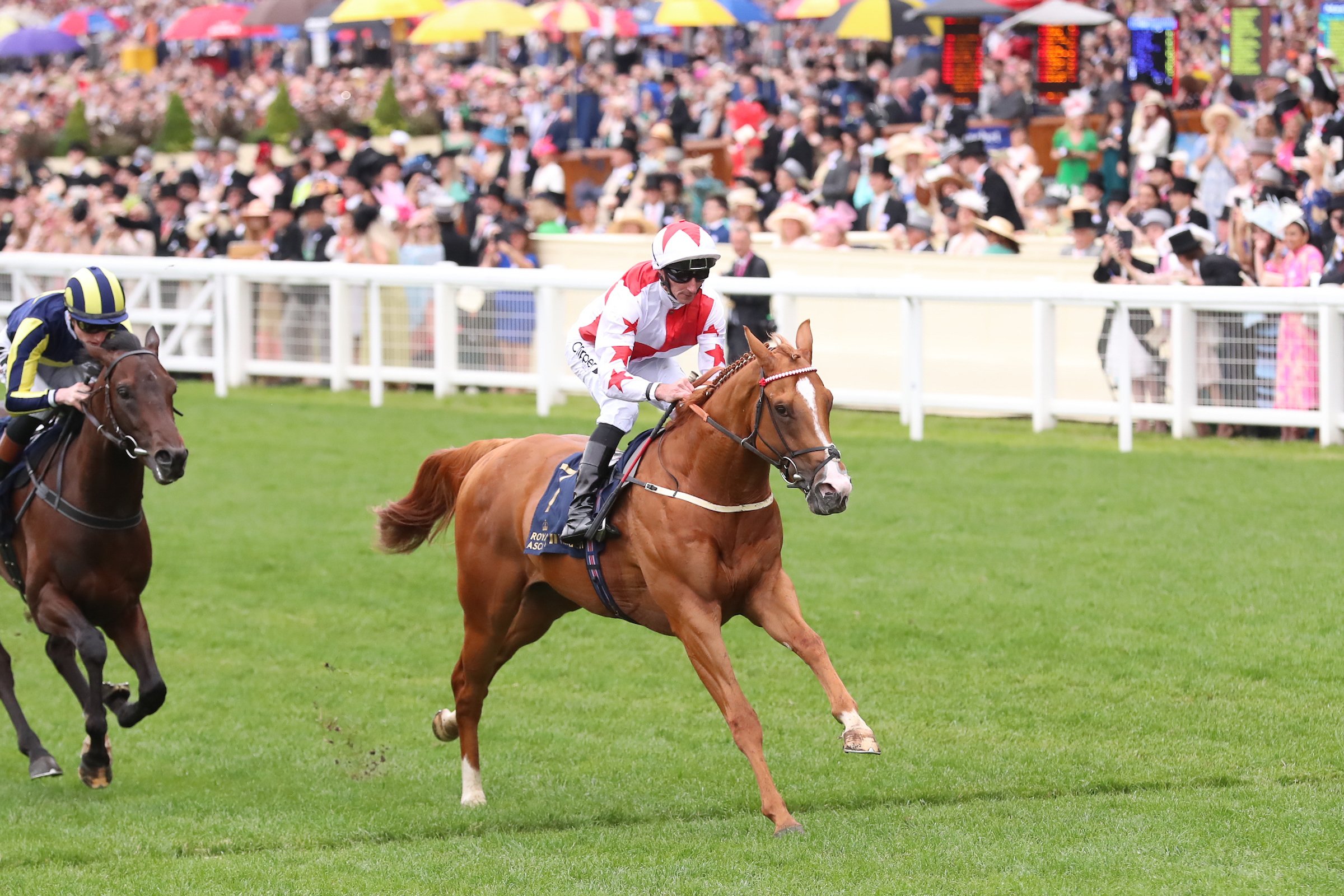
It proved to be a very nice day out, with many more still to come. “We’ve had a lot of interest in him, but we’re not going to sell him,” Burke says. “He did his first canter this morning since Saturday (the Thursday after the meeting) and has taken the race really well. The Superlative Stakes at Newmarket will be his first option, but if we feel that’s a bit too soon for him, then it will be the Vintage Stakes at Goodwood.
“He looks all over a three-year-old already; he’s a good 500kg and stands over 16.1. There’s a little bit of speed in the pedigree, and the Two Thousand Guineas will be the target.”
Burke acknowledges he has a great team at Spigot Lodge—a young team with a nucleus of staff who has been with him since he began. They will certainly have plenty to dream of over the winter, as the One Thousand Guineas looks just as likely a target for unbeaten Dramatised, the filly Burke sent out to win the Gr. 2 Queen Mary Stakes at Royal Ascot.
“We’re very lucky to have a good team of two-year-olds; we have at least half a dozen good two-year-olds still to run. Dramatised should improve on her run and will go for the Prix Morny, and then she’ll have one more run in the Cheveley Park Stakes.
“She is a great feather in her owner Steve Parkin’s cap. She is one of the first homebreds from his Branton Court Stud, so it was a huge result for him.”
Burke now has 130 boxes at Spigot Lodge, situated perfectly between Middleham’s High and Low Moor gallops. “We have several post and rail grass paddocks for turnout during the summer and an all-year-round turnout pit. We have recently developed the centre of our 300m indoor ride, adding a new lunge pen and an Aqua Equine Treadmill.
“The Aqua Equine Treadmill is already making a great addition to our facilities, building the power and performance of our horses. The treadmill will also prove very useful when bringing horses back into work after holidays or injury.”
Electrolyte Balance – vital to the proper functioning of a racehorse's system
Words - Dr. Cath Dunnett

Electrolytes are essential components of the racehorse’s diet as they are vital to the proper functioning of the body’s basic physiological processes, such as nerve conduction, muscle contraction, fluid balance and skeletal integrity. The major electrolytes, sodium, potassium, chloride, calcium and magnesium are widely distributed within the body, but can be more concentrated in particular organs and tissues. For example, the level of potassium is very high in red blood cells but quite low in plasma, and the level of calcium in blood is low, but comparatively very high in bone and in muscle cells. The body has in-built mechanisms that work to maintain the correct electrolyte balance within the tissues, fluids and cells. These modify the absorption of electrolytes in the gut, or their excretion by the kidneys. These mechanisms are not foolproof however, and electrolyte loss through sweat can be a major issue for Thoroughbreds. The sweat of the equine athlete, unlike its human counterpart, is hypertonic; meaning that horse sweat contains higher levels of electrolytes than the circulating blood plasma. Consequently, the horse loses comparatively large quantities of electrolytes through sweating.
Although the electrolyte composition of equine sweat varies between individuals, on average a litre would contain about 3.5g of sodium, 6g of chloride, 1.2g of potassium and 0.1g of calcium. From this we can see that the majority of the electrolyte lost is in the form of sodium and chloride or ‘salt’. The amount of sweat produced on a daily basis and therefore the quantity of electrolytes lost differs from horse to horse and depends on a number of factors. As sweating is primarily a cooling mechanism, how hard a horse is working, i.e. the duration and intensity of exercise and both the temperature and humidity of the environment are all significant. Horses can easily produce 10 litres of sweat per hour when working hard in hot humid conditions. Stressful situations can also cause greatly increased sweating.
For example, during transport horses can lose a significant amount of electrolyte through sweating and the opportunity for replenishing this loss through the diet may be less as feeding frequency is reduced. Use of electrolyte supplements either in the form of powders or pastes is advocated before, during and after travel, especially over long distances. A number of air freight transport companies advise trainers to use a powdered electrolyte supplement added to the feed on a regular basis given for the 3 days prior to travel. As this helps offset much of the loss normally incurred during transport and subsequently the horses arrive at their destination in better shape. Electrolyte supplementation is a valuable attribute in the ongoing battle to reduce in-flight dehydration.
Electrolytes lost from the body in sweat must be replenished through the diet. All feeds, including forages, have a natural electrolyte content and in concentrate feeds this is usually enhanced by the addition of ‘salt’, which is sodium chloride. Forages such as grass, hay, haylage or alfalfa (lucerne) naturally contain a large amount of potassium, as can be seen from the table 1 below. In fact, 5kg of hay for example, would provide in the region of 75g of potassium, which largely meets the potassium needs of a horse in training. It is therefore questionable whether an electrolyte supplement needs to routinely contain very much potassium unless forage intake is low. Calcium is another important electrolyte, but it is lost in sweat in only very small amounts and its availability in the diet tends to be very good.
Calcium is particularly abundant in alfalfa with each kilogram of the forage providing nearly 1.5g of calcium. A kilo of alfalfa alone would therefore go a long way towards replacing the likely calcium loss through sweating. In addition, the calcium found in alfalfa is very ‘available’ to the horse in comparison to other sources, such as limestone. Calcium gluconate is another very available source of calcium, however, it has a relatively low calcium content compared to limestone (9% vs. 38%) and so much more needs to be fed to achieve an equivalent calcium intake. Interestingly, there is great variation between individual horses in their ability to absorb calcium, however, scientific studies carried out at Edinburgh Vet School showed that this variability was considerably less when a natural calcium source in the form of alfalfa was fed.
By far the most important electrolytes to add to the feed are sodium and chloride or ‘salt’. The levels of sodium and chloride found in forage are quite low and due to manufacturing constraints only limited amounts of salt can be added to traditional racing feeds. A typical Racehorse Cube fed at a daily intake of 5kg (11lbs) would provide only about 20g of sodium and 30g of chloride. As can be seen from table 2 this is a fair way short of meeting the daily requirements for these particular electrolytes by a racehorse in hard work.
It is therefore very important that supplemental sodium and chloride is fed. Ordinary table salt is by far the simplest and most economical electrolyte supplement, but the downside is the issue of palatability as the addition of larger quantities of salt to the daily feed can cause problems with horses ‘eating up’. As an alternative salt could be added to the water, but only when a choice of water with and without salt is offered. Salt should not be added to the water if it puts a horse off from drinking, as dehydration will become a problem.
Inadequate water intake can also contribute to impaction colic. Saltlicks are another alternative, although intake can be very variable and we rely on the horse’s innate ability to realise its own salt requirements, which is questionable. So addition to the feed is by far the best route for adding salt or electrolyte supplements to the diet. Splitting the daily intake between two or three feeds can reduce problems with palatability.
Mixing salt and Lo Salt can make another simple DIY electrolyte supplement in the proportion of for example 500g to 250g respectively. Salt is sodium chloride (NaCl), whilst Lo Salt contains a mixture of sodium chloride and potassium chloride (KCl). This formulation provides 3g of sodium, 6g of chloride and 1g of potassium per 10g measure. This DIY mixture will replace these electrolytes in the approximate proportions that they are lost in sweat. What are the implications of a racehorse’s diet containing too little or too much of an electrolyte and how can we assess this? An inadequate level of certain electrolytes in the diet in some horses may simply result in reduced performance. In other individuals, it can make them more susceptible to conditions such as rhabdomyolysis (tying up), or synchronous diaphragmatic flutter (thumps), both of which are regularly seen in horses in training. Conversely, an excess electrolyte intake is efficiently dealt with by the kidneys and is ultimately removed from the body via the urine.

Therefore, the most obvious effect of an excessive electrolyte intake is increased drinking and urination. For this reason, the use of water buckets rather than automatic drinkers is preferred, as whilst the latter are far more labour efficient, the ability to assess water intake daily is lost. Excessive electrolyte intake can also be a causative factor in diarrhoea and some forms of colic. There is also some recent evidence in the scientific press that suggests that repeated electrolyte supplementation might aggravate gastric ulcers. However, these early studies used an electrolyte administration protocol typical of that seen during endurance racing, rather than simply a daily or twice daily administration, which is more commonly used in racing.
Supplements that contain forms of electrolyte that dissolve more slowly in the stomach, however, may be less aggressive to the sensitive mucosa. Unfortunately blood levels of sodium, potassium, chloride or calcium are poor indicators of whether dietary intake is sufficient or excessive unless it is very severe. This is because the body has effective systems for regulating the levels of these electrolytes in blood within very tight physiological limits. A creatinine clearance test, which measures the electrolyte content of a paired blood and urine sample is a much more useful indicator of dietary electrolyte adequacy.
There are a large number of commercial electrolyte products available, with a wide range in the breadth of ingredients that they contain. Consequently, they vary enormously in the amount of electrolyte that they deliver per recommended daily dose, as can be seen in table 3. In addition, whilst some glucose or other carbohydrate can help improve palatability, its presence should not compromise the amount of electrolyte that is contained within the supplement. In humans, it is recognised that the uptake of sodium from the gut is improved in the presence of glucose, while this effect in horses has not been firmly established. Electrolyte paste products are also often used either before and or after racing or travel.
These products are useful as they allow rapid electrolyte intake even when feed eaten may be reduced following racing. These electrolyte pastes often provide a more concentrated form of supplement and it is extremely important to ensure that the horse has access to water immediately following their use. Failure to do this may mean that the concentration of electrolytes in the gut actually draws water from the circulating blood, which can exacerbate dehydration. Another disadvantage with paste supplements is that if they are not formulated well, with an appropriate consistency, they can be difficult to dispense from a syringe and the horse may also be able to spit most of the product out after administration.
Some simple rules of thumb for choosing a good electrolyte are that salt should be one of the first ingredients listed on pack, as all ingredients are listed in descending order of inclusion. Additionally, be wary of supplements that taste sweet, as they may contain a lot of carbohydrate filler and little electrolyte. Some electrolyte supplements also contain many superfluous ingredients such as vitamins and trace minerals. The inclusion of these latter ingredients is largely unwarranted and their presence could cause issues with oversupply if the electrolyte is multi-dosed daily. Some electrolyte products specifically marketed towards racing may also contain bicarbonate.
The theory behind its inclusion is sound as ‘milk shaking’, whilst outside the rules of racing, has some scientific validity. However, the limited amount of bicarbonate contained in such electrolyte supplements is unlikely to have the positive effect on performance attributed to the former practice. Other extra ingredients such as pre-biotics may be more useful as they may improve the absorption of some electrolytes. In Summary, electrolyte supplementation in one form or another is essential within a racing diet. Ensuring that you are using a good electrolyte supplement is important and the quantities fed must be flexible and respond to changes in the level of work, degree of sweating and climate.
Juvenile Jumpers - Is there a place in Britain and Ireland for a juvenile hurdle programme?
Words - Lissa Oliver
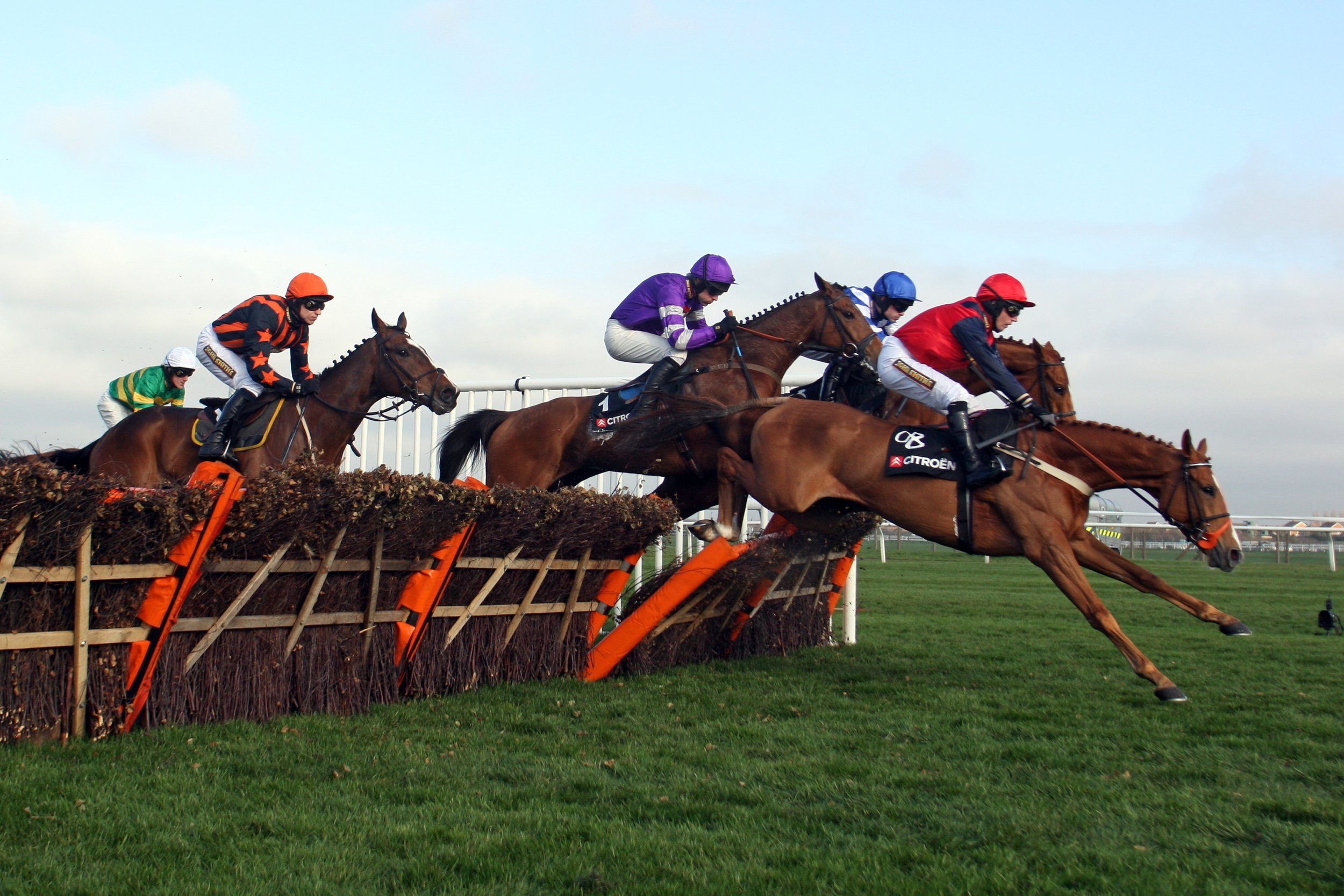
The racing industry can often be accused of living in the past. Horsemen rely to an extent on the sharing of knowledge and experience handed down from one generation to the next, yet trainers in particular are keen to keep up with the latest trends and innovations in the hope they may improve the performance of their horses. While we thrive on tradition, we still constantly chase the next best thing.
Rooted more deeply in the past is National Hunt racing, which could be described as the more accessible side of our sport. Within the ranks of breeders, trainers and amateur jockeys are a great number of hobbyists, who like to do things themselves in the manner they have always done.
So it’s perhaps no surprise that we now delve back to 2013, a year in which we posed just about the same question we pose here: Should National Hunt store horses be broken at time of sale? It was a question then that had emerged out of borderline panic, as British and Irish-bred National Hunt horses struggled to compete against the French-breds. As with most panic attacks, we looked to the most immediate and obvious cause and set about addressing the situation with a campaign to supply ready-broken stores.
Speaking at the 2013 launch of an educational DVD on the breaking of store horses, Irish Thoroughbred Breeders Association Manager Shane O’Dwyer explained, “The view in National Hunt circles is that we need to change the way we do business, in that traditionally the store horse is broken at three and four, but the French system of breaking at two years appears to be a good alternative. The sales companies are pushing for horses to be broken by the autumn of their two-year-old career and then turned away to mature.”
That was 10 years ago. While the tide in results has since turned, the ideas put in place at the time have still yet to find favour. After a decade, 2022 sees the first National Hunt sale to cater for the new Junior Hurdle programme that will commence in Britain this autumn. Goffs UK August Sale at Doncaster in early August will feature a new National Hunt two-year-old session as part of the company’s support of the British Horseracing Authority (BHA) and Thoroughbred Breeders Association’s (TBA) National Hunt Junior Hurdle races.

The National Hunt two-year-old session at the sale will see all horses offered with pre-sale veterinary certificates, in the same way that stores are offered in the Doncaster Spring Sale, and the new National Hunt Junior Hurdle Races will be open exclusively to three-year-olds from October to December and four-year-olds from January to April.
However, if we look at the number of store horses offered broken over the past ten years, early breaking does not seem to have gained any popularity among breeders and consignors, despite drives by the TBA and ITBA. Nor does it have any obvious effect on sales.
Ten years ago, the three largest sales in Ireland and Britain in 2012 catalogued an average of 23% broken stores. 77.3% of the Land Rover Sale catalogue were unbroken, of which 74.4% were sold. 76.2% of horses listed as having been driven in long reins were sold; 71.4% of those listed as driven and backed were sold; and 70.3% of the broken horses found buyers.
Those 2012 figures were similar at Fairyhouse, where 77.8% of the Derby Sale catalogue were unbroken. Only 11 were listed as broken, but all 11 were sold. 79.5% of those driven and backed changed hands, and 80.3% of horses driven in long reins were sold. 83.3% of the unbroken horses found buyers.
Meanwhile, at the 2012 DBS Spring Sale, looking at the 208 stores catalogued on the final day, the picture was much the same. 62.5% were unbroken, of which 73.8% sold. 62.5% of the broken horses changed hands, 66.7% of the youngsters driven and backed were sold, and 72% of those long reined found homes.
A lot depends on the individual horse, and the sheer volume of unbroken horses limits the purchaser’s choice; but the comparative percentages show that having a horse prepared and even broken was certainly not a disadvantage, even then.
If we skip ahead to the current year, Goffs Land Rover Sale 2022 had 715 catalogued, of which only seven were broken, 0.98%. Tattersalls Derby Sale 2022 had 390 catalogued, four of which were broken, 1%. Goffs UK Spring Store Sale 2022 had six broken, from a catalogue of 313, 1.9%. That’s a total of just 1.2% of broken horses, quite a decrease from the 23% of broken stores on offer in 2012.
The French, of course, have a National Hunt programme designed to bring young horses to the track, with sales arising from racecourse performance rather than the ring. The Arqana Grand Steeple Sale 2022 had 38 catalogued, of which 19 raced over hurdles as three-year-olds (50%) and the remainder, bar four in training but unraced, ran on the Flat.
The French system of early racing experience is popular with trainers, who are trying to satisfy the demands of impatient owners who want to go straight from the sales to the racecourse. It’s also a system that benefits its young National Hunt horses, who have a programme in place allowing them to develop and gain experience on the track. Until this year, no such development programme existed for British and Irish horses.
Junior National Hunt Hurdles in Britain are open to horses that have not previously run before 1 October of that season, nor previously started in a Flat race or more than three hurdle races. Horses will be allowed to run in a maximum of four Junior National Hunt Hurdles, with a penalty structure for wins in previous hurdle races.
There will be 10 Junior National Hunt Hurdle races in the 2022/23 season open to three-year-olds and run between mid-October and the end of December, with a similar number for four-year-olds from January to the end of the season, all run at Classes 2 to 4 under WFA terms.
Wins by British-bred fillies nominated to the GBB (NH) scheme will generate bonuses just as they would for Novice Hurdles, which is £20,000 for GB-sired fillies winning fillies-only races and £10,000 for those winning any-sex races. Junior National Hunt Hurdle race winners will still be eligible to compete in Novice Hurdles during the following season, just as for National Hunt Flat races. It is hoped this will boost the sales of two-year-old National Hunt prospects.

“By adding these races to the programme, we’ll be able to gain a much better understanding of the impact of providing young jumping horses with the opportunity to start their careers at an earlier stage,” says Richard Wayman, Chief Operating Officer of the BHA. “Such an approach is already well established in France and to some extent as part of a vibrant Point-to-Point scene in Ireland, and we hope that owners and trainers will support the introduction of Junior National Hunt Development Hurdle Races and view them as an ideal opportunity for the right sort of jumping horse.”
Dr Bryan Mayoh, Chairman of the TBA NH Committee and co-breeder of black-type National Hunt winners, including Sizing John, told the National Trainers Federation, “This could be a long-term game changer for British Jump racing and breeding.”
He points out that “almost half of the horses gaining RPRs of 170 or more from 2009/10 onwards are French-breds” and argues the point, “top-class French-breds are far more likely to have run over obstacles at the age of three or by the middle of their four-year-old year. These horses had probably been schooled over hurdles several months earlier. The early racing of French-bred National Hunt horses, rather than any differences in pedigree, appears to be the single biggest factor generating the superior results of French-breds in recent years.”
Of course, it isn’t only the French-bred horses who benefit from early racing. Irish bred and trained horses are also now dominating the National Hunt scene, as their success at recent Cheltenham Festivals highlights. Once again, we could point to early racing as a probable reason for success, as so many Irish National Hunt horses have come from the Point-to-Point field. As trainer David Pipe tells us, “We do not get many orders for store horses, so tend to buy English or Irish Point-to-Pointers.”
Of the 30 races run at the 2022 Cheltenham Festival, 15 were won by Irish-breds, nine by French-breds and four by British-bred horses. Looking only at the 20 Graded races, only two of the winners ran as three-year-olds, both in France. Thirteen of the Graded winners debuted at four, five of them in Point-to-Points. Three didn’t start until the age of five, one as a six-year-old and one had run on the Flat at two.
The picture in 10 years’ time might be very different, with the trend in National Hunt horses debuting at four changing to a bulk of three-year-old appearances. But, overall, the knee-jerk reactions to stem the tide of rival breeding nations appear neither to have been embraced nor even to have affected the turnaround in results or the turnover at sales.
There is, however, another argument to early breaking and racing. Research by Ely, Avella, Price, Smith, Wood and Verheyen, published in the April 2009 Equine Veterinary Journal, found that ex-store horses were twice as likely to suffer tendon and suspensory ligament injuries as ex-Flat horses. The data collected from 1,223 horses based in 14 different British National Hunt training yards showed the recorded fracture incidence rate varied significantly by trainer, but not by gender or age.
The tendon and suspensory ligament incidence rate also varied significantly by trainer, as well as by age, but not by gender. The findings are clear: Early breaking and training halves the incidences of tendon and suspensory ligament problems.
It has been shown that short, controlled pieces of work at regular intervals, between recovery turnout, allow tendons and ligaments to grow and develop strength in harmony with bone growth. When a young National Hunt horse comes into training from a background of controlled exercise it is far less likely to suffer suspensory ligament problems, and its career is significantly prolonged as a consequence.
Grange Stud has been breaking its stores for the past 20 years and in terms of physical development, it makes logical sense. “It’s the same for any athlete, be they human or equine; the sooner you start skills training, the better it is for their careers,” points out bloodstock agent John O’Byrne. “Look at top professionals in any sport: they had a ball, club or racquet in their hands nearly before they could walk.”
Clean Water and horses - the importance of this often forgotten essential nutrient
Words - Alan Creighton
The Irish Equine Centre monitors the environment in over 200 racing yards across Europe. That monitoring package includes air quality, feed and fodder quality and storage, stable hygiene testing, and indoor exercise hygiene testing. A further major portion of that environmental monitoring package includes regular water sampling both at source and water directly from buckets or troughs. Water is the number-one nutrient fed to any animal, and it is often overlooked both in nutrient programmes and in the diagnosis of health issues resulting from poor performance of racehorses. We often hear the excuse that “Ah sure, horses drink from dirty puddles and ponds; and they seem fine.” That may be true and even OK for horses on farms, where horses are on a break or at pasture, but it’s OK not for high- level stressed racehorses. Anything that affects the gut flora or metabolism of a racehorse can have a negative effect on performance.
By weight, horses consume up to three times as much water as food per day. If the water contains toxins, high levels of minerals or any other environmental contamination, nutritional and performance problems can result.
Horses should consume enough water to replace what is lost through faeces, urine and importantly for racehorses, sweat particularly due to exercise. Water consumption will depend on several factors. These factors can be variable and include temperature, humidity, feed and fodder quality, type and amount of feed and fodder, exercise level, stage of fitness and health. The average daily consumption for a 500kg horse would be approximately 45 litres per day in normal, average weather conditions. The same horse, when in full training, could consume nearly three times that or up to 125 litres of water per day. When racehorses are carrying out their conditioning or fitness work following a long break, particularly in warm weather, the sweat production can increase further, which in turn increases the water and electrolyte requirements.
At this stage of conditioning, there is a fine balance between water and electrolyte concentration, which is essential for appropriate muscle contraction and also in the cooling down process of the horse. An imbalance or a depletion of electrolytes can lead to premature muscle fatigue, reduced stamina, muscle cramps, poor post exercise recovery and tying up. These facts further highlight the need to ensure an abundant, safe supply of water to racehorses.

Contaminated water will impact the performance of both. This is something that may be overlooked in all types of horse management. High bacterial content in water can affect all animals, and in particular young stock and under-pressure racehorses. High iron content in water can cause severe gut upset in horses, which builds up over time. High levels of nitrate, nitrite and aluminium can also have a large negative impact on horses. Water quality in farm wells can fluctuate greatly and require constant monitoring.
There are three main sources of water available to racehorses: mains or municipal water, well or borehole water and finally running water in streams, if using outdoor paddocks daily. Yards in or close to towns usually draw their water from a public or municipal system that provides extensive purification and filtration services and also regularly tests its water for contaminants such as disease-causing bacteria and toxic chemicals including pesticides. The worries are less from this source but not eliminated. If there is damage to the delivery line or a problem with the plumbing on your own yard or farm, your water could still be compromised. Mains water can also be variable in the concentration of fluoride and chlorine, which means it requires regular monitoring as this may affect the palatability of water.
If your drinking water comes from a small group scheme or your own private well, then you are responsible for ensuring it is safe to drink. Many wells provide beautifully clean water, but there is also the potential for contamination. Man-made water sources are not free of issues; they require consistent maintenance.
Wells which are drilled correctly, sealed and more than 50 feet (15m) deep have less chance of becoming contaminated with bacteria. Water from an old or shallow well should be tested more frequently. Wells close together can supply water of varying quality. Even two wells side by side can draw water from separate aquifers (underground water sources) and yield very different results. Water quality from wells, both in terms of bacterial content and physical and mineral makeup, can vary greatly based on seasonal factors. Drought, heavy rainfall, local farming practices all can have a negative impact.
Trainers more and more are seeing the benefits of keeping racehorses in outdoor paddocks either for a portion of the day or permanently. If the water source is only a stream or river, then obviously a good flow is required. Ponds are usually problematic. Agricultural chemicals and other environmental contaminants can cause blue-green algae to bloom in the water. Not all algae produce harmful chemicals, but blooms are indicators of unhealthy or stagnant water.
Horse owners often forget to observe or clean water troughs in paddocks. If the water in a trough appears green or murky, it needs to be dumped and replaced. When cleaning a water trough, it is often necessary to remove algae by more vigorous means than rinsing alone. Stiff brushes and apple cider vinegar are two safe tools for removing algae and discouraging regrowth.
Like us, however, their water intake can quickly be adversely affected if the water’s taste is unpleasant. Horses that refuse to drink from unfamiliar-tasting water sources are distressingly common. There is more and more evidence to suggest that horses are reluctant to drink low pH or acidic water. You may have a scenario where a horse is used to drinking a balanced pH water (6.5-7.5) and then travels to a racetrack were the pH may be much lower (4.5-5.5) and then refuse to drink, which would be a problem and lead to dehydration if stabled there for a number of days.
The most common problem we find in water is bacterial contamination. Testing your well’s water for bacterial contamination on a regular basis is sound practice. A total coliform test checks the water for bacteria normally found in the soil, surface water, and human and animal waste. Coliform bacteria are not, in themselves, considered harmful, but their presence in your water supply is an indication that your well or supply may be contaminated either from runoff from a manure pit, a nearby septic tank, or fertiliser or manure spread on a nearby farm. Coliform levels can vary greatly due to drought conditions or with sudden heavy rainfall. It’s also possible to have high coliform levels when the well has developed physical defects, such as a broken or missing cap that could allow debris, surface water, insects or rodents inside. Bacterial testing is a good idea whenever there is a noticeable change in the colour, odour or taste of your water, or if a group of animals become sick.
If high coliform levels turn up in your well water, it’s possible your own manure management is the culprit. To protect your water, make sure you situate your manure pit in an elevated, well-drained location, not on the lowest spot on the property. After a rainstorm, watch the flow of water—it should go around your manure pile, not through it. Simply rerouting the flow of run-off water can improve your water quality considerably.
The variability of bacterial levels in water supplies often results in trainers needing to install a UV filter onto the water inlet pipe, which feeds their yard. UV filters, once working correctly and maintained, are effective at reducing the bacterial load.
Blue-green algae in natural water sources can produce cyanotoxins, which are extremely dangerous for horses. Blue-green algae poisoning can cause muscle tremors, laboured breathing, bloody diarrhoea, liver damage and even convulsions and death. So it’s best to remove horses from a contaminated water source with algal blooms immediately. Algal growth is usually associated with large amounts of organic material in the water, often as a result of runoff from nearby fertilised fields.

Nitrate levels in natural or well water supplies are also a concern. Nitrate converts to the much more toxic nitrite in the rumen, which reacts with blood haemoglobin, reducing the availability of the blood to hold oxygen. Nitrites and ammonia should only be present in drinking water at very low levels. Ammonia may be present in supplies as a result of runoff from agricultural slurry, fertiliser or industrial waste. It rapidly oxidises to nitrite (which principally exists as an intermediate) and, in turn, to nitrate. Elevated levels of ammonia and nitrites are indicative of effluent contamination, and the source should be investigated and eliminated. For drinking purposes, removing nitrate is required and can be carried out by the installation of a reverse osmosis (RO) system.
When it comes to water safety, pesticides and herbicides are other worries. Though it can be expensive to test for these chemicals, it may be worth doing if you have significant concerns about the agricultural sprays being used in your area, or if you suspect solvents or other toxic chemicals have leached into your water from a nearby industrial facility.
Until recently, the veterinary world had viewed iron toxicity in horses mainly as an acute condition and often only as a result of overdosing on iron supplements. However, research has shown that horses exposed to high iron levels in water, grass or hay over a prolonged period can accumulate the mineral in their livers, resulting in chronic iron overload. This iron overload can prevent the liver from carrying out its essential duties so vital to an exercising racehorse. High iron in water also can have a detrimental effect on the gut flora of horses, which can lead to all types of metabolic issues. Iron levels in well water vary greatly from region to region, and many hotspots have been identified over vast areas in different countries. Iron, like most minerals, can be filtered from water using filtration systems at the point of entry into the yard.
Once trainers have established a reliable clean source of water, they must then ensure that the distribution of clean water is maintained throughout the yard. That means placing covers on header tanks to prevent rodent or bird infiltration, cleaning water bowls, drinkers and buckets and finally flushing water lines to automatic drinkers on an annual basis.
Then there’s the question of which is better: watering using buckets or automatic drinkers? Both have positives and negatives. You can monitor the amount a horse drinks from buckets and then take buckets out of the box to clean as needed. The down side to bucketed water is that it’s labour intensive. Automatic drinkers are not labour intensive, but they do need to be checked daily to ensure they are working. They supply fresh water constantly, but you have no idea how much water a horse has drunk or not, and the systems need constant flushing and cleaning.
Not all natural water sources are problematic, and not all artificially provided water is safe. Keeping a careful watch over the water your horses are drinking will allow you to detect contamination issues before they cause illness, dehydration or loss of performance.
Drinking water must be completely free from any microorganisms or contaminants which are considered a health risk.
The IEC provides water testing for equine, agricultural, domestic and commercial purposes. Water is tested for bacterial content including E. coli and total coliforms but also physical and equine-specific mineral profiles to an ISO 17025 standard. Water can pose a health risk for humans and animals when consumed, even though contamination may not be noticeable by taste, smell or even colour.
Does jockey gender makes a difference to racehorse performance?
Words - Charlotte Schrurs (PGDip VetPhys, MSc)

Male jockeys have no more influence over the performance of a racehorse than female jockeys
Experts from the University of Nottingham have found that the sex of a jockey doesn’t influence any aspect of racehorse physiology and performance.
The findings of the study, presently published as a preprint at Research Square, offer a new perspective on the possible balance of elite male and female jockeys on the start line of races.
Studies assessing the effect of the sex of a rider on racehorse performance and physiology during training have not been reported, mostly due to the lack of available data for female participants within the sport.

The racing of Thoroughbred horses has a tradition dating back to the 18th Century in the UK. However, it was not until the mid-late 20th Century that the first ladies’ race was held. In the present day, more than 90% of participating jockeys, in most racing nations, are men. This is likely an unconscious bias toward male jockeys being, on average, physically ‘stronger’, able to push horses harder, and thus performing better in races than female jockeys.
In horse-racing, male and female jockeys compete against each other in the majority of races. This is because the competitive advantage is less on the physical attributes of the rider but more on skill level or ability to partner with an animal. Indeed, racing requires quick reaction time and agility from the jockey while being able to navigate the horse with dexterity across the peloton at peak speeds often exceeding 60km/h.
In the present day, more than 90% of jockeys, in most racing nations, are men. This is likely an unconscious bias toward male jockeys being, on average, physically ‘stronger’, able to push horses harder, and thus performing better in races than female jockeys.
This decade has seen a marked increase in participation of female jockeys at an elite level in the racing industry. In 2021, the Irish jockey – Rachael Blackmore – made history by winning several high-profile races. This year, she continued her remarkable rise by becoming the first female jockey ever to win the Gold Cup at the Cheltenham Festival. Success stories, like this, are shaping global betting behaviours on the racetrack and challenging the public’s confidence in the ability of male or female jockeys to win big races.
In the UK and Ireland, previous research had suggested an underestimation of the ability of female jockeys to win races, as recorded in betting behaviour.
In racing, a competitive advantage may lie in the ability of a jockey to control the horse, and/or less weight carried by the horse (i.e. weight of jockey plus saddle).

An average racehorse weighs ~500-600kg, an average jockey, ~49-55 kg. Yet, a few 100g extra on the back of a racehorse has been shown to influence race performance. Therefore, weight carried by the horse (jockey, plus saddle and added weights where necessary) is used to further equalise any perceived performance advantage. This allows horses of varying levels to participate in so-called “handicap” races. In such races, each horse is attributed a predetermined weight to carry (jockey plus saddle, with added weights where necessary) determined by the racing regulatory board. Horses with better racing records are allocated higher weights in order to further equalise any perceived performance advantage. Hence, jockeys are weighed in before, and weighed out after, races.
All being equal, would a racehorse during race-pace work-outs perform any differently when ridden by either a female or male jockey? Would that racehorse be more or less likely to win a race?
Researchers from the School of Veterinary Medicine and Science at the University of Nottingham, worked with Guillaume Dubois PhD Scientific Director at Arioneo Ltd – a company that developed a bespoke exercise tracking device for horses; and an Equine Sports Medicine specialist (Dr Emmanuelle van Erck-Westergren PhD; Equine Sports Medicine Practice, Belgium) to answer some of these questions.
They monitored 530 thoroughbred racehorses, ridden by 103 different work riders, which were randomly allocated to a horse (66 male, 37 female) over a total of 3,568 work-outs (varying intensity from slow/med/hard canter to gallop) at a single racing yard (with varying tracks sand, fibre, turf) (Ciaron Maher racing) in Victoria, Australia. Variables such as speed, stride length and frequency, horses heart rate and rate of recovery were recorded with a validated fitness tracker (the ‘Equimetre’©). This tracker was specifically designed to monitor horses during their daily exercise routine with advanced data analysis services (www.arioneo.com).
The investigators found no effect of sex of the jockey on any objectively measured outcome variable, measured from slow-canter to hard, race-pace gallops. But would this lack of effect of sex of jockey in training, also translate to actual race results, where many other variables come into play?
Analysing results from 52,464 races (combining steeplechase and flat races), female jockeys had a similar win percentage (of total race starts) as male jockeys in the UK (female, 10.7% vs. male, 11.3%). In Australia, male jockeys had a slightly higher win percentage (11.0 vs. 9.9%), but this was negated when considering a top three race finish.
Taken together, the researchers found minimal effect of the sex of the jockey on both training and race outcomes. Some curious effects were observed. For example, recovery of racehorse heart rate after exercise appeared influenced by sex of the rider, but only when the usual training intensity on each track surface (grass or sand) was reversed.

Male work-riders, more so than female, perhaps anticipated the ‘expected’ training-intensity (e.g. gallop on grass) and their proposed anticipation was transmitted faithfully to the horse, who responded with higher or lower heart rate. Further work is needed, however, to confirm this effect. When considered across all training sessions, then no difference in expected recovery rates of racehorses were noted between male and female jockeys.
Ms Charlotte Schrurs (PGDip VetPhys, MSc), doctoral student and lead author with Professor David S Gardner PhD, said: “Our study is the first to objectively assess whether sex of the jockey has an influence on any aspect of racehorse physiology and performance. The data convincingly suggest the answer is no and offers a new perspective on the possible balance of elite male and female jockeys on the start line of races. Efforts to favour a more ‘inclusive environment’ would greatly contribute towards equal opportunities and the promotion of fair competition within this highly popular and fascinating sport.”
The full study can be found here - https://www.researchsquare.com/article/rs-1341860/v1
The business of standing thoroughbred stallions
Words - Alysen Miller

Foals gambol in 750 acres of lush green paddocks enlaced by pristine post and rail fencing while the sun glints off the chalky New Forest hills. It’s the sort of timeless vista that could have dripped straight from the brush of George Stubbs. But the bucolic scene belies the harsh reality that the small breeder in Britain is heading towards extinction. “We’re under so much pressure here. On the bad days, sometimes it is tempting to say, ‘Sod it,’” says Ed Harper, director of Whitsbury Manor Stud. “But I have a responsibility to the staff that have been with us for a long time and to my dad, who worked 50 years for this. I don’t want him to see us raise the white flag just yet, so we’re digging our heels in.”
Pressure is, after all, something the denizens of Whitsbury Manor are accustomed to. Harper’s father purchased the farm in the 1980s, having previously managed it for his uncle—the colourful bookmaker William Hill who died of a heart attack while attending the October Sales at Newmarket in 1971. A non-horsey child (“I couldn’t even put a headcollar on”), Harper briefly entertained a career in chartered surveying before the siren call of the breeding shed proved too strong.

Since taking over the reins from his father, Harper has had to get creative in order to keep the bank manager at bay. “I believe that there are different reasons for doing things,” he explains. “I’m very pleased if very rich people want to spend money in our sport and don’t have to make it pay. The more the merrier. But we’ve never been able to do that. My father had to borrow money to buy Whitsbury Manor, and we’ve never been out of debt since. Our choice is not whether to be ultra-commercial or to do it their way. Our choice is to be ultra-commercial or not be in business at all.” He currently stands four stallions at Whitsbury Manor. He has also partnered with the National Stud to stand Lope Y Fernandez in Newmarket. “I think it was a perfect mix of us being very familiar with how to make commercial decisions, and them having the branding and the location,” he explains. “Hopefully Lope Y Fernandez is the start of a really good relationship that can benefit breeders.” But Whitsbury Manor’s flag bearer is undoubtedly Showcasing. After an inauspicious start, “we literally covered a couple of polo ponies with him in years two and three. We were dealing down to £2,500,” Harper says. Showcasing — the son of Oasis Dream — is fast establishing himself as a formidable sire. Currently standing for £45,000, his dance card is full for the current breeding season.
Showcasing’s success has allowed Harper to keep his head above water a little longer. “I think if Showcasing hadn’t come along when he did, we might have 10 mares here and no stallions; and I’d be doing all the mucking out,” he says. But ironically, it has risked pricing out the smaller breeders on whom studs like Whitsbury Manor traditionally rely. “We were dealing regularly with people that would breed one foal every other year, and we were delighted that they were coming to us,” Harper explains. “So it’s a delicate balance.” Harper is aware that in order to survive in the long term, he needs to cater to the smaller breeders as well as those who can afford a £45,000 nomination. “Very much at the front of our minds is that we have to keep the critical mass of breeders alive and breeding,” he says. “They need to have options. When they stop getting the options, they stop.”

Harper’s fears are borne out by the statistics. At one end of the breeding spectrum lies a handful of large operations, many of which have more than 100 broodmares. But the industry also includes around 2,500 small breeders with just one or two broodmares, who operate on a recreational rather than commercial basis. These small breeders account for around a third of the British foal crop each year and so are fundamental to both the breeding and wider racing industries. But the number of small breeders decreased by 5% between 2013 and 2017, according to a 2018 Thoroughbred Breeders’ Association report (the latest year for which figures are available). Of those remaining, 66% were operating at a loss—up from 45% in 2013. It seems certain that if the current trajectory continues, even more small- to medium-sized operators will be forced out of the industry over the coming years. Harper is clear-eyed about what that means for the prospects of operations like his: “We don’t survive unless our clients survive,” he says. “However good our stallions are, if we don’t have clients, no one will know it, and vice versa. They need the opportunities to have stallions they can afford. It goes hand in hand. One can’t do it without the other.”
Of course, nobody ever said that breeding racehorses was easy. “It’s always challenging, even at the best of times, because there are variables that you have no control over,” says Pope McLean, Jr, business manager and co-owner of Crestwood Farm. Some 3,900 miles away in Kentucky, USA, McLean echoes many of Harper’s concerns: “We’re all trying to come up with a good horse that can carry the burden of what we do,” he says. “There are operators that are much smaller than we are who are struggling,” he acknowledges. Founded by Pope McLean père in the 1970s, the McLean family has owned and operated the 1,000-acre facility ever since.
But farms like Crestwood Farm have had to come up with some clever initiatives to support their stallions and the wider breeding industry. This has included jumping on the Share the Upside bandwagon. Originated by the aptly-named Spendthrift Farm in Kentucky, the simple yet innovative concept was originally designed to get more mares for Into Mischief who, in 2010, was entering his second year at stud, and another Spendthrift stallion, Notional. For an initial commitment of $13,000 over two years, breeders could obtain a lifetime breeding right in the stallion. Although met with scepticism from the market at first, both Into Mischief and the Share the Upside programme are now both firm fixtures on the American breeding landscape. “It’s something that’s tangible that can help the smaller breeder,” says McLean. “A lot of farms probably aren’t too keen on it, but I think it’s only fair. You have to have the breeders to move forward. If the stallion becomes successful and the breeders have helped you get there, that’s one way that you can reward them for helping you.”
The Share the Upside scheme has been a lifeline for smaller breeders in the states. Back in the UK, meanwhile, incentive schemes such as the Great British Bonus have started to improve return on investment for domestic breeders, although the potential upside is modest by comparison.
But it is not just a lack of flashy incentives that is driving smaller breeders out of business. The dominance of a handful of powerful owner-breeders means that only around 10% of the 4,000-odd foals born in Great Britain each year are bred primarily for sale, with the result that a dwindling number of breeders must walk an increasingly taut supply-and-demand tightrope. The polarisation between the haves and the have nots is stark.
According to historical data from the Thoroughbred Breeders’ Association report, the average filly sold at the Tattersalls Book 1 sale earned an estimated profit of £118,000. Those sold at Book 3 made an average loss of £23,500. “I suppose that’s the main difference between your market and our market,” says Sam Matthews, general manager of Swettenham Stud in Victoria, Australia. “A lot of the top-end horses—the Dubawis and Galileos of the world—might not have a huge amount of their progeny offered to the trainers and other people in the industry, whereas almost every horse that is bred [in Australia] is offered for sale in some way, shape or form whether offered as a weanling, syndicated privately or offered as a yearling. If a large farm is breeding 100 mares a year, at least 80 of them would likely be offered to the public.” This helps keep supply and demand for stallion services elastic: “It’s almost a year-by-year prospect,” says Matthews. “Certainly, if a horse becomes proven quite early on in their career, they do escalate to the increased service fees quite quickly. But on the flip side, if you don’t have much success, they do drop back quite quickly.”
The effect of a buoyant sales culture means that smaller breeders can still make a profit in an open marketplace: “From our point of view, the smaller breeders are the backbone of what we’re all doing,” explains Matthews. “If somebody can get a return off a $20,000 service fee and get $150,000 for their yearling or weanling, that’s an incredible result and that’s something that we hope to be able to help them to achieve.” It’s all about catering to the market. “There’s not much point in having a Bentley dealership in a low socio-economic area,” says Matthews.
By comparison, the UK racing and breeding industry can appear to be something of an ouroboros. Only six of this year’s Derby field had been through the sales ring at some point in their lives (including an honourable mention for the £3,000-yearling Glory Daze). Frankel and Galileo were responsible for five runners between them. Before Desert Crown’s win in this year’s Derby, you would have had to go back to 2017 to find the last winner of the Epsom Classic that was not bred by Godolphin or Coolmore or one of their affiliates. (Wings Of Eagles, bred in France but snapped up as a yearling for €220,000 by MV Magnier at the Arqana August Yearling Sale. He now stands at stud for Coolmore.)
Back in Hampshire, Harper is clear that he does not believe that the big owner/breeders themselves are the problem: “They’re bringing investment in,” he explains. “[The big operators] want competition. They want to do well, but they also are racing enthusiasts at heart. People soon realise that three-runner races where they’ve got two out of the three runners is not good for anybody.” Like many smaller operations, Harper has adopted an ‘if you can’t beat ‘em, join ‘em’ approach. Of Whitsbury Manor’s four stallions, two—Sergei Prokofiev and Due Diligence—are operated in partnership with Coolmore.
But the consequences of the concentration of power in the hands of a small handful of owner/breeders are not only economic, but genetic. “We’re going down a black hole, genetically,” cautions Harper. “It’s very unwise.” Harper is putting his money where his mouth is: Between Sergei Prokofiev and Due Diligence, Harper reckons he has the highest concentration of AP Indy blood in his corner of the UK. “I’m a big fan of AP Indy blood,” he explains. “That hard knocking tenacity and toughness—the pedigree purists love to throw knives at us, but what they don’t realise is that we’re keeping the bottom half alive. I think it’s important we keep refreshing the genetics in Europe. I’m chuffed that we’re bringing those genes over for people to use. It’s characteristic of breeding in every country that people cherish what’s on their doorstep more than they look over the fence. But I try and have a more global look.” And then there is the pressure to produce early developing horses that trainers can sell: “They’re our shop window, and we’ll do our best to produce what they can sell. There’s no point in producing horses that the trainers are going to struggle to sell to their clients,” says Harper. “The new client is probably shared ownership, and they want instant action. We need to be producing horses that the trainer can sell and say, ‘Hey, look, lads: if you buy this horse, we could be at Royal Ascot in a couple of months’ time.’”
So what is the solution? It is clear that, in the wake of the double whammy of Brexit and COVID-19, the economic situation is more precarious than ever. While the largest operations are probably too big to fail, a swingeing recession could force even more small- and medium-sized breeders to cease their operations for good. In such a scenario, British racing is facing the very real prospect that it will not be able to sustain its racing calendar. Around 20,000 individual runners are needed to maintain the programme, according to the Thoroughbred Breeders’ Association. With fewer races meeting the eight runners per race required for each way betting, the quality of the betting product will deteriorate, along with funding from the gambling industry and media rights payments; and the finances of all racing industry participants will be severely impacted.
Harper is pessimistic about his chances of being able to hand over Whitsbury Manor to the next generation. “I don’t think we will have the client base of small breeders to give our stallions a chance to compete in 25 years’ time if we keep going down this road,” he says. “Our goal is survival. And we don’t survive in this business without our clients. I’ve seen so many breeders stop breeding in this country. Not every foal we produce will make money. But if we can, we will continue to source stallions that we are able to stand at a fee that will give our small-breeding clients an opportunity. Because if we’re not solving that equation and they don’t have options, they stop breeding.”
Racing in Belgium
Words - Dr. Paull Khan

Belgium's Desert Orchid and French-trained Taupin Rochelais sail over the 'world's biggest water jump.' Credit: Photography Piet Eggermont Belgium.
The jumps track at the pristine little Flemish town of Waregem might just boast the shortest finishing straight in the world—the winning post being a matter of yards from the final bend. It is, however, the home of far and away the most valuable race in Belgium. The Grand Steeple-Chase of Flanders boasts a purse of €80,000 (€100,000 pre-COVID) and, August 30th will see the 154th renewal of this venerable 4,600-metre event.
“The race is part of the Crystal Cup,” explains course commentator Nicky de Frene, “thanks to the Gaverbeek—the largest water jump in the world at 6.5 metres—and the famous Irish Bank, which give this Steeple-Chase a little touch of a cross-country race. It’s recently attracted the attention of David Pipe and Jamie Snowden, but I fear that Brexit wasn’t a good thing for Waregem because of the extra travel costs.”
Nowadays, the race is virtually the preserve of French connections (Although Germany can boast a couple of second places in recent years; and Kildagin did win it for Britain back in 1975).
Nicky de Frene is in no doubt about its most remarkable winner. “In the last decade, we have seen the domination of the French trainer Patrice Quinton, who won the race 10 times in a row! That happened with five different horses, one of which was Taupin Rochelais, the near-white grey who won it four times running. At the time of his last victory, in 2018, he had to carry 76kg, (12 stone) and he beat a top-class horse from champion trainer Guillaume Macaire. That day, Waregem witnessed the highest-rated performance in its history.”
“We’re not a racing nation…” continues de Frene, warming to his theme, “but he’s our version of Desert Orchid! I don’t know of a top handicap in the world with a winner of four successive renewals. Even Makybe Diva has just three Melbourne Cups; Red Rum, three Grand Nationals. So Taupin Rochelais deserves, in my opinion, eternal fame.”
However, the Grand Steeple Chase of Flanders is one of just four Belgian jumps races, all run on a single day at Waregem. Flat racing, by contrast, is held year-round.
Belgian racing is, in fact, amongst the most open in the world. All of its races, including handicaps, are open to horses trained in all recognised nations. As long as an entry has a handicap mark in its home country, it will be assigned a mark in Belgium, which uses the same scale as in France.
Some 18% of last year’s runners were foreign-trained—the great majority from Germany, some from Holland and a smattering from France. Gone are the days when British trainers like Michael Jarvis made regular raids over to the seaside resort track at Ostend. This compares starkly with the number of foreign sorties made by Belgian-trained horses, which are almost as likely to run outside Belgium as within it.
Marcel De Bruyne, Belgium’s representative on the EMHF and director of the Belgian Galop Federation, explains the simple truth: “French racetracks are nearby, and the prize money at those favoured by Belgian trainers is more than double ours.”
Average prize money last year was some €4,700 per race, peaking at €12,800 for Ostend’s Grand Prix de Prince Rose, the country’s most prestigious flat race. It is named after the most celebrated Belgian-trained thoroughbred who ran third in the ‘Arc,’ went on to win the Gp. 1 Prix du President at Saint Cloud and become an important stallion—leading sire in France in 1946 and great grand-sire of Secretariat.
Neither can the pool of home-trained horses be said to be extensive, having fallen from 348 pre-COVID to just 318 last year. However, the fixture list which these horses are asked to sustain runs to just 30 meetings and 150 races; and this controlled offering certainly pays dividends as regards competitiveness. Field sizes would be the envy of many top-tier racing nations: 10.8 at Ostende, 10.6 at Waregem and 9.4 at Mons.
Let’s take a look at the country’s three racecourses:
Mons: Two thirds of Belgium’s races are run at Mons, on the same type of All Weather track as can be found at Chantilly and Deauville, some 50km southwest of Brussels near the French border. A left-handed track of 1,200 metres’ circumference which favours front runners, particularly in the sprints, Mons’ Hippodrome de Wallonie races fortnightly from mid-September to the end of April, with a limited menu of five distances: 950m, 1,500m, 2,100m, 2,300m and 2,850m.
Wellington Racecourse at Ostend: Belgium’s high-summer track, racing on turf every Monday, July through August. With a slight incline to the finish, races cover a full range of distances from 1,000m to 4,000m, either on the track’s 1,400m right-handed oval or its 1,000m straight.
Waregem: Not far from Ghent, Waregem now offers four turf flat meetings in May and June, including the St Leger over 2,700m, to add to its flagship jumps day.
Nearly half the horses in training in Belgium are owner-trained. There are 18 professional trainers in the country. Jockeys are also in short supply: just 14 professional riders (with a further seven gentleman riders and seven lady riders.
The long-term sustainability of thoroughbred breeding in the country is, however, a concern for De Bruyne. The country produced just 24 foals last year. “Belgian-bred thoroughbreds are becoming an endangered species because owners prefer to buy race-ready horses; and Belgian breeders often breed in France to be eligible for French breeders’ and owners’ premiums.”
The backdrop against which Belgian racing is attempting to thrive is one of serious under-funding. It's only betting-based income stems from the very modest sums that are wagered by racegoers at its three courses and from bets placed into the French betting operator; PMU’s pools on 100 or so qualifying flat races—the so-called ‘Premium’ races. It is therefore heavily dependent upon this latter income stream. The sport derives no benefit whatsoever from the great bulk of relevant wagering—neither from bets placed by Belgian punters off-course (either in the 3,500 retail outlets or online)—whether on Belgian races or otherwise, nor by punters in other countries betting online on Belgian races (outside the PMU system).
Baron Philippe Casier—former president of the Belgian Jockey Club and a long-time advocate of statutory funding for the sport from betting thereon—describes two recent body-blows to this ambition. “Last year, a law introduced two years earlier, which required betting operators licensed in the country to enter into a funding agreement with racecourses, and which covered betting on both foreign and domestic races, was repealed before a single Euro had been handed over. And in 2018, a tripartite agreement that the Belgian tracks had struck with the PMU and international betting operators, through which common pool betting on the French system had, for a few years, resulted in healthy income for them, also ended.”
So, despite the numerous European Commission precedents, which have established the validity of statutory funding, there seems to be no current appetite for this within the Belgian national government, of which betting is a competency. Racing therefore must look to the largesse of regional governments. The Walloon region has been persuaded of the benefits of supporting this rural industry, and grants Mons a yearly operational subsidy. Hopes in Flanders, where there is currently no such support and into which Ostend and Waregem fall, rest with a proposal to establish a similar subsidy that is funded by raising the tax rate on online bets from 11% to the 15% that already applies to other betting. Despite these impediments, optimism remains, and perhaps we should leave the last reflections to Guy Heymans, Belgium’s chair of the European Trainers Federation: “Because of the repression we had in Belgian racing, a lot of owners stopped owning racehorses. And lots of those who kept on started training their horses themselves. That’s why we have a lot of owner/trainers in Belgium and why there are only a few professional trainers left”.
Racing in Belgium is no longer on a regular basis, as it used to be—there is now a race meeting only approximately every fortnight. But Ostend and Waregem are becoming very popular with the general public, with thousands of spectators at those meetings. For an owner it’s a real pleasure to win a race at one of these meetings with such crowds and all that cheering!
“Belgium is a very interesting place to have horses in training. First of all there is the geographical location: we have easy access to a lot of French and German racetracks (e.g., Paris within only three hours’ drive). Secondly, the trainers have excellent facilities—some of them private, others based on the racetrack in Mons.
Furthermore, the cost of putting a horse in training is cheaper than in our neighbouring countries. That makes it an interesting proposition for foreign owners to put horses into pre-training with a Belgian trainer.
“Belgian racing has been evolving positively over recent years. We hope that this trend will continue in such a way that new and old owners will find their way to the sport.”
200 years of horse racing in Germany
Words - Lissa Oliver

Horseracing is the oldest organised sport in Germany and this year it celebrates a major milestone. The very first thoroughbred race in Germany took place in Doberan, on the Baltic Sea, 10 August 1822, this summer marking the 200th anniversary. Around 30 racing clubs have organised a total of 136 race days to mark the celebration.
German-bred racehorses are recognised internationally for their stamina and soundness, which is no accident and links directly to that historic day in Doberan. Breeding selection and breed improvement through tests of performance remains a mandate of the Animal Breeding Act, with the retirement of stallions to stud strictly governed.
Organised racing in Germany was very quickly established. As early as 13 August of the same year, 1822, the Doberan Racing Club was founded, the first of the racing clubs created to oversee the contests. The Berlin Racing Club followed in 1828 and by the 1830s numerous new clubs had been formed across the country.
Today, the Düsseldorf Equestrian and Racing Club has the proud boast of being Germany’s oldest continuously existing racing club, founded in 1844, and in April Düsseldorf racecourse had the honour of hosting the first of the anniversary celebrations.
Another major milestone followed when, in 1858, the French casino owner Edouard Bénazet had the racecourse built in Iffezheim near Baden-Baden. Ten years later, Emperor Wilhelm I attended the official opening of the Hoppegarten racecourse in Berlin, 17 May 1868, which quickly developed into one of the most important racecourses in Europe.
The oldest continuous race in Germany is the Union Race, first held in 1834. Created as a supreme test for three-year-olds it was eventually relegated by the Deutsches Derby. The Norddeutsches Derby, as it was originally known, was established at Hamburg in 1869, becoming the now-familiar Deutsches Derby in 1889. During the wars it was staged at Grunewald in 1919, Hoppegarten in 1943 and 1944, Munich in 1946 and Cologne in 1947. The great Königsstuhl, in winning the Henckel-Rennen, Deutsches Derby and St-Leger in 1979, remains the only horse to win the German Triple Crown.
The first commercial German bookmakers sprang up in the middle of the 19th century and, following the French model, a totaliser was set up in Berlin in 1875. From 1905 to 1922 bookmaker bets were banned in Germany, but since then the Tote and bookmakers have been competing with each other.
The early part of the 20th century saw racing clubs springing up as vigorously as the grass and in 1912 there were more than 100 racecourses in Germany. Obviously, world events saw that blossoming situation change drastically. The First World War represented a turning point in the fate of German racing, but it was the Second World War that had a lasting and damaging impact.
Appropriately, racing returned to West Germany after the war years on 12 August 1945 at Leipzig, but in the German Democratic Republic racing became, at best, a marginal sport. Hoppegarten was nationalised and one of only six racecourses hosting racing.
It was a brighter new start in the West and the racing season resumed in full at Munich in April 1946. A steady resurgence followed, and Cologne developed into the leading training centre, while Hamburg remained the home of the Deutsche Derby.
As with other European racing nations there was little change in the ensuing years, but 1980 marked another significant milestone when Dortmund became the first all-weather track in Europe, for the first time making winter racing under floodlights possible.
Following the reunification of Germany, racing came more into focus with the public and Berlin’s Hoppegarten, in particular, enjoyed renewed popularity. In 2021, the Group 1 LONGINES 131st Grand Prix of Berlin received great international recognition when it was included in the top 100 of the world's best races. However, it is Baden-Baden that is regarded as the leading German racecourse, in terms of betting turnover and also from a sporting, social and international viewpoint, staging popular meetings in spring, summer and autumn.
As already mentioned, the breeding of German thoroughbreds has always been carefully regulated to ensure continuing success. The German breeding industry began around 1800, originally in Mecklenburg. In 1842 the first Deutsche Stud Book was published. It contained 242 breeders who between them kept 779 broodmares. Less than 10% had more than 10 mares. This has hardly changed to this day; there are only a few large stud farms, but many breeders with only one or two mares. Currently, about 460 breeders have around 1,300 broodmares.
One of the great traditional studs is the Prussian State Stud in Graditz, near Leipzig, founded in 1668 and already dedicated solely to thoroughbred breeding by the first half of the 19th century. Twelve Derby winners were raised there from 1886 (Potrimpos) to 1937 (Abendfrieden) and Graditz-produced horses were esteemed to the extent that there were times when they had to carry additional weight to give their rivals a better chance.

The oldest private stud farm is Gestüt Schlenderhan near Cologne, founded in 1869 by Baron von Oppenheim. From 1908 to the present day, Schlenderhan has bred 19 Deutsches Derby winners, most recently In Swoop in 2020. A great example of the success of small-scale German breeders is, of course, 2021 Prix de l’Arc de Triomphe winner Torquator Tasso, bred by Paul H. Vandeberg from his only mare, Tijuana; herself from Schlenderhan breeding.
The 200th anniversary of German racing is being celebrated across the country, with commemorative stamps produced by Deutsches Post. The highlight will be the festivities at Berlin-Hoppegarten racecourse from 12 to 14 August. The three-day anniversary meeting opens with an official ceremony at the Hotel Adlon Kempinski in Berlin and on Saturday evening, 13 August, the Hoppegarten racecourse invites everyone to a big anniversary party. Details available at:
Milestones in gallop racing - German gallop (deutscher-galopp.de)