
EMHF UPDATE - Dr. Paull Khan reports on the Asian Racing conference, Cape Town, stewarding from a remote 'bunker' and the 'Saudi Cup'.

By Dr. Paull Khan
ASIAN RACING CONFERENCE, CAPE TOWN
The Asian Racing Conference (ARC) is the most venerable institution in our sport. It may seem strange, but the Asian Racing Federation (ARF) is older than its parent body, the International Federation of Horseracing Authorities (IFHA). Its conferences, while only biennial compared with the IFHA’s annual get together in Paris after the ARC, go back further—60 years in fact. And, because of the liberal definition of ‘Asia’ employed by the ARF, the conference found itself this year in Cape Town, South Africa, just as it had done once before, in 1997.
What might one glean from conferences such as this about the state of racing globally?
Well, attendance at the Cape Town event could be taken as evidence of an industry in reasonable health. The gathering attracted around 500 delegates from some 30 countries, but despite the Coronavirus effect, a large contingent of intended delegates from Hong Kong and smaller numbers from mainland China were unable to travel. Ten years ago, when the conference was hosted in Sydney, 550 attended from 36 countries. So, attendance has held up well over the past decade.
But the content of the conference perhaps tells a different story. Back in 2010, the ‘big debate’ centred on the funding of racing, and the relationship between betting and racing in this regard. What struck me about the subject matter in 2020 is that it was less about maximising income, more about the long-term survival of the sport. By way of evidence of this, there were sessions on the battle against the scourge of the rapid expansion of illegal betting, the threats to horse racing’s social licence in the wake of growing global concern of animal welfare and the mere use of animals by humans, and the urgent need to engage governments to retain their support for our industry.
That is not to say that it was all doom and gloom. Far from it. The conference opened with a stirring discussion of the potential benefits of 5G technology and closed with a session explaining why there is now real optimism that, after years of isolation, South African thoroughbreds will soon be able to travel freely to race and breed.
The 5G (fifth generation) standard for mobile internet connectivity is 1,000 times faster than its predecessor, can support 100 times the number of devices and enables full-length films to be downloaded in just two seconds. While the technology is already here, coverage is limited to date but is predicted to expand with searing rapidity over coming months. The implications of this are manifold for all of us. Indeed, it was said that the opportunities it presents will be like ‘a fire hose coming at you’. Potential benefits that speakers identified for all aspects of horse racing came thick and fast. These benefits include:
Real-time horse tracking, enabling punters watching a race to identify ‘their’ horse.
The ability to provide more immersive customer experiences—you will be able to ‘be’ the jockey of your choice and experience the race virtually from his or her perspective.
Hologram technology is already creating ways for music fans to experience gigs from around the world—why not horse racing as well?
Through the internet, the physical world is being ‘datafied’—great advances will flow from this in the shape of; e.g., the monitoring, through sensors, of such things as horses’ heart rates.
Facial recognition at racecourses will (privacy laws permitting) enable the racecourse to know its crowd much better.
Using heat-mapping and apps on racegoers’ mobiles, congestion control will be aided, and individual racegoers encouraged to go to tailored outlets.
The problem, of course, is that 5G’s benefits will be available for all sports and competing leisure and betting activities. In order to retain market share, racing will need to match others’ use of these new technologies. Each race is fast—it’s over in a matter of minutes. And understandably, while racing has some traits that work in its favour in the mobile age, in other respects, it is not well placed. Racing is fragmented, with no overarching governing body and many internal stakeholders bickering over intellectual property rights. For Greg Nichols, Chair of Racing Australia, “There’s an urgency in contemporising our sport”.
On illegal betting, the message for Europe from Tom Chignell, a member of the Asian Racing Federation’s Anti-Illegal Betting Task Force, and formerly of the British Horseracing Authority, was stark: illegal exchanges are already betting widely on European races. Pictures of those races are being sourced and made available through their websites. The potential for race-fixing is obvious.
Policing the regulated betting market and the identification of race-fixing are difficult enough. It becomes significantly more so in the illegal market, since operators are under no obligation to divulge suspicious betting activity and are unlikely anyway to know who their customers actually are.

BHA Chair Annamarie Phelps speaks on the ARC Welfare Panel
It was acknowledged that illegal betting, which is growing faster than legal betting, is already so big—so international that sport alone cannot tackle it. What is needed is multi-agency cooperation, which must include national governments. Indeed, the new Chair of the British Horseracing Authority, Annamarie Phelps, believed these efforts needed to be global to be effective: “if we start to close it down country by country, we’re just pushing people to another jurisdiction; if we act globally, we can push it out to other sports”, she argued.
The critical importance of horse welfare, and the general public’s attitude thereto, was underlined. Louis Romanet, Chair of the IFHA, said: “This is a turning point for our industry—much good has already been done, but there is more to do and dire consequences unless this happens.”
As an indicator of what has already been done, it is noticeable how, in recent years, a much higher proportion of the changes introduced to the IFHA’s International Agreement on Breeding, Racing and Wagering have been horse welfare focussed. For example, this year saw the banning of bloodletting and chemical castration practices—hot on the heels of last year’s outlawing of blistering and firing. Spurs have been banned this year, and it has become mandatory to use the padded whip not only in races but also during training.
For those outside the racing bubble, there would seem to be three core concerns: racing-related fatalities, use of the whip and aftercare. Much space was given over at the conference to the last of these, including a special session organised by the International Forum for the Aftercare of Racehorses, and in this area great strides have certainly been made in several countries. But presentations from Australia demonstrated just how necessary such efforts are. Work on a number of fronts in the interest of the welfare of thoroughbreds has vastly been ramped up in the wake of a number of body-blow welfare scandals, none more powerful than the sickening image of horses being violently maltreated in an abattoir. No longer will the public accept that racing’s responsibility ends when the horse leaves training. Even if it is many years and several changes of ownership after it retires from racing, if it should meet a gruesome end, the world will still point an accusatory finger at us. In the public’s eye, once a racehorse, always a racehorse. It was a fitting coincidence that, just as these presentations were being made in South Africa, across the world, Britain’s Horse Welfare Board was unveiling its major review of horse welfare—a key message that there must be whole-of-life scrutiny.
There is one very troubling aspect of all of this. Having been identified as necessary for racing’s very survival, any of these tasks—exploiting new technology, tackling illegal betting or establishing systems to trace thoroughbreds from cradle to grave—will be costly and resource-hungry to put into effect. The disparity in resources and influence of racing authorities is enormous. At one end of the spectrum, the size and national significance of the Hong Kong Jockey Club is hard to grasp: it employs over 20,000 people and last year paid €3.4bn in taxes and lottery and charitable contributions. In Victoria, and other Australian states, there is a racing minister. New Zealand has been able to boast such a post since 1990, and the current incumbent is also its deputy prime minister, no less.
At the other end, many racing authorities have but one track in their jurisdiction, exist through voluntary labour and are, unsurprisingly, not even on their government’s radar.
It would seem inevitable, without specific countermeasures, that the gap between the ‘haves’ and the ‘have-nots’ will only widen with the risk of smaller racing nations going under. It is surely desirable for our sport as a whole globally that racing exists and thrives in as many parts of the world as possible. Ensuring this is going to take much thought, will and effort.
STEWARDING FROM A REMOTE ‘BUNKER’
An oft-discussed topic in Europe over recent years is what might best be termed ‘remote stewarding’: where stewards officiate on distant race-meetings from a central location with the aid of audio and visual communications links. But it is outside our continent where you will find the pioneers of this concept. At Turffontein racecourse, Johannesburg, within the National Horseracing Authority of Southern Africa’s (NHRA’s) Headquarters, is a room from which ‘stipes’ have for some time now been linking with other racecourses across the country and sharing the stewarding duties.
South Africa has no volunteer stewards—all are salaried, stipendiary stewards and referred to universally as ‘stipes’.


BUY THIS ISSUE IN PRINT OR DOWNLOAD —
WHY NOT SUBSCRIBE?
DON'T MISS OUT AND SUBSCRIBE TO RECEIVE THE NEXT FOUR ISSUES!
Staying power - is the French staying race division running out of steam?

By John Gilmore
The European Pattern Committee's decision that three French Gp2 middle distance races and the Gp1 Criterium de Saint Cloud for two-year-olds risk to be downgraded in 2021, should come as no surprise to anyone.
A major problem has been the lack of quality middle distance horses being trained in France over the past few years, which the country was once famous for. Most of the better stallions like Galileo, Dubawi, Sea The Stars and Frankel are based in Ireland or England, which wouldn't in itself be a problem if the majority of the foals born from French mares who cross the shores to be mated with them, ended up finally being trained in France. The truth is many don't, and it's a pattern that's been getting worse over the years with foreigners from around the globe, buying all the commercially bred top-priced yearling horses.

Earthlight winning the Prix Morny. The only French trained Group I winner at Deauville last August
Arqana can be well satisfied with last August's three-day yearling sales. Overall turnover rose 14.8% to €42,789,000 from 228 yearlings sold, two less than how many went through the ring the previous year. But whether it's also good for French racing is highly questionable. Once again Ecurie Des Monceaux led the way with 28 yearlings, which sold for a total of €9,975,000, including the two highest Lot 147, a Galileo colt , sold to Japanese trainer Mitsu Nakauchida for €1.5m and Lot 148, a filly by Dubawi, bought by Godolphin for €1.625m. Emphasising the studs’ trusted formula of mating, the majority of their mares with top Irish and English stallions.
Of the 20 horses sold through the ring for €500,000 or more last year, all were bought by foreign buyers and only three sired by French based stallions: Siyouni, Shalaa and Le Havre for €650,000, €600,000 and €500,000, respectively. As most of the horses are unlikely to be trained in France, it's hardly positive for maintaining a healthy quality number of racehorses in France and as a consequence is somewhat negative for the future breeding industry, when needing to replace breeding stock in the future.
Significantly, all but one of the American bloodstock agents present were GENERALLY buying only top quality fillies for their clients, not only for racing but also with future breeding in mind. This is a trend that has been increasing at European yearling sales over the past few years to top up the short supply of turf-bred quality US mares.
The negative quality of top-class horses in France is evident looking at French track results over the past few years with British and Irish trained horses taking a large slice of the Group races in France.
At Deauville in August last year, only the André Fabre-trained Earthlight (Shamardal) prevented a clean sweep of the five Gp1 races run there by English and Irish trained horses. French trained horses won their five Classic races in 2019, but ended up winning only 12 of the 28 total annual Gp1 races in France with foreign-based horses taking the rest. This was inferior to the previous year when the French won 14 of the 27 Gp1 races held that year.
The extra Gp1 in 2019 being the Prix Royallieu run at ParisLongchamp over the Arc weekend, which was upgraded to Gp1 status and its distance extended from 2,500m to 2,800. In the past two years the race has been won by a British- and Irish-trained horse. It broke a six-time winning sequence of French-trained horses, who had also won 15 of the previous 17 runnings since 2001.

Roman Candle winning the Prix Greffulhe Group 2. The race is under threat for downgrading in 2021.
In fact there has been a notable descending trend of French-trained Gp1 victories since 2011, when they won 22 of the 27 races on their soil. For the full picture of all Group races, it's a similar pattern, with French-trained horses victorious in 93 from the 110 on offer in 2011, down to 72 out of 115 Group races last year.
All in all, it's not too much of a surprise that the European Pattern committee is looking to downgrade the Prix Grefulhe Gp2 French Derby trial, which admittedly was won by the Niarchos families Study of Man two years ago, winning easily in a small field. The colt subsequently went on to capture the Prix Du Jockey Club but has not done much since. Last year the race was won by Roman Candle, who later finished 5th in the Jockey Club and 4th in the Grand Prix de Paris. Downgrading is not the only major issue here, but more so the weak fields, notably in the past two years, shows the lack of depth in quality middle-distance horses in France.
When you consider that in the past, both the Prix Grefulhe and Prix Du Jockey Club were won by the likes of Peintre Celebre, Montjeu and Dalakhani who all went on to win the Arc de Triomphe and Pour Mol completed the Grefulhe and English Derby double before having a training accident. All horses had one thing in common: they were all owned by owner/breeders.
The key factor is even owner/breeders who can take more time with racehorses have adapted to the change in the Jockey Club distance from 2,400m to 2,100m in 2005, which has led to them copying the commercial market and breeding shorter distance horses. Notably, French owner/breeders like the Aga Khan and Wertheimer, by their own high standards, have not produced a top classic middle-distance performer in the past few years. It is hardly a coincidence that since 2005, the winner of the Prix du Jockey Club has never gone on to win the Prix De L'Arc de Triomphe. By contrast, in the previous 13 years, three horses: Peintre Celebre 1997, Montjeu 1999 and Dalakhani 2003 did the double.
It would appear the prophecy made by the late French journalist and historian Michel Bouchet in May 2016 rings true. “It was a grave mistake to shorten the distance of the Prix Du Jockey Club race for the French breeding industry as it’s now possible to win the Poule D'essai des Poulains over 1,600 metres and Prix Du Jockey Club with the same horse.” Three did it: Brametot, Lope de Vega and Shamardal. “All the trainers I know will regret the change, and it will only encourage breeders to produce fewer middle-distance performers."
This emphasis on the commercial markets’ influence on breeding increasingly shorter-distance horses can be clearly shown by last year's Arqana August yearling sale over the three days. …


BUY THIS ISSUE IN PRINT OR DOWNLOAD —
WHY NOT SUBSCRIBE?
DON'T MISS OUT AND SUBSCRIBE TO RECEIVE THE NEXT FOUR ISSUES!
Introducing ‘Thoroughbred Tales’

By Sally Ann Grassick
The world of racing and breeding has been my home for my entire life. I am lucky enough to have grown up in this wonderful industry that has not only provided me with a career and the opportunity to travel the world but has also introduced me to some of my closest friends and even my boyfriend. After all of this, I feel as though I owe something of a debt back to the industry. We are ultimately just custodians of this great sport, and it is our duty to pass it on to the next generation in as healthy a state as possible.
With that in mind, I have been trying to come up with various projects that would enable me to use my presence on social media to promote racing to a wider audience. Sometimes, racing gets a hard time of it in the press around big meetings and mostly from people who are ignorant to just how well racehorses are cared for. Last year I appealed to racing professionals to respond to negative posts on social media about racing with invitations to their studs, yards and racecourses in order to educate the public rather than with anger and accusations of stupidity. Most people will not take you up on it, but one lecturer of a sports journalism course at a university in the UK contacted me about organising a day out to a yard and the races for her students. I thought if each of us can get through to at least one person on social media, then it is worth the effort; and a positive message will spread organically from there.
I wanted to flood social media with positive messages about the racing and breeding industry and to use the hardworking people behind the scenes to do it. There are so many amazing stories in racing, and I think the sport can only benefit by sharing them with the public. For too long now, top trainers and jockeys are the only faces that the public associate with racing, but I wanted to pull back the curtain and show fans aspects of the industry that they may never have had access to before. I also wanted to provide a bridge between newcomers to the sport and the people who are the backbone of the industry—a link so that they have the opportunity to ask the questions they have always wanted to know the answers to but never had anyone to ask.
Along with some other passionate professionals from various parts of the industry, we launched “Thoroughbred Tales” in November of last year. The social media project, which centres mainly around Twitter, drew inspiration from fellow curated accounts such as “@IrelandsFarmers” which is hosted by a different Irish farmer every week and has almost 27,000 followers. We aim to have different guest hosts from all areas of racing and breeding showcasing the high level of care given to thoroughbreds at every stage of their lives as well as the hard work and dedication that goes on daily behind the scenes in the industry around the world. Within four months we have already over 4,000 Twitter followers, but we feel that number will grow significantly if racing professionals get behind this social media project.
We have had some great guest hosts to date including Godolphin Stud and Stable Staff Employee of the Year 2019 Great Britain Catch Bissett, who showed followers what it is like behind the scenes at Nick Alexander’s yard, Fairyhouse Racecourse Manager Peter Roe, Eddie Linehan, who runs a breaking and pre training yard in Co. Cork, and assistant trainer Leandro Mora, who was looking after USA-based trainer Doug O’Neill’s team of horses at the Dubai World Cup Carnival. Our own Thoroughbred Tales team members Lizzy Sainty and Aisling Crowe also showed our followers around the respective stallion trails in France and Ireland. Each guest host posts photos and videos throughout their week explaining their daily routine and encouraging followers to get involved and ask them questions.
The Thoroughbred Tales team are very passionate about this project, but there is only so much we can do without the support of people within the industry. We have many exciting guest hosts already lined up for the weeks to come, but we need more people to get on board by hosting, following the account and retweeting posts. Let’s make the people at the heart of racing and breeding the real celebrities of our sport.
To get involved, look for us on Twitter: @ThoroughbredTale or on Facebook: facebook.com/ThoroughbredTales.


BUY THIS ISSUE IN PRINT OR DOWNLOAD —
April - June 2020, issue 69 (DIGITAL)
WHY NOT SUBSCRIBE?
DON'T MISS OUT AND SUBSCRIBE TO RECEIVE THE NEXT FOUR ISSUES!
Trainer Profile - Harry Whittington

By Alysen Miller
Photo credits - Georgina Preston
“I actually had no aspirations to be a trainer whatsoever,” confides Harry Whittington five minutes into our interview. The affable Lambourn trainer has already ridden two lots by the time I place my iPhone down on the table in his office: a modern, Scandi-style building perched on the highest point of the Berkshire Downs with commanding views over the Valley of the Racehorse, whose Hygge aesthetic is burnished by a wood-burning fire that he periodically gets up to stoke. Such a statement may seem like false modesty coming from a Gp1-winning trainer who is generally regarded as one of National Hunt’s brightest up-and-coming stars; however, it is already abundantly clear from having spent the morning on the gallops with Whittington that there is nothing false at all about his modesty, or his ambition.

Now in his seventh season as a fully-fledged trainer, the 35-year-old cannot deny that he has racing in his blood. His grandfather was legendary Lambourn horseman Colin Nash, a successful Point-to-Point and Hunter Chase trainer who is famous for giving Richard Dunwoody his first winner. Whittington himself was actually born on the yard where he now trains.
“Mum and Dad have been here since ‘74, when they got married,” he explains. “There was never a yard here, but we grew up riding ponies, hunting, team chasing. We did it all as kids.” Whittington always knew he was going to make horses his career: “I’ve got a brother and sister, and they have the brains,” he says, again without a hint of false modesty. “I didn’t have the brains, but luckily I had the horsemanship skills.” After school, he decamped to Australia, where he worked on cattle stations, breaking in wild brumbies. “I loved it out there, but I missed our winters,” he deadpans, adding a log to the fire. “I was 23 when I came back, and I decided I wanted to break in horses in Lambourn because I grew up here and I thought, ‘maybe one day if I could set up a yard here at home, I could do a business of breaking in and pre-training and that there would be a good market for it because I’m in the right spot.’” It was David Arbuthnot for whom he was riding out at the time who advised Whittington to go work for someone else first, to gain experience and learn the ropes. A chance encounter in the local pub led to finding his way to top pre-trainer and consigner Malcom Bastard.
“He was a phenomenal man to work for,” says Whittington, not attempting to disguise the glint of admiration in his eye. “He was hard on me but very good to me as well. The harder the job, the harder the task master, the more appealing it is to me. I think you learn more from people like that.”

Aside from the 4.30am starts, one of the perks of working for Bastard was the opportunity to attend yearling sales all over Europe and North America. This allowed Whittington to develop an eye for selecting quality bloodstock—a skill that would prove pivotal in his subsequent career as a trainer.
“I learnt from Malcolm all about pedigrees and conformation, what you can and can’t train.”
Whittington eventually rose to become Bastard’s assistant, before deciding the time was right to strike out on his own. In 2007, Whittington set up his own breaking-in and pre-training business at Hill Barn Stables. His main clients were Tom Dascombe and Nicky Henderson. Eventually, Dascombe would move to Cheshire to train for Michael Owen, but it is Lambourn neighbour Henderson who inspired Whittington’s eventual, if not inevitable, decision to take out a training licence. “He was pleased with the way the horses came back to him, and when Tom went up to Cheshire, Nicky started filling me up with horses.” Hill Barn Stables eventually became a satellite yard for Henderson. “We’re right next door. We can get to his gallops as quickly as he can get to his gallops, so we were able to join in the string. I had 25 horses that I was managing for him up here with my own staff. I got a great insight into how Nicky does it, and that’s when I got the bug [for training].”

Now two barns, housing a total of 43 horses, have risen up at Hill Barn; but back then, when Whittington first took the leap in 2012, it was a significantly smaller operation. “I went from having a thriving business to having five horses. I was doing every single job on the yard. It was literally me, and that was it. I was getting in more and more in debt through the winter because I owned half of the horses myself, having just about managed to scrape together some family and friends to take some shares and things.”
But then Whittington experienced a dramatic change in fortune, thanks in no small part to his keen eye for a pedigree, gleaned from all those years working for Bastard. “I had bought a horse, Dubai Kiss, the previous summer for £2,800 at the Doncaster sales, and I just realised straight away he had a lot of ability. He was a backwards-bred flat horse, but by Dubai Destination, who’d just been bought to stand as a National Hunt sire. So I took a chance.” Dubai Kiss went on to win a bumper at Newbury at 100-1 and the rest, as they say, his history. “He won by six lengths on the bridle. I sold him for a very good profit, which cleared all of my debts and allowed me to put a round gallop in that summer.” Whittington’s success brought him into the orbit of owner Tony Holt, who gave him an order for €50,000 to go to France to buy a young horse. “It was my first order, for my first potentially big client. I went over and rode this horse out on the gallops. He’d finished second in two races in the provinces in France.” That horse ended up being Arzal, who went on to give Whittington his first Gp1 winner.
“People always say that if you have a grade 1 winner, it doubles your yard. That literally happened,” he explained…


BUY THIS ISSUE IN PRINT OR DOWNLOAD
WHY NOT SUBSCRIBE?
DON'T MISS OUT AND SUBSCRIBE TO RECEIVE THE NEXT FOUR ISSUES!
The importance of stable ventilation
By Alan Creighton
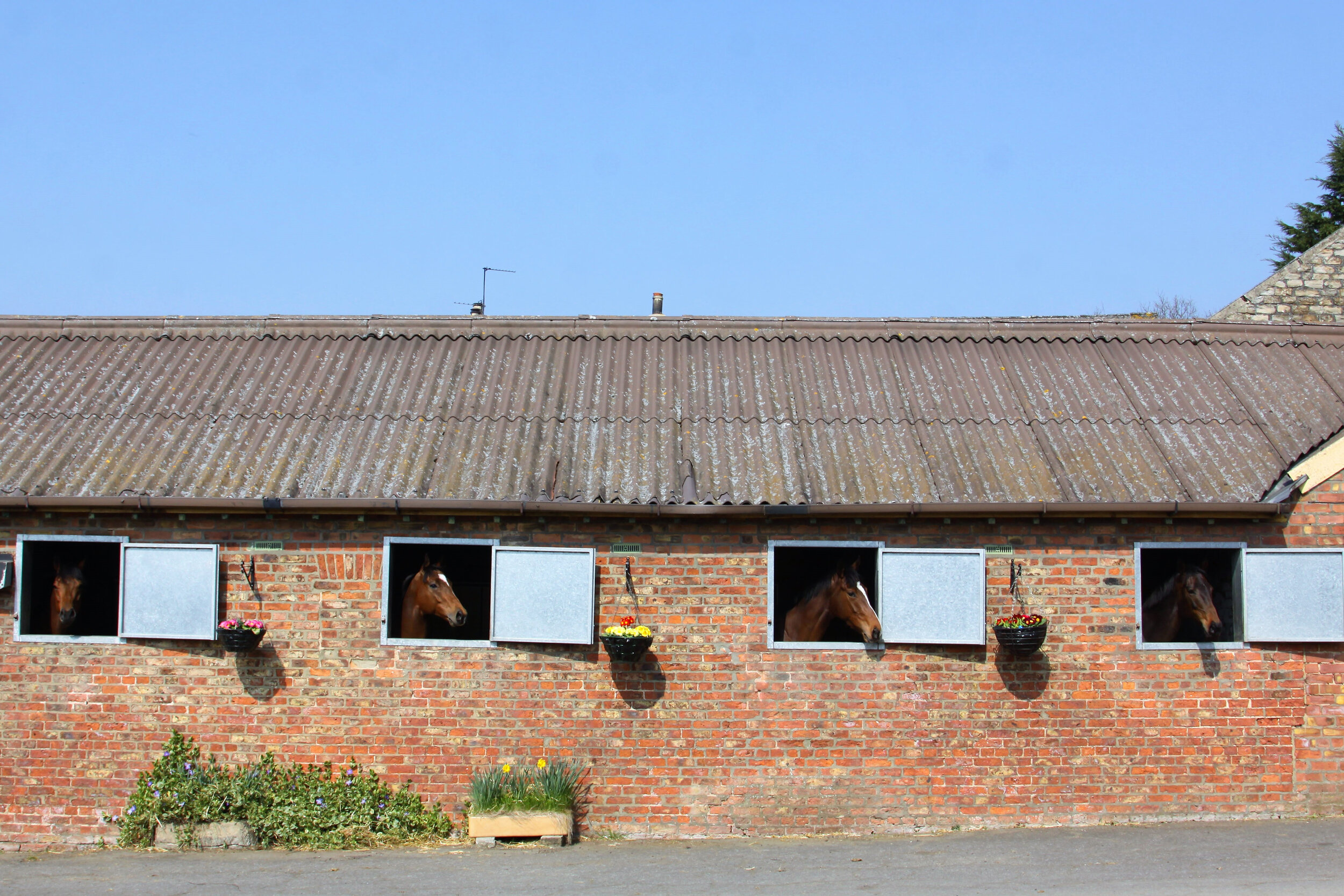
Over the past 20 years the Irish Equine Centre has become world leaders in the design and control of the racehorse stable environment. At present we monitor the stable environment of approximately 180 racing yards across Europe.
The basis of our work is to improve biosecurity and the general environment in relation to stable and exercise areas within racing establishments. This is achieved by improving ventilation, yard layout, exercise areas and disinfection routines, in addition to testing of feed, fodder and bedding for quality and reviewing how and where they are stored.

Racehorses can spend up to 23 hours per day standing in their stable. The equine respiratory system is built for transferring large volumes of air in and out of the lungs during exercise. Racehorses are elite athletes, and best performance can only be achieved with optimal health. Given the demanding life of the equine athlete, a high number of racehorses are at risk of several different respiratory concerns. The importance of respiratory health greatly increases in line with the racehorse’s stamina. Therefore, as the distance a racehorse is asked to race increases so does the importance of ventilation and fresh clean air.
Pathogenic fungi and bacteria, when present in large numbers, can greatly affect the respiratory system of a horse and therefore performance. Airborne dust and pathogens, which can be present in any harvested food, bedding, damp storage areas and stables, are one of the main causes of RAO (Recurrent Airway Obstruction), EIPH (Exercise Induced Pulmonary Haemorrhage, also known as bleeding), IAD (irritable airway disease) and immune suppression. All of which can greatly affect the performance of the racehorse. Yards, which are contaminated with a pathogen of this kind, will suffer from the direct respiratory effect but will also suffer from recurring bouts of secondary bacterial and viral infections due to the immune suppression. Until the pathogen is found and removed, achieving consistency of performance is very difficult. Stable ventilation plays a huge part in the removal of these airborne pathogens.
What is ventilation?
The objective of ventilation is to provide a constant supply of fresh air to the horse. Ventilation is achieved by simply providing sufficient openings in the stable/building so that fresh air can enter and stale air will exit.
Ventilation involves two simple processes:
Air exchange where stale air is replaced with fresh air.
Air distribution where fresh air is available throughout the stable.

Good stable ventilation provides both of these processes. One without the other does not provide adequate ventilation. For example, it is not good enough to let fresh air into the stable through an open door at one end of the building if that fresh air is not distributed throughout the stable and not allowed to exit again. With stable ventilation we want cold air to enter the stable, be tempered by the hot air present, and then replace that hot air by thermal buoyancy. As the hot air leaves the stable, we want it to take moisture, dust, heat, pathogens and ammonia out as shown in Figure 1.

FIGURE 2
It is important not to confuse ventilation with draft. We do not want cold air blowing directly at the horse who now has nowhere to shelter. Proper ventilation, is a combination of permanent and controllable ventilation. Permanent ventilation apart from the stable door should always be above the horse’s head. It is really important to have a ridge vent or cowl vent at the very highest point of the roof. Permanent ventilation should be a combination of air inlets above the horse’s head, which allows for intake of air no matter which direction the wind is coming from, coupled with an outlet in the highest point of the roof (shown in Figure 2). The ridge vent or cowl vent is an opening that allows warm and moist air, which accumulates near the roof peak to escape. The ridge opening is also a very effective mechanism for wind-driven air exchange since wind moves faster higher off the ground. The controllable ventilation such as the door, windows and louvers are at the horse height. With controllable ventilation you can open it up during hot spells or close it down during cold weather. The controllable ventilation should be practical and easy to operate as racing yards are very busy places with limited time.
Where did the design go wrong?
The yards we work in are a mixture of historic older yards, yards built in the mid to late 20th century and yards built in the early 21st century. The level of ventilation present was extremely varied in a lot of these yards prior to working with the Irish Equine Centre. Interestingly the majority of the yards built before World War I displayed extremely efficient ventilation systems. Some of the oldest yards in the Curragh and Newmarket are still, to this day, considered well ventilated.
In parts of mainland Europe including France the picture is very different. In general, the older yards in France are very poorly ventilated. The emphasis in the design of yards in parts of France appears to be more focused on keeping animals warm in the winter and cool during the summer. This is understandable as they do get colder winters and warmer summers in the Paris area, for example, when compared to the more temperate climate in Ireland and the UK. When these yards were built they didn’t have the quality of rugs available that we do now. Most of the yards in France are built in courtyard style with lofts above for storage and accommodation. When courtyard stables are poorly ventilated with no back or side wall air vents, you will always have the situation that the only boxes that get air exchange are the ones facing into the prevailing wind at that time. In this scenario, up to 60% of the yard may have no air exchange at all.
In the mid to late 20th century efficient ventilation design appears to have been overlooked completely. There appears to be no definitive reason for this phenomenon, with planning restrictions, site restrictions in towns like Newmarket and Chantilly, cheaper builds, or builders building to residential specifications all contributing to inadequate ventilation.
Barn and stable designers did not, and in a lot of cases still don’t, realize how much air exchange is needed for race horses. Many horse owners and architects of barns tend to follow residential housing patterns, placing more importance on aesthetics instead of what’s practical and healthy for the horse.
Many horses are being kept in suburban settings because their owners are unfamiliar with the benefits of ventilation on performance. Many of these horses spend long periods of time in their stalls, rather than in an open fresh-air environment that is conducive to maximum horse health. We measure stable ventilation in air changes per hour (ACH). This is calculated using the following simple equation:
Air changes per hour AC/H

N = 60 Q
Vol
N = ACH (Air change/hour)
Where: Q = Velocity flow rate (wind x opening areas in cfm)
Vol = Length x Width x Average roof height.
Minimum air change per hour in a well-ventilated box is 6AC/H. We often measure the ACH in poorly ventilated stables and barns with results as low as 1AC/H; an example of such a stable environment is shown in Figure 3. When this measurement is as low as 1AC/H we know that the ventilation is not adequate. There will be dust and grime build up, in addition to moisture build up resulting in increased growth of mould and bacteria, and there will be ammonia build up. The horse, who can be stabled for up to 23 hours of the day, now has no choice but to breathe in poor quality air. Some horses such as sprinters may tolerate this, but in general it will lead to multiple respiratory issues…


BUY IN PRINT OR DOWNLOAD
WHY NOT SUBSCRIBE?
DON'T MISS OUT AND SUBSCRIBE TO RECEIVE THE NEXT FOUR ISSUES!
Colic - effects of inflammation
By Dr Zofia Lisowski, Prof. Scott Pirie & Dr Neil Hudson
Overview of colic
Colic is a term used to describe the display of abdominal pain in the horse. It is the most common emergency in horses with four to ten out of every 100 horses likely to experience at least one episode of colic each year. It is also the single most common cause of equine mortality. In the US, one study showed that thoroughbreds were more likely to develop colic1 than other breeds. It is of great welfare concern to horse owners, and with the estimated costs associated with colic in the US exceeding $115 million dollars per year2 and the average cost of a horse undergoing colic surgery that requires a resection in the UK being £6437.803, it is also a significant economic issue for horse owners.
Horses with abdominal pain show a wide range of clinical signs, ranging from flank watching and pawing the ground in mild cases, to rolling and being unable to remain standing for any significant period of time in more severe cases. There are numerous (over 50) specific causes of colic. In general, colic occurs as a result of disruption to the normal function of the gastrointestinal tract. This may be attributable to mechanical causes such as an obstruction (constipation), distension (excess gas) or a volvulus (twisted gut). It may also have a functional cause, whereby the intestine doesn’t work as normal in the absence of an associated mechanical problem; for example, equine grass sickness is associated with a functional derangement of intestinal motility due to loss of nerves within the intestine.

Management of colic depends on the cause and can necessitate either a medical or surgical approach. Most horses with colic will either improve spontaneously or with simple medical treatment alone; however, a significant proportion may need more intensive medical treatment or surgery. Fortunately, due to improvements in surgical techniques and post-operative management, outcomes of colic surgery have improved over the past few decades with up to 85% of horses surviving to discharge. Crucially for the equine thoroughbred racehorse population, several studies focussed on racehorses that had undergone colic surgery and survived to discharge, reporting that 63-73% returned to racing. Furthermore, surgical treatment did not appear to negatively impact athletic performance. A similar finding was also seen in the general sport horse population.
Despite significant advancement in colic surgery per se, complications following surgery can have a significant impact on post-operative survival and return to athletic function. Common post-operative complications include:
Complications at the site of the incision (surgical wound)
Infection: Infections at the site of the surgical incision are relatively common. Antibiotics are usually administered before surgery and after surgery. Infections are not normally severe but can increase treatment costs. Horses that develop infections are at greater risk of developing an incisional hernia.
Hernia: Incisional hernias occur when the abdominal wall muscles fail to heal leaving a ‘gap’. Hernia size can vary from just a few centimetres, up to the full length of the incision. Most hernias will not require further treatment, but in more severe cases, further surgery may be required to repair the hernia.
Complications within the abdomen
Haemoperitoneum: A rare complication where there is blood within the abdomen from bleeding at the surgical site.
Anastomosis complications: The anastomosis site is where two opposing ends of intestine that have been opened are sutured back together again. It is important that at this site no leakage of intestinal contents occurs. Leakage or breakdown at this site can lead to peritonitis, which is inflammation or infection within the abdominal cavity and is a potentially life threatening complication.
Adhesions: Scar tissue can form within the abdomen following abdominal surgery. Occasionally this may cause further colic episodes
Further colic episodes
Further colic episodes can occur following surgery. These can occur days to months following discharge.
Endotoxaemia
In some rare cases, horses may develop sepsis in response to toxins released by damaged intestine
Diarrhoea
This is a rare complication. It can develop as a result of infections with C. difficile or Salmonella. As a consequence, some horses may need to be treated in isolation to ensure infection doesn’t spread to other horses or humans.
Post-operative ileus
Post-operative ileus is one of the potential post-operative complications which can lead to a significant increase in hospital stay duration, increased treatment costs and is also associated with reduced survival rates. Post-operative ileus is a condition that affects the muscle function in the intestinal wall. The intestine is a long tube-like structure that has a muscular wall throughout its entire length from the oesophagus to the anus. The function of this muscle is to contract in waves to mix and move food along the length of the intestinal tract, within which digestion occurs and nutrients are absorbed, terminating in the excretion of waste material as faeces. In post-operative ileus these contractions stop and thus intestinal contents are not moved throughout the intestinal tract. In most cases, it is transient and lasts for up to 48 hours following surgery; however, in some cases it can last longer. A build-up of fluid develops within the intestine as a result of the lack of propulsion. This stretches the intestines and stomach, resulting in pain and the horse’s inability to eat. Unlike humans, the horse is unable to vomit; consequently, this excess fluid must be removed from the stomach by other means, otherwise there is a risk of the stomach rupturing with fatal consequences. Post-operative ileus may occur in up to 60% of horses undergoing abdominal surgery and mortality rates as high as 86% have been reported. Horses in which the small intestine manipulated is extensively manipulated during surgery and those that require removal of segments of intestine are at higher risk. Despite the significant risk of post-operative ileus following colic surgery in horses, there is a lack of studies investigating the mechanisms underpinning this condition in horses; consequently, the precise cause of this condition in horses is not fully known.
What causes the intestine to stop functioning?
For many years it was thought that post-operative ileus occurred as a result of a dysfunction of the nerves that stimulate contraction of the muscles in the intestinal wall. This theory has now mostly been superseded by the concept that it primarily results from inflammation in the intestinal wall. Based on human and rodent studies, it has been shown that immune cells in the intestine (macrophages) play a key role in development of this condition. Macrophages are important cells found everywhere in the body, with the largest population being in the intestine. These cells become activated by the inevitable manipulation of the horses’ intestines during colic surgery, with subsequent initiation of a sequence of events which ultimately results in dysfunction of the muscle in the intestinal wall. We know macrophages are present within the wall of the horses’ intestine and that at the time of colic surgery there is an inflammatory response at this site. Although the significance of these findings in relation to post-operative ileus in the horse remains unknown, they provide sufficient justification for ongoing research focused on the inflammatory response in the intestine of horses during and immediately following colic surgery…


BUY THIS ISSUE IN PRINT OR DOWNLOAD
WHY NOT SUBSCRIBE?
DON'T MISS OUT AND SUBSCRIBE TO RECEIVE THE NEXT FOUR ISSUES!
How technology can quantify the impact saddles have on performance
By Dr. Russell Mackechnie-Guire
Thanks to advances in technology, it is getting easier for scientists to study horses in a training environment. This, combined with recent saddlery developments in other disciplines, is leading to significant progress in the design and fit of exercise saddles.
Back pain, muscle tension and atrophy are common issues in yards. Although there are many contributory factors, the saddle is often blamed as a potential cause. Unlike other equestrian sports, where the effect of tack and equipment on the horse has been investigated, until now there has been little evidence quantifying the influence of exercise saddles.
New era
The technological advances used in sport horse research are sparking a new era in racing, enhancing our understanding of the physiological and biomechanical demands on the horse, and helping improve longevity and welfare. For the trainer this translates into evidence-based knowledge that will result in marginal or, in some cases, major gains in terms of a horse’s ability to race and achieve results. Race research has always been problematic, not least due to the speed at which the horse travels. Studies have previously been carried out in gait laboratories on treadmills, but this is not representative of normal terrain or movement. Thanks to new measuring techniques, we can now study the horse in motion on the gallops. Evidence of this new era arises from a recent study published in the Journal of Equine Veterinary Science. It found areas of high pressures under commonly used exercise saddles which had a negative influence on back function, affecting the horse’s gallop and consequently performance.
The pressure’s on
Researchers used a combination of pressure mapping and gait analysis (see Technology in focus panel) to investigate three designs of commonly used exercise saddles: full tree, half tree and three-quarter tree. The aim was to identify pressure magnitude and distribution under each of the saddles then to establish whether the gait (gallop) was improved in a fourth saddle designed to remove these pressures.
Areas of high pressure were found in the region of the 10th-13th thoracic vertebrae (T10-T13). Contrary to popular belief, none of the race exercise saddles tested in this study produced peak pressure on or around the scapula. The pressures around T10-T13 at gallop in the half, three-quarter and full tree were in excess of those detected during jumping or dressage in sport horses. They were also higher than pressures reported to be associated with clinical signs of back pain. Therefore, it is widely accepted that high pressures caused by the saddle could be a contributory factor to back pain in horses in training.

Three most commonly used saddle-tree lengths, plus the new design (purple 40cm)

Half tree: High peak pressures in the region of T10-T14 were consistent with the end of the tree.
Three-quarter tree: Peak pressure was localised on one side of the back at a time, depending on the horse’s gallop lead.
Full tree: Peak pressure was further back and, although not high, gait analysis demonstrated a reduction in the extent to which the hindlimb comes under the horse, reducing the power in the stride.
New design: A more uniform pressure distribution, recording the lowest peak pressures at each location.
Lower pressure leads to longer strides
When looking at propulsion, there are two important measurements: the angle of the femur relative to the vertical and hip flexion. When pressures were reduced beneath the saddle, researchers saw an increased femur-to-vertical angle in the hindlimb and a smaller hip flexion angle (denoting the hip is more flexed).
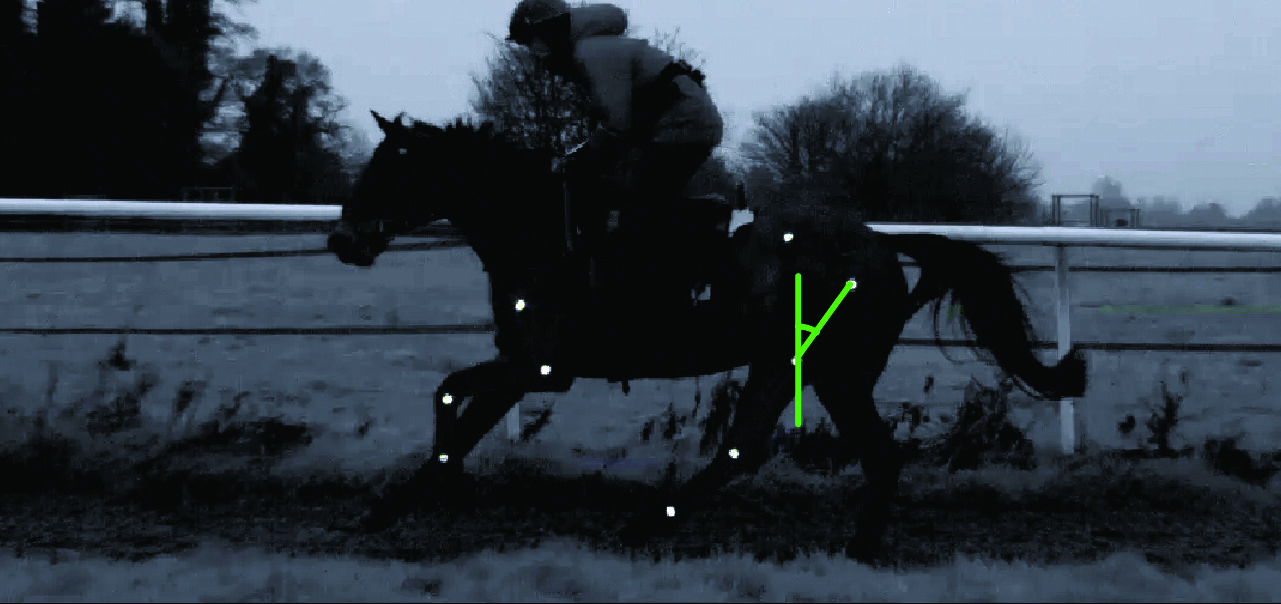
A greater femur-to-vertical angle indicates that the hindlimb is being brought forward more as the horse gallops.

A smaller hip flexion angle denotes the hip is more flexed, allowing the horse to bring his quarters further under him and generate increased power.

Improved hip flexion was recorded in the new saddle design (A) compared to a commonly used saddle (B).
When pressure is reduced in the region of T13, the hindlimb is allowed to come more horizontally under the horse at this point in the stride, leading to an increase in stride length. Researchers speculate that this could be due to the fact that the thorax is better able to flex when pressure is reduced.
Perhaps surprisingly, the study found that reducing saddle pressures did not result in any significant alteration in the forelimb at gallop. The major differences were recorded in hindlimb function. This could be explained anatomically; the forelimb is viewed as a passive strut during locomotion, whereas the hindlimbs are responsible for force production.
This is consistent with findings in the sport horse world, where extensive research investigating pressures in the region of the 10th-13th thoracic vertebrae has shown that reducing saddle pressure is associated with improved gait features in both dressage and jumping.
Speed matters…


BUY THIS ISSUE IN PRINT OR DOWNLOAD
WHY NOT SUBSCRIBE?
DON'T MISS OUT AND SUBSCRIBE TO RECEIVE THE NEXT FOUR ISSUES!
No guts, no glory!
By Catherine Rudenko
Can we increase the efficiency of the digestive system through dietary and supplementary manipulation in order to alter performance and recovery?
The idiom ‘no guts, no glory’, when taken in the literal sense, is quite an appropriate thought for the racehorse. The equine gut is a collection of organs, which when in a state of disease, causes a multitude of problems; and when functioning effectively, it is key for conversion of food to fuel and maintaining normal health.
In the same way we consider how fuel-efficient our car engines are, what power can be delivered and the influence of fuel quality on function, we can consider the horses’ digestive anatomy. The state of the ‘engine’ in the horse is critical to the output. What is fed or supplemented, and the manner in which we do so, has fascinating and somewhat frightening effects on efficiency and recovery.
We now, in a human context, have a much better understanding of the relationship between the gut and states of disease. Before disease in a notable sense is present, we see loss of function and reduction in performance. With equines, in recent years, the focus has fallen toward ulceration and the stomach. Now interest is growing into the small and large intestines, looking at factors that influence their performance and in turn how this affects performance on the track.

In order to consider how we can positively influence gut function, first we need to understand its design and capability, or lack of capability which is more often the problem. The horse, by definition, falls into the category of a large non ruminant herbivore—the same grouping as rhinoceroses, gorillas and elephants. The horse is well designed for a fibre-based diet, as reflected by the capacity of the large intestines, yet we must rely heavily on the small intestine when feeding racehorses. Health and function of both small and large intestines are important and are connected.
Small Intestine
The small intestine is a relatively short tube of approximately 25m in length—the same length as found in sheep or goats. The primary role of the small intestine is the digestion of protein, fats and carbohydrates. The workload of this organ is significant and is also time constrained, with feed typically moving at a rate of 30cm per minute (1). The rate of passage is highly influenced by whether the stomach was empty before feeding, or if forage has recently been consumed. The advice of feeding chaff with hard feed is in part to the slow rate of passage and give further time for the processes of digestion.
The mechanisms for digestion in the small intestine include pancreatic juices, bile and enzymes. Of particular interest are the various enzymes responsible for digestion of protein and carbohydrates— the key nutrients often considered when choosing a racing diet. The ability to digest carbohydrate, namely starch, is dependent on two factors: firstly, form of starch and the level of alpha-amylase—a starch-digesting enzyme found in the small intestine. Whilst the horse is quite effective in digestion of protein, there are distinct limitations around digestion of starch.
Starch digestion, or lack of digestion in the small intestine, is the area of interest. When feeding, the aim is to achieve maximum conversion of starch in the small intestine to simple sugars for absorption. This is beneficial in terms of providing a substrate readily available for use as an energy source and reducing the ill effects seen when undigested starch moves into the next section of the digestive tract. Alpha-amylase is found in very limited supply in the equine small intestine—the amount present being only approximately 5% of that found within a pig. Despite a low content, the horse can effectively digest certain cereal starches, namely oats, quite effectively without processing. However, other grains commonly used, (e.g., barley and maize [corn]), have poor digestibility unless processed. Flaked, pelleted or extruded cereals undergo a change in starch structure enabling the enzyme to operate more effectively.
Processing grains whilst improving digestion does not alter the amount of enzyme present in the individual. An upper limit exists on starch intake, after which the system is simply overloaded and the workload is beyond the capacity of the naturally present enzymes. The level is estimated at 2g starch per kilogram of bodyweight in each meal fed. In practice, this translates to 3.5kg (7 ¾ lbs) of a traditional grain-based diet of 28% starch. In bowls, this is roughly 2 bowls of cubes or 2 ¼ bowls of mix—an intake typical of an evening feed. The ‘safe limit’ as a concept is questionable because of other factors involved in starch digestion, including how quickly a horse will eat their feed, dental issues and individual variation in the level of alpha-amylase present.
In practice, feeding racehorses will invariably test the capacity of the small intestine as the volume of feed required to meet the demands of training is significant, and through time constraints of both horse and human results in a large-sized evening meal. The addition of amylase or other enzymes to the diet is therefore of interest. Addition of amylase is documented to increase digestion of maize (corn)—one of the most difficult grains to digest—from 47.3% to 57.5% in equines (2). Equally, wheat digestion has been evidenced to improve with a combination of beta-glucanase, alpha-amylase and xylanase in equines, increasing starch digestion from 95.1% to 99.3% (3).
Use of enzymes in the diet has two areas of benefit: increasing starch conversion and energy availability, and reducing the amount of undigested starch that reaches the hindgut. The efficacy of the small intestine directly impacts the health of the large intestine—both of which influence performance.

Large Intestine
The caecum and colon, of which there are four segments, form the group referred to as the hindgut. Their environment and function are entirely different to that of the small intestine. Here, digestion is all about bacterial fermentation of the fibrous structures found in forages and parts of grains and other feed materials. The time taken to digest foodstuffs is also significantly different to that of the small intestine, with an average retention time of 30 hours.
The end result of fermentation is the production of fatty acids, namely acetate, butyrate and propionate—the other by-product of fermentation being lactate. The level of fatty acids and lactate produced is dependent on the profile of bacteria found within the gut, which in turn react to the type of carbohydrate reaching the hindgut. There are markedly different profiles for horses receiving a mostly fibre-based diet compared to those with a high-grain intake.
The interaction between the microbial organisms and metabolism, which directly influences health and disease, is gaining greater understanding. By looking at the faecal metabolome, a set of small molecules that can be identified in faecal samples, and the categories of bacteria in the gut, it is possible to investigate the interaction between the individual horse, its diet and bacteria. Of course, the first challenge is to identify what is normal or rather what is typical of a healthy horse so that comparatives can be made. Such work in horses in training, actively racing at the time of the study, has been carried out in Newmarket.
Microbiome is a term used to describe microorganisms, including bacteria, that are found within a specific environment. In the case of the horses in training, their microbiome was described before and after a period of dietary intervention. The study evidences the effect on the hindgut of including an enzyme supplement, ERME (Enzyme Rich Malt Extract). The table below shows changes in nine bacterial groups before and after supplementation.
Along with changes in bacterial abundance, which were relatively small, came more significant changes within the metabolome. The small molecules found in the metabolome are primarily acids, alcohols and ketones. Of particular interest, and where statistical significance was found, were changes in acetic acid and propionic acid evidencing an effect on the digestive process.
Whilst production of fatty acids is desired and a natural outcome of fermentation, further work is needed to determine what is an optimum level of fatty acid production. This study of horses in training is an interesting insight into an area of growing interest.
Effects on Performance & Large Intestine Function…


BUY THIS ISSUE IN PRINT OR DOWNLOAD
WHY NOT SUBSCRIBE?
DON'T MISS OUT AND SUBSCRIBE TO RECEIVE THE NEXT FOUR ISSUES!
Conformation and Breeding Choices

By Judy Wardrope
A lot of factors go into the making of a good racehorse, but everything starts with the right genetic combinations; and when it comes to genetics, little is black and white. The best we can do is to increase our odds of producing or selecting a potential racehorse. Examining the functional aspects of the mare and then selecting a stallion that suits her is another tool in the breeding arsenal.
For this article we will use photos of four broodmares and analyze the mares’ conformational points with regard to performance as well as matings likely to result in good racehorses from each one. We will look at qualities we might want to cement and qualities we might hope to improve for their offspring. In addition, we will look at their produce records to see what has or has not worked in the past.
In order to provide a balance between consistency and randomness, only mares that were grey (the least common color at the sale) with three or more offspring that were likely to have had a chance to race (at least three years old) were selected. In other words, the mares were not hand-picked to prove any particular point.
All race and produce information was taken from the sales catalogue at the time the photos were taken (November 2018) and have not been updated.

Mare 1
Her lumbosacral gap (LS) (just in front of the high point of croup, and the equivalent of the horse’s transmission) is not ideal, but within athletic limits; however, it is an area one would hope to improve through stallion selection. One would want a stallion with proven athleticism and a history of siring good runners.
The rear triangle and stifle placement (just below sheath level if she were male) are those of a miler. A stallion with proven performance at between seven furlongs and a mile and an eighth would be preferable as it would be breeding like to like from a mechanical perspective rather than breeding a basketball star to a gymnast.
Her pillar of support emerges well in front of the withers for some lightness of the forehand but just behind the heel. One would look for a stallion with the bottom of the pillar emerging into the rear quarter of the hoof for improved soundness and longevity on the track. Her base of neck is well above her point of shoulder, adding additional lightness to the forehand, and she has ample room behind her elbow to maximise the range of motion of the forequarters. Although her humerus (elbow to point of shoulder) shows the length one would expect in order to match her rear stride, one would likely select a stallion with more rise from elbow to point of shoulder in order to add more lightness to the forehand.
Her sire was a champion sprinter as well as a successful sire, and her female family was that of stakes producers. She was a stakes-placed winner at six furlongs—a full-sister to a stakes winner at a mile as well as a half-sister to another stakes-winning miler. Her race career lasted from three to five.
She had four foals that met the criteria for selection; all by distance sires of the commercial variety. Two of her foals were unplaced and two were modest winners at the track. I strongly suspect that this mare’s produce record would have proven significantly better had she been bred to stallions that were sound milers or even sprinters.

Mare 2
Her LS placement, while not terrible, could use improvement; so one would seek a stallion that was stronger in this area and tended to pass on that trait.
The hindquarters are those of a sprinter, with the stifle protrusion being parallel to where the bottom of the sheath would be. It is the highest of all the mares used in this comparison, and therefore would suggest a sprinter stallion for mating.
Her forehand shows traits for lightness and soundness: pillar emerging well in front of the withers and into the rear quarter of the hoof, a high point of shoulder plus a high base of neck. She also exhibits freedom of the elbow. These traits one would want to duplicate when making a choice of stallions.
However, her length of humerus would dictate a longer stride of the forehand than that of the hindquarters. This means that the mare would compensate by dwelling in the air on the short (rear) side, which is why she hollows her back and has developed considerable muscle on the underside of her neck. One would hope to find a stallion that was well matched fore and aft in hopes he would even out the stride of the foal.
Her sire was a graded-stakes-placed winner and sire of stakes winners, but not a leading sire. Her dam produced eight winners and three stakes winners of restricted races, including this mare and her full sister.
She raced from three to five and had produced three foals that met the criteria for this article. One (by a classic-distance racehorse and leading sire) was a winner in Japan, one (by a stallion of distance lineage) was unplaced, and one (by a sprinter sire with only two starts) was a non-graded stakes-winner. In essence, her best foal was the one that was the product of a type-to-type mating for distance, despite the mare having been bred to commercial sires in the other two instances.
Mare 3 ….


BUY THIS ISSUE IN PRINT OR DOWNLOAD
WHY NOT SUBSCRIBE?
DON'T MISS OUT AND SUBSCRIBE TO RECEIVE THE NEXT FOUR ISSUES!
Antimicrobial resistance

By Jennifer Davis and Celia Marr

Using antimicrobials as effectively as possible helps to reduce their use overall. For septic arthritis, intravenous regional perfusion of antimicrobials can achieve very high concentrations within a specific limb. This involves placing a temporary tourniquet to reduce blood flow away from the area while the antimicrobial is injected into a nearby blood vessels. The technique is suitable for some but not all antimicrobial drugs.
Growing numbers of bacterial and viral infections are resistant to antimicrobial drugs, but no new classes of antibiotics have come on the market for more than 25 years. Antimicrobial-resistant bacteria cause at least 700,000 human deaths per year according to the World Health Organization (WHO). Equivalent figures for horses are not available, but where once equine vets would have very rarely encountered antimicrobial-resistant bacteria, in recent years this serious problem is a weekly, if not daily, challenge.
The WHO has for several years now, designated a World Antibiotic Awareness Week each November and joining this effort, British Equine Veterinary Association and its Equine Veterinary Journal put together a group of articles exploring this problem in horses.
How do bacterial populations develop resistance?
Certain types of bacteria are naturally resistant to specific antimicrobials and susceptible to others. Bacteria can develop resistance to antimicrobials in three ways: bacteria, viruses and other microbes, which can develop resistance through genetic mutations or by one species acquiring resistance from another. Widespread antibiotic use has made more bacteria resistant through evolutionary pressure—the “survival of the fittest” principle means that every time antimicrobials are used, susceptible microbes may be killed; but there is a chance that a resistant strain survives the exposure and continues to live and expand. The more antimicrobials are used, the more pressure there is for resistance to develop.
The veterinary field remains a relatively minor contributor to the development of antimicrobial resistance. However, the risk of antimicrobial-resistant determinants travelling between bacteria, animals and humans through the food chain, direct contact and environmental contamination has made the issue of judicious antimicrobial use in the veterinary field important for safeguarding human health. Putting that aside, it is also critical for equine vets, owners and trainers to recognise we need to take action now to limit the increase of antimicrobials directly relevant to horse health.
How does antimicrobial resistance impact horse health?

This mare’s problems began with colic; she underwent surgery to correct a colon torsion (twisted gut). When the gut wall is damaged, bacteria easily spread throughout the body. The mare developed an infection in her surgical incision and in her jugular veins, progressing eventually to uncontrollable infection—resistant to all available antimicrobials with infection of the heart and lungs.
The most significant threat to both human and equine populations is multidrug-resistant (MDR) pathogens, including methicillin-resistant Staphylococcus aureus (MRSA), extended-spectrum beta-lactamase (ESBL) producing Escherichia coli, MDR Klebsiella pneumoniae, Pseudomonas aeruginosa, Enterococcus faecium, and rising MDR strains of Salmonella spp. and Clostridium difficile. In an analysis of 12,695 antibiograms collected from horses in France between 2012-2016, the highest proportion (22.5%) of MDR isolates were S. aureus. Identification of ESBL E.coli strains that are resistant to all available antimicrobial classes has increased markedly in horses. In a sampling of healthy adult horses at 41 premises in France in 2015, 44% of the horses shed MDR E.coli, and 29% of premises shedding ESBL isolates were found in one third of the equestrian premises. Resistant E. coli strains are also being found in post-surgical patients with increasing frequency.

Rhodococcus equi is a major cause of illness in young foals. It leads to pneumonia and lung abscesses, which in this example have spread through the entire lung. Research from Kentucky shows that antimicrobial resistance is increasingly common in this bacterial species.
Of major concern to stud owners, antimicrobial-resistant strains of Rhodococcus equi have been identified in Kentucky in the last decade, and this bacteria can cause devastating pneumonia in foals. Foals that are affected by the resistant strains are unlikely to survive the illness. One of the leading authorities on R equi pneumonia, Dr Monica Venner has published several studies showing that foals can recover from small pulmonary abscesses just as quickly without antibiotics, and has pioneered an ‘identify and monitor’ approach rather than ‘identify and treat’. Venner encourages vets to use ultrasonography to quantify the infected areas within the lung and to use repeat scans, careful clinical monitoring and laboratory tests to monitor recovery. Antimicrobials are still used in foals, which are more severely affected, but this targeted approach helps minimise drug use.
What can we do to reduce the risk of antimicrobial resistance?

Faced with a coughing horse, trainers will often pressure their vet to administer antibiotics, hoping this will clear the problem up quickly. Many respiratory cases will recover without antibiotics, given rest and good ventilation.
The simple answer is stop using antimicrobials in most circumstances except where this is absolutely avoidable. In training yards, antimicrobials are being over-used for coughing horses. Many cases are due to viral infection, for which antibiotics will have little effect. There is also a tendency for trainers to reach for antibiotics rather than focusing on improving air quality and reducing exposure to dust. Many coughing horses will recover without antibiotics, given time. Although it has not yet been evaluated scientifically, adopting the ‘identify and monitor’ approach, which is very successful in younger foals, might well translate to horses in training in order to reduce overuse of antimicrobials.
Vets are also encouraged to choose antibiotics more carefully, using laboratory results to select the drug which will target specific bacteria most effectively. The World Health Organization has identified five classes of antimicrobials as being critically important, and therefore reserved, antimicrobials in human medicine. The critically important antimicrobials which are used in horses are the cephalosporins (e.g., ceftiofur) and quinolones (e.g., enrofloxacin), and the macrolides, which are mainly used in foals for Rhodococcal pneumonia. WHO and other policymakers and opinion leaders have been urging vets and animal owners to reduce their use of critically important antimicrobials for well over a decade now. Critically important antimicrobials should only be used where there is no alternative, where the disease being treated has serious consequences and where there is laboratory evidence to back up the selection. British Equine Veterinary Association has produced helpful guidelines and a toolkit, PROTECT-ME, to help equine vets achieve this.
How well are we addressing this problem?….


BUY THIS ISSUE IN PRINT OR DOWNLOAD
WHY NOT SUBSCRIBE?
DON'T MISS OUT AND SUBSCRIBE TO RECEIVE THE NEXT FOUR ISSUES!
Game face – can betting pools find a new market for European racing?

By Lissa Oliver
Where there is competition, there is gambling. Punters naturally take an interest in a sporting outcome and enjoy “putting their money where their mouth is” when it comes to having an opinion on the winner, but never more so than in horseracing. Rightly or wrongly, our industry seems to be inextricably interlinked with gambling and increasingly dependent on betting options. Can betting pools be turned to our advantage and bring in new fans?
A totalisator, or pari-mutuel system, is similar to a lottery in that all the stakes on a race are pooled with a deduction to cover costs and a contribution, where obligated, to racing. The remainder of the pool is divided by the number of winning units to provide a dividend.
On-course bookmakers are struggling to compete with online betting opportunities, and on-course pari-mutuels are no exception. The Irish Tote returned a year-on-year 33% decrease in 2018 to under €70m, due to falling international turnover. Yet a sliver of silver shines in the gloom for 2019, with first-half figures showing a 5.4% increase on-course.
Speaking to a government committee in November, HRI CEO Brian Kavanagh announced a strategic review of the Tote in Ireland, saying, “There is talk of a new gambling regulator being appointed and the taxation status of the Tote has been raised as an issue. The Tote is facing the same struggle as on-course bookmakers. We are in discussions with a number of parties with regard to the future of the Tote, and we will be bringing some strategic options to the board.”
It's interesting to note that in countries such as Ireland and Britain, where horseracing is managing to retain its popularity with the general public, the simple win-only bet is by far the most popular bet, suggesting punters are following form and looking outside our sport for more adventurous fun bets.
The most popular bet in Britain, Ireland, France, Germany, Spain and Switzerland is the win-only, in Greece the trifecta, multiples in The Netherlands, and in Denmark, Norway, Sweden and Russia, it’s the Jackpot that most captures public interest and investment. Understanding the market and what attracts customers is half the battle, but attracting new customers is the greatest challenge.

Cyril Linette
Cyril Linette is the CEO of the French PMU, the biggest betting pool in Europe and the third-largest in the world. Having turned the ailing fortunes of L’Équipe newspaper successfully around, he is now turning his attention to revitalising the PMU. Earlier in 2019, he outlined a new “operating roadmap” designed for corporate recovery and transformation strategy, reviving French racing for all stakeholders.
At a conference in April, Linette expressed confidence in PMU’s long-term prospects, despite declines across its portfolio in 2018—notably sports and poker betting down 2.3% to €9.7bn and horseracing down 2.6% to €8.8bn. This comes on the back of a 20% decrease in betting since 2011, when betting on horseracing has almost halved during that period.
In response to these declines, Linette has launched a €30m cost savings plan, sanctioning “strong actions” across PMU’s retail network, which currently generates 75% of corporate wagers. “If we do not find a solution, in five or 10 years the company puts the key under the door,” Linette warned starkly. As a result, the operator will no longer service the Brazilian horseracing market, ending its partnership with Rio de Janeiro’s Hipódromo da Gávea.
A key proposal is the revamping of the Quinté, which celebrated its 30th anniversary in 2019, removing all bonus rounds to make it “less reliant on chance.” Linette states his aim to simplify the Quinté: “The Quinté is a rather complicated game, not in its formula, but finding five horses is complicated. There are very simple bets where you just have to find the horse that will win, to attract a younger clientele. That is the big challenge in the years to come—to try to rejuvenate our clientele.”
Among other measures introduced is a new loyalty programme, to engage and reward regular French racing patrons.
“The PMU will place horseracing bettors back at the centre of its business, take good care of today's customers; because our PMU clients are important, they contribute to the social link, they contribute to the financing of the sector,” Linette vows.
This goes hand-in-hand with a nationwide campaign to improve the general public’s awareness of the sport and hopefully bring in a wider audience. “I do not know if the PMU is corny, but it's a world a little closed,” Linette acknowledges. "The younger generation is not going to naturally play PMU and does not always go to racetracks. There is a real value to our public image. The PMU is known but not sufficiently considered.”
Linette explains, “One thing is certain: diversification towards gambling is over. The PMU has had years of decay; we are no longer in the 1950s, 1960s or 1970s, during the glorious Thirty Years when we used to play the trifecta to buy our new clothes, caravans or something else. There was competition, so at one time the PMU went into lottery games, games of chance, and I think we were losing our soul a little.
“Basically, it's a life-size board game—you have to find the right combination, and the one who finds the right combination deserves to be rewarded, whether in very expert games like the Quinté or in games a little simpler like finding the horse that wins.
“I think we have two ranges of customers: the turfistes (400,000 people), which represent 80% of our turnover, and those who we could call the gamers (2 to 3 million people), which are more volatile. For the first, we must go back to fundamentals by erasing the maximum references to games of chance. Return to the DNA of horse betting, sagacity and gains. For the latter, we must work on image and innovation, so new types of bets to keep them or conquer them.” The message here is clear: stop trying to diversify and instead specialise for each group of particular clients.

Harald Dorum
The issue of attracting a fresh, new and younger audience is not just a problem for France. Paull Khan spoke with former CEO of the Norwegian Betting Operator Rikstoto, Harald Dorum, who stepped down earlier in 2019 to “allow a ‘new broom’ to attract a younger audience, with whom racing is struggling to communicate.” He remains President of the European Pari-Mutuel Association, however.
Dorum places much emphasis on the benefits of the pool betting model. Primary among these is the greater susceptibility to race-fixing of fixed odds bets and, especially, exchange models.
“The pari-mutuel operator is completely independent of the result of the race. If a punter places a large stake on an unexpected result, his winnings will be correspondingly lower. Moreover, bets on losers are not allowed,” he says and even claims, “In countries with the Tote model, there has been no case of fixed races for years.”
Despite this, pool betting has not been immune to a general trend in public opinion, which is hardening against gambling and focuses not only on its links to race or match-fixing but also on its use for money laundering, the growth of illegal betting and, perhaps most notably, on the social cost of gambling addiction.
“We have to modernise. We have to find a way of bringing a new and modern product to the market, while still taking care of the integrity of the sport. And fixed odds may be a part of that mix,” Dorum concedes.
He believes that the likelihood of public support will be increased if Tote has a real and clearly explained public mission, whereby some of its profits are directed to other causes, such as financial support of broader equestrian interests.
It is an oft-observed fact that there is no universal rule book for horseracing and the discrepancies in the interference rules significantly deter many punters. Dorum agrees that the recent progress in harmonising these rules under the so-called ‘Category 1 approach’—now uniform pretty much the world over save for North America—has “absolutely been good news.” Medication rules would be top of his list of the remaining rules to harmonise. Aside from harmonisation, Dorum believes that the sport’s rules must chime with the sensibilities of today’s population, in particular the need to limit the use of the whip to a broadly acceptable level.
Dorum concedes that progress towards a Global Bet, a single world-wide product available around the world and backed by strong marketing and branding has been very slow with neither the betting operators nor the racing authorities gripping the concept and taking ownership of it. But software developments promise an imminent technical solution, he believes. “Just like with a lottery, you have the chance for a life-changing win, but at the same time, you have a great experience.”
In his view, success in launching a Global Bet will require a joint effort between betting operators and Racing Authorities and this, in turn, will require a commitment in terms of time and policy prioritisation, from the global Racing Authorities, both for galloping and trotting races. And there is a general feeling that the key to this must be the support of the powerhouse that is the Hong Kong Jockey Club. For Dorum, it is political issues rather than technological or legal ones, that have hindered the Global Bet. For instance, he explains, a time of day must be agreed by all the parties, and a publicity programme then to surround it to give it the marketing reach.
Further, Dorum believes, “We need to increase our cooperation between Tote operators and find solutions and future products together.”
In this context, it has been reported that the PMU, Europe’s pre-eminent Tote operator, is considering its future within the EPMA. “I very much regret, if it will be the case, that the PMU will be leaving the EPMA in May and joining the World Lotteries Association. We and the WLA have a lot to learn from each other, and we have established a working group to determine how we might work and cooperate together.”


BUY THIS ISSUE IN PRINT OR DOWNLOAD
WHY NOT SUBSCRIBE?
DON'T MISS OUT AND SUBSCRIBE TO RECEIVE THE NEXT FOUR ISSUES!
Roarers - surgery for recurrent laryngeal neuropathy – impact and outcomes

By Safia Barakzai BVSc MSc DESTS Dipl.ECVS
Recurrent laryngeal neuropathy (RLN), more commonly known as ‘roaring’, ‘laryngeal paralysis’ and ‘laryngeal hemiplegia’ is a disorder affecting primarily the left recurrent laryngeal nerve in horses >15hh. This nerve supplies the muscles that open and close the left side of the larynx. The right recurrent laryngeal nerve is also now proven to be affected, but only very mildly, thus affected horses very rarely show signs of right-sided dysfunction.
Horses with RLN become unable to fully open (abduct) the left side of their larynx. During exercise they then make abnormal inspiratory noise due to collapse of both the vocal fold(s) and the left arytenoid cartilage (figure 1), and airflow to the lungs can become severely obstructed in advanced cases. There is a proven genetic component to RLN, but in many cases the disease progresses over months or years. The age at which clinical signs become apparent is highly variable. Foals can show endoscopic and pathologic evidence of RLN, but some horses do not develop clinical disease until >10 years old.
Treatment of RLN

Laryngoplasty (tie-back) being performed in standing sedated horses.
Traditionally, left-sided ventriculocordectomy (‘Hobday’/ventriculectomy plus vocal-cordectomy surgery) and laryngoplasty (‘tie-back’) surgeries have been used to treat the disorder, depending on which structures are collapsing and how severely. The intended use of the horse, the budget available and other concerns of the owner/trainer also come into play. New techniques of providing a new nerve supply (‘re-innervating’) to the affected muscle are now being trialled in clinical cases. Pacing the muscle with an implanted electronic device has also been attempted in research cases.
Ventriculocordectomy
Ventriculocordectomy is commonly now referred to as a ‘Hobday’ operation; however, the ‘Hobday’ actually only refers to removal of the blind ending sac that constitutes the laryngeal ventricle. Currently, surgeons tend to remove the vocal cord as well as the ventricle, because it is vocal cord collapse that creates the ‘whistling’ noise. It is a relatively straightforward surgery to perform with minimal risks and complications for the patient. In the last 15 years, there has been a shift to performing it in a minimally invasive way, using a diode laser under endoscopic guidance in the standing sedated horse rather than with the conventional method, via an open laryngotomy incision on the underside of the neck with the horse under a general anaesthetic. However, transendoscopic laser surgery is technically difficult with a very steep learning curve for the surgeon. All ventriculocordectomies are not equal (Fig. 2) and for both laser and ‘open surgery’ methods, incomplete resection of the fold can leave behind enough tissue to cause ongoing respiratory noise and/or airway obstruction after surgery.
Severity of disease can be reasonably estimated using endoscopy in the resting horse (grades 1-4), but the gold standard for assessing this disease is endoscopy during exercise, when the high negative pressure—generated when breathing—test the affected laryngeal muscle, which is trying its best to resist the ‘suction’ effect of inspiration.
During exercise, RLN is graded from A to D, depending on how much the left side of the larynx can open.
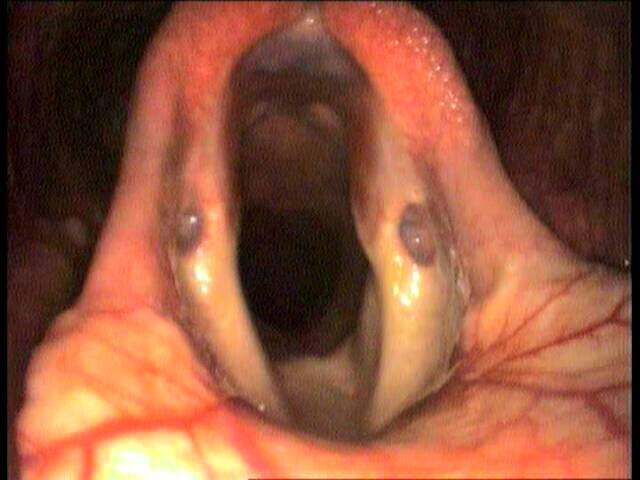
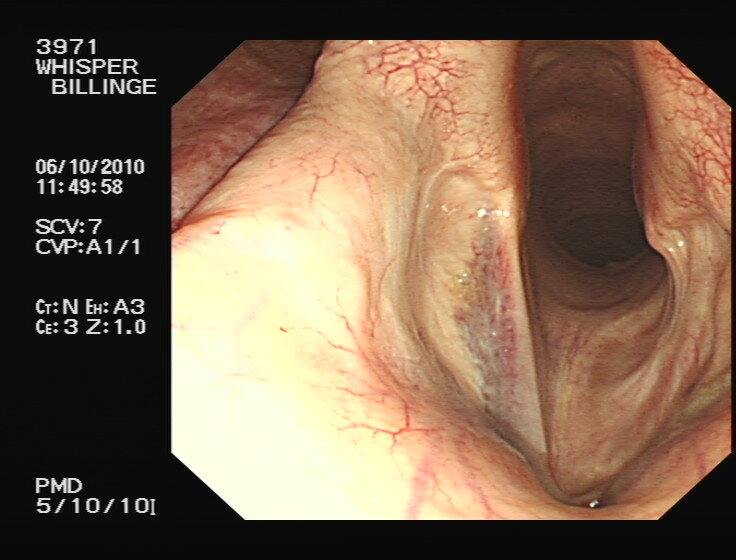
Figure 2: Two horses after ventriculocordectomy surgery. The horse on the left has an excellent left-sided ventriculocordectomy, with complete excision of the vocal fold tissue (black arrow). The right cord is intact, but the right ventricle has been removed (‘Hobday’). The horse on the right has bilaterally incomplete vocalcordectomies, with much of the vocal fold tissue left behind.
Sports horses, hunters and other non-racehorses were often previously recommended to have a ventriculocordectomy performed rather than a laryngoplasty, even if they had severe RLN. This decision was often made on the grounds of cost, but also due to fear of complications associated with laryngoplasty (‘tie-back’ surgery). A new study has shown that for horses with severe RLN, a unilateral ventriculocordectomy is actually extremely unlikely to eliminate abnormal noise in severely affected horses, because the left arytenoid cartilage continues to collapse.3 The authors recommended that laryngoplasty plus ventriculocordectomy is a better option than ventriculocordectomy alone for all grade C and D horses if resolution of abnormal respiratory noise and significant improvement of the cross sectional area of the larynx are the aims of surgery.
Advancements in laryngoplasty (‘tie-back’) surgery
Laryngoplasty is indeed one of the most difficult procedures that equine surgeons perform ….


BUY THIS ISSUE IN PRINT OR DOWNLOAD
WHY NOT SUBSCRIBE?
DON'T MISS OUT AND SUBSCRIBE TO RECEIVE THE NEXT FOUR ISSUES!
EMHF UPDATE - What’s been going on at The European Mediterranean Horseracing Federation - Dr Paull Khan reports on a busy end of year schedule

By Dr Paull Khan

WINDSOR AND CHELTENHAM: EMHF EXECUTIVE COUNCIL MEETING
Britain had never before hosted a meeting of the EMHF’s Executive Council. We try to move this annual event around, between as many member countries as possible, so as to further our education of the sport in our region and give the host country a chance to showcase its racing. We have had some memorable racing experiences to accompany our reunions in recent years, including the fearsome fences of Pardubice; the quirky charms of the Grand Steeplechase des Flandres; and the glorious ocean views of Jersey’s Les Landes racecourse. So the pressure was certainly on the British Horseracing Authority to provide an occasion befitting one of Europe’s major racing nations. They did not disappoint, although the British weather all but conspired to ruin the party. The Saturday of Cheltenham’s November Meeting always serves up some of the best jump racing outside the festival itself, and for several of our number, it was the first visit to jump racing’s beating heart. The management of Cheltenham were extraordinarily generous, receiving us all in its Royal Box.
The following day, it was time to do some business, and the spookily imposing Oakley Court Hotel in Windsor, on the banks of the River Thames, provided our base. For fans of the Rocky Horror Picture Show, this was Dr Frank N. Furter’s castle and was also a star of over 200 films including The Brides of Dracula and The Plague of the Zombies. A fitting venue, then, for our nine-strong Executive Council.
Our constitution dictates that representatives of France, Ireland and Great Britain, (as the three EuroMed countries with the largest-scale racing industries), have permanent seats on the ‘Executive Council’ (ExCo). In addition, at least one will always represent the Mediterranean countries, and another the non-European Union countries. This year, we re-elected our chairperson, Brian Kavanagh, also CEO of Horse Racing Ireland, who has held the role since the EMHF’s inception, in 2010. Omar Skalli, CEO of the racing authority of Morocco, was also re-elected as one of our three vice-chairs.
One of the seats on the ExCo of our parent body, the International Federation of Horseracing Authorities (IFHA), is reserved for the EMHF, to represent our ‘smaller’ racing nations. We agreed to repeat the nomination of Rudiger Schmanns, experienced racing director at Germany’s Direktorium.
Very sadly, we said farewell to both Austria and Libya. The continued political upheaval in Libya is well known to us all, and Austria’s thoroughbred racing activity has regrettably shrunk to such an extent that its Direktorium felt unable to continue as members. We hope very much that they will feel able to return one day.
On the positive side, there has been a flurry of interest in joining the EMHF, with Bulgaria, Romania and Russia all expressing an interest. A process of inspection precedes the accession of any new racing authority, and this will take place in these three countries over forthcoming months.
A key role of EMHF is to keep our members abreast of changes to the International Agreement on Breeding, Racing and Wagering (International Agreement). There have been more changes than ever this year, and the key ones were explained. We also discussed the prospects of more EuroMed countries being able, in future, to stage Black Type races.
We wanted to take advantage of being in Britain by arranging for presentations to be made covering some areas in which British racing has chosen to place more resources than have other racing authorities. One such are the efforts being made to increase the degree of diversity to be found within the sport. Rose Grissell, recently appointed as Head of Diversity and Inclusion in British Racing, described the work that she and the BHA’s Diversity in Racing Steering Group are engaged in. Tallulah Lewis then explained the role and aims of Women in Racing—the organisation of which she is the new chair. The second British ‘specialty’ we chose was the work done at the BHA on analysing betting patterns. Chris Watts, Head of Integrity at the BHA, presented on his team’s work identifying suspicious activity, thereby upholding the integrity of the racing and fending off race-fixing attempts.
ROME: INSPECTION VISIT, ITALIAN MINISTRY OF AGRICULTURE
Not many racing authorities have their headquarters in a palace. The governing body for horse racing in Italy is the country’s Ministry of Agriculture (MIPAAFT), whose offices are situated in the magnificent Palazzo dell'Agricoltura, a building replete with paintings, frescos adorning ceilings and walls, wrought-iron decorations and stained-glass windows. It also houses a world-renowned library of all things agricultural.
In January 2019, the European Pattern Committee (EPC) announced that, in view of various ongoing concerns relating to the administration of racing in Italy, not least MIPAAFT’s record of prize money payment, the country would no longer be a full member of the Committee, but would become an associate member and be subject to monitoring. That process has now begun, and this was the first of three planned visits which I shall make by way of an inspection programme, likely to conclude in the summer. The inspection is not restricted in its scope to race planning matters and is therefore being undertaken under the EMHF’s auspices. Additionally, it is evidence of the EPC working ‘with Italy to try to progress matters as quickly as possible such that Italy will hopefully become a full member of the EPC again in the near future’.
SOFIA: INSPECTION VISIT, BULGARIAN NATIONAL HORSE RACING ASSOCIATION….


BUY THIS ISSUE IN PRINT OR DOWNLOAD
WHY NOT SUBSCRIBE?
DON'T MISS OUT AND SUBSCRIBE TO RECEIVE THE NEXT FOUR ISSUES!
What is equine welfare? Asks Johnston Racing’s vet Neil Mechie

Neil Meche
The world of equine welfare—and animal welfare in general—is a proverbial can of worms. Decisions regarding equine welfare must be made on logical scientific evidence and not be biased by emotion or fear of incorrect perceptions in the media or public eye. As with many things in life, education is the key, especially in a world where large parts of the population have very little experience or knowledge of keeping or working with animals.
The welfare of animals is protected in national legislation in the UK. The Animal Welfare Act 2006 makes owners and keepers responsible for ensuring that the welfare needs of their animals are met. These include the need:
for a suitable environment (place to live)
for a suitable diet (food and water)
to exhibit normal behaviour patterns
to be housed with, or apart from, other animals (if applicable)
to be protected from pain, injury, suffering and disease
Reading these concise bullet points, one would think it quite simple to meet these needs, but issues arise when it comes to interpreting and putting this guidance into practice.
As an insight into how emotive language can change the interpretation of animal welfare requirements, below are the The Royal Society for the Prevention of Cruelty to Animals (RSPCA) “Five Freedoms,” which are not too dissimilar to the above but portrayed in a different light:
Freedom from hunger and thirst
Freedom from discomfort
Freedom from pain, injury or disease
Freedom to express normal behaviour
Freedom from fear and distress

The RSPCA is a charity champions animal welfare, and the use of words such as hunger, thirst, discomfort, fear and distress conjure up images of tortured animals wasting away in squalor. There is no need for this dramatic language when the preservation of welfare only actually requires common sense and compassion.
The same can be said when considering the welfare of horses, but sadly this is not the case. The biggest welfare issues facing the horse population are not, as the media would have you think, horses breaking their legs on racetracks or the travelling community mistreating horses at Appleby Fair. It is obesity and the mis-management of horses in the general population. Every day horses are being killed by a plethora of issues caused by over-feeding and poor management regimes. Laminitis, colic and numerous hormonal and metabolic diseases negatively affect the welfare of thousands of horses each year and are in a large part caused by the poor knowledge and horsemanship of their owners. It is now a large part of most equine vets’ job to educate horse owners on appropriate feeds and management regimes for their horses.
Racehorses, on the contrary, are looked after with the highest of standards as they are athletes competing at a high level.


BUY THIS ISSUE IN PRINT OR DOWNLOAD
WHY NOT SUBSCRIBE?
DON'T MISS OUT AND SUBSCRIBE TO RECEIVE THE NEXT FOUR ISSUES!
Are we going soft on our horses?
By Amy Barstow

Over the years there has been a steady move away from traditional concrete surfaces in yards towards surfaces that are generally considered softer, such as rubber. Furthermore, in some areas, the surfaces of the tracks which link yards with training facilities (horse walks) have also moved towards ‘softer’ surfaces. This has led some to wonder if our horses are missing out on a key opportunity to condition their musculoskeletal system. This article will explore what the scientific research tells us about how different surfaces affect the horse and what this might mean for musculoskeletal conditioning and injury resistance.
The majority of the research that has highlighted the links between surfaces and injuries is from epidemiology studies. These studies view large populations of horses and pull together lots of different factors to elucidate risk factors for injury. They, therefore, do not attempt to investigate why surfaces may be implicated as a risk. To understand the link between surface and injury risk, other types of research must be done including biomechanics studies, lab-based studies on bone and tendon samples and prospective experimental studies. Biomechanics studies explore how the horse, especially their limbs and feet, move on different surfaces and the forces and vibrations that they experience. Lab-based work investigates how musculoskeletal tissues respond to loading and vibrations at the cellular and extracellular level. Prospective experimental studies take a group of horses and expose them to different environments (e.g., conditioning on different surfaces). Then you compare the groups, for example, looking for signs of musculoskeletal injury using diagnostic imaging techniques. The research done using these different techniques can then be pieced together to help us decide how to better manage the health and performance of racehorses.
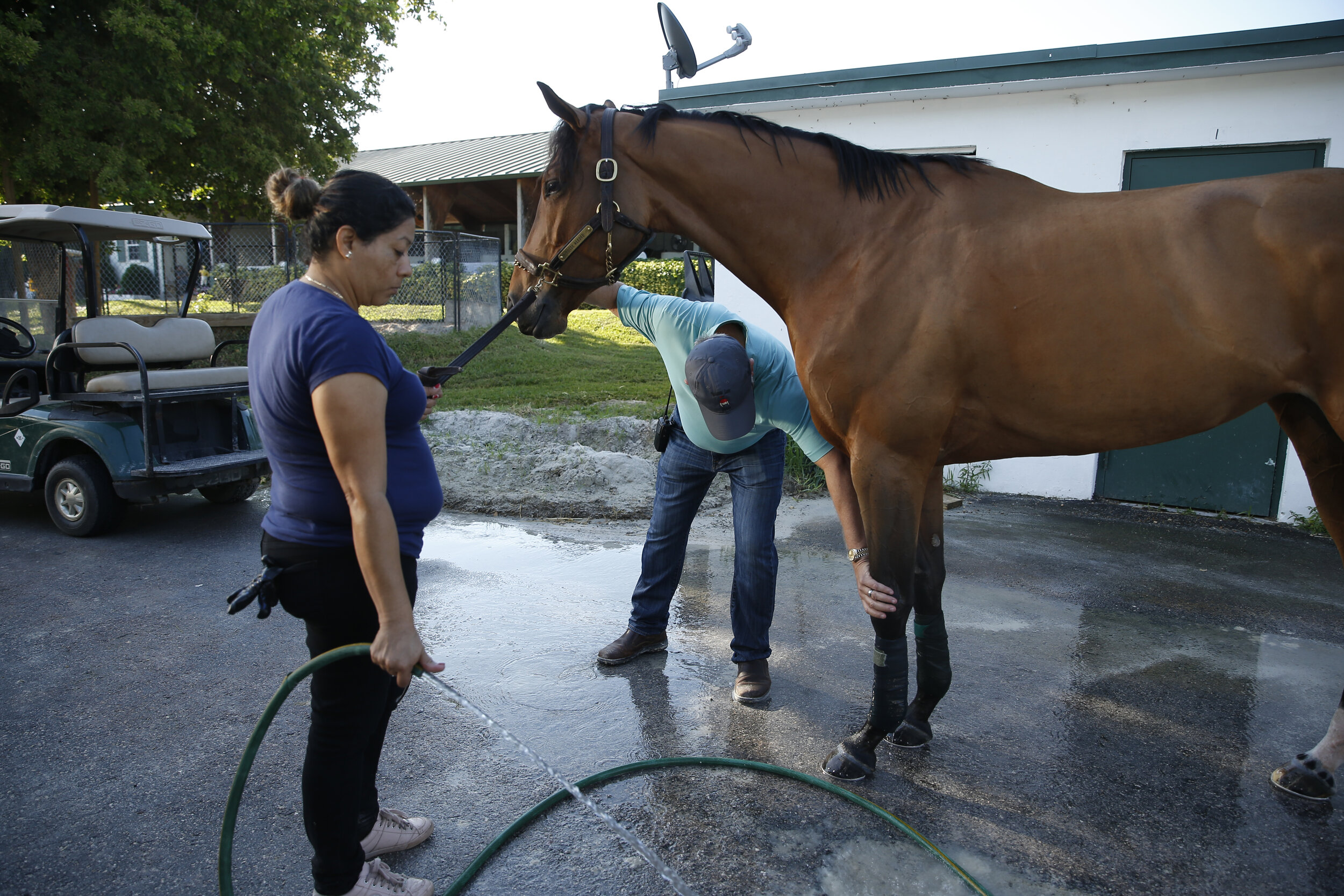
There is a wealth of epidemiological data to suggest that the surface type and condition during racing influences the occurrence of musculoskeletal injuries in the racehorse. Though it must be remembered that musculoskeletal injury is multifactorial with training regimens, race distance, the number of runners, horse age and sex all coming into play. Though there are comparably fewer data available relating to the effect of training surface type and properties on musculoskeletal injury rates, what is available also suggests that firmer surfaces increase the risk of sustaining an injury either during training or racing. For example, horses trained on a softer, wood fibre surface are less likely to suffer from dorsal metacarpal disease (bucked shins) than those trained on dirt tracks. However, horses trained on a traditional sand surface have been shown to be at a greater risk of injury (fracture) during racing. This could be due to the soft sand surface not stimulating sufficient skeletal loading to adequately condition the musculoskeletal system for the forces and loading experienced during racing. It could also be the result of horses racing on a surface with very different properties to those that they trained on.

So far the majority of the scientific research discussed relates to horses galloping and cantering, which are not the gaits that they will generally be using around the yard or getting to and from the gallops. There is very little work to link sub-maximal (low) speed exercise on different surfaces to injury in horses. In a small group of Harness (trotting) horses, those trained on a softer surface had a lower incidence of musculoskeletal pathology identified using diagnostic imaging techniques, compared to those trained on a firm surface. There is also evidence of the benefit of softer surfaces in livestock housing. Experimental work by Eric Radin in the 1980s found that sheep kept on a concrete floor compared to a softer dirt floor had more significant orthopaedic pathologies at postmortem. Furthermore, the use of rubber matting reduces the incidence of foot lameness in dairy cattle. So it would appear that a softer ground surface is beneficial even at sub-maximal intensity locomotion.
The epidemiological data discussed so far tells us that surface can play a role in injury, but it does not provide any answers for why that may be the case. From a veterinary and a scientific perspective, I am interested in how different surfaces influence limb vibration characteristics and loading in horses. …
TO READ MORE —
BUY THIS ISSUE IN PRINT OR DOWNLOAD
WHY NOT SUBSCRIBE?
DON'T MISS OUT AND SUBSCRIBE TO RECEIVE THE NEXT FOUR ISSUES!
Diversity and inclusion in European racing
By Dr Paull Khan
When France decided in 2016 to introduce a weight allowance for female riders, it set the racing world murmuring and shone a light on the issue of gender diversity among jockeys.
Jean-Pierre Columbu, vice-president of France Galop, explains: “My president, Edouard de Rothschild, who had introduced Lady Riders’ races about a decade earlier, still felt they were something of a ‘ghetto’, and wanted to do more to see females compete on equal terms”. The 2-kg (4.4lbs) allowance applied to both flat and jump races, but excluded Pattern races. Last year, the allowance was reduced on the flat to 1.5kg.
It was a bold step and one that has quickly produced some dramatic results. Within three years, female professional flat jockeys are getting three times the number of rides they used to, and their winners tally has risen by a staggering 340%. Despite the exclusion of the most lucrative races, the prize money won by horses ridden by females has also nearly trebled, from €4.1M to €12M. To Columbu, this increase in earnings among lady riders is crucial to the recruitment and retention of women. “In our Jockey School”, he notes, “65% are now female. And there are, of course, many, many females in our stables who must have the opportunity to earn money”.
Indeed, it could be said that that the allowance has achieved its objective. Female riders’ percentage of rides, which are winners, has improved from 7.14% to 9.08%—rapidly closing in on the male riders’ equivalent figure of 9.73%. So has the experiment run its course, and will the allowance soon be phased out? Columbu does not think so.
“The allowance is going to stay”, he concludes. “I used to be a surgeon. In males, 35% of body weight is made up of muscle. In women, that figure is 27%. That is why the allowance is needed”.
Of course, France is far from being alone in experiencing under-representation of women riders.
Other countries have been studying the French experiment with interest from afar. In Britain, flag-bearer Hayley Turner’s exploits are well-known. However, not all in the garden is rosy. Rose Grissell, recently appointed Head of Diversity and Inclusion for British Racing, notes: “Recent successes should be celebrated and promoted, but there is further to go. Fourteen percent of professional jockeys are female, but women receive just 8.2% of the rides and, in 2018, no woman rode in a flat Gp1 race. So, while the trends are in many ways encouraging, they do not apply across the board”.
These concerns are echoed by the organisation Women in Racing. Established in 2009, Women in Racing was formed to encourage senior appointments at Board level across the industry and to attract more women into the sport. That ambition remains, but today, according to its chair, Tallulah Lewis, there is more focus on strengthening career development for women at all levels. For Lewis, a prime concern is the attrition rate; in other words, the fact that the 14% figure for female riders that we have noted above occurs despite the ratio of new recruits entering into racing through the two racing schools in Britain, being as high as 70:30 in favour of females. Understanding their lack of progression is a key aim.
Grissell, indeed, intends to examine issues of recruitment, training and retention, looking to help either remove the barriers to lady riders’ success or to lend support. One tactic might be to challenge the perception of the innate inferiority of the female jockey. Grissell again: “A study by PhD student Vanessa Cashmore identified that punters undervalue women riders: a woman riding a horse at odds of 9/1 had the same chance of victory as a man riding one at 8/1”.
Such findings call into question the need for a gender-based riders’ allowance and, indeed, British lady riders themselves have voiced opposition to the concept.
The French experiment—and its undoubted success—presents a dilemma to those who seek better outcomes for women riders but who are convinced that they are equally effective as their male counterparts, given the opportunities.
“We applaud what the French have done in this experiment, as it gives us all more information than we had before”, says Lewis. “Our concern is that it is based on the premise that women are not men’s equal when it comes to race riding—something the evidence disproves”.
Belgium, which boasts the highest percentage of the countries polled, has crunched the numbers and decided against following the French example. Marcel de Bruyne, director of the Belgian Gallop Federation, explains:
“We have the same percentage of females—43% among our professional and amateur riders and, as they achieve approximately the same percentage of winning rides as the men, we do not envisage giving a weight allowance for females”.
(All of which suggests Belgium would make an interesting case study.)
Spain, by contrast, is due to have introduced a 1.5-kg allowance for females by the time this magazine is published. It would be surprising if other countries did not decide to follow suit, either by replicating the weight allowance or conjuring some other incentive for the female jockey. A prize money premium for connections who engage female riders would be one such option, which would have the benefit of leaving the actual terms of competition undistorted.
Of course, gender diversity is but one aspect of diversity in general. It is often the first to be tackled because of the (at least traditional) binary classification applying to the sexes, and the relative ease of data collection. But diversity and inclusion in ethnic or racial terms, in sexual orientation and identification, in physical ability, etc. are all key components when assessing the extent to which a sub-group reflects the wider society in which it sits.
The argument is now widely accepted that homogeneity stifles innovation and that, in addition to any altruistic motivation for advancing the cause of the under-represented, there is also an economic, self-interested imperative for organisations to do so. And there is every reason to suppose that this applies equally to racing. The benefits, in terms of staff recruitment and retention, for example, that would likely flow from well-managed diversity should be just as applicable to, say, a trainer’s yard as to any other commercial operation.
Talking of trainers, the table below shows the percentage of female professional licensed trainers by country, and as with the professional jockeys, again reveals a very wide variation.
What, if anything, is being done to address this disparity? Or indeed, manifestations of a lack of diversity among other groups within racing: administrators and racecourse executives, for example, or, looking more broadly, among those who attend races, or place bets on horseracing?
The short answer would appear to be: not a lot. The country which has done by far the most work in this space would appear to be Great Britain where, two years ago, the British Horseracing Authority established a Diversity in Racing Steering Group.
The story starts in 2017, when Women in Racing jointly commissioned and published a study by Oxford Brookes University, entitled ‘Women’s representation and diversity in the horseracing industry’. The report found evidence of ‘a lack of career development opportunities (at all levels including jockeys), progression and support, some examples of discriminative, prejudice and bullying behaviour, barriers and lack of representation at senior and board level, and negative experiences of work-life balance and pastoral care’.
TO READ MORE —
BUY THIS ISSUE IN PRINT OR DOWNLOAD
WHY NOT SUBSCRIBE?
DON'T MISS OUT AND SUBSCRIBE TO RECEIVE THE NEXT FOUR ISSUES!
Down Royal racecourse, tradition reborn
By Lissa Oliver
Down Royal racecourse in Northern Ireland boasts a heritage as regal as its name. They have been racing on the course since the early 18th century—the land originally donated by the first Marquess of Downshire, but its history goes back even further. In 1685, King James II issued a Royal Charter and formed the Down Royal Corporation of Horse Breeders. In 1750, King George II donated £100 to run the King’s Plate, a race still run today as one of the summer’s highlights, the 2800m Listed Her Majesty’s Plate. The Ulster Derby, now a premier handicap, is the most valuable Flat race hosted by the track, but Down Royal is best loved for the National Hunt Festival held at the start of November and headlined by the Champion Chase.
Inevitably, a rich history must also include challenges and threats and the racecourse has been no exception. As recently as last year the course faced the prospect of closure, its operators, Down Royal Corporation of Horse Breeders, signalling intent to cease operations in October. Fortunately, owners Merrion Property Group took over the running of the course from January of this year and it has been business as usual.

Emma Meehan CEO
With a bright new future and lofty ambitions, Manager Emma Meehan is charged with seeing those aims achieved, but the path ahead remains fraught with new challenges, not least the spectre of Brexit. Based in the UK, but under the authority of the Irish Horseracing Regulatory Board (IHRB), places Down Royal in a tricky position and the timing of the NH Festival opening on 1 November could bring unknown difficulties.
“The impact of any change in the current Tripartite Agreement could create initial difficulties”, Meehan recognises. “We remain in limbo regarding Brexit and continue to communicate with DAERA and the IHRB. We are ready to react to support the passage of runners and riders to our flagship festival on Friday 1 November and Saturday 2 November and beyond. The landscape is changing daily at British Parliamentary level; a general election could be on the cards very soon. Whatever the outcome, we will adapt to any new requirements and ensure we provide maximum assistance to our owners and trainers”.
Facing the unknown isn’t new territory to Meehan and she joined Down Royal at a particularly difficult time, following a successful 14 years as marketing manager at Dundalk Racing Stadium. “I found the transition in the early stages tumultuous to say the least”, she admits. “I likened it to trying to put a jigsaw puzzle back together again and I had to figure out where pieces were and, indeed, that some individuals were holding some of those pieces behind their backs. It was a challenging phase, but one that I grew from personally.
“Fast-forward to now; nine months on and I have a wonderful team and I couldn’t be happier.
The support I have received from Merrion Property Group and their progressive mind-frame has complimented my thinking at all levels. Merrion Property Group have a vision for Down Royal, with racing centric to that vision. We have a five-year investment strategy in the pipeline to bring the facilities, both for the social racegoers and racing fraternity, in line with a Grade 1 track, and modernising in tandem. I’m very excited about the changes afoot at Down Royal”.

In the modern landscape, investing in a racecourse doesn’t seem the best of ventures, particularly a ‘fixer-upper’ in property agent parlance, but Merrion Property Group bought the racecourse as far back as 2006 and saw the end of the lease with the Down Royal Corporation of Horse Breeders as an opportunity to run its own racing-centred business from the track.
“The overall site and infrastructure at Down Royal are huge. Continuous investment is fundamental to remaining competitive in the industry and providing a best in class environment for owners, trainers, bookmakers, punters and all the services and supports which go into racing”, Meehan explains.
“Our aim is to provide memorable and sociable experiences for groups, businesses and sports people, looking to bring together racing, good food and entertainment. Our investment compliments this objective”.
She sees the importance and influence of a community vital and central to the objectives of the new management. “It’s hugely important that the racecourse is the epicentre of the local community, and it’s our intention to embrace the community through several initiatives. Looking ahead to 2020, we are choosing local charities to collect at our gates, ensuring that the platform and the opportunity to raise monies is directed back to our charitable community partners. …
TO READ MORE —
BUY THIS ISSUE IN PRINT OR DOWNLOAD
WHY NOT SUBSCRIBE?
DON'T MISS OUT AND SUBSCRIBE TO RECEIVE THE NEXT FOUR ISSUES!
Planning a diagnostic-led worm control programme

Common horse worms
By Dr Corrine Austin (Austin Davis Biologics) and Prof Jacqui Matthews (Roslin Technologies)
Planning a diagnostic-led worm control programme
All horses are exposed to worms while grazing, but how we control these parasites is essential to horse health and performance. Most horse owners are aware of testing to determine whether their horse needs deworming. The tests comprise faecal worm egg counts (FEC) for redworm/roundworm detection and saliva testing to detect tapeworm infections (standard FEC methods are unreliable for tapeworm). Until now, encysted small redworm larvae have remained undetectable as FEC only determines the presence of egg laying adult worms. This has meant that routine winter moxidectin treatment has become recommended practice to target potentially life-threatening burdens of small redworm encysted larvae. Excitingly, a new small redworm blood test is being commercialised* which detects all stages of the small redworm life cycle, including the all-important encysted larval phase. Together, these tests offer a complete worm control programme for common horse worms using diagnostic information. This is known as ‘diagnostic-led worm control’ (see Figure 1 for common worms in horses). Essentially, testing is used to tell you whether your horse needs deworming or not.
Why should you use testing to determine whether you should use dewormers or not?
Gone are the days of routinely administering dewormers to every horse and hoping for the best. That strategy is outdated as it has caused widespread drug resistance in worms (i.e., worms are able to survive the killing effects of dewormers and remain in place after treatment, which can lead to disease and in worst cases, death). To reduce the risk of further resistance occurring, we need to ensure that dewormers are only used when they are genuinely needed—when testing detects that horses have a worm burden requiring treatment. Regular testing also helps identify horses likely to be more susceptible to infection and thus at risk of disease in the future.
How to plan your horse’s worm control programme ….
TO READ MORE —
BUY THIS ISSUE IN PRINT OR DOWNLOAD
WHY NOT SUBSCRIBE?
DON'T MISS OUT AND SUBSCRIBE TO RECEIVE THE NEXT FOUR ISSUES!
Trainer Profile: Cathrine Erichsen
By Amie Karlsson
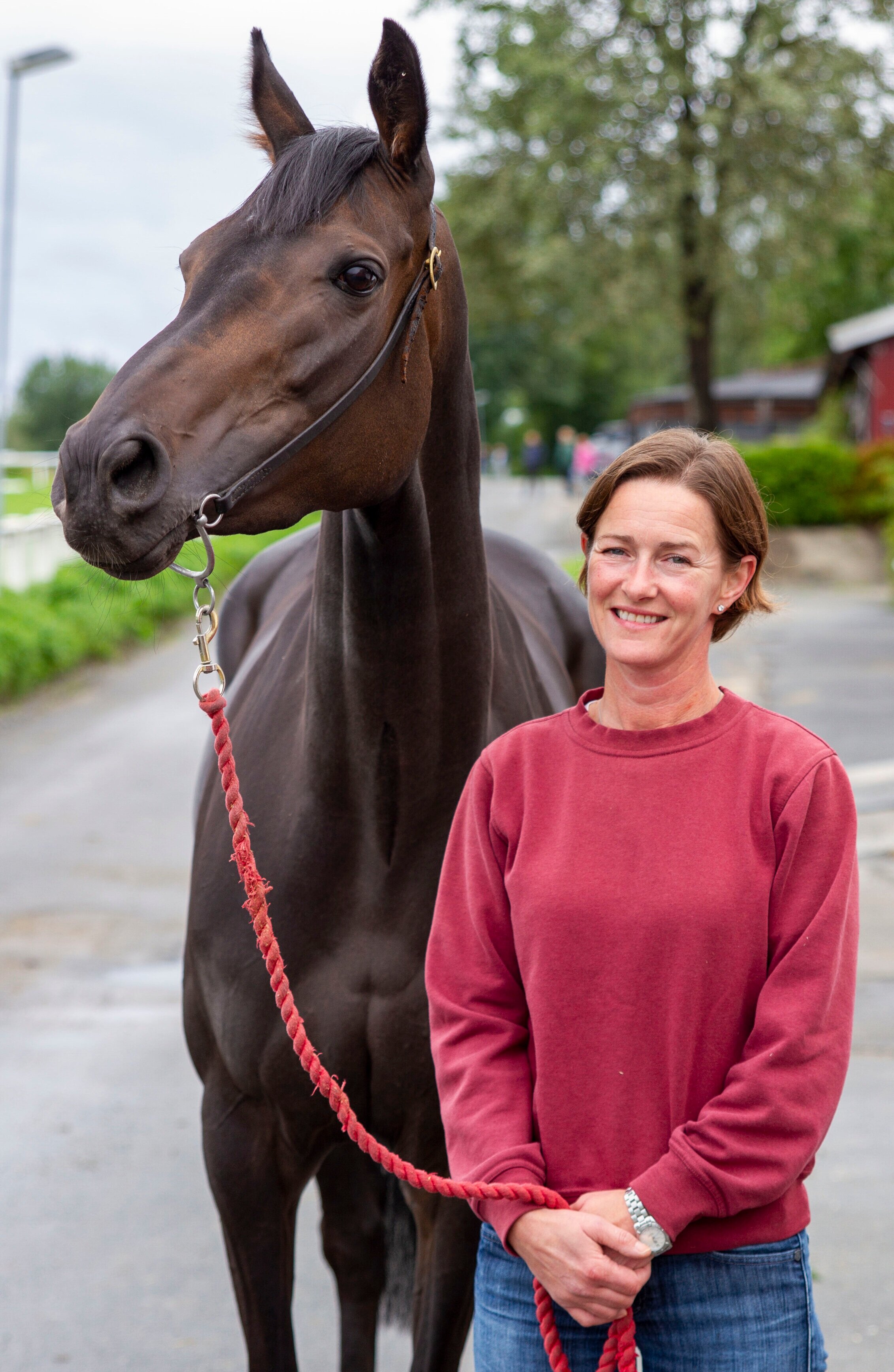
With 400 winners and plenty of pattern-race successes to her name, Cathrine Erichsen is the most successful female trainer ever in Norway.
This interview takes us to Oslo, or to be more precise, a 12-km drive northwest of the city center. Here, tucked away in a quiet residential area, we find Øvrevoll Galoppbane, the sole thoroughbred venue in Norway.
It is the end of August. Erichsen, an independent, charismatic woman with more than 400 winners under her belt, has just got back to routine again after the Norwegian Derby Weekend—the highlight of the Norwegian racing calendar a few days earlier.
Øvrevoll is where Erichsen participated in her first amateur race, saddled her first winner and enjoyed her first black type success. Today, it is where she cares for a string of almost 25 thoroughbreds. Erichsen is one of ten professional trainers at Øvrevoll—there are twenty in total in the country—and she has her base in one of the barns on the backstretch.
She has been training for half her life, but the last four years have been particularly fruitful. In the last three weeks of August, she had won two Gp3 races in Scandinavia with two different horses.
In the middle of summer, Øvrevoll is a beautiful place. Barns, outdoor boxes, lunge pits, paddocks and horse walkers are scattered around the backstretch and in the infield. It is charming and a little bit unpolished racing venue surrounded by mature trees, which provide green barriers between the racecourse and the adjacent villas.

Right now, November seems an eternity away, when freezing temperatures and just a few hours of daylight brings the racing season to a halt until the following April.
One would forgive a Norwegian racehorse trainer for complaining about the winters—even trainers living at latitudes far south of Norway tend to mutter and moan about the weather and training conditions of the winter months.
However, Erichsen’s view on training racehorses in Norway in the winter may come as a surprise.
She explains: “In my opinion, our strong winters is one of the particulars with training horses in Norway, but it is definitely one of the benefits. The cold gets rid of a lot of bacteria, and the snow is one of the best surfaces you can train horses on.”
“We use special shoes with studs which prevent the horses from slipping and snow rim pads that prevent snow packing into their feet. The track workers at Øvrevoll are great. They harrow the snow and make it into a nice training surface. It is smooth—and cold. What other surfaces are there that cool the horses’ legs whilst they train?”
Erichsen talks from experience. More than 35 winters have passed since she, for the first time, sat on a racehorse at the age of 12.
For a child growing up in Norway, horse racing may not be the first thing that springs to mind when given the opportunity to choose a hobby. But the young Cathrine liked horses, and a school friend happened to be the daughter of a racehorse trainer; and that is how Erichsen got acquainted with the racing industry.
It did not take long until her passion for horse racing was developed. When she turned 15 (the minimum age for race riding in Norway), she began a successful stint as an amateur rider.
“I was lucky to get the chance to ride in the Fegentri World Champion series for amateur riders. The race riding experience is a great benefit for me as a trainer, and I learnt a lot from riding in different countries.”
Despite the successful years as an amateur rider, Erichsen did not consider turning her hobby into a career. She had other plans in life and signed up for a degree in economics and marketing. For a while, her only connection to the racing industry was her riding horse, a retired racehorse.
“One day I needed to get hold of the farrier. I knew he would be shoeing in a stable at Øvrevoll that day, so I rang the trainer.”
The trainer answered, but before the phone was passed over to the farrier, Erichsen had found herself with a job.
“He asked if I wanted to come and ride out, and I thought ‘why not?’ I was studying and needed some money.”
What the economics student did not expect was that she, a year later, would have the sole responsibility for the stable.
“One day, after I had ridden out part-time for a year, the trainer told me that he had decided to retire from training. He offered me to take over his yard. At the time I was 25 years old and quite fed up with school, so I thought it could be a fun thing to do for a while.”

Erichsen with Gro Kittilsen and the mare Seaside Song (GB)
Being a trainer seemed quite easy, at least to start with. A stable full of race-fit horses, well-established routines, several loyal owners and an experienced employee who knew the stable inside out. Erichsen was off to a head start in the game of racehorse training.
“It was great. I didn’t have much experience, of course, but I got everything served: here is a barn, here are 14 horses, here is the girl who works for you. What I didn’t think about was that I soon would have to acquire new horses, recruit more owners and find new employees!”
Erichsen laughs when she recalls the beginning of her new career.
“When the employee some time later handed in her notice, it was certainly a cold shower for me. That wasn’t according to plan!”
There were times when the young Norwegian wished she had stayed far away from the racehorse business. …
TO READ MORE —
BUY THIS ISSUE IN PRINT OR DOWNLOAD
WHY NOT SUBSCRIBE?
DON'T MISS OUT AND SUBSCRIBE TO RECEIVE THE NEXT FOUR ISSUES!
Brexit remains the heaviest cloud on the horizon
By Lissa Oliver

This is now the third update on Brexit we have carried and we could easily reprint the first, from March 2018; so little has changed or moved forward. Alarmingly, the bleak 2018 predictions from those involved at the highest level have come to bear, yet Britain and the EU have appeared to turn a blind eye to the prospect of a no-deal Brexit until the last possible moment. While we look at the current views and contingency plans of individual countries most affected, it is clear that their problems are shared by all, and a common thread runs throughout.
EEA nationals and UK nationals
We all need to be aware of how Brexit will affect our freedom of movement and right to live and work throughout Europe and the UK. Any EEA national with five years continuous residence in the UK can apply for Permanent Residence to protect them from future legislative changes. Applicants must have been resident and in employment, or self-employment, for five years; and it is recommended to apply before the official date of Brexit.
There are strong indications that the current Common Travel Area of the UK and Ireland is likely to remain, to enable Irish nationals to move freely and work in the UK, but this remains unconfirmed; and it is recommended that Irish nationals living and working in the UK apply for Permanent Residence.
The EU has yet to decide how UK nationals living and working in the EEA will be treated. They may qualify for Permanent Residence in the applicable country and are advised to make an application prior to the UK’s withdrawal from Europe.
France

Edouard Philippe
The economy of the French equine sector is driven by horseracing, sports and leisure, work, and horse meat production. While the sports and recreation sector is responsible for the majority of horses (68%), horseracing has the largest economic impact and financial flow (90%), for only 18% of the horse population, and will be the most affected by Brexit.
The start of the year found France preparing for a disaster scenario, and the view hasn’t softened. Prime Minister Édouard Philippe has told press,
“The hypothesis of a Brexit without agreement is less and less improbable. Our responsibility is to ensure that our country is ready and to protect the interests of our fellow citizens.”
In January he initiated a no-deal Brexit plan prepared in April 2018. Philippe’s priority is to protect French expatriate employees and the British living in France in anticipation of the restoration of border control.
Fishing is considered the business sector most at risk, but Philippe has also looked to protect the thoroughbred industry with a €50m investment in ports and airports, where 700 customs officers, veterinary controllers and other state agents have been added—in the hope of avoiding administrative delays. He told press,
“It will be necessary that there are again controls in Calais.”
Dr Paul-Marie Gadot, France Galop, is also working to avoid delays at the border posts. "The political negotiation is still going on, as you know, and as long as it lasts we will not get agreement on the movement of horses. We have prepared for two years, with our Irish and English counterparts, a technical solution—the High Health Horse status—which would allow thoroughbreds and the horses of the Fédération Equestre Internationale to benefit from a lighter control.
“This organisational scheme was presented to the Irish, UK and French Ministries of Agriculture, and we received their support. It was also introduced to the International Office of Epizootics, which is WHO for animals, and it was very favourably received. We have presented it to the European Commission, but we are not getting a favourable answer at this time.
“In the absence of agreement, border control will be put in place. This means for the public authorities and the European Commission the implementation of ‘Border Inspection Posts’ with the ability to process movements. Our departments are very aware that this situation will be very difficult to manage without endangering the economic activity and the well-being of horses. We are working on palliative solutions, but I strongly fear that the situation is unmanageable.”
Gadot points out there are 25,000 horse movements per year between Ireland, the UK and France, and any hindering of these movements would be a blow to international racing and participation and to the breeding industry. Any challenge to the current freedom of movement could also threaten sales companies such as Arqana, where Irish and British-bred horses are catalogued, and Irish and British buyers are active.
Germany
The Haile Institute for Economic Research reveals that a hard Brexit will hit employment in Germany the hardest, with an estimated loss of 102,900 jobs; although that is just 0.24% of the country’s total employment figure. With its thoroughbred industry barely figuring in any economic impact, it is little wonder that Germany’s sport-related concerns focus on football. But the issues facing Britain’s Premiership are similar to racing’s problems and also heavily tied to Ireland.
Currently, as per EU law, Britain’s Premier League clubs are allowed to have as many EU players in a team as they wish, but a minimum of eight players in a 25-player team must be British. Elsewhere, Portugal limits non-EU players to just three per top flight team, with none allowed in the lower leagues. Italy also has restrictive rules on the purchase of non-EU players. If German football managers are concerned by the effect Brexit will have on the transfer market, how worried should British trainers be at the prospect of similarly curtailed recruitment?
And the concerns of German trainers? These are not being highlighted by the general press or by the government, but German racing and breeding are fairly self-contained and self-sufficient. How many British and Irish-bred horses are catalogued at the BBAG, however, and what percentage sell to Britain and Ireland? Ireland may still be in the EU, but its landbridge will not be come October.
At the 2019 BBAG Yearling Sale, five British-bred yearlings were catalogued and 18 Irish-bred—four of which were offered by an Irish agent. The top five lots at the 2018 sale were purchased by Godolphin, Peter and Ross Doyle Bloodstock and Meridian Bloodstock; and the sixth highest-priced yearling was foaled in the UK, as was the ninth in the listings. Fetching €110,000 and €100,000 further down the list were two Irish-foaled colts, both bought by German agents. The marketplace is cosmopolitan, and no market can afford to lose two supplier links or two buyer links.
Sweden
Swedish trade minister Ann Linde warns that a no-deal Brexit could have major implications for the country, which has a prosperous trading relationship with Britain. “The big companies have the possibility to analyse what is happening and prepare themselves, but there are too many small and medium-sized companies which have not fully prepared,” she points out. The Swedish National Board of Trade has sent out checklists to companies to work through to understand the consequences of a no-deal Brexit.
Linde is also concerned for the futures of 100,000 Swedes living in Britain and 30,000 Britons living in Sweden. Hans Dahlgren, the Secretary of State for Exiting the EU, fears it is unclear how the new British government will treat EU citizens who want to move to the UK for work after 31 October.
"The previous British government had made some openings for people coming to the UK after Brexit, and those statements have not yet been endorsed by the new government," he said.
TO READ MORE —