
Meet the stallion - Red Vine

Renowned Olympic gold medallist Bode Miller, a former skier, has a dream: to return the Mid-Atlantic horse industry to its former glory.
“Pennsylvania and Maryland were the powerhouses of the sport 150 years ago,” Miller explained. “People think breeding is a pipe dream, but I really believe in him.”
The “him” in question is Red Vine, Miller’s stallion standing at Barbara Rickline’s Xanthus Farm in Gettysburg. He has the tools to make it as a stud: pedigree, race record, and demeanor, and those connected with him are pleased with the early results.
Trained by Christophe Clement for Jon and Sarah Kelly, Red Vine earned $775,915 on the track, and although he never obtained a signature graded stakes victory, he knocked heads with some of the best of his generation and finished in the top three 19 times from 23 starts. He broke his maiden going a mile on the grass at Del Mar, won a turf allowance at Keeneland, and won twice on the dirt at Aqueduct before winning the Majestic Light Stakes, also on dirt, at Monmouth Park. Other notable performances for Red Vine were a behind Beholder at Del Mar in the Grade 1 TVG Pacific Classic; a second, by less than two lengths, in the Grade 2 Kelso Handicap at Belmont; a second in the Grade 3 Salvator Mile; and a third in a hotly contested Grade 1 Las Vegas Breeders’ Cup Dirt Mile at Keeneland, all in 2015. Red Vine wrapped up his stellar season that year by narrowly missing to Belmont Stakes winner Tonalist in the Grade 1 Cigar Mile.
Miller purchased Red Vine for $25,000 out of the 2017 Keeneland January Horses of All Ages Sale. It was the bay’s pedigree that intrigued him, as sire Candy Ride went unbeaten in six career starts and has developed into a tremendous sire. “We already know Candy Ride has great stuff,” Miller said, “and it’s been cool to see (2017 Horse of the Year) Gun Runner have great success.”
Red Vine is out of the winning Storm Creek mare Murky Waters, who has produced three winners from four starters to date. She is a half-sister to the El Prado sire Fort Prado, a multiple graded stakes winner of more than $1.2 million; and the stakes-winning Giant’s Causeway horse Cammack.
Miller himself has four broodmares, three of whom have visited Red Vine. “That’s the part of breeding that can sink the ship,” Miller said. “I’d be in bankruptcy if I tried to support him all by myself, but that’s the advantage of having lots of people becoming strong believers in him.”
Miller is also fond of homebred runners. “It’s exciting because I find homebreds inspirational,” he said. “It’s different when you’ve been a part of it the whole time watching the foals grow up and develop, versus buying a horse out of the sale.”
Red Vine’s first foals are on the ground this spring, and farm owner Rickline likes what she sees. “I’ve been very pleased. They are all well balanced, athletic, correct, and a good size. They all look nice from a variety of different kinds of mares.”
Red Vine will see between 65 and 70 mares in 2018, slightly up from his numbers in his first season. “He’s getting his mares in foal and everything has gone according to plan,” Rickline said. “We have no problems with him, because he’s real kind, easy to work with, and a fast learner.”
“Being an athlete,” Miller said, “I view horses as athletes. Red Vine’s style was so similar to that of Candy Ride. But he’s also got the intangible things that can make a stallion: attitude and personality. We’ve had good local support, and we appreciate the people that are taking a chance with him. I believe we have a really good shot to hit with Red Vine.”
Top 20 Pennsylvania Breeders of 2017
By Linda Dougherty

It was a record-setting year for Glenn E. Brok, who in 2017 collected the most Pennsylvania Breeding Fund awards in the program’s history.
Brok, who owns Diamond B Farm in Mohrsville with his wife Becky, saw his homebreds earn $374,651, while he garnered stallion awards of $75,191, for a total of $449,842. The top homebred for Brok was The Man, a son of Ecclesiastic, who formerly stood at Diamond B. He captured the Banjo Picker Sprint Stakes for Pennsylvania-breds at Parx Racing, as well as five consecutive allowance races for a perfect six-for-six season.
“The Pennsylvania breeding program has been really great for us,” Brok said. “And our program is stronger and better than other states.”
* Donald L. Brown Jr. was the second-leading breeder in Pennsylvania in 2017, with his combined breeder and stallion awards totaling $326,862. His top three award winners were all sired by the stallion Messner, who stood at Penn Ridge Farms in Harrisburg before being exported. These were Ruby Bleu ($42,127), Wildcat Cartridge ($42,806) and Wildcat Combat ($41,794).
“The Pennsylvania breeder awards give you the best opportunity to recover and possibly profit from the expenses of raising a horse,” said Brown. “Further, the awards are great for Pennsylvania agriculture! I would rather see a farm and green grass than a parking lot or strip mall.”
* It was sheer sire power for Northview-PA, as the Peach Bottom nursery owned by Richard Golden earned $321,053 in stallion awards. Dominating the Pennsylvania sire list in terms of stallion awards earned was Jump Start, whose progeny garnered $207,984. Other stallions who stand or stood at the farm were Fairbanks ($54,988), Medallist ($28,836), Love of Money ($21,298), El Padrino ($7,352), and Bullsbay ($366). Jump Start was the top sire in the Mid-Atlantic region in 2017, with total progeny earnings of more than $5.4 million. His top Pennsylvania-bred during the year was Late Breaking News, who earned more than $47,000 in awards for his breeder, Stacy McMullin Machiz.
* Thanks to a pair of stakes-winning half-sisters, the Barlar LLC stable of owner/breeder Larry Karp was the fourth-leading recipient of breeders awards in 2017. Karp’s homebreds earned $214,866 while he earned $58,431 in stallion awards from the progeny of E Dubai, for a total of $273,297. Imply, a daughter of E Dubai out of Allude, by Orientate, captured the Northern Fling Stakes at Presque Isle Downs, accruing $161,000 in breeder awards. Her younger half-sister Advert, by Lonhro, won the Malvern Rose Stakes at Presque Isle, earning $92,624 in breeder awards.
* A bevy of homebreds and a slew of stallion awards combined to boost William J. Solomon VMD, owner of Pin Oak Lane Farm in New Freedom, into fifth place of all Pennsylvania award winners last season. Solomon had 14 homebreds running at area racetracks and they earned $102,616 in breeder awards, with the top two earners being Invisible and Hygh Life. Stallion awards for horses that stand or stood at Pin Oak Lane were $162,981, for a total of $265,597, with his leading stallion being Offlee Wild ($35,159), followed by Albert the Great ($34,102).
* Thanks to the success of homebreds at Pennsylvania racetracks sired by her champion Smarty Jones, Patricia L. Chapman completed 2017 as the sixth-leading breeding fund award recipient. Chapman earned $162,409 in breeder awards and $94,120 in stallion awards, for a total of $256,529. Chapman’s top homebreds were Someday Jones, a multiple allowance winner and second in the Lyman Stakes at Parx Racing, and Mama Jones, who placed in the Plum Pretty Stakes and the Dr. Teresa Garofalo Memorial, both at Parx.
“I’m thrilled about my top award winners,” said Chapman. “The Pennsylvania Breeders Award program has been very good to me. I am especially happy that my top winners are homebreds, by a homebred, out of my homebred mares, and that both are trained by John Servis.”
TO READ MORE --
BUY THIS ISSUE IN PRINT OR DOWNLOAD -
August - October 2018, issue 49 (PRINT)
$5.95
August - October 2018, issue 49 (DOWNLOAD)
$3.99
Why not subscribe?
Don't miss out and subscribe to receive the next four issues!
Print & Online Subscription
$24.95
Social Media Horse Sense Part II: The industry in the digital age

By Peter J. Sacopulos
This is the second article in a two-part series on social media for Thoroughbred trainers. Part I appeared in the Winter 2017 issue. It examined social media usage and issues faced by trainers who wish to promote their business online. This installment focuses on broader issues facing the racing industry and how trainers can use social media to affect positive change and ensure the future of the sport.
In 1868, the publication of the The American Stud Book sparked the establishment and phenomenal growth of organized horseracing across the United States. America’s first racetrack had opened in colonial New York in 1665, and racing was popular in various areas of the country ever since, particularly the south. But the arrival of the first U.S. Thoroughbred registry was the game changer that transformed racing into a truly national sport.
This year marks the 150th anniversary of the American Stud Book’s debut, but do not expect much in the way of celebration. America’s Thoroughbred racing industry currently faces a slew of challenging issues, and the future of the sport is far from guaranteed. Another historic game changer would certainly be welcomed, but today’s problems will not likely be resolved with a single stroke. Odds are that positive, popularity-driving change will unfold via a variety of initiatives and approaches over time.
Since these efforts will take place in the digital age, the power of social media will play a vital role in their success or failure. Proponents of racing will seek to harness social media to succeed. Opponents of racing will do everything they can to use social media to foil such efforts. This dynamic has already been playing out online for years, and we may expect it to intensify in the years ahead.
As a trainer working to build a business and a reputation, you may feel that dealing with larger industry issues is someone else’s responsibility. After all, you have plenty on your plate, and the people addressing the industry’s problems are the experts on these matters, so they should be able to handle them.
Though this line of thinking is perfectly understandable, it is a mistake. Positive change and growth that assures a healthy future for the industry increases your opportunities and helps assure your future as a trainer. Your professional voice on social media matters, and adding it to the chorus promoting racing is a wise investment of your time and energy. However, before discussing ways social media may help combat industry issues, a review of the issues is in order.
Declining Popularity
For decades, the steady decline of Thoroughbred racing’s popularity has been a serious challenge facing the industry in the United States. It remains so today. Before you type a phrase such as “Popularity of horseracing in the U.S.” into your computer’s search engine, brace yourself for some very dispiriting results. You will be presented with a list of articles with titles including “Horse Racing Fading in Revenue, Popularity” (Newsweek, 2016), “American Horse Racing Isn’t Dead–But It’s Getting Awfully Close” (The Guardian, 2015), “Horse Racing Faces Decline in Popularity” (The Sport Digest, 2016) and “The Kentucky Derby and the Slow Death of Horse Racing” (The Atlantic, 2012).
American horseracing was tremendously popular in the years before World War II, when it was one of the country’s favorite sports, along with baseball and boxing. Its popularity declined after the war, but still remained high. A slowly stewing combination of factors began gnawing away at it in the 1950s and ‘60s. The appearance of three Triple Crown winners in the 1970s created a resurgence of public interest, but the renewed enthusiasm proved fleeting.
It would take a book to detail all the causes of racing’s fading popularity, but the rise of other sports and other forms of gambling and entertainment played crucial roles, as did suburbanization and repeated economic downturns. The fact that a surprisingly small number of “superstar” horses and riders have emerged over the last four decades further dampened public interest. A lack of cohesive marketing was also to blame. When racing failed to capture the imagination of the Baby Boom generation and those that followed, the industry appeared to do little to counter the loss of interest.
The Dark Side Of Racing.....
TO READ MORE --
BUY THIS ISSUE IN PRINT OR DOWNLOAD -
August - October 2018, issue 49 (PRINT)
$5.95
August - October 2018, issue 49 (DOWNLOAD)
$3.99
Why not subscribe?
Don't miss out and subscribe to receive the next four issues!
Print & Online Subscription
$24.95
Mike Machowsky: in profile

By Mary Dixon Reynolds
In Southern California, the San Gabriel Mountains serve as the backdrop to Santa Anita Park, the home of many top trainers, including Michael Machowsky Stables. Machowsky has been based on this circuit for 34 years, from the time he worked as assistant trainer and stable foreman for Richard Mandella for almost six years before he went out on his own.
Recently, Hall of Famer Mandella recalled Machowsky’s early days: “Mike was a young man when he worked for me. I was a younger man, too! He was a very devoted, hard-working young person who had nothing on his mind but racing horses. I have watched him grow through the years, he’s still that way and always puts his horses first. I’m in the Hall of Fame because of people like Mike
Machowsky and so many others. They have propelled me to where I am now,” Mandella said.
“Machowsky has a very good feel for horses, which is innate. He proves it year after year. It’s not something you can acquire. You have it or you don’t, and Machowsky has it!”
Although Mandella was speaking in serious tones, a sense of pride was evident in his words. Machowsky credits his mentor with teaching him patience, and Mandella deflected the compliment from himself by saying, “We all learn patience from the horses.”
Patience is not all that Machowsky took away from his time with Mandella. “I learned everything from him,” he said. “Detail, leaving no stone unturned on the horses -- those traits stayed with me. Mandella taught me it’s the little things that matter.”
The Sunday after Breeders’ Cup at Del Mar, Machowsky trainee Make It a Triple won a claiming race. Machowsky’s smile was as wide as any of the people representing owner Richard Barton in the winner’s circle. Afterwards, Machowsky celebrated his victory at the restaurant 14 Hands. The
5’ 11” trainer was sitting at a table, wearing a long-sleeved dress shirt, jeans, and the same smile from the winner’s circle. He stated, ”I always expect to win. We put everything into these horses: conditioning, proper diets, daily care. It’s my position to decide what type of race they should enter for a win. If things do not go right, I blame myself, as I should because I am with these Thoroughbreds every day and know them inside out.”
Machowsky took out his trainer’s license in 1989 and saddled his first winner, Bidadip, on New Year’s Day at Santa Anita in 1990. Almost two years later, on December 22, 1991, Native Boundary became his first stakes winner, while Dancing Rhythm, winner of the Grade 3 Senorita Stakes in 1998, was his first graded stakes winner. In 2009, he won the $900,000 Sunland Derby with Kelly Leak, over future Kentucky Derby winner Mine That Bird in fourth.
Born September 19, 1965, in Cincinnati, Ohio, Machowsky was two when his family moved to Southern California. He became interested in horses through his physician father’s ownership of Quarter Horses and, later, Thoroughbred racehorses. When the popular, nearly white colt Vigors -- winner of the 1978 Santa Anita Handicap -- caught Machowsky’s attention, he never looked back.
He knew he had found his calling and would be relentless in its pursuit. He began working as a hotwalker and mucked stalls for trainer Clay Brinson after school and on weekends. At 15, he traveled to Del Mar with Brinson and stayed in a motorhome across the street from the track. He worked as a groom for trainer Henry Moreno for two years before moving to Mandella’s barn.
TO READ MORE --
BUY THIS ISSUE IN PRINT OR DOWNLOAD -
August - October 2018, issue 49 (PRINT)
$5.95
August - October 2018, issue 49 (DOWNLOAD)
$3.99
Why not subscribe?
Don't miss out and subscribe to receive the next four issues!
Print & Online Subscription
$24.95
Rejuvenation and uncertainty in Maryland

By Linda Dougherty
One may be in its death throes. The other is getting a new lease on life. Pimlico Race Course and Laurel Park, Maryland’s two major racetracks, are a study in contrasts.
Laurel Park, located near the affluent suburbs of northern Virginia and bustling Washington, D.C., has received a considerable facelift in the last two years by its owner, the Stronach Group. It’s come with an eye towards hosting future major events, including the Breeders’ Cup World Championships, and possibly the Preakness Stakes, second jewel of racing’s Triple Crown.
While Laurel, which opened in 1911, has a long history, it is Pimlico, which opened in 1870 and is the nation’s second-oldest racetrack behind only Saratoga, that holds a special place in the annals of the sport. Pimlico not only hosts the Preakness, set this year for May 19, but has been the scene of such memorable events as the celebrated match race between Seabiscuit and War Admiral in 1938. And despite Pimlico being surrounded by a distressed Baltimore neighborhood, the Preakness is an economic boon to both the city and state.
But for more than a few years, as attention shifts to Baltimore soon after the dust settles from the Kentucky Derby, questions have arisen as to the future of Pimlico, which has often been described as decrepit, run down, and completely devoid of the charm that is associated with Churchill Downs, or the enormous wonder of Belmont Park.
Those questions have become more pointed recently with the reduction of live racing dates at Pimlico, the shift of those dates to Laurel Park, and the absence of any serious renovations to Pimlico by the Stronach Group.
The release last year of Phase 1 of a two-phase study of Pimlico by the Maryland Stadium Authority concluded that it will require an enormous amount of money for either extensive improvements or a complete rebuilding, and has many wondering how much longer the track will remain.
The Stronach Group has indicated it is not prepared to make a major investment in Pimlico for what amounts to just a dozen racing dates per year without financial help from the city and state. The company’s focus on improvements to Laurel Park are part of a plan to land the Breeders’ Cup World Championships, which it hopes to be awarded in the next few years after submitting a formal bid earlier this winter. If Laurel is successful in handling a large crowd with the attendant festivities, the Breeders’ Cup could be a precursor towards it being the new home of the Preakness Stakes, though it’s not expected to happen without a fight.
A Glorious Past, An Uncertain Future
The 90-page Phase 1 Stadium Authority study, published February 24, 2017, examined the current condition of Pimlico, its potential future use, and the estimated costs for renovation or rebuilding.
TO READ MORE --
BUY THIS ISSUE IN PRINT OR DOWNLOAD -
August - October 2018, issue 49 (PRINT)
$5.95
August - October 2018, issue 49 (DOWNLOAD)
$3.99
Why not subscribe?
Don't miss out and subscribe to receive the next four issues!
Print & Online Subscription
$24.95
Horseracing in South Korea: A Global Vision

By Alex Cairns
On the evening of January 19, 2017, something special happened in Dubai. To the casual spectator it might have seemed like any other horse race, but to viewers in the Republic of Korea, the 1200m District One Handicap at Meydan was a watershed moment in their nation’s sporting history. The winner of this race was Main Stay, a four-year-old colt trained by Kim Young Kwan and the first Korean-trained horse to win at a significant international meeting since Thoroughbred horse racing was established in South Korea almost 100 years ago. What is more, the winner carried the (KOR) suffix in the racecard, underlining the fact that the country is now capable of producing internationally competitive Thoroughbreds.
Yet as Main Stay crossed the line on that fateful night, even switched-on racing enthusiasts and professionals with a broad international perspective may have asked, “So they race in Korea?”
Indeed, this otherwise significant nation’s racing industry remains relatively unknown across the globe. Recent developments have brought Korean racing into the spotlight however, and notable domestic and international expansion projects put in place by the Korea Racing Authority (KRA) could soon see it established as an influential player on the global racing scene.
CONTEXT
In sporting terms, South Korea would most commonly be associated with taekwondo, baseball, soccer, or even figure skating. Yet horseracing is in fact the country’s second most popular spectator sport after baseball, with annual attendance of over 15 million. What is more, betting turnover stands at around $6.5 billion USD per annum, the seventh-highest in the world, meaning that horseracing in Korea already boasts figures that some of the most celebrated racing nations can only dream of.
Despite massive obstacles such as Japanese occupation (1910-1945), partition (1945), the Korean War (1950-53), and an ongoing state of tension with the North, horseracing in Korea has succeeded in following the same upward trajectory taken by Korean society as a whole through the second half of the 20th Century. Admittedly, it remains relatively underdeveloped compared to other jurisdictions in certain respects, such as horsemanship and welfare, but has come a long way in a short period and continues to develop at a rapid rate.
With formalized racing having first begun in Korea in 1922, it was only in the 1980s that races were limited to Thoroughbreds and subject to regulation of an international standard. Today, Korean racing runs like a well-oiled machine, with a highly developed administration harnessing advanced infrastructure so as to offer an attractive sporting product. There are serious challenges facing the sport in Korea, too, although difficulties overcome so far suggest that these in turn will be surmounted given time.
CURRENT STATE
Only flat racing takes place in the country and there are three racecourses: one in the Seoul suburb of Gwacheon, another in the southern city of Busan, and a final track based on the volcanic island of Jeju, some 50 miles to the southwest of the Korean peninsula. Racing takes place year-round, with regular fixtures at Seoul on Saturdays and Sundays, Busan on Fridays and Sundays, and Jeju on Fridays and Saturdays.
Races in Jeju are limited to an indigenous breed of pony. These stocky beasts may cause some amusement when urged to a full gallop by their seemingly over-sized riders, but pony racing in Jeju is no joke, with serious betting turnover registered and an important specialized breeding sector supporting the on-track action.
The Thoroughbreds race at Seoul and Busan and are stabled and trained at the tracks, which are both sand-based ovals. Horses are limited to racing at their home track, except when it comes to some of the season’s most significant races, and there is a healthy rivalry between the two cities’ racing people.
TO READ MORE --
BUY THIS ISSUE IN PRINT OR DOWNLOAD -
August - October 2018, issue 49 (PRINT)
$5.95
August - October 2018, issue 49 (DOWNLOAD)
$3.99
Why not subscribe?
Don't miss out and subscribe to receive the next four issues!
Print & Online Subscription
$24.95
The ongoing effort to minimize the rate and impact of fractures

By Professor Celia Marr
In Thoroughbred racing, musculoskeletal injury is a major safety concern and is the leading reason for days lost to training. Musculoskeletal injury is the greatest reason for horse turnover in racing stables, with financial implications for the owner and the racing industry. Injuries, particularly on race day, have an impact on public perception of racing.
Upper limb and pelvis fractures are less common than lower limb fractures, but they can lead to fatalities. Reducing the overall prevalence of fractures is critical and, at the very least, improving the rate of detection of fractures in their early stages so the horse can be withdrawn from racing with a recoverable injury will be a big step forwards in racehorse welfare. Currently, we lack information on the outcomes following fracture, and an article recently published in the Equine Veterinary Journal (EVJ) from the veterinary team at the Hong Kong Jockey Club (HKJC) addressed this important knowledge gap.
Hong Kong Fracture Outcome Study
The HKJC veterinary team is in a unique position to carry out this work because their centralized and computerized database of clinical records, together with racing and retirement records, allows them to document follow-up, which is all but impossible elsewhere in the world. Dr. Leah McGlinchey, working with vets in Hong Kong and researchers from the Royal Veterinary College in London, reviewed clinical records from 2003 to 2014 to identify racehorses that suffered a fracture or fractures to the bones of the upper limb or the pelvis during training or racing, confirmed by nuclear scintigraphy, radiography, ultrasonography, or autopsy.
During these 11 racing seasons there were an average of 1468 horses in training each year, amounting to 102,785 starts over 8147 races, with 11% on dirt tracks and the rest on turf. McGlinchey found records of 108 racehorses that sustained 129 upper limb or pelvic fractures during 119 injury events. The most commonly fractured bone was the humerus at 50%, followed by the tibia at 30%. Nine horses sustained fractures that led to their immediate demise, five involving the scapula and four involving the humerus.
The majority (65%) of fractures occurred in training. The overall incidence of upper limb and pelvic fractures in Hong Kong was three per 10,000 starts, and there were very similar incidences comparing both turf and dirt surfaces. The fatality rate due to upper limb and pelvic fracture was 0.8 per 10,000 starts. Over comparable time periods, race day upper limb and pelvic fracture rates were four per 10,000 starts in the UK, while race day fatalities were 1.8 per 10,000 starts in the UK and 1.9 per 10,000 in California; thus, rates of upper limb and pelvic fracture and fatality were lower in Hong Kong than in other racing jurisdictions. Differences in training and racing regimens, racehorse surveillance, and veterinary care will vary across these racing centers, leading to different risk profiles for horses racing in these different locations.

This CT image taken during an autopsy, shows a comminuted fracture with multiple bone fragments.
All horses presented with lameness but importantly, the lameness grade was not necessarily very high. Indeed, 6.7% of the horses were Grade 1 of 5 lame, and 30.3% were Grade 2 of 5 lame, highlighting how important it is to rest and investigate mild new lameness. Typically, stress fractures cause acute lameness following fast work that soon eases in severity, and incipient fracture of the upper limb and pelvis can present as mild lameness with a subtle onset, which is all too easy to overlook. The degree of lameness associated with stress fracture is typically greatest when the scapula is involved and progressively less severe with the tibia, humerus, or radius. The diagnosis is all too obvious once severe, complete fracture has occurred. In many cases, however, a diagnosis cannot be immediately made. Nuclear scintigraphy (also known as bone scanning) is the most sensitive method to detect stress fractures of the long bones and pelvis, although radiography and ultrasonography may also be useful.
Following fracture, all of the Hong Kong horses had a period of box rest followed by handwalking only. Three-quarters of these horses returned to racing a median of 169 days after sustaining the fracture; these made numerous starts, and 45 won. In total, 59 horses had retired from training, 23 of which retired without returning to racing and, in 13 of these cases, with retirement directly attributable to the upper limb fracture.
TO READ MORE --
BUY THIS ISSUE IN PRINT OR DOWNLOAD -
August - October 2018, issue 49 (PRINT)
$5.95
August - October 2018, issue 49 (DOWNLOAD)
$3.99
Why not subscribe?
Don't miss out and subscribe to receive the next four issues!
Print & Online Subscription
$24.95
Workers' comp insurance

By Denise Steffanus
Workers' compensation, like death and taxes, is a fact of life horsemen must accept. Owners and trainers are required to have workers' comp insurance to care for their injured employees. Even freelancers, such as some exercise riders and hotwalkers, need the security of knowing they will be taken care of if they are hurt on the job.
With medical and drug costs skyrocketing, premiums have soared to a level that makes it difficult for some trainers to stay in business. Geography also comes into play. Areas of the country where medical costs are the highest, such as New York, have the highest workers' comp premiums, while Kentucky is among the lowest. New York has the second-highest cost of living in the nation, and Kentucky has the second lowest.
Everyone seems to have skin in the game: underwriters, insurance brokers, state insurance departments, racetrack management, claims managers, owners, trainers, and injured horsemen. The issue is so complex that whoever you call to discuss workers' comp is likely to refer you to someone else for answers. At the end of the day, after several phone calls, you probably will be more confused than when you started.
The nuts and bolts of workers' comp
The most simplistic explanation of insurance is that the total amount of premiums collected by a plan must be adequate to pay all the claims filed against it. All employers in a workers' comp plan share the risks. The goal is for the plan to have an overall safety record so the fewest possible claims are paid out.
For a workers' comp plan to be fair and effective, trainers must report their employee rosters accurately and honestly, and all stables in the plan must operate in the safest manner possible to reduce claims. Insurance is a form of socialism, where everyone contributes to the premium pool but only a few reap those benefits when an adverse event happens. The more individuals who do NOT file a claim, the greater the safety rating for the plan, which results in a reduced risk and eventually lower premiums.
Before a company can offer insurance, it must have enough start-up assets (in money or collateral) to support anticipated claims until enough premiums come in to create a pool to pay claims. The insurance company invests a portion of those premiums to increase the plan's assets, and it may purchase insurance from a third party to protect itself against large, catastrophic claims.
Every occupation falls into a workers' compensation class code. Codes are rated based on risk, the number and severity of on-the-job injuries the class experiences. That rate determines the premium needed to insure that employee, based on demonstrated risk. Among racetrack occupations, exercise rider is the most dangerous, even more dangerous than jockey.
Trainer Rick Violette Jr., who served as the president of the New York Thoroughbred Horsemen's Association from 2008-2017, has been working on the workers' comp situation in New York since the 1990s. Violette explained that although jockeys take significant risks while performing a perilous job, statistics show that they are less likely than exercise riders to have accidents because they work in a more controlled environment—policed by outriders, followed by an ambulance, and all the horses travel in the same direction around the track. For an exercise rider, the environment can be chaotic.
"In the morning, there might be 100-150 horses on the racetrack," Violette said, "all with different experience, all going different speeds, going counterclockwise and clockwise on the racetrack, horses coming out of the gate. So when you look at that, it's pretty black-and-white how the morning exercise time is much more dangerous and fraught with injury than the afternoon."
Another problem for workers' comp coverage is that many exercise riders aren't employees of a particular stable, but rather get on horses for several trainers who pay them by the head, often in cash when they get off the horse. The extent of the trainer's knowledge about the rider might be only his (or her) first name and how well he handles a horse. If that exercise rider is injured, complications can arise when he seeks to file a claim and none of his trainers have him listed on their workers' comp policy.
TO READ MORE --
BUY THIS ISSUE IN PRINT OR DOWNLOAD -
August - October 2018, issue 49 (PRINT)
$5.95
August - October 2018, issue 49 (DOWNLOAD)
$3.99
Why not subscribe?
Don't miss out and subscribe to receive the next four issues!
Print & Online Subscription
$24.95
Standing in the wings - Assistant Trainers

By Ed Golden
The term “second banana” originated in the burlesque era, which enjoyed its heyday from the 1840s to the 1940s.
There was an extremely popular comedy skit where the main comic was given a banana after delivering the punch line to a particularly funny joke. The skit and joke were so widely known that the term “top banana” was coined to refer to anyone in the top position of an organization.
The term “second banana,” referring to someone at a pejorative plateau, had a similar origin from the same skit. There would have been no Martin without Lewis, no Abbott without Costello, and no Laurel without Hardy.
Racing has its own version of second bananas, only they’re not in it for the yuks. They’re called assistants, and it’s a serious business.
Most of the laughs come in the winner’s circle, and if not outright guffaws, there at least have been miles of smiles for Hall of Fame trainer Jerry Hollendorfer and assistant Dan Ward, who spent 22 years with the late Bobby Frankel before joining Hollendorfer in 2007.
While clandestinely harboring caring emotions in their souls, on the surface, Frankel did not suffer fools well, nor does Hollendorfer. A cynic has said Ward should have been eligible for combat pay during those tours.
But he endures, currently with one of the largest and most successful barns in the nation, with 50 head at Santa Anita alone. Hollendorfer hasn’t won more than 7,400 races being lucky. It is a labor of love through dedication and scrutinization to the nth degree, leaving little or nothing to chance.
A typical day for the 71-year-old Hollendorfer and the 59-year-old Ward would challenge the workload of executives at any major corporate level. Two-hour lunches and coffee breaks are not on their priority list.
“I get to the track before three in the morning,” Ward said, “because we starting jogging horses at 3:30. It takes about a half-hour until we get every horse outside, check their legs, jog them up and down the road, and if we see something that will change our routine--the horse doesn’t look like it’s jogging right or if it’s got a hot foot--we’ll adjust the schedule.
“We won’t send a horse to the track without seeing it jog. We’ll watch all the horses breeze, and if something unexpected happens that we have to deal with, we diagnose it and take care of it. Meanwhile, we’re also going over entries and the condition book, making travel arrangements and staying current on out-of-town stakes and nominations.
“Each time a new condition book comes out, I go over it with Jerry, we agree on which races to run in, and then go out and try and find riders.
“I’ll ask him what claiming price we should run a horse for, but with big stakes horses, the owners have the final say. Jerry and I usually agree on the overnight races, but in some big stakes, it might take more time deciding which horses run in what races. All this consumes most of the day, plus doing the time sheets and the payroll.”
It’s a full plate even with a shared workload, but Ward is considering flying solo should a favorable chance come his way.
“I’m hoping to go on my own,” he said. “Right now, I’m in a very good position, but if the right opportunity comes along, or if Jerry one day decides not to train anymore, I would be qualified to take over. In the future, however, I definitely hope to train on my own.”
Despite his workaholic demeanor, Ward has found time recently to enjoy a slice of life in the domestic domain.
“I was married for a year on March 6 and it’s been the best time,” he said. “My wife (Carol) already had two kids, and now they’re our kids, and it’s really great.”
Ward is a worldly man with diversity of thought, traits Hollendorfer sought when he brought him on board.
“In my barn, I often give the reins to my assistants,” Hollendorfer said. “I like them to make decisions, so when I hired Dan Ward I told him that I wasn’t looking for a ‘yes man’ but for somebody who would state his opinion, and if he felt strongly about it, to stand his ground.
“I make the final decisions, but I want a person who is not afraid to make decisions and lets me know what’s going on when I’m not there. There’s not a successful trainer I know of who doesn’t fully have good support back at his barn, and that’s where I’m coming from.
“It’s not only Dan who makes important contributions, it’s (assistants) John Chatlos at Los Alamitos and Juan Arriaga and (wife) Janet Hollendorfer in Northern California.
“Your supporting cast of assistant trainers has to be solid, too,” said Hollendorfer, who had a trio of three-year-olds hoping to prove they were Triple Crown worthy at press time: Choo Choo, a son of English Channel owned and bred by Calumet Farm; Lecomte winner Instilled Regard; and San Vicente winner Kanthaka.
“If horses are good enough to go (on the Triple Crown trail), you go,” Ward said. “If you miss it, you concentrate on a late-season campaign. It worked well for Shared Belief and Battle of Midway.” Shared Belief, champion two-year-old male of 2013, won 10 of 12 career starts but missed the 2014 Kentucky Derby due to an abscess in his right front foot. Given the necessary time off, he recovered and won the Pacific Classic later that year, and in 2015, the Santa Anita Handicap.
Battle of Midway outran his odds of 40-1 finishing third in the 2017 Kentucky Derby and won the Breeders’ Cup Dirt Mile last November.
Ron McAnally, in the homestretch of a Hall of Fame career that has reaped a treasure trove of icons led by two-time Horse of the Year John Henry, is down to a dozen runners at age 85, none poised to join Bayakoa, Paseana, Northern Spur, and Tight Spot on the trainer’s list of champions. As McAnally says, “I have outlived all my owners,” save for his wife, Deborah, and a handful of others.
Still, maiden or lowly claimer, Thoroughbreds deserve the best of care, which any dedicated trainer readily provides, cost be damned. His glorious past well behind him, trouper that he is, McAnally remains a regular at Santa Anita, although leaving all the heavy lifting to longtime assistant Dan Landers.
Landers was born in a racing trunk, to paraphrase an old show business lexicon. His late father, Dale, rode at Santa Anita the first day it opened, on Christmas Day 1934, and won the second race on a horse named Let Her Play. Landers still has a chart of the race.
“Even if I weren’t here for a few weeks, Dan would know what to do because he’s been with us a long time,” McAnally said. “Dan really works hard, and although he’s got three or four grooms, if they don’t perform their duties as they should, he finds someone else.
“That’s the type of guy he is. He wants things done perfectly--the barn is always clean--and that’s what you look for in an assistant, someone who can take your place when you’re not there, and he’s there.
TO READ MORE --
BUY THIS ISSUE IN PRINT OR DOWNLOAD -
August - October 2018, issue 49 (PRINT)
$5.95
August - October 2018, issue 49 (DOWNLOAD)
$3.99
Why not subscribe?
Don't miss out and subscribe to receive the next four issues!
Print & Online Subscription
$24.95
Equine Herpes Virus-1: An elusive target

By Neil Bryant
Infectious diseases are not uncommon in racehorses in training, breeding stock, and pleasure horses. Some of the more serious diseases can be financially devastating to the animal’s owners and to the equine industry on the whole. Viruses belonging to the herpesvirus family cause some of the most well characterized equine infectious diseases, and the most problematic of these is equine herpesvirus 1 (EHV-1; species Equid alphaherpesvirus 1).
EHV-1 is ubiquitous in most horse populations in the world. It is responsible for major economic and welfare problems causing respiratory disease, neurological disease (mainly seen in adult horses), and abortion and neonatal foal death in pregnant mares. This was most notably highlighted by the multiple abortion outbreak recorded in Hertfordshire, England, between February and April 2016 in fully vaccinated animals (http://www.aht.org.uk/cms-display/interim-report16-april2.html). Studies have determined that EHV-1 is a common cause of abortion. Occasional cases have also been linked to EHV-4 infection, but this is much rarer and doesn’t account for episodes of multiple abortion, as is seen occasionally with EHV-1.
The virus
EHV-1 was first isolated from an equine abortion in the U.S. in the 1930s. At the time of first isolation the vets weren’t sure what it was, but they knew it was infectious. Subsequent genetic analysis much later led to the classification of the virus in the genus Varicellovirus (family Herpesviridae), together with its close relatives equine herpesvirus 4 (EHV-4; species Equid alphaherpesvirus 4) and equine herpesvirus 8 (EHV-8; species Equid alphaherpesvirus 8). Interestingly it is grouped with, and is therefore genetically similar to, the human herpesvirus responsible for chickenpox, the Varicella Zoster virus. Initial infection of horses was thought to occur around weaning, when virus-neutralizing antibodies transferred to the foal from the mare’s colostrum had declined enough to make them susceptible to infection. However, virus has been isolated from foals as young as seven days old with high antibody levels but without any significant clinical signs. Immunity to re-infection after primary infection is relatively short-lived, lasting between three-six months, but it is rare for naturally infected mares to abort in consecutive pregnancies.
Disease processes
The virus first enters the horses’ body via the respiratory tract, usually by direct contact with infected animals, contaminated surfaces, or equipment such as tack or veterinary instruments. Direct contact with infected aborted fetuses or placental tissues is also a major source of virus, which experience indicates can cause serious problems if they occur in open barns or large groups of horses.
Once the cells in the respiratory tract are infected, the virus spreads cell-to-cell until it finds its way to the regional lymph nodes, where it can infect white blood cells called lymphocytes. These lymphocytes circulate through the body carrying the virus with them, which is known as a “cell associated viraemia.” The infected lymphocytes can come into contact with and infect numerous cell types, including cells known as “endothelial cells,” which line the inside of blood vessels of the central nervous system and the pregnant uterus. With EHV-1 infection, these endothelial cells undergo an inflammatory response which can lead to bleeding, cell death, and blood clot formation, which in narrow veins disrupts blood supply. This process results in subsequent tissue damage and serious complications such as placental separation (occasionally with delivery of a virus-negative fetus) and/or leakage of virus across the separating placenta (most frequently with delivery of a virus-positive fetus).
Similar mechanisms play a role in neurological disease, a condition called equine herpesvirus myeloencephalopathy or EHM. This condition is also sometimes referred to as an equine stroke, as it is caused by the cellular inflammatory response rather than direct virus infection of nerve cells, which occurs with some other herpesviruses. Less serious clinical signs of infection can include fever, lethargy, inappetence, enlarged lymph nodes, and profuse clear nasal discharge, although not all infected animals will display clinical signs. Recently published work from the Irish Equine Centre has identified EHV-8 as also being occasionally responsible for abortions in mares. Cases of EHV-8 abortion have also been detected retrospectively by the Animal Health Trust (AHT) among its pathology caseload, as this virus, which is genetically almost identical to EHV-1, triggers positive results in the EHV-1 tests. The frequency and clinical relevance of EHV-8 at this stage is unclear. Of 100 viruses presumed to be EHV-1 and whose genetic material were recently analyzed by the AHT, three were actually confirmed as EHV-8.
TO READ MORE --
BUY THIS ISSUE IN PRINT OR DOWNLOAD -
August - October 2018, issue 49 (PRINT)
$5.95
August - October 2018, issue 49 (DOWNLOAD)
$3.99
Why not subscribe?
Don't miss out and subscribe to receive the next four issues!
Print & Online Subscription
$24.95
Voodoo Song wins many races

By Bill Heller
Once upon a time, Thoroughbreds raced on little rest: on consecutive days, twice in three days, three times in eight days. Those days are long gone, but every now and then one Thoroughbred reminds us that it can be done; that while such quick-recovering horses may be an endangered species, they are not yet extinct. Of course, it only happens if a horse’s trainer believes that particular Thoroughbred can do so and can live with the result, positive or negative, for thinking outside the box.
Last summer at Saratoga, trainer Linda Rice sent out Barry Schwartz’s three-year-old colt Voodoo Song to compete in a mile-and-three-eighth New York-bred grass allowance four days after he won an open mile-and-a-sixteenth $40,000 claimer by 5¼ lengths gate-to-wire. Voodoo Song, who had been with Mike Hushion until the trainer’s retirement in July, opened a 16-length lead in that allowance and held on to win by three-quarters of a length.
“If you’re afraid to take chances or afraid to be wrong, you’re going to be paralyzed,” Rice said. “Some people are too afraid to make mistakes or be proven wrong. If it doesn’t work, it doesn’t work.”
Boy did it work with Voodoo Song. “The more latitude the owner gives you, the better,” she said. “Barry was fine with the direction we took. If the horse is doing well, run him.”
According to the Daily Racing Form, Voodoo Song’s victory made Rice seven-for-her-last-eight starts with a horse returning within seven days.
But Rice wasn’t done with Voodoo Song at Saratoga. With ample time to recover from the two races, Voodoo Song won another mile-and-a-sixteenth New York-bred allowance by one length four weeks later. Nine days after that, the colt made his stakes debut in the $300,000 Grade 3 Saranac, and he won again on the front end, by a neck over a field which included previously undefeated Bricks and Mortar. Those four victories in a single Saratoga meet, all under Jose Lezcano, matched Native Dancer’s four-race Saratoga spree in 1952 when the meet, now 40 days long, was just 24. All four of Native Dancer’s victories were in stakes.
To match the feat of four Saratoga wins is nothing short of amazing in 2017 because Thoroughbreds have never seemed more fragile.
According to The Jockey Club, average number of starts per Thoroughbred has plummeted from 11.5 in 1960 to 9.8 in 1975 when the diuretic Lasix and analgesic butazolidin first began showing up on backsides of racetracks. By 1990, the average number of starts was 9.0. It dropped to 6.8 in 2005 and 6.2 in 2016. Accordingly, average field size was 9.0 in 1960, 8.6 in 1975, 8.0 in 1990 and in 2005 and 7.6 in 2016.
Go further back in time and Thoroughbred racing was a different universe. Trainers raced and worked healthy horses constantly, even when they were two-year-olds. And they kept racing for years.
Imp (during the 1896 season), Princess Doreen (1923), and Zev (1924) ran on consecutive days. Imp finished first and third, Princess Doreen was first twice, and Zev won twice. Zev won his following start on one day’s rest, completing three victories in four days. Later in her career, Imp raced six times in 15 days, posting three wins, two seconds, and a fourth.
More famously, Maskette (1908) won her career debut in an allowance race against males and then the Spinaway Stakes two days later.
In 1918, a year before he became the first horse to win the races that later came to be recognized as the Triple Crown, Sir Barton began his career with a fifth, a ninth, another ninth on one day’s rest, and a seventh, all in stakes.
Man o’ War (1919) won two stakes in three days.
Seabiscuit began his career on January 19th, 1935, finishing fourth in an allowance race at Hialeah. Just three days later, he finished second in a $2,500 claimer. Did returning quickly affect his career? Not even close. Seabiscuit made three more starts with two days of rest and then raced on one day’s rest, finishing sixth in a stakes and third in an allowance race at Aqueduct Sept. 2nd and 4th. He went on to make 35 starts as a two-year-old, posting five wins, seven seconds, and five thirds. He would make 54 more starts and achieve stardom.
TO READ MORE --
BUY THIS ISSUE IN PRINT OR DOWNLOAD -
August - October 2018, issue 49 (PRINT)
$5.95
August - October 2018, issue 49 (DOWNLOAD)
$3.99
Why not subscribe?
Don't miss out and subscribe to receive the next four issues!
Print & Online Subscription
$24.95
Rodolphe Brisset - The Frenchman making his mark on American racing

By Jessie Oswald
The calendar will show that Rodolphe Brisset passed the one-year mark as a trainer on April 1st, but he’s quickly making a name for himself with the success of Grade 2 Lambholm South Tampa Bay Derby winner Quip. Owned by WinStar Farm, China Horse Club, and SF Racing, the win put the Distorted Humor colt on the list for consideration for the spring classics and gave his young trainer his first graded stakes win.
“Winning that race was very rewarding and emotional, but you have to make sure you keep your feet on the ground, enjoy it for a day or two and then regroup and try to get another one,” said the humble Brisset.
Delve deeper into his record over his first year as a trainer and it becomes apparent that come the first Saturday in May, Brisset will have plenty to cheer about should either Justify or Noble Indy get their nose down in front on the wire.
Brisset may be most recognized as a former assistant trainer for Hall of Famer Bill Mott, but the French native has been working with and riding horses for much of his 34 years. Growing up in the countryside of Tours, France, Brisset and his sister spent weekends at the family vacation home about 30 miles from his parents’ restaurant and down the road from a horse ranch. With no family connection to horses, it was at the ranch that Brisset picked up the horse-riding bug, beginning lessons at age five. He took naturally to riding and progressed quickly.
“I think I was born to be on the racehorse,” Brisset joked from his base at Keeneland Racecourse in Lexington, Kentucky. “It’s really something that feels very natural for me. I’m more comfortable on the horse than on my feet.”
As Brisset’s aptitude for horses grew, he competed in cross-country and dressage and was at the ranch most every day, even helping break their young horses. By age 10 he was riding in France’s popular pony races. At 12, representatives from the esteemed AFASEC School in Chantilly, France, approached the pre-teen after his win in a pony race that was sandwiched between races on Chantilly’s regular racing card. His future was set. Brisset enrolled in the school at age 14 and attended for two years before riding his first professional race as a jockey at age 16, the earliest he could be licensed. But with his body still growing, a career as a jockey would not last long.
“It was fun,” recalled Brisset. “But from 18 to 21, it was tough, between the weight and maybe I started to mature and realize that I was not very good as a jockey, I just started to think about something else.”
With his dreams of being a jockey coming to an end, Brisset looked for other opportunities in the industry. Though he couldn’t ride in the afternoon races, his nearly 20 years of experience riding and working with horses made him an excellent exercise rider and horseman. Recognized for his talents on and off the racetrack, Brisset was offered a job with one of France’s leading trainers, Alain de Royer-Dupré, where he learned how to make the transition from jockey to assistant trainer.
“It was a big change for me,” said Brisset. “He’s a very detail-oriented person. He’s the one that gave me that passion about getting your horse ready to the point that you get the best out of them for the start. I started to get on some of the horses that were difficult in the morning and we tried to fix them. The turn for me between being a jockey and trainer. I spent time with him and it really made me realize that this was something maybe I would be, an assistant trainer, and, maybe at some point, train.”
TO READ MORE --
BUY THIS ISSUE IN PRINT OR DOWNLOAD -
August - October 2018, issue 49 (PRINT)
$5.95
August - October 2018, issue 49 (DOWNLOAD)
$3.99
Why not subscribe?
Don't miss out and subscribe to receive the next four issues!
Print & Online Subscription
$24.95
Trainer of the Quarter - Brad Cox

By Bill Heller
The quote greeting visitors to the Brad Cox Racing website tells you all you need to know about the 38-year-old trainer on an unbelievable roll: “I think to be successful at this, you’ve got to be somewhat obsessed.”
How could he not be?
In the space of six days, Cox, who grew up in Louisville, Kentucky, five blocks from Churchill Downs, realized he has two live contenders for the Grade 1 Kentucky Oaks: Monomoy Girl, who gave Cox his first Grade 1 stakes victory when she won the Ashland Stakes by 5½ lengths at Keeneland on April 7th; and Sassy Sienna, who rallied to take the Grade 3 Fantasy Stakes by a nose at Oaklawn Park on April 13th. Monomoy Girl is now five-for-six, the lone miss a second by a neck in the Grade 2 Golden Rod Stakes last year. “When she hit the wire, it was like, ‘Wow!’” Cox said. “To get a Grade 1 is something I’ll never forget. She means a lot to us.”

Cox’s success isn’t surprising to trainer Dallas Stewart, Cox’s mentor for five years before he ventured on his own in 2004. “Brad is doing a great job,” Stewart said. “I’m very proud of him. He works hard. He’s doing what he should be doing. He’s knocking it out of the park.”
No lie there. In 2017, Cox posted career highs in victories and earnings for the fourth consecutive year, finishing eighth in wins (204) and ninth in earnings ($8.83 million) in North America. So far this year, he’s fifth in both categories. That’s quite a progression from winning just 52 races and $1.1 million in his first five years total.
Cox said he never wavered in his belief that he would be more successful during his lean years. “There’s no substitute for the hours you put in,” he said. “I kept telling myself, ‘You’re one of the younger guys doing it. You’ll get a break.’ I never even thought about doing something different. I made a commitment to myself: this is what I want to do. This is what I’m going to do. It’s a lot of work, but I do believe if you stay focused and do the right things every day, opportunity will knock. If you stay with it, you will get a chance.”
He has made the most of his chances. He credits the first two trainers he worked under, Burk Kessinger Jr. and Jimmy Baker, for teaching him “to take pride in horses, how to take care of a horse, and horsemanship.” He thanks Stewart, one of D. Wayne Lukas’ many assistants who have starred in their own careers, with “learning organization, how to run a large barn. It’s meant a lot to our program,” Cox said.
Cox’s stable has grown to 100 horses. They raced at Oaklawn Park and Keeneland this spring, and will race at Churchill Downs, Belmont, Saratoga, and in Indiana. “We’re very comfortable with where we are now,” he said.
And if succeeding requires a bit of obsession, so be it. “It’s something we talk about,” Cox said. “On a daily basis, you can work from the minute you wake up until the minute you go to bed. You can’t spend the time we do if you didn’t love it.”
Cox has loved it ever since his dad took him to Churchill Downs. “I was five or six years old,” Cox said. “I was intrigued.” He was intrigued enough to sneak into the track after school and dream: “I always dreamed of being big in the business. I’ve dreamed of having good horses for a while.”
He has them now. The up-and-comer has just about reached the head of the class.
BUY THIS ISSUE IN PRINT OR DOWNLOAD -
Why not subscribe?
Don't miss out and subscribe to receive the next four issues!
Print & Online Subscription
$24.95
Alan Balch - "You never know..."

“You never know how much you can do until you try to undo what you just did.”
So proclaimed my old riding teacher, one of the world’s greatest horsemen. Constantly. He was talking about teaching and training horses, of course, but the same wisdom applies to business, all business, and in our case, the plight of racing today in America, especially California.
We have made so many mistakes, and taken so many wrong turns; that we seem to continue to do so is of constant wonder to me. And I include myself in the “we,” since I was part of track management for so long, and for the last eight years have been leading the staff of California’s trainers’ organization. I’ve had an up-close chance to see what’s been happening since 1971, in one role or another.
I readily confess that in my early days, although I came from a horse background, I shared the prevailing management view that “the horsemen” – meaning owners and trainers combined as they were in one California organization in those days – just did not (and quite possibly could not) understand the decision-making process we went through in track management. In my first few years, racing at Santa Anita was threatened as it had never been before, due to a combination of circumstances. Its future was cloudy. Return on investment from our 440-acre property was grossly insufficient, especially for a publicly held company. Our stock price was suffering. The horsemen didn’t understand the necessity for our development of about 110 acres for a regional shopping center that would provide year-round income. About 20 weeks of racing a year couldn’t carry the whole load.
That was my introduction to “analytics,” but it wasn’t called that at the time. In truth, I don’t remember what we did call it – possibly just cost-benefit analysis. This was before pocket calculators were in significant use, long before personal computers and their spreadsheets and models. My boss, a Kansas Jayhawk engineer named Ray Rogers, always had a slide-rule in his jacket pocket that he would produce to do instantaneous calculations in planning meetings. Most people now don’t even know what a slide-rule is. Or was.
Track owners and managers simply had to be the ones to prioritize, inform, and make the decisions, we argued, because our investment was enormous by comparison to an individual horseman’s; ours was long-term and illiquid. The business was really owned and directed by the tracks. Horsemen, particularly owners, might make major investments in bloodstock, to be sure, but they came and went. Trainers might consider their profession a livelihood, but were perceived as agents of the owners and therefore less consequential no matter how annoying (and persuasive?) their opinions might be.
California racing enjoyed a long-term relative prosperity (even a boom) from the mid-seventies to the early 1990s. In my view, that era of health was based on balanced rivalries as well as competition among the track managements throughout the state to invest in their facilities and market them aggressively. For the most part, it was a positive competition, although the various track leaderships didn’t exactly love each other. I heard plenty of grumbling about how much more money we could make if this or that particular track would just understand more sophisticated business analysis and pricing, for example. And we were all living in a regulated environment, of course.
Ironically, our California industry wheels began to wobble when for numerous reasons the horsemen – the relatively inconsequential stakeholders, supposedly – were divided by statute into two separate organizations of owners and trainers and, due to litigation among trainers, stall limits were banished. In addition, the owners, who also claimed “ownership” of the purse fund, were therefore provided serious statutory oversight and even approval of what theretofore had been racing association prerogatives.
That intrusion by owners, or complication for the tracks’ planning and decision-making – just as monumental threats from the proliferation of Indian gaming, simulcasting, the Internet, and telephone wagering advanced on the gaming multi-verse – caused every wheel of California’s industry to wobble even more. The economic regression of 2008 witnessed the most serious contraction of the sport in its history.
I have no doubt that leaders in the legislature, the regulator, the tracks, and the horsemen’s organizations have been well-intended. But what happened to using objective analytics prior to making critical decisions? Business is way beyond and above the slide-rule era! Endless proliferation of exotic and high-takeout wagers, takeout adjustments themselves, reductions in minimum betting denominations, reduction or elimination of admission and parking prices, discontinuation of investments in marketing and the backstretch, simultaneous and enormous increases in prices for food and beverage and box seats – all these things and more must have sounded like good ideas to someone. But it’s hard to believe they were based on carefully considered forecasts and cost-benefit analysis, or developed by those who really understand horses and racing.
Analytics. Yes, analytics. We were almost certainly the first sport based on analytics, and at least one fortune was made on developing the analytics that enabled horseplayers to bet the races with greater and greater confidence by their publication in The Daily Telegraph and Daily Racing Form.
Is it too much to expect our leaders to apply serious analytics to the decisions made that define their future, and ours?
BUY THIS ISSUE IN PRINT OR DOWNLOAD -
August - October 2018, issue 49 (PRINT)
$5.95
August - October 2018, issue 49 (DOWNLOAD)
$3.99
Why not subscribe?
Don't miss out and subscribe to receive the next four issues!
Print & Online Subscription
$24.95
Trainer of the Quarter - Jason Servis
By Bill Heller
The start of a new year did nothing to slow the momentum of 60-year-old trainer Jason Servis. He headed into February just 20 wins shy of a 1,000th career victory thanks to a sensational 2017 campaign, when he posted career highs in earnings, victories, and starts. And his legitimate Kentucky Derby contender, Firenze Fire, already has a step up on his rivals, having captured his three-year-old debut.
Though he may lack a national presence, Servis has a phenomenal career win percentage of 23.3, with 9,800 victories in 4,211 starts.
“Life is great, I was telling myself when I was out on my stable pony the other morning,” Servis said on February 1st. “I had my son (Garrett, 29) with me. I said, ‘I can’t believe I’m getting paid to do this.’”
At the start of his lifetime with horses, he wasn’t getting paid much. And he didn’t even mind. “My dad ended up a steward at Charles Town. That’s where I cut my teeth. No money. But they were the good old days. My dad made me. I learned the straight and narrow. Work hard. Keep your nose clean.”
It’s not only worked for Jason, but also for his younger brother John, who guided Smarty Jones to a career that came up one length short of winning the 2004 Triple Crown.
Servis started out as a jockey before he conceded to his size and weight. Next, he worked as an exercise rider and assistant trainer for Peter Fortay in the mornings and in the jockeys’ room in the afternoons at Monmouth Park.
In his first year as a trainer, he saddled just one horse. “I didn’t start training until I was 43,” he said. “I had seen a lot. It was a very good education for me.”
In his first full year of training in 2002, he won 14 races from 71 starts, just under 20 percent.
Two years later, his brother John had the horse of a lifetime in Smarty Jones, whose victories in the Kentucky Derby and Preakness Stakes left him eight-for-eight. “I’ll never forget, I was just sitting at the kitchen table by myself at a quarter to five the day after the Derby,” Jason said. “And I’m looking at these roses my wife had taken. I can’t believe my brother won the Kentucky Derby. We were on the track our whole lives.”
On the day after Smarty Jones won the Preakness, John, Jason, and their father were at Pimlico. “John did ‘Good Morning America’ and other interviews,” Jason said. “We were in such a fog from the race. It was overwhelming. We were kind of dazed. We couldn’t get the car started.”
There was a good reason. They were in the wrong car.
Talking about Smarty Jones’ second by a length in the Belmont Stakes is still painful for Jason Servis. You can hear it in his voice. “Gosh, I was really sad for my brother,” he said. “It was like someone beat him up.”
Maybe he can avenge that loss on behalf of his brother. Firenze Fire is now the winner of four-of-six starts, including the Grade 1 Champagne and Grade 3 Sanford Stakes, and the Poseidon’s Warrior colt started 2018 off right with a win in the Jerome Stakes at Aqueduct.
In 2017, Servis won 112 races and $4.9 million – 23rd in the country – from 391 starts, and it proved to be his most successful season to date, with Mr. Amore Stable’s Firenze Fire providing him with his first Grade 1, and Gary and Mary West’s Actress winning two graded stakes races.
He split his 50-horse stable at Belmont Park in New York and Payson Park in Florida this winter. “I could have more horses,” he said, but I think maybe less is worth more. I like to keep my hands on my horses.”
His philosophy is simple. “I developed a program from galloping horses,” he said. “Keep your horses happy. Once they’re fit, stay out of their way.”
BUY THIS ISSUE IN PRINT OR DOWNLOAD -
Spring 2018, issue 47 (PRINT)
$6.95
Spring 2018, issue 47 (DOWNLOAD)
$3.99
WHY NOT SUBSCRIBE?
DON'T MISS OUT AND SUBSCRIBE TO RECEIVE THE NEXT FOUR ISSUES!
Print & Online Subscription
$24.95
Trainer Profile - Roger Attfield
By Alex Campbell
At 78 years old, Hall of Fame trainer Roger Attfield is still at the top of his game, showing no signs of slowing down.
“While I’m well and healthy and enjoying it, I’ll keep on doing it,” Attfield said. “I enjoy the horses. I always have. I’m still enjoying the people and my owners that I’m working with, so there’s no reason not to.”
While some people are born into the sport, Attfield developed a love of horses all on his own. Born in England to Leslie, a coal merchant, and Gladys, a stay-at-home mother, in 1939, he grew up in the town of Newbury. Attfield said that as a child, he would often venture off with a group of foreign settlers that made their home just outside of his village.
“The Romaners used to come up and camp on the village green, and still do apparently,” Attfield said. “They used to come up there with donkeys and goats, and when I was very young I followed them up. They sort of befriended me up there. My parents went mad when they found me because they thought they were stealing me. I fell in love with animals, and especially horses, from a very early age.”
This love of horses led him to a riding school. His parents didn’t have the means to pay for lessons, so Attfield funded them himself by working for farmers in the area.
“I started riding for some local farmers that had ponies kicking around,” Attfield said. “I used to do a milk round and I used to go ferreting for rabbits and sell the rabbits to the village and the local butchers to get enough money to go to the riding school.”
As Attfield got older, he moved into competitive riding. He started with show horses and eventually raced steeplechase horses as a teenager, where he won the juvenile steeplechase championship in 1955 at 16 years of age. The next year, he enrolled in the Berkshire Institute of Agriculture, where he specialized in farm management. Once he finished his education, Attfield started his own training and breeding business, while also riding show jumpers at the same time.
But as he moved into his 30s, Attfield was finding it tough to get by, even while competing in international equestrian competitions. In 1970, he made the decision to move to Canada in search of greener pastures.
“It’s pretty hard to make a living, no matter how well you’re doing, riding jumpers and show jumpers,” he said. “You had to sell the odd horse every now and then to make ends meet and you’re working really, really hard. That was getting to be a little tedious, and I didn’t see how I was going to do much better financially.”
Attfield had established a good foundation in the horse business during his time in England.
“A number of the people that I rode for were horse and cattle dealers, and they were just true farmers and horse people,” he said. “I used to go around sales and ride for a lot of these horse dealers that were really, really good horse people. I was always asking them questions and listening to conversations. I was always surrounding myself with some pretty good older horse people that really knew horses.”
Attfield said it was easy to spot the differences in horseracing between England and Canada once he made his first visit to Woodbine Racetrack in Toronto.
“When I first came over, I went down to the track with Frank Stronach one morning,” he said. “It was an eye opener for me as opposed to how we train horses in England. I was going into a situation where there’s riders and hotwalkers and grooms. Back home, somebody would do two or three horses and do everything with them.”
Attfield said he initially gave himself three years in Canada before he was going to move back to England. His first job at Woodbine was as a freelance exercise rider, but he quickly moved into training himself. He was given the opportunity to spend one season at Blue Bonnets Raceway in Montreal with Stronach’s trainer Fred Loschke, but when the meet at Blue Bonnets ended, Attfield wasn’t sure if he wanted to continue in racing.
TO READ MORE —
BUY THIS ISSUE IN PRINT OR DOWNLOAD -
Spring 2018, issue 47 (PRINT)
$6.95
Spring 2018, issue 47 (DOWNLOAD)
$3.99
WHY NOT SUBSCRIBE?
DON'T MISS OUT AND SUBSCRIBE TO RECEIVE THE NEXT FOUR ISSUES!
Print & Online Subscription
$24.95
Diamonds are Forever: Chuck Fipke in Profile

By Frances J. Karon
The kitchen table is in a state of organized chaos. Thick white binders; thin red binders; a three-hole punch; scissors; clear tape; paper printouts; a box filled mostly with yellow HB 2 Paper Mate pencils, their erasers worn to the nub. From where Charles “Chuck” Fipke is seated at the table, he need only glance up to see Forever Unbridled’s Breeders’ Cup Distaff trophy. To his left, down the length of the wooden table, is a window bench that was overtaken long ago by more fat white binders, behind a Nikon with an 800mm lens on a tripod.
This is where Fipke plans his matings, like the one that produced Eclipse Award-winning champion older female Forever Unbridled.
The view through the back window is magnificent: the house backs up to the shore of the Okanagan Lake in Kelowna, British Columbia. And the Nikon is pointed at the top of a tall perch, recently frequented by an osprey, on the dock outside. On the ground, plump quail, unperturbed by a fat squirrel in their midst, peck at the birdseed that Fipke tosses out from a container near the door.
The yard, says his son Taylor, the youngest of Fipke’s six children, is “like a mini-ecosystem.”
For as long as anyone knows, Fipke has always had this connection with nature, linked with his fearlessness, fervor for adventure, and the methodical approach of a passionate and unwavering workaholic. Listen – you don’t discover diamond mines by accident or luck.
Nor has his Thoroughbred breeding operation been run by accident or luck.
“In both disciplines [horses and geology], I do my own little research,” he says. “To identify minerals that go with diamonds, I’ve got my ways of doing it. It’s pretty complicated, and I do the same with horses, too.”
They’re really not so different, finding diamond mines and breeding champions.
Chuck Fipke was the first of Ed and Anna’s four children, born in Alberta, Canada, in 1946 with independence and a take-charge attitude.
Anna was, she says, “always right behind” her young son.
“I remember when he was just a little boy and he used to take his little tricycle and go down a hill,” says Anna, “and there was traffic down there. That really scared me. I didn’t want him to do that but he did it anyway. It was a challenge for him to go fast down there and just stop.”
Instead of curbing his strong personality, she gave him freedom. “I always encouraged him to do things, I never restricted his doings. He was quite a kid to raise.” And here she laughs again. “He had his own way and he wanted it done his way. He always was a leader. Whenever he was with a group of boys, he was the one that was always arranging things and taking them wherever they should go, which he still does. And it seemed like he did good because I never heard complaints about it.”
His family couldn’t afford much, and with Ed drifting in – and mostly out – of the picture during the early years, Anna resolutely raised four children. “I always found a way,” she says. “They never went hungry.”
“My dad left us once for two years, eh.” Fipke says matter-of-factly. It’s consigned to the past now. “We had this garden, and at one stage all we had left was celery to eat. I didn’t like celery after that, but now I love celery, because I ate it when I was young.”
Jerseytown
Fipke was a quick thinker, precocious and clever enough to devise means of earning money – though not always in ways that he could tell his mother. “I actually was quite a good entrepreneur,” he says. “I was probably the richest kid in my class. And you know, I never got anything from my parents.
“I did a lot of questionable things, to be quite honest. Even though I was a Scout,” he says quietly, looking back on a child’s survival instinct through an adult’s filter.
When his father started an aerial farm photography business and settled down somewhat, moving the family from Alberta to British Columbia – to a Peachland farm on the outskirts of Kelowna – Ed was more present in their lives, although his work took him away often.
Anna used a paintbrush to turn Ed’s pictures into beautiful works of art, and their oldest son knocked on doors to sell the photos. Young Fipke was, he discovered, good at sales, and the job helped prepare him for the future. “It doesn’t matter what you do, you have to sell yourself,” he says.
“My dad was always critical, which was good. It’s good to have criticism. But my mum was always positive, so I had a balance of both.”
While finding his balance, Fipke began to yearn for a horse. He says, “I liked all animals, but all I dreamt about was having a horse. I never thought I’d get one.”
He’d raised a collection of birds, from pigeons to owls and even a falcon, from a very young age. Maybe he was attracted to the freedom that birds experienced. One day he’d stood helplessly watching as his falcon flew away, never to return.
With horses, he, too, could fly. Their wildness that could never be fully tamed was a buzz.
“The thing about riding a horse going full blast is it’s exciting, because with downhill skiing, you can control yourself, but with a horse you never really know exactly what’s going to happen. You direct it, but it doesn’t necessarily go there!” He laughs, his enthusiasm boyish and pure.
He had two horses before he was out of high school, an Arabian filly he lost when his father still owed money for her and an ex-racehorse he sold after it nearly killed him, giving Fipke a concussion and fracturing his skull in three places.
“I used to love to ride like the wind. You develop quite an attachment to them, too. It’s one of the things I don’t like about having so many horses, that I can’t really see them all,” he says.
He rode the ex-racehorse against Exhibition (now Hastings) Park racehorses that were on their way to the Calgary Stampede. “I came dead last, but it didn’t discourage me,” he says, remembering that he’d ridden Western against real jockeys on lightweight saddles. “I didn’t think I’d lose, you know.”
Taylor tells his dad, “That doesn’t cross your mind often.”
Unbridled Forever
Fipke graduated from high school in Kelowna and enrolled at the University of British Columbia (UBC). His father had advised him that there were nine jobs available for every geophysicist who earned a degree, so he started off in that direction until a required course unearthed a talent for geology.
“Before I went to university, my little brother liked rocks, but I didn’t really. You know, they were interesting, but…”
Rocks, he soon learned, presented him with the intellectual challenge of discovery and the physical challenge of the hunt that drives him even now. Geology could unlock the secrets, billions of years old, of the Earth for anyone with the intelligence, patience, and derring-do to find them.
On a typical day, Chuck Fipke spends his mornings poring over the papers in his horse binders and afternoons poring over samples, results, charts, and maps at his lab, where he’s in the process of finalizing a “very important” diamond indicator mineral classification scheme that no one else has done.
C.F. Mineral Research Ltd. is in a modest building that’s been the company’s base since it relocated from the kitchen of Fipke’s first house. His parking spot – which he uses more often now that he isn’t bicycling or rollerblading to the office anymore – is marked with a sign: “Stud parking only. All others will be towed.” An old, broken-down Oldsmobile, AKA “The Shark,” occupies a parking space, too.
“We do things cost-effectively. What I found when we were starting out is that it was cheaper to put five guys in a car and drive than it was to have everyone go on a bus, eh!” he says. The Shark is kept around as a reminder of how Fipke once had to make do on a shoestring budget.
The work that goes on inside the lab is, frankly, staggering. The process of sifting through each sample of what, to the uneducated eye, looks like dirt, dirt, and more dirt is incredibly detailed and exacting. No single grain is ignored; each step sifts out particles of earth whose analysis will not lead to diamonds, gold, or whatever element they happen to be looking for, until they are left with a small, viable sample that warrants closer examination.
The man running the wet-sieving equipment removes every last speck of dirt before moving on to another bag of dirt. If he doesn’t do this perfectly, the next sample will be contaminated. And so it goes for each of the weeding-out processes. One tiny misstep can put prospectors on a costly false trail – or turn them away from a legitimate one.
This lab, it’s been said, is the world’s best in its field. “One reason we’re so successful in mining,” Fipke says, “is we developed the technology ourselves.”
That technology has helped Fipke identify what he thinks is his second diamond mine, in the Attawapiskat area north of Toronto.
“It’s fun finding diamonds!” he says.
But despite using the highest level of technology to separate and analyze millions of grains in a bag of dirt – or to breed and develop horses – Fipke doesn’t use the internet. For him, the fax machine is still king, and, though his horses sometimes wear heart monitors and GPS equipment, there’s nothing better than a stopwatch when it comes to training.
Fipke, who has a perpetual hint of mischief in blue eyes and a laugh always percolating under the surface, says, “I’ve learned how to use a microwave! People call me a dinosaur, but I’m high tech now that I use that microwave.”
Maybe his reluctance to embrace all aspects of modern technology is a vestige of his earliest days in the field when, just out of college with a wife (from whom he’s divorced) and young son, he lived among cannibals, warriors, and bushmen, sometimes sleeping with a double-barreled shotgun by his side.
TO READ MORE —
BUY THIS ISSUE IN PRINT OR DOWNLOAD -
Spring 2018, issue 47 (PRINT)
$6.95
Spring 2018, issue 47 (DOWNLOAD)
$3.99
WHY NOT SUBSCRIBE?
DON'T MISS OUT AND SUBSCRIBE TO RECEIVE THE NEXT FOUR ISSUES!
Print & Online Subscription
$24.95
Practical Tips for International Travels
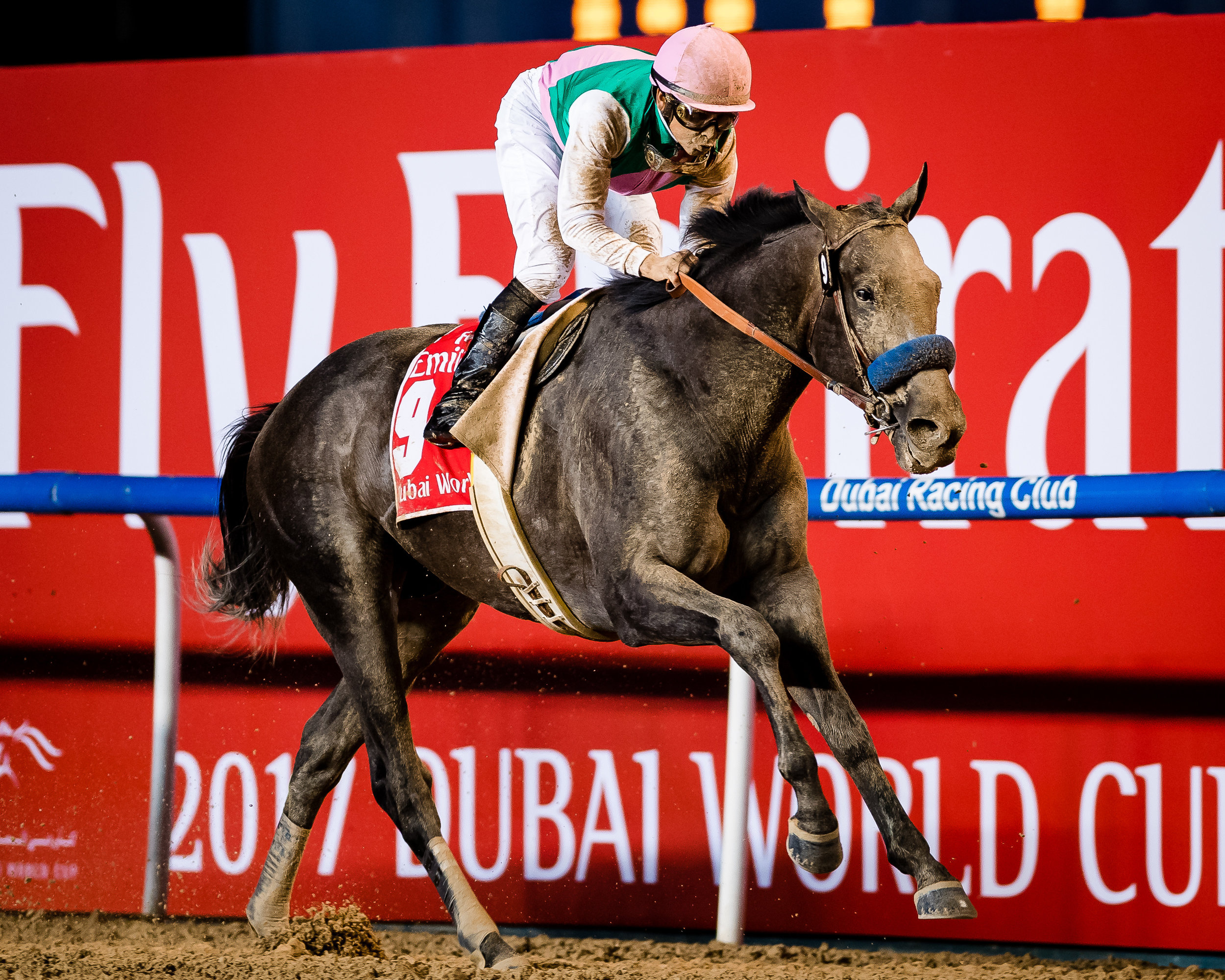
By Denise Steffanus
Horses thrive on a daily routine and do their best when racing in a familiar environment, like a sports team with home-court advantage. But more and more American trainers are trying their hand at racing abroad, in places where racing is very different from what their horses are accustomed to.
Racehorses in Europe don't live and train on the racetrack. They are stabled at training yards, similar to a trainer's private farm in America. Riders hack the horses to grass gallops, sometimes through the nearby town, to get their daily exercise. It is a relaxing, pastoral setting.
When the horses head to the races, they are vanned from the training yard to the racetrack. The disadvantage for an American horse racing for the first time at a European racecourse is it doesn't have the opportunity to train over the track. So on race day, the horse finds itself in strange surroundings without the security of a lead pony, which are not customary in European racing.
Eoin Harty is a fifth-generation Irish trainer now based in California. Under his tutelage, Bill Casner's Well Armed dominated the Group 1 Dubai World Cup in 2009, winning by 14 lengths, the largest margin in the race's history.
Harty described the scene at England's famed Newmarket.
"The town is just basically around different training establishments," he said. "When you go to the track, you might be driving through the town and there's 50 horses walking on the street beside you, and I mean literally walking on the street. Then they just turn off and they go gallop up a hill somewhere. Then they walk back down through the middle of town and go back to their stalls. It takes a little bit of getting used to."
Racetrack configurations
Racetracks in America differ greatly from those in Europe. Here, horses travel counterclockwise on an oval, usually with a dirt surface that the track crew diligently works to keep as flat and even as possible. Turf courses are located inside the dirt tracks, so they are shorter with tighter turns. In Europe, horses race both clockwise and counterclockwise, primarily on turf, traveling up and down grades, and not necessarily in an oval.
England's racecourses are the most interesting. At Goodwood Racecourse in Chichester, the straightaway leads into a loop with sharp turns on a severely undulating surface that sends the horses back over the ground they traversed on the way out. Windsor Racecourse in Berkshire is a figure eight, with horses negotiating both right and left turns. Epsom Downs in Surrey also has right and left turns and a steep downhill turn. At Ascot, some races, such as the Group 1 Queen Anne Stakes, are contested over a straight mile course.
Goodwood
"The hardest thing for me has been dealing with the straightaway, which is such a different race," said trainer Graham Motion, who grew up in Newmarket and apprenticed with Jonathan Pease in Chantilly, France, before coming to the United States. "It's more figuring out the idiosyncrasies of how the race should be run. Because you can't really teach a horse to run straight. It's something they're going to have to adjust to."
Find a local trainer
Harty said American horses tend to get mentally stressed in this strange environment. The way to solve the problem, he said, is to arrive a few weeks earlier and have a local trainer assimilate the horses into his own yard's string so they can train on the same gallops and become accustomed to the local racing environment.
Trainer Art Sherman did exactly that when California Chrome's connections decided to send the horse to Royal Ascot after his second-place finish in the 2015 Dubai World Cup.
"I wasn't familiar with how they train in Newmarket, up and down those hills and different courses," Sherman said. "So I thought it would be better off for the horse to be with somebody who knew everything going on in that area."
California Chrome was placed with Newmarket trainer Rae Guest, but Sherman remained his trainer of record. Guest was tasked with introducing the American Horse of the Year to running clockwise as he prepared for the Group 1 Prince of Wales's Stakes.
"You're not going to go there cold turkey and have them go the wrong way and think they're going to run their best race," Sherman said. "Another factor of going the opposite way is they're going to be on a lead they're not used to running on. That's why you need to train them that [direction] for that type of turn, going from one lead to the other."
Unfortunately, a bruised foot knocked California Chrome out of the race. Sherman visited the horse and said, "He was not a happy camper." His grueling two-year campaign had caught up with him, so California Chrome's connections brought him home for a three-month turnout at Taylor Made Farm in Kentucky.
Trainer Ken McPeek has raced at Ascot and Epsom. In 2004, his Hard Buck finished second in the Group 1 King George VI and Queen Elizabeth Stakes at Ascot. When he built his Magdalena Farm in Lexington, he installed a two-mile European turf gallop up and down the Kentucky hills.
"We train them right-handed and left-handed on gallops here on my farm to prepare them," he said. "If they're going to run at Ascot, we train them right-handed every day. And if they're going to run at Epsom, they go left. And they also get a chance to gallop the hills."
Trainers at the racetrack are not as fortunate.
"I don't know of any track in the States where you can do that," Harty said. "Maybe the racetrack that you're training at would work with you and give you 10 minutes at the end of the day to gallop the wrong way."
Take a Pony
Getting a horse the distance to the starting gate without incident is Motion's concern.
"It's a very free gallop down to the start of the race," he said. "Normally, for the mile at Ascot, the start is a mile away. So you have to gallop a mile down to the start the wrong way up the racetrack. So that can be an issue. Last year McPeek's horse got loose going down to the start."

Daddys Lil Darling, Epsom
Motion was talking about Daddys Lil Darling, who was loping toward the start of last year's Group 1 Epsom Oaks with nine other horses when a loud clap of thunder startled her. The filly ran off with rider Olivier Peslier, eventually parting company with him and running loose until she was caught and scratched from the race.
“I can’t tell you why or how that happened, though I was initially kicking myself that I should have had a pony with her,” McPeek told the Daily Racing Form after the incident.
Lead ponies aren't prohibited in Europe. Trainers just rarely use them.

"Our horses, when they go over there, need that security blanket," Harty said. "If you look at their horses, they send two-year-olds to three different racetracks and three starts and they're in front of a crowd and it doesn't seem to bother them. So I think it's just a different kind of horse with a different kind of upbringing, and that's why they don't use ponies."
A trainer can make a request in advance for permission to use a pony, but has to supply it himself. That often means shipping it to Europe with his other horses.
To further add to the horse's comfort, most trainers take their key personnel with them. Sherman took California Chrome's groom, Raul Rodriguez, and his exercise rider, Dihigi Gladney, to Dubai. Both times, the horse’s regular jockey, Victor Espinoza, was aboard.
Riders up
In the history of the Dubai World Cup, American trainers always have taken the horse's regular jockey with them. Notably, Baffert named Chantal Sutherland-Kruse to ride Game On Dude in the 2012 edition. She is the only female jockey to compete in the auspicious race on United Arab Emirates soil.
Hall of Fame trainer Steve Asmussen said, "With that caliber of horse it would be insulting not to continue to ride who has helped you get there."
In 2008, Asmussen teamed Curlin with Robby Albarado for the win, and Gun Runner had Florent Geroux up for their second-place finish behind Arrogate in 2017.
In Europe, Wesley Ward primarily taps the jockeys with whom he has had the most success in the U.S., among them John Velazquez, Joel Rosario, and Espinoza. Recently, Ward has teamed up over there with champion jockey Frankie Dettori.
"He seems to be able to ride anywhere in the world and adapt to certain situations," Ward said. "He has, in fact, won certain races that I think an American rider or a rider from there wouldn't win, just because he's a phenomenal rider."
Ward was the first American trainer to win a race at Royal Ascot when his Strike the Tiger, with Velazquez in the irons, took the Windsor Castle Stakes by a neck in 2009. Ward returns every year to England and France with a string of horses that rack up impressive wins.
He begins preparing his horses for the midsummer Ascot meet around the first of the year, with a winter break to freshen them. His goal is to give the horses one or two well-spaced prep races in the U.S. before shipping them to England.
"We give them ample time to recover and ample time from their last start here to go there to prepare for those starts. So, essentially, we are running very fresh horses on the day, not tired horses," he said.
Logistics of the trip…
TO READ MORE —
BUY THIS ISSUE IN PRINT OR DOWNLOAD -
Breeders’ Cup 2018, issue 47 (PRINT)
$6.95
Breeders’ Cup 2018, issue 47 (DOWNLOAD)
$3.99
WHY NOT SUBSCRIBE?
DON'T MISS OUT AND SUBSCRIBE TO RECEIVE THE NEXT FOUR ISSUES!
Print & Online Subscription
$24.95
The Legacy of El Prado

By Frances J. Karon
From the town of Cashel in County Tipperary, Ireland, at Lyonstown Stud, sprang a stallion that launched a breeding operation for Canadian entrepreneur Frank Stronach and has left an unmistakable mark on Thoroughbred racing.
Raced, like his sire and dam before him, by Robert Sangster, El Prado was trained on the holy ground of Ballydoyle by the incomparable Vincent O’Brien.
A son of Sadler’s Wells, in his day the leading sire in Great Britain and Ireland a record 14 times, El Prado caught the attention of bloodstock agent Dermot Carty.
To appreciate what El Prado has accomplished, one must recognize the brilliance of his sire.
Sadler’s Wells entered stud in 1985 to immediate success. Over time, he became the sire of 294 stakes winners, including 14 individual Irish classic winners, 12 classic winners England, and three classic winners in France.
But it was El Prado, foaled in 1989 from the brilliant Lady Capulet, that would travel his talents to North America and find a home in Kentucky as the stud who made Stronach’s Adena Springs an award-winning force in racing.
*
Charles O’Brien, an assistant to his father, trainer Vincent O’Brien, when El Prado was racing, looks back fondly on the young horse.
“He was not a very typical Sadler’s Wells and didn’t look like him,” recalled O’Brien. “Most of them were bay with white points, and he was grey and bigger and more substantial. Many were quite light-framed, but he was a big, heavy horse.”
O’Brien recalls putting a green El Prado through his paces.
“He wasn’t the two-year-old type but he had such a good constitution that we just kept moving him up in his work, and he thrived on it and just kept going, although he didn’t really have the physique of a sharp two-year-old,” said O’Brien.
El Prado at the Curragh
But familiarity through the bloodlines struck a chord and despite physical appearances, O’Brien knew that El Prado had a genetic right to be good young.
“We knew him well from scratch. He was out of a very good filly, Lady Capulet, which won the Irish Guineas first time out. We knew him all his life,” said O’Brien.
Blessed by pedigree, El Prado is a half-brother to Irish champion Entitled. El Prado made six starts in his juvenile campaign, including a score at first asking and a next-out win in the Group 3 John J. Long Memorial Stakes.
In his third career start, the Group 3 Anglesey Stakes, he came up against a monster in St. Jovite, who denied a stubborn El Prado by a desperate neck.
St. Jovite went on to win the Futurity en route to sharing year-end championship honors with El Prado. A year later, St. Jovite would win the Irish Derby.
Keeping El Prado, a horse already considered not your typical juvenile racing prospect, in form, however, was proving to be something of an issue.
“He was such a good eater it was hard to keep the weight off him. You had to give him a little more work than most, plus he wasn’t the greatest work horse in the world so it took a fair bit of graft to keep him fit,” said O’Brien.
If anything, that narrow loss to St. Jovite may have been the race to bring El Prado to top form. On September 7, 1991, El Prado made his Group 1 debut in the National Stakes at the Curragh. With Lester Piggott up, El Prado was expected to win, which he did by a half-length over Nordic Brief.
“The Group 1 National was his peak. It was very typical for him. He wasn’t a flashy horse; it was very much a grind for him. He wasn’t the type to quicken away in a matter of strides but he’d just grind other horses down through sheer power,” offered O’Brien.
El Prado traveled to England, where he was 12th of 30 runners in a valuable Tattersalls-sponsored race, before finishing out his juvenile season with a win in the Group 2 Beresford Stakes in Ireland.
“He took on whatever was around at the time as a two-year-old,” said O’Brien.
El Prado’s three-year-old campaign didn’t pan out as desired. From three starts, he mustered a fifth in the Group 3 Scottish Classic at Ayr and failed to impress in consecutive Group 1 tries in France.
“His first run back as a three-year-old was obviously disappointing,” admitted O’Brien. “We thought we had him back to somewhere near his best but he didn’t show any spark.”
Given the success of El Prado’s high-profile son Medaglia d’Oro, some might wonder what El Prado might have accomplished if given a chance on a natural dirt surface.
“It wouldn’t have happened (trying dirt) as a two-year-old anyway, and then he got hurt in the spring of his three-year-old year, he twisted an ankle basically and was never really right again afterwards, so it never became a possibility,” said O’Brien.
Instead, he prefers to hold onto the family ties to the great grey.
“It makes it that much more special to know (my father) had trained both parents and then him. That adds a bit of extra to it,” he said.
El Prado's racing career had come to a close, but his true calling was about to begin.
A native of Austria, Frank Stronach made his fortune as the founder of Magna International, an auto parts company in Aurora, Ontario, Canada. His Adena Springs Farm now stands multiple stallions in Canada and the U.S. -- in Ontario, Kentucky, and California -- but El Prado was the start of it all.
In 1993, Dermot Carty, equine consultant, bloodstock agent, and the man responsible for Stronach's Adena Springs North location, asked longtime friend and associate Edward Daly to provide a list of potential stallion prospects from the Sadler’s Wells line. Daly sent three names, including that of El Prado.
On paper, the horse’s two-year-old form was exceptional, but a closer analysis of his family line found many threads worth pulling.
“I started my research by going to Kentucky to speak to one of my mentors, Tom Gentry,” said Carty. “Tom had a great understanding of pedigrees and had bred Terlingua (the dam of Storm Cat), War and Peace, Pancho Villa, Royal Academy, and many more.”
Gentry’s analysis of El Prado, out of the grey Lady Capulet (by Sir Ivor, another horse trained by Vincent O’Brien), found that bringing the horse to North America might have precedent.
“Tom told me that El Prado had more of an American pedigree and when I asked him why, he said, ‘Well, Lady Capulet’s brother is a horse called Drone, who stood at Claiborne Farm and was very successful,’” smiled Carty.
Carty, in addition to his own keen eye, knew that the knowledge of the veteran horsemen that came before him was priceless and reached out to another friend and mentor in Arthur Stollery. A member of the Canadian Horse Racing Hall of Fame as a builder, Stollery owned Angus Glen Farm and bred standouts such as fellow Canadian Horse Racing Hall of Famers Kennedy Road and Lauries Dancer.
At the time of Carty’s research, Stollery had two Drone mares on hand and Carty simply had to know why.
“He said, ‘Speed, unbelievable speed,’” recalled Carty with a shake of the head.
Carty recognized the potential, but was there opportunity? He worked the phones to his native Ireland and started to dig up all the information he could on his budding stallion prospect and the people who owned him.
TO READ MORE —
BUY THIS ISSUE IN PRINT OR DOWNLOAD -
Spring 2018, issue 47 (PRINT)
$6.95
Spring 2018, issue 47 (DOWNLOAD)
$3.99
WHY NOT SUBSCRIBE?
DON'T MISS OUT AND SUBSCRIBE TO RECEIVE THE NEXT FOUR ISSUES!
Print & Online Subscription
$24.95
Career Makers - The Role of Jockeys’ Agent
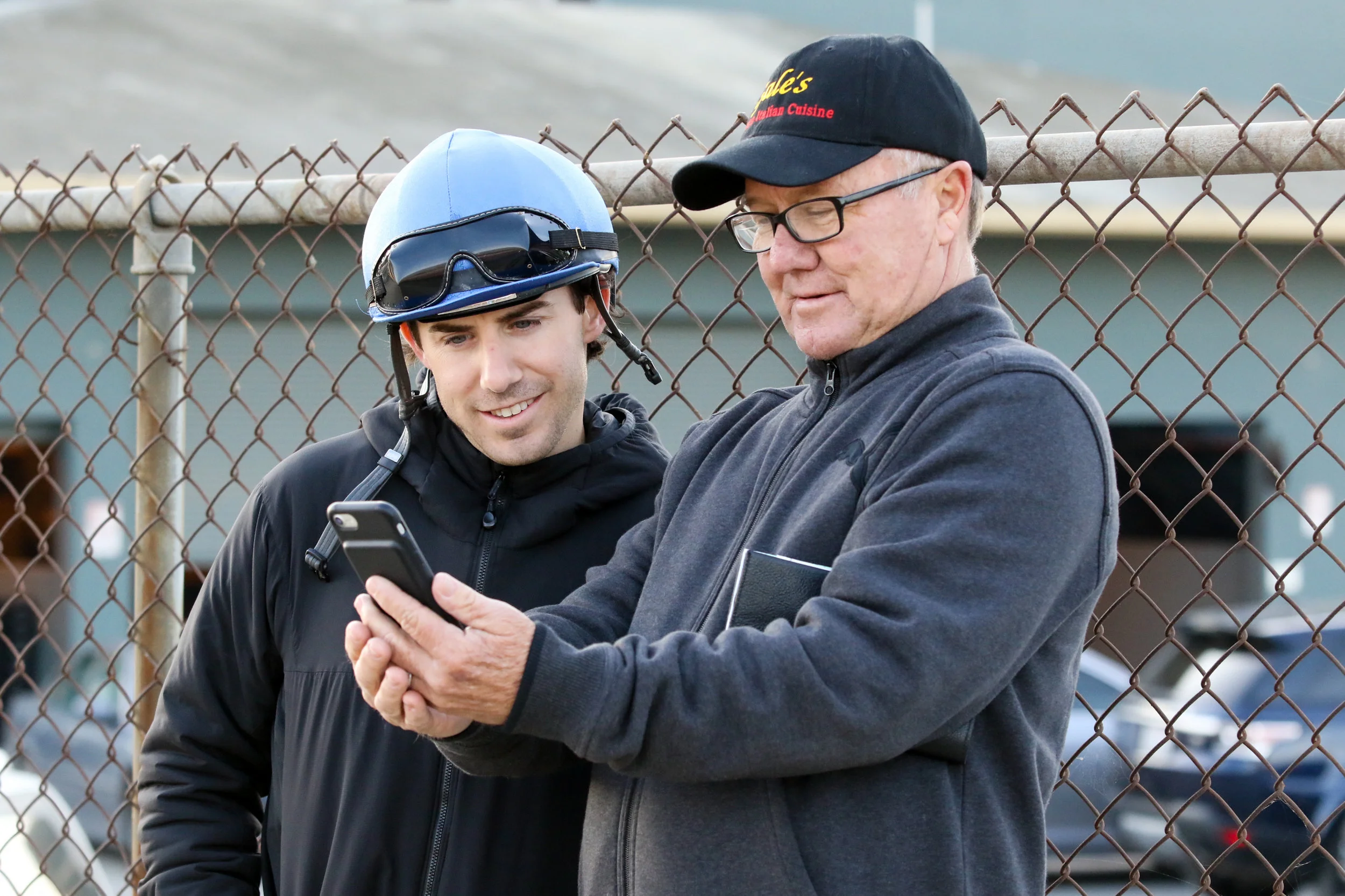
By Ed Golden
Manager, mastermind, guru, agent, call him what you will, Colonel Tom Parker was the man who made Elvis Presley.
The King of Rock and Roll’s talent was only exceeded by his raw sex appeal, and Parker, self-proclaimed military officer or not, saw to it that the world would march en masse to a cadence called by Presley’s signature tones.
Elvis died more than four decades ago, but not before he and Parker reached the apex in gold and glory, still yielding riches of infinite proportions all these years later.
In racing, it’s not clothes that make the man; in part it is the agent directing the jockey. Agent and jockey provide a service to trainers, a salesman offering a product.
An agent in this instance is best described as a person empowered to transact business for a jockey. On any given morning at any given track, condition book in hand, there they are, Monty Hall wannabes, ready to make a deal.
A standard arrangement calls for an agent to be paid 25 percent of a jockey’s earnings, but that percentage could vary. If the rider’s services are in great demand, he could pay the agent a smaller percentage. Or, if the agent possesses the persuasive prowess of a Colonel Parker, he could warrant the higher percentage. It’s Economics 101.
Back in the day, agents were not prominent, if in evidence at all. Major stables employed contract riders and in order to ride for an outside trainer, the jockey had to receive permission from his contract stable to do so.
Now, the vast majority of riders have an agent, although jocks on a restricted budget with limited mounts have been known to represent themselves.
Agents wear many hats, including those falling under the Three P’s: politician, psychiatrist, and pacifist, and they can be a boon to racing departments.
“In my career around the country at tracks on both coasts, I’ve worked with agents who mostly helped the racing office,” said Rick Hammerle, Santa Anita’s vice president of racing as well as racing secretary. “We’re both trying to accomplish the same thing: get horses into races. Working with agents and sharing information about trainers’ intentions can help us achieve our goal.”
Even though it’s his first tour as an agent, Mike Lakow has racing’s paradigm of Tom Brady in jockey Javier Castellano, a 40-year-old Venezuelan at the zenith of his career. The reigning four-time Eclipse Award winner, a world class rider be it at Dubai or Churchill Downs, was inducted into racing’s Hall of Fame in 2017.
Still, for an agent, the pressure is always on.
Although he never trained, the 60-year-old Lakow (pronounced LAKE-ow) otherwise has an extensive background enabling him to understand ramifications that simmer just below racing’s surface.
“When I was working as general manager at Hill ‘n’ Dale (a major breeding farm in Kentucky),” he said, “I owned a quarter of one horse, and believe me, it’s a tough deal, so I respect all the owners, as well as trainers.”
Lakow, now based on the East Coast, was racing director at Santa Anita before Castellano hired him in August of 2016. Lakow also was racing secretary for the New York Racing Association (NYRA) from 1993 to 2005, served as a racing official in Florida and Dubai, and was hands-on with horsemen regularly at Santa Anita’s Clockers’ Corner during his sojourn at the historic Southern California track.
“I’m incredibly fortunate to represent Javier,” Lakow said, “because he’s a professional who’s liked by everybody. We have no issues as far as not being able to ride for one trainer or one owner. He’s won four Eclipses, done it all, and now we’re trying to focus on riding the top horses.”
Stress and pressure are standard fare in the workforce, whether you’re Donald Trump unceasingly enduring “fake news” attacks 24/7 or a McDonald’s minimum wage burger slinger serving up $2.50 McPicks. It’s all relative.
That includes Lakow, although he is averse to pointing it out, lest he might be looked upon as a malcontent, what with two chickens in the pot.
“People who see all the money we’re making might wonder how being agent for a top jockey could be stressful, but it is,” Lakow said. “I’ve been in administrative positions in racing for many years, with NYRA and at Santa Anita, but if you happen to make a mistake here and there, you move on.
“It affects the company, but it doesn’t affect an individual. If I happen to make a mistake with Javier, it affects him.
“It’s impossible to keep everybody happy. Any agent will tell you that. Fortunately, Javier is level-headed, so I’m in a good position. That’s not the case with some other jockeys, from what I’ve heard. I respect Javier and Javier respects me, but like I’ve said, it’s impossible to keep everybody happy.
“You try to do the right thing. I respect all the horsemen who give us calls, because it’s a tough game for trainers. Horses will fool you, so I understand the stress trainers and owners face. I don’t look at this as a one-shot relationship.
Tom Knust
“Luckily, I have the respect of horsemen because of my work in New York and California. When I started with Javier, horsemen gave me the benefit of the doubt. I was a bit green and I think other agents probably thought, ‘Look at this guy. He starts a job and has a top rider,’ but I’m lucky because I didn’t burn any bridges. I get along with most people and treat everybody with respect. That’s what’s made it so much easier for me.
“In the long run, honesty is the best policy, and I’m always honest. It hurts sometimes, but in the long run, I think it helps.”
Another agent who has been on both sides of the wall is Tom Knust, former racing secretary at Santa Anita and Del Mar, now booking mounts for two-time Kentucky Derby-winning jockey Mario Gutierrez.
“One thing I learned quickly as an agent is that if you have a good rider, it makes things pretty easy, and if you don’t, it’s very, very difficult,” Knust said. “That’s the key, whether you’ve had experience in the racing office or you’ve just come in off the street.
“If you give a call, you want to honor it, although situations develop where you’re in a bind and ask a trainer if he can help you out, but if he doesn’t, you’ve got to keep your word and ride his horse.”
An additional plus comes from riding regularly for a winning trainer, in the case of Gutierrez, that being Doug O’Neill, who saddled I’ll Have Another and Nyquist to capture the Kentucky Derby for principal owner J. Paul Reddam in 2012 and 2016.
“It’s absolutely an advantage, 100 percent, if you have a go-to stable that wins a lot of races, like O’Neill,” Knust said.
As a female, Patty Sterling is in the minority among agents, but with her extensive familial background in racing, she is looked upon as one of the boys.
Her late father, Larry, trained 1978 Santa Anita Handicap winner Vigors and is the father of jockey Larry Sterling Jr. Patty’s uncle, Terry Gilligan, rode and trained, and his brother, also Larry, made his bones as a rider, too. Now 80, he is the quick official at Santa Anita and Del Mar.
“It’s probably a lot easier for a woman in this business than it used to be,” said Patty, 54, a former clocker. “I don’t see that as a problem.
“Being an agent is almost parallel to training horses; it’s very similar. Right now, it seems owners pick the jockeys more so than they ever did before, when trainers were deciding who to ride.”
TO READ MORE —
BUY THIS ISSUE IN PRINT OR DOWNLOAD -
Spring 2018, issue 47 (PRINT)
$6.95
Spring 2018, issue 47 (DOWNLOAD)
$3.99
WHY NOT SUBSCRIBE?
DON'T MISS OUT AND SUBSCRIBE TO RECEIVE THE NEXT FOUR ISSUES!
Print & Online Subscription
$24.95