
Polish horse racing gets a major boost
Article by Dr. Paull Khan

Night Tornado (11) and jockey Stefano Mura on their way to winning the Wielka Warszawska 2022, a race they won for the second year running at Sluzewiec Racecourse

Warsaw’s impressive Sluzewiec Racecourse
On Sunday, October 1st, Poland’s first ever internationally recognised Listed Race will be staged. The €100,000 Wielka Warszawska, for three-year-olds and upwards, is run over 2600m/13f of the impressive, 50-metre wide, turf track at Warsaw’s Sluzewiec Racecourse.
At its meeting in Ireland in February, the European Pattern Committee (EPC) confirmed its decision to award Black Type to the race, deeming it to have met the conditions of the recently introduced ‘flagship race’ scheme. Poland is the second country (after Spain) to benefit from this scheme, introduced last year, which gives EMHF member nations (which have no internationally recognised Group or Listed races) the opportunity to apply for a single ‘flagship race.’ This race is treated slightly more leniently than other races when being assessed for Black Type. Normally, the average internationally agreed rating of the first four finishers in the most recent three runnings of the race should be 100 or over. Under this scheme, a score of 95 in any two of the three most recent renewals is the threshold.
How did the Polish race meet the standard? It was undoubtedly given a boost in 2020, when the globe-trotting Czech-trained Nagano Gold (GB) – who had recently run second in both the Gp.2 Hardwicke Stakes at Royal Ascot and the Gp.1 Grand Prix de Saint Cloud – graced Poland’s premier track with his presence. Nagano Gold, then a six-year-old, prevailed by just a ½ length from a locally trained three-year-old named Night Tornado.
No one could tell at the time that Night Tornado would go on to be quite the star of the show, winning both the 2021 and 2022 editions, more recently with French- and German-trained raiders in his wake, including Nania (GER), who was fresh off a victory in a Hannover Listed Race.
Attaining Black Type is not only an honour for Polish racing but has wider implications, according to Jakub Kasprzak, racing secretary at the Polish Jockey Club and recently voted onto the nine-strong executive council of the EMHF – another example of Polish racing’s growing profile.

Jakub Kasprzak
Kasprzak reflected on the prospect in the run-up to the EPC’s decision: “If the Wielka Warszawska receives the Black Type status, it will undoubtedly be a great distinction and appreciation of Polish racing. The race has a long tradition, and several horses have appeared in the international arena. In addition, for the entire central and eastern European region, it will be a great opportunity to popularise racing.”
But Kasprzak is keeping his feet firmly on the ground: “Of course, we know that receiving such an award is really the beginning of the hard work, to show that it was not a ‘fluke.’ Personally, I am very happy, but I approach it with caution, being aware of the new challenges it poses for us.”
The journey that Polish racing has taken to get to this point is tumultuous. It has featured the need to rebuild from scratch on no fewer than three occasions and can only be understood in the context of the history of Poland overall.

Sluzewiec opening, 1939
The first organised races were run in Warsaw in 1841, on the Mokotow Field, now a large park just south of the city centre, which houses the Polish National Library. At the time, there was no ‘Poland.’ This was in the middle of a 123-year period during which Poland did not exist—having been partitioned in the late eighteenth century between Austria, Prussia and Russia. Warsaw fell into the Russian area and, since 1815, within a semi-autonomous state entitled Congress Poland. The Russian regime curtailed economic and public activity in the region, and racing in Warsaw was, for example, completely suspended between 1861 and 1863.
Originally a dirt track, four stands were erected along its finishing straight. In 1888, it moved to turf, at a time of fresh prosperity: pool betting had recently been introduced and was providing funds for prize money.

Sluzewiec, 1973
At this time, the horses were predominantly domestically bred, oriental horses, initially favoured by Polish breeders as they had historically provided Poland with success on the battlefield. However, the supremacy of the thoroughbred over racing distances (2km–5km) began to be recognised over time; and a thoroughbred breeding industry developed, drawing stallions and broodmares predominantly from England, France, Germany and Austria.
The stud of Count Ludwik Krasinski was pre-eminent in the four decades leading up to the first World War. Based in Krasne, (100kms to the north of Warsaw), it ranked top across the whole Russian Empire on 14 occasions. It produced the winners of five all-Russian derbies, in Moscow, including the famed Ruler.

Lwow Racecourse, 1943
This was an outward-looking period of international competition and success, with Polish-breds winning Classic races in Austria, Germany and Hungary. Two-year-old racing was introduced in the 1880s. (Initially, races were for four-year-olds and up only.) Trainers and riders were often brought in from abroad, and a breakthrough in riding styles occurred in 1901 when American jockey Cassius Sloan showcased the shorter-stirruped style to great effect and was soon mimicked by the domestic riders.
World War I put a stop to all this. In 1915, the racing stables were evacuated to the East. However, the racing spirit was not snuffed out and the president of the Horse Racing Society at the time, Fryderyk Jurjewicz, gathered most of the Polish stables at the track in Odessa (Ukraine) and organised races there throughout the rest of the war. Following which, in the Spring of 1919, about 250 thoroughbreds began their return home, arriving at the Warsaw track on June 28, laying the foundations for thoroughbred racing and breeding in a newly reborn independent Poland. In 1919, over 22 racing days, 193 races were run and a Western European-style racing programme, capped by traditional Classic races, was adopted.
There followed a spell of great growth and optimism. In 1924, the first volume of the Polish Stud Book was published. The following year, the Horse Racing Act was passed, establishing the Horse Racing Committee, with representation from a remarkably broad range of government departments: the Ministries of Agriculture, Military Affairs, Interior Affairs and Treasury all had seats, alongside representatives of the racecourses and breeders.

Lwow Racecourse, 1943
Breeding stock was imported in significant numbers – over 1,000 broodmares from the disintegrated Austro-Hungarian Empire, as well as from England, France, Russia and Germany. By 1930, the number of mares bred – often a useful barometer for the health and scale of the sector as a whole – had climbed back up above pre-war levels.
Many racing societies and racetracks emerged in the 1920s at places like Lublin, Lodz and Katowice. From 1933, racing was staged over the winter at the southern town of Zakopane. These regional tracks not only played an important role in the development of the thoroughbred sector, they also enriched the society by providing focal points for social life. Sadly, for most, their time in the sun was short-lived, as Poland was hit especially hard by the Great Depression of the 1930s, leading to their closure.
Even during these straitened times, a grand project was undertaken to construct a modern track on land from the Sluzewiec farm, which had been purchased by the Society for the Encouragement of Horse Breeding. With the help of international experts and renowned landscape architects, the racecourse – which is present-day Poland’s most important track and host to the Wielka Warszawska – was opened on June 3, 1939.
The Second World War caused a complete dispersion of breeding stock. For the third time in a century, thoroughbred breeding had to be started from afresh, and this time, under the constraints of Communism. Private breeding was banned and state studs were established in the place of the liquidated private studs. Slowly, activity increased from the 45 thoroughbred mares registered in 1944. A draft of 230 thoroughbreds reclaimed from Germany provided a timely fillip. By 1950, the mares’ roster had risen to 150, and this figure grew by an average of 10 per year for the next four decades.
Then, in 1989, came the seismic political changes in which Poland played such a pivotal part and saw the overturning of communism. Several state studs were closed down, and private stud farms re-appeared in their place. Individuals could now own and lease racehorses, and racing stables began competing on the principles of the free market. Broodmare numbers shot up to 900 – returning at last to the pre-WWII levels.
The story of Polish racing is, indeed, one of immense resilience. It is a vivid example of how societies – in so many parts of the world, after conflict or disaster – hasten at the earliest opportunity to re-establish horse racing, emblematic as our sport can be of normalcy resumed.

Runners pass the stands at the Baltic Sea resort track of Sopot.
What, then, of Polish racing in the 21st century? The exploits of two horses might be highlighted: those of Galileo (POL) and Va Bank (IRE) – both of whom made waves in Western Europe: the first in the jump racing sphere, the second on the flat.
Let us consider the ‘Polish Galileo’ first. Poland’s Ministry of Agriculture continued to own stallions for some years after 1989 (an example of state involvement that was only eventually ended when, in 2004, Poland entered the EU) and one of the last such was Jape (USA), whose second crop included Galileo, who had won the Polish St Leger, had placed second in the Polish Derby and had been voted Horse of the Year. Galileo was put up for sale at the Sluzewiec Sale in Autumn 2001 and was purchased by British trainer Tom George to go hurdling. Winning on his British hurdling debut in February 2002, George went directly the following month to the Cheltenham Festival, where Galileo was famously victorious in the 27-runner Gr.1 Royal and SunAlliance (now Ballymore) Novices Hurdle.

Polish superstar Va Bank
Va Bank’s remarkable career began with a 12-race unbeaten sequence, which included the Wielka Warszawska, Polish Derby and a German Gp.3. Later, while in training in Germany, he added a further German Gp.3 and Italy’s Premio Roma (Gp.2) to his tally. He now stands as a leading sire in Poland.
Today, Poland has three active racecourses, all turf, of which Sluzewiec is the youngest. Partynice in Wroclav, not far from the Czech and German borders, was founded in 1907 and is dual-purpose, hosting all the country’s 36 jump races. The Baltic Sea track of Sopot is the daddy of the trio, dating back to 1898.
Sixty trainers are licenced in Poland, with a quarter of these confined to training their own horses – just over half train from their own premises; the rest occupy stables at either Warsaw or Wroclav. Training fees average around €6,500pa, excluding veterinary and transport costs. The champion thoroughbred trainer last year, Adam Wyrzyk, notched up 36 wins.
Average prize money on the flat is around €4,600; over jumps, it approaches €7,000. Field sizes are knocking on the door of the ‘magic 8,’ with the flat averaging 7.9 and the jumps 7.1.
All of Poland’s jump races are open to foreign competition, including the Crystal Cup (€37,000) and Wielka Wroclawska (€43,000). On the flat, of the 278 races, the top 35, including all five Classics, and a few lower-class races, are open. Last year, 82 foreign-trained runners were attracted to race in Poland, from Slovakia, Czech Republic, France, Sweden and Germany.
Recent years have seen a growing reliance upon foreign-bred horses, which now represent the slight majority of horses-in-training. Of the 386 imports, 164 were from Ireland, 128 from France and 43 from Britain. Six years earlier, the picture was very different, when over 70% of horses-in-training were home-bred – a cause of some concern in Poland.

Tight finish in front of packed stands at Wroclaw
Despite a new television racing channel and internet betting platform, on-track betting is still the predominant channel for horse racing bets. Turnover is buoyant, but the returns to racing from betting turnover are modest.
The Polish Jockey Club, established in 2001, sits beneath the Ministry of Agriculture. Polish racing is heavily dependent upon government support, with 90%–95% of prize money emanating from that source. It is a relationship that is not without its frustrations:
“If we need to change something, like a rule of racing,” explains Kasprzak, “we are unable to do so without specific governmental approval; and we, as just one among many organisations, often find we are waiting and waiting for this approval to come through.”
What does Kasprzak consider to be Polish racing’s prime challenges and opportunities?
“The first challenge is the support of Polish-bred horses, to rebuild our breed. At this moment, we have a few stallions with good pedigrees and race records. Their first offspring will race this year.
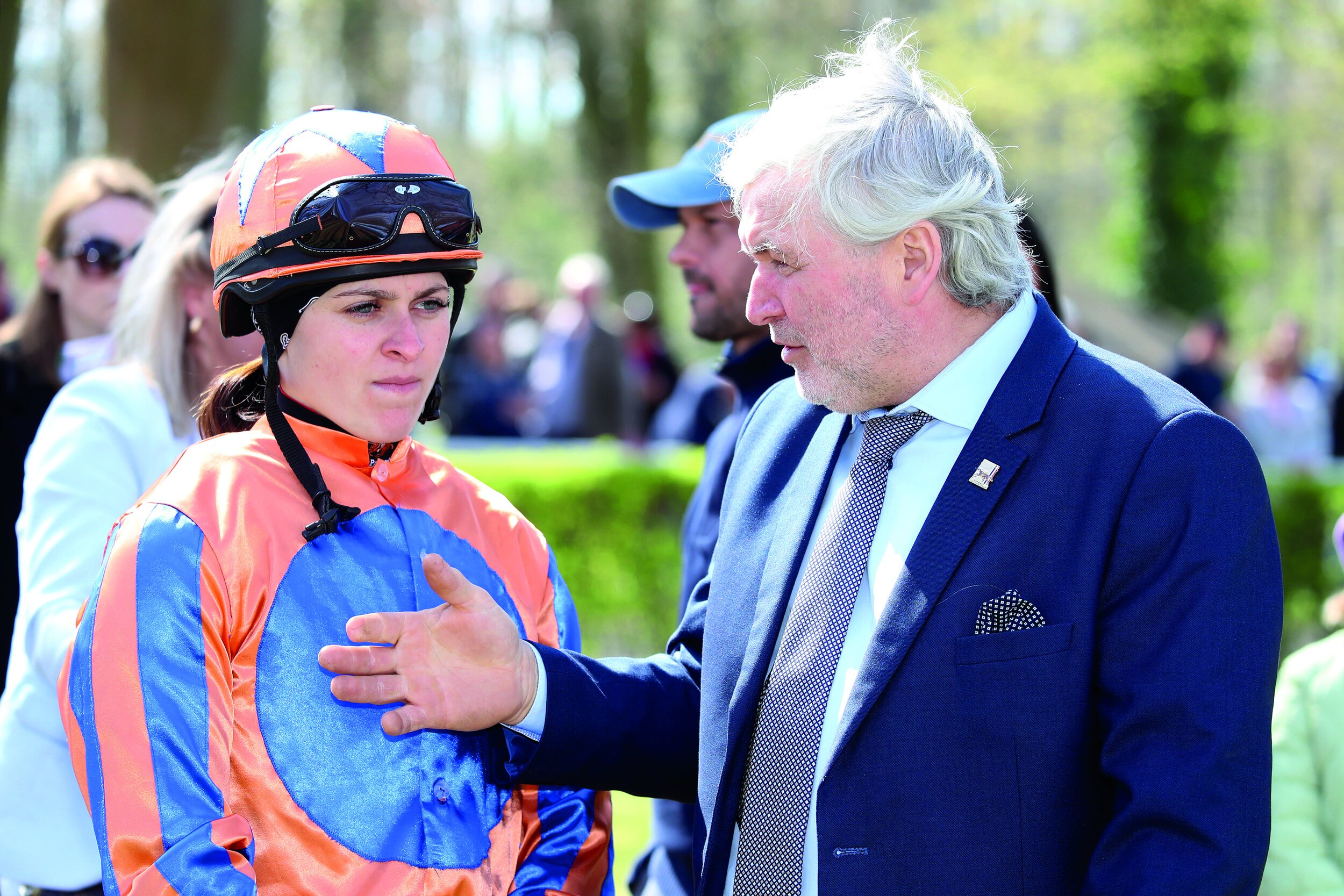
2022 Polish champion thoroughbred trainer Adam Wyrzyk and daughter Joanna, who became the first woman to win the Polish Derby when winning in 2021 on Guitar Man
“Second, we need new racing rules. Third, we have problems in sourcing stewards. People don’t want to be stewards; it is a very hard and responsible job.”
“As regards opportunities, these days, there are many possibilities when it comes to spending free time, but in Poland, our three racecourses offer something special. You can meet friends, eat and drink as well as watch horses compete in the flesh. We have the chance to sell to a new audience this unique way of having a good time.”
This year, Poland is taking centre stage within European racing in another respect. It will, for the first time, host the EMHF’s General Assembly over two days in May. Immediately following this, the inaugural EuroMed Stewards’ Conference will take place at the same Warsaw venue.
And then, thoughts will turn to the Wielka Warszawska, whose shiny new Black Type status has been rewarded with a hefty boost in prize money – the winner taking home €58,000 (up from €38,000 last year). So, trainers seeking a realistic shot at Black Type (remember, statistically, the race has been easier to win than any other European Listed Race) and a nice prize money pot with a 2400m+ horse rated around the 95 mark, consider a trip to Warsaw this October.
Prep school - the role of the pre-trainer in the flat racing world
Article by Daragh Ó Conchúir

WC Equine’s Ellie Whitaker & Tegan Clark
Having had a little poke around the inner workings of pre-training in jumps racing for the last edition, it is now time to do the same in the Flat world.
In both National Hunt and Flat, owners and trainers send horses to be broken and prepped specifically to race, enabling trainers to get on with the job of attending to those in their yard that are ready to run.
Then there is the trading side. In jumps racing, that revolves around the point-to-point scene, where proving a level of ability in competition increases value. In the Flat division, the breeze-up sales are not competitive, but they illustrate athleticism, temperament, physical prowess and of course, raw speed.
While very successful, pre-trainers aren’t universally popular. As mentioned in the pre-training jumpers article, retired trainer and former CEO of the Irish Racehorse Trainers’ Association Michael Grassick argued that they were making an already difficult staffing situation for trainers even worse.
Last February, recently retired trainer Chris Wall asserted in a Racing Post feature that the proliferation of pre-trainers was accelerating the growth of the so-called super trainer, enabling them to stockpile horses.
But then, in the same article, Ben de Haan described the demand for pre-training as a very welcome opportunity to improve revenue streams.
Obviously, Flat racing is a more global field than jumps, so we had to be a little less parochial in sourcing our contributors; we touched base with successful operators in England, France and Ireland, namely Nicolas Martineau, Ellie Whitaker, Tegan Clark, Willie Browne and Ian McCarthy.

Willie Browne
Browne is featured elsewhere in this publication for his training prowess, but it is his nonpareil acumen in sourcing future champions as young stock and then producing them through the breeze-ups that he can hang his hat on. It’s also a lot better way to pay the ever-escalating bills.
Now approaching his 77th birthday, he has more than 40 years’ experience in this sector, having consigned a draft at the very first breeze-up sale in 1978. And though he has moved from the original Mocklershill location outside Fethard, Co Tipperary, to build Grangebarry Stables just over the road, he has retained the home label as a brand for excellence.
It was Browne who sold the first breeze-up graduate to win a Classic, when Speciosa galloped to victory in the 1000 Guineas in 2006, little over a year after breezing at Doncaster. Walk In The Park and Trip To Paris are others to go through his hands while Mill Reef Stakes victor Sakheer has the 2000 Guineas in his sights in the coming months.
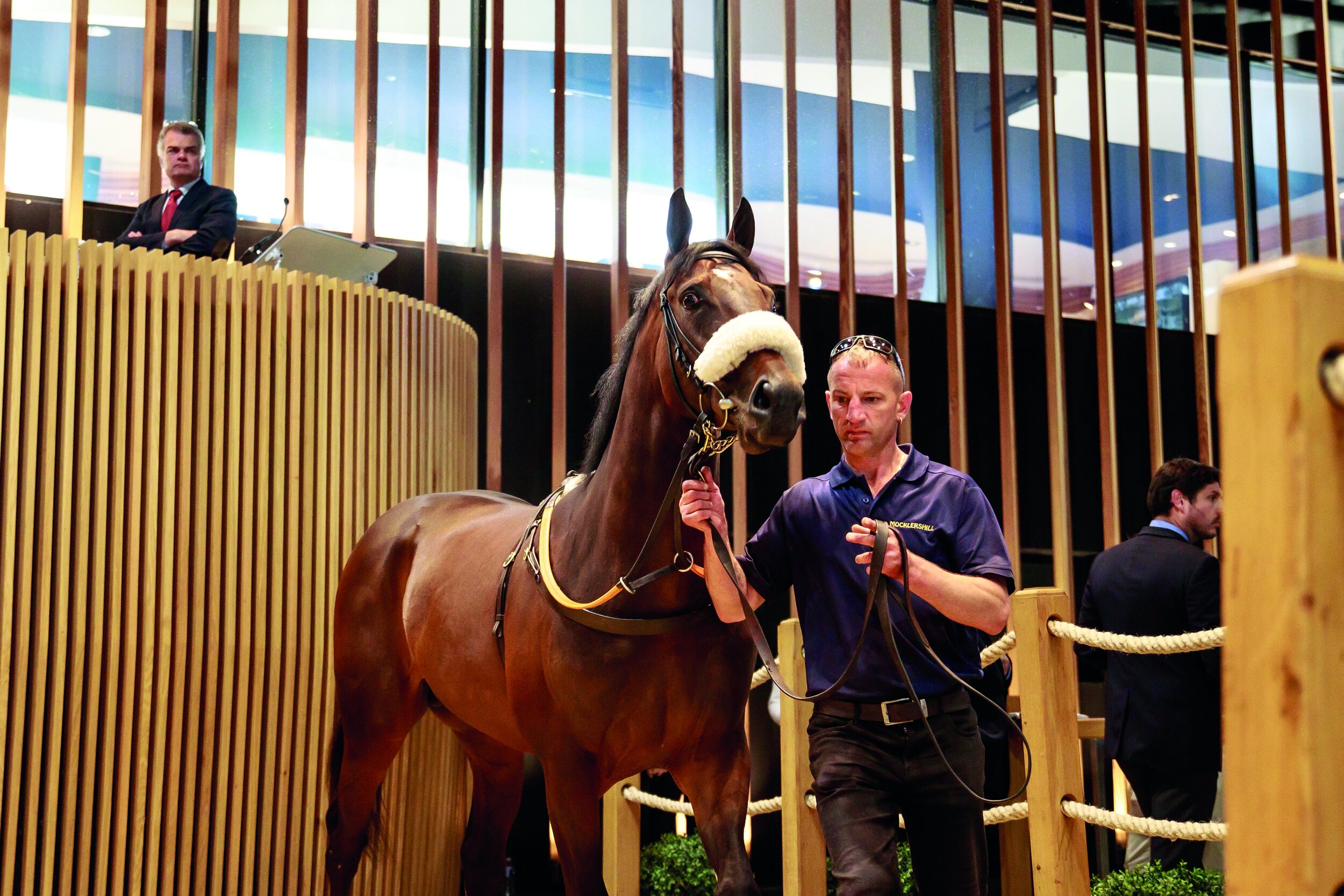
Zoffany colt Sakheer
He has broken the million-pound barrier twice at the sales and was one of the first to explore the American market for value when buying horses to breeze—Sakheer, a most recent example having been acquired as a yearling at Keeneland for $65,000 in September 2021 and then making €550,000 at Arqana, eight months later. A year and two days after he was picked up in his native land, the Zoffany colt was a three-and-a-half-length winner of the Mill Reef.
Browne also has a lengthy list of clients who send horses his way to break and pre-train, including Coolmore, the Niarchos family and Canadian owner Chuck Fipke. He trained Spirit Gal to bag a listed prize for Fipke last season before she was moved on to continue her career with André Fabre.
“When we are at it as long as we are, and we know our gallops, it’s fairly smooth,” says Browne. “Basically, we train horses here to run fast for two and a half furlongs, maybe three furlongs. That is what they are gauging you on.
“If you are training and you get to your three-furlong pole, and when you go to the next furlong, then you know if you have a racehorse or not. Because if horses are going very fast for two and a half or three, they’ll invariably slow down. But Spirit Gal wouldn’t slow down. That’s our yardstick, if we think we have something good.

“In pre-training, you wouldn’t have to put in the miles that you’d put in with the horses that are breezing—less time on their backs, you know? I have two horses going away tomorrow—one to John Gosden and one to Ralph Beckett—and we would never have put a gun to their head. I wouldn’t want anybody to think we gun the daylights out of these breeze-up horses, but you have a better idea.
“The horses for trainers, the half-speed is as far as they’d have ever gone, unless they gave them to you until July or August. They’d usually go between March and May. The pre-training is great … it keeps the whole business ticking along.”
Le Mans is noted for horsepower of a different kind, but Nicolas Martineau and his wife Pauline Bottin have a premises just 20 minutes from the venue for the world-famous 24-hour rally that in five years, has established a reputation for producing speed on four legs, rather than wheels.
Among their clients are the Devin family, Louisa Carberry, Tim Donworth and Alessandro Botti. Last year’s Gp. 1 Prix Royal-Oak winner Iresine was one of the earliest graduates from the Martineau school while of the younger crop, Good Guess was placed in a listed race as a two-year-old last term. Starlet du Mesnil and Enfant Roi are some of the graded jumpers he has prepped, while British and Irish followers will know the high-class Fil Dor well.
“At the stable I work with a lot of trainers,” Martineau . And with each horse, we work like the trainer works. We don’t work a horse for Francois Nicolle like we do for Gabriel Leenders. We do specific work, horse by horse.
“The big problem in France is staff, personnel for racing stables. So the trainer, when they call me, they want me to prep the horse to be ready to go racing in four or five weeks, six weeks maximum, just after they leave me. You are doing all the pre-training but up to the stage too where they are ready to go racing.”
That is clearly a dissimilar approach to what is required by most British and Irish trainers, but one aspect of it that is very similar is the staffing shortage, which Browne attributes to his numbers being down to around 50 this year.
Back in France, Martineau even has different feed for the breeze-up two-year-olds and those in pre-training because they are not being trained for the same jobs; and his time learning about both sides of the equation has informed his methods.
“I have my experience from Ireland. I worked for Mick Murphy at Longways Stables. For me, he is the best for the breeze-ups, and I learned so much. He’s exceptional, and I took a lot from working with him.
“I worked for a long time for Jean-Claude Rouget. I worked for a year as well with my wife Pauline for Willie Mullins, and she worked as well for Joseph O’Brien. That was very good experience for pre-training.”
Indeed, the woodchip gallop is a mid-way point between what Mullins and O’Brien have at Closutton and Carriganóg respectively, so that they can cater for all types of horses.
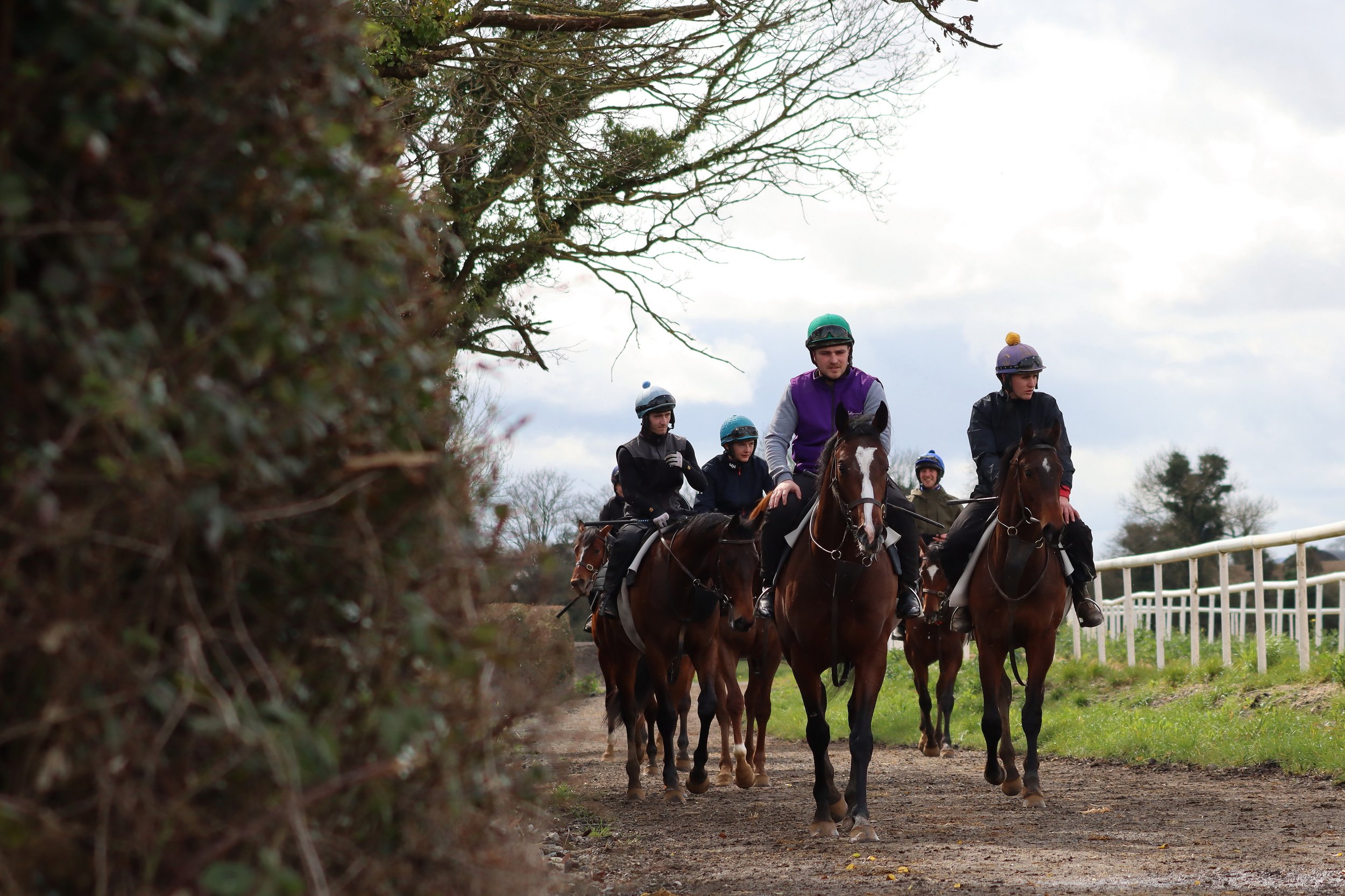
McCarthy is a former NH jockey who had already built his breaking, pre-training and breeze-up operation, Grangecoor Farm on a greenfield site in Kildangan, Co Kildare by the time he had retired in July 2021.
The 34-year-old, who expects to have between six and eight juveniles bound for the Craven, Guineas and Goresbridge Breeze-Ups (while also breaking and pre training Flat and NH youngsters for the racetrack directly and producing jumps horses through the point-to-point sector), places a heavy emphasis on detail and that means not taking any shortcuts, even with spiralling costs.
“I spent ten years with Dessie Hughes and he was a horseman in himself,” McCarthy explains. “I was always interested in the breaking side of it with the stores during the summer, so it was always something that was in my mind from then that I might do.
“I went from there to Ted Walsh, where I learned an awful lot that stood to me when I started breaking and pre-training.
“I put it out there that I was doing it and was lucky enough to have ridden for some good owners that supported me when I was starting out and good trainers when I was freelancing that supported me as well.
“We have about 50–55 horses here, which is a number that works very well. I am so lucky, given how difficult it is for everyone to get staff in that I have five excellent full-time people here. Niall Kelly is head man, and Alan Davison, Johnny Wixted, Sean Donovan, Christine Worrell and Orla McKenna are with me as well. They are vital. We also have eight part-time workers.”
In his experience, there are varying techniques for getting to the same end game of a horse being prepared to give its best on race day. What is sure is that you cannot bring the same approach to every model.
“You try and get to know the horse the best you can. You’ve different types of horses—horses coming from the sale and homebred horses coming from the farm. The sales horses will have a sales prep done and will have that under their belt. Horses coming in off the farm just won’t be as advanced, so they’ll take a little more TLC.
“Here, the yearlings are started off in the lunge ring and are driven for a couple of weeks. They then go on the furlong sand-and-fibre gallop. Then, just before Christmas, they’re put on the three-furlong round sand-and-fibre gallop.
“From day one they’re driven through the stalls so that they adapt to it really well.
“I do like to get the two-year-olds away at the end of January, start of February. We use The Curragh on a regular basis for a day away. It’s an important part of it.”
Two of the best illustrations of Grangecoor’s work arrived in 2021, starting when he had Hierarchy for the Tattersalls’ Guineas Sale. The son of Mehmas breezed the second-fastest time and was sold to David Redvers for 105,000 guineas, going on in the following months to win twice and be placed twice at group level, before only being beaten a length and a quarter in the Breeders’ Cup Juvenile Turf Sprint.

Hierarchy – Tattersalls Guineas Breeze Up Sale 2021
The same year, he was sent a Profitable filly that had been purchased privately by Liam Donovan on behalf of the Dunphy family. The pocket rocket turned out to be Quick Suzy, who would shed her maiden status at Curragh Racecourse before blitzing the opposition in the Gp. 2 Queen Mary Stakes at Royal Ascot.
“You get a great thrill and satisfaction from something like that. I’d say it’s more satisfying than when riding a winner because you’re putting an awful lot more time into them, and you actually get attached to them and love to see them do well.”
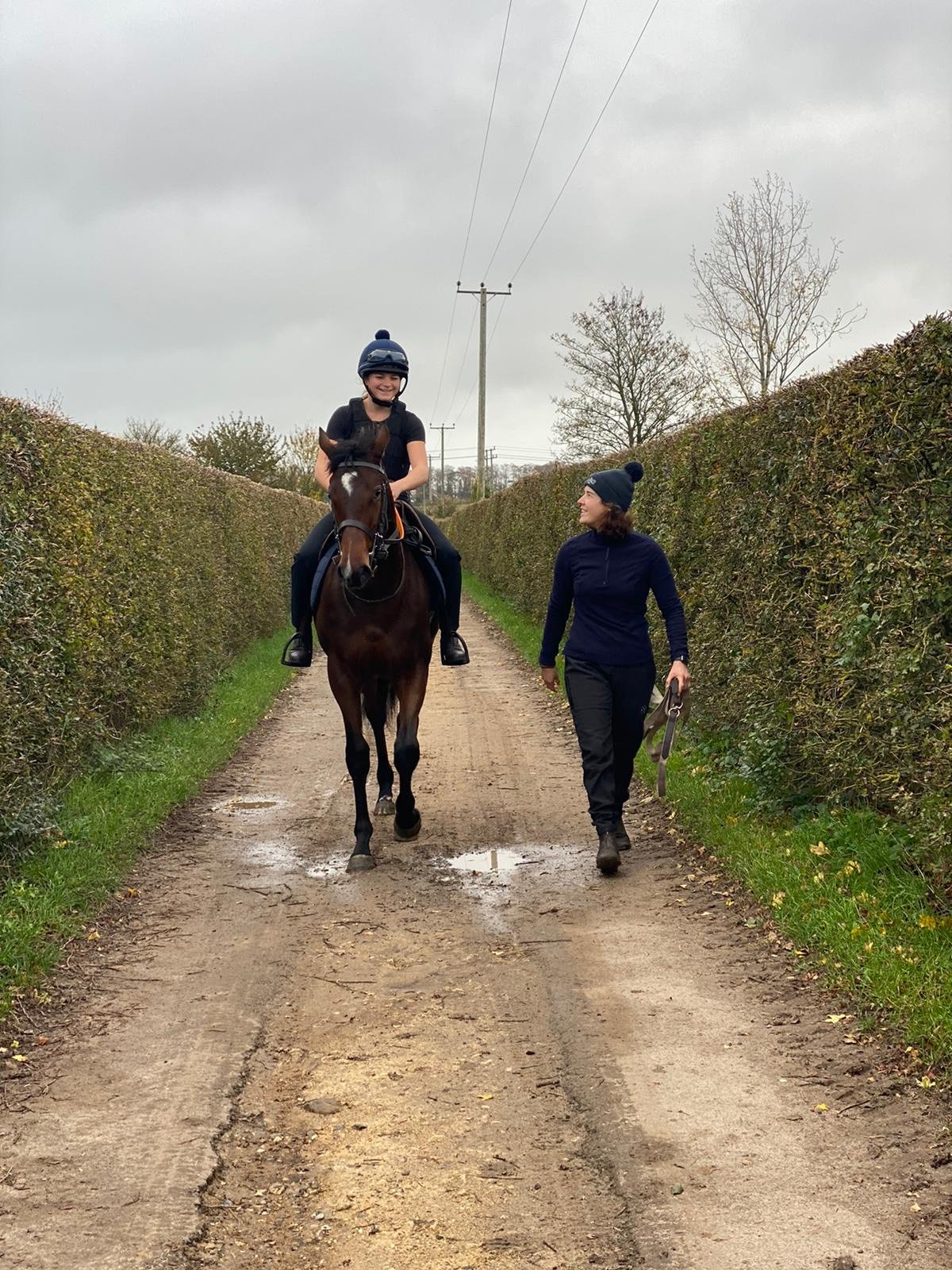
Ellie Whitaker (26) and Tegan Clark (33)
Ellie Whitaker (26) and Tegan Clark (33) set up WC Equine in September 2020, as the world was in Covid lockdown. It wasn’t ideal, but with Robert Cowell looking to let out a yard at Bottisham Heath Stud in Six Mile Bottom, just outside Newmarket, they took the plunge.
What has been so vital for them, given the difficulties in finding enough good staff, is that they are both hands-on, able to muck out and ride, with 35 boxes full. Between the two of them, they broke 64 horses in a five-month period.
Having Newmarket facilities was a considerable help in getting established quickly but so was the initial support of trainers Kevin Philippart de Foy and Roger Varian. They sent yearlings to break and pre-train, while Brendan Morrin of Pier House Stud utilised their services to prep some more for the breeze-ups.

Tegan Clark
Whitaker was working for Cowell at the time, having started out with Mark Dwyer, the former Gold Cup-winning pilot who is a wizard of the breeze-up realm and indeed, has enjoyed extensive success in tandem with Browne. She also worked for Charlie Appleby and among the horses she broke in was triple Gp. 1 winner and champion two-year-old, Pinatubo.
Meanwhile, Clark had worked for Varian. That early support allowed them to showcase their talents, with James Fanshaw and Sean Woods among new clients this year.
“Last year was the first year we managed to get a good client specifically for the breeze-ups,” Clark explains further. “We also bought a few ourselves and have shares here and there, but this is the first year people have rung us and put horses with us to specifically breeze; and we want to try and build on that this year to take those relationships and partnerships into the future.”
This was on the back of two notable successes at the Guineas Sale. In 2021, Royal Aclaim won a maiden within a month of being consigned by WC Equine for Pier House. She won twice more at three and though losing her unbeaten status in the Gp.1 Nunthorpe when favourite, she ran creditably in sixth and was placed subsequently at group level.

Having Newmarket facilities was a considerable help in getting WC Equine established quickly.
Twelve months later, Village Voice was sold. Not the same type of model, she holds an entry in the Irish Oaks for Jessica Harrington, after having just two runs in October, winning her maiden and finishing third in a Gp.3.
“You’ve got to be honest and educate the horses as well as you can so that they do have a lasting career within the sport. It’s brilliant to have a mature two-year-old that’s breezed, but then that’s going to go on and probably have a lovely three-year-old, if not four-year-old career with Jessie Harrington. She already has her black type. So as long as you keep producing that sort of quality, people take notice.”
Initially, all the yearlings go through the same routine, though never together.
“The breezers go through the same process as the pre-trainers from breaking until Christmas time. We give them all a break then; but when the breezers come back in, they have to start knuckling down. You can’t expect a pre-trainer to lay up with them because we are putting the breezers under pressure a lot earlier.”
“There’s a fine line,” notes Whitaker in relation to horses being pre-trained for owners and trainers. “We’re not here to physically break horses or to see how good they are. Our job is to get them through the breaking process and get them up to a path in the training process where they can go up to town (Newmarket) and go up Warren Hill with ease—get them to a business level.
“Every trainer is different, their standards are different and it’s about meeting their standards and what they require. At the end of the day, it’s a product we’re selling and that product needs to appeal to each individual. We’re equipping these young horses with the right tools; and if they can go into a training facility with the right sort of attitude—be calm and confident, we know we’ve done our job well then.”
In terms of the breeze-ups, with Browne owning most of those horses himself or in partnership with others, sourcing is key. He dabbles in buying foals with long-time ally Dwyer, but the majority are yearlings.
“The trouble with nice horses is they might not be racehorses. When we are looking now, we are looking for a completely different type of animal than that we used to look at 10 to 15 years ago. You’d buy a nice-looking horse, with a nice pedigree and if he breezes up with a nice action but maybe not going that quick, he’s compared against nothing else; and if they like what they see and if they like the movement and the horse’s page, and he’s good looking, you are going to get him well done.
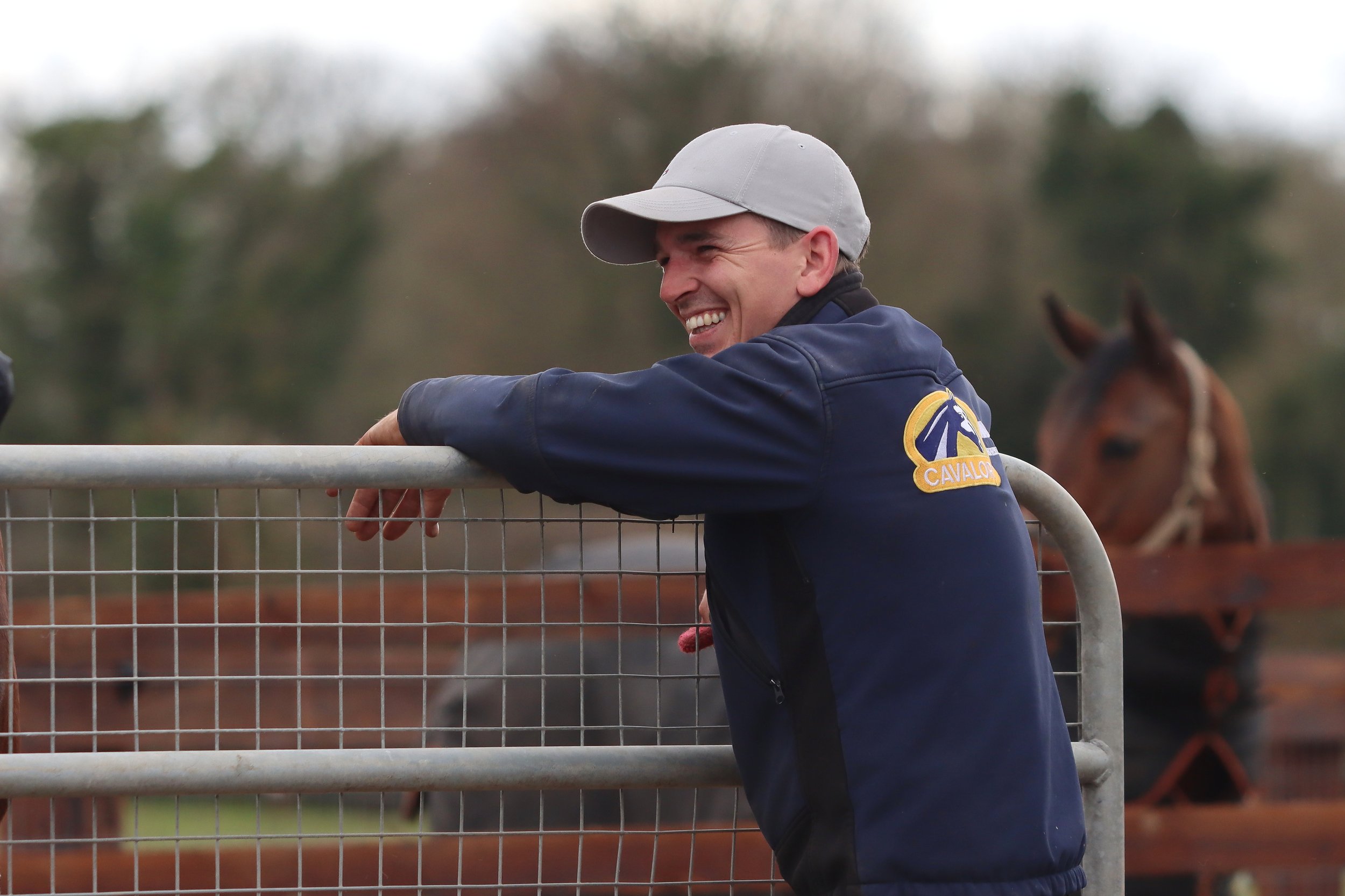
McCarthy learned from the likes of Dessie Hughes and Ted Walsh that stood him in good stead when he started breaking and pre-training
“Now I’ve a horse out there that I gave three hundred grand for, and he’s going to the sale in France. He’s by a sexy American sire Into Mischief, he’s training very well and we hope we’ve struck gold; but If he doesn’t breeze well, no matter how well he’s bred or how nice he is, you’ll get badly hurt.”
Nice horses are pricier than ever before, so Browne will prioritise the page and walk if he must. McCarthy suggests that at his price range, “you have to be lenient towards the page... I’ll focus on the individual.”
And while the breezers are pressed far more than pre-trainers because of the more immediate job they must do, McCarthy argues that you can’t make them faster than they are.
“You’re just trying to get the nice individual with the suitable and affordable pedigree, and then to keep them sound and watch their minds, as they are only two-year-olds and still developing.”
“We would be riding horses ten days after they came in,” Browne details his system for the breezers. “When you’ve big numbers, it is a matter of getting them done, but I wouldn’t say a word to somebody who is five or six weeks breaking a horse. There is nothing wrong with that; it’s good practice.”
Everyone agrees that good communication is crucial, be that in terms of honesty about the calibre of animal you are selling or being able to pass on as much information as possible to whoever is taking on a horse you have pre-trained.
In France, once again, it goes a little further.
“Sometimes clients will say, ‘I would like to go to this trainer with this horse’; but I might say, ‘I’m not sure, for this horse, it might be better to go to this one,’” Martineau reveals. “When you know the horses, you know what trainers might be suitable, and that gives the client confidence.”
Apart from staffing, increased costs is a huge challenge. Browne changes the wood chip on his gallop twice a year, and says it is 50 percent more expensive than before.
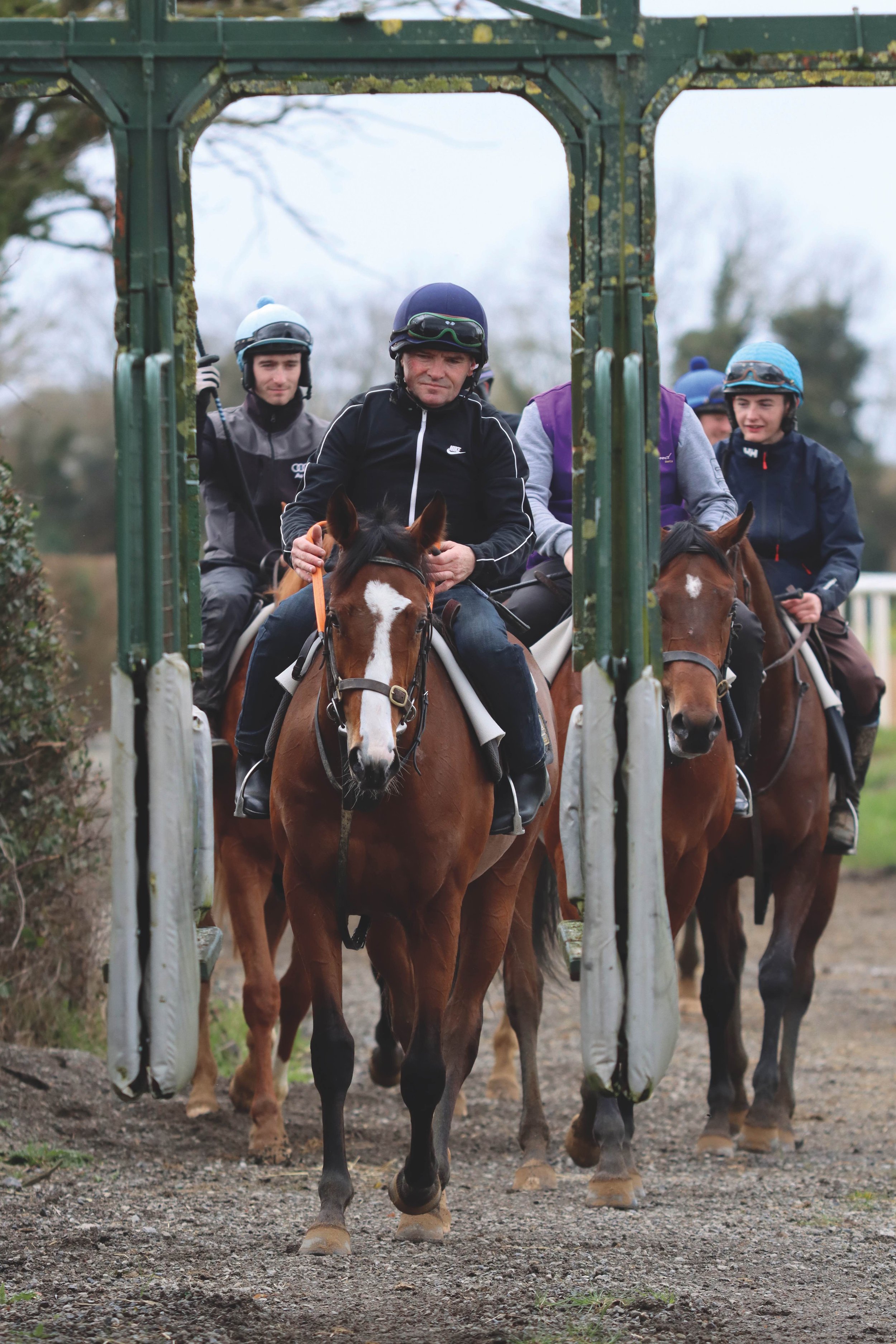
Martineau points out that the expenses are like those of a licenced trainer but that pre-trainers in France charge around €30–32 a day, while full trainers will get in the region of €70. Still though, he likes having a little more time and a little less pressure. The trade-off is worth it, particularly as the business has been built up now and is making money.
McCarthy offers a pragmatic tone abouts the price of everything rising. It eats into the bottom line, but it cannot lead to a reduction in the calibre of his service, given how appreciative he is of the loyalty shown to him by his various clients.
“The big thing for me is attention to detail,” McCarthy emphasises. “That is of the utmost importance through the entire process, and that starts with feed and every step of the way after that.
“Everything is more expensive now, but I look at it that you put in the best of what you need. You can’t cut corners. What you’re doing is educating young horses, and that’s how we see ourselves—as educators of young horses before they join the big boys and go into the next stage of their lives. You need to do everything right, no matter what it costs.”
It is interesting, given Wall’s criticism in particular, that McCarthy will have horses all year around, but that is imperative according to the Galway native, as you have to tailor your approach to the systems horses will be entering.
“For the different trainers we work for, we know their regimes and try to have the horse prepared for them to fit into their regime when they think they’re up to it. The ideal is for them to go in February, but it doesn’t always work like that as all horses are different.
“All the big trainers are going up in numbers. Early into the year and early into the Flat season, we’d be dealing with a lot of the backward two-year-olds and trying to organise them for trainers, giving an opinion of what’s early and of what wants a little more time. And the ones that want a little more time, we’ll be holding onto them and letting them progress and grow into themselves.
“Plenty of trainers would have a couple with me that are not going to be early two-year-olds. They’ll be built up and they’ll be rode in bungees to try [to] strengthen them up and put a top line on them. It’s basically strength and conditioning we’re doing with them.”

Browne states that even the horses he has pre-trained that are being sent to England will most likely go to another pre-trainer, due partly to offset fears of any bug being transmitted, but also because they are full.
“Chris Wall wouldn’t be mad about what we do, but I would go along with what he said about it helping the big trainers stock up,” Browne remarks. “You are taking away half a year’s livelihood from him by doing what you are doing.”
“Unfortunately, trainers don’t have the staff,” observes Clark. “We’ve got the room, we’ve got the availability, we’ve got the staff.
“We’ve got trainers in the hustle and bustle of Newmarket who send horses to us 10 minutes down the road. They might only use us for 10 or 14 days in the summer on grass, keep them ticking over; and then they go back in and are running straight off of that and are happy with the results. The horses are running well.”
And that’s the point. Be it breaking, pre-training, a little R&R, prepping for breeze-ups—the results speak for themselves.
“It’s about being calm and straight,” concludes Martineau. “The voice is always calm. I want my horses very calm and straight on the gallop. If that happens, they can go to the races anywhere and whenever you want.
“They are ready.”

"The Captain" - Cecil Boyd-Rochfort
Article by Jennifer Kelly

Captain Cecil Boyd-Rochfort
In the hours leading up to her coronation, Elizabeth sat deep in thought, quiet with contemplation. A lady-in-waiting saw the new Queen’s preoccupied countenance and asked her if all was well.
"Oh, yes,” Her Majesty replied, “the captain has just rung up to say that Aureole went really well."
On the precipice of great responsibility, the new monarch’s mind was not only on the serious matters of state, but on the Derby candidate she hoped would carry her colors to victory in a matter of days.
The man entrusted with Aureole’s preparation, the Irishman whose skills had inspired the confidence of a sovereign and the daughter that succeeded him, was Captain Cecil Boyd-Rochfort. The youngest son of a family known for its service to the Empire and a fondness for sport, Boyd-Rochfort spent his life with horses, a calling that took him from the countryside of County Westmeath, Ireland to the gallops of Newmarket and inspired the confidence of royalty from both sides of the Atlantic.

Aureole, and jockey Harry Carr before the 1953 Epsom Derby, where he eventually finished second, four lengths behind winner Pinza.
A life in sport
When Cecil Charles Boyd-Rochfort greeted the world on April 16, 1887, he was the last of Hamilton and Florence Boyd-Rochfort’s sons, joining brothers Arthur and Harold. His father had been a major in the 15th Hussars and had served as high sheriff of County Westmeath, Ireland, where the family made their home at Middleton.
There, the Boyd-Rochfort family hunted. They rode. They farmed. After his father’s early death, his mother bred horses and raised cattle, sheep, and pigs and even had a racing stable. Cecil carried this love of horses into his education at Eton, where he was an indifferent student, focused more on pedigrees and racing than his studies.
He attended the races along with his coterie of friends who were also keen for the sport. When Cecil left Eton in 1903, his next step was uncertain. His brother Harold encouraged his younger brother to follow him into military service, but Boyd-Rochfort was unwilling to commit, still awaiting his chance to work in racing. That came in 1906, when one of his heroes came knocking with an offer too irresistible to refuse.
Lessons from the best
Like Boyd-Rochfort, Henry Seymour ‘Atty’ Persse heard the siren’s call of the racetrack and followed it to a career as both a rider and a trainer. He finished third in the 1906 Grand National and soon after switched to training at his Park Gate stables near the village of Grately. In need of an assistant, Persse offered the job to the aspiring horseman.
The Irishman had long been a hero of Boyd-Rochfort’s, since the young man had seen Persse win the Conyngham Cup in 1897. Boyd-Rochfort’s tenure with Persse, though, was short, as the latter became the private trainer for Colonel William Hall Walker, the future Lord Wavertree, in 1908. He soon found a position with Colonel Robert Dewhurst’s Bedford Lodge in Newmarket. The young man so impressed his new boss with his knowledge of racing and breeding that Dewhurst allowed him to help with the business of running the stable and sent him with the horses running out of the Newmarket area.
When Sir Ernest Cassel sought a new racing manager, Boyd-Rochfort was suggested for the task. Alongside trainer William Halsey, he bought yearlings, learned more about keeping horses sound, and watched preparations for tries at the English classics. In 1912, Boyd-Rochfort bought a yearling by leading sire Desmond for 3200 guineas. The colt, later named Hapsburg, proved to be worth the price: he finished second in the 1914 Derby and then won the Eclipse and Champion Stakes. He later became a good sire, a testament to the young man’s eye for bloodstock. Boyd-Rochfort would not have long to enjoy his success as World War I prompted him to join the Scots Guard. Cassel promised that his job as racing manager would be there when he returned.
A good start
After the war, where his experience at the Somme had earned him the Croix de Guerre and a promotion, he returned to England as Captain Boyd-Rochfort, a title he would go by for the rest of his life. Back in Newmarket, he found Cassel’s racing stable in a sad state. Sir Ernest himself was in poor health and the stable reflected the same; they had only one win in 1917 and then none in 1918. After William Halsey retired, the captain found a new trainer for the ailing stable, but their fortunes did not improve.
However, the captain’s did. He connected with the American horseman and businessman Marshall Field III, heir to the Marshall Field department store fortune. Field was looking for a trainer for his English stable and Boyd-Rochfort volunteered for the job provided Cassel was open to it. Sir Ernest was cutting back his racing interests and gave the captain permission to work for Field as well.
One of the first horses the captain bought for Field was a filly named Golden Corn. At two, she won the Champagne and the Middle Park Stakes, a rare double achieved by greats like Pretty Polly, the Filly Triple Crown winner of 1904. Field and the captain had struck gold with one of the first horses he picked out for his new owner. Though Golden Corn showed her best at age two, her success promised much for the captain and his association with the American owner.
As Golden Corn was winning, the captain‘s grand year turned sad with the passing of Sir Ernest Cassel. He left the captain a year’s wages in his will, but it was not enough for a new yard for the fledgling trainer. Both his mother and Field lent the needed funds for the purchase of Freemason Lodge in Newmarket. With fifty stalls to fill, the captain took out his trainer’s license in 1923 and got to work.
On his own
That first year, Boyd-Rochfort trained for several owners, including his brother Arthur and Field. He won nineteen races, one of those a victory with Golden Corn in the July Cup at Newmarket. In 1924, he scored his first win in the Irish Oaks, the Irish equivalent of the Oaks at Epsom, with Amethystine.
Through his connection with Marshall Field III, Boyd-Rochfort soon had horses from more American owners, including William Woodward, a banker and chairman of the American Jockey Club, with whom the captain would win races like the Ascot Gold Cup and the St. Leger. In addition to Woodward and Field, his list of American owners counted some of the sport’s biggest names, like Joseph Widener, John Hay Whitney, cosmetics magnate Elizabeth Arden, and diplomat and businessman Harry Guggenheim.

1955 Fillies Triple Crown winner Meld.
Boyd-Rochfort soon picked up another important owner, Lady Zia Wernher. The daughter of the Countess Torby, a granddaughter of Alexander Pushkin, and Grand Duke Michael Mikhailovich, a grandson of Tsar Nicholas I, Lady Zia invested heavily in racing after her marriage to Sir Harold Wernher. For Lady Zia, the captain won the Ascot Gold Cup with Precipitation; the Coronation Cup with Persian Gulf; and the One-Thousand Guineas, the Oaks, and the St. Leger, the Filly Triple Crown, with Meld.
Boyd-Rochfort’s old friend Sir Humphrey de Trafford was another of his earliest owners and one that would stay with him the whole of his career. The captain trained Alcide, who won the 1958 St. Leger, and Parthia, who gave both men their only Derby victory in 1959. In addition to training for his old friend, Boyd-Rochfort made Sir Humphrey best man at his 1944 wedding to Rohays Cecil, the widow of Lieutenant Henry Cecil and mother of four sons, including Henry, who would follow in his stepfather’s footsteps.
To attract owners like Wernher and de Trafford and that cadre of Americans spoke to the skills and expertise that the captain offered, developed through tangibles like hard work and discipline and intangibles born of a life spent with horses.
The man behind it all
His prodigious success had its roots in a confluence of factors. He was brought up in a family with a lifelong interest in horses and racing. He was mentored by two former riders turned trainers who shared the benefits of their time in the saddle and their knowledge acquired while developing horses. The captain was keen to learn from others, from his earliest years at school studying racing and pedigree between lessons to those years with Persse, Dewhurst, and Cassel, where he took in the lessons of healing ailments, feeding the bodies and minds of the horses in his care, and any other topic related to racing and breeding Thoroughbreds. He was a patient trainer, focused on the horse as an individual and less on the expectations that might put his charge in the wrong race at the wrong time.
He was keen to hire the best and set them to the tasks needed to run the yard, but he also had his hands on the horses in his care. He trusted his employees to keep the rigorous schedule he set each day. He felt the legs of his charges, mandated soft water and weighed and measured specific feeding plans for each horse, and believed in long walks for his horses to warm them up for their exercise. He broke in horses at the Lodge in the early days and then later leased Heath Lodge Stud for that purpose. Trainer Sir Mark Prescott, who was a young assistant to Jack Waugh in the late 1960s, remembered that the captain’s horses “used to run in a sheepskin noseband, the lot of them and they always looked marvelous, something maybe a bit above themselves.”
At a given time, as his son Arthur remembers, he would have upwards of 65-70 horses and a stable of around twenty-five staff, from a farrier to a collection of exercise riders and jockeys, that were, as Sir Mark put it, well-mannered “like little gentlemen.” At 6’5”, the captain towered over most of his staff, and was, as his secretary Anne Scriven recalled, “a very stately Irish gentleman. Very upright, very Edwardian.”
“He would say, ‘You boy do that,’ even to [assistant trainer] Bruce Hobbs,” she shared. After winning the Grand National on Battleship, the youngest jockey to do so, Hobbs spent a decade and a half as Boyd-Rochfort’s assistant.
Arthur remembered his father as “being a Victorian and very upright. They were brought up in a different era then they were very strict in the yard, and everything was immaculate.”
“The captain was old school, aristocratic, he was completely confident in his superiority to most people,” Sir Mark remembered. “But he was always nice, very polite.”
As a trainer, he was an observation horseman and a stickler for detail and demanded the same of his employees. He eschewed gossiping on the Heath as some trainers were wont to do, preferring to watch his charges intently. The captain no doubt stood at attention watching one horse in particular for owner William Woodward, a long and lanky chestnut with a wide white blaze, a champion in America who was trusted to this singular conditioner for a tall task: winning the Ascot Gold Cup.
A challenge for the captain
Americans know Omaha as the third name on the short list of horses to have won the Kentucky Derby, the Preakness Stakes, and the Belmont Stakes, the American Triple Crown. Owner William Woodward’s aspirations were not limited to winning classic races in his own country, but also in England, the place where he cultivated his grand ambitions as a young man working for the American Ambassador Joseph Choate in the earliest years of the 20th century. One of the classics he aspired to was the 2½-mile Ascot Gold Cup.
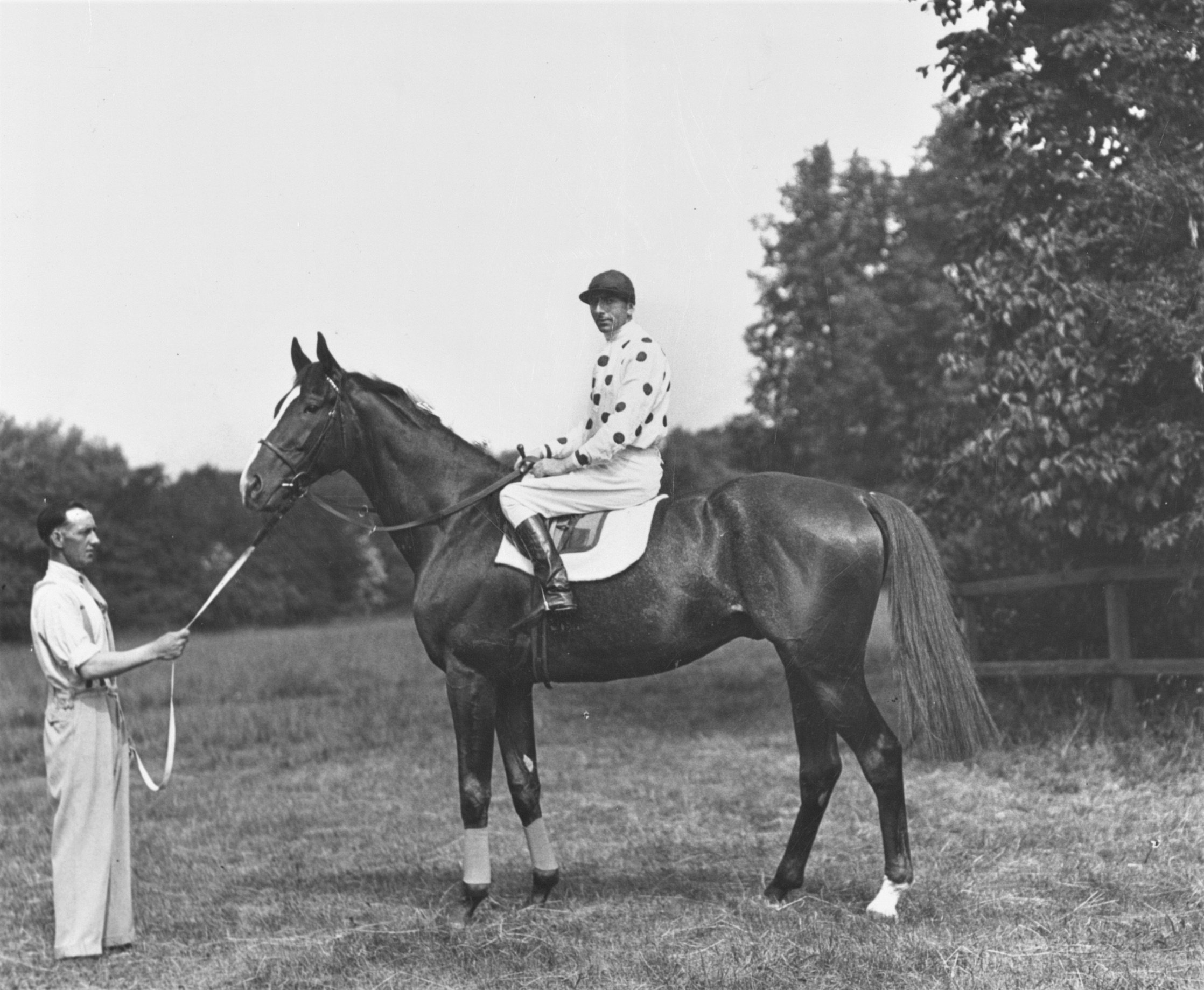
Omaha with jockey pat beasley and groom bart sweeney
Omaha’s three-year-old season had been cut short by injury, and, with his sire Triple Crown winner Gallant Fox already representing Woodward’s Belair at stud, the American did not need to retire his second Triple Crown winner. Instead, he took the risk of sending Omaha via the Aquitania to England, his ultimate destination Freemason Lodge. The Triple Crown winner was not the first Woodward had sent to the captain, but the task ahead of the trusted horseman could be considered somewhat of a titanic one: take a horse primarily trained on dirt, who had only raced counterclockwise and never more than 1½ miles and prepare him to run a mile longer clockwise on grass.
The captain would send the American horse on longer gallops, from a mile and a quarter to two miles at least once a week, building the colt’s stamina and giving him the chance to stretch out the long stride that had made him such a success at distances over a mile. Couple those regular gallops under Pat Beasley, the stable’s lead jockey, with the captain’s regimen of walking, water, and feed, and Omaha was quickly fit enough to easily win his first start in England, the 1½-mile Victor Wild Stakes at Kempton Park. Three weeks later, back at Kempton Park, he took the two-mile Queen’s Plate with ease. Clearly, the captain’s plan to acclimate and prepare the American horse for the Ascot Gold Cup was working.
In the Gold Cup itself, nearly three weeks later, the 2½ miles came down to the last two furlongs, as Omaha and the filly Quashed, herself an accomplished stayer, battled down the stretch. Anytime one pulled ahead, the other fought back, neither giving way until the very end. In what would be a photo finish today, the ultimate decision came down to judge Malcolm Hancock. The difference between the winning Quashed and the captain’s charge Omaha was a simple nose. That Omaha was able to come so far in such a short amount of time was testament to not only the well-bred champion but also Cecil Boyd-Rochfort, a horseman whose true brilliance came through in how he was able to sense and cultivate a horse’s potential.
It was this instinct about the individual horse, the care he put into their development, and the discipline he imbued into his staff and himself that brought him an opportunity afforded to few: a chance to train for the Royal Stable. First for King George VI and then for Queen Elizabeth II, he brought his beloved monarchs great victories, ones befitting a man who had made horses his life's work.
A royal opportunity
When Captain Cecil Boyd-Rochfort took over the Royal Stable, he had already been leading trainer in 1937 and won his share of both English and Irish stakes. As he went to work for the Royal Family, whom he greatly admired according to son Arthur, he was able to continue working with Lady Zia and Sir Humphrey as well as his American owners. With the Royal Stable, though, came some of his signature wins.
For the King, he won the Coronation Stakes at Royal Ascot with Avila, the One Thousand Guineas and the Dewhurst with Hypericum, and the Cesarewitch with Above Board. Days after Queen Elizabeth II’s coronation, the captain started Aureole in the Derby, seeking a Classic victory for the lifelong horsewoman. Aureole mounted a bid in the stretch but could not catch Pinza. Aureole would go on to win the King George and Queen Elizabeth Stakes at Royal Ascot the following year, giving the Queen her first victory on the Ascot Heath.

Captain Cecil Boyd-Rochfort and Queen Elizabeth II in the paddock at Kempton Park as she watched her colt Agreement being unsaddled after his victory in the Coventry Three Year Old Stakes.
Though the Derby would elude them, the captain would bring the Queen a Classic win in the Two-Thousand Guineas with Pall Mall. In all, he conditioned fifty-seven winners for the King, one hundred and thirty-six for Queen Elizabeth II, and three for the Queen Mother. As he approached his eighty-first year and the end of his time as a conditioner, the Queen made him a Knight Commander of the Royal Victorian Order for his service to the Royal Stable.
As he prepared his exit, the captain named his stepson Henry Cecil as his successor at Freemason Lodge. Cecil had been his assistant for four years, his education and experience preparing him to take the helm from his stepfather. Though his temperament differed from that of his stepfather and their relationship could be fragile at times, Henry picked up where the captain left off and crafted a Hall of Fame career of his own.
A legacy of excellence
Forty years after his death and a century after he took out his trainer’s license, Sir Captain Cecil Boyd-Rochfort lives on in racing’s record books, as the conditioner of champions and the mentor of a man named Cecil, the one who gave us Frankel in all of his glory. The friends of his time are all gone yet his regal bearing and enduring reputation for discipline and detail live on in the stories of the horses he conditioned.
His patience for developing horses yielded a trio of victories in the Ascot Gold Cup and a Triple Crown with a girl named Meld. It was his brilliance that capitalized on the untapped potential of Omaha, already an elite name in America, and brought him to the precipice of victory at Ascot.
The captain took his boyhood love of horses and turned it into his calling as a conditioner of champions for royalty on both sides of the Atlantic. Though his name may ring unfamiliar to 21st century ears, Cecil Boyd-Rochfort made his mark on the century that preceded it, etching his name into the record books many times over for King, Queen, country, and beyond.

The captain (left) and trainers Ben and Jimmy Jones with American Triple Crown winner Citation at Hialeah, c1949.
TopSpec Trainer of the Quarter - Tony Martin and Good Time Jonny
Article by Lissa Oliver

It might be hard for some to choose a single highlight from the Cheltenham Festival, but it was very easy indeed to single out a shrewd training performance by AJ (Tony) Martin, who is our TopSpec Trainer of the Quarter following Good Time Jonny’s fine win in the Pertemps Network Final Handicap Hurdle. Martin mapped a clever campaign to the Final and had the eight-year-old gelding spot-on for the day to secure Martin’s first win at the Festival since 2015.
Based in the tranquil Irish countryside at Trimblestown Stud in Kildalkey, County Meath, Irish handler Martin has the ideal facilities for both Flat and National Hunt horses. A successful amateur jockey in his day, Martin has now been training for over 20 years and has earned a reputation for getting the best out of his horses and for his patience at allowing every horse to progress at their own pace.
Just such a horse is Good Time Jonny, who notched two wins at Leopardstown in the 2021/22 season and promised enough to start in the Gr.1 Albert Bartlett Novices' Hurdle at last year’s Cheltenham Festival before being pulled up in the Gr.1 Novice Hurdle at Punchestown.
This season, his jumping let him down somewhat when he was tried over fences, although he managed a fourth place in the Beginners’ Chase at Listowel. Having lost his way a little, he bounced back with a qualifying run when third in the Pertemps Network Handicap Hurdle, enough to secure his place at Cheltenham in the Final. In between, he warmed up at Leopardstown, when hampered by a faller.
The ups and downs of jumping stood him in good stead, though. In the Final, Good Time Jonny lost ground at the start, was hampered by a second-flight faller and was just about last turning for home. Under a superb ride from Liam McKenna, he kept persevering and hit the front on the run-in to win, going away by three and a quarter lengths.

Martin was predictably delighted to land another Festival winner. “Days like this are the ones you live for. He was last at the top of the hill but Liam had the patience to sit and wait, and it turned out well," he says. "It’s been a few years now since we had a winner here, but it is worth the agony and the hardship. It’s absolutely brilliant. A bit of a gap makes it better!
“The horse has been coming along really well since Leopardstown last time, I just thought the ground might not suit him—he likes better ground, but he went through it well.
“We had a lot of good years and some bad luck, and it’s nice to be back with some good horses. They are not Gr.1 horses, but in their own category, they are all right. I have some great men, jockeys and staff behind me this year, and I’m just so happy for them. These colours, the Beneficial colours, have given us great days.
Product Focus
Three new products available for trainers this spring 2023
PAVESCO - TWYDIL® ARTRIDAY

NEW feed supplement for joints from TWYDIL®, Switzerland.
Since MSM has been registered as a controlled substance, we decided to launch on the equine market a product that can be used daily and long term.
Following our recent scientific investigations, it appears that the combination of chondroïtin, glucosamine, pro-anthocyanin and ASU brings an active and efficient support on the cartilage health and its functionality.
ASU means « avocado and soybean unsaponifiable fatty acids ». This extract is particularly efficient for the stabilisation of the cartilage extra-cellular matrix, bringing a noticeable preventive effect. The combination of these ingredients have an effect on all parts of the joints: cartilage, synovial fluid and membrane. The pro-anthocyanin fraction has a powerful anti-oxidant property with a high tropism for joints, so breaking the vicious circle conducting to lameness.
Horses show an improvement of their general suppleness and of their stride. The well-being is also taken into consideration because training is better tolerated.
50g daily for 30 days minimum is recommended to observe an improvement. It may be needed to continue for a longer period in sensitive horses.
The product is available in 1.5 kg pails.
For more information visit: www.twydil.com
NAF Five Star Metazone
By Dr Andy Richardson BVSc CertAVP(ESM) MRCVS, Veterinary Director at NAF

Whatever the challenge, keep your yard ‘in the zone’ with NEW NAF Five Star Metazone.
Metazone has been formulated by the Veterinary and Nutrition experts at NAF and is an innovative, evidence based nutraceutical that targets the support of natural anti-inflammatory pathways in all racehorses. The synergistic blend of plant based phytochemicals that make up this product support these pathways wherever they are needed in the body - whether that be for joints, hooves, tendons, ligaments, muscles or skin. The unique herbal complex of Metazone works in synergy wherever those triggers occur within the system, to ensure we maintain freedom from discomfort. Maintaining optimum comfort ensures racehorse welfare and provides an optimal environment for recovery and maximising athletic potential.
Unwanted or excessive inflammation is a major issue for the well-being and performance of horses in training and a major cause of lost training days and missed races. Metazone is the culmination of many years of research and knowledge gathered by the scientific team at NAF on how plant based phytochemicals can positively influence the body.
Formulated specifically to manage, relieve and control, Metazone provides nutritional support for common issues that may interrupt a training schedule. Metazone supports a horse’s natural anti-inflammatory responses, which are often under maximum stress when in training, helping them to stay sound through periods of repeated, strenuous exercise. The product is suitable when a short term boost is needed but may also be used for long term daily administration when comfort is key. The natural formula is gut kind and designed to work effectively without compromising gut health. It can be fed alongside any other NAF product that will support underlying structures as required.
Independently trialled, Metazone has been robustly trialled by equine researchers at The Royal Agricultural University, Cirencester in a blinded, cross-over designed trial, and assessed by a panel of external vets. Real results research also includes trials with leading trainers, who have all seen the benefit of getting their horses ‘in the Metazone’.
Metazone is available as a fast-acting liquid, in an instant use syringe and as palatable powder. The liquid comes in 5L and 1L sizes with the syringes available as 3 x 30ml and the powder is in a 1.2kg tub.
For more information on pricing and the product, contact NAF’s Racing Manager Sammy Martin on 07980 922041 or smartin@naf-uk.com.
Plusvital - Neutragast
Plusvital Neutragast is now available in pellets.
Ideal for fussy eaters, Neutragast Pellets promote gastrointestinal health in convenient & palatable soy protein base pellet form.
Using research proven ingredients to promote digestive performance the pellets contain key ingredients boswellia extract, calcified seaweed, saccharomyces cerevisiae and provides a source of B vitamins to help with food metabolism.
Boswellia extract (Terepenes and Boswellic acids) have been shown to have several beneficial effects including anti-inflammatory and analgesic properties. Boswellia compounds have been shown to be of benefit in cases of intestinal inflammation. This is achieved through modulation of the inflammatory cell (leukocyte) response.
Calcified seaweed has been reported to have a positive effect on buffering of pH in equine stomachs. Presented in the form of Lithothamnium Calcareum this acts as a safeguard against excess acid within the stomach.
Additionally Plusvital Neutragast Pellets contain the amino acid Threonine which is one of the main amino acid components of the protein mucin. Mucin forms a gel-like structure which makes up the mucosal barrier that protects the stomach wall against its own acidic secretions.
Saccharomyces cerevisiae (active yeast) is a probiotic which promotes intestinal health through multiple pathways including increased fibre digestion.
As it is a pellet supplement it works well with pelleted feed or straight feed concentrates and can be used as part of a daily routine.
For more information visit: www.plusvital.com
Sarah Steinberg - One of Germany’s up-and-coming trainers
Article by Catrin Nack
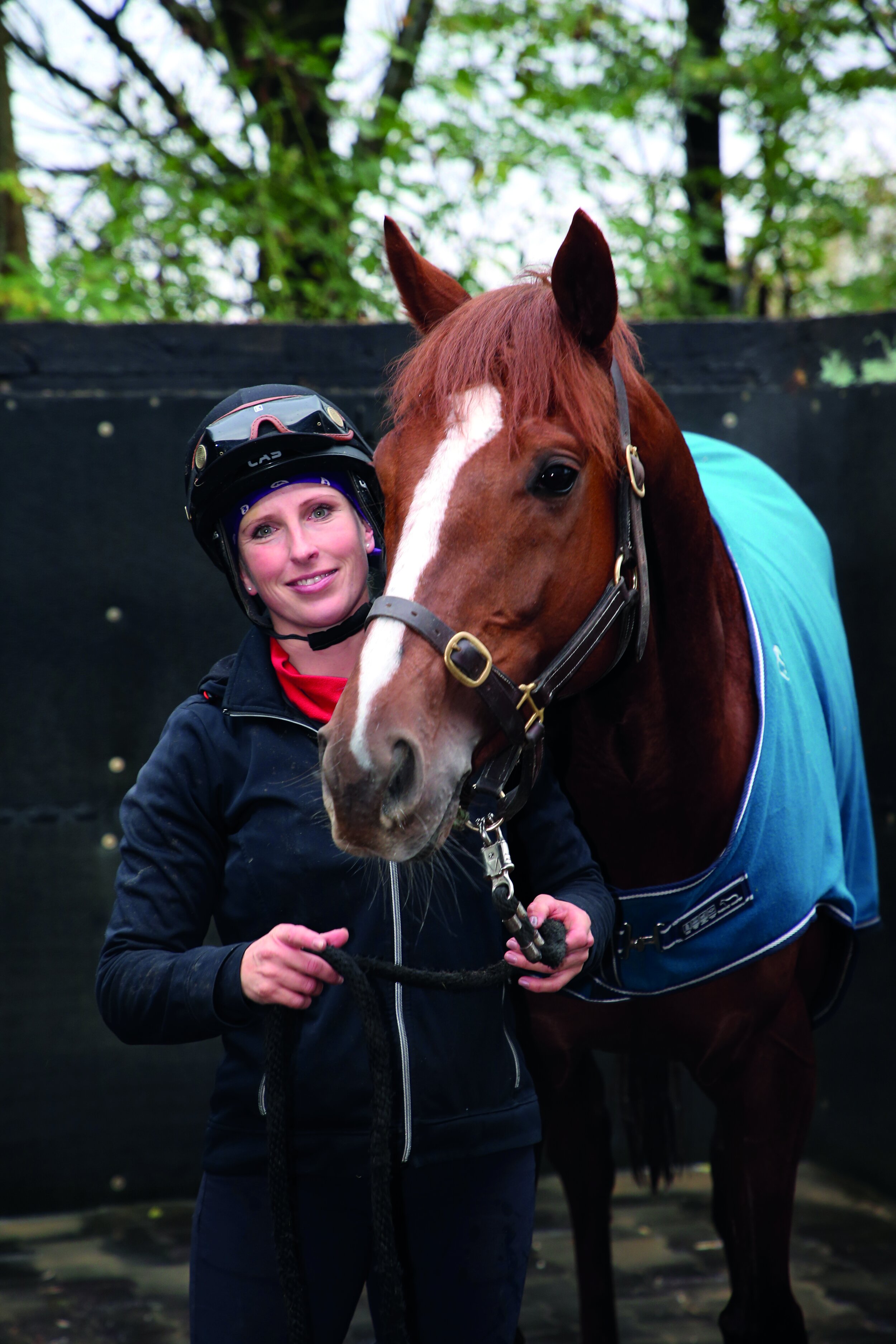
Compared with leading European racing nations, Germany's figures are very small indeed. Roughly 2200 horses, trained by 70 licensed trainers are trained here. With a big chunk trained by a chosen few – think Marcus Klug, Henk Grewe, Andreas Wöhler or Peter Schiergen – the numbers for smaller stables become smaller still.
Few trainers train more than 100 horses at the best of times; the ‘powerhouse’ yards with 150+ or even 200+ horses – which are so common nowadays in England, Ireland and France – are simply non-existent in a racing country constantly boxing above its weight.
As does Sarah Steinberg, no pun intended.
Sarah Steinberg´s official training list comprises 26 horses, three of which are her own. This is small even by local standards. Sarah Steinberg makes no excuses: “I do not want to train more than 35 anyway.” Small, but brimming with quality, it is quality horses that she strives to train. “My owners do not want runners in low (rated) handicaps, and for them I do not want that either. We think big and aim big”
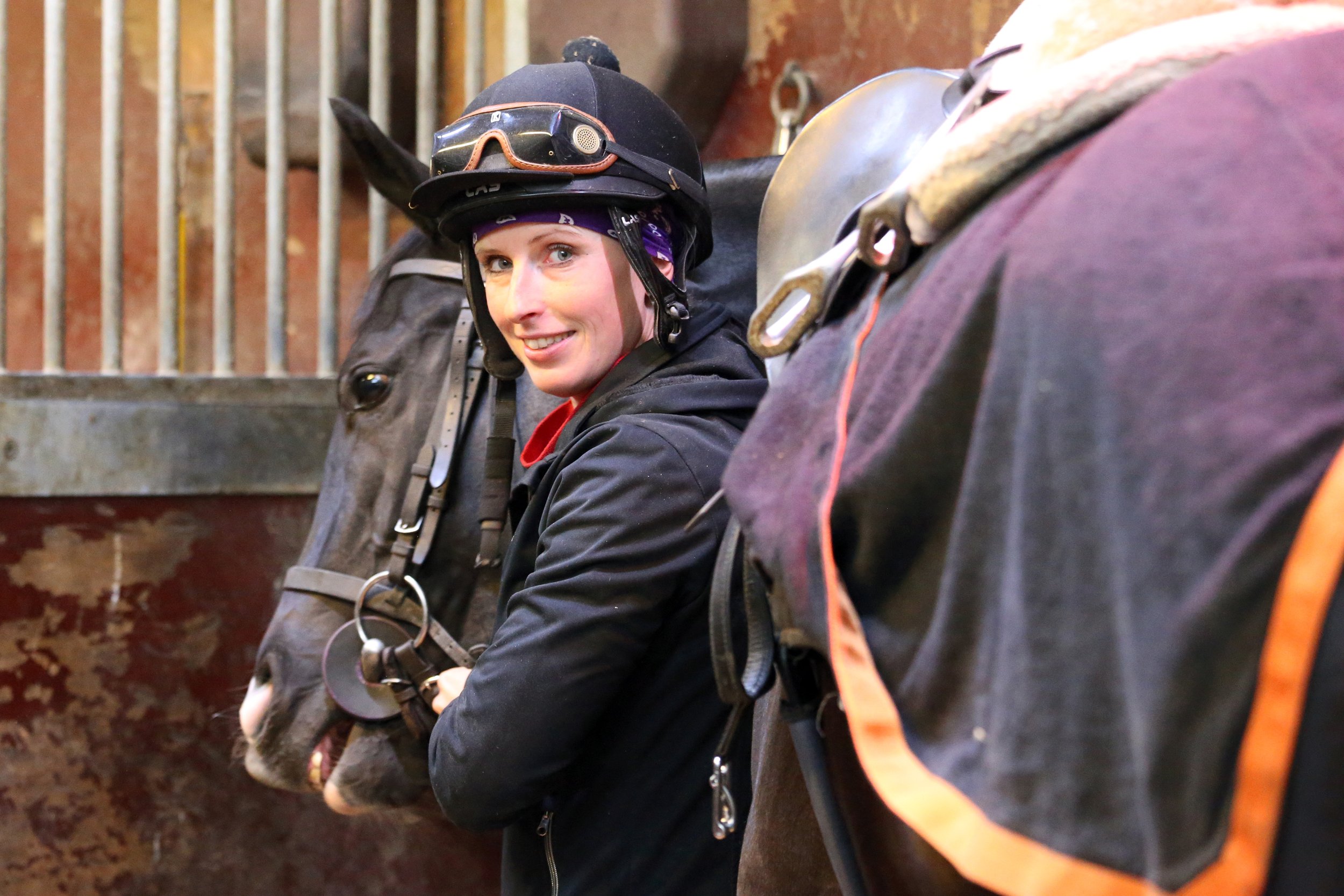
Steinberg is a salaried trainer, employed by the RTC Rennpferde Trainings-Center GmbH. The name behind the entity is that of Hans-Gerd Wernicke, a 93-year-old manufacturer of quality sleeping systems.
His company Wenatex was founded in Salzburg, and it is under that name that his horses race. Stall Salzburg has 13 horses in training – thus comprising 50% of Steinberg’s inmates.
A further five are owned by Brümmerhof Stud, a major owner-breeder and supporter of German racing. Famous as the breeder of Danedream – and infamous for selling her early in her 2yo season - Brümmerhofs Gregor Baum just closed his own private training facility in Hannover. His link to Sarah Steinberg could well point to her future. But let's look back into her already remarkable journey in racing before we dare to look into the future.
Sarah Steinberg is 34 years old, with no family ties in racing whatsoever. Her aunt kept Arabian horses, and early memories consist of watching the Germany Derby on TV; but she can’t recall her first Derby winner, “I wasn’t really interested, and I certainly did not catch fire early on.” Animals – horses and dogs – were part of her upbringing; and while circumstances were traumatic, the following story is early proof of the unusual dedication and commitment to the creature. “My father had a very serious accident. He was hospitalised for months and had to spend long weeks in rehabilitation after. This meant I had to look after the 30 Huskies (we owned) for more than a year, otherwise they would have been given away.” Steinberg was just eight years old.
She was given a holiday on a pony farm for a job well done after, and it was then that her fascination for horses took root.
Her education with horses was classic and western style. Racing came into her life by default rather than design. Yet again, it certainly wasn’t love at first sight.
With her parents pressing for a solid education, her growing passion for horses got in the way. A small local permit holder with eight horses – Steinberg had answered an advert in a local (non-racing) paper – could not provide the structure they desired.
But Germany's formal education system – even in racing – led to a visit to Cologne, still the administrative centre of German Racing. Here she was taken on by Andreas Trybuhl, son of a racing family and the first proper trainer who spotted her talent. Steinberg was on her way.

Well, sort of. It wasn´t that Deutscher Galopp had waited for a young female rider, with fancy ideas at that. Steinberg rode in a couple of races. Nineteen rides and two wins are hardly the stuff of legends. She then plied her trade as a work-rider — in big yards.
Leaving Trybuhl, she worked for Peter Schiergen, had a short stint with Marcus Klug and was riding out for Jens Hirschberger when he trained Adlerflug. But Steiberg was still ‘just’ a work-rider nonetheless.
When the opportunity came, Steinberg grabbed it with both hands. Enter Hans-Gerd Wernicke. By the time their paths crossed, Wernicke had been an owner for nine years, with group performer Poseidon Adventure and the wonderful Gp1 winner Night Magic – both trained in Munich by Wolfgang Figge.
Figge retired at the end of the 2015 season, and Wernicke was on the lookout for a new trainer. Again, it was an advert that changed the course of Steinberg’s life.
“I thought I really had nothing to lose. But I had nothing to recommend me either – no references, no proper job description to boost. After all, I was only a work-rider.” Wernicke liked what he read – liked even better what he heard when Steinberg detailed her ideas about training and didn’t ponder for long. It didn’t take Steinberg long to prove just how good of a choice she had been, either.
It wasn’t that Wernicke approached his new, young trainer with starry eyes. He was prepared to give her a chance, but at first it was with horses for whom she was second choice – horses from other yards, who for whatever reason didn’t, or couldn’t, fulfil their potential.
Night Wish, in March 2016, was her first winner as a fully fledged trainer; he was only the second starter she sent out. Better was to come when Night Wish again read the script and became her first pattern scorer when taking the Grand Prix de Vichy (Gp3) later that year.
In seven full seasons Steinberg has now, at home and abroad, trained 124 winners, 14 of them Group winners. This year she operated at a nearly 30% winner-to-starter ratio in her native Germany. She has trained a Classic winner in Fearless King (German 2000 Guineas, Gp2) – the first female trainer to do so in Germany – and Mendocino, was her first Gp1 winner, when scoring in German´s most prestigious open-age Gp1, the Großer Preis von Baden this past September.
Trainers simply do not come more hands-on than Sarah Steinberg. She rides six lots a day, she grooms, and she drives the horsebox. She even, unique among her peers, leads up nearly all her charges.
Finding good staff is a challenge even she cannot resolve, but Steinberg is the first to admit she isn’t easy to work for either. “I expect a lot and cannot tolerate mediocrity. I had to learn that I simply cannot expect employees to work as hard as I do.”
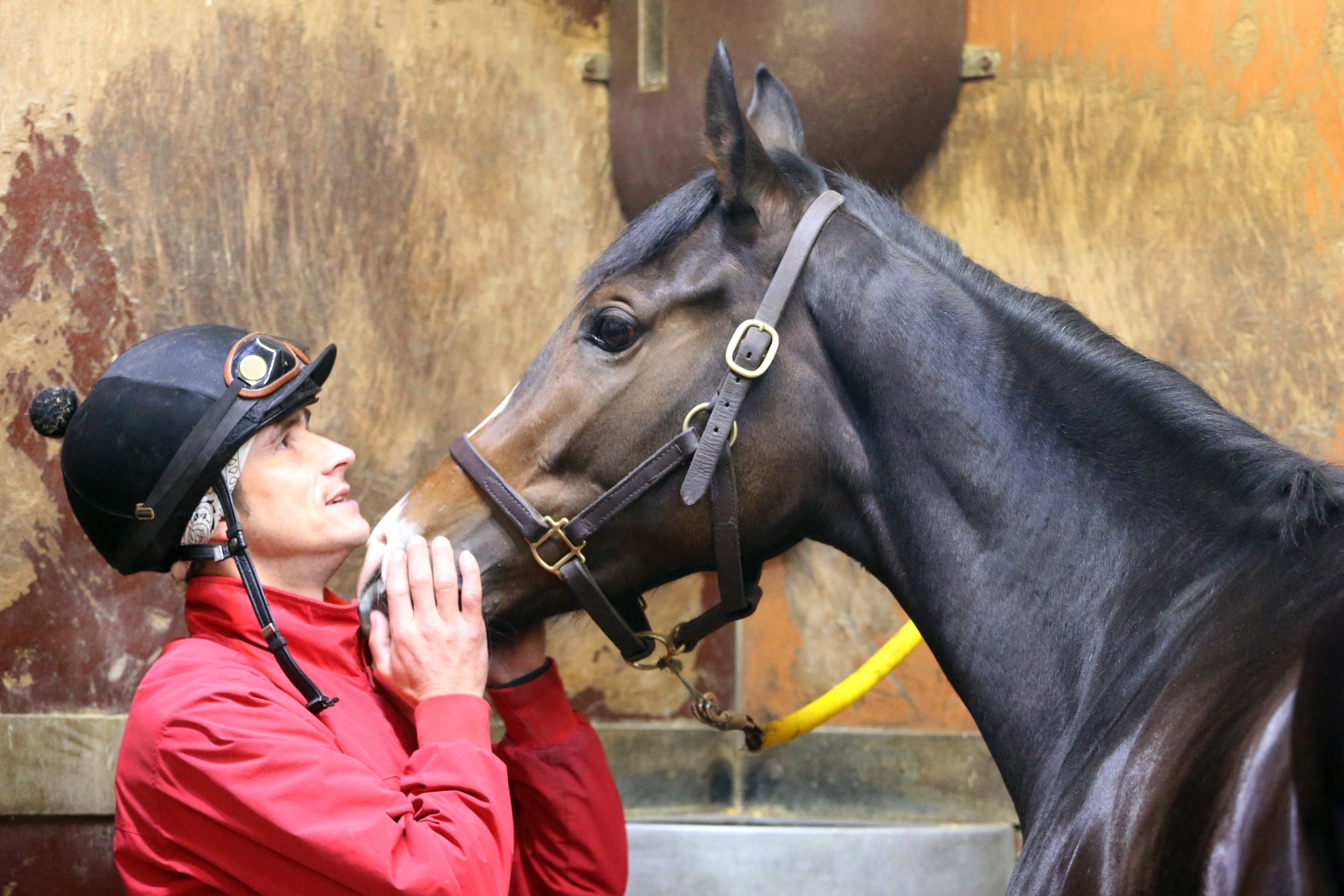
Invaluable assistance comes in the shape of René Piechulek, of Torquator Tasso-fame. The jockey's rise to fame is worth its own chapter, but he started riding out for Steinberg at the end of 2017, becoming attached to Stall Salzburg in the process.

With no chances of foreign jockeys, COVID accelerated his rise to salaried stable jockey. And he did become attached, quite literally, to Sarah Steinberg as well; they are life partners now.
“René is invaluable – simply irreplaceable to the yard; I simply could not do it without him. I am the trainer after all, he does as I tell him, but I would be lost without his feedback.” For Steinberg, training horses is a mission. With her background in classic riding, it is small wonder that above-average riding skills are essential for her staff.
“Horses need to use their backs, and they can only do this if they bend their necks properly. So much damage is done when horses do not use themselves right.”
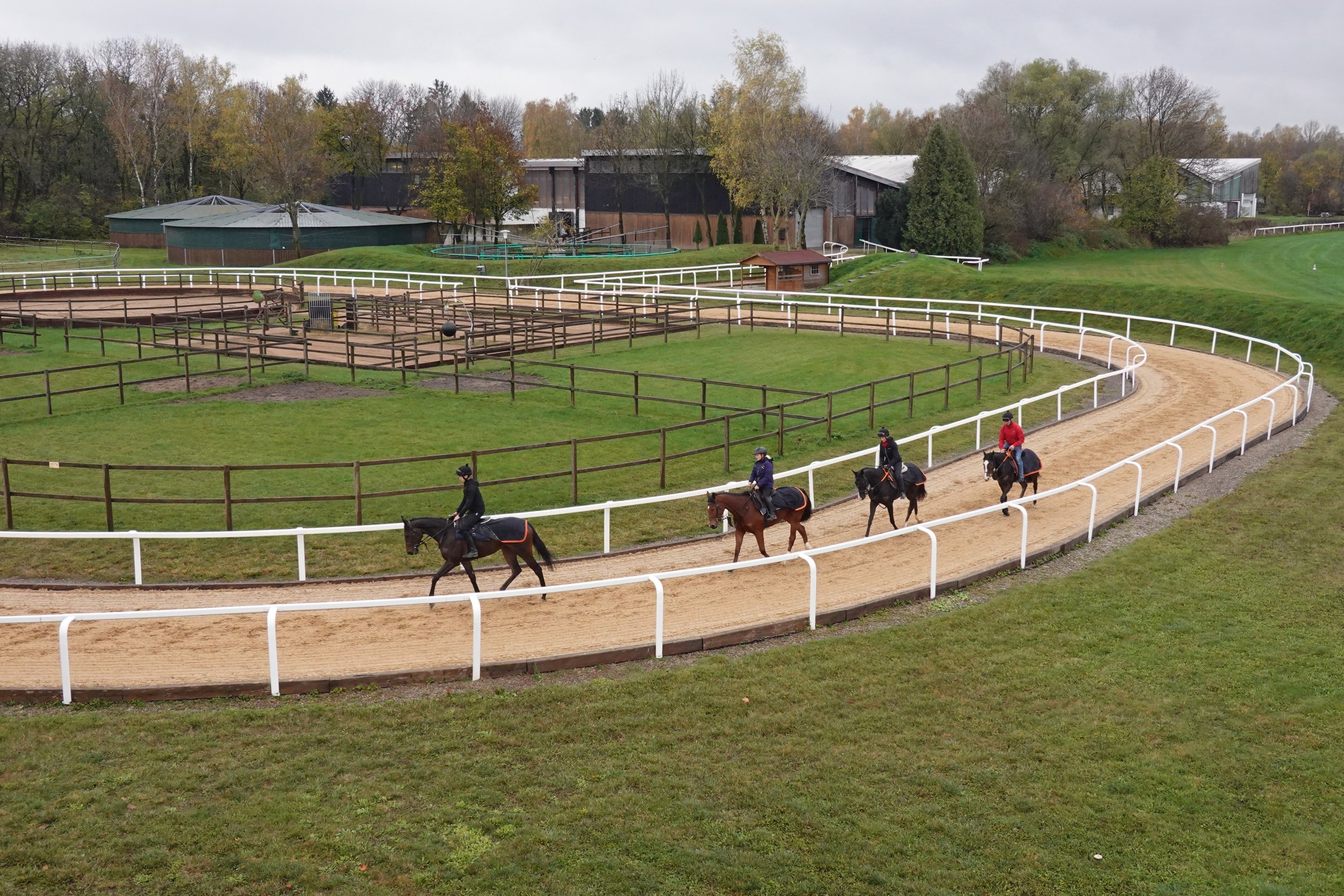
On average, her horses are ridden about an hour a day, with an additional four hours spent in one of the six (four grass) paddocks. Daily, that is.
With few exceptions, racehorses in Germany are trained directly on the racecourse – Munich in Steinberg´s case – a base she cannot praise highly enough.
Crucially, Munich´s training centre is right next to the track itself with long and well-maintained grass and sand gallops, and with only a handful of trainers sharing those facilities.
Wernicke's generous approach and competitive nature developed just what Steinberg wanted in their own stables. “I really have everything I need; it’s top class. I have my private trotting ring; there is a covered hall. I have a salt box, which I use to great effect, and two solariums. The open country next to the training tracks is another plus; we have choices and can give the horses a change of scenery.”
She works closely with her trusted vets and a chiropractor, not to mention a top-class farrier. Conveniently, the RTC GmbH comes with a racing secretary too, so the time Steinberg has to spend in the office is very limited indeed.
“Really, I would never want to work self-employed. My system simply would not work with all those pressures attached.” Individuality is the key. “Of course, the basic work is the same for all horses, but the individuality starts creeping in once horses start showing their quirks. We love to get to the bottom of problems and want to bring the best out of every horse in our care.”
Remarkably, three of her 26 inmates have a German GAG (rating) of 90 or higher – roughly 106 plus in International ratings. Nowadays, Steinberg is responsible for selecting youngsters at the sales. Wernicke is a racing man and not a breeder.
The stable's flagbearer for the last couple of years has been the above-mentioned Mendocino, bred by Brümmerhof Stud and a son of the late Adlerflug.

Selected by Steinberg, he represents all she looks for in a horse. “I look at horses, not pedigrees. In fact, I couldn’t care less about the breeding. I need to see the horse's personality. I try to read their eyes, and how they play with their ears tell me something too. They need to be alert – lively. I don’t like the docile ones. A shorter back and strong back hands are essential to me, but I can forgive small mistakes if I feel the attitude is right. After all, it's all down to their character and their will to win.”
Offspring of the much missed sire Adlerflug, present their own challenges, but in Mendocino, Steinberg has found a horse of a lifetime.
The now 5yo has won three races from 11 starts and has provided Steinberg with that all-important win at the highest level, and he did take his team to Paris Longchamp on the first Sunday in October.
“I am accredited as his ‘lass’ and ride him myself every morning.” She rejects the notion that surely she will not lead him up when competing in a big race.
“Of course I will,” she muses. Steinberg has lost count of the winner´s ceremonies she missed because of her role as a ‘lass’ – something Wernicke had learned to accept. “He was a bit miffed when I kept skipping the ceremonies because I wanted to be with the horse after the race, so I pointed out that it's better to have those winners and no trainer, or not so fast horses. He can see the humorous side now.”
The whip-debate and animal welfare put extra pressure on German racing. Steinberg has a clear view on both: “The whip is essential – a life-saver for riders. With the short stirrups, we need it to correct but never to abuse. We need strict rules and even stricter penalties. As for animal welfare, I am in the game because I like horses – we all do. We like them, and we want the best. Performance is no cruelty to horses, and I firmly believe the majority of racehorses couldn’t be better cared for. There are black sheep in all walks of life, and much more must be done to educate about the good work that is done away from the public eye.”
Steinberg is realistic enough to wonder what the future holds, even though Wernicke shows no signs of stopping. The recent trip to Hong Kong (with Mendocino) came at Wernicke’s insistence and was Germany's sole representative.
There is no happy ending to report, as Mendocino proved worth his billing as a “character.” After behaving beautifully in the preliminaries, he reared in the starting stalls and refused to jump with the field – the first time he has shown such antics. But Steinberg wouldn’t be Steinberg if she wouldn’t rise to this challenge too.
Artificial Intelligence tools - and their growing use in racing

Book 1 of the Tattersalls October Yearling Sale is traditionally where some of the finest horseflesh in the world is bought and sold. The 2022 record-busting auction saw 424 lots pass through its hallowed rotunda for a total of 126,671,000 guineas. One of the jewels in the crown was undoubtedly lot 379, a Frankel colt out of Blue Waltz, who was knocked down to Coolmore's M.V. Magnier, joined by Peter Brant, for 1,900,000 guineas.
It is easy to see why lot 379 made Coolmore open its purse strings. He has a stallion’s pedigree, being out of a Pivotal mare. His sire has enjoyed a banner year on the track, with eight individual Gp/Gr1 winners in 2022. He is a full brother to the winning Blue Boat, himself a 450,000 guineas purchase for Juddmonte Farms at Book 1 in 2020. Lot 379 is undeniably impressive on the page.
But it is not his impeccable pedigree that makes Tom Wilson believe lot 379 has the makings of a future champion. “The machine doesn’t have any biases. It doesn’t know whether it’s a Galileo or a Dubawi or a Havana Grey,” he says. “The machine just looks at the movement of the horse and scores it as it sees it. It has no preconceptions about who the elite sires in the market are. It’s completely neutral.”

The “machine” to which Wilson is referring is, in reality, a complex computational model that he claims can predict with 73 percent accuracy whether a horse will be elite (which he defines as an official rating of 90 or above, or the equivalent in its own jurisdiction) or non-elite (horses rated 60 or below) based on its walk alone. It’s a bold claim. So how does he do it?
First, Wilson taught an open source artificial intelligence tool, DeepLabCut, to track the movements of the horse at the walk. To do this, he fed it thousands of hours of footage. He then extracted around 100 frames from each video and manually labelled the body parts. “You teach it what a hock is, what a fetlock is, what a hip is,” he explains. “Eventually, when you feed new videos through, it automatically recognises them and plots the points. Then you can map the trajectories and the angles.”
He then feeds this information into a separate video classification algorithm that analyses the video and compares it to historic data in order to generate a predicted rating for the horse. “Since 2018, I’ve taken about 5,000 videos of yearlings from sales all around the world with the same kind of biometric markers placed on them and then gone through the results and mapped what performance rating each yearling got,” he says. “So we’re marrying together the video input from the sale to the actual results achieved on track.”
Lot 379 has a projected official rating of 107 based on his biomechanics alone, the highest of all the Frankel’s on offer in Book 1 (yes, even higher than the 2,800,000 gns colt purchased by Godolphin). Wilson’s findings have been greeted with scepticism in some quarters. “There’s so many other factors that you can’t measure,” points out trainer Daniel Kübler. “There’s no way an external video can understand the internal organs of a horse, which you can find through vetting. If it’s had an issue with its lungs, for example, it doesn’t matter how good it looks. If it’s inefficient at getting oxygen into its system, it’s not going to be a good racehorse.”
“It’s not a silver bullet,” concedes Wilson. “There are multiple ways to find good horses. It’s just another metric, or set of metrics, that helps.” But is it really “just another metric,” or the opening salvo in a data revolution that has the potential to transform the way racehorses are bought and sold?

Big data. Analytics. Moneyball. It goes by many names, but the use of data in sports is, of course, nothing new. It was brought to popular attention by Michael Lewis in his 2003 book Moneyball and by the 2011 film of the same name starring Brad Pitt.
It charted the fortunes of the Oakland Athletics baseball team. You know the story: Because of their smaller budget compared to rivals such as the New York Yankees, Oakland had to find players who were undervalued by the market. To do this, they applied an analytical, evidence-based approach called sabermetrics. The term ‘sabermetrics’ was coined by legendary baseball statistician Bill James. It refers to the statistical analysis of baseball records to evaluate and compare the performance of individual players. Sabermetrics has subsequently been adopted by a slew of other Major League Baseball teams (in fact, you would be hard pressed to find an MLB team that doesn’t employ a full-time sabermetrics analyst), and ‘moneyball’ has well and truly entered the sporting lexicon on both sides of the Atlantic.
Take Brentford FC. As recently as 2014, the West London club was languishing in the third tier of English football. Today, Brentford is enjoying its second consecutive season in the top flight (Premier League), bucking the trend of teams that gain promotion only to slingshot back down to the lower leagues after one season.
What is their secret? Moneyball. Brentford’s backroom staff has access to vast streams of data that detail how their players rank across a number of key metrics. This information helps them make day-to-day training ground decisions. But crucially, it also shapes their activity in the transfer market by helping them to identify undervalued players to sell on for a profit. Players such as Ezri Konsa, purchased from Charlton for a rumoured £2.5 million in 2018 before being sold, one year later, to Aston Villa for a £10 million profit. Think of it as the footballing equivalent of pinhooking.
The bottom line is that data analysis has already transformed the way athletes are recruited and trained across a range of sports. It stands to reason, therefore, that statistical modelling could help buyers who are spending, on average, 298,752 guineas for a yearling at Book 1 make informed purchasing decisions.
“I’ve always been interested in applying data and technology to an industry that doesn’t exactly embrace technology.” That’s according to star bloodstock agent Bryon Rogers. Rogers is widely regarded as the godfather of the biometrics movement in racing. “The thoroughbred industry is one that moves slowly, rather than quickly,” he adds, with a dash of irony.
Having cut his teeth at Arrowfield Stud in his native Australia and Taylor Made Farm in Kentucky, in 2011 he started his own company, Performance Genetics. As its name implies, the company initially focused on DNA sequencing, attempting to identify markers that differentiated elite and non-elite horses.
From there, it branched out into cardiovascular and biomechanical research. Rogers quickly discovered that it was the biomechanical factors that were the most influential in terms of identifying future elite horses. “When you put all the variables in, the ones that surface to the top as the most important are actually the biomechanical features: the way the horse moves and the way the horse is constructed. They outweigh DNA markers and cardiovascular measurements,” he explains.
According to Rogers, roughly a fifth (19.5 percent, to be exact) of what makes a horse a horse is explained by the way it moves. “That’s not to say that [those other factors] are not important. It’s just that if you’re ranking them by importance, the biomechanical features are more important than the cardiovascular ones.”
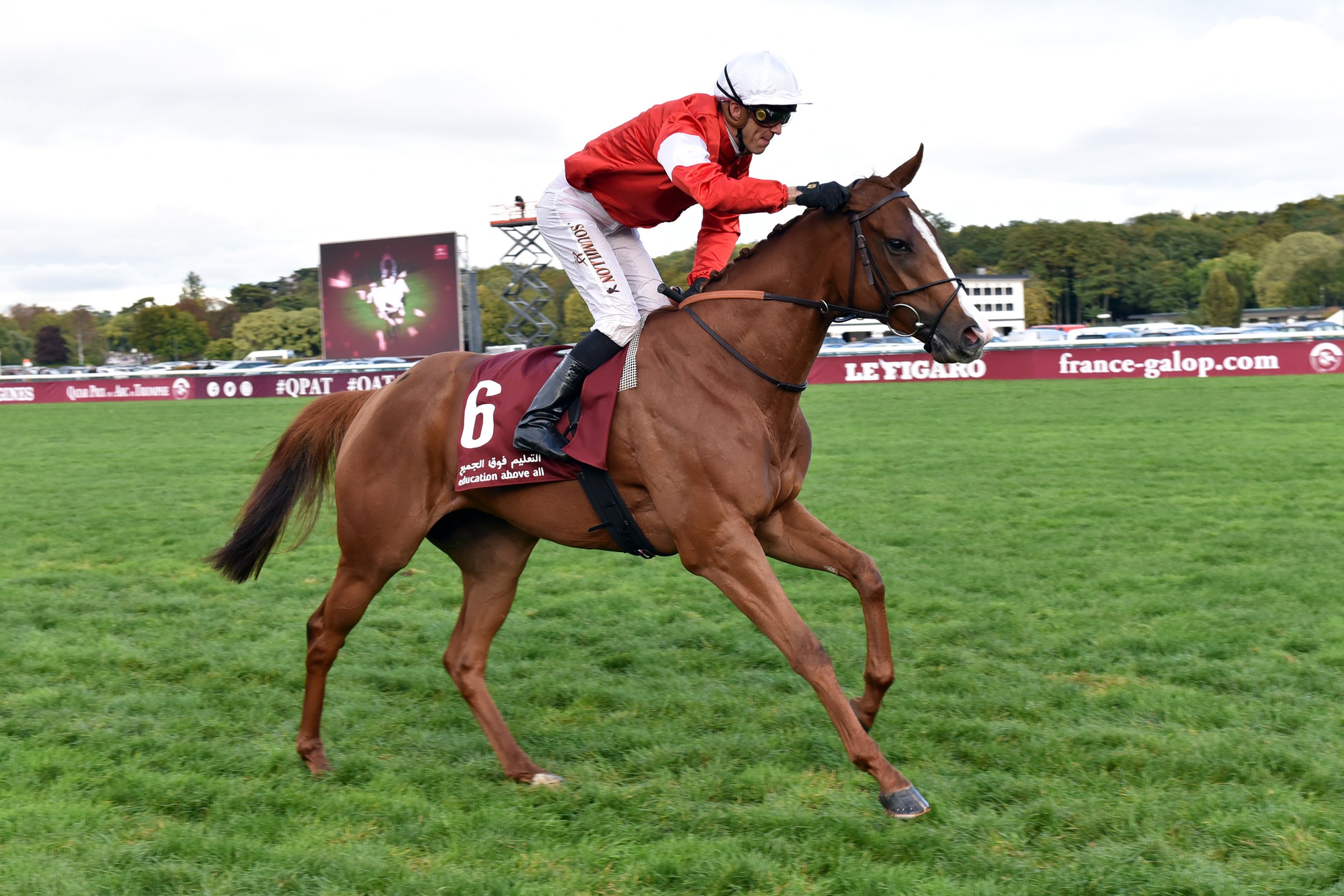
His flag bearer is Malavath. Purchased at the 2020 Goffs Premier Yearling Sale for £29,000, she was first sold for €139,200 at the Arqana Breeze Up Sale the following year. “I know when I’ve found one,” recounts Rogers. “I walked up to her [at the sale], and there was nobody else there. At that time, [her sire] Mehmas wasn’t who he was. But her scores, for us, were an A plus. She shared a lot of the common things with the good sprinter-milers that we’ve got in the database. A lot of the dimensions were very similar, so she fit into that profile.” She has since proven herself as a Gp2 winner and most recently finished second behind Kinross in the Prix de La Forêt on Arc day.

In December 2022, Malavath sold again, but this time for €3.2m to Moyglare Stud and is set to continue her racing career in North America under the tutelage of Christophe Clement.
A find like Malavath has only been made possible through the rapid development of deep learning and artificial intelligence in recent years. Rogers’s own models build on technology originally developed for driverless cars—essentially, how a car uses complex visual sensors and deep learning to figure out what’s happening around it in order to make a decision about what to do next.
But wait. What is deep learning? Here comes the science bit! Machine learning and deep learning are both types of artificial intelligence. “Classical” machine learning is A.I. that can automatically adapt with minimal human interference. Deep learning is a form of machine learning that uses artificial neural networks to mimic the learning process of the human brain by recognising patterns the same way that the human nervous system does, including structures like the retina.
“My dad’s an eye surgeon in Australia and he was always of the opinion that what will be solved first in artificial intelligence will be anything to do with vision,” says Rogers knowingly. Deep learning is much more computationally complex than traditional machine learning. It is capable of modelling patterns in data as sophisticated, multi-layered networks and, as such, can produce more accurate models than other methods.
Chances are you’ve already encountered a deep neural network. In 2016, Google Translate transitioned from its old, phrase-based statistical machine translation algorithm to a deep neural network. The result was that its output improved dramatically from churning out often comical non-sequiturs to producing sentences that are closely indistinguishable from a professional human translator.

So does this mean that the received wisdom around how yearlings are selected is outdated, subjective and flawed? Not exactly. “There are so many different ways of being a good horse; I don’t think [selecting horses] will ever completely lose its appeal as an art form,” says Rogers. “But when we get all this data together and we start to look at all these data points, it does push you towards a most predictable horse.” In other words, following the data will not lead you to a diamond in the rough; rather, it’s about playing the percentages. And that’s before all before the horse goes into training.
After that point, the data only gets you so far. “I would say [the use of biomechanical modelling] probably explains somewhere between 30 to 40 percent of outcome,” says Rogers. “It’s very hard to disentangle. The good racehorse trainer has got all the other things working with him: he’s got the good jockeys, the good vet, the good work riders. He’s got all of those things, and their effect on racetrack outcomes is very hard to model and very hard to disaggregate from what we do.”
Nevertheless, it does not look like big data is going away any time soon. “It might be a couple of years away,” says Rogers. “As bloodstock gets more and more expensive and as the cost of raising a horse gets more and more expensive, the use of science is going to rise.” He believes there’s already an analytics arms race happening behind the scenes.
“For me, it isn’t a case of if it’s valuable; it’s a case of when it will be recognised as being valuable.” That’s Wilson again. “What you see in every sport is a big drive towards using statistical analysis and machine learning to qualify and understand performance. Every other sporting sector tells us that these methods will be adopted, and the ones that adopt them first will gain a performance edge over the rest of the field.”
Comparisons to Deep Blue’s defeat of Garry Kasparov might be premature, but it is clear that the racing industry is fast approaching a tipping point. “I don’t think the machine on its own beats the human judge,” says Wilson. “But I think where you get the real benefit is when you use the information you've been given by machine learning and you combine that with deep human expertise. That’s where the application of these types of things are the most successful in any sport. It’s the combination of human and machine that is power. Humans and machines don’t have to compete with each other.”
So will more trainers be adopting the technology? “There’s lots of different data points that you can use to predict a horse’s potential, and it’s understanding all of the pieces together,” says Kübler. “I’d want a bit more proof of concept. Show me that your system is going to save me loads of time and add loads of value. We’ll see in three or four years’ time how good it was.”
In the meantime, all eyes will be on Lot 379.

TopSpec Trainer of the Quarter – SIR MARK PRESCOTT BT.

Article by Giles Anderson
Heath House Stables in Newmarket has been the only yard our deserved TopSpec Trainer of the Quarter, Sir Mark Prescott, has trained from during his fifty-three years with a training licence.
Britain’s longest serving trainer has produced many horses at the highest level. Consider the fact that he operates with a self imposed limit of fifty horses under his care at any given time and his record seems even more impressive.
Over time, Prescott has worked closely with many leading owner breeders - none more so than Kirsten Rausing. Over the years, they have produced the likes of Albanova and Alborada to score at the highest level.
In 2019 a filly named Alpinista, made her racecourse debut on July 18th at Epsom. The debut was a winning one. Prescott wouldn’t necessarily be a trainer you would associate with winning debutantes, so many took note of this performance. The Racing Post reported that Alpinista; “dwelt, in touch in 5th, slightly green when asked for effort over 2f out, soon closed to lead over 1f out, pushed clear, unchallenged after”.
It would be fair to say that the five horses who finished behind her, haven’t exactly set the form book alight since. The same can’t be said for Alpinista.
Her subsequent start at Goodwood in August (2019) proved to be her only start where she finished out of the first four - when finishing 6th in the Gp.3 Prestige Stakes.
Winning ways resumed the following August (2020) when scoring in the Listed Upavon Fillies Stakes at Salisbury.
In 2021 Alpinista simply dominated the German Gp.1 races, with victories in the Grosser Preis von Berlin, the 59th running of the Preis von Europa and the Grosser Preis von Bayern.
Prescott, has always been a devotee of the European Pattern, looking further afield to pick up (in his own words) “cheap black type” for the fillies in his care. But little did he know when Alpinista beat Torquator Tasso and Walton Street in the Grosser Preis von Berlin what impact this race would have and cement Alpanista as the filly of her generation.
Walton Street ran two places better on his next start in Toronto when a fascicle 5 3/4 length winner of the Gr.1 Pattison Canadian International.
Torquator Tasso went onto frank the form in a duo of Gp.1 races - the prestigious Grosser Preis von Baden before a ‘shock’ win in the Prix de l’Arc de Triomphe.
The only person who probably wasn’t suffering from shock on the first Sunday in October 2021 was Sir Mark Prescott - he now knew he now had a serious filly in his care.
When the actual plan was hatched to aim Alpanista for the 2022 running of the Arc de Triomphe one will never know. But one can safely bet that by the time the 2022 Pattern Book dropped through the letterbox at Heath House Stables, Prescott had already worked out her plan for 2022.
Fast forward to the build up for the 2022 Arc and anyone who has enjoyed the shere entertainment of Prescott’s company will have enjoyed the build up for the race. With Prescott providing a level of light relief, regaling stories of previous voyages to France and the disappointment of defeat that most such ventures result in.
But in Alpanista’s victory in the 2022 Arc de Triomphe we got to celebrate the victory of two of the greatest proponents of the European Pattern in Sir Mark and Kirsten Rausing.
Alpanista was retired in November to embark on her next career as a broodmare at Lanwades Stud.
Her final race record reads as; 15 starts, 10 victories - with 6 in Gp.1 company - coming in three different countries. Quite a record.
What is racing's "Social Licence" and what does this mean?
Paull Khan expands upon a presentation he gave at the
European Parliament to the MEP’s Horse Group on November 30th

As World Horse Welfare recently pointed out in its excellent review of the subject—while social licence or the ongoing acceptance or approval of society may be ‘intangible, implicit and somewhat fluid’—an industry or activity loses this precious conferment at its peril. Examples, all too close to home, can be seen in greyhound racing in Australia and America or jumps racing in Australia.
What is clear is that our industry is acutely aware of the issue – as are our sister disciplines. The forthcoming Asian Racing Conference in Melbourne in February will feature a session examining what is being done to ‘ensure that (our) a sport is meeting society’s rapidly evolving expectations around welfare and integrity’. And back in November, the Federation Equestre Internationale (FEI) held a General Assembly whose ‘overriding theme’ was ‘that of social licence, and the importance for all stakeholders to understand the pressing needs for our sport to adapt and monitor the opinions of those around us’.
Considered at that meeting were results of a survey, which indicated that two-thirds of the public do not believe horses enjoy being used in sport and have concerns about their use. Those concerns mainly revolve around the welfare and safety of the horses. Intriguingly, a parallel survey of those with an active involvement in equestrian sport revealed that as many as half of this group even did not believe horses enjoyed their sport; and an even higher proportion than the general public—three-quarters—had concerns about their use.
While it is likely true, to an extent at least, that the public tends not to distinguish between equestrian sports, the specific concerns about horse racing are certainly different from those about Olympic equestrian disciplines, which centre on such matters as bits, bridles, spurs and nosebands.
Upon what, then, does our social licence in European horse racing critically depend? What are the major issues about which the public has opinions or worries, and on which the continuance of our social licence may hang? It should be said at the outset that what follows is not based upon scientific evidence (and the research should certainly be undertaken) but merely reflects the belief of the author. But it is suggested with some confidence that the following (in no particular order) are the three issues uppermost in public consciousness. They are:
Use of the whip
Racecourse injuries/fatalities
Aftercare – the fate of retired racehorses
There are, of course, other matters – the misuse of drugs and medications, gambling harms, etc., but the three topics above seem to account for a large proportion of the public’s anxieties about racing. There are likely to be subtle differences in the views of the public between one European country and another. Certainly, it is true that the volume of public disquiet varies very considerably between nations. In Scandinavia and Great Britain, for example, horse welfare and animal welfare more generally are very much front of mind and near the centre of public discourse. It is far less evident in several other countries.
But it is illuminating to look at what racing has been doing in recent years in the three areas listed above, and what the future looks like. A survey was conducted among member countries of the European and Mediterranean Horseracing Federation (EMHF); and it is clear that, while there is much still to be done, there has been significant and sustained progress and good reason to believe that this is likely to continue – and in fact accelerate – over the next few years.
Use of the whip
Let us consider whip use first. At the most recent World Horse Welfare Annual Conference in London in November, straplined ‘When Does Use Become Abuse’, one speaker was called upon to give strategic advice as to how to counter negative perceptions of equestrianism.
What he decided to major on was striking. With the whole breadth of the equine sector from which to draw, he chose to hone in on horseracing and—more specifically yet—on the issue of whip use. It was a salutary further example of how, while the whip may be a tiresome distraction to many, it is front and centre in the minds of many of the public.
Is there any more emotive or divisive issue within racing than the whip? Admittedly, most racing professionals hold that it really is very difficult to hurt a horse with the mandated padded crops, even if one wanted to. And, with veterinary supervision at all tracks, it is impossible to get away with, even if one did. In brief, they don’t consider this a welfare issue, but rather one of public perception.
But it is then that the divisions set in. Some conclude that all that is necessary to do has been done, and that any further restriction on the whip’s use would constitute pandering to an ignorant public. Others argue that, even if it is just a matter of public perception and the horses are not being hurt or abused, the sight of an animal being struck by a human is now anathema to increasingly broad swathes of society—in a similar way to the sight of a child being struck by an adult: a commonplace 50 years ago, but rare today. Therefore, the sport must act to be ahead of the curve of public sentiment in order to preserve its social licence.
How is this argument playing out? Let us look at a key element of the Rules of Racing in 18 European racing nations—the maximum number of strikes allowed in a race is a blunt measure, indeed, and one that takes no account of other variables such as the penalty regime for transgressions, but one that, nonetheless, paints a telling picture.
The first map shows how things stood 20 years ago. The majority of the countries are shown in black, denoting that there was no specified limit to the number of strikes. Just one appears in white – Norway banned the use of the whip as long ago as 1986.
The second paints the picture as it was 10 years ago. Eleven of the 18 countries had, in the intervening decade, changed their rules and applied a lower maximum number of strikes, and are shown in a lighter colour as a result.
Today’s situation is shown in the third map. All but one of the countries (excluding Norway) have tightened up their whip use rules still further over the past decade. None now allows unlimited use, and countries now banning the use of the whip for encouragement, number four.
It can be concluded that all countries across Europe are moving towards more restricted use of the whip. At different speeds and from different starting points, the direction of travel is common.
What will the situation be in another 10 years? Many administrators within EMHF countries, when asked to speculate on this, gave the view that there would be no whip tolerance within ten years and that the Scandinavian approach will have been adopted.
On the other hand, Britain has recently concluded that the biggest public consultation on the subject and the new rules that are being introduced do not include a reduction in the number of strikes, but rather a series of other measures, including the possible disqualification of the horse and importantly, the requirement only to use the whip in the less visually offensive backhand position.
Whether or not we will see a total ban within the next decade, it must be long odds-on that restrictions on whip use, across the continent, will be stricter again than they are today.
Aftercare
Twenty years ago, little thought was given to the subject of aftercare. There were some honourable exceptions: in Greece, the Jockey Club required its owners to declare if they could no longer provide for their horse, in which case it was placed in the care of an Animal Welfare organisation. Portugal had a similar reference in its Code. Most tellingly, in Britain a trail-blazing charity, Retraining of Racehorses (RoR), had been launched, following a review by the former British Horseracing Board.
Ten years ago, RoR had nearly 10,000 horses registered, had developed a national programme of competitions and events in other equestrian disciplines, and was holding parades at race-meeting to showcase the abilities of former racehorses to enter new careers.

Di Arbuthnot, RoR’s chief executive, explains, “In the UK, a programme of activities for thoroughbreds had started to encourage more owner/riders to take on former racehorses. This was supported by regional volunteers arranging educational help with workshops, clinics and camps to help the retraining process. Other countries were looking at this to see if similar ideas would work in Europe and beyond.
“Racing’s regulators had begun to think that this was an area they should be looking to help; retraining operators and charities that specialised in thoroughbreds were becoming recognised and supported; and classes at equestrian events began in some countries. Owner/riders were looking to take on a thoroughbred in place of other breeds to compete or as a pleasure horse; the popularity of the thoroughbred was growing, not just by professional riders to use in equestrian disciplines, but also by amateurs to take on, care for and enjoy the many attributes of former racehorses.
“The aftercare of the thoroughbred was on the move.”
But not a great deal else was different in the European aftercare landscape.
Since then, however, there has been little short of an explosion of aftercare initiatives. In 2016, the International Forum for the Aftercare of Racehorses (IFAR) was born, “to advocate for the lifetime care of retired racehorses, to increase awareness within the international racing community of this important responsibility.” In this endeavour, IFAR is not in any way facing resistance from Racing Authorities – far from it. It is pushing against an open door.
The International Federation of Horseracing Authorities has, as one of its twelve objectives, the promotion of aftercare standards. And the chair of its Welfare Committee, Jamie Stier, said some years ago that there is ‘now a better understanding and greater recognition that our shared responsibility for the welfare of racehorses extends beyond their career on the racetrack’.
This direction from the top has been picked up and is increasingly being put into active practice. Also in 2016, France launched its own official charity Au Dela des Pistes, (‘beyond the racetrack’), in 2020 Ireland followed suit with Treo Eile (‘another direction’). By 2019, in Britain, remarkably, many more thoroughbreds were taking part in dressage than running in steeplechases!
So now the three main thoroughbred racing nations in Europe all have active and established aftercare programmes; and many other smaller racing nations are moving in that direction. It is not just a matter of repurposing in other equestrian pursuits – many of those horses retiring from racing that are not suited to competitive second careers are simply re-homed in retirement and others find profitable work in areas such as Equine Assisted Therapy.
Arbuthnot (also chair of IFAR) adds: “For racing to continue as we know it, we must assure the general public, those that enjoy racing, that thoroughbreds are not discarded when their racing days are over and that they are looked after and have the chance of a second career. It is up to all of us around the world to show that we care what happens to these horses wherever their racing days end and show respect to the thoroughbred that has given us enjoyment during their racing career, whether successful or not on the racecourse. If we do this, we help ensure that horse racing continues in our lifetime and beyond.”
It is important to publicise and promote the aftercare agenda, and the EMHF gives IFAR a standing platform at its General Assembly meetings. EMHF members have translated the IFAR ‘Tool Kit’—for Racing Authorities keen to adopt best practice—into several different European languages.

Time Down Under and Justine Armstrong-Small: Time Down Under failed to beat a single horse in three starts but following his retirement from racing, he has reinvented himself, including winning the prestigious showing title of Tattersalls Elite Champion at Hickstead in June 2022. Images courtesy of Hannah Cole Photography.
British racing recently established an independently chaired Horse Welfare Board. In 2020, the Board published its strategy ‘A Life Well Lived’, whose recommendations included collective lifetime responsibility for the horse, incorporating traceability across the lifetimes of horses bred for racing.
Traceability will be key to future progress, and initiatives such as the electronic equine passport, which has been deployed among all thoroughbreds in Ireland and Britain, will play a vital part. Thoroughbred Stud Book birth records are impeccable, and we know the exact number of foals registered throughout this continent and beyond. The aim must be to establish the systems that enable us to ascertain, and then quantify the fate of each, at the least until their first port of call after retirement from racing.
Racecourse injuries
There can be nothing more distressing – for racing professionals and casual observers alike – than to see a horse break down. The importance of minimising racecourse injuries—and, worse still, fatalities—is something everyone agrees upon. What is changing, though, it would appear, is the potential for scientific advances to have a significant beneficial effect.
Of course, accidents can and do befall horses anywhere and they can never be eliminated entirely from sport. But doing what we can to mitigate risk is our ethical duty, and effectively publicising what we have done and continue to do may be a requirement for our continued social licence.
There is much that can be said. It is possible to point to a large number of measures that have been taken over recent years, with these amongst them:
Better watering and abandonment of jump racing if ground is hard
Cessation of jump racing on all-weather tracks
Cessation of jump racing on the snow
Safer design, construction and siting of obstacles
By-passing of obstacles in low sunlight
Colouring of obstacles in line with equine sight (orange to white)
Heightened scrutiny of inappropriate use of analgesics
Increased prevalence of pre-race veterinary examinations, with withdrawal of horses if necessary
The outlawing of pin-firing, chemical castration, blistering and blood-letting
Abandonment of racing in extreme hot weather
Many of the above relate to jump racing, and Britain has witnessed a reduction of 20% in jump fatality rates over the past 20 years. But there is more that must be done, and a lot of work is indeed being done in this space around the world.
One of the most exciting recent developments is the design and deployment of ground-breaking fracture support kits which were distributed early in 2022 to every racecourse in Britain.
Compression boots suitable for all forelimb fractures
By common consent, they represent a big step forward – they are foam-lined and made of a rigid glass reinforced plastic shell; they’re easily and securely applied, adjustable for varying sizes of hoof, etc. They reduce pain and anxiety, restrict movement which could do further damage, and allow the horse to be transported by horse ambulance to veterinary facilities.
X-rays can then be taken through these boots, allowing diagnosis and appropriate treatment. These kits have proved their worth already: they were used on 14 occasions between April and December last year, and it would appear that no fewer than four of these horses have not only recovered but are in fine shape to continue their careers. It is easy to envisage these or similar aids being ubiquitous across European racetracks in the near future.

Modular splints suitable for slab fractures of carpal bones
Perhaps of greatest interest and promise are those developments which are predictive in nature, and which seek to identify the propensity for future problems in horses.
Around the world, there are advances in diagnostic testing available to racecourse vets. PET scanners, bone scanners, MRI scanners and CT scanners are available at several tracks In America, genetic testing for sudden death is taking place, as is work to detect horses likely to develop arrhythmias of the heart.
Then there are systems that are minutely examining the stride patterns of horses while galloping to detect abnormalities or deviations from the norm. In America, a great deal of money and time is being spent developing a camera-based system and, in parallel, an Australian-US partnership is using the biometric signal analysis that is widely used in other sports.
The company – StrideSAFE – is a partnership between Australian company StrideMASTER and US company Equine Analysis. They make the point that, while pre-race examinations that involve a vet trotting a horse up and down and looking for signs of lameness, can play a useful role, many issues only become apparent at the gallop.
There are, in any case, limitations to what is discernible to the naked eye, which works at only 60 hertz. StrideMASTER’s three-ounce movement sensors, which fit into the saddlecloth, work at 2,400 hertz, measuring movements in three dimensions – forward and backward, up and down and side to side, and building up a picture of each horse’s ‘stride fingerprint’.
In a blind trial, involving thousands of horses, 27 of which had suffered an injury, this system had generated a warning ‘red-flag’ for no fewer than 25 of them. The green lines in the centre of this diagram are this horse’s normal stride fingerprint; the red line was the deviant pattern that would have flagged up the potential problem, and the grey line was where the horse then sadly injured itself.
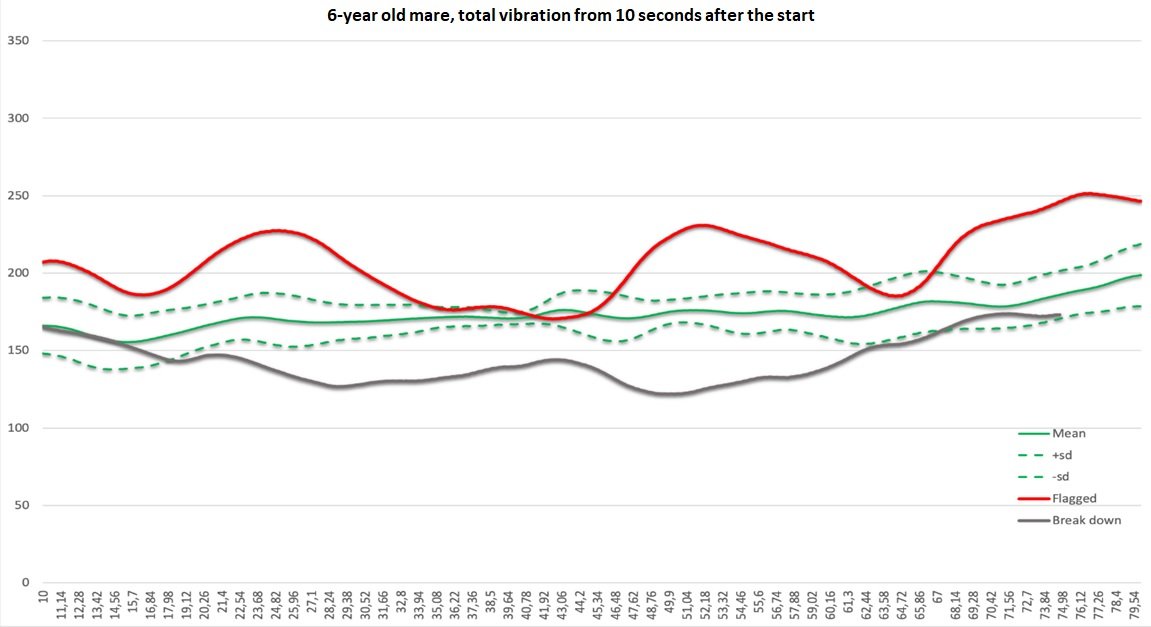
The ‘stride fingerprint’ of a racehorse
While the false-positive rate is impressive for such screening tools, another enemy of all predictive technologies is the false positive, and ways need to be found to take action on the findings without imposing potentially unnecessary restrictions on horses’ participation. At present, the StrideMASTER system is typically throwing up three or four red flags for runners at an Australian meeting—more in America.
A study in the spring by the Kentucky Equine Drug Research Council, centering on Churchill Downs, will seek to hone in on true red flags and to develop a protocol for subsequent action. David Hawke, StrideMaster managing director, expands, “Protocols will likely vary from jurisdiction to jurisdiction, depending on the imaging modalities available. At Churchill Downs, they will have a PET scan, and we will be going straight from red-flag to PET scan.”
There will be other approaches available to regulators involving, for example, discussion with the trainer, a requirement for a clean vet’s certificate, or perhaps for a normal ‘fingerprint’, before racing next.
CONCLUSIONS
There is a need for continued investment and resource allocation by Racing Authorities. But the will would seem to be there. In Britain, €7M from betting will, over the next three years, fund an extensive array of no fewer than 26 horse welfare projects, covering such matters as education and support for re-homers, analysis of medication data and clinical records, fatalities occurring off the track, ground/going research and obstacle improvement and development. That is a serious statement of intent and an illustration of just how high in importance the welfare of racehorses has now become.
Of course, not all racing nations have the resources to conduct such research. It will be vital, therefore, that the lessons learnt are shared throughout the racing world. In Europe, this is where the EMHF will play a vital role. The federation has always had, as primary aims, education and the adoption of best practice across its membership.
The hope must be that, through all these measures and many others in combination, we can assuage the concerns of the public sufficiently to retain our social licence. But let our ambitions not rest there. We must also strive to shift the debate, to move onto the front foot and invite a focus on the many positive aspects of racing, as an example of the partnership between man and horse that brings rich benefit to both parties.
Elsewhere in this issue, there is a feature on racing in Turkey, and it was the founding father of that country, Kemal Ataturk, who famously said:
“Horseracing is a social need for modern societies.”
We should reinforce at every opportunity the fact that racing provides colour, excitement, entertainment, tax revenues, rural employment, a sense of historical and cultural identity and much more to the human participants. It is also the very purpose of a thoroughbred’s life and rewards it with ‘a life well lived.’
We have a lot more to do, but let’s hope we can turn the tide of public opinion such that people increasingly look at life as did Ataturk.
Nutrition and the new science of the "Gut-Brain connection"
Article by Scott Anderson

Trainers are always looking to gain an edge in performance. But what about their mental state? Are they jittery, distracted or disinterested? No matter how strong the horses, their heads must be in the game to succeed.
Surprisingly, much of that mental attitude is driven by gut health, which in turn depends on the collection of microbes that live there: the microbiota. In a horse, the microbiota is a tightly packed community of about 100 trillion microbes, composed of bacteria, archaea, fungi and protozoa. It colonises the entire GI tract but is largely concentrated in the hindgut, where it works to ferment the prebiotic fibre in forage. The microbial fermentation of fibre into fatty acids produces 70% of the animal’s energy requirements and without it, the horse couldn’t get sufficient energy from simple forage. Intriguingly, byproducts of that fermentation can affect the brain.
It is easy to be sceptical about this gut-brain connection, but over the last decade, research has made it clear that gut microbes have an outsized influence on mood and behaviour. Microbes that improve mental state are called psychobiotics, and they may completely change the way you train and manage your horses. A horse’s health – and consequently its performance – starts in the gut.
Inflammation
When the microbiota is unbalanced by stress, diet or sickness, it is said to be dysbiotic. It loses diversity, and a handful of bacterial species compete for domination. Without the pushback of a diverse population, even beneficial bacteria can become pathogenic. Surprisingly, that can affect the brain. Multiple studies in various animal models have shown that transmitting faecal matter from one animal to another also transmits their mood. This demonstrates that a dysbiotic microbiota can reliably cause mental issues including anxiety and depression, thereby affecting performance.
An important function of the microbiota is to fight off pathogens by outcompeting, starving or killing them. However, a dysbiotic microbiota is less diligent and may permit pathogens to damage the gut lining. A degraded gut lining can leak, allowing bacteria and toxins into the bloodstream. The heart then unwittingly pumps them to every organ in the body, including the brain. This makes the gut the primary source of infection in the body, which explains why 80% of the immune system is located around the intestines. Over time, a leaky gut can lead to chronic systemic inflammation, which weakens the blood-brain barrier and interferes with memory, cognition and mood.
Inflammation is a major component of the gut-brain connection, but not the only one.

Neurotransmitters and hormones
Horses and humans use neurotransmitters to communicate between nerve cells. Brains and their attendant nerve bundles constitute a sophisticated network, which makes it somewhat alarming that microbes also produce neurotransmitters. Microbes use neurotransmitters to converse with each other, but also to converse with their host. The entire gut is enmeshed in nerve cells that are gathered up into the vagus nerve that travels to the brain. Microbial neurotransmitters including serotonin and dopamine thus allow certain microbes to communicate directly with the brain via the vagus nerve. We know this happens with specific bacteria, including Lactobacillus species, because when the vagus is severed, their psychobiotic effects disappear.
As well as neurotransmitters, hormones are involved in gut-brain communications. The hypothalamus-pituitary-adrenal (HPA) axis controls the stress response in animals. The hypothalamus is located low in the brain and responds to stressors – such as a lurking predator – by producing hormones that stimulate the neighbouring pituitary, which then triggers the adrenal gland to produce cortisol, the stress hormone. Cortisol acts as a threat warning and causes the horse to ramp up glucose production, supplying the energy needed to escape a predator. This is the same hormonal circuit that trainers exploit for racing.

The HPA axis produces cortisol in response to stress. Cortisol inhibits the immune system, which in combination with a leaky gut allows pathogens to enter the bloodstream. Susequent systemic inflammation and vagal feedback lead to stereotypies.
The production of these hormones redirects energy to the heart, lungs and muscles at the expense of the immune system. From an evolutionary point of view, the tradeoff makes sense: first escape the predator and deal with infections later. After the danger has passed, cortisol causes the HPA to return to normal – the calm after the storm.
However, continued stress disrupts that cycle, causing anxiety and diminishing the brain’s ability to store memories. This can dramatically interfere with training. Stress can also induce the release of norepinephrine, which promotes the growth of pathogenic bacteria including Campylobacter jejuni, Listeria, Helicobacter pylori, and Salmonella. Prolonged high cortisol levels can increase gut leakiness, potentially leading to infection and further compounding the situation. In the long term, continued stress leads to systemic inflammation, which is a precursor to problematic behaviours.
Short-chain fatty acids
When microbes consume proteins and fibre, they break them down into their constituent molecules, such as amino acids, fatty acids and sugars. These are the metabolites of the microbes. As well as neurotransmitters and hormones, the gut-brain conversation is mediated by metabolites like butyrate, an important short-chain fatty acid which plays multiple roles in the body.
In the gut, butyrate serves as a preferred nutrient for the cell lining. It encourages the differentiation of stem cells to replenish gut cells that are routinely sloughed off or damaged. It plays an important role in the production of mucus – an essential part of gut protection – which coats the gut from mouth to anus. In the muscles, butyrate boosts the growth of skeletal muscle, crucial to athletic performance, as well as inducing the production of glucose, the primary muscle fuel. One-quarter of systemic glucose is driven by butyrate. In its gut-brain role, butyrate passes through the blood-brain barrier, where it nourishes and enhances the growth of new brain cells.
These factors make butyrate a star player in the gut-brain connection. They also highlight the benefits of prebiotic fibre, especially when high-energy, low-fibre feeds are provided.
Starting a microbiota
We’ve explored the major pathways of the gut-brain connection: inflammation, neurotransmitters, hormones and fatty acids. Some of these pathways are at odds with each other. How does such a complicated system come together?
As mentioned, the microbiota is an animal’s first line of defence against pathogens, attacking and killing them often before the immune system is even aware of them. That means a healthy microbiota is an essential part of the immune system. However, the immune system is designed to attack foreign cells, which includes bacteria. For the microbiota to survive, the immune system must therefore learn to accept beneficial microbes. This lesson in tolerance needs to take place early in the foal’s development, or its immune system may forever fight its microbiota.

There are multiple ways nature ensures that foals get a good start on a microbiota that can peacefully coexist with the immune system. The first contribution to a protective microbiota comes from vaginal secretions that coat the foal during birth. After birth, microbes are included in the mare’s milk. These microbes are specially curated from the mare’s gut and transported to the milk glands by the lymphatic system. Mare’s milk also includes immune factors including immunoglobulins that help the foal to distinguish between microbial friends and foes. An additional way to enhance the microbiota is through coprophagia, the consumption of manure. Far from an aberration, foals eat their mother’s manure to buttress their microbiota.
Microbes affect the growth and shape of neurons in various brain sites as the foal develops – a remarkable illustration of the importance of a healthy early gut microbiota.
The cooperation between the immune system and the microbiota is inevitably complex. Certain commensal bacteria, including Clostridiales and Verrucomicrobia, may be able to pacify the immune system, thus inhibiting inflammation. This is a case where microbes manage the immune system, not the other way around. These convoluted immune-microbial interactions affect the mental state – and consequently the behaviour – of the horse, starting at birth.
Stereotypies
A 2020 study of 185 performance horses conducted by French researchers Léa Lansade and Núria Mach found that the microbiota, via the gut-brain connection, is more important to performance than genetics. They found that microbial differences contributed significantly to behavioural traits, both good and bad. A diversified and resilient microbiota can help horses better handle stressors including stalling, training, and trailering. A weakened or dysbiotic microbiota contributes to bad behaviours (stereotypies) and poor performance.
The horses in this study were all carefully managed performance horses, yet the rates of stereotypies were surprisingly high. A kind of anxiety called hypervigilance was observed in three-quarters of the horses, and almost half displayed aggressive behaviour like kicking or biting.
The study found that oral stereotypies like biting and cribbing were positively correlated with Acinetobacter and Solibacillus bacteria and negatively correlated with Cellulosilyticum and Terrisporobacter. Aggressive behaviour was positively correlated with Pseudomonas and negatively correlated with Anaeroplasma.
Some of these behaviours can be corrected by certain Lactobacillus and Bacteroides species, making them psychobiotics. That these personality traits are correlated to gut microbes is truly remarkable.
Intriguingly, the breed of a horse has very little impact on the makeup of its microbiota. Instead, the main contributor to the composition of the microbiota is diet. Feeding and supplements are thus key drivers of the horse’s mental state and performance.
The gut-brain connection and training

How might the gut-brain connection affect your training practices? Here are some of the unexpected areas where the gut affects the brain and vice-versa:
High-energy feed. Horses evolved to subsist on low-energy, high-fibre forage and thus have the appropriate gut microbes to deal with it. A high-energy diet is absorbed quickly in the gut and can lead to a bloom in lactic acid-producing bacteria, which can negatively impact the colonic microbiota. High-energy feeds are designed to improve athletic output, but over time, too much grain can make a horse antisocial, anxious and easily spooked. This can damage performance—the very thing it is trying to enhance. Supplementary prebiotics may help to rebalance the microbiota on a high-starch regimen.

Changing feed regimens quickly. When you change feed, certain microbes will benefit, and others will suffer. If you do this too quickly, the microbiota can become unbalanced or dysbiotic. Slowly introducing new feeds helps to prevent overgrowth and allows a balanced collection of microbes to acclimate to a new regimen.
Stress. Training, travelling and racing all contribute to stress in the horse. A balanced microbiota is resilient and can tolerate moderate amounts of stress. However, excessive stress can lead, via the HPA axis, to a leaky gut. Over time, it can result in systemic inflammation, stereotypies and poor performance.
Overuse of antibiotics. Antibiotics are lifesavers but are not without side effects. Oral antibiotics can kill beneficial gut microbes. This can lead to diarrhoea, adversely affecting performance. The effects of antibiotics on the microbiota can last for weeks and may contribute to depression and anxiety.
Exercise and training. Exercise has a beneficial effect on the gut microbiota, up to a point. But too much exercise can promote gut permeability and inflammation, partly due to a lack of blood flow to the gut and consequent leakiness of the intestinal lining. Thus, overtraining can lead to depression and reduced performance.
Knowing how training affects the gut and how the gut affects the brain can improve outcomes. With a proper diet including sufficient prebiotic fibre to optimise microbiota health, a poor doer can be turned into a model athlete.
References
Mach, Núria, Alice Ruet, Allison Clark, David Bars-Cortina, Yuliaxis Ramayo-Caldas, Elisa Crisci, Samuel Pennarun, et al. “Priming for Welfare: Gut Microbiota Is Associated with Equitation Conditions and Behavior in Horse Athletes.” Scientific Reports 10, no. 1 (May 20, 2020): 8311.
Bulmer, Louise S., Jo-Anne Murray, Neil M. Burns, Anna Garber, Francoise Wemelsfelder, Neil R. McEwan, and Peter M. Hastie. “High-Starch Diets Alter Equine Faecal Microbiota and Increase Behavioural Reactivity.” Scientific Reports 9, no. 1 (December 9, 2019): 18621. https://doi.org/10.1038/s41598-019-54039-8.
Lindenberg, F., L. Krych, W. Kot, J. Fielden, H. Frøkiær, G. van Galen, D. S. Nielsen, and A. K. Hansen. “Development of the Equine Gut Microbiota.” Scientific Reports 9, no. 1 (October 8, 2019): 14427.
Lindenberg, F., L. Krych, J. Fielden, W. Kot, H. Frøkiær, G. van Galen, D. S. Nielsen, and A. K. Hansen. “Expression of Immune Regulatory Genes Correlate with the Abundance of Specific Clostridiales and Verrucomicrobia Species in the Equine Ileum and Cecum.” Scientific Reports 9, no. 1 (September 3, 2019): 12674.
Daniels, S. P., J. Leng, J. R. Swann, and C. J. Proudman. “Bugs and Drugs: A Systems Biology Approach to Characterising the Effect of Moxidectin on the Horse’s Faecal Microbiome.” Animal Microbiome 2, no. 1 (October 14, 2020): 38.
Pre-trainers and their influence on Irish NH racing
Article by Daragh Ó Conchúir

Pre-trainers have always existed but there is far more prevalence in recent times, be that to lighten the loads of trainers themselves or, ever increasingly, within a business model of providing licensed conditioners with ready-to-run horses, or as near as dammit.
It was interesting to see former Irish Racehorse Trainers’ Association chief executive, Michael Grassick opine in The Irish Field on December 17 that pre-trainers were actually impacting negatively on the men and women he used to represent – and indeed was one of, before handing over the reins to his son, Michael Jnr – as it made it more difficult for them to retain staff.
Surely, though, the only reason a yard uses such services is because it doesn’t have the time, manpower or expertise to do the job. It makes no sense for trainers to add to an already hefty catalogue of expenses if they and their staff are twiddling their thumbs for “three, four and five months,” as Grassick seemed to suggest.
Trainer Tom Mullins isn’t a fan of the point-to-point production line in Ireland, believing that more potential owners are choosing to invest in stores with a view to a quick return at the boutique NH Sales, rather than going in on a young horse to race. But that route is available to everyone within the industry. If you want to work full-time with horses, you have to find a niche, or create one.

We all know Barry Geraghty as the former champion jockey who won the Grand National, and counted two Gold Cups, five Champion Chases, four Champion Hurdles and two Stayers’ Hurdles among his 43 Cheltenham winners.
Long before he called time on his career in 2020, Geraghty was pre-training young horses at home in Hallstown, just outside Dunshaughlin, and moving them on, most of the time through the point field via Warren Ewing and Aidan Fitzgerald. His second Gold Cup triumph came in 2013 on Bobs Worth, a horse he had sold to Nicky Henderson as an unbroken store.
There have been plenty others that have had good careers but Supreme Novices’ Hurdle winner, Champion Hurdle favourite Constitution Hill and Tipperary 4yo maiden runner-up, does have the potential to be the best of his many graduates.
“It’s getting harder at all levels,” as Geraghty explained. “With the price of foals, the price of stores, it’s harder to get what you’re looking for. Bobs Worth, he was bought as a yearling and sold as a four-year-old unbroken store. As I got older, I would have got involved with Warren Ewing buying stores and going straight to the point-to-point field with them. But then we’ve been buying foals as well since then.
“For example, Constitution Hill was bought as a foal. I would have kept him for three years, broken him as a two-year-old, pre-trained him as a two-year-old, pre-trained him as a three-year-old until the autumn and then he went up to Warren’s to be trained for a point-to-point.”

John Nallen, famous for the Minella soubriquet in honour of his Clonmel hotel and who produced Minella Indo and Minella Time to win a Gold Cup and Grand National within a few weeks of one another in 2021, is another who focuses on foals. So too Walter Connors, the man who found Gold Cup winner Don Cossack as a foal in Germany, as well as ill-fated Champion Hurdle hero Espoir D’Allen and multiple Grade 1 victors Envoi Allen and Bacardys.
More can go wrong in that length of time but the outlay is lower and there is less intensity required with the work. And to be able to break them younger is a considerable advantage.
In days of yore, National Hunt horses might not have come out of the field until they were five or six. But all athletic pursuit has advanced and science tells us that once the loading is appropriate, earlier development and conditioning work pays off in the long run.
“It’s like the underage structure with county teams, the strength and conditioning that’s being done with 15- and 16-year-olds. They’re your two-year-olds and three-year-olds. So then you’ve a young lad coming out of minors and he’s as big as (GAA footballer of the year) David Clifford.
“And it’s only teaching them graft. It’s not hardship. You’re not galloping them. You’re conditioning them. If you’re to keep a horse right through from a foal to running in a point-to-point or a bumper, it’s an awful lot easier physically to break them at two than it is at three, but there’s great development in it for them too, both physically and mentally. I think you can connect with them well. Because you’re not having the struggle that you might have with a bigger horse, it makes them more amenable, which is a positive thing for when they go into training. They’ve learned rather than been taught.”
As the Meath native acknowledged, acquiring the raw material is the key starting point.
“You’re looking for the best individual you can get, in every sense and obviously a certain level of page to back it as well – sire, damsire. Your budget won’t allow you to buy perfection (so) you just have to pare back as to where you are with your budget and what are the acceptable faults.”
Judging from the laugh that greets the query about what flaws you might be willing to accept, it isn’t always straightforward.
“It’s very hard to sell one by an unfashionable sire. It doesn’t help. There’s lots of different things. A horse is probably judged at his harshest at the store sale. Whereas he goes and wins a point-to-point, his faults might be more acceptable.”

WALTER & DAVID CONNORS
Walter Connors is renowned as the pioneer of sourcing foals in France – Envoi Allen and Espoir D’Allen were in the same field at Bruno Vagne’s Elevage Allen when the Waterford man picked them out – and he chooses what route he takes to disperse his stock in accordance with those faults Geraghty refers to.
“It’s pretty random with us, the selection of what goes to the sales and what doesn’t,” Connors told me. “A horse could be backward and not fit for the sales so we might point-to-point him but it’s a blank canvas on the first of January and while we aim for the sales, there’s always one reason or another why a horse doesn’t make it and we’ll point-to-point instead.”

After the best part of three years growing up at Sluggara Farm in Dungarvan, Envoi Allen was prepped by Colin Bowe a for a facile triumph in a Ballinaboola maiden because Muhtathir was not a sire that got the market’s pulse racing. But Connors would not like to have his entire investment, or anything like it, relying on form, albeit that the decision to focus on foals is budget-driven.
“Buying foals has worked out okay for us but it’s full of risk,” the vet stated. “All you can see at that stage, is whether they’re big or small. We try and have a look at them as they’re coming along and see how they’re developing. But when did I know Envoi Allen was a good horse? When he jumped the second-last in Ballinaboola. That’s the reality of it. All we can do is try and improve the way we rear them, to make sure they get the best chance they can.
“Buying foals and selling as three-year-olds means you have a lot of capital tied up. You have three years of stock on hand before you have something to sell. Then when those horses are sold, hopefully it takes the pressure off the horses in training. I am full of admiration for the lads depending on form for everything.”
Nallen and Pat Doyle are in that latter category, though Nallen acquires foals mostly and Doyle focuses primarily on the more expensive but more immediate turnaround of stores.
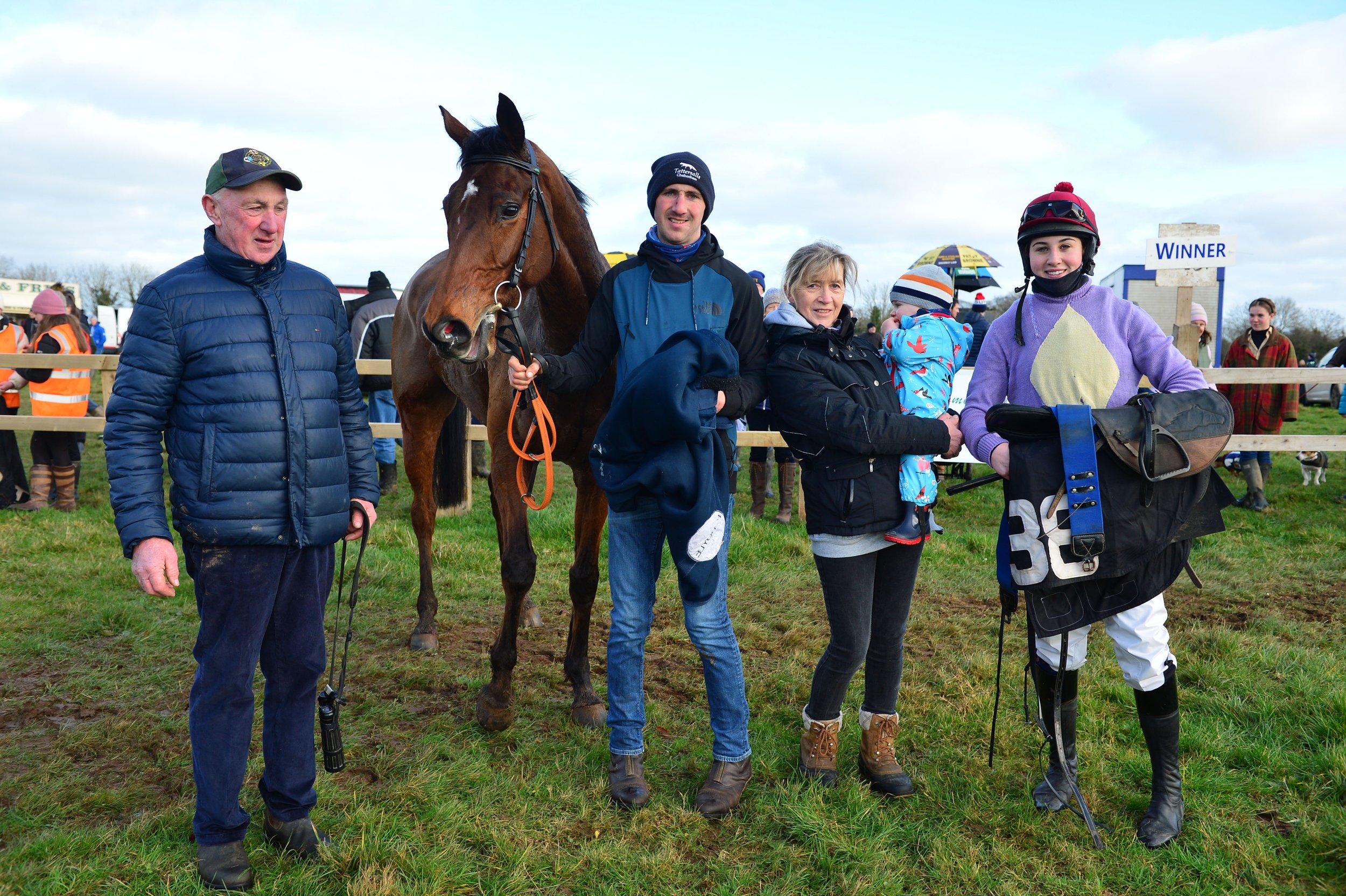
Doyle, who broke Champion Hurdle legend Monksfield and subsequently educated and sold Grand National and Grade 1 winner Minnehoma as well as other top-flight victors Bob Olinger, Shattered Love, First Lieutenant and Brindisi Breeze, bought Appreciate It and Asterion Forlonge as stores the same day for €60,000 each before selling the future Grade 1 winners.
“Nowadays horses are pretty well done from the time they’re foals,” Doyle detailed.” It’s not like it was 20 years ago. Three-year-olds weren’t touched until six weeks before sales. It’s totally different now. Most of the three-year-old stores have been to a sale as stores and they’re very professional men, the men that buy them.
“We’ve a few fellas around here and they would bring their yearlings in for the winter and probably put breaking tack on them and drive them on long reins, and probably do that for the months of December, January and February, and probably do it again their two-year-old days. They’re so well-handled, horses are a lot more forward than they were.
“We don’t like to do things too quick. It actually takes me probably between four and five months to get a horse to where I want to get him. You will get the odd horse that will get there in four months. We break them, let them out for a month and bring them back in the middle of August. We do an awful lot of conditioning work before we’d do anything else. You’re talking five good months.“
There is an important theme here. Sometimes, the charge is levelled at the point-to-point producers that they don’t leave much in the tank. But that wouldn’t make sense from a business perspective because you want clients to return. You don’t get the best of the horse by finding out about them before you need to.
Minella Indo is another fine example of the benefit of patience. Nallen bought him as a foal from breeder Dick Lalor, of Carrigeen fame, and kept him until he was five.
“He could have made it at four but we always want to do right by the horse and played it cautiously with him,” Nallen revealed. “He is a Beat Hollow, it’s a good family, but his dam was 22 and people thought we were a bit mad buying out of a 22-year-old mare. He came through the system well and we just didn’t rush him to get him out at four.
“When we saddled him up at Dromahane, the day after St Patrick’s Day in 2018, he was ready and he won easily. And the rest is history… It’s about getting them over the line. Find out as much as you can about their ability without wrecking them.”
That said, when you have them for years rather than months, there are various landmarks along the way that you know should be hit.
“You’re going through all the stages from a foal and a two-year-old to three-year-old,” Geraghty noted. “Some will grow, some won’t grow. There are different stages and some will grow into a horse you’d hope them to be and Constitution Hill would have been that horse as an individual, but desperately laid back. But he always found everything really easy and it was then a case of doing everything right for what you would expect a horse to do at every stage. But it’s only when you look under the hood that you see what’s there. It’s only when you give them a squeeze and with him (when he went in training with Ewing), it was instant.”
Unfortunately for Doyle, he chose the same point-to-point for future multiple Grade 1 winner Appreciate It as Envoi Allen ran in and his charge tired to finish third having gone toe-to-toe with his good friend Connors’ star. The vital win was recorded next time out and Willie Mullins bought him privately.
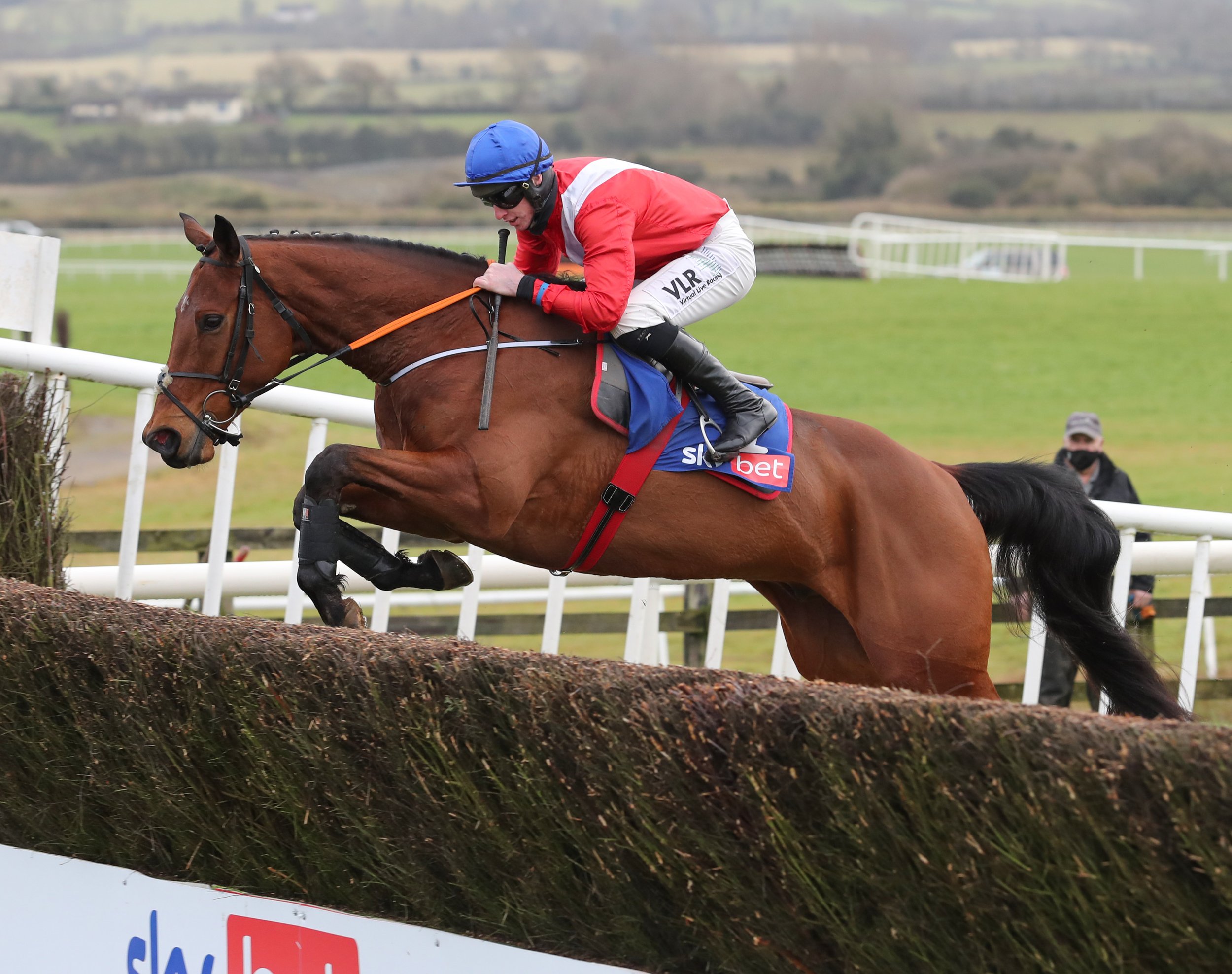
Mullins sends a lot of his horses to Sonny Carey for the other side of pre-training – readying horses for a full-time training regime. While Carey also buys a few stores himself and has a permit to train a few horses on the track for family and friends, it is breaking horses for trainers or readying them for their routines that is the core of his operation, which is based in Arthur Moore’s yard outside Naas.
Appreciate It, Laurina and Captain Guinness are just some of high-calibre talent he and his team have been entrusted with.
“The way I work it is we break them, educate them and get them ready to go into a string so that from the day they arrive into the yard, they can just go into the string,” said Carey.
“It all depends on what the trainer will want. Some trainers will want them to just fit into the string. Some trainers will want to know how good they are, what you think of them. Owners sometimes want to find out if a horse is worth putting into training. It just all depends on the client. And the horse.
“We more or less start them off steady, get them hacking away, step them up to cantering away then and if the trainer wants them worked, they can start working and be schooled along as well.
“It’s all in collaboration with the trainer but it’s down to the individual horse. Some horses will take plenty and be ready for rocking and some horses fall away or get little injuries or the normal young horse kind of things. They’ll all get their ringworm and they’ll get sick at some stage, just the things that young horses get. It’s better for those things to happen in my yard than the trainer’s yard”.
Carey explained how he goes about breaking young horses.
“Everyone has their own way of doing it. It’s what works for you, isn’t it? I was lucky, my father did it for I’d say the guts of 50 years and I learned it off him.

“You’re handling, starting them lunging, getting them used to a bit in their mouth, start with a roller, which simulates a girth. Once they take that, you’ve no problem and we’ll stick a second rope on them then and start turning them on a long reign, which simulates a rider steering them. Some horses would do no better for three weeks driving than they would three days. They just have it. Some horses need more driving.
“After that, in the stable, you just start lying over them, patting them away. And slowly get in on them and then you’ll start riding them around the box, putting your leg on them, teaching them. We’ll go from the box then to the lunge ring, ride them in the lunge ring and then introduce another horse into the lunge ring with them after a day or two.
“Then we might have four or five in the ring together then so that when they head out to the gallop, they’re fairly straightforward.”
Captain Guinness is an example of the advantage of having more time with horses and breaking them younger. He won quickly for Henry de Bromhead but proof that the lemon hadn’t been squeezed to the pips was that he was a Grade 2 victor just last November, three years later.
“For a National Hunt horse now you’d be better off breaking them at two and get a little pop into them. That’s in a perfect world. Store horses are so well handled now coming from the sales that there’s not much work in them in that way. There’s a massive difference between a sales horse and a homebred.
“We broke Captain Guinness at two, he came back in at three and came back in again at four. When he came back it was just hacking away steady, getting miles under the built and schooling him away. He’d go on another little break then and come back in. We had him cantering away and when he went down to Henry as a four-year-old he’d a good bit done, over a good period of time. He won as a four-year-old for Henry.”
Carey never had any interest in going into training full-time, more enthused by teaching youngsters.
“You’ll never be rich but you’ll always have a wage. We bring along a few horses ourselves and we’ve been lucky trading the last few years and that slots into it as well. We’d always have a store or two and we’d always have a yearling or two as well for the Flat. We might run a couple over in France and have had a bit of luck there.”
Carey was almost apologetic as he continually reverted to the importance of the raw material. But it’s the key tenet of the pre-training process. It can’t be a one-size-fits-all routine.
“Treat them as individuals. We’d a filly gone away there that you couldn’t get a second rope on her. She kept kicking herself. So we had to skip that step. We had to ride her rather than drive her. But you’ll get that. We’d a horse last year, we had to ride him on the walker because he kept bolting. So that was what we did to get him to accept the rider. There’s lots of different things that can come up and it’s all about the individual.”
Clearly, while the process is vital, it will never make a bad horse a world beater. But it can turn a potentially good one into a plug if it isn’t done properly. We’ll give the last word to Geraghty.
“The most important thing is that you’ve a nice horse in the first place. It’s a bit like the silk purse. You need the horse. A good pre-training system will make the best of a horse, but there’s no magic.”
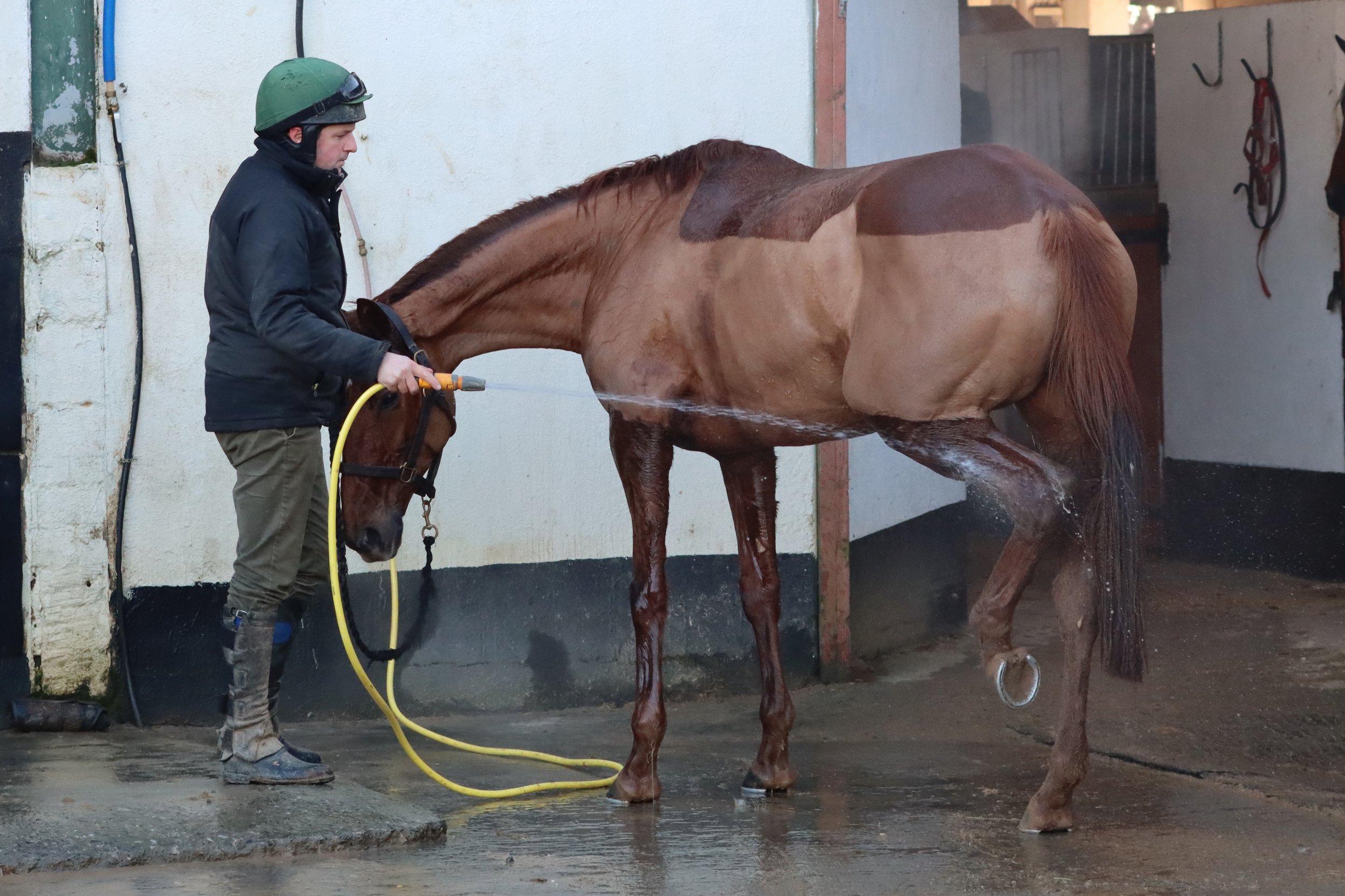


Racing and breeding in Turkey
Article by Paull Khan

The true scale of the thoroughbred industry in Turkey is surely widely underestimated. Turkey is indeed a big hitter in the racing and breeding world, but much of its activity flies under the international radar. This is perhaps not unsurprising, as Turkish racing is almost completely closed. Of the 3,159 thoroughbred races run in the country annually, all but six are closed to foreign-trained runners. All its races may be broadcast across two television channels, but pictures of Turkish racing are rarely seen abroad; and unless one has a Turkish identity number, one cannot place a bet on those races on the Turkish Jockey Club’s platforms. There are only 10 foreign-based owners in the country, and hardly any of its racehorses were bred anywhere other than in Turkey.
But shine a light on this sunniest and most welcoming of countries, and the vibrancy of the industry is remarkable.
Let’s take breeding first. The latest figures available to the International Stud Book Committee (the 2020 foal crop) show that Turkey is one of the few major thoroughbred breeding nations whose foal numbers have actually grown over the past decade. In 2010, Turkey ranked 15th in the world, in terms of number of foals bred, with 1,500. She now ranks as high as 9th in the world, with 2,103 foals – a 40% increase, no less, at a time when global production is in marked decline. Turkey is, in fact, the fastest-growing major breeding nation in the world. Amongst the top ten, only Ireland’s and Japan’s foal crops have increased over this decade, and both have seen much more modest growth than Turkey’s (15% and 11% respectively). And this Turkish expansion continues: some 2,280 foals were registered in 2022 – a further 8% rise.
Look down a racecard in Turkey, and you would be lucky to see a foreign-bred suffix beside any of the runners’ names. With only 24 out of 3,500+ horses having been foaled outside the country, such a racecard would be something of a collector’s piece. The explanation can be found in a regulation that only allows Thoroughbreds to be imported in the year of their birth. A striking example of the closed nature of Turkish racing, this rule is in place to support local breeders. Another disincentive to buying foreign-breds is that imported horses only receive 75% of the normal prize money.
So, it is domestic production that, almost exclusively, fuels Turkey’s racing product. But that does not mean Turkey is closed to the purchase of foreign bloodstock. Far from it. It has embraced a long-term policy of importing stallions and broodmares strategically to build up the quality of its herd over time. Ten of these stallions are currently owned by the Turkish Jockey Club (TJC) and stand at one or another of their various Stud Farms, which also hosts 47 privately owned stallions. In this way, they are able to offer world-class stallions to their mare owners at knock-down prices.
The most expensive stallion, at least of those whose fees are in the public domain, Luxor, stands at under €8,000.
Current Champion Sire, 1998 Belmont Stakes winner Victory Gallop (CAN), heads the roster of TJC-owned stallions. By the time TJC bought him from America in 2008, he was the sire of multiple-stakes winners. His nomination fee: around €3,000.
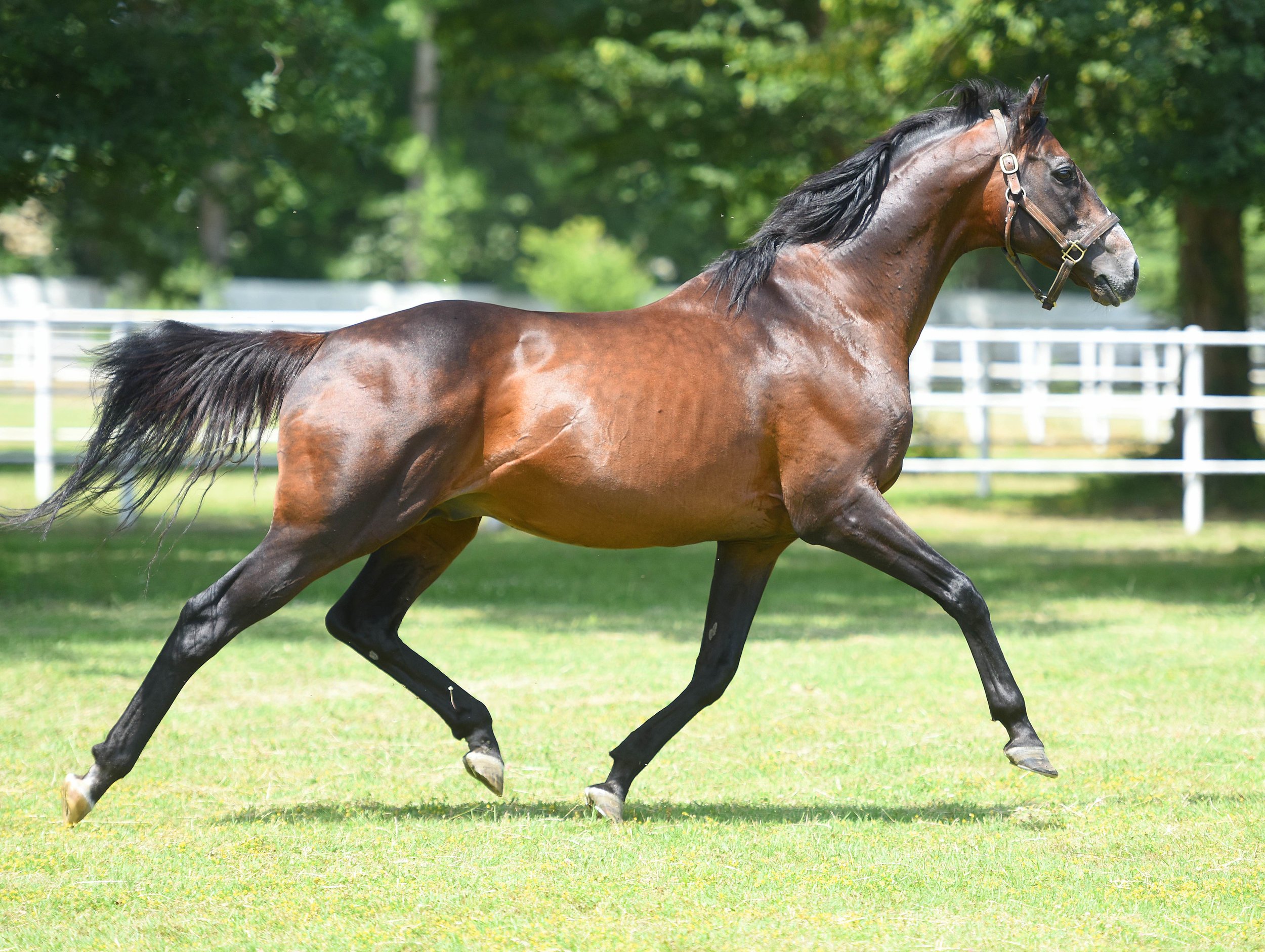
2007 Derby hero Authorized (IRE) now stands in Turkey.
A more familiar name to many European Trainer readers among the TJC’s team is 2007 Derby hero Authorized (IRE). Having stood at Dalham Hall, Newmarket and Haras de Logis in France, this sire of six individual Gp1 winners, as well as of Grand National winner Tiger Roll, was acquired by the TJC in 2019, where he stands at some €2,500.

Daredevil (USA), dual Gr1 winner for Todd Pletcher, was purchased by the TJC in 2019.
Daredevil (USA), dual Gr1 winner for Todd Pletcher, was purchased by the TJC in 2019 and stood the 2020 season in Turkey, before returning to his native USA to stand at Lane’s End Farm. However, the TJC have retained ownership of the horse.
Ahmet Ozbelge, General Secretary of TJC, explains the rationale behind this arrangement and the Turkish philosophy on stallion purchases. “After we bought Daredevil, his offspring Shedaresthedevil and Swiss Skydiver performed incredibly well; and we subsequently received many offers from various US stud farms to buy or to stand him. We evaluated all offers and decided not to sell him because of his young age but to stand him at Lane’s End. This is a first for the Turkish breeding sector, and we are glad to be in such a collaboration, to the benefit of the global breeding industry.
“In Turkey, we have very strict criteria for breeding stock purchases from abroad, based on performances of the stallion or the mare in question but also of his/her progeny’s performances. On top of that, we work hard to select the best-suited ones for our country’s specific conditions, including racetrack types, race dıstances, conformation and bloodlines. We also try to build up a good variety in our stallion pool in order to meet the various expectations of our breeders.”
Rising foal numbers are but one example of how Turkey is, in many ways, swimming against the tide. While many countries are seeing a slow decline in their racecourse numbers, Turkey is adding to its roll. Antalya is the latest addition, and it would take a brave punter to bet against further tracks opening their doors in the coming years.
Some €70M will be distributed across Turkey’s national race programme, creating a more than respectable average prize money of €8,200 per race, with owner’s and breeder’s Premiums boosting this to €11,300 per race.
The TJC has no fewer than 2,300 people on its payroll and an outlook that places social engagement higher up the list of priorities than do many racing authorities – perhaps in part to win over the hearts and minds of a populace which tends to be disapproving and to conflate racing and betting. For example, the racecourses offer not only pony and horse rides for the general public but also free equine assisted therapy for the handicapped.

Pony Rides for children and the disabled are routinely offered at Turkish racecourses.
How is an industry of this size sustained? In a word – and unsurprisingly – through betting. Horserace betting has long provided a rich seam of income for the TJC via a formula of which most racing governing bodies can only dream and which is likely to have yielded some €190M in 2022.
By international standards, the Turkish punter gets a raw deal, indeed, with only a 50% return on his stakes. The TJC retains an eye-watering 22% of monies staked, with the remaining 28% slice going to the government. Other income streams for the TJC pale into insignificance: any money from sponsorship, for example, is heavily taxed at a rate of 74%.
Enviable though the TJC’s position may be to many Racing Authorities, it rues the fact that sports betting enjoys yet more favourable treatment. “This is a key point, actually,” explains Ozbelge. “There is a seven-point tax gap between the two sectors in favour of sports betting, which allows them to offer higher payouts. As football is so popular and the most beloved sport in Turkey, we have so many common punters to both racing and football. As a result, they can easily be driven away from the lower payout environment to high payouts.” The paucity of the horseracing return is most evident in single bets, and least apparent in exotics such as the Pick 6 - the Turks’ favourite bet.
To support Ozbelge’s point, sports betting dwarfs horserace betting, accounting for no less than 90% – to racing’s 10% – of legal betting activity. To what extent this is due to the payout differential is difficult to tell. There is also the underlying relative popularity of football which he alludes to; and a further factor may be that, while racing offers pool betting, sports betting is fixed odds. (Exchange betting is outlawed in the country due to integrity concerns).
What is clear is that, with payouts so low, the temptation to bet via the illegal websites is high. “We import race meetings from different countries to prevent Turkish citizens from betting on illegal sites on these races,” continues Ahmet Ozbelge. Even so, it is estimated that the scale of illegal betting at least matches that of legitimate betting.
If European punters and bloodstock agents are likely to find the Turkish landscape somewhat alien, so too might trainers and owners, as the structure is, again, very different.
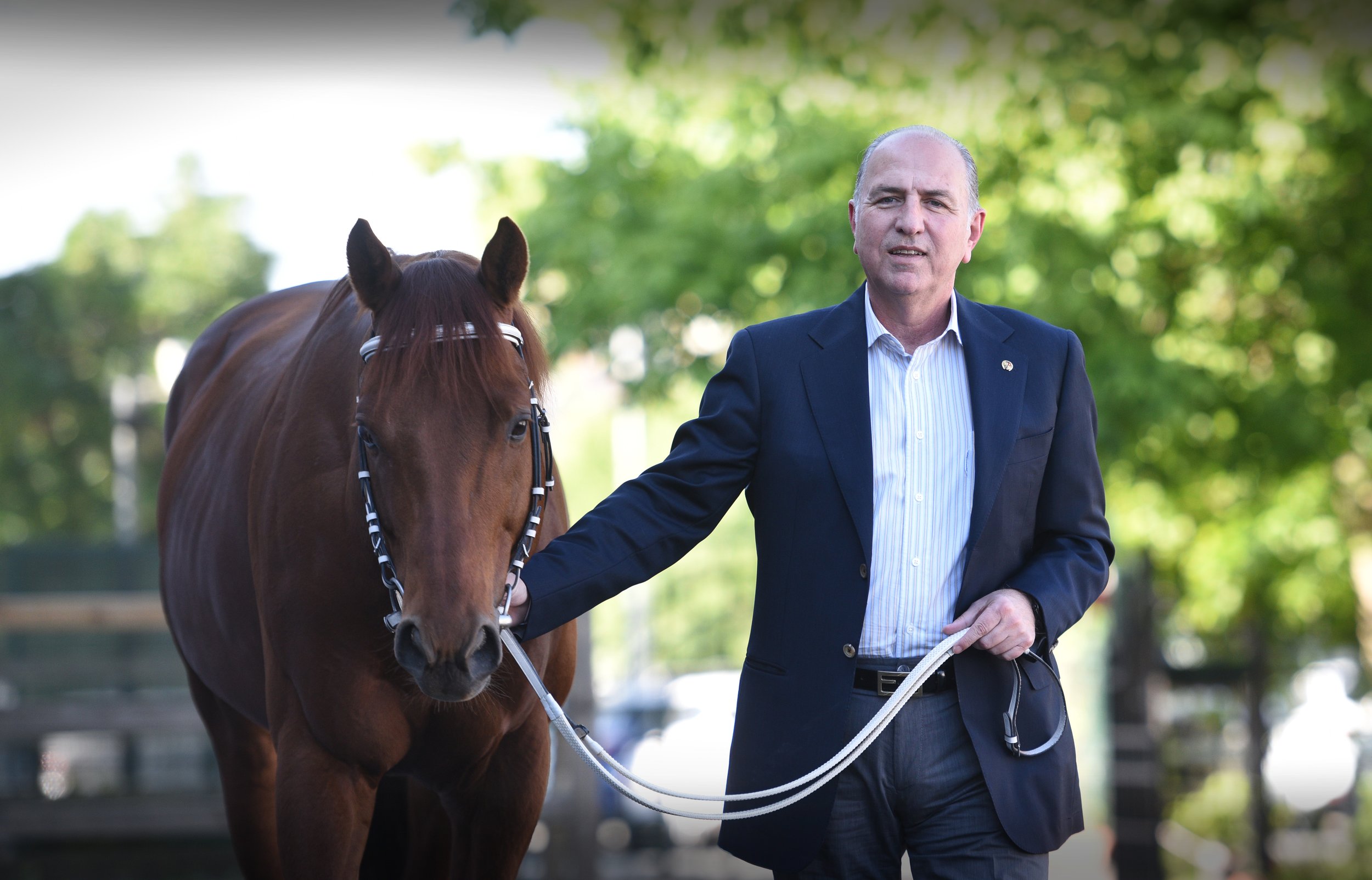
General Secretary Mr. Ahmet Ozbelge .
There are 795 trainers in the country whose licences allow them to train thoroughbreds or purebred Arabians. There are almost as many Arab races as thoroughbred races, and the prize money is similar. Between the codes, there are over 8,000 horses in training.There is no jump racing nor trotting. A quarter of the race programme is on turf: the majority of races are run on sand with around 10% on a synthetic surface.
To retain their licences, trainers must attend compulsory training sessions, which have heretofore been annual, but are about to be moved onto an ‘as required’ basis. The great majority of trainers train US-style on the racetracks, and each track has plentiful boxes for the local horses-in-training.
But here’s the thing: for the most part, trainers do not charge a fee to their owners, in the manner of those in Western Europe. Their sole remuneration is, rather, a percentage of their horses’ earnings – 5% or 10%. (Some do strike separate agreements with their owners for a fixed salary, but this is not the norm).
The owner, for his or her part, is then responsible for all their horses’ expenses. However, what one might imagine would be a hefty part of those costs – that of the horse’s stable at the racetrack – is again heavily subsidised by the TJC, who charge just €15 to €20 (depending on the racecourse) per annum per box. The owner’s total expenses – including the salary and insurance of the stable staff, feed, bedding, veterinary expenses, etc. – are not far in excess of €1,000 per month. But, lest this information should start a goldrush amongst European owners, salivating at the potential returns on investment, it should be explained that not everyone can become an owner in Turkey. One must have a Turkish residence permit and be able to demonstrate financial sufficiency. This explains why there are only 10 foreign-national owners on the TJC’s books.
Turkey is one of a select few European countries with internationally recognised Group races (the others being France, Germany, Great Britain, Ireland, the three Scandinavian countries and Italy). The Gp2 Bosphorus Cup (3yo+, 2,400m/12f) and Gp3 Topkapi Trophy (3yo+, 1,600m/8f) are the richest, worth north of €150,000. The Istanbul Trophy (Gr3), for fillies and mares, makes up its Group-race trio. All are run over the turf course at Istanbul’s impressive Veliefendi racetrack – the main centre and flagship of Turkish racing. They are joined by the International Thrace Trophy (turf) and International France Galop FRBC Anatolia Trophy (dirt), both of which are international Listed Races. The only other open race takes place at the nation’s capital, Ankara, being the Queen Elizabeth II Cup for two-year-old thoroughbreds; but this has never attracted any European runners.

The start of the Gazi Derby.
Richer than all of these is the Gazi Derby, a €330,000 race run over the classic mile and a half in late June.
Veliefendi is not, however, Turkey’s oldest racecourse. That honour goes to Izmir, at which members of the EMHF’s Executive Council spent a most enjoyable day’s racing in September, following this year’s annual meeting.
The window into Turkish racing has for some years been its International Festival, at which all Veliefendi’s international races are run. Its wide – up to 36 metres – turf track and attractive prize money once proved highly popular with foreign trainers, who frequently made the journey to Istanbul in September. The Topkapi Trophy , for example, saw a 10-year unbroken spell of foreign-trained winners, with Michael Jarvis, Mike De Kock, William Haggas, Richard Hannon Snr., Kevin Ryan, Andrew Balding and Sascha Smrczek all making the scoresheet. However, COVID has brought about a sea-change in behaviour, and there has not been a foreign-trained winner of any Turkish Group race for the past five years.

EMHF ExCo members at Izmir Racecourse.
Inevitably, the quality of the race fields has suffered. In 2022, the Topkapi Trophy had to be downgraded from Gp2 as a result, and the pressure on all the Turkish Group races is unlikely to ease unless and until the raiders can be enticed back.
Turkey’s governance structure is also a little unusual. The Ministry of Agriculture and Forestry plays a very hands-on role when it comes to regulation – appointing the Stewards and taking responsibility for race day operations and doping control. The Jockey Club itself operates under the provisions of a triad agreement with the Ministry of Agriculture and the Turkish Wealth Fund, which is the holder of the licence for racing and betting in Turkey.
The TJC prides itself on its not-for-profit status and ethos. Ozbelge explains: “Having a centralised governing system of the racing, breeding and betting activities by a nonprofit organisation with a non commercial approach, but rather a ‘horsemen’ one, with a main goal being to develop [the] racing industry by improving the racehorse breed in the country, has many advantages. This system supports the horse owners and breeders by offering them world-class stallions for very reasonable covering fees, offering boarding and veterinary services of high quality for minimum possible costs to them. Also, supplying the industry with well-educated jockeys in its own Apprentice School and delivering live broadcasting of all races through two TV channels and so on.
“But when one thinks about the cost of all of these investments as well as all the facilities that the Club has to operate with its staff of 2,300 experienced people, with betting revenue being its sole income, it’s easy to see that this has many challenges that come with it. But the main challenge is the unfortunate general perception of ‘gambling’ of our beloved sport, which is considered the king of sports and the sport of kings throughout the world. With a little bit of support or at least a ‘fair approach’ in comparison to betting on other sporting activities, Turkey has great potential to be a major player in the world league of horse racing.”
So, what are the prospects of the veil over Turkish racing being lifted?
There is hope of a new media rights deal which promises to bring pictures of Turkish races to an international audience. But those hoping to see Turkey adopt the policy of most of its European neighbours – namely that of having open races – are likely to be disappointed. Ozbelge again: “As Turkey is not in close proximity to major racing countries in Europe, horses cannot travel frequently by road as between central European countries, but only by air in order to participate in international races. As one can imagine, this is quite costly, and in order to attract some horses from abroad, the prize money is the key factor here. So, it all comes down to the economics of the industry and of the country for sure. We do plan and hope to have more international races, but we can realise it only if and when we have the right infrastructure and dynamics for it.”
The importance of the Sacroiliac joint
Article by Annie Lambert
Horses that present as sore in the hindquarters can be perplexing to diagnose. Sometimes the problem is found in the last place you look – the sacroiliac joint.

Even though the sacroiliac joint (SI) was on veterinary radars long ago, due to its location buried under layers of muscle in the equine pelvic region, the joint and surrounding ligaments were tough to diagnose and treat.
The sacroiliac joint is often a source of lower back discomfort in race and performance horses. Trainers may notice several clinical signs of a problem. These hints include sensitivity to grooming, objections to riders getting legged up, stiffness of motion, pain to manual palpation of the rump or back, resistance to being shod behind and poor performance.
Of course, those symptoms could describe other hind limb soundness issues, making the origin of the problem arduous to ascertain. A thorough physical examination with complete therapeutic options can relieve sacroiliac pain. The treatments are complicated, however, by the anatomy of the SI area.

The equine pelvis is composed of three fused bones: ilium, ischium and pubis. The sacrum, the lower part of the equine back, is composed of five fused vertebrae. The sacroiliac joint is located where the sacrum passes under the top of the pelvis (tubera sacrale). The dorsal, ventral and interosseous sacroiliac ligaments help strengthen the SI joint.
The SI and surrounding ligaments provide support during weight bearing, helping to transfer propulsive forces of the hind limbs to the vertebral column—creating motion much like the thrust needed to break from the starting gate.
Sound complicated? It certainly can be.
Diagnosing Dilemmas
It wasn’t until modern medical technology advanced that the SI could be explored seriously as a cause of hind lameness.
“The sacroiliac is one of the areas that’s very hard to diagnose or image,” explained Dr. Michael Manno, a senior partner of San Dieguito Equine Group in San Marcos, California. “[Diagnostics] of the area probably correlated with bone scans or nuclear scintigraphy. You can’t really use radiographs because the horse is so massive and there is so much muscle, you can’t get a good image.
“About the only time you can focus on the pelvis and get a decent radiograph is if the horse is anesthetized—you have a big [x-ray] machine and could lay the horse down. But, it’s hard because with anything close to a pelvic injury, the last thing you want to do is lay them down and have them have to get back up.”
The nuclear scintigraphs give a good image of hip, pelvis and other anatomical structures buried deep in the equine body, according to Manno, a racetrack practitioner. “Those images can show areas of inflammation that could pretty much be linked right to the SI joint.”

The other modern technological workhorse in the veterinary toolbox is the digital ultrasound machine. Manno pointed out that veterinarians improved diagnostics as they improved their ultrasounding skills and used those skills to ultrasound areas of the body they never thought about before. Using different techniques, frequencies and various heads on the machine’s probe, the results can be fairly remarkable.
“The ultrasound showed you could really image deeper areas of the body, including an image of the sacroiliac joint,” Manno said. “It can also show some ligament issues.”
Where the SI is buried under the highest point of a horse’s rump, and under heavy gluteal muscles, there are two sets of ligaments that may sustain damage and cause pain. The dorsal sacroiliac ligaments do not affect the sacroiliac joint directly, but help secure the ilium to the sacral spine. The ventral sacroiliac ligaments lie deeper, in the sacroiliac joint area, which they help stabilize. These hold the pelvis tight against its spine. The joint itself, being well secured by these ligaments, has little independent movement and therefore contains only minimal joint fluid.

Diagnosing the SI can be complex because horses often travel their normal gait with no change from normal motion—no signs of soreness. Other horses, however, are sore on one leg or another to varying degrees, sometimes with a perceptible limp.
“I don’t know that there is a specific motion,” Manno explained. “You just know that you have a hind end lameness, and I think a lot of performance horses have mildly affected SI joints.
“The horses that are really severe become acutely lame behind, very distinct. You go through the basic diagnostics, and I think most of these horses will show you similar signs as other issues behind. We palpate along the muscles on either side of their spine and they are sore, or you palpate over their croup and you can get them to drop down—that kind of thing. Other times you do an upper limb flexion on them and they might travel weird on the opposite leg. So, it can be a little confusing.”
In the years prior to the early 2000s, the anatomical location of the SI hindered a definite diagnosis; decisions on hind soreness were more of a shrug, “time and rest” treatment evaluation. As one old-time practitioner called it, a SWAG – “Scientific Wild Ass Guess.”
Even with modern tools, making a conclusive diagnosis can be opaque.
“The less affected horses, through exercise and with medications like Robaxin [muscle relaxer] or mild anti-inflammatories, seem to be able to continue to perform,” Manno said. “I don’t know how you can be perfectly sure of an inside joint unless you try to treat it and get results.”
“That’s why bone scans came into play and are really helpful,” Manno added. “You can image that [SI] area from different angles with the machine right over the path of the pelvis, looking down on it or an angle view into it, and then you see it from the side and the back very often. We can get an idea from the different views and angles of where the inflammation is and pinpoint the problem from that.”
Once Manno has a generalized idea of where the problem is, he fine-tunes his hypothesis using more diagnostics with a digital ultrasound machine.
“You can ultrasound from up above and see the joint that way,” he said. “As ultrasound has progressed, we’ve found that the rectal probes the breeding vets have used can also be tuned in to start looking for other things. If you turn them upwards, you can look at the bottom of the pelvis and the SI joint. You can see things through the rectum by just looking straight up. That is a whole new thing that we probably never thought about doing. I don’t profess to be very great at it; it’s not something I do a lot, but there are people that are just wonderful at it.”
Treating a Theorem
But, if the diagnosis is incorrect, the prescribed treatment may be anything but helpful.

“In many cases, if a horse is really sore, you need to be very careful,” cautioned Manno. “What you don’t want to do is go from a strain or some sort of soft tissue injury into a pelvic fracture by trying to keep them going. In many cases you are back in the old rest and time type of treatment.”
Manno pointed out one treatment that has advanced over many years is injecting the SI joint directly. There are a couple of techniques used when injecting the SI. With a blind injection the practitioner directs a long, straight needle into the joint by relying solely on equine anatomy. The other technique employs an ultrasound machine to guide the placement of the needle into the joint.
“Normally we are just injecting cortisone in those cases,” Manno noted. “We are trying to get the inflammatory response to settle down. Hopefully that gives the horse some relief so that they’re a bit more relaxed in their musculature. You know how it is when you get a sore back; it’s hard to keep yourself from cramping, which makes everything worse.”
A slight tweak of that technique is to use a curved needle. When you are positioning the curved needle, it follows the curve of the horse’s anatomy and helps the practitioner direct the injection into the joint.
“It curves right into position for you; it gives you a little help,” Manno confirmed of the curved needle. “Some people are really good with that technique; others still like to go to the straight needle. [The curved needle] helps you approach the site without interference from the bones in that area.”
SI joint injuries affect most performance horses, including Standardbred trotters and pacers, Western performance athletes as well as hunters, jumpers and dressage horses.
The older show horses are often diagnosed with chronic SI pain, sometimes complicated by arthritis. These chronic cases—and admittedly some racehorses—are treated with different therapies. These conservative, nonsurgical treatments have been proven effective.
In addition to stall rest and anti-inflammatories, physical training programs can be useful in tightening the equine patient’s core and developing the topline muscles toward warding off SI pain. Manno, a polo player who also treats polo ponies, believes the hard-working ponies avoid having many SI injuries due to their fitness levels.
“I think these polo horses are similar to a cross between a racehorse and a cutting horse,” Manno opined. “They are running distances and slide stopping and turning.”
Other treatments utilized include shockwave, chiropractic, acupuncture, therapeutic laser and pulsed electromagnetic therapy.
Superior Science
With the new diagnostic tools and advanced protocols in their use, veterinarians can pinpoint the SI joint and surrounding areas much closer. This gives them an improved indication that there definitely is an issue with the sacroiliac.
When there is a question about what is causing hind end lameness, most practitioners begin with blocking from the ground up.

“In many cases with hind end lameness that we can’t figure out, we block the lower leg; if it doesn’t block out down low, we conclude the problem is up high,” Manno said. “Once you get up to the hock you’re out of options of what you can figure out. You start shooting some x-rays, but by the time you get to the stifle, you’re limited. Bone scans and ultrasounds have certainly helped us with diagnosing.”
Manno doesn’t see a lot of SI joint injuries in his practice, but he noted there were cases every now and again. He also opined that there were probably other cases that come up in racehorses on a short-term basis. He also noted that, although it may not be a real prominent injury, that’s not to say it has not gone undiagnosed.
“I think we realize, in many of the horses we treat, that the SI joint is something that may have been overlooked in the past,” Manno concluded. “We just didn’t have the ability to get any firm diagnosis in that area.”
International Codes of Practice on equine disease for 2023
Article by Victoria Colgate and Richard Newton
Horses are one of the most internationally travelled species, second only after humans, and this mobility, both between and within countries, means that the spread of equine infectious diseases is a very real and ever-present threat.
Indeed, infectious disease outbreaks are often related to new arrivals at, or movement of animals on and off premises, such as to competitions and race meetings. As well as having a negative impact on horse health and welfare, disease outbreaks can have further reaching consequences in terms of treatment costs, economic losses due to movement restrictions and an inability to compete, as well as disruption to the breeding schedule, which may have effects in racing in future years. Additionally, restrictions imposed in the face of the diagnosis of certain diseases can prevent the free export of horses between countries, impacting trade and equestrian sport. Infectious diseases are truly trans-boundary, and such a problem necessitates global cooperation and communication, echoing the mantra that ‘prevention is better than cure’.
The origins and evolution of the Codes of Practice

Figure 1
In 1977 in Newmarket, UK, there was widespread development of vulval discharge in thoroughbred mares post-covering that adversely affected their fertility and to an extent that caused temporary closure of stallion barns and stud farms. Initially unknown, the cause of this outbreak was later identified as the bacterium Tayorella equigenitalis, the causative agent of contagious equine metritis (CEM) and often referred to as the CEM organism, or CEMO.
The impact on the 1977 breeding season was significant enough for the Horserace Betting Levy Board (HBLB) to consider a serious need to control CEM in future years and in reaction to this, the Codes of Practice (CoP) were created. First developed by HBLB committee discussion in the summer of 1977 and then formally published in 1978, the HBLB CoP outlined swabbing protocols in the weeks prior to covering in an attempt to prevent the venereal transmission of CEM.
Despite the perceived draconian nature of these first codes, compliance was high and overall were highly successful—with CEM cases drastically falling following their introduction. In subsequent years, the CEM CoP was extended to include control measures on reproductive disease caused by the other venereal bacterial pathogens: Klebsiella pneumoniae (capsule types 1, 2 and 5) and Pseudomonas aeruginosa. Codes on the prevention and management of equine herpesvirus-1 (EHV-1) and equine viral arteritis (EVA) were also added following disease outbreaks of significant concern to the thoroughbred breeding industry in subsequent years.
Today the CoP are referred to as the ‘HBLB International Codes of Practice’, with the 2020 CoP being the inaugural internationally branded edition and representing a comprehensive manual outlining a series of voluntary standards (codes) and advisories (guidelines), with accompanying appendices. They are intended to assist breeders, trainers and horse owners (in collaboration with their veterinary surgeons) to control and prevent a range of important infectious diseases in equids. The CoP have a broad application among thoroughbred breeders; and the UK, Ireland, France, Germany and Italy are all signatories. Additionally, in a translated form, they have formed the basis of written equine infectious disease advice in many other countries. The initial reduction and then sustained maintenance of low levels of infectious disease outbreaks experienced after the CoP’s introduction is testament to the document’s effectiveness and importance.
The HBLB International Codes of Practice for the 2023 breeding season
The CoP are reviewed annually by a group of international veterinary breeding and infectious disease experts and stakeholder representatives. This review ensures that all advice is as current as possible regarding the latest scientific evidence and global disease situation. The CoP convey practical recommendations gained considering recent experiences with the occurrence and control of relevant outbreaks.
The 2023 edition of ‘The CoP Manual’ (title cover, above Fig 1 and table of contents, below Fig 2) comprises:

Figure 2
Six Codes on the following diseases: CEM (covering CEMO, Klebsiella pneumoniae and Pseudomonas aeruginosa), EVA, EHV-1, equine coital exanthema (ECE, caused by EHV-3), equine infectious anaemia (EIA) and dourine
Five Guidelines on equine influenza (EI), piroplasmosis, strangles, West Nile Fever (WNF) and artificial insemination (AI)
Eleven Appendices with a range of supporting information and guidance
The CoP are published on the HBLB website (https://codes.hblb.org.uk/); a PDF download (https://codes.hblb.org.uk/downloads/2023/Codes%20of%20Practice%202023.pdf) is also available. In Great Britain, the Thoroughbred Breeders Association (TBA) produces a spiral-bound printed hard copy for its members.
The CoP outline each disease sequentially, using a standardised format of sections which include information on notification procedures, clinical signs, transmission, prevention, diagnosis, control, treatment, freedom from disease and export requirements. It is a document that continues to evolve over time in terms of both the diseases included and the expert advice imparted.
Why ‘codes’ and ‘guidelines’?
Although the logic behind the distinction as to why specific diseases in the CoP are covered by a guideline rather than a code is not necessarily immediately initiative. It is worth remembering that a Code of Practice may be defined as ‘A documented set of recommended or preferred processes, actions or organisational structures to be applied in a given setting’, whereas a guideline is: ‘A general rule, principle or piece of advice’. Therefore, the diseases applied as codes are those that directly relate to, and have an impact on, breeding and that necessitate particular actions either to prevent or control disease, should they occur. The guidelines, in contrast, are merely advisory measures to those involved in thoroughbred breeding businesses, but cover diseases and practices that are also highly applicable to other populations of horses. The remainder of the article outlines several of the important codes and guidelines.
Strangles
Strangles, caused by the bacterium Streptococcus equi, is a disease affecting the lymph nodes of the upper respiratory tract. Although endemic within the UK horse population, it only occasionally affects thoroughbred stud farms. Accordingly, it was first included in the CoP as an advisory guideline in 2004 and has since been periodically updated in line with developments in diagnostic testing and vaccination. Due to the ability of Streptococcus equi to develop persistent infection, remaining within material (pus/chondroids) in the guttural pouches long after resolution of clinical signs, one of the key elements in prevention and control is identification and treatment of these carrier animals. This involves performing guttural pouch endoscopy and lavage of strangles cases around 30 days after clinical recovery from infection, and also of any new arrivals at a premises during the quarantine period, before they are allowed to mix with the resident herd.
Equine infectious anaemia (EIA)

Figure 3
EIA, also known as swamp fever, is caused by the equine infectious anaemia virus (EIAV) and is transmitted between horses by the transfer of infected blood, either by insect vectors or contaminated veterinary equipment or through administration of infected blood products (e.g., plasma or whole blood transfusion). It is found in thoroughbred and non-thoroughbred populations worldwide, including parts of mainland Europe; but it is currently not present in Great Britain, where any suspicion of disease is notifiable by law to the Animal and Plant Health Agency (APHA) and would result in compulsory slaughter of the affected animal. Following an outbreak in Ireland in 2006, a CoP for EIA was developed by Defra in the UK in August that year and was included as an addendum for the 2007 breeding season (Figure 3) and subsequently as a full code from 2008 onwards. EIA has been included as a full CoP since 2008, and it recommends pre-breeding testing of all mares and stallions prior to commencement of the covering season as the best way to establish and maintain freedom from infection.
Dourine
A new code on dourine was added in 2012, following its re-identification in Sicily and the Italian mainland during 2011, which necessitated pre-import screening of horses arriving from this area. A notifiable venereal disease caused by the protozoan parasite Trypansoma equiperdum, once widespread, had largely undergone eradication and of late had only been reported in Asia, Africa, South America, Eastern Europe, Mexico and Russia. There is no cure for dourine, and euthanasia is usually the advised treatment option on the grounds of animal welfare and population health. As investigations into the 2011 Italian outbreak indicated subclinical seropositivity to dourine in many regions of Italy, it was evident that the disease was closer to our shores than anticipated. That led to its addition to the CoP in order to keep all owners/breeders informed and appropriately advised.
Equine influenza (EI)
EI was added to the CoP in 2020 as an advisory guideline following the 2019 European epidemic, which saw a major outbreak in the UK (Figure 4), including cases of clinical disease in vaccinated thoroughbreds. This led to the cancellation of British horseracing for six days in February 2019 as a pre-emptive control measure, but still at significant economic cost to the industry.

Figure 4
Although clinical EI is usually fairly mild and self-limiting, the resulting damage to the respiratory epithelium can impact performance for up to six months and leaves the horse vulnerable to secondary bacterial infections and potential pneumonia. Appropriate vaccination, biosecurity protocols and effective quarantining of new arrivals are outlined in the Code as the cornerstone to EI control. With such a highly contagious virus capable of spreading over large distances and with great speed, especially in the immunologically naïve, awareness and prevention are key.
West Nile fever (WNF)
WNF, caused by West Nile virus (WNV), is an infectious but non-contagious disease transmitted through the bite of an infected mosquito. Although the natural host-vector cycle is between birds and mosquitoes, horses and indeed humans can become infected but act as so-called incidental or ‘dead-end’ hosts; importantly, not presenting is a risk for onward transmission as there is insufficient WNV in their bloodstream. Many horses infected with WNV remain without signs, but approximately 10% will develop neurological disease, which can be fatal. Historically confined to Africa and the East, it entered North America in 1999 leading to widespread infection with many equine and human fatalities. Since then it has become endemic in the USA and continues to spread further into northern Europe as climate change alters vector habitats and life cycles. After the development of equine cases in Germany in 2018 and evidence of human and bird cases in the Netherlands in 2020, WNV was considered to pose an increasing threat to the UK horse population, especially animals that travelled overseas for competition and breeding purposes. WNF was therefore added as a guideline to the CoP in 2021.
Piroplasmosis
The latest disease addition to the CoP was an advisory guideline on piroplasmosis in 2022, following concern that the disease was becoming increasingly important among the international equine population. Piroplasmosis is a tick-borne disease caused by the intracellular parasites Babesia caballi and Theileria equi. Although the UK is currently considered to be free from locally acquired endemic disease (referred to as ‘autochthonous’), cases have occasionally been confirmed in the UK and are endemic in other European countries. With no formal requirements for pre-import screening, infection could re-enter the UK through importation of infected horses. The code gives informative background information to raise awareness among thoroughbred breeders and owners/keepers of other horse populations.
Improving accessibility and applicability of the CoP
Another way in which the CoP have more recently evolved is through the mechanisms of delivery to stakeholders. In July 2016, the accessibility and reach of the CoP took a further leap with the generation of the smartphone EquiBioSafe app (https://play.google.com/store/apps/details?id=com.veterinaryadvances.android.equibiosafe&hl=en_GB&gl=US&pli=1). With the HBLB Codes of Practice and National Trainers Federation Codes of Practice précised into key elements for the control and prevention of infectious diseases, the app allows interactive and stable-side access to advice, as well as assisting trainers to comply with sporting authority vaccine regulations and disease notification procedures. With the ability to send emergency notifications in the event of heightened disease threats in a particular area, the app provides real-time relevant information to assist with implementation of proactive biosecurity measures. This helps safeguard horse health and the socioeconomic livelihoods of all those involved in equestrian sport. Like the CoP, the EquiBiosafe app has mainly been targeted to a European audience, but downloads recorded from North America, Asia and Latin America demonstrate its international application.
The HBLB International Codes of Practice act as broad, minimum requirement recommendations for the identification, treatment, prevention and control of a range of important equine infectious diseases—equally relevant across international borders and from pleasure to elite competition horses. They are also dynamic, evolving over time in line with the ever-changing disease situation, and therefore acting as a vital education and reference resource to all those involved in the equestrian industry. They form a user-friendly instruction manual of exactly ‘how (not) to’ allow infectious diseases to fulfil their devastating potential.
How the Chehboub family has become a major player in the French breeding and racing industry
Article by John Gilmore

Kamel Chehboub and Sealiway at the Haras de Beaumont
The Chehboub family have started an exciting new breeding development in Normandy, through purchasing the Haras de Beaumont stud. The deal also included a part of the adjacent Haras du Quesnay land, which is being sold by the Head family in two parts. The other part is being bought by Businessman Stephane Courbit. “We will know in a few months whether Haras du Quesnay will continue as a stud,” indicated Freddie Head. The stud, which was made famous by his father Alec Head, was originally bought by his grandfather William Head in 1958.
Buying Haras de Beaumont and part of the neighbouring Haras du Quesnay has certainly created the environment for Kamel Chehboub to develop his racing and breeding interests. His daughter Pauline Chehboub is responsible for day-to-day operations.
The Chehboub family have for the past eight years, owned the Haras de la Gousserie, in the Loire region of France. That farm is due to be sold, with all the mares and stallions being relocated to Haras de Beaumont. As a result, the Chehboub racehorses, which previously ran under the name of Haras de La Gousserie, will now be changed to ‘Ecurie de la Gousserie.’

Rougir
Overall, it’s been an eventful past couple of years for the Chehboub family. Their filly Rougir, winner of the Gp 1 Prix de L’Opera, went through the ring at the Arqana Breeding stock sale December 2021 as a 3-year-old for a record €3m, selling to Peter Brant’s White Birch farm and Coolmore partnership.
Rougir is now trained in the United States by Chad Brown and has since justified the high price tag, with a first time out three-length facile victory at Belmont when capturing the Gr3 Beaugay Stakes in May and stepping up in October to take the Gr1 EP Taylor Stakes at Woodbine Canada.
Rougir’s sale was certainly a jackpot pay day for Kamel Cheboub and his Haras de la Gousserie breeding and racing enterprise. Rougir was bought as a yearling for €55,000 at the Arqana yearling sale, after previously being sold as a foal through the same auctioneers for just €11,000.

Sealiway
The 2021 Champion Stakes winner Sealiway, which the Chehboub family owns in partnership with Guy Parente, will be a major attraction at Beaumont. His stud fee has been set at €12,000.
Additionally, another high-profile Gp1 winner Intello, who the Wertheimer brothers own and previously stood at the Haras du Quesnay, will be transferred next door to take up stud duties at Beaumont for an €8,000 euro.
“We thought it was an appropriate stud to place Intello, as Champion Stakes winner Sealiway will certainly be popular, which could also add interest from breeders to our 2013 Prix du Jockey Club winner, stabled in the same place,” said Pierre-Yves Bureau Breeding and Racing manager for the Wertheimer brothers.
Sealiway was originally a €62,000 yearling purchase at Arqana. Both Rougir and Sealiway’s performances on the racecourse have certainly put Haras de la Gousserie on the map. They have also expanded their racing presence through acquiring a new yard at Chantilly, in addition to their other main training yard in Marseille.
It’s a far cry from those early days more than 30 years ago for property businessman Kamel Chehboub, which first sparked his initial interest in racing. “My father first started going to the racetrack with friends who were punters and gradually began to enjoy the sport himself”, explained Pauline Chehboub.
“After a while, my father began to take shares in racehorses sourced from claiming races. The first was Onegar in 1987, bought out of Andre Fabre’s stable.” The big breakthrough came with the filly Lavayssiere, who was placed 5 times in 13 runs on the flat but proved a revelation at stud. Lavayssiere produced 5 Black Type horses from 8 runners, including her second foal Gp1 winner Spirit One, born in 2004.
“Spirit One and jockey Ioritz Mendizabel’s enterprising all the way win in the Gr1 Arlington Million race at Chicago in August 2008, trained by Philip Demcastel, was a tremendous boost to my father’s racing operations-enabling him to start developing the business and buy more racehorses.” The €403,504 pot of prize money for the Arlington Million victory, boosted Spirit One’s career earnings to €974,269, which included winning 5 races from 19 starts.
Spirit One entered the Haras de Lonray in the Herault southern region of France and later relocated to Sablonnets in the Sarthe department (western France) from 2013. The best of his 36 winning offspring was Eleuthera, who won the Gp3 Prix de Royaumont in 2013 and was subsequently purchased by Teruya Yoshida. Spirit One sadly died of a tumour at Haras des Sablonnets in April 2016.

Pauline Chehboub
Pauline Chehboub has been working for her father and Uncle Bouzid Chehboub’s racing interests for the past 7 years, after obtaining her commercial business licence. Previously in her youth she rode in show jumping events to a high level. “I was show jumping champion of France at 16 years old and have been riding since I was a child. So working within the horseracing industry was always something I wanted to do, especially as my father was very involved in the industry.”
She added, “My father has had more than 20 years’ experience in this business, through regularly going racing, visiting the sales, and observing the training. Over the past few years, he has taken the trouble to pass on this valuable knowledge to me, concerning key points of what to first look out for in a racehorse and their development through observation, physique and origin.”

Pauline Chehboub is now manager of the family racing and breeding operations, which operates two training yards in Chantilly and Marseille, plus stud activities. She is often seen at the racecourse and regularly on the early morning gallops in Chantilly.
“It’s a seven-day-a-week job, with 35 horses in training at Chantilly, and a further 20 at Calas-Cabriès training centre in Marseille. Apart from keeping tabs on the racehorses, there is also the stud. Not forgetting the administration side, which includes discussing the well-being of the racehorses, future race entries with the trainer, accounts work, buying yearlings, horses to sell and the breeding nominations.”
“In September 2021, we bought the yard in Chantilly on the Chemin des Aigles as we thought it was important to have a presence for all the main meetings in the Paris region, as well as in Marseille. In this way we can cut down on travelling, through having yards both in the North and South, with the better horses generally based in Chantilly.”
Marseille-based trainer Cedric Rossi trained for a number of different clients, including the Haras de la Gousserie up until December 2021. The subsequent revelation of alleged doping and stopping horses’ investigation by the police three days after Rougir went through the ring, concerning several people including Cedric Rossi, was a major shock for French racing.

“Cedric Rossi was our principal trainer at the time, and after the alleged doping investigations, we transferred our horses to other trainers, with many at the time going to Richard Chotard and Sealiway to Francis Graffard at Chantilly,” said Pauline Cheboub.
“We transferred Sealiway to Francis Graffard’s stables in Chantilly this season, because his record shows the trainer has a lot of talent. Sealiway has not really had conditions in his favour this season. His best races have been when coming off a fast pace and on soft ground conditions, as in the Champion Stakes.” After a disappointing run in this year’s Arc de Triomphe, Sealiway was subsequently retired to stud.
The Haras de la Gousserie racing and breeding business has worked in a certain tried and trusted way. The stud was bought eight years ago; after the Haras de Lonray, in the South of France Herault region, where the Chehboub breeding stock was previously lodged, went into financial difficulties. Finally they chose to purchase Haras de la Gousserie in the Loire region because it also offered pre-training facilities.
“We do not sell many of our breeding stock at the sale, as we breed to race. Each year we buy around 20 yearlings at the Arqana August and October sales, looking for French-bred horses with precocity and the possibility to win as two-year-olds, and not by yearlings with expensive leading stallion pedigrees.”
“The objective is to find some good horses each year to eventually add to our breeding stock. Those that turn out to be not future breeding prospects may end up in claiming races to be claimed, or sold through the in-training sales. We like to keep around 20 broodmares to breed from.”
Now they hope to continue to develop and progress, after transferring their entire breeding stock to their new stud venture in Normandy.
It is clear the Chehboub’s racing and breeding operations has been developing over the past decade, through its policy of buying more and better quality yearlings at the Arqana August and October sales, that has borne fruit as results on the track clearly show.
In 2013, just 19 racehorses won €573,853 in prize money and premiums; and last year, 41 racehorses earned €2,107,125—nearly 4 times as much.
They have now progressed to be one of the top ten racehorse owners in France, finishing 9th in 2021; and in early December, nearing the end of the 2022 season, they were once again in 9th position.
It would seem the Chehboub family name has now been firmly established, to become a major player in the French breeding and racing industry. Next year (2023) looks set to be another milestone year.

Haras de beaumont
Investing in All Weather racing
Article by Catrin Nack
The European ‘all-weather’ racing scene has come a long way since racing on an artificial (non-turf) surface was first introduced in the UK at Lingfield Park in 1989. Today, ‘all-weather’ racing accounts for 23% of the French racing programme; and in the UK, racing has recently benefited from a major ‘all-weather’ prize money boost.
‘All-weather’ racing is enhancing the opportunities for those connections wishing to keep horses in training across Europe over the winter months.
But what are opportunities like on a country by country basis? Which countries are investing in ‘all-weather’ racing?

France
While trotting is still the main racing sphere by some way in France – and all their racing is on dirt tracks – all-weather in France has been gathering momentum for over a decade now. Of roughly 5,000 races run in France in 2021, 1,149 were staged on an all-weather surface, thus comprising some 23% of the race program.
Prestigious tracks such as Deauville and Chantilly have all-weather circuits; in total there are seven all-weather tracks in the country: Deauville, Chantilly, Pornichet, Lyon-la-Soie, Cagnes-sur-Mer, Pau and Marseille-Vivaux.
In contrast to other racing nations, where usually the whole raceday will take place on one surface, French tracks have mixed cards and use the all-weather (all with a Polytrack surface) in summer also.

While diversifying the programme, it also takes pressure off the grass tracks, with rising temperatures in southern Europe providing new challenges in turf maintenance. French racing has eight Listed races run on its all-weather surfaces, Cagnes-Sur-Mer stage two, Chantilly one and five at Deauville. A review to enhance the Black-type programme is on the way, but plans are in the very early stages. French tracks are part of the All-Weather Championships programme to qualify for the finals on Good Friday in the UK – something French raiders did to good effect in 2022.
French racing receives the majority of its income – read prize money – from its betting turnover, as the PMU (the French Tote) has a monopoly on betting. The rise in all-weather racing has naturally seen a rise in betting turnover in this sphere – roughly 18% of all PMU-flat races are run on the all-weather circuit. Recent results suggest that the betting public is gradually switching from traditional jump-races to all-weather racing.
According to Adrien Cugnasse, all-weather racing also caters well for a new type of owner. With syndicates still very scarce in France, a new type of ‘middle class’ owner has been emerging over the last couple of years – much needed new blood, but a type of owner that relies on a more regular income through prize money.
UK
It's Year 10 since the creation of Arena Racing Company (ARC) backed All-Weather Championships, and racing on this surface does continue to increase in volume. Six racecourses in Britain stage all-weather racing, on either Polytrack (Lingfield, Kempton, Chelmsford) or Tapeta (Newcastle, Southwell, Wolverhampton); roughly one fifth of all flat races are now on a synthetic surface.
Huge investments have been made by the operator ARC across their four all-weather racecourses to improve the surface. With Southwell being the latest course to convert to a Tapeta surface (from Fibresand).

Mark Spincer, managing director of ARC’s Racing Division says that “changing the surface, particularly at Southwell, was the right thing to do and the feedback from trainers and owners has been very positive so far.”
The creation of the All-Weather Championships 10 years ago can only be viewed as a major success story; the series now incorporates races from Ireland, France, Dubai and even races in Saudi Arabia, as well as the enhanced Fast-Track-Qualifying system.
The switch of Finals day from Lingfield to Newcastle two years ago was followed by the creation of “All-Weather Vase Day” at Lingfield Park last year, also staged on Good Friday.
A day that traditionally saw no racing at all now has two high-profile all-weather meetings taking place – a definite illustration of the rise of racing on this surface. Along with geographically diverse racing in the north and the south, All-Weather Vase Day naturally comes with added prize money, the whole raceday is worth around £390,000.

No fast-track-qualifying here, but at least three runs are needed akin to Finals Day, thus creating additional incentive to run on the all-weather. Even the quickest of glances at any given fixture list on the all-weather does reveal the extent to which these races are contested now; with even the choicest-bred horses from big yards coming under starters orders.
While headline names to race synthetic surface will forever include the mighty Enable and Stradivarius, Godolphin recently raced a half-brother to Guineas hero Coroebus to name just one. Tracks learn about the adaptability of the surface all the time, with the recent extreme temperatures providing a new challenge. “Without all-weather racing, there wouldn’t have been any racing in the recent cold snap,” remarks Mark Spincer.
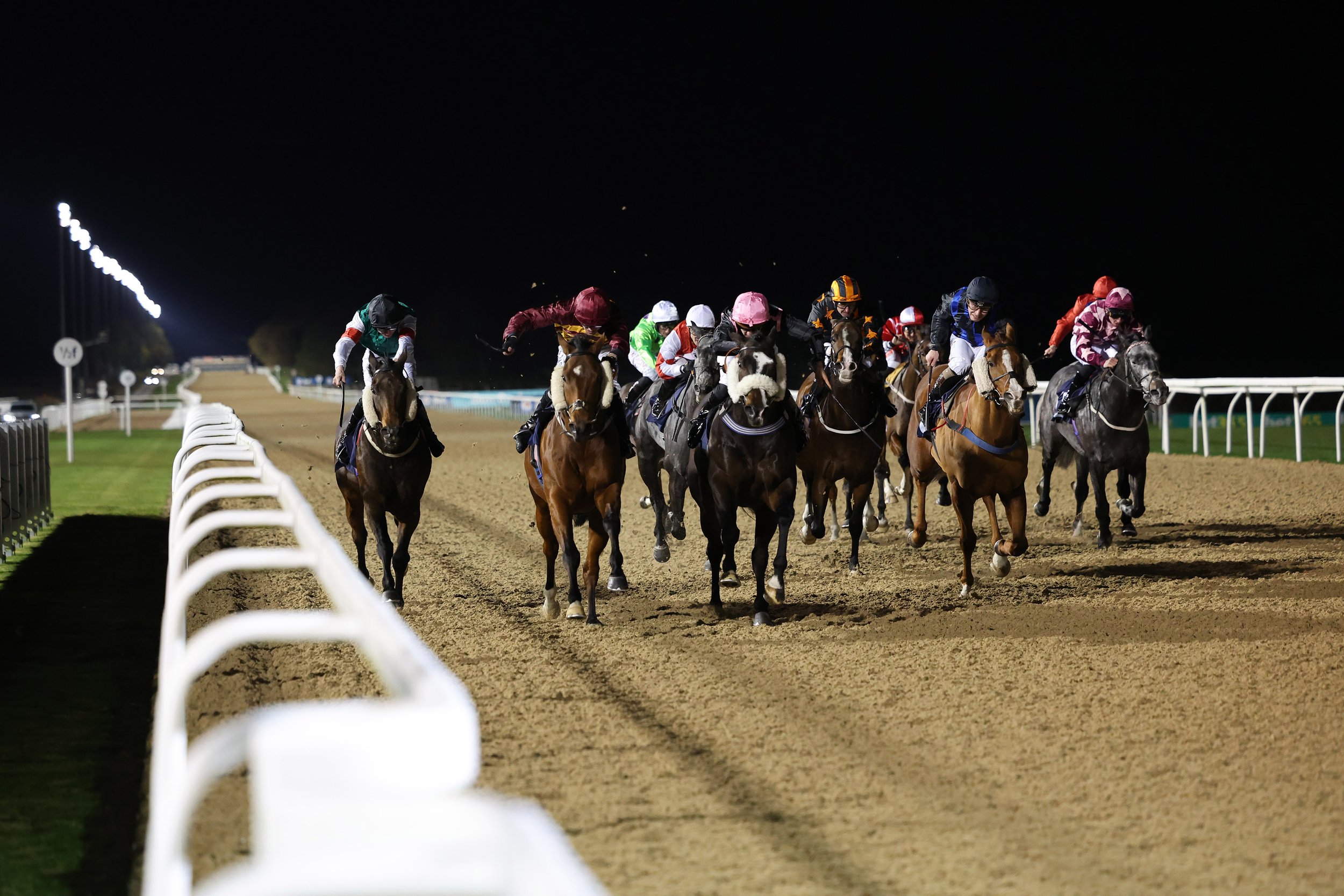
2022 saw two ARC initiatives to increase the quality of racing their tracks, one of those aimed specifically for (winter) all-weather racing. The mother company of Lingfield Park, Newcastle, Southwell and Wolverhampton announced a further bonus of over £1,000,000 not just added to prize money, but to reward connections of the most consistent performers during the winter months.
“While it is early days, some eagle-eyed trainers have already seen the chance to bag a bonus, of course we would love to attract more horses and their connections to our four all-weather tracks. We know that, for many, jump-racing is the winter focus in the UK, but all-weather racing during this period has a wide fan base both domestically and abroad,” concludes Spincer.
Coinciding with the exact timeframe of the All-Weather Championships, the bonus aims to reward consistency in given periods, no matter what the rating of the horse. Points scored go towards a “Horse of the Month” prize with rising extra money paid out from February onwards as well as £700,000 in bonuses for the horses with the most points at the end of the season.
The scheme clearly aims to enhance field sizes. Giving trainers, owners, jockeys as well as stable staff monetary reasons to race on at ARC tracks.
Germany
Germany's all-weather racing scene was quite vibrant at the end of the last century, but it has been in steady decline for some time now.
In 2019, Neuss racecourse closed its doors for the last time, and along with 144 years of turf racing went the second of the all-weather tracks.

Winter racing is now taking place at Dortmund racecourse only. Dortmund has a grass and an all-weather track, thus providing racing literally all year round.
However, the all-weather surface is a dirt track, Germany does not have any tracks with an artificial surface. The surface has not been renewed for some time now and has a huge kickback.
Racing takes place on roughly 14-day intervals, at time of writing eight meetings are planned this winter. Races are part of the French PMU funding and receive other subsidiaries. Generally, there are six-race-cards, the quality being no better than class 3 handicaps – Germany's second lowest class, with some sellers thrown in for good measure.

Prize money is at basic level for these types of races, meaning total purses per race do not exceed €5.500. Broadly speaking, all-weather racing in Germany caters for the very base level of the sport, with major trainers and owners very rarely venturing into this sphere.
Racing on the sand does count towards the Trainer and Jockey Championships in Germany, and this might lure the odd runner from the bigger stables. Plans for a second track with a synthetic surface have been mulled over by Deutscher Galopp for some time, but along with the general dire financial situation of racing in Germany, it remains only a very distant possibility at the moment.
Ireland
All-weather racing finally reached Ireland in 2007 with the remodelling and re-opening of Dundalk Stadium. It’s the only track in Europe to combine horses and dog-racing and judging by online reviews. This has been a huge success with fun-loving Dubliners.
From October till March, the track stages some 43 meetings, with at least once a week racing – mainly on a Friday night with floodlight and dog-racing following. Racing on the Polytrack continues sporadically throughout the year.
While the quality of handicaps is clearly not premium class, the track does stage a fair share of quite decent 2yo and 3yo maiden races, and these are contested by even the biggest yards in the country.
In addition, Dundalk stages two Gp.3 and three Listed races. Plans for the second Irish all-weather track have been developing for a number of years now, with planning permission for a new track at Tipperary expected to go ahead in early 2023.
This clearly points to an ever-increasing demand to stage flat racing all year round, largely independent from weather influences. In fact, many races on Dundalk's cards continue to be oversubscribed and operate with reserves – a further pointer to huge demand.
Smaller yards definitely target horses for Dundalk races and have owners who buy horses for this sphere. While larger yards may pick and choose their races at Dundalk, smaller trainers rely on the extra income to keep the yard going through the long winter months.
As jump-racing starts losing its tag of catering for the ‘small man,’ the domination of just a few trainers and owners is becoming more and more blatant by the year. All-weather racing gives a different type of trainer and owner a new lease of racing life.
With added entertainment around the product, Dundalk has created a largely vibrant scene; being in a prime spot no doubt helps, but all-weather racing with regular consistency is clearly a success story in Irish racing.

Which products and services should trainers be using in 2023?
Cavalor - ArtiTech
Low-grade inflammation is common in joints that perform. However, joint inflammation initiates a cascade of catabolic reactions that gradually degrade the cartilage and may result in lameness.

During an extensive research program, Cavalor has designed a multi-ingredient nutraceutical that helps with protecting joints of equine athletes. The effectiveness of Cavalor ArtiTec has been documented by both in vitro and in vivo experiments and the overall efficacy in the treatment of lameness is supported by the results of a clinical pilot study.
The efficacy and especially the synergistic potential of the individual raw materials and botanical ingredients on inflammation, cartilage protection and repair has been studied over 7 years. These findings have led to the final formulation of Cavalor ArtiTec.
Combining botanical ingredients is a widely applied practice to compose effective products. The final result is believed to be of similar or better potency as that of a single herb. The advantage of using suboptimal efficacious dose levels of each botanical ingredient is reducing the risk of potential toxicities associated with the usage of single herbs.
In the follow-up of the results of previous studies, 7 candidate formulations were evaluated (in vitro) to further unlock the mechanism of action of these formulations and their efficacy. The influence on various biomarkers related to joint health and homeostasis were evaluated using primary human chondrocytes isolated from knee joints in various in vitro models. This study has led to the development of the final candidate formulation for evaluation in a combined mechanistic and efficacy horse specific joint inflammation model (Phase III).
In conclusion, Cavalor ArtiTec is a complete multi-ingredient nutraceutical with proven efficacy for optimising joint health in equine athletes. Cavalor ArtiTec delivers everything our equine ‘athletes’ deserve during periods of intense activity and stress.
For more information contact: Website: www.cavalordirect.co.uk Telephone: +44 1902 213483
Duggan Veterinary - ConfidenceEQ®
Pheromone communication has been at the heart of Duggan Veterinary Supplies expertise for over 40 years, and we are now pleased to announce the launch of the innovative equine appeasing pheromone, ConfidenceEQ®.

A pheromone is a naturally occurring chemical that an animal produces used for intraspecies communication, which means that their presence automatically and predictably affects all members of the same species, regardless of age or gender.
Like many mammals, nursing mares naturally emit a calming pheromone that reassures their newborn foal. When the foal encounters unfamiliar situations and uncharted territory, this pheromone makes the foal feel comfortable, secure, and more self-assured, enabling them to better learn about their surroundings. ConfidenceEQ® is an identical replica of this horse appeasing pheromone. Numerous studies have been conducted since the equine appeasing pheromone was discovered, proving its effectiveness in reducing stress in conditions that occur frequently in horses of all ages.
Donal Duggan is delighted to add ConfidenceEQ® to the Duggan Veterinary Equine armoury, stating: “The ideal time to use ConfidenceEQ® is when you anticipate your horse will be exposed to something new which they may find stressful. ConfidenceEQ® helps reassure horses, helping them focus allowing them to use their own skills to cope with their surroundings and can be used to help build confidence in situations such as: Loading, travelling and recovery after arrival; Environmental changes (new yard, stabling) or competition environment; Social situations (weaning foals, meeting new horses); Dealing with loud noises (large crowds, thunderstorms, fireworks); Breaking young horses and introducing new exercises during training; Farrier, vet, or dental visits.”
Horses in these situations may show signs of stress such as pawing, vocalising, flared nostrils, kicking, lack of concentration, and resistance. These behavioural changes are due to an elevated cortisol level, which when prolonged, also triggers multiple physiological responses like increased heart rate and blood pressure, weakening of the immune system, cribbing, and digestive issues - all of which can develop into significant problems for owners, trainers, and veterinary practitioners.
ConfidenceEQ® is easy and quick to apply. There are no syringes, mixing food, pills or other uncomfortable application methods that can be difficult to administer or add stress to your horse. It takes effect in 30 minutes, lasts 2.5 hours, and can be reapplied as needed.
For more information contact: Email: sales@dugganvet.ie or uksales@dugganvet.com
Freedom Health - Total Gut Health
Horses actively training and racing commonly struggle with digestive health, problems which manifest most obviously in gastric issues. Additionally, many racehorses experience concurrent hindgut problems less easily recognised. Not eating well, sudden changes in behaviour, resistant and mean attitudes, not fully using the body, and struggling to maintain weight and condition are a few of the problems that can be associated with hindgut health.

It’s important to actively manage the health of the horses’ entire digestive tract to stop the treat-and-repeat cycle and keep your horses in top condition. A healthy gut is a core requirement for a racehorse to perform to its full potential.
Unfortunately, training, travelling, racing, and breeding chronically stress the horse and especially the digestive tract. Management and feeding practices have changed beyond recognition over the last few decades. But the equine digestive tract remains the same, having been accustomed to a low-stress, nomadic lifestyle while consuming a high-fibre, trickle-fed diet. Modern husbandry practices and feeding grain-based feeds, further complicated by competition stresses, can be significant contributors to digestive issues. What, then, can you do for these horses?

Support total digestive health by feeding SUCCEED® Digestive Conditioning Program™ once a day every day. SUCCEED maintains optimal digestive health in athletic horses naturally with science-based, human-food-grade quality, proven ingredients. It serves as an ongoing maintenance program for the health of the entire digestive tract.
Product trials available on a limited basis. Contact Sandra Hughes: shughes@freedomhealthllc.com.
SUCCEED® Digestive Conditioning Program™
The patented and proven SUCCEED formula delivers nutrients the body requires for GI anatomy and function. It provides a variety of benefits including:Oat Oil – specially extracted to preserve polar lipids which support nutrient absorption and bioavailability; Oat Flour – specially processed to preserve ß-glucan, a soluble fibre that provides support for a healthy immune system and a normal, healthy rate of feed transit through the GI tract; Yeast – a combination of a mannan oligosaccharide and a yeast ß-glucan help maintain a healthy, balanced hindgut and natural immunity; Amino Acids – provide fuel for muscles and support production of mucin, a necessary component of the mucus that lubricates and protects the gut lining.
“I have been using SUCCEED, and I couldn’t be happier with the results. You can visually see a big difference in the horses’ condition very quickly. I believe that it is really enabling their digestive systems.”
Richard Hughes, Horse Trainer
For more information visit: Succeed-equine.co.uk or @succeedequine
NAF - Immuforte
Keep the whole yard healthy, and ready to race, with NEW NAF Immuforte.
The busy racing yard environment presents the perfect storm of challenges for your horses’ immune systems; and any trainer knows when immune challenge hits, training days, performance and results are lost. Keeping them healthy keeps your training regime on track, and ensures the season’s goals remain in sight for every horse on your yard.

CREDITED TO JESS PHOTOGRAPHY
Regular travel, intense exercise and being stabled in close proximity, often with shared air space, means a daily assault on every racehorse’s natural defences. Add the challenge of frequent new arrivals, particularly young horses, with naïve immune systems, working closely together, and the risk is self-evident.
Requested by trainers. Formulated by Equine Vets and Registered Nutritionists. Trialled by trainers, riders and professionals in elite equine sport. BETA NOPS accredited, and designed to meet the highest regulatory and quality standards for racing throughout Europe, and beyond. New NAF Immuforte builds on over 30 years of experience at NAF, in innovative evidence-led solutions, to provide targeted immune support for equine athletes.
Containing a key natural extract proven to boost the equine immune system, Immuforte supports white blood cell numbers and activity, and targets the oxygen load capacity of red blood cells. Uniquely, Immuforte combines the recognised immune support of echinacea with natural antioxidants and adaptogenic botanical extracts, including, rosehip, turmeric, ginkgo and omicha, to regulate cellular responses, and further support the body’s own defence against unwanted attack.
NAF Immuforte is available as a palatable liquid, in an easy to feed, auto-measured pump dispense liquid. The perfect solution to your yard’s natural defences.
For more information contact: Website: www.naf-equine.eu Telephone: 0800 373 106
Plusvital - Racing Syrup
The globalisation of racing has eroded the margins of success between trainers. High performance is no longer guaranteed based on pedigrees. A study carried out on winning margins in racing suggests that the overall percentage difference between first place and second place is 0.32%, the difference between first and third was 0.75%. Never before has optimising recovery and nutrition been as important in gaining percentages of improvement which can be the difference between winning and not.

Days post-race or fast work the body recovers and adapts allowing the horse to become more oxygen efficient and physically stronger. Muscle recovery requires specific vitamins, minerals and amino acids to give the horse the best possible opportunity to maximise its full potential. This vital edge is optimised by correct nutrition. Supporting race horses' mineral and vitamin levels is critical to racing success today.
Used for 47 years by global racing elite Plusvital Racing Syrup is formulated to provide 30 essential vitamins and minerals exceeding NRC recommendations. Key ingredients facilitate strength and recovery.
B vitamins are an essential group of vitamins for a horse to perform at its best. The harder they work the higher the requirement for vitamin B is. B vitamins play a vital role in forming red blood cells, responsible for carrying oxygen to muscles allowing the horse to continue galloping at high intensity whilst removing carbon dioxide. When muscle has a high level of carbon dioxide the horse becomes tired and cannot finish the race.
Additional key ingredients include Vitamin E which reduces oxidative stress. Selenium neutralise free radicals supporting the immune system. Branched chain Amino acids and Threonine supports muscle recovery essential for strengthening. Zinc and biotin support cellular repair and hoof growth. Available in 2L or 5L Plusvital racing syrup supports your horse in pursuit of their performance goals.
For more information visit: www.plusvital.com
Why Choose Pro-Dosa in 2023?
As we all know, horsemen are responsible for the management of horses’ health, wellbeing, and fitness, to ensure they can perform to the best of their ability on the racetrack, but at the same time, a racing stable must be a profitable business and each horse must be economically viable for their owners. As a result, in 2023, more than ever, horsemen must ensure they are getting the best possible value from the products they purchase.

Quite logically, horses under the added stress of hard work, transport, racing, competition, or illness have increased nutrient requirements. Unlike people though, who often turn to food when under stress (think chocolate or chardonnay), horses tend to go off feed and drink less than they normally would. Horses that fail to eat or drink well when travelling and racing will recover more slowly and will often perform below their best. That is why many stables consider traditional, veterinary-administered, injectable pre-race/pre-travel treatments to be essential. Corrine Hills says “I originally developed Pro-Dosa BOOST, for horses in my own racetrack veterinary practice, as a more economical, less invasive, oral alternative to those treatments.”
Pro-Dosa BOOST is a complete, balanced multi-nutrient paste that I formulated to fill the gap between good daily nutrition and the increased requirements horses have when they are under stress. Pro-Dosa BOOST provides a practical way to deliver essential nutrients to horses that may not be eating or drinking enough, at those times, to support normal metabolism, performance, recovery, and heath.
It contains a comprehensive range of water-soluble vitamins, trace elements, electrolytes, and amino acids in doses that reflect requirements established in scientific literature. I have included them in readily usable forms, in good balance with each other, and in balance with the cofactors required for their absorption and function.”
Pro-Dosa International Ltd is GMP registered, demonstrating quality, safety, and security of the product from raw materials through to finished product. Each batch of Pro-Dosa BOOST undergoes laboratory testing including complete quantitative analysis, demonstrating that each portion contains precisely what is on the label; microbial cultures, to ensure it is safe to feed; and Naturally Occurring Prohibited Substance screening.
For more information contact: Email: info@pro-dosa.com Telephone: +64 27 238-8482
SPILLERS™ - Perform & Restore Mash
Racehorses need optimum nutrition to help them fulfil their full potential which is why SPILLERS™ has launched their new SPILLERS Perform & Restore Mash. The mash soaks super-fast in under 2 minutes providing convenience especially when travelling and is designed to be fed daily to support optimum condition and recovery. It’s been formulated to assist hydration and complement the replacement of electrolytes post exercise. Re-hydrating quickly is important particularly for horses in high intensity exercise as they rely heavily on muscle glycogen (stored glucose) for energy metabolism and although it takes up to 72 hours for glycogen stores to be fully restored, replenishment will be slower in dehydrated horses.

SPILLERS Perform & Restore Mash is a low starch, molasses free blend of highly digestible fibre and oil to support digestive health and includes probiotic live yeast alongside prebiotic MOS and FOS. The mash offers a high level of the essential amino acid lysine to support muscle tone and topline and includes branch chain amino acids to support muscle synthesis post exercise. What’s more, it supplies powerful antioxidants including vitamin C to support respiratory health and natural, bioavailable vitamin E to support immunity, muscle health and an athletic performance.
Finally, SPILLERS Perform & Restore Mash includes an appetising apple aroma which is released when soaking to encourage even the fussiest of fussy feeders.
All SPILLERS feeds are BETA NOPS approved.
For more information contact: Website: www.spillers-feeds.com Care-Line number: 01908 226626
Fairfax - Better condition – better performance
Resolve to make 2023 the year you take a closer look at the exercise tack your horses wear on a daily basis – and follow the science when it comes to making choices that will improve performance.

Switching saddles could significantly improve a horse’s back health and movement, as well as reducing time off and vet bills this year. In scientific trials commonly-used exercise saddles (1/2 tree, 3/4 tree, and full tree) all caused areas of potentially detrimental high pressure. The Fairfax Exercise Saddle relieves pressure at a crucial point on the back (T13) so in gallop the hindleg is brought forward more and the quarters come further under the horse. The proven result is increased stride length and therefore more power.
If a horse is girthy or aggressive when being tacked up, consider the girth it wears on a daily basis. When straight girths were tested at gallop on a treadmill, the pressure was so high that the pressure mat was unable to record it. To achieve a significantly freer gallop with increased hindlimb extension, make the switch for 2023 to the Fairfax Race Exercise Girth which is shaped to avoid a peak pressure zone behind the elbow. It may also be an effective part of a multi-disciplinary approach in supporting horses with ulcers.
You could reduce or eliminate sore or rubbed withers this year by using a medical-grade closed-cell foam pad with a shaped central webbing spine. The Fairfax Race Exercise Pad provided superior pressure reduction without slipping in a pilot study where foam, gel and polyfill pads were compared. Gel pads increased pressure at the front of the saddle and those without a central spine (such as polyfill pads) slipped down onto the back at speed. In addition, using multiple polyfill pads does not relieve pressure – it increases bulk and instability.
Scientists have proven that changing to a bridle that reduces pressure at the TMJ has a significant positive effect on the horse’s power, straightness and efficiency of stride. This is because the TMJ area is massively influential when it comes to locomotion. The Fairfax Race Bridle relieves pressure at the TMJ and other areas on the face resulting in improved front and hindleg range of motion. In addition, the Mexican grackle helps keep the bit stable in the mouth reducing sores and hanging associated with bridle pressure.
For more information visit: Fairfaxracing.com
Baileys New Race-Pro Cubes for the “Challenging Temperament”
Baileys’ new Race-Pro Cubes are a reduced starch alternative to oat-based racing feeds, delivering a highly palatable combination of slow and fast release energy to fuel racehorses of all types, in training, racing and recovery, throughout their season. Ideal for horses whose temperament can be challenging when fed high starch mixes, these high fibre cubes support sustained performance and stamina, while also fueling speed.

They contain a blend of highly digestible super fibres and oil, for slow release calories, with micronised wheat for readily available energy, and boosted antioxidant levels support muscle function and recovery. Digest Plus prebiotic and a live probiotic yeast are included for optimum gut health, while a reduced starch content encourages a healthy gastric environment. To complete the package, Race-Pro Cubes contain a full performance range of vitamins and minerals, including B vitamins, for healthy hoof growth, bone and tissue integrity and general well-being.
Where a low starch, high energy feed is required, for those prone to gastric ulcers for example, Baileys’ renowned Ease & Excel blend and Ease & Excel Cubes are proven to deliver, with starch levels of just 8%, yet Digestible Energy (DE) contents of 13MJ/kg and 12MJ/kg respectively. Race-Pro Cubes provide 12MJ/kg of DE with a 17% starch level, compared to Racehorse Cubes (starch 26%/DE 13.5MJ/kg) and Racehorse Mix (starch 32%/DE 14MJ/kg).
For more information contact Baileys UK Racing Specialist, Will Humphries, on 07731 997580 or will@baileyshorsefeeds.co.uk
Outside of the UK, contact Export Manager, Mark Buchan, on + 44 (0)7711 701565 or mark@baileyshorsefeeds.co.uk www.baileyshorsefeeds.co.uk/racing
Bloomfields - Professional Raceline
This is the ultimate horsebox for young or difficult horses, stallions, & bloodstock.
Designed and precision engineered in the UK specifically for the transport of Bloodstock, the unmistakable & seamless Bloomfields Professional Raceline oozes class & elegance as well as its evident suitability for the industries demands.

A twist to our popular Professional model, which has been a market leading design used by amateurs and professionals throughout the world for over 15 years, we have designed with the involvement of industry experts to meet the needs of the end user, comfort and practicality for both the travelling staff and the horses.
The Professional Raceline is fitted with our one piece composite floor. Sliding partition, wall, door and roof padding is fitted as standard for superior comfort of the horse. Our woven, thermally bonded panels, doubled with our captive design are, in our opinion, the strongest on the market, but for extra peace of mind we also add an aluminium kick board throughout the horse area.
Bloomfields have designed and developed a slam locking system for the individual doors to each horse. Knowing that some travellers can be difficult, this gives super easy exit and entry to the grooms area without needing to bend down in front of the horses. Our Double catch slam locks make shutting the doors effortless and safe plus super easy access to each horse for easy preparation.
A very popular option for the Professional Raceline is the exquisite sliding partition. Absolutely indispensable for transporters and studs who carry mares and foals. Effortlessly glide the full height partition to the far wall with one hand and back to the centre point when required, meaning there is no need for more than one person to alter the stalls. Our 4 point locking system adds superior strength when in the central position.
The seamless under-sprung ramp gives a progressive lifting pivot meaning opening and closing the ramp is effortless. We never use gas rams, meaning the weight of the ramp will not change from the day of purchase.
What sets the Raceline apart from any other is the careful consideration into the practicality of the grooms area and how it can be a useful and resourceful place for storing everything from tack to veterinary medication and water barrels. Thorough research was undertaken to maximise the use of the space in the grooms area, with this in mind we have the option of a washable removable Hammock that is, as standard, mounted securely on the bulkhead. This allows travelling staff to relax without taking up essential weight or space.
One of the main factors considered when designing the Raceline was to put preventatives in place for cross contamination, particularly in the racing industry this is essential, So we have, as standard, supplied individual storage compartments for racing equipment & feed etc.
With safety in mind, believed to be the safest way to travel horses, The horses are separated by means of a full height, grilled partition, head divider, two full height grilled access doors, eliminating the need for a breast bar. The professional Raceline comes fully padded with an oversized rear door and dual reinforced glass fibre and Coat-X coated wheel arch covers.
With an expansive list of optional extras to suit almost any requirement, including the 4.5t crewcab option in 2023, the Bloomfields Professional Raceline is the first and only form of 2 horse transportation you’ll need.
Our Professional Raceline is used throughout the world by professional transporters and riders, proving the strength and durability is second to none.
Contact us today to arrange a yard visit or for further details.
Telephone: 01558685117 / 07534849749 Email: BloomfieldsRaceline@Gmail.com Website: www.bloomfields.co/horsebox-models/raceline-professional
Jérôme Reynier - The French horseman’s pathway to success
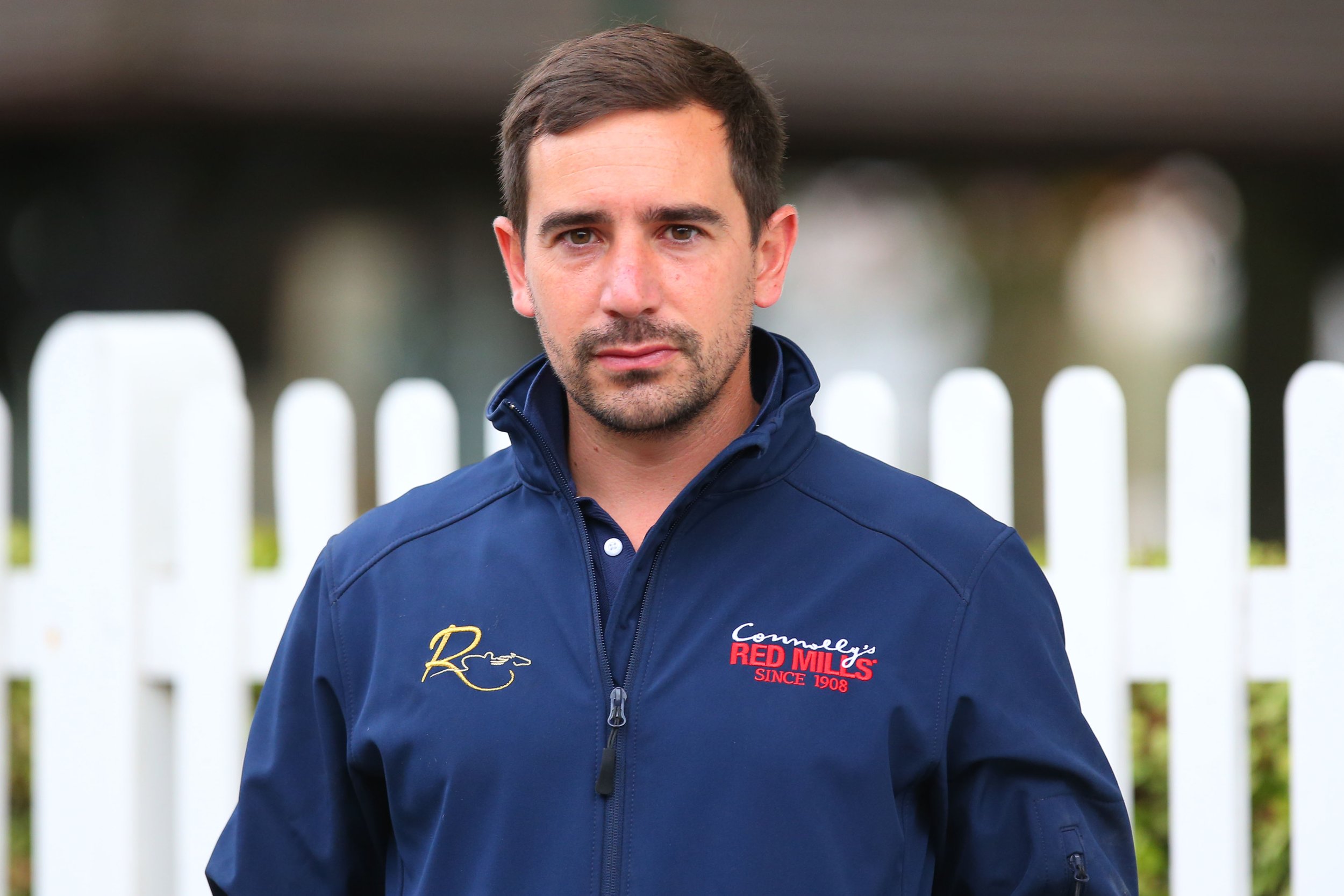
Article by Katherine Ford
Take a look at the French trainers’ standings in September, and hot on the heels of the Classic powerhouses of Rouget, Fabre and Graffard in fourth place was Jérôme Reynier. Based in his native Marseille, still a couple of years shy of his 40th birthday, the discreet yet determined professional has climbed step by step to racing’s top table, and his ascension is far from over.
I met Reynier at Deauville during the August meeting and interrupted his breakfast with half a dozen staff. “We have a family atmosphere and a good relationship. I’m not a difficult boss, but if there are decisions to be made, that’s my job. I don’t want anyone else to take initiatives without consulting me first. That’s why I’m always available in case there’s a problem,” Reynier admits.
What is striking with Reynier is an attention to detail, whether that be in the organisation of his training regime, his assiduous desire to answer any queries from any quarters, or his true passion and almost encyclopaedic knowledge of bloodstock and racing. Going back to the origins of his love of racing, he explains, “I caught the virus from my father who was an architect but passionate about racing and breeding. I was born in 1985, and that was the year that he bred his first horse, called Shaindy.”
Reynier goes on to recount in great detail the destiny of Shaindy, who was bought back as a yearling and ended up Group-placed as a juvenile and winner of the then Listed Prix Djebel. It is easy to forget from the vividness of the description that at the time he was still in nappies and has no direct memories of the time. “It was magical, for a first homebred, carrying my grandfather’s colours. That caused a snowball effect with my father who bought more mares. He was lucky, but then you make your own luck.”
Learning the trade
Just a few years later Reynier’s father sold all his burgeoning thoroughbred interests when his son was still too small to remember, in order to devote more time to his wife and family.

However, the marriage broke down and his son remembers, “My parents separated when I was 12, and I went to live with my father who took me to Deauville sales to see if I took to the bloodstock world. It was all new to me, but I loved it and thought of nothing else from then on.
“At school, I put sales catalogues inside my textbooks; so during lessons I was engrossed in the pedigree pages. I had never touched a horse in my life—my experience all came from books as there wasn’t even [French racing channel] Equidia at the time.”
At 15 years old, Jérôme Reynier had his first hands-on experience during a summer at Alain Brandebourger’s Haras de Chartreux, and the following summer his father sent him to Newmarket to learn English. “I spent two months with David Shekells at Old Mill Stud. He had two yearlings for Deauville sales, but I was only tiny and not strong enough to hold a yearling weighing 400kg. They were both monsters—a Nashwan and an Unfuwain—so my job for two months was to walk behind them to keep them moving forward.
“Then during the journey from Newmarket to Deauville, I had to travel in the back of the horsebox at their heads all the way to stop them from fighting. It was a real test of my enthusiasm!”
Full marks for effort
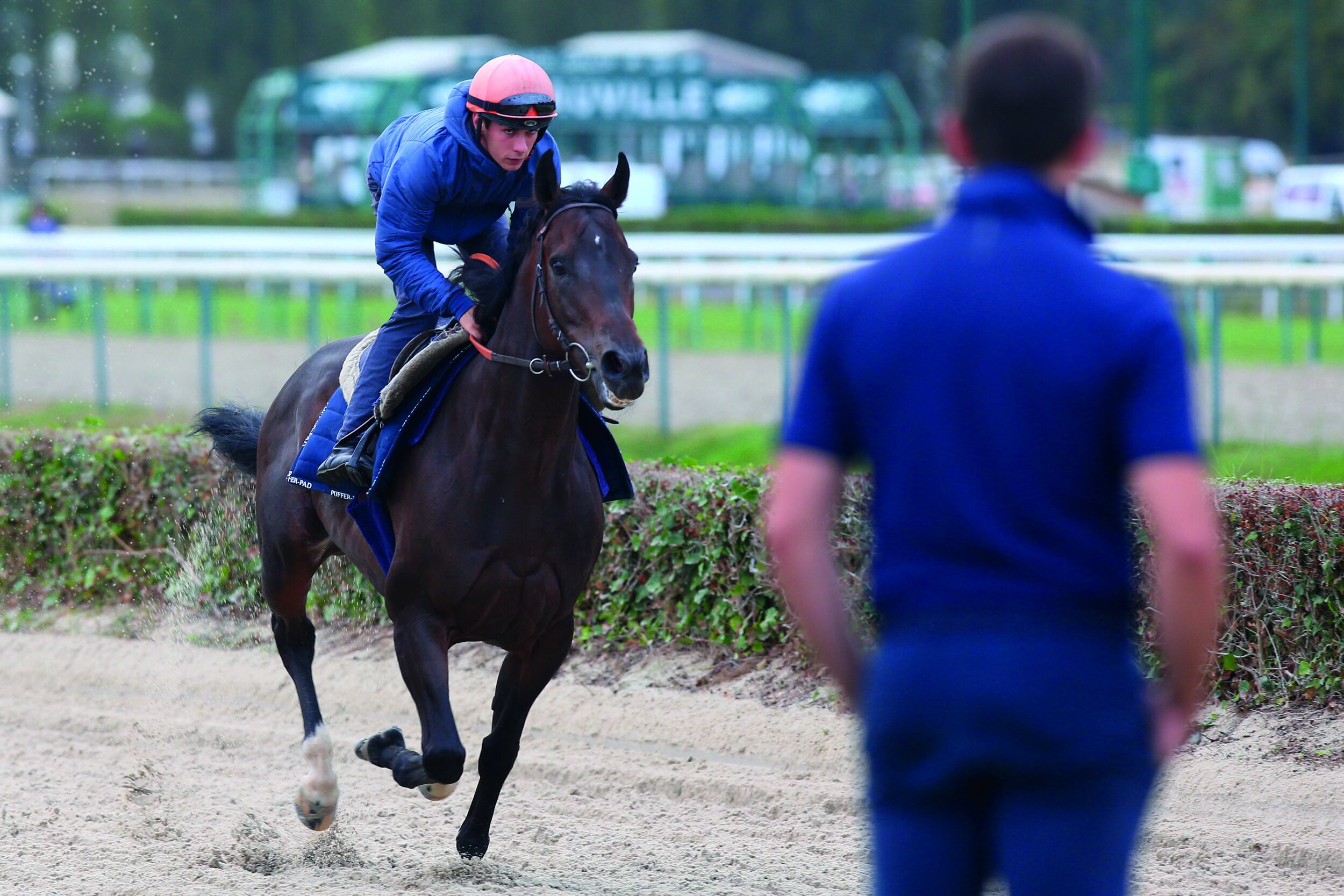
Jérôme passed the test with flying colours, and his enthusiasm remained intact, more so than his academic career, which suffered from his obsession with thoroughbreds. “I failed my Bac [baccalauréat], and things weren’t easy then as I had no qualifications, contacts or references. When I went to the races at Deauville, I didn’t have access to any of the reserved areas; I saw racing as a very closed environment. For me, it was unattainable. During that summer, I worked at the Forien’s Haras de Montaigu to prepare the yearlings. After that, I applied to do a season at Coolmore, and they took me on from January to June in 2005; so I went to Ireland and passed my Bac as an external candidate.”
A fascination for pedigrees
Jérôme Reynier has stars in his eyes as he remembers his stint at Coolmore. “I worked in one of the small yards with barren or maiden mares, so there were no foals but some amazing pedigrees, and we took them to stallions like Sadler’s Wells, Galileo and Montjeu. I got to see the stallions and how the system worked. I was always more interested in the pedigrees and breeding aspect than the racing in the afternoon.”
The Irish National Stud course followed in 2006 and while there, the determined and precocious Jérôme applied for and was accepted onto the Darley Flying Start programme. “I didn’t waste a minute!” he remembers. “In 2008 I was 22 years old and found myself with qualifications from the Irish National Stud and Darley Flying Start. The problem was that I was overqualified for my age. I needed work, but everyone considered that I was too young to take on the jobs in the breeding industry that I was qualified for. At the same time, my father fell ill so I went back to Marseille and as nobody would employ me, I set up my own business as a bloodstock agent. But I soon realised it was very difficult to earn a living without a large volume of trade. I knew a few people, but I didn’t have a network of clients. I was young and based in Marseille, so I didn’t tick the boxes…”
It was therefore by default that Reynier began his successful training career, initially as a private trainer for the Ecurie Camacho Courses. “I was employed to train around 15 horses for them at Marseille, and in two years we had 38 winners and €800,000 in earnings with modest horses. It was a great way to start off, but after two years, I wanted my independence.”
Starting from scratch

From four horses at the outset in March 2013, the ambitious professional soon made himself noticed and his stable grew. “I was getting good results, including in the Parisian region where I could find favourable entries and make a name for myself, rather than focusing on local races at Marseille. I’ve always tried to look beyond my immediate horizon. I had horses of a limited quality, but my passion was to find winnable races. I was back to what I loved—really hands on, mucking out in the morning, going to the track, driving the horses to races myself. I wouldn’t hesitate to make a long journey for a made-to-measure entry. I think that was the best period in my career as a trainer.”
Reynier was hit hard by the untimely death of his father in November 2014 and doubled down to bury his grief in work, “to make him proud from where he is now.”
He was satisfied with his 40-capacity stable but in 2018 received a career-changing offer from powerful local owner Jean-Claude Seroul, whose orange and grey colours were a familiar sight in Marseille. They are now known far beyond, thanks notably to the exploits of prolific top-level winners Skalleti and Marianafoot.
Reynier took on the job as private trainer to Seroul’s 50-55 strong string, based just across the road from his own yard at the Calas training centre, 30km north of Marseille, “Mr Seroul has his own stable, his own horses and his own staff; it didn’t affect my own structure. They are two separate operations, and the strings don’t go out at the same time; so instead of having four lots with 30 riders in each, I have eight lots with 15 riders each time. It’s much more manageable as I like to give each rider precise instructions for including the exact position of every horse in each lot. All the details are indicated on the list, which is sent out the previous evening, and that organisation now allows me to delegate more; and for instance to spend the month here in Deauville where we have an allocation of 14 boxes and a rotation of horses. If we win six races here and a few places, it will be a good result.”
That August target was achieved with the highlight being a Listed victory for the Seroul-owned filly, Rose Premium.
Calas ticks all the boxes

The conversation moves back to Calas, described by Reynier as a “perfect” facility with a main 3km round track, which gives the opportunity to work left- or right-handed depending upon the day. It also offers an incline for interval training, as well as turf, sand and jumps schooling tracks. “We have all that we need, and the results are proof of that. I will never abandon Calas because it is a good training centre with a wonderful climate, and it allows us to create a very progressive programme for the horses. We all—Christophe Escuder, Fabrice Vermeulen and myself—like to run our horses as much as possible rather than over-train them, so we provide a lot of runners for the PMU. Our owners want to see their horses at the races, so as soon as the horse is ready, whatever his level, I find a race for him. I find the French programme clear and simple, with opportunities for all categories.”
Marseille was rocked in late 2021 as dawn raids saw three members of the Rossi family among several professionals taken into police custody under suspicion of the use of forbidden substances and conspiracy to defraud and fix races. Frederic, Cédric and Charley, who were responsible for around 150 horses at Calas, are currently suspended from training and under police investigation. Reynier comments, “It saddened me because I know Cedric and Charley (Rossi) well, and I am sure that they are not cheats. It’s been a tough time for the region to be in the spotlight for negative reasons, and there is also the risk that if we don’t generate enough runners for turnover on the PMU, they will reduce the number of races at our tracks.”
The city’s best racecourse, seaside Marseille-Borély, is already under threat of closure and Reynier adds, “The lease has been extended until 2024. It’s perfectly situated for development, but it will be a disaster if it is lost; so that’s why it is important to keep an open mind geographically. I wouldn’t exclude creating a small satellite yard in Chantilly to start with to avoid too much travelling for some of the horses. Then why not extend the Chantilly stable to have two bases… But it is certain that the future lies in Paris, or maybe abroad.”
Plotting a path to success

Jérôme Reynier has always had the opposite of a blinkered approach and loves to see a well-made plan come to fruition, as his first stable star Royal Julius, winner of the inaugural Bahrain International Trophy, demonstrates. “When Bahrain created the new international race, the prize money was very generous. And the conditions were optimal for Royal Julius, who was a true right-hander who loved a fast surface and ten furlongs, so I set out to prepare and qualify him for that race. He needed to keep a high rating, so I sent him to Italy where it was easy for him to do well in Stakes company; whereas if I’d run him in a Gp. 3 in France and he’d finished fifth, his rating would have dropped and I would never have been invited there or to Qatar. He was a great horse for the stable, as was Master Spirit who was a “second hand” horse we received; and from being a handicapper, we managed to take second place in the Grand Prix de Deauville with him. I’ve been lucky to train some good horses, but it’s important to take good care of them to age well.”
More recently, flag bearers Skalleti and Marianafoot have rewarded the patience and skill of their handler, along with Thunder Drum who joined Reynier for owner Lady Bamford. “It was particularly satisfying for me to receive beautifully bred horses for Lady Bamford and exceptional to win the Prix du Royaumont (Gp. 3) last year on Jockey-Club day with Thunder Drum, who couldn’t win a maiden in England as a juvenile. We had intended to run her in the Italian Oaks that weekend but made a last-minute change of plan due to a modest field and rain in Chantilly; and it worked perfectly! As for Skalleti and Marianafoot, they both had their best seasons last year at six years old, which is amazing. In fact, I was the leading French trainer on Gp. 1 wins, with the three victories of that pair. Cédric Rossi and André Fabre had two each!”
Prize money for happy owners and trainers
“We don’t have a star this year, but a lot of horses are earning their keep and that keeps the stable going. Take the example of Happy Harry, a son of Zarak that we claimed in January; in six months, he has earned €70,000 (the gelding boosted his earnings by a further €14,000 in prize money and owners’ premiums for a handicap win days after our interview). If I have 50 Happy Harrys, I’m happy! The French system makes this possible if you have a healthy horse who can run regularly. In England, if you have a decent horse, you either try and win some good races or you try the commercial route, win on the debut and then sell it on. It’s impossible to earn money with prize money in England, and I couldn’t train there. It’s a different policy. The French way of constructing a career is with a horse that might be just 80 percent ready for his debut and he will progress as he races. So, we can think of the long term rather than the short term. As long as we can keep our system in France with the PMU and decent prize money, we are privileged. We are the best country for racing in Europe or maybe in the world, but a whole generation of punters is on the way out, and I don’t see many young people betting on racing, so I often feel pessimistic.”

Despite his concerns, Jérôme Reynier is, as always, aware of upcoming opportunities and a changing of the guard, which may enable him to move even further up racing’s top table. “There is a whole older generation of trainers in Chantilly who are on the way out, so there will be opportunities. The new trainers who are there now and setting up soon will create a new dynamism. Maybe I will be a part of it and maybe I won’t…”
One thing is certain, whatever Jérôme Reynier does or doesn’t become a part of will depend upon a carefully constructed plan, leaving little to chance and attracting more good luck his way.
EIPH - could there be links to sudden death and pulmonary haemorrhage?
Dr Peter W. Physick-Sheard, BVSc, FRCVS, explores preliminary research and hypotheses, being conducted by the University of Guelph, to see if there is a possibility that these conditions are linked and what this could mean for future management and training of thoroughbreds.

"World's Your Oyster,” a three-year-old thoroughbred mare, presented at the veterinary hospital for clinical examination. She won her maiden start as a two-year-old and placed once in two subsequent starts. After training well as a three-year-old, she failed to finish her first start, easing at the top of the stretch, and was observed to fade abruptly during training. Some irregularity was suspected in heart rhythm after exercise. Thorough clinical examination, blood work, ultrasound of the heart and an ECG during rest and workout revealed nothing unusual.
Returning to training, Oyster placed in six of her subsequent eight starts, winning the last two. She subsequently died suddenly during early training as a four-year-old. At post-mortem, diagnoses of pulmonary haemorrhage and exercise-induced pulmonary haemorrhage were established—a very frustrating and unfortunate outcome.
Across the racing world, a case like this probably occurs daily. Anything that can limit a horse's ability to express its genetic potential is a major source of anxiety when training. The possibility of injury and lameness is the greatest concern, but a close second is respiratory disease, with bleeding from the lungs (most often referred to as exercise induced pulmonary [lung] haemorrhage or EIPH) being high on the list.
EIPH is thought to occur in as many as 85 percent of racehorses, and may initially be very mild without obvious clinical consequences. In some cases it can be associated with haemorrhage of sufficient severity for blood to appear at the nostrils, even at first occurrence. In many racing jurisdictions this is a potentially career-ending problem. In these horses, an impact on performance is unquestionable. Bleeding from the lungs is the reason for the existence of ‘Lasix programs,’ involving pre-race administration of a medication considered to reduce haemorrhage. Such programs are controversial—the justifications for their existence ranging from addressing welfare concerns for the horse to dealing with the performance impacts.
Much less frequently encountered is heavy exercise-associated bleeding from the nostrils (referred to as epistaxis), which can sometimes be accompanied by sudden death, during or shortly after exercise. Some horses bleed heavily internally and die without blood appearing at the nostrils. Haemorrhage may only become obvious when the horse is lying on its side, or not until post-mortem. Affected animals do not necessarily have any history of EIPH, either clinically or sub-clinically. There is an additional group of rare cases in which a horse simply dies suddenly, most often very soon after work and even after a winning performance, and in which little to nothing clearly explains the cause on post-mortem. This is despite the fact most racing jurisdictions study sudden death cases very closely.
EIPH is diagnosed most often by bronchoscopy—passing an endoscope into the lung after work and taking a look. In suspected but mild cases, there may not be sufficient haemorrhage to be visible, and a procedure called a bronchoalveolar lavage is performed. The airways are rinsed and fluid is collected and examined microscopically to identify signs of bleeding. Scoping to confirm diagnosis is usually a minimum requirement before a horse can be placed on a Lasix program.
Are EIPH, severe pulmonary haemorrhage and sudden death related? Are they the same or different conditions?

At the University of Guelph, we are working on the hypothesis that most often they are not different—that it’s degrees of the same condition, or closely related conditions perhaps with a common underlying cause. We see varying clinical signs as being essentially a reflection of severity and speed of onset of underlying problems.
Causes in individual cases may reflect multiple factors, so coming at the issues from several different directions, as is the case with the range of ongoing studies, is a good way to go so long as study subjects and cases are comparable and thoroughly documented. However, starting from the hypothesis that these may all represent basically the same clinical condition, we are approaching the problem from a clinical perspective, which is that cardiac dysfunction is the common cause.
Numerous cardiac disorders and cellular mechanisms have the potential to contribute to transient or complete pump (heart) failure. However, identifying them as potential disease candidates does not specifically identify the role they may have played, if any, in a case of heart failure and in lung haemorrhage; it only means that they are potential primary underlying triggers. It isn't possible for us to be right there when a haemorrhage event occurs, so almost invariably we are left looking at the outcome—the event of interest has passed. These concerns influence the approach we are taking.
Background
The superlative performance ability of a horse depends on many physical factors:
Huge ventilatory (ability to move air) and gas exchange capacity
Body structure including limb length and design - allows it to cover ground rapidly with a long stride
Metabolic adaptations - supports a high rate of energy production by burning oxygen, tolerance of severe metabolic disruptions toward the end of race-intensity effort
High cardiovascular capacity - allows the average horse to pump roughly a brimming bathtub of blood every minute
At race intensity effort, these mechanisms, and more, have to work in coordination to support performance. There is likely not much reserve left—two furlongs (400m) from the winning post—even in the best of horses. There are many wild cards, from how the horse is feeling on race day to how the race plays out; and in all horses there will be a ceiling to performance. That ceiling—the factor limiting performance—may differ from horse to horse and even from day to day. There’s no guarantee that in any particular competition circumstances will allow the horse to perform within its own limitations. One of these factors involves the left side of the heart, from which blood is driven around the body to the muscles.
A weak link - filling the left ventricle
The cardiovascular system of the horse exhibits features that help sustain a high cardiac output at peak effort. The feature of concern here is the high exercise pressure in the circulation from the right ventricle, through the lungs to the left ventricle. At intense effort and high heart rates, there is very little time available to fill the left ventricle—sometimes as little as 1/10 of a second; and if the chamber cannot fill properly, it cannot empty properly and cardiac output will fall. The circumstances required to achieve adequate filling include the readiness of the chamber to relax to accept blood—its ‘stiffness.’ Chamber stiffness increases greatly at exercise, and this stiffened chamber must relax rapidly in order to fill. That relaxation seems not to be sufficient on its own in the horse at high heart rates. Increased filling pressure from the circulation draining the lungs is also required. But there is a weak point: the pulmonary capillaries.
These are tiny vessels conducting blood across the lungs from the pulmonary artery to the pulmonary veins. During this transit, all the gas exchange needed to support exercise takes place. The physiology of other species tells us that the trained lung circulation achieves maximum flow (equivalent to cardiac output) by reducing resistance in those small vessels. This process effectively increases lung blood flow reserve by, among other things, dilating small vessels. Effectively, resistance to the flow of blood through the lungs is minimised. We know this occurs in horses as it does in other species; yet in the horse, blood pressure in the lungs still increases dramatically at exercise.
If this increase is not the result of resistance in the small vessels, it must reflect something else, and that appears to be resistance to flow into the left chamber. This means the entire lung circulation is exposed to the same pressures, including the thin-walled capillaries. Capillaries normally work at quite low pressure, but in the exercising horse, they must tolerate very high pressures. They have thin walls and little between them, and the air exchange sacs in the lung. This makes them vulnerable. It's not surprising they sometimes rupture, resulting in lung haemorrhage.
Recent studies identified changes in the structure of small veins through which the blood flows from the capillaries and on toward the left chamber. This was suspected to be a pathology and part of the long-term consequences of EIPH, or perhaps even part of the cause as the changes were first identified in EIPH cases. It could be, however, that remodelling is a normal response to the very high blood flow through the lungs—a way of increasing lung flow reserve, which is an important determinant of maximum rate of aerobic working.
The more lung flow reserve, the more cardiac output and the more aerobic work an animal can perform. The same vein changes have been observed in non-racing horses and horses without any history or signs of bleeding. They may even be an indication that everything is proceeding as required and a predictable consequence of intense aerobic training. On the other hand, they may be an indication in some horses that the rate of exercise blood flow through their lungs is a little more than they can tolerate, necessitating some restructuring. We have lots to learn on this point.
If the capacity to accommodate blood flow through the lungs is critical, and limiting, then anything that further compromises this process is likely to be of major importance. It starts to sound very much as though the horse has a design problem, but we shouldn't rush to judgement. Horses were probably not designed for the very intense and sustained effort we ask of them in a race. Real-world situations that would have driven their evolution would have required a sprint performance (to avoid ambush predators such as lions) or a prolonged slower-paced performance to evade predators such as wolves, with only the unlucky victim being pushed to the limit and not the entire herd.
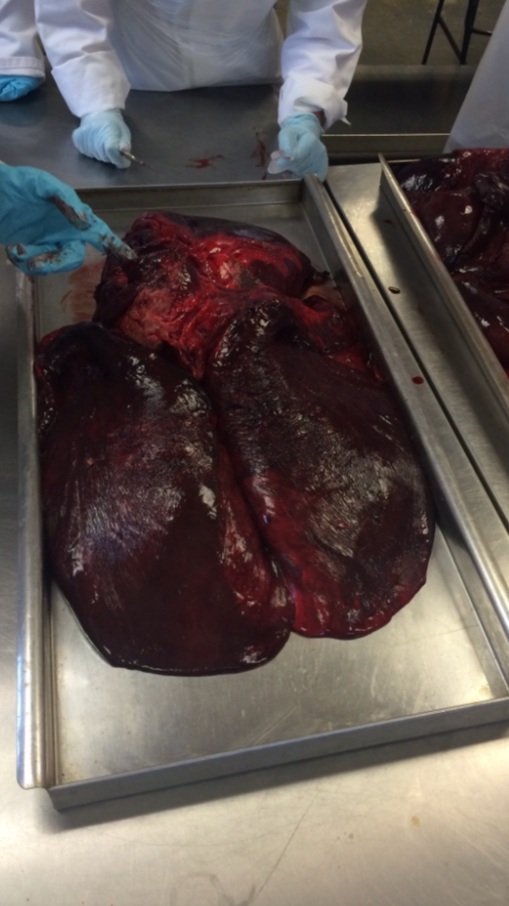
Lung blood flow and pulmonary oedema
There is another important element to this story. High pressures in the capillaries in the lung will be associated with significant movement of fluid from the capillaries into lung tissue spaces. This movement in fact happens continuously at all levels of effort and throughout the body—it's a normal process. It's the reason the skin on your ankles ‘sticks’ to the underlying structures when you are standing for a long time. So long as you keep moving a little, the lymphatic system will draw away the fluid.
In a diseased lung, tissue fluid accumulation is referred to as pulmonary oedema, and its presence or absence has often been used to help characterise lung pathologies. The lung lymphatic system can be overwhelmed when tissue fluid is produced very rapidly. When a horse experiences sudden heart failure, such as when the supporting structures of a critical valve fail, one result is massive overproduction of lung tissue fluid and appearance of copious amounts of bloody fluid from the nostrils.
The increase in capillary pressure under these conditions is as great as at exercise, but the horse is at rest. So why is there no bloody fluid in the average, normal horse after a race? It’s because this system operates very efficiently at the high respiratory rates found during work: tissue fluid is pumped back into the circulation, and fluid does not accumulate. The fluid is pumped out as quickly as it is formed. An animal’s level of physical activity at the time problems develop can therefore make a profound difference to the clinical signs seen and to the pathology.
Usual events with unusual consequences
If filling the left ventricle and the ability of the lungs to accommodate high flow at exercise are limiting factors, surely this affects all horses. So why do we see such a wide range of clinical pictures, from normal to subclinical haemorrhage to sudden death?
Variation in contributing factors such as type of horse, type and intensity of work, sudden and unanticipated changes in work intensity, level of training in relation to work and the presence of disease states are all variables that could influence when and how clinical signs are seen, but there are other considerations.
Although we talk about heart rate as a fairly stable event, there is in fact quite a lot of variation from beat to beat. This is often referred to as heart rate variability. There has been a lot of work performed on the magnitude of this variability at rest and in response to various short-term disturbances and at light exercise in the horse, but not a lot at maximal exercise. Sustained heart rate can be very high in a strenuously working horse, with beats seeming to follow each other in a very consistent manner, but there is in fact still variation.
Some of this variation is normal and reflects the influence of factors such as respiration. However, other variations in rate can reflect changes in heart rhythm. Still other variations may not seem to change rhythm at all but may instead reflect the way electrical signals are being conducted through the heart.
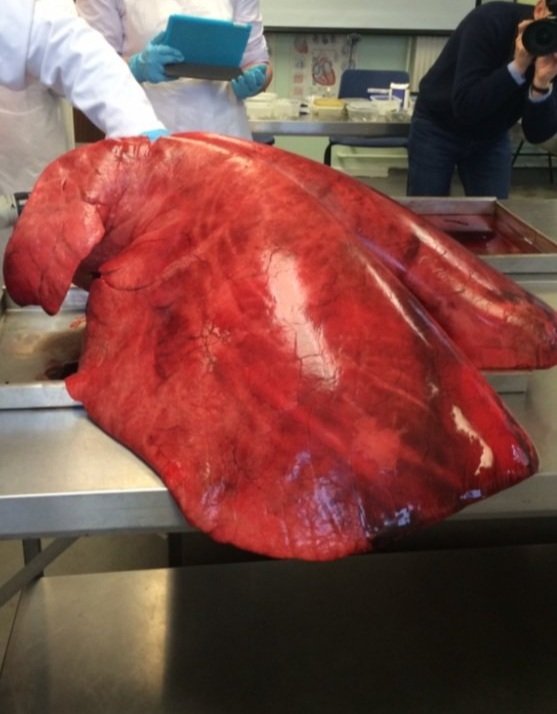
These may be evident from the ECG but would not appear abnormal on a heart rate monitor or when listening. These variations, whether physiologic (normal) or a reflection of abnormal function, will have a presently, poorly understood influence on blood flow through the lungs and heart—and on cardiac filling. Influences may be minimal at low rates, but what happens at a heart rate over 200 and in an animal working at the limits of its capacity.
Normal electrical activation of the heart follows a pattern that results in an orderly sequence of heart muscle contraction, and that provides optimal emptying of the ventricles. Chamber relaxation complements this process.
An abnormal beat or abnormal interval can compromise filling and/or emptying of the left ventricle, leaving more blood to be discharged in the next cycle and back up through the lungs, raising pulmonary venous pressure. A sequence of abnormal beats can lead to a progressive backup of blood, and there may not be the capacity to hold it—even for one quarter of a second, a whole cardiac cycle at 240 beats per minute.
For a horse that has a history of bleeding and happens to be already functioning at a very marginal level, even minor disturbances in heart rhythm might therefore have an impact. Horses with airway disease or upper airway obstructions, such as roarers, might find themselves in a similar position. An animal that has not bled previously might bleed a little, one that has a history of bleeding may start again, or a chronic bleeder may worsen.
Relatively minor disturbances in cardiac function, therefore, might contribute to or even cause EIPH. If a horse is in relatively tough company or runs a hard race, this may also contribute to the onset or worsening of problems. Simply put, it's never a level playing field if you are running on the edge.
Severe bleeding
It has been suspected for many years that cases of horses dying suddenly at exercise represent sudden-onset cardiac dysfunction—most likely a rhythm disturbance. If the rhythm is disturbed, the closely linked and carefully orchestrated sequence of events that leads to filling of the left ventricle is also disturbed. A disturbance in cardiac electrical conduction would have a similar effect, such as one causing the two sides of the heart to fall out of step, even though the rhythm of the heart may seem normal.
The cases of horses that bleed profusely at exercise and even those that die suddenly without any post-mortem findings can be seen to follow naturally from this chain of events. If the changes in heart rhythm or conduction are sufficient, in some cases to cause massive pulmonary haemorrhage, they may be sufficient in other cases to cause collapse and death even before the horse has time to exhibit epistaxis or even clear evidence of bleeding into the lungs.
EIPH and dying suddenly
If these events are (sometimes) related, why is it that some horses that die of pulmonary haemorrhage with epistaxis do not show evidence of chronic EIPH? This is one of those $40,000 questions. It could be that young horses have had limited opportunity to develop chronic EIPH; it may be that we are wrong and the conditions are entirely unrelated. But it seems more likely that in these cases, the rhythm or conduction disturbance was sufficiently severe and/or rapid in onset to cause a precipitous fall in blood pressure with the animal passing out and dying rapidly.
In this interpretation of events, the missing link is the heart. There is no finite cutoff at which a case ceases to be EIPH and becomes pulmonary haemorrhage. Similarly, there is no distinct point at which any case ceases to be severe EIPH and becomes EAFPH (exercise-associated fatal pulmonary haemorrhage). In truth, there may simply be gradation obscured somewhat by variable definitions and examination protocols and interpretations.
The timing of death
It seems from the above that death should most likely take place during work, and it often does, but not always. It may occur at rest, after exercise. Death ought to occur more often in racing, but it doesn't.
The intensity of effort is only one factor in this hypothesis of acute cardiac or pump failure. We also have to consider factors such as when rhythm disturbances are most likely to occur (during recovery is a favourite time) and death during training is more often a problem than during a race.
A somewhat hidden ingredient in this equation is possibly the animal's level of emotional arousal, which is known to be a risk factor in humans for similar disturbances. There is evidence that emotions/psychological factors might be much more important in horses than previously considered. Going out for a workout might be more stimulating for a racehorse than a race because before a race, there is much more buildup and the horse has more time to adequately warm up psychologically. And then, of course, temperament also needs to be considered. These are yet further reasons that we have a great deal to learn.
Our strategy at the University of Guelph

These problems are something we cannot afford to tolerate, for numerous reasons—from perspectives of welfare and public perception to rider safety and economics. Our aim is to increase our understanding of cardiac contributions by identifying sensitive markers that will enable us to say with confidence whether cardiac dysfunction—basically transient or complete heart failure—has played a role in acute events.
We are also looking for evidence of compromised cardiac function in all horses, from those that appear normal and perform well, through those that experience haemorrhage, to those that die suddenly without apparent cause. Our hope is that we can not only identify horses at risk, but also focus further work on the role of the heart as well as the significance of specific mechanisms. And we hope to better understand possible cardiac contributions to EIPH in the process. This will involve digging deeply into some aspects of cellular function in the heart muscle, the myocardium of the horse, as well as studying ECG features that may provide insight and direction.
Fundraising is underway to generate seed money for matching fund proposals, and grant applications are in preparation for specific, targeted investigations. Our studies complement those being carried out in numerous, different centres around the world and hopefully will fill in further pieces of the puzzle. This is, indeed, a huge jigsaw, but we are proceeding on the basis that you can eat an elephant if you're prepared to process one bite at a time.
How can you help? Funding is an eternal issue. For all the money that is invested in horses there is a surprisingly limited contribution made to research and development—something that is a mainstay of virtually every other industry; and this is an industry.
Look carefully at the opportunities for you to make a contribution to research in your area. Consider supporting studies by making your experience, expertise and horses available for data collection and minimally invasive procedures such as blood sampling.
Connect with the researchers in your area and find out how you can help. Watch your horses closely and contemplate what they might be telling you—it's easy to start believing in ourselves and to stop asking questions. Keep meticulous records of events involving horses in your care— you never know when you may come across something highly significant. And work with researchers (which often includes track practitioners) to make your data available for study.
Remember that veterinarians and university faculty are bound by rules of confidentiality, which means what you tell them should never be ascribed to you or your horses and will only be used without any attribution, anonymously. And when researchers reach out to you to tell you what they have found and to get your reactions, consider actually attending the sessions and participating in the discussion; we can all benefit—especially the ultimate beneficiary which should be the horse. We all have lots to learn from each other, and finding answers to our many challenges is going to have to be a joint venture.
Finally, this article has been written for anybody involved in racing to understand, but covering material such as this for a broad audience is challenging. So, if there are still pieces that you find obscure, reach out for help in interpretation. The answers may be closer than you think!
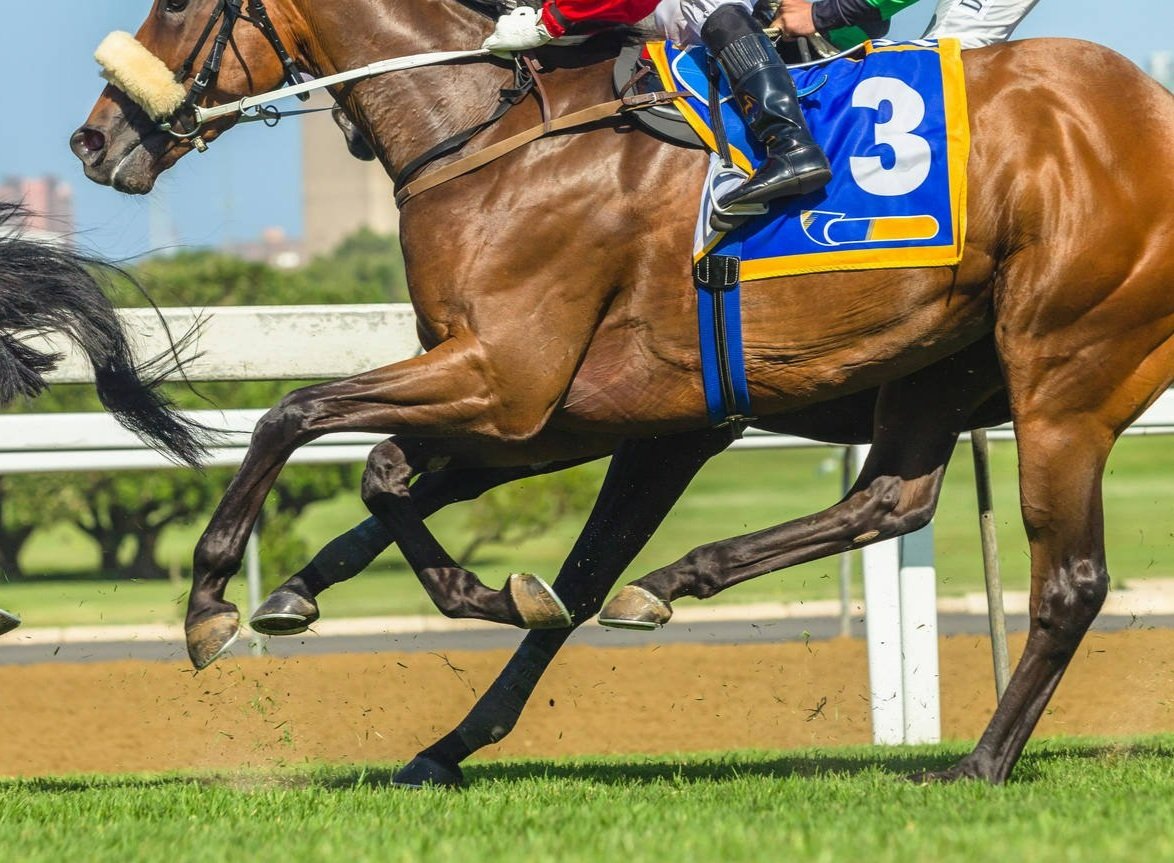
Oyster
And what about Oyster? Her career was short. Perhaps, had we known precisely what was going on, we might have been able to treat her, or at least withdraw her from racing and avoid a death during work with all the associated dangers—especially to the rider and the associated welfare concerns.
Had we had the tools, we might have been able to confirm that whatever the underlying cause, she had cardiac problems and was perhaps predisposed to an early death during work. With all the other studies going on, and knowing the issue was cardiac, we might have been able to target her assessment to identify specific issues known to predispose.
In the future, greater insight and understanding might allow us to breed away from these issues and to better understand how we might accommodate individual variation among horses in our approaches to selection, preparation and competition. There might be a lot of Oysters out there!
For further information about the work being undertaken by the University of Guelph
Contact - Peter W. Physick-Sheard, BVSc, FRCVS.
Professor Emeritus, Ontario Veterinary College, University of Guelph - pphysick@uoguelph.ca
Research collaborators - Dr Glen Pyle, Professor, Department of Biomedical Sciences, University of Guelph - gpyle@uoguelph.ca
Dr Amanda Avison, PhD Candidate, Department of Biomedical Sciences, University of Guelph. ajowett@uoguelph.ca
References
Caswell, J.I. and Williams K.J. (2015), Respiratory System, In ed. Maxie, M. Grant, 3 vols., 6th edn., Jubb, Kennedy and Palmer’s Pathology of Domestic Animals, 2; London: Elsevier Health Sciences, 490-91.
Hinchcliff, KW, et al. (2015), Exercise induced pulmonary hemorrhage in horses: American College of Veterinary Internal Medicine consensus statement, J Vet Intern Med, 29 (3), 743-58.
Rocchigiani, G, et al. (2022), Pulmonary bleeding in racehorses: A gross, histologic, and ultrastructural comparison of exercise-induced pulmonary hemorrhage and exercise-associated fatal pulmonary hemorrhage, Vet Pathol, 16:3009858221117859. doi: 10.1177/03009858221117859. Online ahead of print.
Manohar, M. and T. E. Goetz (1999), Pulmonary vascular resistance of horses decreases with moderate exercise and remains unchanged as workload is increased to maximal exercise, Equine Vet. J., (Suppl.30), 117-21.
Vitalie, Faoro (2019), Pulmonary Vascular Reserve and Aerobic Exercise Capacity, in Interventional Pulmonology and Pulmonary Hypertension, Kevin, Forton (ed.), (Rijeka: IntechOpen), Ch. 5, 59-69.
Manohar, M. and T. E. Goetz (1999), Pulmonary vascular resistance of horses decreases with moderate exercise and remains unchanged as workload is increased to maximal exercise, Equine Vet. J., (Suppl.30), 117-21.
Probiotics as an alternative to antibiotics to reduce resistance in the gut
Article by Kerrie Kavanagh
The leading causes of horse mortality can be attributed to gastrointestinal diseases. Therefore, maintaining the balance of the gut microbiota and avoiding a shift in microbial populations can contribute to improved health status. The gut microbiota, however, can be influenced by countless dynamic events: diet, exercise, stress, illness, helminth infections, aging, environment and notably, antimicrobial therapy (antibiotics). These events can lead to gut dysbiosis—a fluctuation or disturbance in the population of microorganisms of the gut, which can contribute to a wide range of disease. The use of antibiotics in horses is thought to have one of the most notable effects on the gut microbiota (gut dysbiosis), which can lead to diseases such as colitis, colic and laminitis.
Antibiotics, which are antimicrobial agents active against bacteria, are important to equine medicine; and bacterial infections can be resolved quite successfully using antibiotics for antimicrobial therapy, but there are consequences to their use. An antimicrobial agent can be defined as a natural or synthetic substance that kills or inhibits the growth of microorganisms such as bacteria, fungi and algae. One of the consequences of antibiotic use is that of antibiotic-associated diarrhoea, which can contribute to poor performance in the horse and even mortality. In antimicrobial therapy, the target organism is not the only organism affected by the antimicrobial agent but also the commensal microbiota too (the normal flora of the equine gut). Antibiotics can promote fungal infections and resistant organisms and impede or even eliminate the more sensitive organisms; and they can have both short and long-term consequences on the gut microbiota composition and function.

Research has indicated that antibiotic treatment may adversely affect metabolic function in the gut by decreasing protein expression responsible for biochemical pathways such as glycolysis, iron uptake, glutamate hydrolysis and possibly even more metabolic functions. The use of antimicrobial drugs directly impacts and possibly contributes to the most notable effect on the gut microbiota of the host, leading to gut dysbiosis; and certain antibiotics can have further-reaching consequences on the microbiota than others. The type of antibiotic and mode of action (bacteriostatic versus bactericidal) will differ in their influences on the gut microbiota composition, e.g., clindamycin operates a bacteriostatic mode of action by inhibiting protein synthesis and exerts a larger impact on the gut microbiota compared to other antimicrobials. These influential consequences that are imparted by the antimicrobial agent are relatively yet to be elucidated and may result in the manifestation of illness or conditions later in life. For example, the development of asthma in humans has been linked to antibiotic treatment in early childhood as a result of bacterial infections. It may yield interesting results if researchers were to examine the gut microbiome of horses suffering from chronic obstructive pulmonary disease (COPD) and other chronic respiratory illnesses and to establish if there is indeed a link with antibiotic therapy used in horses from an early age.
In comparison to the vast wealth of human studies conducted so far, the volume of equine studies falls disappointingly far behind, but that is changing as researchers focus their interest on developing and filling this gap of knowledge. One such study which examined the effect of antibiotic use on the equine gastrointestinal tract, demonstrated a significant reduction in culturable cellulolytic bacteria (>99%) from equine faeces during the administration period of trimethoprim sulfadiazine and ceftiofur in a study comparing responses to antibiotic challenge. That reduction was still evident at the end of the withdrawal period when compared to the control group. In other words, there was a significant reduction in the ‘normal’ bacteria of the gut. The ability of antibiotics to modulate the gut microbiota was evidenced by the proliferation of pathogenic Salmonella and Clostridia difficile (commonly associated with diarrhoea in horses) in the antibiotic challenged horses. This trend of reduction in cellulolytic bacteria associated with antibiotic use was also mirrored in a relatively recent study conducted in 2019, where a short-term reduction in culturable cellulolytic bacteria was combined with a progressive increase in amylolytic bacteria. The heavy reliance on cellulolytic bacteria in the role of equine digestion (without these types of bacteria the horse cannot break down their food) may, therefore, adversely affect the dietary energy available from forage during antimicrobial therapy and may therefore impact performance.
Another study that compared the effect of penicillin, ceftiofur and trimethoprim sulfadiazine (TMS) on the gut microbiota in horses using next-generation sequencing showed that TMS had the most profound impact on the microbiota, in particular the phylum Verrucomicrobia. This same study also reported a significant decrease in bacterial richness and diversity of the faecal microbiota. A reduction in bacterial diversity is certainly a trend that is commonly seen in gastrointestinal disease in horses. The restoration of the normal gut microbiota after completion of antibiotic treatment can take up to 40 days, but the organisational structure of the bacterial populations can take many years to re-establish the original structure map that was laid out in the gut pre-antibiotic treatment.
The equine studies certainly show similarities to the human studies, indicating the consequences of antibiotics that can be seen across more than one species. Human studies have reported long-term consequences of antibiotic treatment on the human microbiota. One such human study investigated a 7-day clindamycin treatment and monitored the patients for two years. The impact on the human microbiota remained evident two years post-treatment, where a reduction in bacterial diversity and detection of high-resistance to clindamycin were detected.
Interestingly, no resistant clones were detected in the control group over the two-year sampling period. Another study focusing on the effects of antibiotic treatment for Helicobacter pylori showed findings mirrored in similar studies of that field. The findings demonstrated the rapidly reducing bacterial diversity (one week) after antibiotic treatment and found that disturbances in the microbiota and high levels of macrolide resistance were evident four years post-treatment. Human studies may predict that equine studies will find similar trends with equine antimicrobial therapy. These studies highlight the impact of antibiotic use and the long-term persistence of antibiotic resistance remaining in the intestinal microbiome, which is a concern for both humans and animals.
Antibiotics can lead to the selectivity and proliferation of resistant bacteria, which is evidenced by the long-term effects observed on the gut microbiota harbouring drug-resistant encoded genes. Horizontal gene transfer (HGT) commonly occurs in the gut (can be up to 25 times more likely to occur in the gut than in other environments). HGT can be attributed to the close proximity of the microbiota in the gut, allowing the transfer of genetic material via routes such as plasmids and conjugation; in other words, the bacteria in the gut have developed a pathway to transfer antibiotic resistant genes from one generation to another. Resistance to antibiotics is now a global issue for the treatment of many diseases.
With the unfavourable association tied to Clostridium difficile infections (CDI) and the onset of colitis particularly in mature horses treated with β-lactam antibiotics (commonly used for equine infections), the incidences in which antimicrobial therapy is considered should be minimised and only used if entirely necessary. The use of broad-spectrum antibiotics in recurrent presentations of symptoms of disease such as urinary tract infections in humans or diarrhoea as a result of CDI in both humans and horses is promoting drug resistance.
The antibiotics, by disrupting the gut microbiota (which act as a defence against the establishment and proliferation of such pathogenic bacteria) are allowing the opportunity of growth for these multi-resistant microorganisms such as C. difficile, vancomycin-resistant enterococci (VRE), and multi-resistant Staphylococcus aureus (MRSA). The organism C. difficile and its antibiotic resistance has been demonstrated in the treatment of CDI for both humans and animals. The introduction of vancomycin (a glycopeptide antibiotic) in 1959 for the control of CDI remained effective until the 1990s when a more virulent form of C. difficile emerged. This new form of C. difficile with reported broad-spectrum antibiotic resistance resulted in chronic conditions and increased human mortality. C. difficile is most noted with human hospital-acquired infections. C. difficile BI/NAP1/027 has been shown to have resistance to fluoroquinolone antibiotics, moxifloxacin and gatifloxacin, which was not seen in historical genotypes. As C. difficile infections are found to cause gastrointestinal disease in horses as well as humans, this is certainly of concern.
Alternative therapies to antibiotic therapy to restore or modulate the gut microbiome after a gut dysbiosis event could be considered in certain circumstances where antibiotics are no longer effective (e.g., CDI), nor may they not be the best course (presence of Extended-spectrum -β-lactamase producing (ESBL) organisms) nor essential for example, when the diagnosis of the bacterial cause is uncertain. The rationale to using probiotic treatment along with antimicrobial treatment is that the antibiotic will target the pathogenic bacteria (e.g., C. difficile) and also the commensal microbiota of the gut, but the probiotic bacteria will help to re-establish the intestinal microbiota and in-turn prevent the re-growth of the pathogenic bacteria in the case or residual spores of C. difficile surviving the antibiotic treatment. Alternative therapies such as faecal microbiome transplant (FMT) or probiotic solutions can reduce the risk of proliferation of antibiotic-resistant bacteria and also have fewer implications on the gut microbiome as evidenced by antibiotic use.
Probiotics have been defined by the Food and Agricultural Organisation (FAO) and the World Health Organisation (WHO) as “live non-pathogenic microorganisms that, when administered in adequate amounts, confer a health benefit on the host”. The word ‘probiotic’ is Greek in origin, meaning, ‘for life’; and the term was coined by Ferdinand Vergin in 1954. While the mechanisms of action of probiotics are complex and require a deeper knowledge of the modulations of the gastrointestinal microbiota, and the health benefits due to their use are the subject of some debate, there is no doubt that probiotics are considered by many as a vital resource to human and animal health.
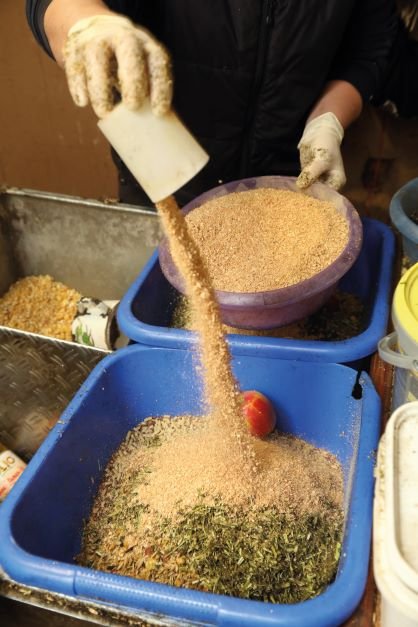
The use of probiotics in animal production, particularly in intensive swine and poultry production, has increased in recent years, primarily as an alternative to the use of antimicrobials in the prevention of disease. The problem of antibiotic-resistance and antimicrobial residues in food-producing animals (the horse is considered a food-producing animal), as a result of historical antibiotic use with the corresponding reduction in antibiotic efficacy in humans, leads to having to look at more sustainable options such as probiotic use to combat disease. Probiotics in horses are predominantly used as a treatment modality in the gastrointestinal microbial populations to combat illnesses such as diarrhoea—to prevent diarrhoea (particularly in foals) or help improve digestibility. Shifts or fluctuations in the microbial populations of the equine gastrointestinal tract have been associated with diseases such as laminitis and colic.
Gut dysbiosis, as mentioned previously is, a fluctuation or disturbance in the population of microorganisms of the gut is now being recognised as a cause of a wide range of gastrointestinal diseases; and in horses, it is one of the leading causes of mortality. The ability of probiotics in conferring health benefits to the host can occur via several different mechanisms: 1) inhibiting pathogen colonisation in the gut by producing antimicrobial metabolites or by competitive exclusion by adhering to the intestinal mucosa preventing pathogenic bacteria attachment by improving the function and structure; 2) protecting or restabilising the commensal gut microbiota; 3) protecting the intestinal epithelial barrier; 4) by inducing an immune response.
It is known that there is a wealth of factors that will adversely affect the gut microbiome, antibiotics, disease, diet, stress, age and environment are some of these compounding contributors. To mirror one researcher’s words echoing from an era where antibiotics were used as growth promoters in the animal industry, “The use of probiotic supplements seeks to repair these deficiencies. It is, therefore, not creating anything that would not be present under natural conditions, but it is merely restoring the flora to its full protective capacity”. In the case of using concurrent antibiotic and probiotic treatment, this strategic tweaking of the microbiota could be used as a tool to prevent further disease consequence and perhaps help improve performance in the horse.

The benefits of probiotic use in horses have not been investigated extensively but as mentioned previously, they are now being focused upon by researchers in the equine field. The most common bacterial strains used in equine probiotic products are Lactobacillus, Bifidobacterium, Streptococcus, Enterococcus, Bacillus and yeast strains of Saccharomyces. Lactobacillus, Bifidobacterium and Enterococcus strains typically account for less than 1% of the microbiota large gastrointestinal populations.
Regulation is lacking regarding labelling of probiotic products, often not displaying content with clarification and quality control (such as confirmed viability of strain[s]) not excised with over-the-counter probiotic products. There is evidence to suggest that host-adapted strains of bacteria and fungi enjoy a fitness advantage in the gut of humans and animals. Therefore, there may be an advantage in using the individual animal’s own bacteria as potential probiotics. Probiotics and antibiotics used concurrently could be the way to minimise the introduction of antibiotic-resistant bacterial strains in the gut, and in turn, protect future antibiotic efficacy.