
Career Makers - The Role of Jockeys’ Agent
By Ed Golden
Manager, mastermind, guru, agent, call him what you will, Colonel Tom Parker was the man who made Elvis Presley.
The King of Rock and Roll’s talent was only exceeded by his raw sex appeal, and Parker, self-proclaimed military officer or not, saw to it that the world would march en masse to a cadence called by Presley’s signature tones.
Elvis died more than four decades ago, but not before he and Parker reached the apex in gold and glory, still yielding riches of infinite proportions all these years later.
In racing, it’s not clothes that make the man; in part it is the agent directing the jockey. Agent and jockey provide a service to trainers, a salesman offering a product.
An agent in this instance is best described as a person empowered to transact business for a jockey. On any given morning at any given track, condition book in hand, there they are, Monty Hall wannabes, ready to make a deal.
A standard arrangement calls for an agent to be paid 25 percent of a jockey’s earnings, but that percentage could vary. If the rider’s services are in great demand, he could pay the agent a smaller percentage. Or, if the agent possesses the persuasive prowess of a Colonel Parker, he could warrant the higher percentage. It’s Economics 101.
Back in the day, agents were not prominent, if in evidence at all. Major stables employed contract riders and in order to ride for an outside trainer, the jockey had to receive permission from his contract stable to do so.
Now, the vast majority of riders have an agent, although jocks on a restricted budget with limited mounts have been known to represent themselves.
Agents wear many hats, including those falling under the Three P’s: politician, psychiatrist, and pacifist, and they can be a boon to racing departments.
“In my career around the country at tracks on both coasts, I’ve worked with agents who mostly helped the racing office,” said Rick Hammerle, Santa Anita’s vice president of racing as well as racing secretary. “We’re both trying to accomplish the same thing: get horses into races. Working with agents and sharing information about trainers’ intentions can help us achieve our goal.”
Even though it’s his first tour as an agent, Mike Lakow has racing’s paradigm of Tom Brady in jockey Javier Castellano, a 40-year-old Venezuelan at the zenith of his career. The reigning four-time Eclipse Award winner, a world class rider be it at Dubai or Churchill Downs, was inducted into racing’s Hall of Fame in 2017.
Still, for an agent, the pressure is always on.
Although he never trained, the 60-year-old Lakow (pronounced LAKE-ow) otherwise has an extensive background enabling him to understand ramifications that simmer just below racing’s surface.
“When I was working as general manager at Hill ‘n’ Dale (a major breeding farm in Kentucky),” he said, “I owned a quarter of one horse, and believe me, it’s a tough deal, so I respect all the owners, as well as trainers.”
Lakow, now based on the East Coast, was racing director at Santa Anita before Castellano hired him in August of 2016. Lakow also was racing secretary for the New York Racing Association (NYRA) from 1993 to 2005, served as a racing official in Florida and Dubai, and was hands-on with horsemen regularly at Santa Anita’s Clockers’ Corner during his sojourn at the historic Southern California track.
“I’m incredibly fortunate to represent Javier,” Lakow said, “because he’s a professional who’s liked by everybody. We have no issues as far as not being able to ride for one trainer or one owner. He’s won four Eclipses, done it all, and now we’re trying to focus on riding the top horses.”
Stress and pressure are standard fare in the workforce, whether you’re Donald Trump unceasingly enduring “fake news” attacks 24/7 or a McDonald’s minimum wage burger slinger serving up $2.50 McPicks. It’s all relative.
That includes Lakow, although he is averse to pointing it out, lest he might be looked upon as a malcontent, what with two chickens in the pot.
“People who see all the money we’re making might wonder how being agent for a top jockey could be stressful, but it is,” Lakow said. “I’ve been in administrative positions in racing for many years, with NYRA and at Santa Anita, but if you happen to make a mistake here and there, you move on.
“It affects the company, but it doesn’t affect an individual. If I happen to make a mistake with Javier, it affects him.
“It’s impossible to keep everybody happy. Any agent will tell you that. Fortunately, Javier is level-headed, so I’m in a good position. That’s not the case with some other jockeys, from what I’ve heard. I respect Javier and Javier respects me, but like I’ve said, it’s impossible to keep everybody happy.
“You try to do the right thing. I respect all the horsemen who give us calls, because it’s a tough game for trainers. Horses will fool you, so I understand the stress trainers and owners face. I don’t look at this as a one-shot relationship.
Tom Knust
“Luckily, I have the respect of horsemen because of my work in New York and California. When I started with Javier, horsemen gave me the benefit of the doubt. I was a bit green and I think other agents probably thought, ‘Look at this guy. He starts a job and has a top rider,’ but I’m lucky because I didn’t burn any bridges. I get along with most people and treat everybody with respect. That’s what’s made it so much easier for me.
“In the long run, honesty is the best policy, and I’m always honest. It hurts sometimes, but in the long run, I think it helps.”
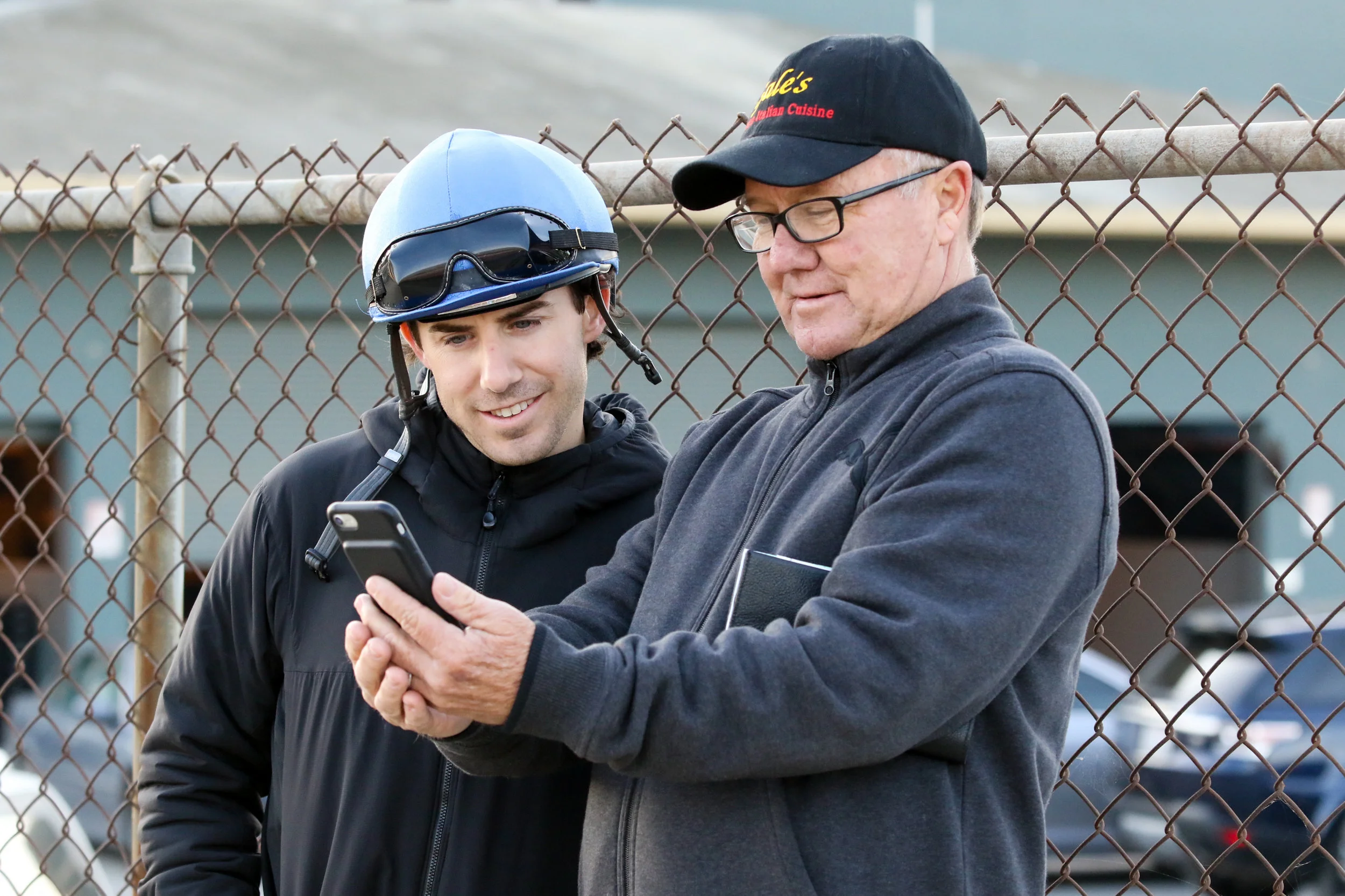
Another agent who has been on both sides of the wall is Tom Knust, former racing secretary at Santa Anita and Del Mar, now booking mounts for two-time Kentucky Derby-winning jockey Mario Gutierrez.
“One thing I learned quickly as an agent is that if you have a good rider, it makes things pretty easy, and if you don’t, it’s very, very difficult,” Knust said. “That’s the key, whether you’ve had experience in the racing office or you’ve just come in off the street.
“If you give a call, you want to honor it, although situations develop where you’re in a bind and ask a trainer if he can help you out, but if he doesn’t, you’ve got to keep your word and ride his horse.”
An additional plus comes from riding regularly for a winning trainer, in the case of Gutierrez, that being Doug O’Neill, who saddled I’ll Have Another and Nyquist to capture the Kentucky Derby for principal owner J. Paul Reddam in 2012 and 2016.
“It’s absolutely an advantage, 100 percent, if you have a go-to stable that wins a lot of races, like O’Neill,” Knust said.
As a female, Patty Sterling is in the minority among agents, but with her extensive familial background in racing, she is looked upon as one of the boys.
Her late father, Larry, trained 1978 Santa Anita Handicap winner Vigors and is the father of jockey Larry Sterling Jr. Patty’s uncle, Terry Gilligan, rode and trained, and his brother, also Larry, made his bones as a rider, too. Now 80, he is the quick official at Santa Anita and Del Mar.
“It’s probably a lot easier for a woman in this business than it used to be,” said Patty, 54, a former clocker. “I don’t see that as a problem.
“Being an agent is almost parallel to training horses; it’s very similar. Right now, it seems owners pick the jockeys more so than they ever did before, when trainers were deciding who to ride.”
TO READ MORE —
BUY THIS ISSUE IN PRINT OR DOWNLOAD -
Spring 2018, issue 47 (PRINT)
$6.95
Spring 2018, issue 47 (DOWNLOAD)
$3.99
WHY NOT SUBSCRIBE?
DON'T MISS OUT AND SUBSCRIBE TO RECEIVE THE NEXT FOUR ISSUES!
Print & Online Subscription
$24.95
From fertility to foal - Considerations for digestive tract health

By Emma Hardy, PhD
The success or failure of any breeding program is dependent on the nutritional status and digestive tract health of foals, mares, and stallions alike. Although this aspect of the operation is often overlooked, it is only by ensuring that these considerations are optimised that foals are given the best chance to survive and thrive, from birth through weaning and on to sale.
A weighty issue
There exists surprisingly little research surrounding the nutrient requirements of the breeding stallion. This may be in part complicated by the great variation in activity; some stallions may serve several mares a day during peak periods in the breeding season, while others may serve only that number in a year. Other influencing factors may include temperament, management routine, and competitive activities. However, it is generally agreed that energy demands are indeed above maintenance levels, and according to various National Research Council studies it has been suggested that active stallions require approximately a third more digestible energy than their non-breeding, sedentary counterparts.

Research in other species has shown that a body condition that deviates greatly from the ideal can be associated with an increased risk of infertility (Nguyen et al. 2009). Nutritional content is also of great importance, with zinc and omega-3 fatty acids playing important roles in sperm motility, mobility, and viability.
Extremes in body weight and condition can also affect the fertility of broodmares. Low levels of body fat in mares can inhibit or delay ovarian activity, and obesity is often associated with insulin resistance (equine metabolic syndrome, or EMS), which can also disrupt cyclicity. Gentry et al. (2002) found that mares with a body score of 3-3.5 demonstrated a longer anaestrus than mares with a good body score (eg., 5) (Henneke et al. 1983) and was accompanied by lower plasma leptin, prolactin, and insulin-like growth factors.
It would therefore be sensible to carefully manage the weight and condition of both broodmares and stallions to optimise breeding potential.
Safely improving body condition and weight
For horses struggling to maintain ideal body condition it is important to assess forage intake and quality, and to also increase concentrates. Energy-dense grains and fats are often employed in these situations; however, caution must be taken to avoid the digestive tract issues these can cause.
Adding fat-fortified feeds to the diet, or top dressing fats or oils, can be an effective way to increase caloric intake. However, oils can pose a palatability issue. For a significant caloric contribution, somewhere between 200-500 ml/day of vegetable oil would be required. This would also increase the need for additional vitamin E and selenium to counteract the greater antioxidant need of a horse on such levels of supplementation.
The horse is naturally limited in its capacity to digest large volumes of starch, so concentrations should be limited to about 2g starch/kg body weight per meal, which equates to 0.2% starch or 1.4kgs of grain per meal. Anything over this risks starch bypass through to the large intestine, which can cause a bacterial inversion and ultimately a range of issues from poor feed absorption and inflammation to colic and laminitis.
While it is prudent to ensure that a diet is appropriate both in volume and quality, the health of the digestive tract itself can sometimes be overlooked. Optimal absorption can only be maximised when the mucosal surface of the tract and its vascular supply is healthy, the structure facilitates effective nutrient uptake, and the transit rate allows adequate time for digestion.
Other factors known to affect fertility and gestation can include naturally occurring contaminants found in feed, bedding, and housing. It has been well established that exposure to toxins produced by moulds and yeast can have detrimental effects on many biological systems. Of particular interest to breeders are mycotoxins, such as ergotalcaloids (found in some species of grass) and zearalenone (occurring in cereals). Zearalenone disrupts the oestrous cycle leading to lower conception rates, and ergotalcaloids can induce late gestation fetal loss and placental abnormalities. Mycotoxin binding agents can be a beneficial addition to a broodmare’s diet in a bid to combat mycotoxicosis. Biological products such as yeast cell wall, containing polysaccharides such as glucan or mannan, are emerging as potent adsorbers, with multibinding properties to numerous chemically different mycotoxins (Diaz & Smith, 2005).
Clearly, risk management should be applied at all levels of the feed production and manufacture chain to minimise contamination. Correct storage and regular quality assessment are paramount but the addition of a mycotoxin absorbent to the diet is also likely to be beneficial.
Nutritional demands of the pregnant mare
The nutrient and energy requirements of the pregnant mare begin to increase from month five of gestation (as placental tissues significantly develop). Consequently, a carefully devised diet containing adequate protein, vitamins, and minerals (major and trace) is imperative.
The pregnant mare’s caloric intake should also be increased and, depending on climate, housing, etc., feed volume may need to be increased by up to 30% by the end of gestation. This may be complicated during late gestation when the foal occupies an increasing proportion of the mare’s abdominal cavity, thus making large volumes of feed difficult to ingest.
The foal will gain approximately 80% of its birth weight during the last trimester, and the most rapid growth period will be in the few days before or after birth (Staniar et al. 2004). Ensuring optimal gastrointestinal support helps to safeguard the health of both the mare and her foal.
Colostrum IgG transfer crucial to foal health…
TO READ MORE —
BUY THIS ISSUE IN PRINT OR DOWNLOAD -
Spring 2018, issue 47 (PRINT)
$6.95
Spring 2018, issue 47 (DOWNLOAD)
$3.99
WHY NOT SUBSCRIBE?
DON'T MISS OUT AND SUBSCRIBE TO RECEIVE THE NEXT FOUR ISSUES!
Print & Online Subscription
$24.95
Is EIPH beyond the scope of dietary change?
GET YOUR HANDS ON THIS ISSUE - VISIT OUR ONLINE SHOP HERE!
Are you a subscriber?
Don't miss out and subscribe to receive the print magazine now! CLICK HERE
Tendon Function and Failure - Recent Advances
GET YOUR HANDS ON THIS ISSUE - VISIT OUR ONLINE SHOP HERE!
Are you a subscriber?
Don't miss out and subscribe to receive the print magazine now! CLICK HERE
Sid Fernando - The Grass is Greener Stateside
GET YOUR HANDS ON THIS ISSUE - VISIT OUR ONLINE SHOP HERE!
Are you a subscriber?
Don't miss out and subscribe to receive the print magazine now! CLICK HERE
PA Breeders - More Great Reasons to Race and Breed in Pennsylvania
GET YOUR HANDS ON THIS ISSUE - VISIT OUR ONLINE SHOP HERE!
Are you a subscriber?
Don't miss out and subscribe to receive the print magazine now! CLICK HERE
Norm McKnight - Woodbine's Leading Trainer
GET YOUR HANDS ON THIS ISSUE - VISIT OUR ONLINE SHOP HERE!
Are you a subscriber?
Don't miss out and subscribe to receive the print magazine now! CLICK HERE
NEW 2018 MEDIA CARD PUBLISHED!
For those who would like to advertise in the North American edition of Trainer Magazine, we've just launched our media card for the year ahead. To access, simply click on the cover below!


Profile - Mick Ruis

Published in North American Trainer, Winter 2017 issue.
Trainers are nothing if not confident.
It’s rarely their fault when they lose a race.
It’s the track, the ride, the post position, the equipment, the weather.
Mick Ruis is a refreshingly standup guy in a game where the batter often receives a curve ball rather than a pitch right down the middle. He speaks with a child’s innocence, and he believes in the Golden Rule.
After he won three races at Santa Anita on opening day, September 29, he was humble, appreciative, and forthcoming when asked about the feat.
“Usually we’re lucky if we run one horse a day,” Ruis (pronounced ROO-is, as in Lewis) said, speaking of Ruis Racing, LLC, the ownership comprised of himself and his wife, Wendy.
“But we saved all the horses for that meet. I’m a believer that if someone helps you, like Santa Anita did by giving us stalls, you try to help them, so we wanted to save our horses for the short meet (19 days) since we were stabled there.”
Most magnanimous, but one would expect nothing less from a man whose philosophical foundation is based on curiosity and practicality. His esteemed business sense was developed through hands-on application, not surprising from a high school dropout who became a millionaire.
“I was penniless when I started, and to this day I work for everything I’ve got,” he said.
To read more of this article - subscribe here!
Buy this issue here
The Art of Clocking Horses

Published in North American Trainer, Winter 2017 issue.
Time, an old racetrack axiom holds, only counts in prison.
But that ain’t necessarily so to horse players and horsemen worldwide who depend diligently on mathematical mavens called clockers to provide thorough, accurate, and prompt figures that might help cash a bet or win a race.
Clockers, succinctly described as people who time workouts, ply their trade at tracks from Aqueduct to Zia Park, zeroing in on Thoroughbreds and their exercises from before sunup until the track closes for training, a span of some five hours.
There are private clockers, too, whose primary interest focuses on padding their wallets or making their valued information available to the public for the right price.
They all watch like hawks, displaying the close-up intensity of a movie directed by Sergio Leone, often adding a comment such as “breezing” or “handily,” the latter being the most accomplished workout.
Each track later in the morning sends its works to Equibase, which publishes distances and times of said workouts for all to see, a regimen that has been ongoing for decades...
To read more of this article - subscribe now!
Trainer Profile - Dennis Collins
Published in North American Trainer, Winter 2017 issue.
Accepting reality is a lot more difficult when you’re on your back in a hospital bed. When your whole world has crashed. When you realize the rest of your life will be spent in a wheelchair.
Asked when he was able to wrap his mind around that, Dennis Collins, a 53-year-old jockey with 2,287 victories who was paralyzed in an accident at The Downs at Albuquerque in 2016, said, “The third day. I said, ‘This is the way it’s going to be. Why bitch and moan about it? I’m not going to walk again. But I’ll always have my own chair in a restaurant.’”
Collins, who recently began training horses with his fiancée Heather Brock – his lifeline, his saint, and his best buddy – has already scored a victory by not letting an accident take him out of racing and away from his passion, one begun whenever his parents, who had no connections to racing, took him out for a drive from their home in Gloucester City, New Jersey. “When I was a kid, every time we’d drive by a farm, if I saw a horse, I’d scream and cry,” Collins said. “We’d stop, and I’d go pet him. They’re beautiful animals. I’ve always loved horses. It was in my blood. I knew if I was short enough” – and at five-feet tall, he was – “I wanted to get into horse racing.”
Brock is so glad he did.
To read more of this article - subscribe now!
Better Owner-Trainer Relations
Published in North American Trainer, Winter 2017 issue.
The owner-trainer relationship is the core of racing. The owner supplies the horses, and the trainer supplies the know-how to manage them. It's a simple concept, but sometimes things go awry.
Some owners go through a succession of trainers with barely time for the horses to settle into a new routine before moving them again. If the owner has more than a couple of horses, the move is disruptive for the trainer, also. And the owner may develop a reputation as a difficult client who could pull the horses at any time.
Racing Hall of Fame trainer Jack Van Berg had 220 horses snatched from him one day because he was charging $25 a day and a young trainer, whom Van Berg had mentored, offered owner W. O. Bridge a $20 day rate.
"I won 368 races for them in 1974 and on January 1, 1975, they took 220 horses away from me. My friend took them over," Van Berg said.
The racing icon devotes an entire chapter to the incident in his book, Jack: From Grit to Glory.
Asked about owners who habitually change trainers, Van Berg said, "That's their prerogative to switch where they want to, and they'll see a trainer get hot and win a few races, and they'll want to put their horses over there."
Terry Finley, founder and president of the racing syndicate West Point Thoroughbreds, said owners have the right to manage their horses however they choose. Some changes are for the best, some are not.
To read more of this article - subscribe now!
Social Media Horse Sense Part I: The Thoroughbred Trainer in the Digital Age
Published in North American Trainer, Winter 2017.
This is the first article in a two-part series on social media for Thoroughbred trainers. It examines social media usage and issues faced by trainers who wish to promote their business online. Part II will focus on broader industry issues and how trainers may use social media to affect positive change and ensure the future of the sport.
In less than 15 years, social media has changed the way Americans meet, work, shop, communicate, consume news and entertainment, find romance, and more. Few aspects of our lives have been left untouched by this remarkable phenomenon. Social media has made a limited group of people incredibly wealthy, empowered others to create new businesses or expand existing ones, and made various individuals famous or infamous.
Simply defined, social media consists of online networks that allow users to connect, create, communicate, and share in virtual communities. And Americans cannot seem to get enough. The Pew Research Center’s annual Social Media Fact Sheet on 2016 includes the following sobering statistics.
• 69% of Americans use some type of social media.
• The number of Americans using social media increased 64% in the 11 years from 2005 to 2016.
• 68% of Americans use Facebook, the most popular social media platform.
• Many Americans, including three-quarters of Facebook users, log onto social media sites as part of their daily routine.
• Most American social media users utilize more than one social media platform.
• The growth of social media is likely to remain steady for years to come.
Meanwhile, Google reported that 58% of Americans had watched at least one video on YouTube in 2016. Though some refer to YouTube as a video delivery platform, it is also a social media entity that allows commentary and conversation.
As a trainer, you may be one of the hundreds of millions of Americans who is familiar with the ins and outs of social media. You may be an occasional, routine, or even heavy user. Alternatively, you may be a hold-out who is too busy or privacy-oriented. After all, the Handbook for Thoroughbred Owners of California has described many horse trainers as “secretive” individuals who “keep to themselves.” Regardless of your personal opinion of social media, it is worthwhile to step back and examine how social media may assist in expanding your training business or, alternatively, present potential risks including both civil liability and criminal violations.
As a trainer, unless you have a full roster of owners, it is wise to have a social media presence to promote your business. Consider the many positives:
Getting Found
Traditionally, personal recommendations and referrals have been the method that owners use to learn about and connect with trainers....
To read more of this article - subscribe now!
Does nutrition factor in injury, repair and recovery?
Published in North American Trainer, Winter 2017.
Lost training days through injury or infection are problematic for trainers, both practically and commercially. It is a stark fact that 50% of Thoroughbred foals, bred to race, may never reach the racecourse. In young Thoroughbreds, musculoskeletal problems have been cited as the most common reason for failure to race, and this appears to continue to be a major issue for horses in training.
An early study carried out in 1985 in the United Kingdom reported that lameness was the single biggest contributor to lost days of training, and subsequent research 20 years later found that this was still the case, with stress fractures, which involve normal bone being exposed to abnormal stress, being cited as a significant underlying cause. Perhaps not surprisingly, two-year-olds were more susceptible to injury than three-year-olds.
While there are of course many other reasons – including muscular issues such as tying up, respiratory problems, and viral infection – why horses may fail to train, in this survey medical issues accounted for only 5% of the total training days lost.
Balance between damage and repair processes are imperative
There are many factors that affect the chance of injury in Thoroughbreds in training, including genetic predisposition, conformation, and training surface. Style and type of training, in terms of frequency and intensity and how this is balanced through recovery protocols, is also likely to be a significant factor in the incidence of injury. The nature of training means that a balance between damage and repair processes are imperative. Physiological systems need to be put under stress to trigger a suitable training response, which inevitably involves a degree of micro-damage.
To read more of this article - subscribe now!
Epiduroscopy: An exciting window into back pain in horses
Published in North American Trainer, Winter 2017 issue.
Back pain is a well-known cause of lameness, gait alterations, and poor performance in sport horses. Up to 25% of dressage horse owners report back problems in their animals, but not only sport horses are affected.
Although racehorses compete at a younger age than other equine athletes, they might suffer from back pain more often than we think, as autopsy studies have identified pathological changes in the back of the majority of examined young Thoroughbreds.
Until recently, it has been very difficult to investigate back pain and it is easy to overlook this as a cause of disappointing performance. A novel surgical technique that has recently been reported in Equine Veterinary Journal may change all this....
To read more of this article - subscribe now!
Training yearlings: Schools of thought around the world
Published in North American Trainer, Winter 2017.
Consider throwing a 13-year-old school child into a university environment straight from prep school.
The child would be faced with sights, sounds, and influences that the young mind would struggle to compute, with physical rigors on the sports field that would either disappoint the mind or cause physical damage. I cannot think of any parent that would choose this for their adolescent. Yet we often do this to the young horse, plucking them straight from the sleepy pastures of their nursery into an environment that is measured upon its production of top-level runners. Perhaps we send them via the sales…an entrance examination of sorts.
When put like this it is clear that, as custodians of young bloodstock, we might consider a period of preparation during which the horse would be introduced to saddle and rider and taught the basic lessons that would allow it to fit into the program of the trainer that its owner chooses. These early lessons would also give each individual a careful conditioning of the physical stresses that will be tested further upon his or her graduation to the greater strains required to reach race fitness.
For the sake of this article pre-training will be considered to be the safe development of a horse towards its first joining a trainer or returning from a break not enforced by injury, as opposed to rehabilitation. The American racing industry has the perfect phrase for this: “legging up.”
While there has been a constant uptick in the number of commercial pre-training yards in Europe over the last 25 years to satisfy a growing demand for this service, this is something that has been a longstanding practice further afield, particularly in countries where there is stabling pressure at the racetrack or in metropolitan stables, not to mention numerous larger owners who employ a farm trainer or establish their own pre-training division.
To read more of this article - subscribe now!
Isn't Training Thoroughbreds Hard Enough? - Overcoming Adversity
Published in North American Trainer, Winter 2017 issue.
Nearly 30 years before paralyzed jockey Dennis Collins turned to training Thoroughbreds to continue his lifelong passion with horses, Donna Zook took that journey, one she’s still on. Racing primarily at Mountaineer Park and Charles Town Races in West Virginia, she has saddled 205 winners from 2,617 starts, with earnings of nearly $1.5 million, all after her terrifying riding accident nearly took her life.
Her journey – made even harder by prejudices against women trainers - gives hope that others can also train Thoroughbreds from a wheelchair. And others have, indeed, followed that incredibly difficult path.
Isn’t training Thoroughbreds hard enough? “I wouldn’t tell anybody to become a trainer,” said California trainer Dan Hendricks, whose successful career has continued despite a motorcycle accident that left him paralyzed in 2004. “It’s a tough way to make a living. It’s 24/7. And it’s become harder, much harder to start out than when I did.”
He had considerable success before his accident, but two of his best horses, Brother Derek and Om, came after Hendricks was forced to train from a wheelchair. “The one advantage I had is I had been training for a while,” he said. “I had owners who stood with me. I didn’t lose a single owner.”
To read more of this article - subscribe now!
The importance of identifying lower and upper limb lameness
Published in North American Trainer, Winter 2017 issue.
In Thoroughbred racing, injuries to the limbs are a major welfare and safety concern, the leading reason for horses to be taken out of training. Lameness causes a high turnover in racing stables and, as many trainers know, it has huge financial implications for the owner, trainer, and the racing industry in general. Previous investigators have found that just over 50% of horses in training in England and Germany experience lameness during training, and approximately 20% of horses in the U.K. suffer lameness that prevents them from returning to training. With this amount of horses on lay-up, it can be difficult to run a profitable racing stable.
In addition to having an impact on the horse’s welfare, severe musculoskeletal injury poses a serious danger for riders, who are at risk when a horse sustains a catastrophic injury or suffers sudden death. Researchers in the U.S. found that a jockey was 171 times more likely to be injured when a horse they were riding in a race died. In Thoroughbred racing, the most common life-threatening injury to horses involves fractures of bones in the fetlock. Therefore, the best way to improve safety and welfare of both horses and jockeys is to highlight risk factors for fractures in an attempt to prevent these catastrophic traumas.
To read more of this article - subscribe now!
Trainer of the Quarter - Tim Glyshaw

By Bill Heller
Trainer Tim Glyshaw might still be pinching himself. On October 7th at Keeneland, the five-year-old horse Bucchero, owned by Ironhorse Racing Stable, LLC and trained by Glyshaw, captured the Grade 2 Woodford Stakes by a length and three-quarters at odds of 26-1. Eight days later in Toronto, he trained Wayne Spalding and Faron McCubbins’ five-year-old gelding Bullards Alley to a win in the Grade 1 Canadian International by 10¾ lengths at odds of 42-1.
“It was pretty incredible,” the former high school teacher and basketball coach said. “We always thought those horses were really nice horses, but it’s almost unimaginable.”
The kicker? Bullards Alley, who had given Glyshaw his first graded stakes victory by taking the Grade 3 Louisville Handicap at Churchill Downs on May 21st, 2016, hadn’t won another race since, losing 15 straight, including all nine starts this year, heading into the Canadian International. “He hadn’t won a race all year, but he sure picked a good time to do it,” Glyshaw laughed.
These are happy times for Glyshaw and his wife/assistant trainer Natalie, who race at Churchill Downs and Indiana Grand. Natalie, a daughter of jockey Ronald Ardoin, was working as a track photographer at Lone Star Park when she met Tim. She was also a track photographer at Churchill Downs.
He’s come a long way after deciding to re-direct his life. Unlike his wife, Glyshaw didn’t come from a racing background. “I am absolutely not from a racing family,” he said. He attended Indiana University and taught high school English, history, physical education, and driver’s education for three years while coaching basketball and soccer. “I really loved coaching, not so much the teaching,” he said.
Bucchero
He changed his life when he decided to attend the Taylor Made Farm internship program for one year. “The only time I’d been around horses was with Lipizzaner Stallions, picking feet and brushing them,” he said.
He loved working with Thoroughbreds and became a hotwalker for trainer Bob Holthus. “They took bets on how long I would last,” Glyshaw said. “I showed up in a polo shirt. They thought I was a little pretty boy.” He said the over-under was one week. He stayed seven years.
After working for trainer Cole Norman for two years, Glyshaw opened his own stable in 2004. “I just decided it was time,” he said.
He struggled the first four years, winning just 32 races. In 2008, his numbers jumped up with 22 wins and earnings of $468,610. He has already clinched his sixth consecutive year with more than $1 million in earnings after a rough patch when his horses were among those quarantined at Fair Grounds in the winter and spring following an outbreak of Equine Herpes Virus (EHV-1). “A lot of horsemen were affected,” he said. “It wasn’t just me.” His situation became worse when eight of his horses were claimed.
Now he’s back up to 27 horses, with 19 at Churchill Downs and eight at Indiana Grand. That includes two graded stakes winners. “I almost started crying when Bucchero won at Keeneland,” he said. “Now people can see we can win graded stakes at Keeneland and Woodbine. It would be nice if we get noticed.”
He was asked if he ever wonders what his life would have been had he remained a teacher and coach. “I really miss coaching basketball,” he said. “But getting to play and work with horses, it doesn’t get any better than that. And they don’t talk back.”
BUY THIS ISSUE IN PRINT OR DOWNLOAD -
Breeders’ Cup 2017, issue 46 (PRINT)
$6.95
Breeders’ Cup 2017, issue 46 (DOWNLOAD)
$3.99
WHY NOT SUBSCRIBE?
DON'T MISS OUT AND SUBSCRIBE TO RECEIVE THE NEXT FOUR ISSUES!
Print & Online Subscription
$24.95