
Tendon Treatments - how to treat the common injury
Tendon damage is one of the most common and perplexing soft tissue injuries in racing jurisdictions throughout the world. Roughly eight to thirty percent of racehorses in the United States, eleven percent in Japan, five to fifty percent in the United Kingdom (including jump horses) and at least five percent in Australia sustain tendon injuries during their careers.
Kimberly French (20 January 2009 - Issue Number: 11)
Amino Acid Supplements - the important element of protein

Dr Catherine Dunnett (20 January 2009 - Issue Number: 11)
Oaklawn - the first Eclipse Award-winning racetrack

Last fall, ownership of the New York Yankees was passed from George Steinbrenner to his son Hank, ensuring the Steinbrenner stewardship of professional sports’ most prestigious franchise will continue after George's 35 years.That's a little more than a third as long as the Cella family's astute leadership of Oaklawn Park in Hot Springs, Arkansas.
Bill Heller (20 January 2009 ) Issue 11
Simplify Taxes? Keep a record of it!
Chris E. Wittstruck (20 January 2009 - Issue Number: 11)
Heart Monitors and Lactate Analysis - how they can help train horses

Eight
days after winning the longest and most grueling of the Triple Crown
races, the Belmont Stakes,Swale died of a heart attack. Was this great
champion pushing himself so far to the limit that his heart could not
cope?
James Tate BVMS MRCVS
(20 January 2009 - Issue 11)

Adrian Maguire: the ‘hands-on’ horseman

A brilliant and brave jockey, who had his fair share of misfortune with injuries – a broken neck forced him to retire from race riding – Adrian Maguire is now forging a successful career as a trainer and while laid back in personality, he has plenty to say about the state of racing in his home country.
Lissa Oliver (European Trainer - issue 24 - Winter 2008)
Amanda Perrett - following in her father's footsteps

Guy Harwood trained Dancing Brave, one of the all-time great racehorses. Ten years after the horse’s dramatic Prix de L’Arc de Triomphe victory Harwood handed over the reins of his Coombelands Stables to the eldest of his three daughters. What Amanda Perrett inherited in 1996 was not just a prestigious operation; it was one of the most innovative and best-equipped training establishments that Europe had ever seen.
Sean Magee (European Trainer - issue 24 - Winter 2008)
Stress and the Thoroughbred - a closer look at the loosely-used term

There can be few terms used as loosely by both practical horse people and animal scientists as the term ‘stress’.
Dr Mark Kennedy (European Trainer - issue 24 - Winter 2008)
The challenge of transport - the practical considerations for transporting horses
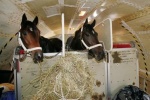
The after-effects of travel on racehorses has vexed trainers for decades. Short-distance transport of racehorses is, as every trainer knows, almost always of very little consequence. Longer distance transport presents a much greater challenge and months of work and planning can be undone in the course of a few hours.
Des Leadon (European Trainer - issue 24 - Winter 2008)
Italian racing goes on strike and brings Rome to a standstill

Alitalia lives to fly another day thanks to a combination of Italian Prime Minister Silvio Berlusconi’s business acumen, unshakable confidence, negotiation skills tuned finer than the engine of a Boeing 747, and utter persistence in the face of strong opposition from syndicate representatives well beyond the eleventh hour.
Niki Sweetnam (European Trainer - issue 24 - Winter 2008)
Amino Acid Supplements - the important element of protein

Horses in training are traditionally fed a diet that is high in protein, but it is the amino acid content of the protein-rich ingredients that is the important component.
Dr Catherine Dunnett (European Trainer - issue 24 - Winter 2008)
Picky Eaters - a common problem in horses in training

Poor appetite in horses in training is not uncommon, whether this is a transient problem following racing, or, more regularly, during training in particular horses.
Dr Catherine Dunnett (European Trainer - issue 24 - Winter 2008)
TRM Trainer of the Quarter - François Cottin
The TRM Trainer of the Quarter goes to Francois Cottin with more than €4 million in winnings and €600,000 advantage over Guillaume Macaire, the Chantilly handler is almost certain to be champion French jumps trainer this year.
Katherine Ford (European Trainer - Issue 24 / Winter 2008)
Richard Mandella on the basics that make racing work
Hall of Fame trainer Richard Mandella is not in his tack room office between sets at Del Mar this morning. Instead, the son of a blacksmith is at the end of the long indoor barn, artfully sweeping a rasp across a back hoof of a two-year-old Storm Cat filly. When prompted, he says, simply, “The basics are what make this game work. Believe me, basic horsemanship will hold you in good stead. It's the most important thing. Knowing that a horse is shod as correct as he can be, that the blacksmith's doing a good job You? Embarrassed, he downplays his handiwork. No, I tinker around, that's all. I don't do it every day. And it doesn't make me any better than anybody else.
Frances J Karon (14 October 2008 - Issue Number: 10)
Better Talk Now - the multi-millionaire BC winner
Bill Heller (14 October 2008 - Issue Number: 10)
From Good to GREAT - the pain of losing a good horse to another trainer
Losing an under-achieving horse is a reality trainers live with daily. But how do you lose a horse who performs spectacularly in his debut? How do you lose a horse you’ve waited your whole lifetime to train?

Bill Heller (14 October 2008 - Issue Number: 10)
The Gate Crew - behind-the-scenes but in full view
On Blue Grass Day in 2008, roughly 26,000 people in the stands went crazy as Visionaire, the last to load into the starting gate, took his place in the lineup. When the doors shut behind him, it was the signal that the feature race of Keeneland’s spring meet was only seconds away, and the crowd cheered, wild with anticipation. Everything fell perfectly into place, and head starter Robert “Spec” Alexander released the field: the shrill clang and sharp burst of the metal gate springing open gets the blood flowing like no other thrill associated with horseracing.
Frances J Karon (14 October 2008 - Issue Number 10)
Picky Eaters - a common problem in horses in training

Poor appetite in horses in training is not uncommon, whether this is a transient problem following racing, or, more regularly, during training in particular horses. In some situations, ‘failure to clean up’ may simply be explained by horses being offered more feed than they require and so they are being overfed, whilst in other instances, where it is accompanied with poor condition, the causes may be more complicated. Certainly, physiological mechanisms exist in horses to match energy and nutrient intake to daily requirements and these systems form the basis for self regulation of feed intake in horses in the wild or at grass.
Catherine Dunnett (14 October 2008 - Issue Number: 10)
The Role Vitamins Play in the Diet
Vitamins are a key part of the diet for racehorses and although the clinical signs associated with an overt deficiency or excess of one vitamin or another are rare, we should not presume that the level of vitamins provided in the diet is optimized for performance. Horses are, generally speaking, quite tolerant of sub-clinical deficiency or excess with regards to vitamins, and the margin of acceptable intake to prevent health issues is therefore relatively wide in most cases. However, maintenance of health is a separate issue compared to optimal performance, which is the ultimate target for horses in training.
Catherine Dunnett (14 October 2008 - Issue Number: 10)
