
Mario Baratti - how he’s created a classic winning stable in the heart of Chantilly
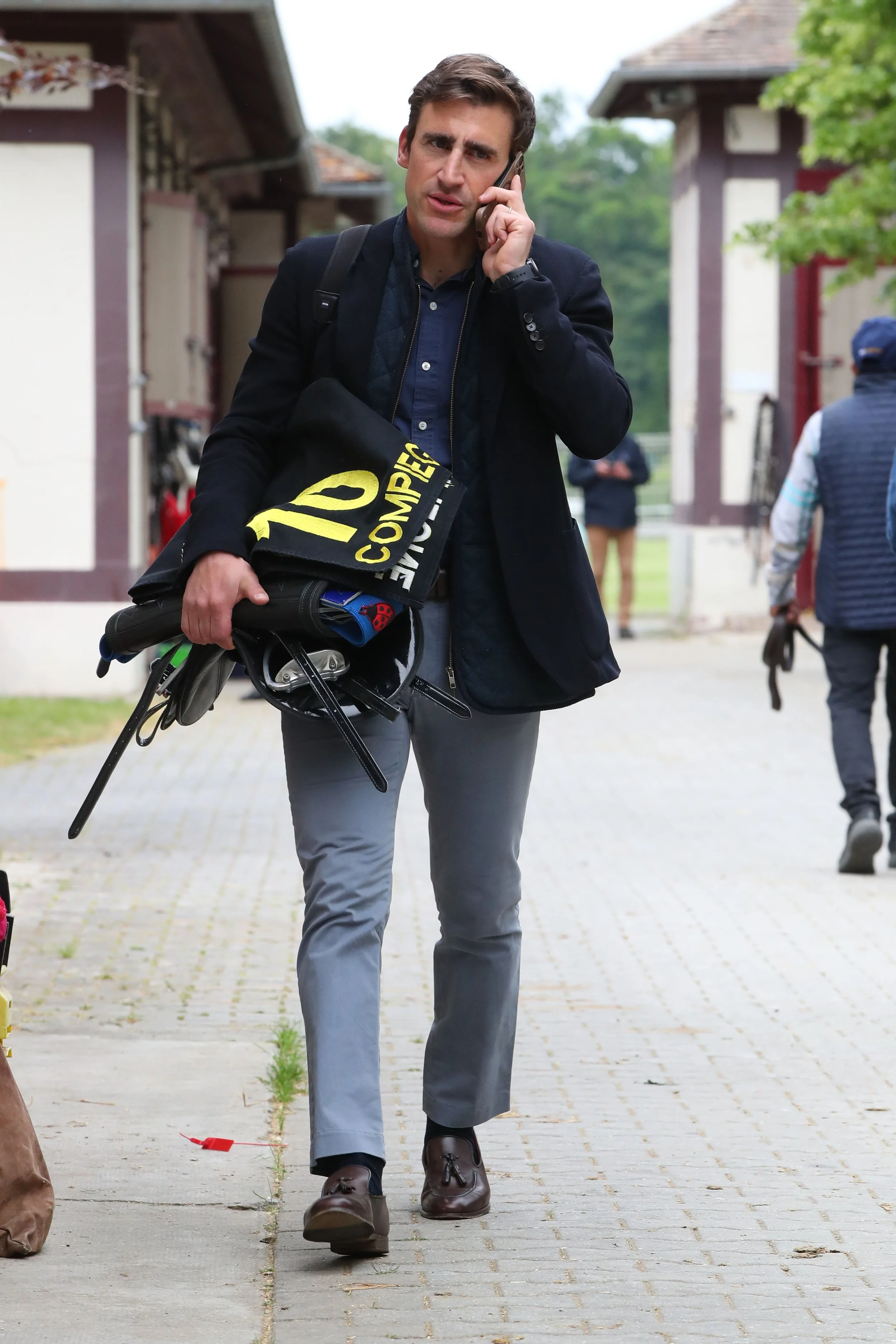
Mario Baratti is sitting behind the desk in the spacious office of his stable off the main avenue leading into Chantilly, munching a croissant in between second and third lots. I decline his offer of breakfast, and we quickly agree to communicate in French and to use the friendly “tu” form instead of the more formal “vous”.
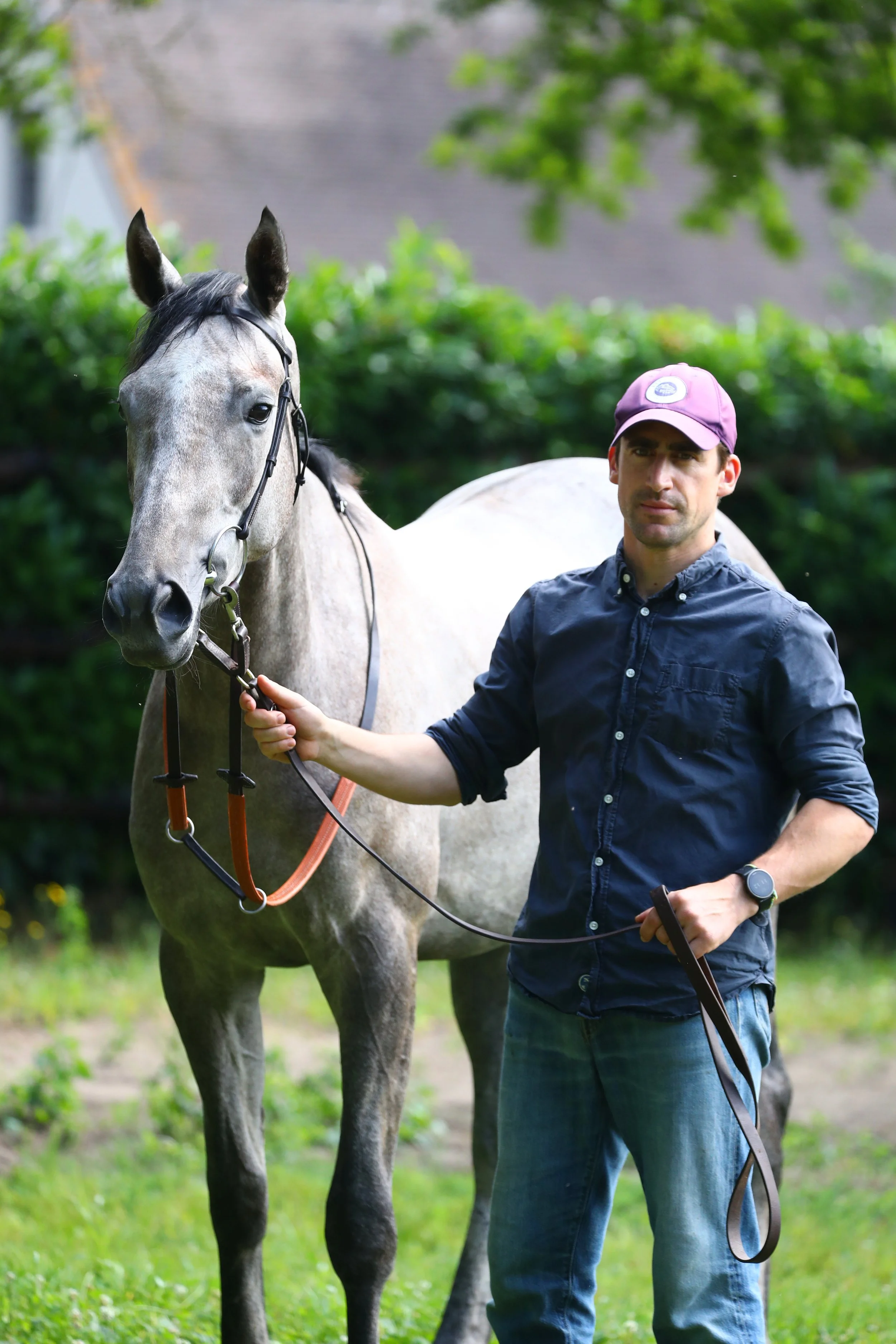
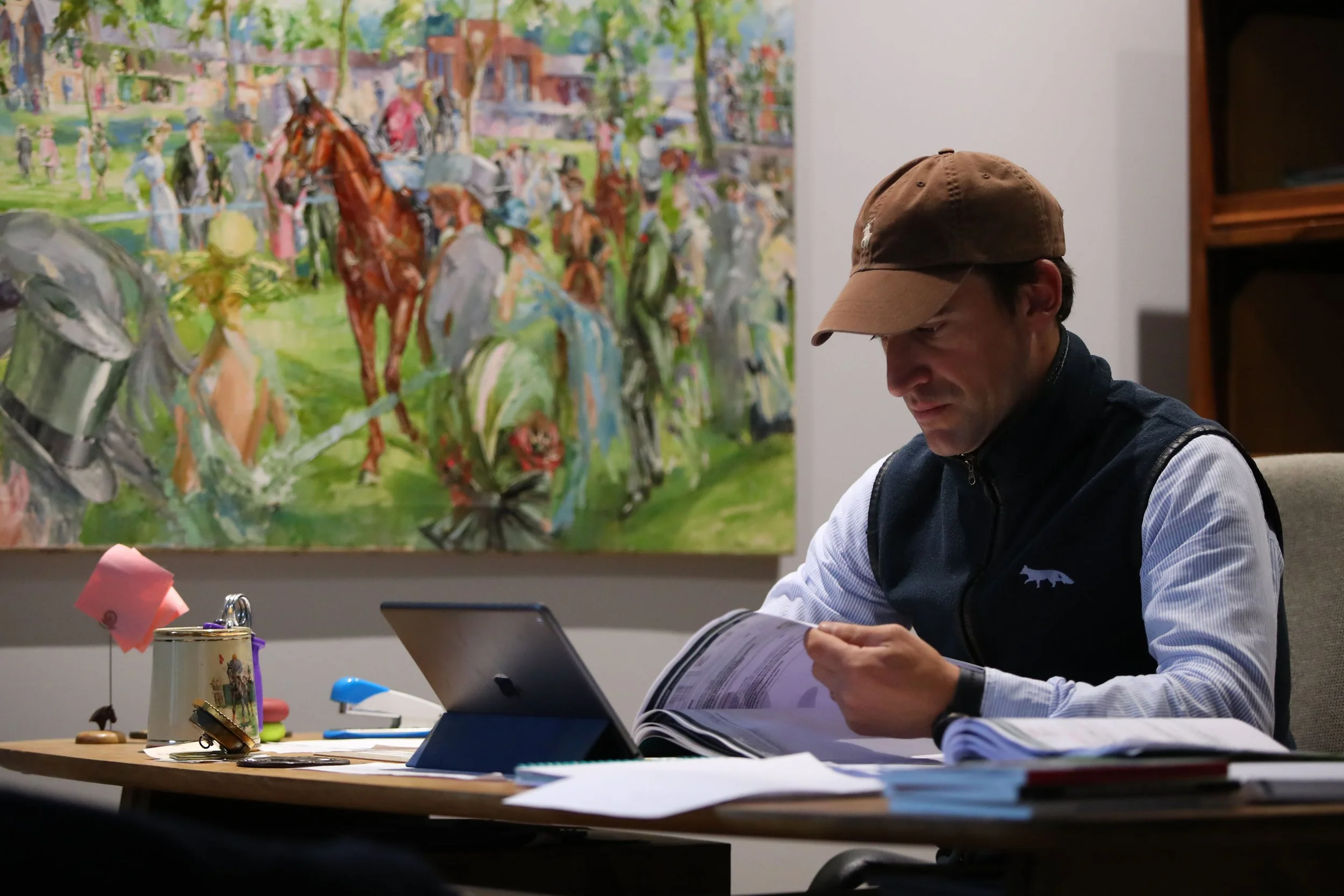
Above the trainer’s right shoulder, a large watercolour depicts a scene of Royal Ascot, “it was a wedding gift and it was too big for the house so it has a perfect place here… The colours are beautiful and it’s a wonderful source of inspiration!” The walls are also adorned with photos and a framed front page of French racing daily Paris-Turf showing Baratti’s two Classic winners to date, Angers who lifted the German 2000 Guineas at Cologne in 2023 and Metropolitan who propelled his handler onto the big stage with a first Group 1 victory in the Poule d’Essai des Poulains a year later. There is plenty of space left for memorabilia which seems sure to come to celebrate wins in the future.
Born and raised in Brescia in North-West Italy near Lake Garda, Mario Baratti has a slightly different profile from several of his compatriots who are now successfully operating in Britain and France. The 35-year-old does not hail from a big racing family and he has little experience of training in his native country.
He explains, “My father was a great sportsman and was good at a lot of sports. Between age 18 and 25 he rode over jumps as an amateur. I started riding very early, at age four or five, and showjumped and evented when I was young and then started riding as an amateur as soon as I could. I was a true amateur as I didn’t start working in racing until I was 19. I was lucky to ride about 70 winners, in Italy but also in Britain and France, in a relatively short career in the saddle.”
A couple of summer stints with John Hills in Lambourn as a teenager further fuelled the young Mario’s passion for racing and he soon joined Italy’s legendary trainer, Mil Borromeo in Pisa, “Mil Borromeo was a great trainer, very sensitive and with an amazing capacity to listen to his horses. His objective was to create champions and he succeeded many times during his career. He was on the same level as the top trainers from England, Ireland and France from the time. He was very sensitive and attentive to his horses. My official title with him was assistant but I was so young I was more of an intern.”
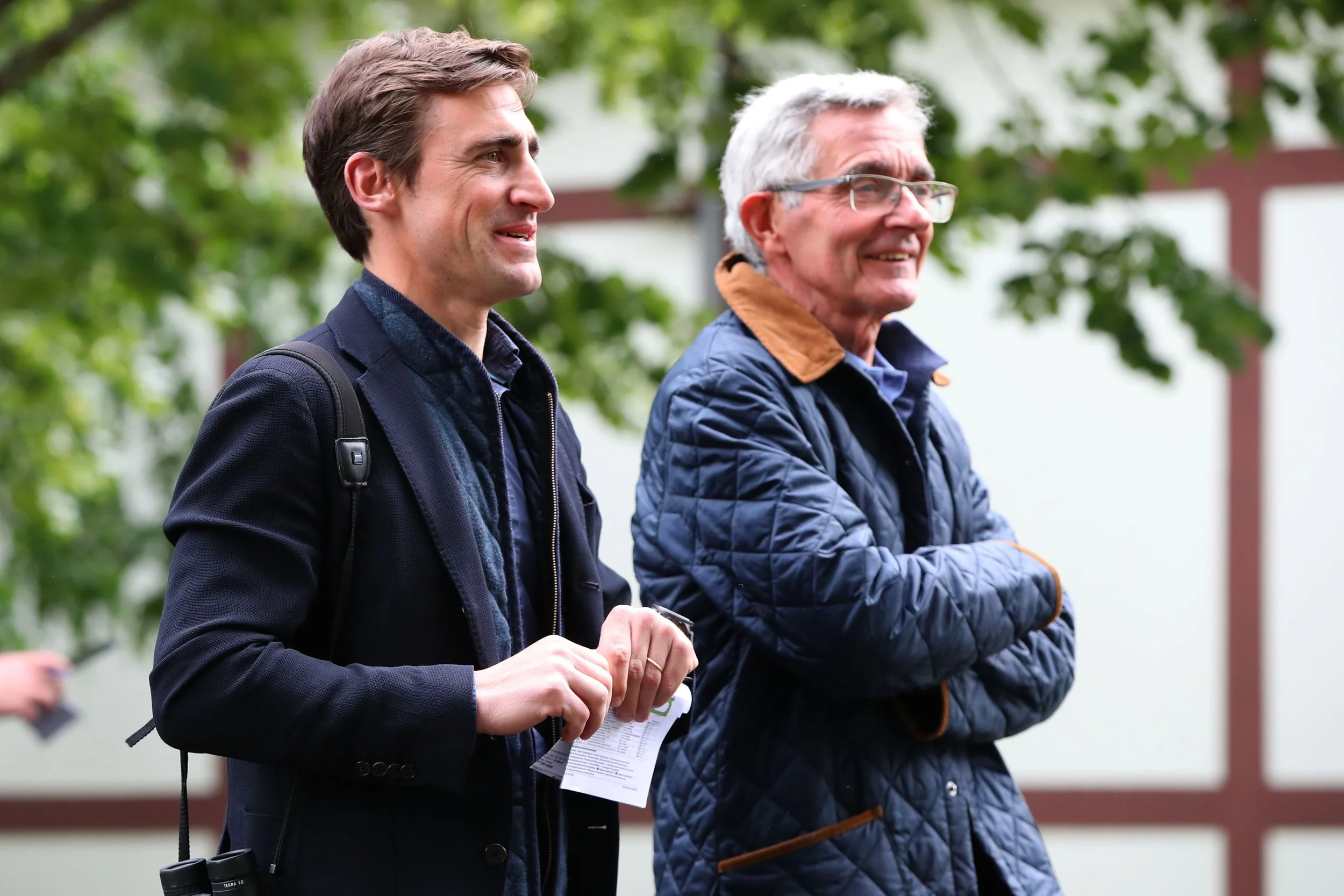
After a year with the Classic Italian trainer, Borromeo advised the young Barrati to spread his wings and continue his education, both in racing and academically.
The Botti Academy
The logical port of call was Newmarket and the stable of training’s rising Italian star of the time, Marco Botti. “I used to ride out in the mornings and go to Cambridge in the afternoons to learn English. The original plan was to spend just a year in England to pass a language exam, but after I passed the exam, Marco Botti proposed the position of assistant if I stayed with him. When I started he had less than 50 horses and during the four years I was there the number rose to over a hundred so it was a real growth period. I had the good fortune to ride horses like Excelebration who was exceptional, and to travel to Dubai, or Santa Anita for the Breeders’ Cup... He had six or seven real high-quality Group horses, who could travel and win abroad.
I learnt many things during my time with Marco and the most important was probably how to manage the horses in the best possible way to optimize their potential. I think the secret to his international success is that he travels his horses at the right moment. He understands when a horse is tough enough to go abroad, and he doesn’t take them too early in their careers.”
After four years in the buzzing racing town of Newmarket, it was time to continue the learning curve and despite an offer to join another compatriot, Luca Cumani, Baratti remembers, “everyone advised me to go to America or Ireland.” So the young Italian found himself in rural County Kilkenny. “Jim Bolger said he would only take me if I stayed for three years, but in the end I cut my time short. It was a very good experience and I learnt a lot about breaking in yearlings and working with youngsters. I learnt what I could in a short time as I was only there for three or four months, an intense experience of work and life. Mr Bolger is a real horseman, who is tough on his horses but always manages to produce champions. He can do things that others cannot allow themselves to do, because he breeds and owns a lot of the horses himself.”
Despite the prestige of his Classic-winning mentor, Baratti was unable to settle in Ireland. “I like the countryside, but I was isolated. I was 25 years old and never saw or spoke to anyone and the lifestyle wasn’t for me. So one day I told him, “I can’t stay three years”, and he said, “you want to train in London? You can’t train in London!” I’ll never forget that! But he understood and in the end he said, “I’ve taught a lot of top professionals, McCoy, O’Brien, but it’s up to you if you want to leave. I hope that you find someone as good as me…””
Pascal Bary an inspiring mentor
Next stop was France, and Baratti took advantage of a couple of months before his start date with his next boss, Pascal Bary, to join fellow Italian Simone Brogi who had recently set out training in Pau. He also spent a month with Brogi’s former boss, Jean-Claude Rouget, at Deauville’s all-important August meeting.

“The time helped me to learn French and integrate into the French ambiance, which wasn’t easy. I found it much tougher to settle in France than in Newmarket. As a foreigner I felt less well received. Even at Newmarket, I started as an assistant when I was 18 years old, with no experience, and it was tricky to manage a team of 25 or 30 staff. But when I started here it was even more difficult to handle the French staff. They would say to me ‘I’ve never done that in 30 years and I’m not going to start now…’ During the early days with Pascal Bary, I thought that France wasn’t going to be for me. Then it became a personal challenge and I decided to stick it out. Now, Pascal Bary is one of the closest friends I have here in Chantilly, but at the start he wasn’t an easy boss. It took two years, of the four that I was there, before we built up a real relationship. On my side, I was very respectful, and I saw him as someone who was very reserved, so we kept our distance. I was in awe of him and his career. He wasn’t interested in just winning races, he wanted to develop the best out of his horses. That’s why he had such a great career. 41 Group 1 wins in a 40-year career is a huge achievement. He won Dianes, Jockey-Clubs, Poules, Guineas, Breeders Cups, the Irish Derby… He’s the only French trainer to win the Dubai World Cup. He started off going to California for the Breeders’ Cup when he was very young. He would dare to step into the unknown, because at the time it was much more complicated to travel around the world.
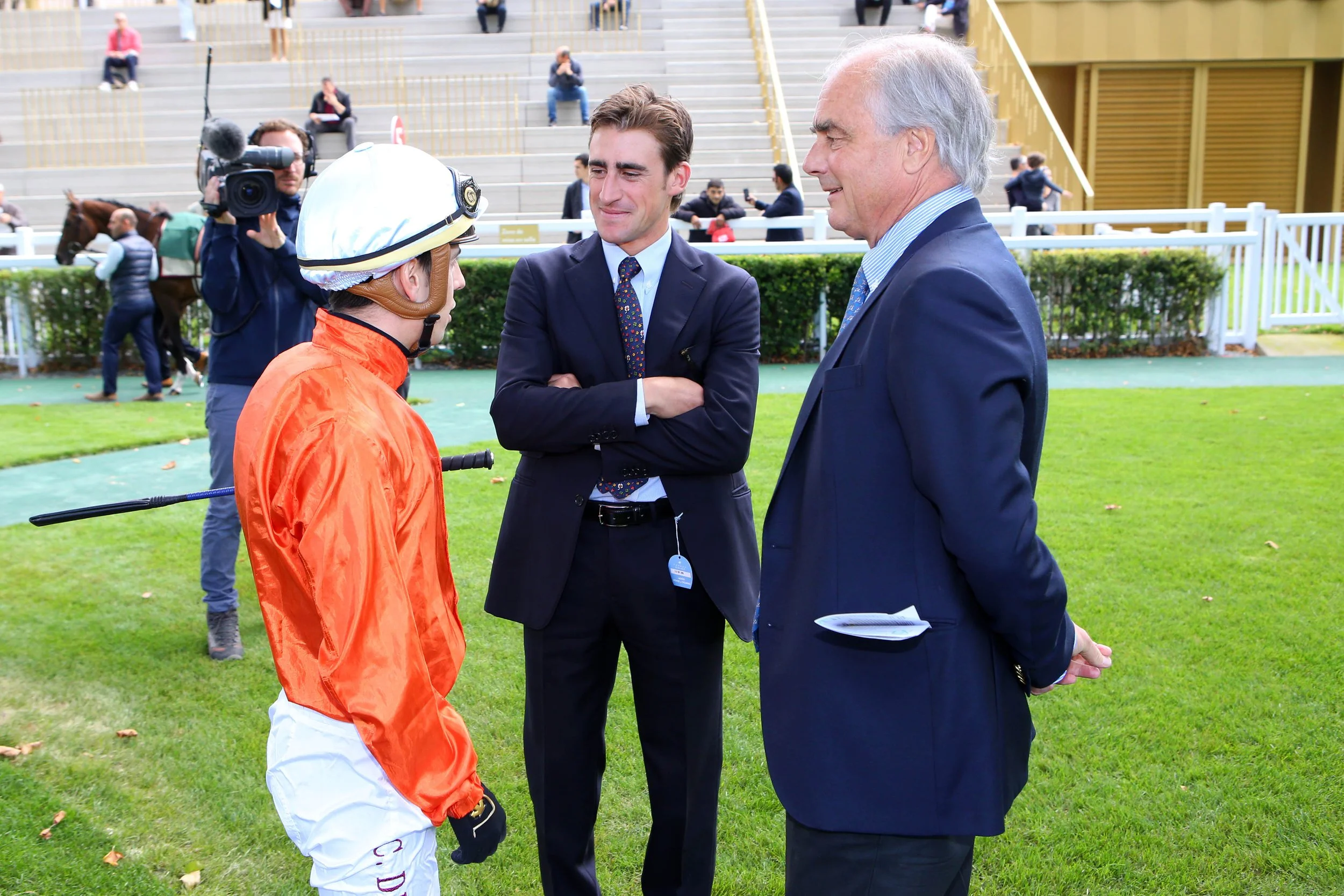
I was lucky to be there at the time of Senga - who won the Prix de Diane and Study of Man won the Prix du Jockey-Club. So I worked with top horses, who were perfectly managed, and many of them were for owner-breeders. Very early in the season, when the grass gallops opened, he would immediately pick out the three or four standout horses and plan their programme. He could tell right away which ones had talent ‘this one will debut in the Prix des Marettes at Deauville… ‘ I remember that year the filly did exactly that and won; it was Senga and she went on to win the Diane.
When you spend time with someone at the end of their career, there is more to learn. Pascal Bary had a superb training method, and he had the success he did because he was very firm in his decisions. He’s not someone who changes his mind every day, and there aren’t many people like that nowadays. He was very sensitive to his horses and always sought to create champions. I try to keep in mind his method.”
Changing dimension
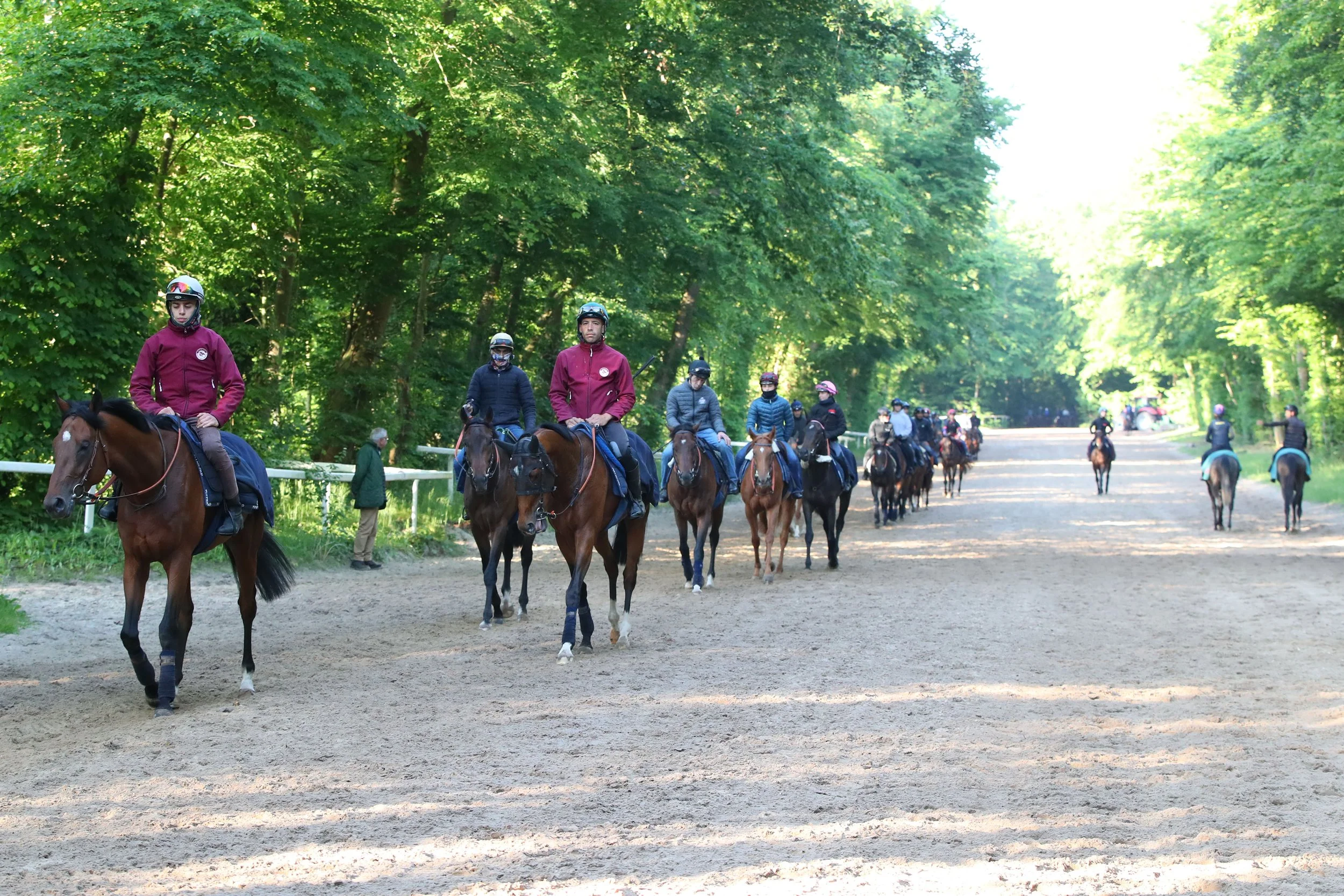
The string for third lot is now ready to pull out and we make our way through the yard which has been adapted to accommodate an expanding string.
“We recently acquired the next-door yard and we knocked through the walls of a stable to make a passageway between the two. I now have 73 boxes in these two yards, plus 15 at another site which has the benefit of turnout paddocks.”
Through a gate in the hedge at the back of the courtyard and we are straight onto the famed Aigles gallops as the sun starts to break through the clouds on what had begun as an overcast morning.
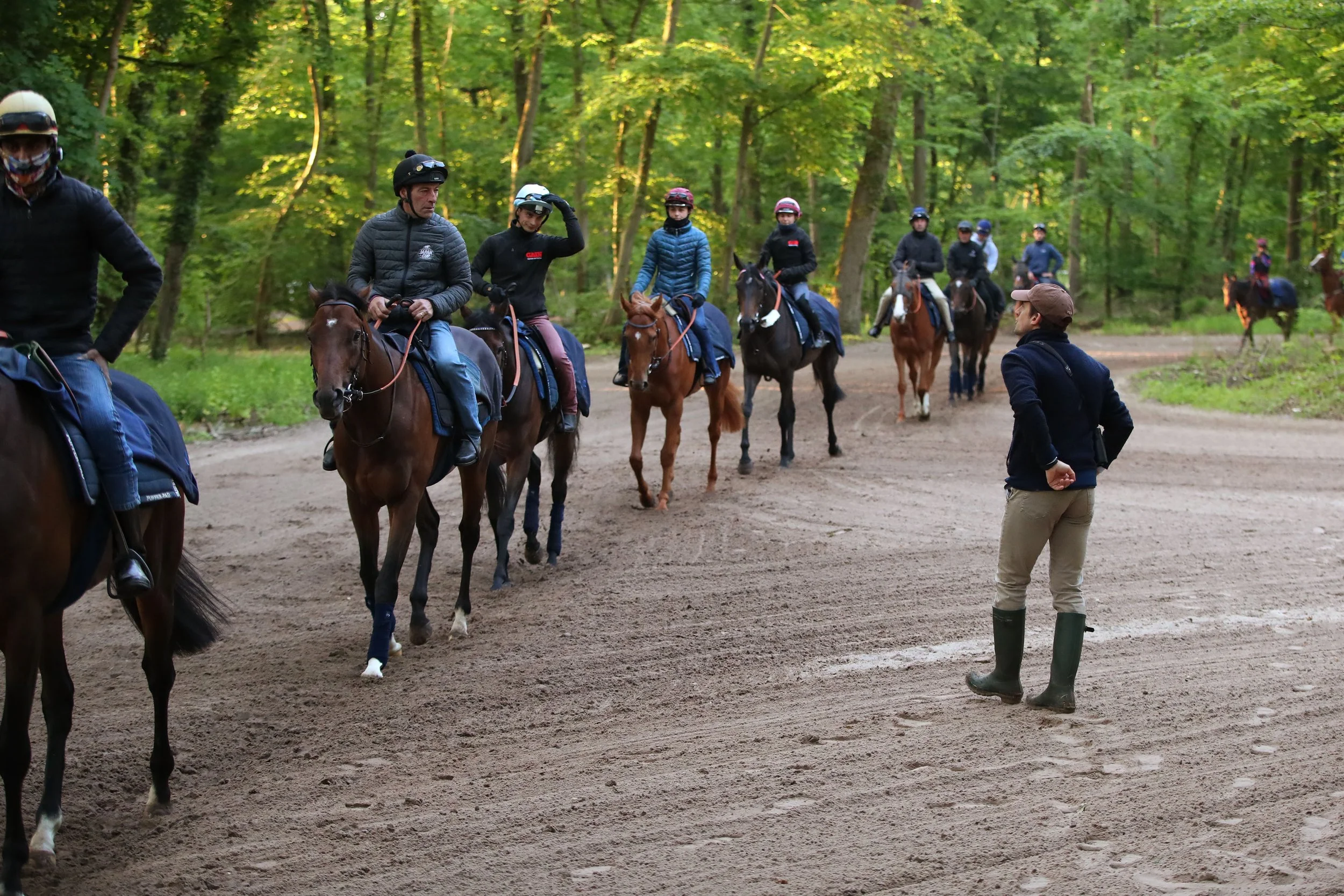
“It’s a magnificent site; we are so lucky to have such beautiful surroundings and for me to be able to access the gallops on foot.” As we make our way to the walking ring in the trees where the Baratti string circles before and after work each morning, the trainer tells me, “I still ride out every Sunday, bar only two or three weeks in the year. I think it’s important to exercise as many as we can on a Sunday and if I ride two, that’s a help to the staff and a real pleasure for me too.”
The string of around twenty juveniles, many still unraced, passes before the trainer who gives multilingual orders. “Here we speak Italian, French, English, Arabic and Czech,” he explains, “we try to all speak French but of course sometimes we communicate in Italian, especially when things get heated! We’ve more than doubled in size since last autumn and so we built up the new team throughout the winter and in spring. It’s all coming together now. For the first few years everything went very smoothly, but there were only half a dozen members on the team! When you get up to 25, it’s a different story.”
The team includes a couple of former Italian trainers who left their country and now work as managers for the burgeoning Baratti stable, plus veteran Filippo Grasso Caprioli, Mario’s uncle who was a leading amateur rider in Italy in his time. “He “just” rides out, he doesn’t have a position of responsibility but he does give us the benefit of his age and experience!”
Another vital member of the team is Monika, Mario’s Czech-born wife. “We first met at the Breeders’ Cup when I travelled with Planteur and she was the work rider of Romantica for André Fabre. When I first moved to France we both lived in the same village, 100m away from each other but we never bumped into each other. We met again four years after I moved to France. We’ve been together now for seven years and married this spring. Monika is an excellent rider and she also takes care of the accounts, but her most difficult job is taking care of our two small boys. I think she sometimes comes into the yard for a break!”

As we trudge across the damp turf to the Réservoirs training track, Baratti expands on his choice of Chantilly. “When I was in Newmarket I thought I would never leave, but then it was logical to continue here after I had done my time with Pascal Bary. And of course, the French system is very beneficial compared to elsewhere in Europe. The facilities here in Chantilly are second to none. When I first started I used to use all of the gallops but now I have my routine and regularly use Les Réservoirs. I often use the woodchip but there is plenty of choice. Once you have understood how each track works then it’s simple.”
The first group of two-year-olds canter past, and Mario runs through some of the sires represented: Siyouni, Lope de Vega, Wootton Bassett, for owners such as Nurlan Bizakov, Al Shir’aa, Al Shaqab and powerful French operators such as Laurent Dassault, Bernard Weill and others.
“This is the first year that I’ve had such a good panel of owners, and a better quality of horses. It is certainly thanks to Metropolitan and the successful season we had last year. In previous years, we did well with limited material, and we managed to win Listed or Group 3 races which isn’t easy when you only have 20 horses. This year we have more horses but haven’t won any big races yet (he laughs nervously) but they will come…”
Indeed days after the interview, the stable enjoyed a prestigious Group success on Prix du Jockey-Club day with the Gérard Augustin-Normand homebred Monteille, a sprinting filly who was trained last year by the now-retired Pascal Bary.
“It's very important to have owners who also have a breeding operation. They have a different outlook on racing and they are often the ones that produce the really top horses. They expect good results, of course, but they understand the disappointments and are generally more patient. The other owners are important too, and Metropolitan, who we bought at the sales, is the proof of that.”
Classic memories
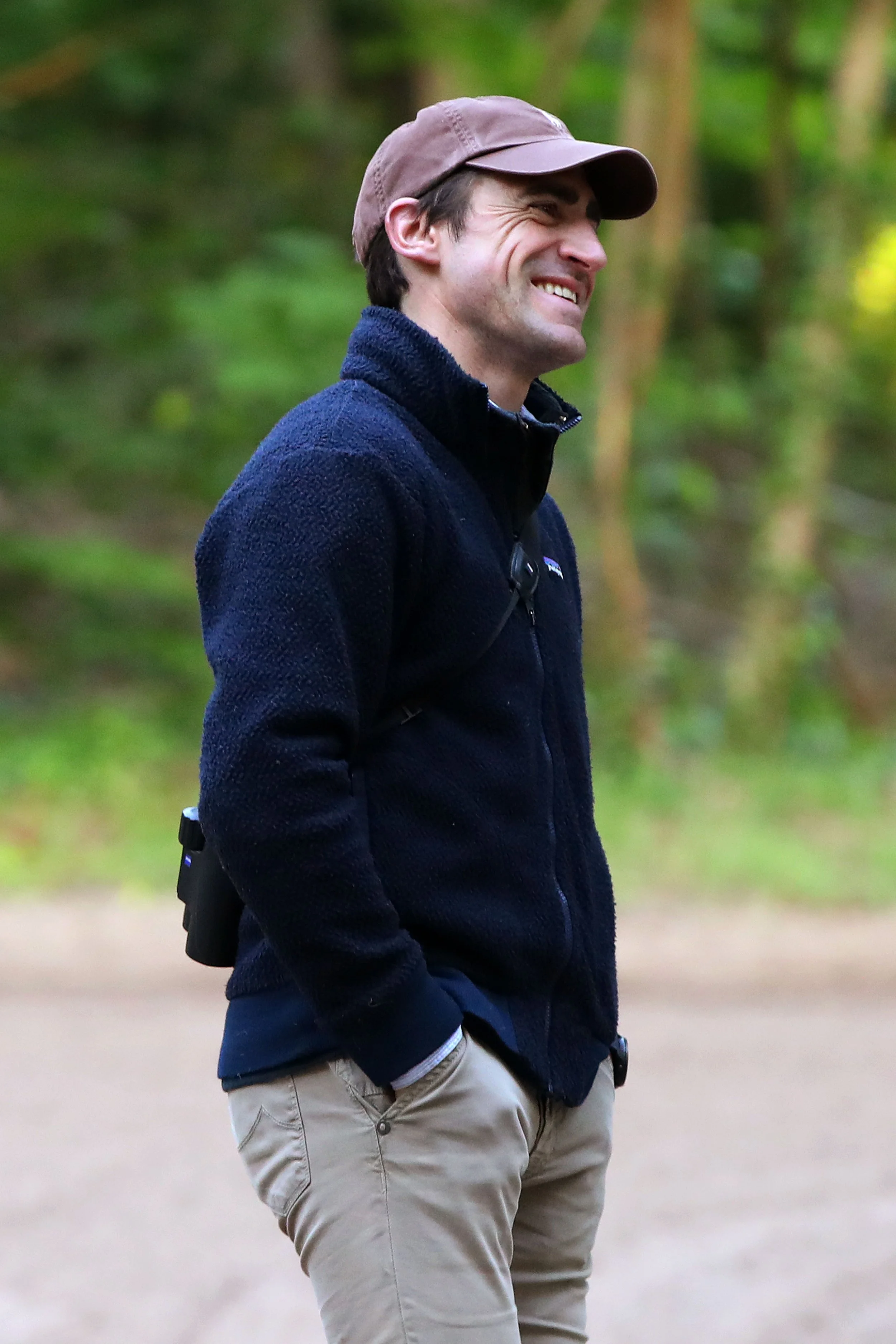
Understandably, a smile widens across Mario’s face as he remembers the day when the son of Zarak lifted the Poule d’Essai des Poulains to offer the trainer his first major Classic winner.
“I was only in my fourth year of training, it wasn’t even in my dreams to win a Poule so soon in my career. It’s hard to describe, the joy was enormous. The fact that we ran in the race again this year, with a very good horse (Misunderstood) but everything went wrong, makes you realise now how difficult it is for everything to go right on a day like that. I always thought that Metropolitan was an exceptional horse. We were far from favourites in the Poule but I knew we had a good chance of winning. The owners rang me on the morning of the race and asked, ‘Mario do you think we can win?’ and I said Yes! He had finished fifth in the Prix de Fontainebleau and we had ridden him to avoid a hard race, but still, many observers overlooked him. Apart from in his last race on Champions Day, he never put a foot wrong. He confirmed his class when third in the St James’s Palace Stakes in a top-class field and then was beaten by the best four-year-old miler in Europe, Charyn, in the Jacques le Marois. And at the time, we only had three or four three-year-olds in the yard, so the percentage was amazing.”
Baratti had already tasted Classic glory a year earlier, thanks to Angers (Seabhac) who won the Group 2 Mehl-Mülhens-Rennen (German 2000 Guineas). A first successful international raid from the handler who learnt from some of the industry’s specialists.
“You travel if your horse is very, very good, or not quite good enough,” he explains.“If you travel to Royal Ascot, you have to be exceptional, the same for the Breeders’ Cup. But for Germany you can take a decent horse who isn’t quite good enough for the equivalent races here. Angers had finished second in the Prix Machado which is a trial for the Poule d’Essai. I already had Germany in mind for him if he was placed in the Machado, and he went on to win well in Cologne. Every victory is very important, the key is to aim for the right race within the horses’ capabilities. Each horse has his own “classic” to win, with a made-to-measure programme.”
Many expatriate Italian trainers target Group entries in their native country, but Baratti is not keen to explore this option. “I have never had a runner in Italy. I did make an entry recently but we ended up going elsewhere. Italian black-type is very weak for breeding purposes, so it’s not really worthwhile for me to race there. There are a lot of good professionals in Italy but I don’t really have much connection with them because I’ve never worked over there, I left when I was young.”
A realistic approach
Baratti’s adopted homeland of France has recently announced austerity measures for the forthcoming seasons to compensate for falling PMU turnover and pending the results of a recovery plan which aims to increase the attractivity of French racing for owners and public. France Galop prize money will be reduced by 6.9%, equating to 10.5 million euros during the second half of 2025 and 20.3 million euros for following seasons until a hoped-for return to balance in 2029.
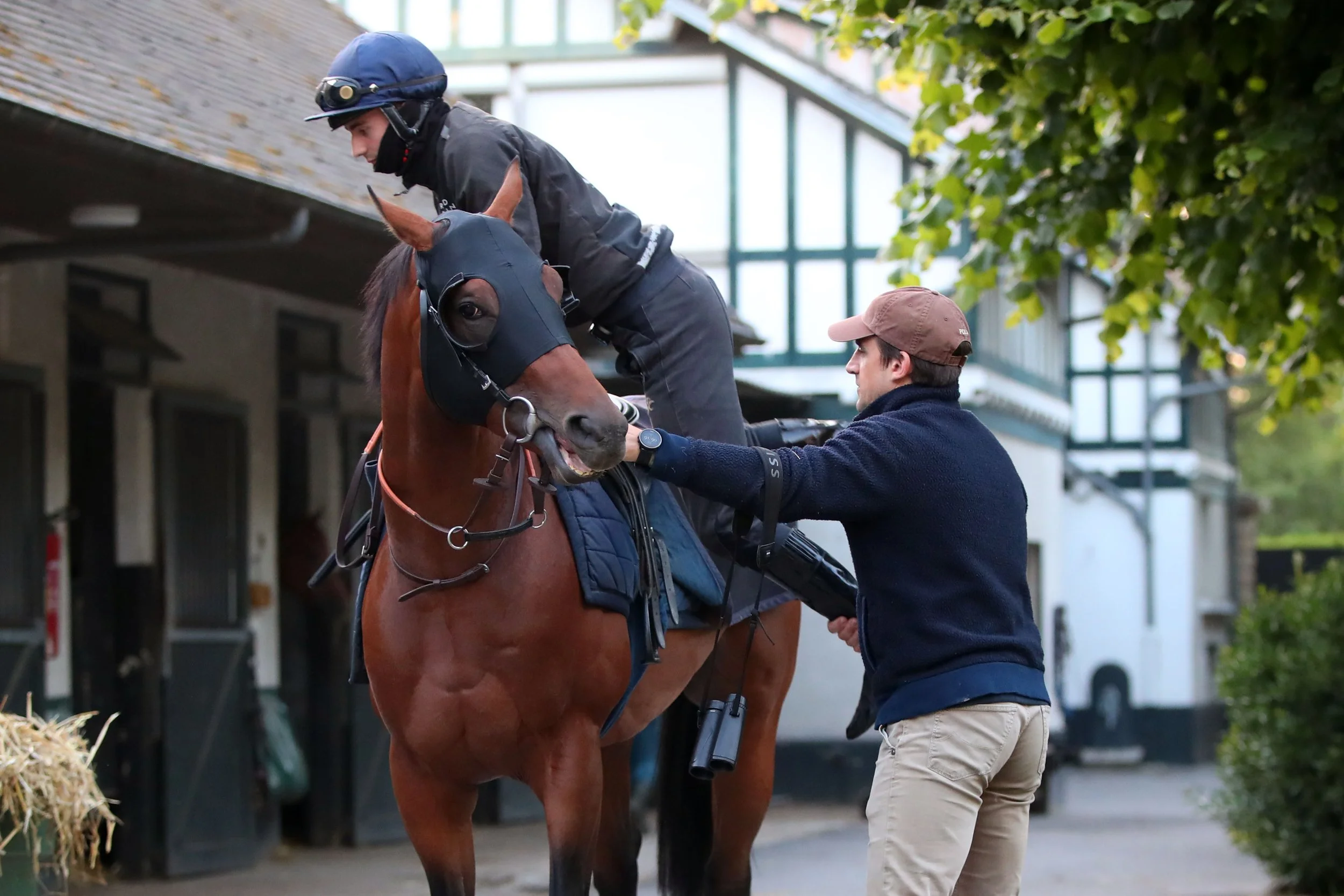
“It’s normal,” says the Italian pragmatically. “It’s better that they make a small reduction now than wait two or three years and have to make drastic cuts. It’s necessary to take the bull by the horns, not like how it was in Italy when they let the situation decline and then it became too hard and too late to redress. We are fortunate to be in a country where prize money is very good compared with our neighbour countries in Europe, so a small reduction won’t affect people too much.
Owning racehorses is a privilege and a passion. It is a luxury and people should treat it as such, not buy horses as a means to earn money. If you buy a magnificent yacht, it costs a fortune, and it’s pure outlay. Money spent on having fun. Nowadays, a lot of people invest in racehorses for business purposes, but they need to have the necessary means. If you are lucky to buy a horse like Metropolitan and then sell him for a lot of money, that’s another story, but it wasn’t the aim at the outset.”
He remembers an important lesson on owner expectations from former mentor Pascal Bary. “I was surprised once when Mr Bary received some foreign owners in his office. They wanted to buy ten horses. He told them, the trainer earns money, not every day, but he tries, in any case his objective is to earn money, the staff earn money and the jockey earns money. Normally, the owner loses money. If things go well, they don’t lose much, if they go very well they can break even, and when it’s a dream, then you can make money, but that’s the exception to the rule. The guys had quite a lot of money to invest and they were there, open-mouthed. In the end they chose another trainer. But Mr Bary was right. If I decide to buy a horse tomorrow for 5,000€, I have to consider that 5,000€ as lost. If I want to invest, I should buy a house.
His explanation was very clear and that’s how racing should be understood. It would be nice to have a group of friends buy a horse, but it costs a lot. Ideally it should just be for pleasure, like membership at the golf, or tennis. It's an expenditure. And if in the end you end up winning, then all the better. And it can happen. Bloodstock agents do that for a living but it’s their profession. My owners are in racing for the pleasure.”
With an upwardly-mobile, internationally-minded and ambitious young trainer, Baratti’s owners certainly look set for a pleasurable ride over the forthcoming seasons, and the office walls are unlikely to remain white for long.
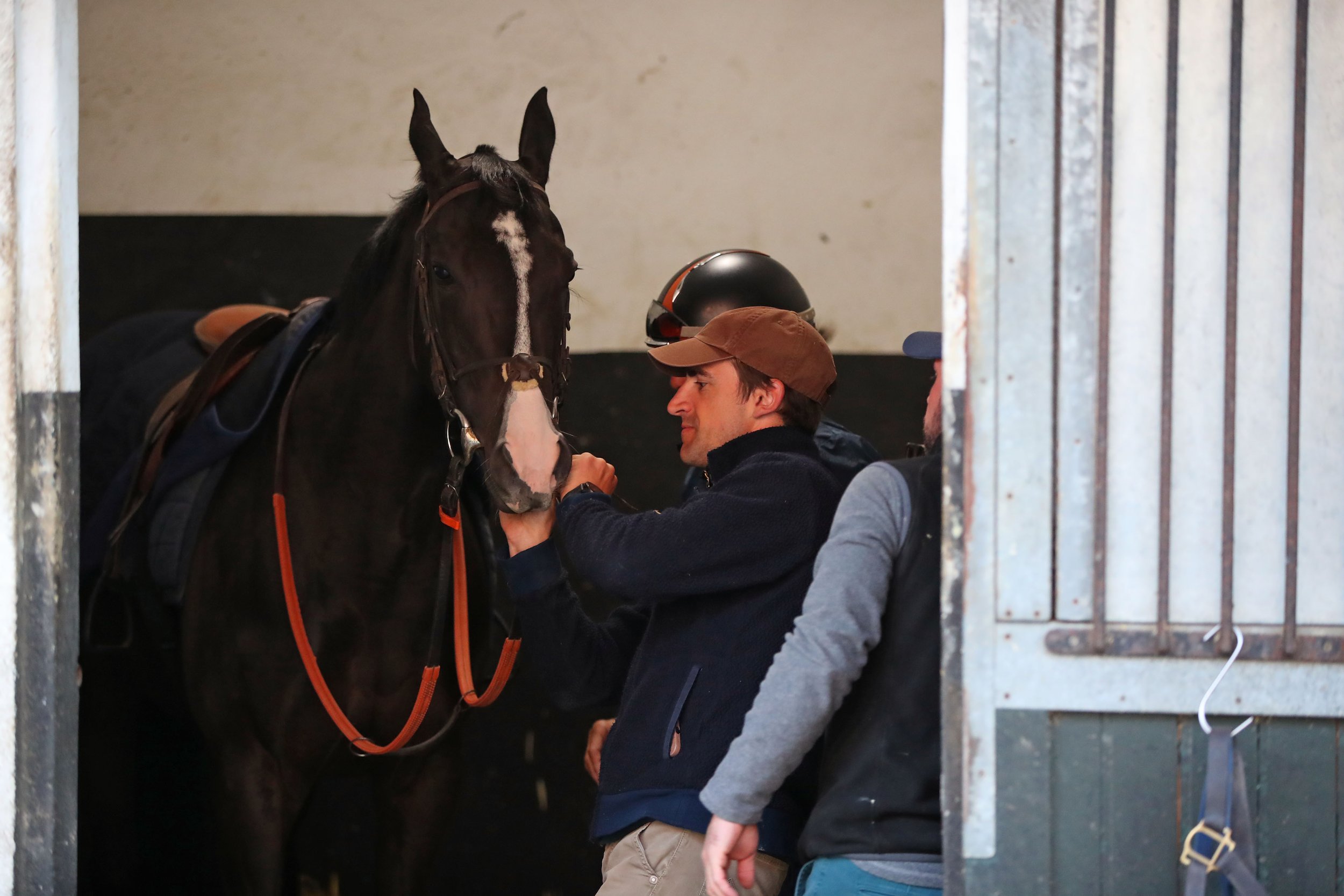
Henk Grewe - the Classic winning German Trainer
Article by Catrin Nack

When Grewe retired from race-riding and took up training in 2014, it wasn’t exactly the hottest news in German racing. He had been a middle-of-the-road jockey, never reaching lofty heights. But as a trainer, he has made it to the top of his profession.
Eleven years later and February 2025 - it’s six fifteen in the morning and It's pitch black. The first lot is out already, and Grewe is in the saddle.
The majority of German racehorses are trained on a racecourse. Nearly every main track – think Düsseldorf, Cologne, Hannover, Iffezheim or Hoppegarten – doubles as a training centre. A chosen few have the luxury of private premises, but Grewe shares Cologne racecourse with three other major trainers, and roughly 300 horses.
Shared facilities consist of a trotting ring, and two sand gallops, sand, not fibre. His roughly 78 boxes are split into four stable blocks, of various size and quality. The largest block of roughly 40 boxes was actually a grandstand in bygone times.
Tighter animal welfare measures saw a row of windows being installed, with one row of horses glancing onto the stable alley, the other side enjoying a room with a view to both sides.
Every box is filled generously with straw, something increasingly rare in domestic racing yards. “The year I used sawdust was my worst ever, and I am convinced there is a correlation. Horses feel comfy on straw so there you go.” Three horse-walkers grace the place, one is called “the terrace” as it has no roof. And basically, that’s it. The height of technical racehorse training.
A covered trotting ring is in the distance, but “that’s not mine. That’s Peters [Schiergen, of Danedream fame]” says Grewe.
No saltbox, treadmill, solarium, let alone a pool. Scales somewhere, “but I hardly use them.” He concedes that horses may have a perfect racing weight, “but I need to see that. If a trainer can´t spot it, well….”
There is a simplicity in the whole setup, mirrored in the trainer´s beliefs. “Really, you can train a horse anywhere. Hans-Walter Hiller [who was Champion Trainer in 1999, and whose yard he was attached to as a jockey] trained on a strip next to a motorway, so clearly you don’t need much.”

Grewe’s principles when it comes to readying horses are cut from the same cloth. “The most important thing is routine. Routine. Once the horse figures out what he has to do he can relax in that routine, and he feels secure. I don’t like fresh horses. On average my horses are out three hours a day, it comes down to three things: routine, the feeding, and proper medical care.”
The yard has a couple of paddocks now too, and some horses are turned out in the afternoon. Roughly 23 people work for Grewe, with active and retired jockeys playing a vital part in the morning. Thore Hammer-Hansen is one of them.
Having returned to his roots in 2024, the jockey, with a retainer from Cologne racecourse president Eckard Sauren, wasted little time to take German racing by storm. He combined with Grewe (but not Sauren) to win the German Derby on Palladium (more of him later); the end of the year saw him crowned Champion jockey as well.

Fresh from a trip to Riyadh, where he guided the Marian-Falk Weißmeier-trained, Straight to a respectable 5th place at Gp.2 level, Hammer-Hansen feels slightly under the weather but is full of praise of Grewe, who “is a team-player and a very good trainer”.
Much needed positives after other work-riders declare that the trainer's most remarkable trait is “his bad mood before the first lot”. While such statements are (hopefully) tongue-in-cheek, the relaxed atmosphere with a lot of banter is duly noted; Grewe is usually riding three lots himself and doesn’t shy away from the general chores.
Grewe doesn't miss a beat: while preparing his horse and answering cumbersome questions at the same time, his eye is all over the place and every idleness is (duly) spotted.
It all started inconspicuously. Born in 1982, his parents had a couple of horses, so the foundations were laid early on. “I had to decide whether I wanted to be a professional table tennis player or pursue horses. I felt there was more money in the latter.” The good, the bad and the ugly, money is a recurring theme for Grewe.
It is what drives him, because, quite plainly, “I want to be rich”. Grewe retired from race-riding with a handful of Black-Type wins to his name. With the help of then-business partner Christoph Holschbach he set up a limited company to train racehorses on August 1st 2014, with a mere 12 (bad) horses; his first runner, just 20 days later, was a winner.

They kept coming. It was quantity over quality at first, “I had to get my name out”. In his prime Grewe had roughly 120 horses. The first Listed winner came in 2017, the first Group winner, Taraja in a Hamburg Gp.3, in May 2018. Khan, who eventually switched to hurdles, provided the breakthrough at the highest level when taking the Großer Preis von Europa in September 2018.
The hardy and consistent Rubaiyat flew the flag for four seasons; unbeaten as a 2yo in 2019, he won at least one Group race in every season. While he missed out on valuable Gp.1 glory, his trainers list of high-class winners started growing: the German Derby (Gp.1) twice (Sisfahan and Palladium), the German Oaks (Muskoka), the Großer Preis von Europa (Donjah and Khan), The Großer Preis von Bayern (Sunny Queen and Assistent).
When asked if he has a preference for fillies or colts, the answer is an emphatic “no”. While the German Derby was the highlight of 2024 (next the birth of his son Mikk), the yard won eight more Group races. Having been crowned Champion Trainer in 2019 and 2020, Grewe's focus started to shift.
He still likes to travel, but now it´s for Black-Type and not for claimers. His intimate knowledge of the French racing system means that country still is his preferred hunting ground, along with Italy, where he has won 10 Group-races to date if our counting hasn’t let us down. But gone are the days when for every domestic runner he had two abroad.
Grewe no longer has that number of horses, nor does he want to. “Horse numbers are down [in Germany] because training is just too expensive,” he admits. “Look, I am very open about this but every month my owners part with €3000 per horse. Who can afford that? Look at the prize money and do the maths. Syndicates are the solution, no two ways about it.”
It helps that Grewe has syndicated horses in his yard. While Germany may not be ready for micro share syndicates (even though Hammer-Hansen evidently thinks so), it was certainly ready for a syndicate called Liberty Racing, founded in 2020 by shrewd entrepreneur Lars-Wilhelm Baumgarten and partner Nadine Siepmann. Selling 25 shares at €25.000 apiece (for a bundle of three hand-picked horses) may have taken some persuasion at first, but success came almost instantly; now there is a waiting list.

Buying (and owning) a Group 1 winner in every year since its foundation, Liberty Racing has now won two German Derby’s in a row. Fantastic Moon was their flagbearer in 2023 when taking the blue ribbon for trainer Sarah Steinberg, and Palladium was the winner of last year's race on the first Sunday in July - the traditional date for the German Derby.
Palladium was trained by Grewe, who still marvels in the wonders of it all. After spending considerable time telling me that he doesn’t ‘do’ emotions, doesn’t have a favourite horse and doesn’t get attached to horses, his eyes did light up when recalling that day. “Look, nothing came easy to Palladium and he didn’t excite us at home.” He ran ok as a 2yo [no win] and proceeded to win a small race on his fourth start, before finishing a lacklustre 4th in Germany's main Derby trial, the Union Rennen.
“I am still not sure what wonders combined in Hamburg and how we managed to win there. It was great, especially with my girlfriend being heavily pregnant with our first child [son Mikk was born later that month]“.
So you had emotions that day? “Maybe for five minutes,” he smiles.
Mikk naturally changed a lot. “Everything changed with him, and I wonder what I did all day before he came. We came home from a holiday the other day, so many suitcases and his buggy. I thought - clearly we need a bigger car! I don’t think it changed the way I train, but I do feel more pressure to succeed, to earn money as I want him to have every chance in life.” The money, right? No emotions, right?

Palladium of course went on to write his own chapter in Grewe's (and Liberty Racing’s) vita when selling for €1.4 million at last year's Arc Sale. This made him the highest-priced horse ever to go hurdling and joined Nicky Henderson’s famed Lambourn stable. He was a winner on his first start over the smaller obstacles at Huntingdon in late January. But, come this summer, an ambitious flat campaign may beckon too.
It's not that Grewe and Liberty Racing are resting on their laurels. The latter naturally features prominently on Grewe's owners list, with five 3yo’s for three different syndicates. Among those is a strapping son of Camelot, purchased for €180,000 at the 2023 BBAG Sales and from Röttgen Studs fabled A-damline.

Called Amico, and stabled in the same block that housed Assistent and Muskoka, Grewe asks, “do you want to see this year's Derby winner?” Well that is some introduction. History in the shape of three Derby winners in a row would beckon for Liberty Racing, and while that’s not unprecedented in the annals of the German Derby, it certainly hasn’t been done with shared ownership.
Nowadays Grewe trains roughly 80 horses and runs a tight ship. “It´s too expensive to have a bad horse in training and I am quick to call a spade a spade. Not everyone likes that.”
He always has an eye on the strike-rate and had nearly 30% winners to runners in 2024. His horses are brought along a little slower nowadays, but 2yo racing with its lucrative sales races is vital to his business. “Nothing wrong with training 2 year olds, in fact they need it and studies clearly show the benefit of starting early. I am no fan of pre-training though.”
He calls a spade a spade when it comes to German racing too, where low prize money, “ineffective” leadership and rival racecourses are his main complaints.
He misses the sense and obligations for the wider good of racing from the latter group in particular, but feels the tide is ever so slowly turning for the better.
“They [the racecourses] need to work together, and with the owners, to create a more potent environment. My impression is they slowly understand. I do speak my mind, and people listen.”
Syndicates, as mentioned, are Grewe’s idea of accelerating fortunes in German racing and he sees responsibilities with trainers, himself included. “I know I need to get much better at communicating with owners, and yes, no doubt trainers could – and should – set up racing clubs and syndicates.”
Grewe remains as hungry as ever, if not hungrier. “I have won nearly everything worth winning in Germany, but there is loads left abroad.” Eckhard Sauren's horse, Penalty - a rare son of Frankel on these shores, is pencilled in for European Gp.1 mile races.
Constant rumours suggest that Grewe is only biding his time in Germany, but more imminently he plans to take the helm of his training company buying out his (new) business partners in 2025. New chapters will be written, and the best is surely yet to come.

Sarah Steinberg - One of Germany’s up-and-coming trainers
Article by Catrin Nack
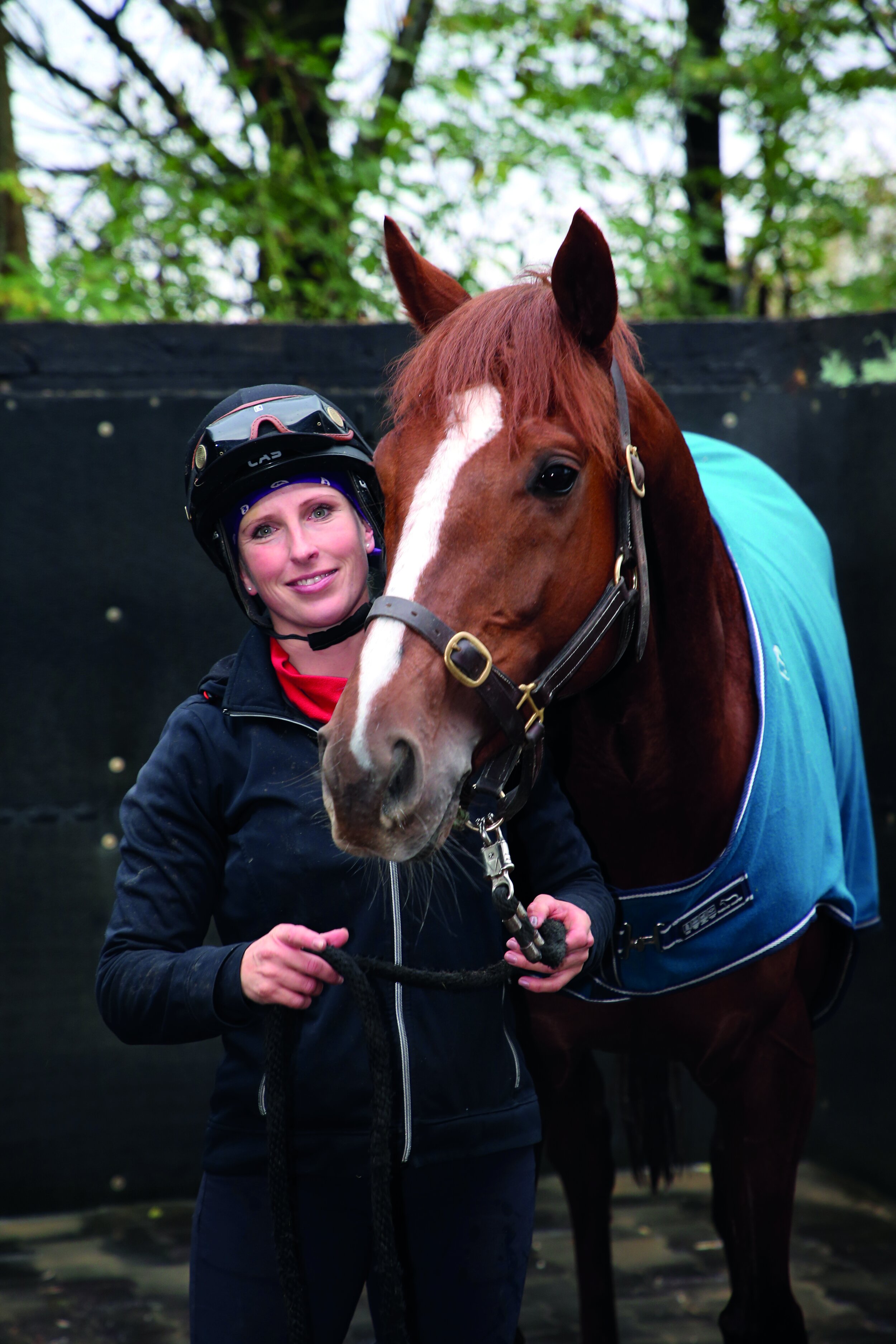
Compared with leading European racing nations, Germany's figures are very small indeed. Roughly 2200 horses, trained by 70 licensed trainers are trained here. With a big chunk trained by a chosen few – think Marcus Klug, Henk Grewe, Andreas Wöhler or Peter Schiergen – the numbers for smaller stables become smaller still.
Few trainers train more than 100 horses at the best of times; the ‘powerhouse’ yards with 150+ or even 200+ horses – which are so common nowadays in England, Ireland and France – are simply non-existent in a racing country constantly boxing above its weight.
As does Sarah Steinberg, no pun intended.
Sarah Steinberg´s official training list comprises 26 horses, three of which are her own. This is small even by local standards. Sarah Steinberg makes no excuses: “I do not want to train more than 35 anyway.” Small, but brimming with quality, it is quality horses that she strives to train. “My owners do not want runners in low (rated) handicaps, and for them I do not want that either. We think big and aim big”
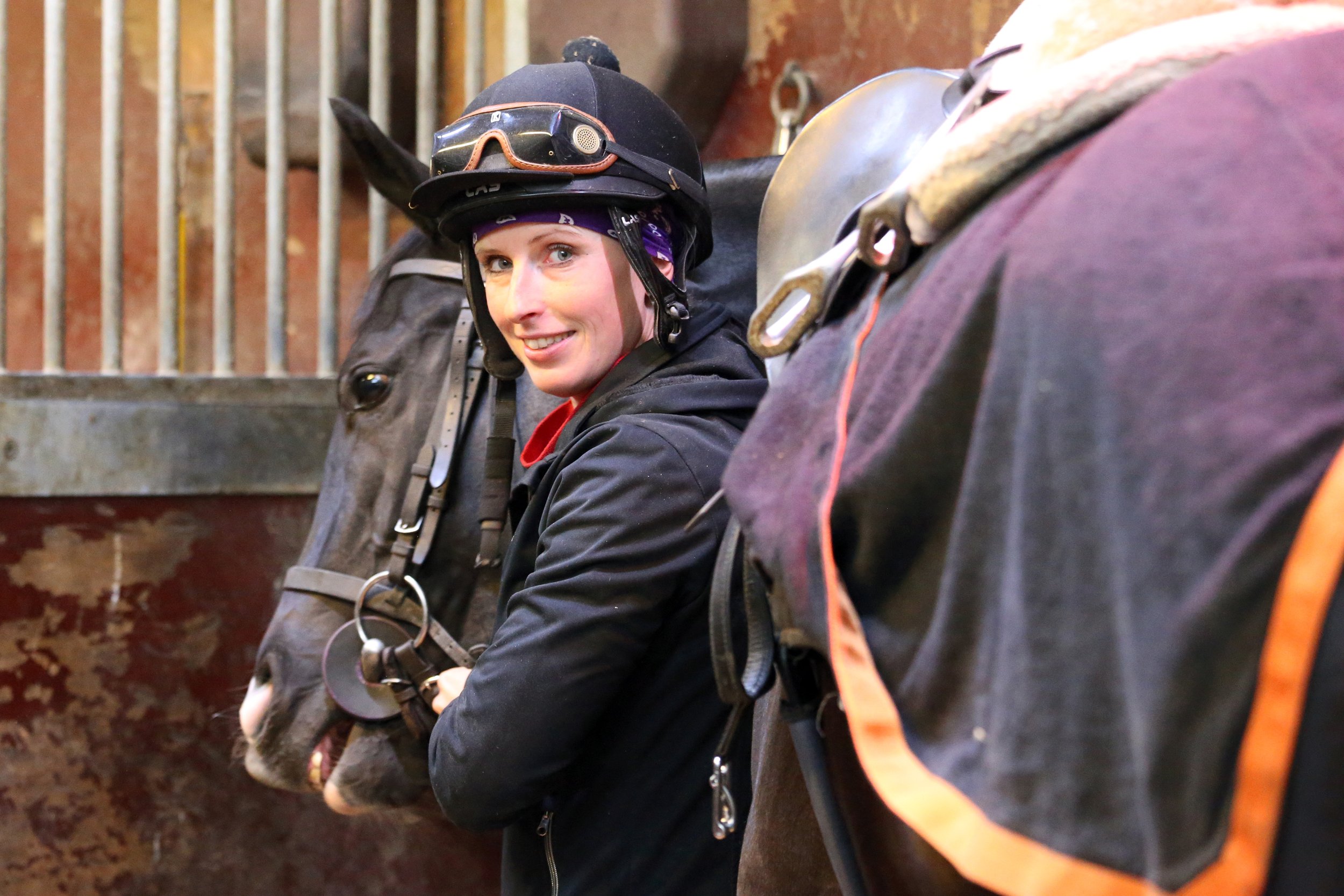
Steinberg is a salaried trainer, employed by the RTC Rennpferde Trainings-Center GmbH. The name behind the entity is that of Hans-Gerd Wernicke, a 93-year-old manufacturer of quality sleeping systems.
His company Wenatex was founded in Salzburg, and it is under that name that his horses race. Stall Salzburg has 13 horses in training – thus comprising 50% of Steinberg’s inmates.
A further five are owned by Brümmerhof Stud, a major owner-breeder and supporter of German racing. Famous as the breeder of Danedream – and infamous for selling her early in her 2yo season - Brümmerhofs Gregor Baum just closed his own private training facility in Hannover. His link to Sarah Steinberg could well point to her future. But let's look back into her already remarkable journey in racing before we dare to look into the future.
Sarah Steinberg is 34 years old, with no family ties in racing whatsoever. Her aunt kept Arabian horses, and early memories consist of watching the Germany Derby on TV; but she can’t recall her first Derby winner, “I wasn’t really interested, and I certainly did not catch fire early on.” Animals – horses and dogs – were part of her upbringing; and while circumstances were traumatic, the following story is early proof of the unusual dedication and commitment to the creature. “My father had a very serious accident. He was hospitalised for months and had to spend long weeks in rehabilitation after. This meant I had to look after the 30 Huskies (we owned) for more than a year, otherwise they would have been given away.” Steinberg was just eight years old.
She was given a holiday on a pony farm for a job well done after, and it was then that her fascination for horses took root.
Her education with horses was classic and western style. Racing came into her life by default rather than design. Yet again, it certainly wasn’t love at first sight.
With her parents pressing for a solid education, her growing passion for horses got in the way. A small local permit holder with eight horses – Steinberg had answered an advert in a local (non-racing) paper – could not provide the structure they desired.
But Germany's formal education system – even in racing – led to a visit to Cologne, still the administrative centre of German Racing. Here she was taken on by Andreas Trybuhl, son of a racing family and the first proper trainer who spotted her talent. Steinberg was on her way.

Well, sort of. It wasn´t that Deutscher Galopp had waited for a young female rider, with fancy ideas at that. Steinberg rode in a couple of races. Nineteen rides and two wins are hardly the stuff of legends. She then plied her trade as a work-rider — in big yards.
Leaving Trybuhl, she worked for Peter Schiergen, had a short stint with Marcus Klug and was riding out for Jens Hirschberger when he trained Adlerflug. But Steiberg was still ‘just’ a work-rider nonetheless.
When the opportunity came, Steinberg grabbed it with both hands. Enter Hans-Gerd Wernicke. By the time their paths crossed, Wernicke had been an owner for nine years, with group performer Poseidon Adventure and the wonderful Gp1 winner Night Magic – both trained in Munich by Wolfgang Figge.
Figge retired at the end of the 2015 season, and Wernicke was on the lookout for a new trainer. Again, it was an advert that changed the course of Steinberg’s life.
“I thought I really had nothing to lose. But I had nothing to recommend me either – no references, no proper job description to boost. After all, I was only a work-rider.” Wernicke liked what he read – liked even better what he heard when Steinberg detailed her ideas about training and didn’t ponder for long. It didn’t take Steinberg long to prove just how good of a choice she had been, either.
It wasn’t that Wernicke approached his new, young trainer with starry eyes. He was prepared to give her a chance, but at first it was with horses for whom she was second choice – horses from other yards, who for whatever reason didn’t, or couldn’t, fulfil their potential.
Night Wish, in March 2016, was her first winner as a fully fledged trainer; he was only the second starter she sent out. Better was to come when Night Wish again read the script and became her first pattern scorer when taking the Grand Prix de Vichy (Gp3) later that year.
In seven full seasons Steinberg has now, at home and abroad, trained 124 winners, 14 of them Group winners. This year she operated at a nearly 30% winner-to-starter ratio in her native Germany. She has trained a Classic winner in Fearless King (German 2000 Guineas, Gp2) – the first female trainer to do so in Germany – and Mendocino, was her first Gp1 winner, when scoring in German´s most prestigious open-age Gp1, the Großer Preis von Baden this past September.
Trainers simply do not come more hands-on than Sarah Steinberg. She rides six lots a day, she grooms, and she drives the horsebox. She even, unique among her peers, leads up nearly all her charges.
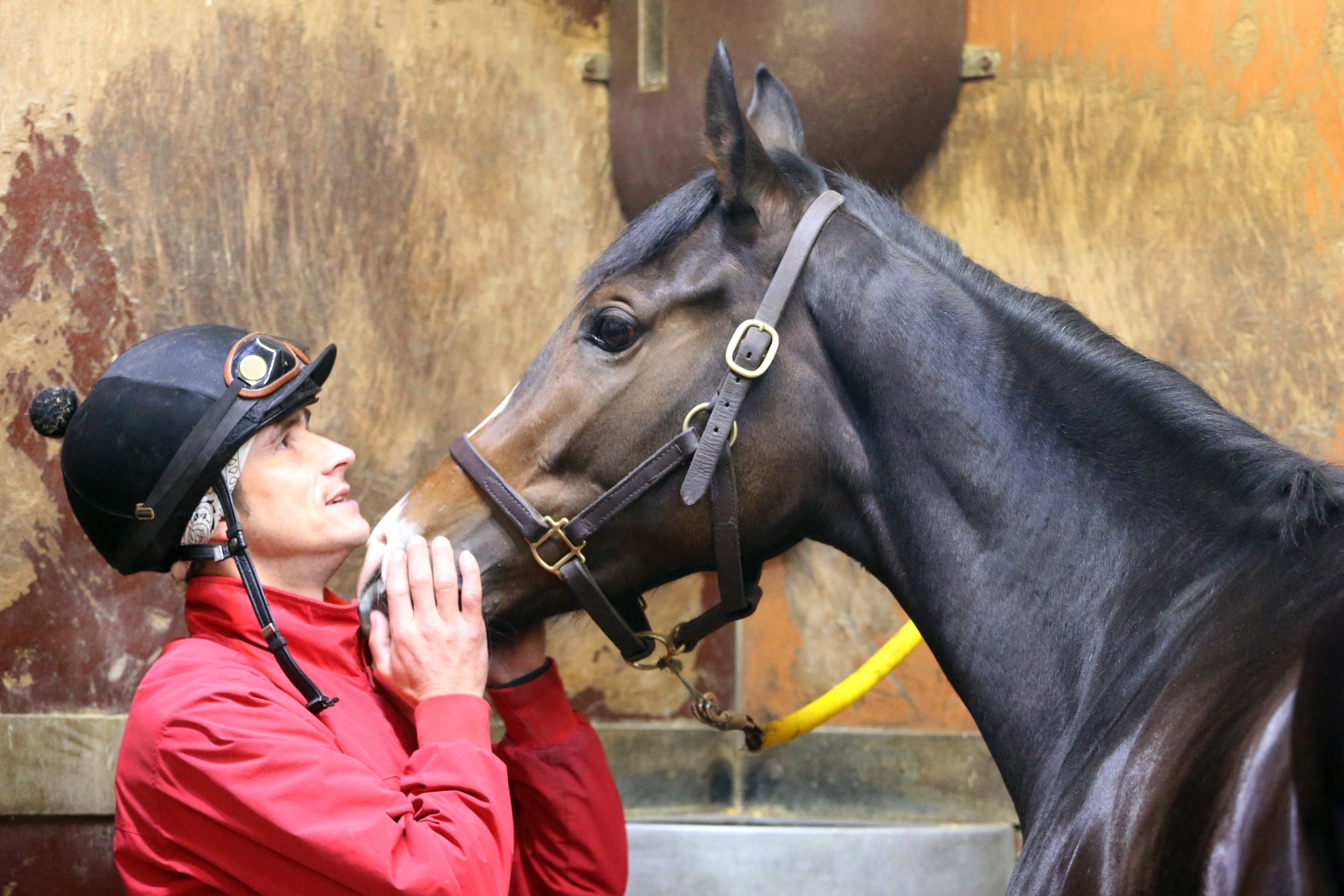
Finding good staff is a challenge even she cannot resolve, but Steinberg is the first to admit she isn’t easy to work for either. “I expect a lot and cannot tolerate mediocrity. I had to learn that I simply cannot expect employees to work as hard as I do.”
Invaluable assistance comes in the shape of René Piechulek, of Torquator Tasso-fame. The jockey's rise to fame is worth its own chapter, but he started riding out for Steinberg at the end of 2017, becoming attached to Stall Salzburg in the process.

With no chances of foreign jockeys, COVID accelerated his rise to salaried stable jockey. And he did become attached, quite literally, to Sarah Steinberg as well; they are life partners now.
“René is invaluable – simply irreplaceable to the yard; I simply could not do it without him. I am the trainer after all, he does as I tell him, but I would be lost without his feedback.” For Steinberg, training horses is a mission. With her background in classic riding, it is small wonder that above-average riding skills are essential for her staff.
“Horses need to use their backs, and they can only do this if they bend their necks properly. So much damage is done when horses do not use themselves right.”
On average, her horses are ridden about an hour a day, with an additional four hours spent in one of the six (four grass) paddocks. Daily, that is.
With few exceptions, racehorses in Germany are trained directly on the racecourse – Munich in Steinberg´s case – a base she cannot praise highly enough.
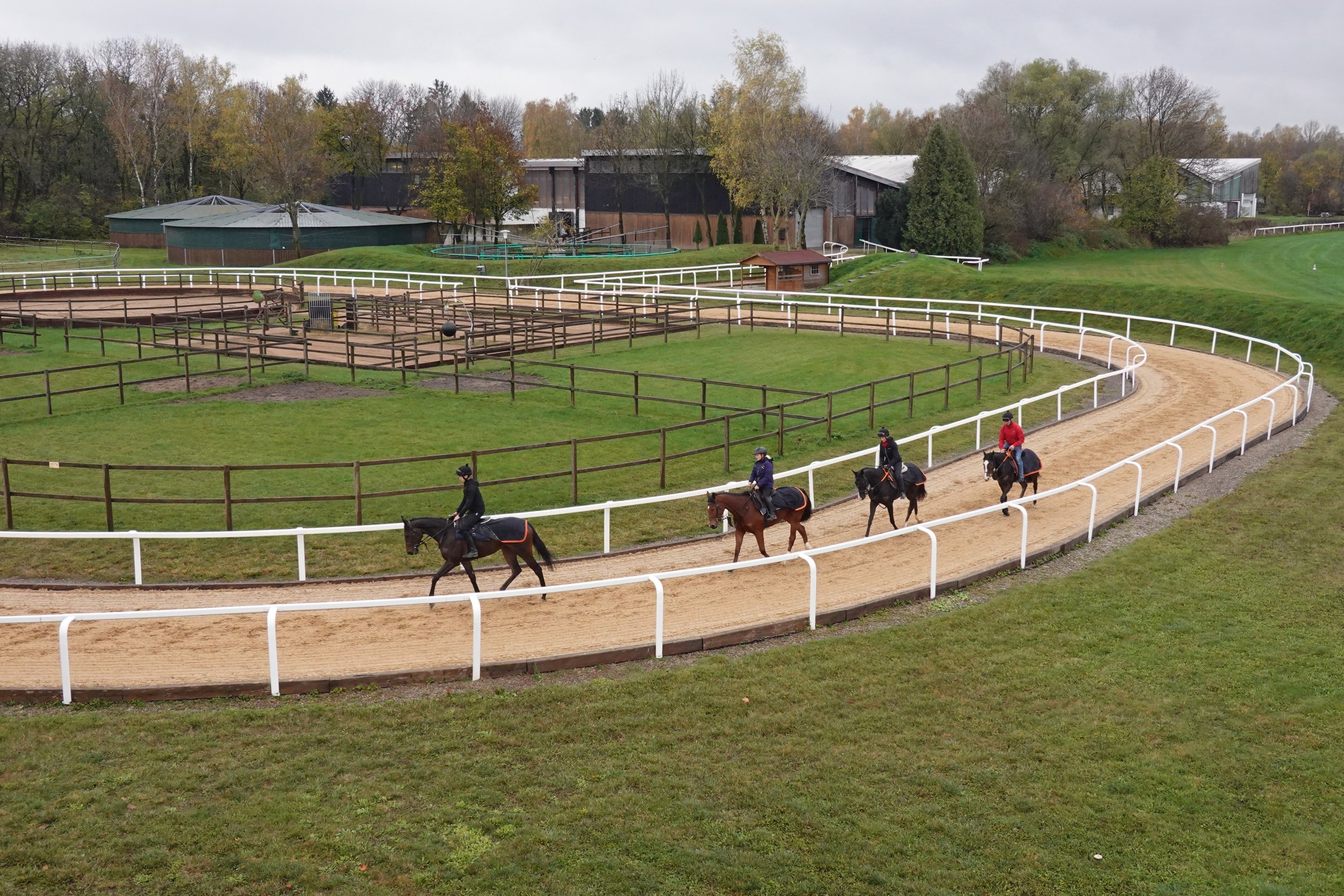
Crucially, Munich´s training centre is right next to the track itself with long and well-maintained grass and sand gallops, and with only a handful of trainers sharing those facilities.
Wernicke's generous approach and competitive nature developed just what Steinberg wanted in their own stables. “I really have everything I need; it’s top class. I have my private trotting ring; there is a covered hall. I have a salt box, which I use to great effect, and two solariums. The open country next to the training tracks is another plus; we have choices and can give the horses a change of scenery.”
She works closely with her trusted vets and a chiropractor, not to mention a top-class farrier. Conveniently, the RTC GmbH comes with a racing secretary too, so the time Steinberg has to spend in the office is very limited indeed.
“Really, I would never want to work self-employed. My system simply would not work with all those pressures attached.” Individuality is the key. “Of course, the basic work is the same for all horses, but the individuality starts creeping in once horses start showing their quirks. We love to get to the bottom of problems and want to bring the best out of every horse in our care.”
Remarkably, three of her 26 inmates have a German GAG (rating) of 90 or higher – roughly 106 plus in International ratings. Nowadays, Steinberg is responsible for selecting youngsters at the sales. Wernicke is a racing man and not a breeder.
The stable's flagbearer for the last couple of years has been the above-mentioned Mendocino, bred by Brümmerhof Stud and a son of the late Adlerflug.

Selected by Steinberg, he represents all she looks for in a horse. “I look at horses, not pedigrees. In fact, I couldn’t care less about the breeding. I need to see the horse's personality. I try to read their eyes, and how they play with their ears tell me something too. They need to be alert – lively. I don’t like the docile ones. A shorter back and strong back hands are essential to me, but I can forgive small mistakes if I feel the attitude is right. After all, it's all down to their character and their will to win.”
Offspring of the much missed sire Adlerflug, present their own challenges, but in Mendocino, Steinberg has found a horse of a lifetime.
The now 5yo has won three races from 11 starts and has provided Steinberg with that all-important win at the highest level, and he did take his team to Paris Longchamp on the first Sunday in October.
“I am accredited as his ‘lass’ and ride him myself every morning.” She rejects the notion that surely she will not lead him up when competing in a big race.
“Of course I will,” she muses. Steinberg has lost count of the winner´s ceremonies she missed because of her role as a ‘lass’ – something Wernicke had learned to accept. “He was a bit miffed when I kept skipping the ceremonies because I wanted to be with the horse after the race, so I pointed out that it's better to have those winners and no trainer, or not so fast horses. He can see the humorous side now.”
The whip-debate and animal welfare put extra pressure on German racing. Steinberg has a clear view on both: “The whip is essential – a life-saver for riders. With the short stirrups, we need it to correct but never to abuse. We need strict rules and even stricter penalties. As for animal welfare, I am in the game because I like horses – we all do. We like them, and we want the best. Performance is no cruelty to horses, and I firmly believe the majority of racehorses couldn’t be better cared for. There are black sheep in all walks of life, and much more must be done to educate about the good work that is done away from the public eye.”
Steinberg is realistic enough to wonder what the future holds, even though Wernicke shows no signs of stopping. The recent trip to Hong Kong (with Mendocino) came at Wernicke’s insistence and was Germany's sole representative.
There is no happy ending to report, as Mendocino proved worth his billing as a “character.” After behaving beautifully in the preliminaries, he reared in the starting stalls and refused to jump with the field – the first time he has shown such antics. But Steinberg wouldn’t be Steinberg if she wouldn’t rise to this challenge too.