
Have horse will travel - this quarter we focus on opportunities in Dubai, Saudi Arabia, Qatar and Hong Kong
Article by Lissa Oliver

Hong Kong
While the celebrated Champions Day and Longines International races attract plenty of attention globally, all 31 Group races run in Hong Kong are open to overseas entries and include x12 established Group 1 contests, x7 Group 2 and x12 Group 3 races.

Prize money for Group 1 races ranges from HK$13 million (€1.5m/£1.3m) to HK$40 million (€4.6m/£3.84m), while Group 2 races are worth HK$5.35 million (€622,000/£530,000), and Group 3 races offer HK$4.2 million (€493,000/£420,000). The Group 1 contests include prize money down to sixth place and all are open to three-year-olds and up and run on Turf at Sha Tin.
The Triple Crown includes a bonus of €1.1m/£1m to be paid to the owner of the horse that wins all three legs of the Triple Crown. The opportunity opens with the 1600m (8f) Stewards Cup worth €1.48m/£1.2m, Sunday 19th January 2025. Free entries for international runners close 25th December and supplementary entries close 16th January 2025.
The second leg of the Triple Crown is the Hong Kong Gold Cup on Sunday 23rd February 2025 over 2000m (10f), worth €1.48m/£1.2m. Free entries close 27th January 2025 and supplementary entries close 11th February 2025.
The final leg of the Triple Crown is on Sunday 25th May 2025, the 2400m (12f) Champions & Chater Cup, with a purse of €1.48m/£1.2m. Free entries close 27th April 2025 and supplementary entries close 11th May 2025.
Another bonus available is for the winning horse of all three legs of the Hong Kong Speed Series. Sunday 19th January 2025 sees the 1200m (6f) Centenary Sprint Cup, the first leg of the Hong Kong Speed Series, worth €1.48m/£1.2m, with free entries closing 30th December 2024 and supplementary entries closing 13th January 2025. A bonus of €580,000/£500,000 will be paid to the owner of the horse that wins all three legs of the Hong Kong Speed Series.
Sunday 23rd February 2025 is the 1400m (7f) Queen’s Silver Jubilee Cup, the second leg of the Hong Kong Speed Series, carrying prize money of €1.48m/£1.2m. Free entries close 30th January 2025 and supplementary entries close 16th February 2025.
The 1200m (6f) Chairman’s Sprint Prize is the final leg of the Hong Kong Speed Series, worth €2.5m/£2.2m, run on Sunday 27th April 2025, free entries closing 16th March 2025 and supplementary entries closing 6th April 2025.
The Hong Kong feature event is the Longines Hong Kong International Races on Sunday 8th December, billed as the epitome of elegance and speed, featuring elite jockeys and the world’s best horses. As well as four Group One races on the day, racegoers can enjoy a variety show, live music, exquisite cuisine and a vibrant party atmosphere. Free entries for the major races on the day close 21st October and supplementary entry closes 18th November at €27,804/£23,690.
The four Group 1 races are the €2.78m/£2.31m Hong Kong Vase over 2400m (12f); the €3.01m/£2.51m 1200m (6f) Hong Kong Sprint; the €4.17m/£3.48m 1600m (8f) Hong Kong Mile; and the €4.63m/£3.86m 2000m (10f) Hong Kong Cup.
Sunday 27th April 2025 sees FWD Champions Day, one of Hong Kong’s most popular sports events. Featuring three prestigious Group 1 races on the day, free entries closing 16th March 2025 and supplementary entries closing 6th April 2025, it provides local racing fans with the chance to see how the city’s top horses shape up against their overseas counterparts.
The 1600m (8f) Champions Mile is worth €2.76m/£2.3m; the 2000m (10f) QEII Cup is worth €3.2m/£2.7m; and the aforementioned 1200m (6f) Chairman’s Sprint Prize is the final leg of the Hong Kong Speed Series.

The Hong Kong Jockey Club offers shipping incentives to selected overseas horses for the seven feature Group 1 races (Longines Hong Kong Cup, Longines Hong Kong Mile, Longines Hong Kong Sprint, Longines Hong Kong Vase, FWD QEII Cup, FWD Champions Mile and Chairman’s Sprint Prize). The Quarantine Stables are located at Sha Tin Racecourse, 45 minutes from Hong Kong International Airport.
The stable blocks are temperature controlled, with rubber flooring throughout and monitored by closed circuit television. Each stable is equipped with a feed manger and tie up ring.
The isolation stables compound includes rubberised horse walkers, sand rolls, weighing scales, wash bays, ice machines, freezers and an all-weather arena. Paper strips and shavings are available for bedding.
The Club imports feed from Australia, China, New Zealand, South Africa, the UK and the USA, and large selections of proprietary feeds are also available. The Club has excellent stocks of Timothy Hay, Lucerne Hay and Chaffs. Importation of feed and water, subject to examination, is permitted, however the import of plant material such as hay and chaff is subject to a valid Phytosanitary Certificate issued by the exporting country.
Connections of selected overseas horses for Hong Kong’s seven feature Group 1 races will enjoy travel and accommodation packages provided by the Hong Kong Jockey Club, two tickets each for the owner and trainer and one ticket for the jockey. Four nights hotel accommodation (room only) will be provided for a maximum of two persons per category at the Club’s selected hotel. All airport and racecourse transfers are also included.
For staff, a maximum of two persons per horse will also be provided with accommodation (one room each) at the Club’s selected hotel in Sha Tin for the normal duration of the trip. A predetermined daily allowance to cover in-house expenses such as food and beverages, transport, telephone and internet, as well as laundry, will also be provided. All airport, stabling facilities and racecourse transfers are also included.
For those visiting, the five-star Hyatt Regency at Sha Tin provides an urban resort with a luxury spa, adjacent to the University MTR Station in Sha Tin, with lush greenery only steps away from busy urban areas.

Dubai
The Dubai Racing Carnival, now in its 20th year and given a new look for last year’s season, opens in November at Meydan Racecourse. Alongside top-class racing, Meydan boasts five-star dining and live entertainment and is 15 minutes from Dubai’s central hub. The racecourse offers tailored hospitality packages at the restaurants, lounges and private suites, all with elevated views of the racing. The climate is also described as “pleasant” during the winter season.
Home of the €28.1m (£24m) Dubai World Cup meeting, Meydan is the world’s largest integrated racing facility and hosts 15 meetings throughout the season, concluding in early April with the Dubai World Cup, the highlight of Dubai’s sporting and social calendar.

There are a number of valuable opportunities all season, beginning in November with the €125,600 (£106,912) Listed Dubai Creek Mile on dirt for three-year-olds up. January is busy, with 11 black type races from 1000m (5f) up to 2810m (14f) and ranging from €125,600 (£106,912) for Listed up to €213,489 (£181,719) for Group 2s and €924,282 (£786,662) for the Group 1 Al Maktoum Challenge, 1900m (9f) on dirt. On turf, the Group 1 Jebel Hatta, 1800m (9f) carries a purse of €464,658 (£395,469).
The 2025 Carnival sees the introduction of The Dubai World Cup bonus scheme, which offers a total prize pool of €3.5m (£2.9m) across 10 races. Winners of these races will get automatic entry to Dubai World Cup night.
An additional 10% bonus is awarded to horses that win both the qualifying race, and the corresponding race on Dubai World Cup night.

The scheme has been created to encourage more owners and trainers to prepare their horses in Dubai ahead of the Dubai World Cup.
Fifteen black type races from Listed up to Group 2 are run at Meydan during February and March, again from 1000m (5f) to 2810m (14f) and with similar valuable prizes, all of which lead through to the end-of-season highlight of Dubai World Cup night.
The Group 1 Dubai World Cup itself will be run a week later than normal next year on April 5th and the feature race will be worth €10.7m (£8.9m)
The highlights of the supporting card’s Group 1s are the 1200m (6f) Al Quoz Sprint on turf worth €1.4m (£1.2m), the 1200m (6f) Dubai Golden Shaheen on dirt worth €1.8m (£1.6m), the 1800m (9f) Dubai Turf worth €4.6m (£3.9m), and the 2410m (12f) Dubai Sheema Classic on turf worth €5.5m (£4.7m).

In 2025 the UAE Derby, worth €900k (£745k), will form the final leg of the revised Euro/Mideast Road to the Kentucky Derby. The winner of the race will get an automatic spot in the starting gate at Churchill Downs on the first Saturday in May - subject to the horse being nominated to the U.S Triple Crown series.
Elsewhere in the UAE, the Abu Dhabi Equestrian Club hosts the Listed 1600m (8f) Sheikh Zayed bin Sultan Al Nahyan National Day Cup in December, and the Listed 1400m (7f) HH The President Cup, both on turf with a prize of €95,443 (£81,242) each. Jebel Ali Racecourse hosts the Listed Jebel Ali Sprint, the third leg of the Emirates Sprint Series, 1000m (5f) on dirt for a prize of €125,600 (£106,912), and the Group 3 Jebel Ali Mile on dirt, €175,840 (£149,677).
Saudi Arabia

Since its inaugural running in 2020, The Saudi Cup has rapidly become a major international race and in 2025 Saudi Cup Weekend at King Abdulaziz Racecourse in Riyadh will have total prize money of over €34.68m (£29.5m) on offer, including the 1800m (9f) Group 1 Saudi Cup itself worth €18.5m (£15.73m). The meeting, at the end of February, is also Riyadh’s social event of the year, offering visiting racegoers a taste of the finest style, culture and hospitality of Saudi Arabia.
The two days of top-quality racing include an International Jockeys Challenge, two Group 1 Purebred Arabian races, the €462,235 Al Tuwaiq Cup for locally-trained horses and dirt and turf races culminating in the Group 1 Saudi Cup, the world’s richest race, run on the King Abdulaziz dirt track, the final event on Saturday’s eight-race card.

Adding international flavour to the Friday card is the 2100m (10f) €462,235 (£393,255) Saudi International Handicap confined to horses trained within the IFHA-registered Part II and III racing countries, which should be of interest to the relevant European countries. (Part II nations Bahrain, India, Italy, Korea, Malaysia, Panama, Puerto Rico, Saudi Arabia, Scandinavia, Singapore, Turkey, Uruguay, Venezuela, and Zimbabwe. Part III nations Belgium, Czech Republic, Dominican Republic, Ecuador, Hungary, Jamaica, Mauritius, Mexico, Morocco, Poland, Qatar, Slovakia, Spain, Switzerland, and Trinidad & Tobago.)
With prize money down to 10th place, The Saudi Cup serves to raise the profile of racing to local communities, as well as foreign fans and professionals. The Jockey Club of Saudi Arabia was formed in 1965, but the founding of The Saudi Cup and the 1800m turf track at King Abdulaziz Racecourse has seen Saudi Arabia upgraded from Part III to Part II by the IFHA and is likely to achieve Part I status in the near future.
2022 saw the first international Pattern races held as part of The Saudi Cup weekend. The 2100m (10f) Neom Turf Cup, the 1351m (7f) Turf Sprint, the 1600m (8f) Saudi Derby, the 1200m (6f) Riyadh Dirt Sprint and the 3000m (15f) Red Sea Turf Handicap were all promoted to Group 3, while the Saudi Cup became Group 1.
With more than 70 international horses, The Saudi Cup hosts more international runners than any other race meeting. Stabling, quarantine and training facilities are provided at all of the racecourses, subject to availability, and invited connections at King Abdulaziz Racecourse are provided with complimentary access to the Howden Owners & Trainers Lounge, and dining in the Al Thuraya Trackside Restaurant.
The Jockey Club of Saudi Arabia can arrange transport for delegates and guests between venues, and the racecourses have plentiful free parking with international airports close by. Riyadh Airport Marriott Hotel is a 5-star hotel five minutes from King Khalid International Airport and ten minutes from the racecourse, with a restaurant, gym and outdoor pool. The Radisson Hotel Riyadh Airport is close to the airport and 15 minutes from the racecourse, with spacious rooms, duplexes and villas, as well as restaurants and leisure facilities.
The Equine Hospital in Riyadh provides advanced care in diagnostic procedures, treatment, emergency care and hospitalisation for equine patients, open around-the-clock every day of the year for emergency and critical care cases.
Qatar

The 2023/24 racing season, running from mid-October through to the end of April, saw a rise in prize money and international runners, reflecting the commitment of the Qatar Racing and Equestrian Club (QREC) and the high standards of Al Rayyan and Al Uqda racecourses. Work will continue to ensure that the 2024/25 season will meet expectations and continue to raise standards. Al Rayyan at Doha is the premier racecourse and home to the state-of-the-art training centre. The turf track is 1800m (9f) and the sand track 1400m (7f).
Abdulla Al Kubaisi, QREC Racing Manager, says, “We organised 67 race days during the last season, including 45 on both turf and sand at Al Rayyan and the rest on both turf and sand at Al Uqda. We base the season on weather conditions and take into account the ratings of Arabians and thoroughbreds to ensure the largest possible number of horses have the opportunity to run in races, which suit their ages and abilities.
“The 2023-2024 season saw the prize money reach an unprecedented figure in QREC’s history, €22.2m (£18.9m), of which €19.8m (£16.8m) was offered by the races held at Al Rayyan and the remainder at Al Uqda. This contributed to raising the standard, enhancing the stature of the Festival in the region and attracting several runners from European and Asian countries. For the first time, the minimum prize money for a feature race was €30,442 (£25,900).”
Mid-February sees the highlight of the season, the Group 3 HH The Amir Trophy for four-year-olds and up, over 2400m (12f) at Al Rayyan, Doha, carrying a total purse of €2.3m (£2m) and worth €1.3m (£1.1m) to the winner.


Northern Dancer - small in stature but a giant among thoroughbreds
Few horses were ever as animated and filled with a zest for life as the great racehorse and sire, Northern Dancer. Frank Mitchell looks at why this unfashionably bred thoroughbred went from being an unwanted yearling to one of the influential thoroughbreds of all time.

CLICK ON IMAGE TO READ ARTICLE
THIS ARTICLE FIRST APPEARED IN EUROPEAN TRAINER - ISSUE 46
Calvin Borel - the leading Kentucky Derby winning jockey in profile

Calvin Borel’s portrayal on the mural of Kentucky Derby-winning jockeys at Churchill Downs, painted by the renowned artist Pierre “Peb” Bellocq, had already undergone minor surgery in 2009, when the jockey followed up a 2007 Derby on Street Sense with a win aboard Mine That Bird.
Frances Karon (European Trainer - issue 31 - Autumn 2010)

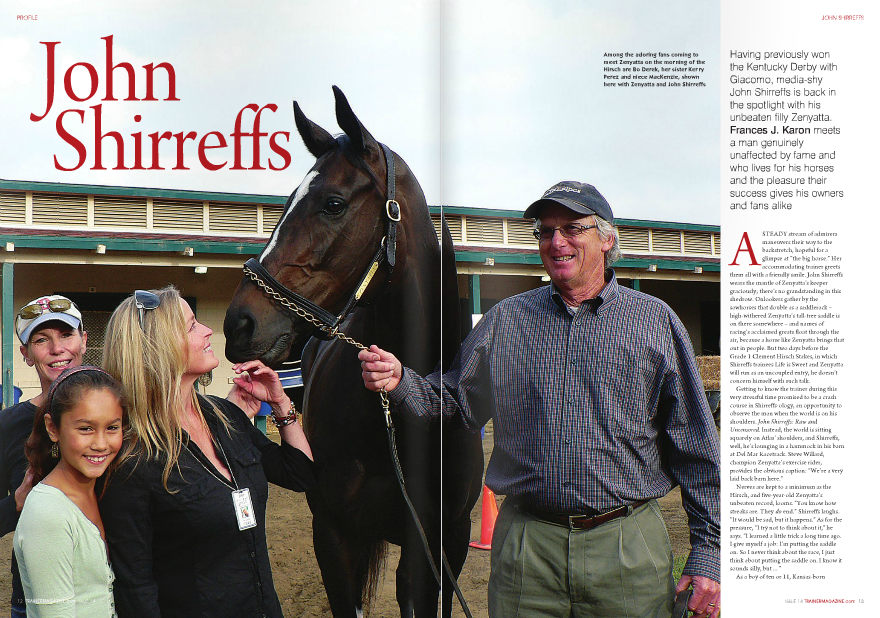

The Land of Enchantment - an introduction to New Mexico
Mine That Birds victory in the Kentucky Derby confirmed what many already knew – New Mexico produces top quality horses and horsemen.
Larry Bortstein
First Published: (16 July 2009 - Issue Number: 13)
Derby Fever for Gilchrist was Lost In The Fog
At
this time of the year when trainers and owners can sometimes be swept
up in an obsession to get a three-year-old with any glimmer of hope to
the Kentucky Derby, trainer Greg Gilchrist remains forever thankful that
he developed immunity to Derby Fever.Relaxing in his home in Castro
Valley in Northern California recently, the veteran conditioner cited
the 2005 tale of Lost in the Fog as a memorial to both the horse and his
owner, Harry Aleo.
Steve Schuelein
(08 April 2009 - Issue Number: 12)
From Synthetic prep race to the Kentucky Derby dirt
Street Sense's dramatic, decisive victory in last year's Kentucky Derby restructured a lot of perceptions about winning the Run for the Roses. Not only could a Breeders'Cup Juvenile winner return the following spring to capture the first leg of the Triple Crown, but he could make his final prep for Churchill Downs' dirt track on a synthetic one.
Bill Heller (26 June 2008 - Issue Number: 8)
By Bill Heller
Street Sense’s dramatic, decisive victory in last year’s Kentucky Derby restructured a lot of perceptions about winning the Run for the Roses. Not only could a Breeders'Cup Juvenile winner return the following spring to capture the first leg of the Triple Crown, but he could make his final prep for Churchill Downs' dirt track on a synthetic one.
Street Sense wasn’t alone in switching from synthetic to dirt. Six Derby starters last year had their final preps on synthetic surfaces: the top five finishers in the Blue Grass Stakes on Keeneland’s Polytrack - Dominican, Street Sense, Zanjero, Teuflesberg and Great Hunter - as well as Hard Spun, who won the Lane’s End Stakes on Turfway Park’s Polytrack.
Trainer Carl Nafzger had no reservations about using Polytrack as Street Sense’s springboard to the Derby because he’d done exactly that the year before when Street Sense followed a third in the Lane’s End Breeders'Futurity at Keeneland with a resounding 10-length victory in the Breeders'Cup Juvenile at Churchill Downs.
Nafzger, however, said he would not have used the Blue Grass as Street Sense’s final Derby prep if Street Sense hadn’t already raced on dirt. "Even if he had worked on dirt, there’s a lot of difference between working and running,"Nafzger said. "I would definitely want to see my horse in a dirt race first. I don’t care if it was an allowance race; I’d want to see him in a race.”
Sedgefield did not have that luxury, finishing fifth last year as the first North American-based starter since at least 1955 to run in the Kentucky Derby without a previous dirt race.
He won’t be the last.
In mid-March, it appeared that at least three of California’s top Kentucky Derby prospects – Colonel John and El Gato Malo, the 1-2 finishers in the Sham Stakes, and San Vicente and San Felipe victor Georgie Boy – will also be making their first dirt start at Churchill Downs on the first Saturday of May.
"I don’t think it’s going to be a problem for the California horses,"said Darrin Miller, who trains both Sedgefield and Dominican. "I don’t think it’s a disadvantage at all.”
Obviously, the California trainers of those three Derby hopefuls – whose final race before the Derby figures to be the Santa Anita Derby – agree, as will other trainers who use the Blue Grass or the Lane’s End for their horses' final Derby prep.
"My concern is just getting to the race,"El Gato Malo’s trainer Craig Dollase said laughing. "That’s the objective of the synthetic track. The whole point is to keep your horse sound. We just want a healthy, sound horse going into the first Saturday of May. So be it if it’s on dirt.”
That’s the approach Miller took with Sedgefield. The 36-year-old native of Verona, Missouri, began training at Canterbury Park in Minnesota in 1995, and splits his year between Florida and Kentucky. He did an admirable job of getting both Sedgefield and Dominican to the Derby for Tommy and Bonnie Hamilton’s Silverton Hill Farm in Springfield, Kentucky.
Silverton Hill purchased Sedgefield, who is a full brother to 2007 Turf Champion English Channel, for $300,000 at Keeneland’s Two-Year-Olds-In-Training Sale in April, 2006. A month earlier, the Hamiltons purchased Dominican at the Ocala Two-Year-Olds-In-Training Sale for $150,000.
Sedgefield began his career late in his two-year-old season, finishing seventh on Polytrack at Keeneland on October 27, 2006. After running fifth on grass at Churchill Downs, he won a maiden race easily on Turfway Park’s Polytrack.
Miller asked a lot of Sedgefield in his next start, the Grade 3 Tropical Park Derby at Calder on grass, and Sedgefield fought it out on the lead the whole way, finishing second by three-quarters of a length to Soldier Dancer. "After the Tropical Park Derby, we decided that the Kentucky Derby was an option for him," Miller said. "The plan was this: we run in the Hallandale Beach (on grass) and the Lane’s End.”
First, though, Miller gave Sedgefield a confidence builder. Dropped to allowance company on grass at Gulfstream Park, Sedgefield won handily. Then, in the Hallandale Beach, Sedgefield again displayed his grittiness, finishing second by half a length to Twilight Meteor despite breaking from the 10 post. Sedgefield drew even worse in the Lane’s End: the outside post in a field of 12. Regardless, he finished second by 3 ½ lengths to Hard Spun.
Trainer Larry Jones chose not to give Hard Spun another race before the Kentucky Derby because Hard Spun’s graded stakes earnings were already enough to ensure he’d start in the Derby. Sedgefield’s weren’t.
So Miller, after considering the Blue Grass Stakes, sent Sedgefield back to turf instead in the Grade 3 Transylvania at Keeneland just 13 days after the Lane’s End. Sedgefield again battled on the lead, but this time he tired late to fourth as the 7-5 favorite.
"I messed up,"Miller said. "I raced him back too quick. It seemed like the right thing to do at the time. We thought it was an easy spot and it would give him the earnings he needed. We were right on the cusp there.”
With the fourth-place finish, though, Sedgefield did have enough earnings to break into the Derby field of 20. And Miller wasn’t worried about the switch to dirt. "He’d been on dirt as a two-year-old,"Miller said. "We didn’t see dirt as a problem for him at all.”
To prepare him for his first dirt race, Miller, who was stabled at Keeneland, worked Sedgefield four furlongs twice at Churchill Downs. Sedgefield breezed in: 49 (15th fastest of 35) 13 days before the Derby and in :48 2/5 (11th of 52) four days before. "After the first week, we moved the two horses to Churchill Downs,"Miller said. "He trained really well when he went there. He really stepped up to the plate. He was doing everything right. Then we had a lot of rain that week. He relished it. He trained very well on it.”
Dominican, who had two thirds from four previous races on dirt, including a fourth in an allowance race and a third in a Grade 2 stakes at Churchill Downs, worked just once after his gutsy victory in the Blue Grass. Five days before the Derby, Dominican breezed a bullet five furlongs in :59 2/5, fastest of 26 that morning.
Miller had both Sedgefield and Dominican primed for top efforts, but their preparation was seriously compromised the morning the selection order for post positions was drawn for the 20 Derby starters. "Our picks were 17th and 19th,"Miller said. "It was a pretty bad go. It left us in a pretty tough spot."Miller chose the rail for Sedgefield and the 19 post for Dominican, who finished 11th after a rough trip. The lack of a previous dirt start didn’t impact Sedgefield, who was dispatched at 58-1 from the highly disadvantageous rail.
Forwardly placed from the outset under Julien Leparoux, Sedgefield worked his way up to second midway through the mile-and-a-quarter classic. "I was just hoping he’d keep coming,"said Miller, who had never started a horse in the Derby before. Sedgefield tired late to fifth, nine lengths behind Street Sense, but just a length off third-place finisher Curlin, who subsequently was Horse of the Year and Three-Year-Old Champion.
Miller was proud of Sedgefield’s effort: "He gave us everything that day. He put it all out there.”
Some 10 months later, Miller said of his first experience in the Kentucky Derby: "It’s life-changing, for sure. It’s certainly a special opportunity and I’m grateful for it. It makes you want to do it again, searching for the next one."
Colonel John’s trainer, Eoin Harty, knows the feeling – kind of. The 45-year-old native of Dublin, who began his career as an assistant trainer for John Russell, was an assistant to trainer Bob Baffert when he nearly won three consecutive Kentucky Derbies. Cavonnier lost the ’96 Derby by a nose to Grindstone, then Silver Charm and Real Quiet took back-to-back Derbies. "It’s going to be my name on the program this time,"Harty said. "I’m going to bear full responsibility for the action of myself and my horse.”
He is perfectly comfortable with his decision to not give Colonel John a dirt start prior to the Derby. "I won’t because I’m a firm believer in training on synthetic courses,"Harty said. "I just think they’re so much kinder to the horse. You avoid the constant pounding, the bone on bone. The carnage rate of horses [on dirt] is unacceptable.”
Harty has had success training his horses on synthetic surfaces and then racing them on dirt. "From my own experience, I had a very good year at Churchill Downs last year, and my horses had worked on synthetic,"he said. "I did it with quite a few. I brought horses over [from Keeneland] the morning of the race at Churchill Downs, and that was it. It’s better for your horse. They stay sounder. If they’re sounder, they’re around to race longer and it’s good for the sport.”
Harty says he’s frequently asked about the difference between training horses on dirt vs. synthetic surfaces. "These are my opinions; they’re not facts,"he said. "From my own experience and from watching other trainers training on synthetic tracks, I wouldn’t say that training on synthetic is an advantage, but it gives a horse a different level of fitness. Every horse I’ve worked on a synthetic track who had been training on a dirt track, the first work is terrible. The second and the third are better. When I was at Santa Anita before they put in the synthetic track, and took them to Hollywood on synthetic for the first time, the horses seemed to be at a major disadvantage. When you look at synthetic tracks, they don’t have to work as hard to cover ground.”
Colonel John has been covering ground just fine on synthetic tracks. His victory in the Sham Stakes was his third in five starts. He was second in the other two races, one of them a Grade 1 stakes.
If he goes into the starting gate at Churchill Downs on the first Saturday of May, it will be his first dirt race, but not be his first time on dirt. "I’ll probably work him and gallop him at Churchill Downs,"Harty said. "It probably won’t hurt.”
Like Harty, Dollase, whose El Gato Malo had won his first three starts, including the Grade 3 San Rafael Stakes, before finishing second in the Sham, will also work his horse on Churchill Downs'dirt track before he starts in the Derby. Dollase’s only previous Derby starter, Wilko, finished sixth in 2005.
"My routine is usually to get a work over the track,"said the 37-year-old Dollase. Unlike Harty, Dollase has a different opinion regarding training on synthetic vs. dirt tracks. "I think you get a lot more fitness out of the synthetic,"he said. "You have to work harder. I used to train at Hollywood Park when it was the only cushion track, then run on Santa Anita when it was dirt, and what an advantage I had. I had a good meet a year and a half ago. So did a lot of the guys who trained at Hollywood Park. We were the guinea pigs starting out. Our horses trained on it, and I trained them hard at Hollywood Park and they ran well on Santa Anita’s dirt track. It might be harder the other way. A lot of guys who trained at Santa Anita didn’t do that well at Hollywood Park.”
Will a horse who has never raced on dirt win this year’s Kentucky Derby? "I think ultimately it comes down to the best horse wins the Kentucky Derby,"Harty said. "Look over the past 133 Derbies; usually the best horse wins. I think if the horse is good enough, he’ll overcome not racing on dirt.”
And if Harty’s horse doesn’t overcome that? "It would be a convenient excuse,"he said. "Based on my own experiences and the feelings of my owners, this is the route I take.”
Undoubtedly, as synthetic tracks grow in popularity, more trainers will take that route. Ultimately, the question won’t be can horses who have raced exclusively on synthetic surfaces win the Derby, rather which synthetic surface - Polytrack, Cushion or Tapeta - is more conducive to making that transition.
Eoin Harty - profile of the former assistant to Bob Baffert
There was always an air of levity at Bob Baffert's barn when Eoin Harty
worked there. Not that the game they played wasn't serious. It was.
Preparing 1,000-pound equine athletes with spindly legs to perform at
their peak on the world's stage is not a job for anyone in short
pants.During the seven years Harty was Baffert's assistant, they won the
Kentucky Derby twice - with Silver Charm in 1997 and Real Quiet in
1998-and missed by a heart-breaking nose with Cavonnier in 1996. But in
between the regimented tedium, there was always time for a good hoot.
Fact is, it was and still is part of Baffert's DNA.
26 June 2008 - Issue Number: 6
Therewas always an air of levity at Bob Baffert's barn when Eoin Harty worked there. Not that the game they played wasn't serious. It was. Preparing 1,000-pound equine athletes with spindly legs to perform at their peak on the world's stage is not a job for anyone in short pants.
During the seven years Harty was Baffert's assistant, they won the Kentucky Derby twice–with Silver Charm in 1997 and Real Quiet in 1998–and missed by a heart-breaking nose with Cavonnier in 1996. But in between the regimented tedium, there was always time for a good hoot. Fact is, it was and still is part of Baffert's DNA.
"He's got a sense of humor," Baffert said of Harty. "He has a good disposition and we liked to have a lot of fun, so he fit in well."
But work came first, and Harty had his priorities in order. His foundation was ingrained. Lean and sinewy with chiseled features, Harty hails from a family of Irish horsemen that extends back at least five generations. His grandfather, great grandfather, and great-great grandfather were trainers in their native Ireland. Eoin (pronounced Owen) began to hone his craft under the learned wing of the late John Russell before joining with Baffert, who saw a master in the making.
"Eoin showed up every day," Baffert recalled. "He works hard and he's passionate about what he does, and I like that in all my assistants. He made sacrifices that have to be made in this business. He loves what he does."
Not that Harty doesn't have a touch of rebel in him. In fact, it was his streak of independence and his flair for adventure that brought him to America, not loyalty to convention. His sense of humor, indigenous to the Irish, helped, too. Asked how his clan developed their wit, Harty said it was "a case of poverty and depravation." Still, it was not mandated that he follow in his forebearers' footsteps.
"No, it was not pre-ordained that I would train horses," Harty said. "I left high school and came over here. I can't say I graduated; my time in high school was up, so that's why I ended up here. There was nothing going on in Ireland. Jobs were really hard to find. It was pretty much a third-world economy at the time, and America's the land of opportunity."
Following one year working for the Irish National Stud, Harty came to the United States at the age of 17.
"I had always worked around horses as a kid, so when I came here in 1981, I got a job at the track and worked for John Russell for a long time," Harty said. "He was winding down and Bob was starting up and I was lucky enough to get a job.
"I learned common horsemanship and basic training methods. Both were very good trainers, just different. John trained a lot of European grass horses and was kind of old school. Bob was more into developing 2-year-olds and 3-year-olds. They had different philosophies."
Harty struck out on his own in 2000 and was hired by Godolphin to take over the Darley Stud Management arm of Sheikh Mohammed al Maktoum's racing empire, with emphasis on developing young runners, an undertaking termed Godolphin's "American project."
In his second full season, he saddled Tempera to win the 2001 Breeders' Cup Juvenile Fillies. She earned an Eclipse Award for her achievement, but in 2002 was euthanized due to colitis and laminitis. Training her was a challenge.
"We tried to work together on Tempera," recalled David Flores, who rode her in the Juvenile Fillies. "She was not an easy filly and Eoin did a great job getting her to settle down, because she was one that wanted to run off. She was kind of flighty, but he got her to relax. I was so pleased when she was ready to go to the Breeders' Cup, and it was mainly due to Eoin's perseverance."
Now, if the fates allow, the clock of destiny will click Harty towards the Kentucky Derby on May 3, thanks to a robust 3-year-old named Colonel John, one of 25 horses Harty has in training at Santa Anita. A bay son of two-time Horse of the Year Tiznow owned by the Versailles, Kentucky-based WinStar Farm of Kenny Troutt and Bill Casner, Colonel John was preparing for the Santa Anita Derby at press time and was a leading Kentucky Derby contender. The colt looked like a million bucks in the post parade for the Sham Stakes on March 1 before winning that race, handing El Gato Malo his first defeat in the process.
In measured terms, Harty discussed the possibility of Colonel John capturing the Run for the Roses, a race in which Harty has never flown solo.
"I think Colonel John is good enough to run well, but I don't know if he's good enough to win," Harty said. "He's certainly good enough to show up and I feel pretty confident that he's a contender."
Winning the Derby would be a crowning achievement, of course, but not necessarily one that would perpetuate the Harty family custom to the next generation. Eddie, the 15-year-old son of Eoin and his wife, Kathleen, is not destined to be a horseman.
"Racing is a 24-7 business, with no days off, no vacations and no benefits," Harty said. "You have to love it and I wouldn't want him to do it unless he wanted to. I wouldn't push him. It's a tough life. There's got to be a better way to make a living."
Not that Eoin Harty is looking for one, especially if he wins the Kentucky Derby.
Then he can laugh all the way to the winner's circle.
26 June 2008 - Issue Number: 6
Derby Starters - where do they go from there?
Led by Kentucky Derby winner Street Sense, the three-year-old crop of 2007 rearranged a lot of people's thinking on what it takes to succeed on the first Saturday of May and beyond.Street Sense not only became the first colt to win the Breeders' Cup Juvenile and the Run for the Roses the following spring, but along with the Derby's second and third place finishers, Hard Spun and Curlin, thrived later in the year. So did Tiago and Any Given Saturday, who finished seventh and eighth in the Derby and joined the top three in the starting gate for the Breeders' Cup Classic.
Bill Heller (14 February 2008 - Issue Number: 7)
By Bill Heller
Led by Kentucky Derby winner Street Sense, the three-year-old crop of 2007 rearranged a lot of people’s thinking on what it takes to succeed on the first Saturday of May and beyond.
Street Sense not only became the first colt to win the Breeders' Cup Juvenile and the Run for the Roses the following spring, but along with the Derby's second and third place finishers, Hard Spun and Curlin, thrived later in the year. So did Tiago and Any Given Saturday, who finished seventh and eighth in the Derby and joined the top three in the starting gate for the Breeders' Cup Classic.
"Maybe they did wind up in the Classic because they weren't burned out," said Hall of Fame trainer Nick Zito, whose undefeated 2007 Two-Year-Old Champion Colt War Pass will attempt to give him his third Kentucky Derby victory. "Last year was an exceptional crop."
The leader of the crop was Curlin, who didn't make his career debut until last February 3rd, showing that not racing at two doesn't preclude greatness at three. After winning the Preakness, Jockey Club Gold Cup and Breeders' Cup Classic, he was 2007 Three-Year-Old Champion and Horse of the Year.
So how do trainers of this year's top Kentucky Derby contenders plan their horses' schedules? Specifically, how much time off do they give their colts between their last start at two and first start at three? Has everything changed because of last year?
The 20 horses that entered the starting gate for last year's Kentucky Derby had layoffs ranging from 20 to 133 days before beginning their three-year-old campaign. Hard Spun's was just 26. Street Sense was 133.
Todd Pletcher, who led North American trainers in earnings for the fourth consecutive year, saddled four other starters in last year's Derby besides Any Given Saturday. "There's an obvious trend toward more time between races," Pletcher said last December. "The spacing of races is obviously critical. You want to peak on the first Saturday in May, but there are big stakes that you also want to do well with. There's a fine line between having a horse ready and fit to run in his first start at three and still be able to build on that. It's a delicate balance."
Pletcher's 2007 Derby quintet had layoffs ranging from 70 to 98 days. "If anything, I would lean toward making my first start even later, and maybe having only two or three starts before the Derby," he said. "If I had a horse with a real good foundation leading into winter, I'd consider going into the Derby with just two starts, one in March and one in April.
That's what Carl Nafzger did with Street Sense, the 2006 Two-Year-Old Champion Colt. Nafzger's work getting Street Sense to last year's Derby was nothing short of brilliant. "I think Carl Nafzger did a masterful job with only the two preps," Zito said.
As a two-year-old, Street Sense had five starts, culminating with his breathtaking 10-length romp in the Breeders' Cup Juvenile at Churchill Downs after finishing third by 1 ¾ lengths to Great Hunter in the Grade 1 Breeders' Futurity over Keeneland's Polytrack surface.
"I had five starts as a two-year-old, but it's not how many times he ran, it's how many times he played the New England Patriots vs. how many he played against a weaker team," Nafzger said. "We played against the best two starts in a row. My horse wasn't mature. He needed some time. He was still growing and developing."
Nafzger decided Street Sense would enter the Derby off two races at three. Then he delayed Street Sense's three-year-old debut an additional 2 ½ weeks until a showdown with Any Given Saturday in the Grade 3 Tampa Bay Derby last March 17th. "We had a three-week window," Nafzger said. "The horse got light on his feet. He was a little crabby traveling. We needed a couple more weeks. Actually, going into that race, I was scared Any Given Saturday would pull away and he (Street Sense) wasn't going to get enough out of it. I might not be as tight as I needed to be. I didn't want to win it as much as I needed a race I had to work hard in. He won anyway (by a nose)."
Street Sense then was nosed by Dominican in the Grade 1 Blue Grass Stakes at Keeneland before winning the Derby by 2 ¼ lengths, Nafzger's second Run for the Roses, following Unbridled's victory in 1990. "If he only had two races as a two-year-old, I wouldn't have given him only two preps," Nafzger said. "I would have run him maybe four times before the Derby. The horse had what he needed."
So did Hard Spun, who had three starts as a two-year-old neatly spaced out. In fact, entering the Derby, Hard Spun had made one start in October, November, December, January, February and, in his final Derby prep, the Grade 2 Breeders' Futurity, on March 24th. His first start at three was just 26 days after his final start at two, and he won both of them. Hard Spun's gutsy second in the Derby affirmed trainer Larry Jones' wisdom in spacing his races.
"We felt like it was the right schedule for him," Jones said. "He got his career started a little late (last October 22nd). We never felt we had the time to put him into the racing wars, then give him time off. We figured how many races it would take to peak without training him hard. We tried to pick spots where he could move forward and not overmatch him. We felt once a month would take him into the Derby and have him educated enough and be able to increase his distance to keep moving forward to the mile and a quarter (of the Derby). We could probably do that 20 more times, and it wouldn't work for 20 other horses."
What will work this year?
The man with the horse to beat is Zito, seeking his third Kentucky Derby following the triumphs of Strike the Gold in 1991 and Go for Gin in '94. Both had four preps at three.
Strike the Gold, who won one of three starts as a two-year-old, had two allowance races at three before finishing second by a length in the Grade 1 Florida Derby and winning the Blue Grass by three lengths leading up to his 1 ¾-length victory in the Kentucky Derby. "He was a throwback in many ways," Zito said.
Go for Gin, who won three of five starts at two, prepped for the Kentucky Derby by winning the un-graded Preview Stakes, finishing second by three-quarters of a length in the Grade 2 Fountain of Youth, finishing fourth in the Florida Derby and running second in the Grade 1 Wood Memorial preceding his two-length victory in the Kentucky Derby, his 10th career start. Last year, the Kentucky Derby was Street Sense's eighth lifetime start.
"At one time, you had to have four races before the Derby," Zito said. "But you're looking at 1991 and 1994," Zito said. "I don't think you can do that now. War Pass can't do that. Anak Nakal (who won the Grade 2 Kentucky Jockey Club Juvenile at Churchill Downs last November 24th), I don't know. He's not a big horse. Unfortunately, they don't make the horses like they used to anymore."
They also don't follow the same schedule. The inception of the Breeders' Cup in 1984 gave trainers of precocious two-year-olds a tangible reason to have their juveniles peak in late October or early November. "The Breeders' Cup had a lot to do with it," Zito said.
In last year's Breeders' Cup Juvenile, War Pass completed his perfect two-year-old season at four-for-four with a 4 ¾-length romp that left no doubt as to who the winter-book favorite for the Derby would be. Interestingly, Zito didn't follow War Pass's debut victory at Saratoga with a step up to stakes, but rather in an allowance race. War Pass then won the Grade 1 Champagne and Breeders' Cup. "He's a tremendous horse, an exceptional two-year-old," Zito said. "I don't know what he'll be at three, but boy what a heck of a two-year-old."
Zito's initial intention is to give both War Pass and Anak Nakal two or three separate Derby preps. "The thing you love to do is keep them separated until the big show," he said.
Whether War Pass will be the star of that show won't be revealed for months. "It's exciting, but I'm worried," Zito said. "Let's face it. It brings a lot of pressure. I wouldn't say bad pressure, but we'll see. I know one thing. He's talented, that's for sure."
Tampa Bay Downs - from afterthought to success
Slowly, yet surely, Tampa Bay Downs is evolving from that "other track in Florida" into a viable winter/spring option for good and even great horses and horsemen."We were an afterthought," Tampa Bay Downs Vice-President and General Manager Pete Berube said. "But we've been able to dispel that stigmatism the last few years."
Bill Heller (01 December 2007 - Issue Number: 6)
By Bill Heller
Slowly, yet surely, Tampa Bay Downs is evolving from that “other track in Florida” into a viable winter/spring option for good and even great horses and horsemen. “We were an afterthought,” Tampa Bay Downs Vice-President and General Manager Pete Berube said. “But we’ve been able to dispel that stigmatism the last few years.”
Maybe it was the lush turf course added in 1997. Or the continuing development of a three-year-old stakes program highlighted by the Grade 3 Tampa Bay Derby, which attracted Bluegrass Cat in 2006 and Street Sense and Any Given Saturday in 2007. Adding a 22-acre, state-of-the-art golf practice facility - with wagering available in the pro shop - and the Silks Card Room didn’t hurt.
The bottom line is that track ownership and management has made a commitment to make the only track on the west coast of Florida an attractive destination for horsemen from December through May. “It’s changed, and it’s a good thing,” said trainer Jane Cibelli, who has been at Tampa Bay Downs since 1994 and was the eighth leading trainer there last year. “There was no money here before. Horses came from small tracks where the competition wasn’t so tough. Now those horses are having a tougher time. You see a better class of horse.”
You don’t get much classier than Bluegrass Cat, Street Sense and Any Given Saturday. Bluegrass Cat was attempting to give trainer Todd Pletcher his second victory in the Tampa Bay Derby following Limehouse’s win in 2004, but he was upset on the track’s Festival Day by Deputy Glitters. Bluegrass Cat then finished second in the Kentucky Derby, Belmont Stakes and Travers Stakes.
In the 2007 Tampa Bay Derby, Pletcher’s Any Given Saturday and Street Sense, trained by Carl Nafzger, staged an epic head-to-head battle through the stretch before Street Sense prevailed by a nose. Street Sense went on to win the Kentucky Derby, Jim Dandy Stakes and Travers. Any Given Saturday finished eighth in the Kentucky Derby then won the Grade 2 Dwyer Stakes, the Grade 1 Haskell Invitational and the Grade 2 Brooklyn Handicap in his first start against older horses.
Pletcher, seeking his fourth consecutive Eclipse Award as the country’s outstanding trainer, cited two reasons he continues to use the Tampa Bay Derby as an early Kentucky Derby prep for his top three-year-olds. “It has the reputation as a very safe track,” Pletcher said. “And, more important for me, is that they offer a mile-and-a-sixteenth opportunity. To me that’s really important. With developing three-year-olds, you want to go that mile-and-a-sixteenth, and the Tampa Bay Derby is a good one to do that. In some ways, it worked out well for Bluegrass Cat and Any Given Saturday, as well as for Limehouse. They didn’t win the Derby, but I think that it had a lot to do with their positive development.”
Track management, of course, couldn’t be happier to host Pletcher’s three-year-old colts in Tampa. “Todd’s been able to have success over here,” Berube said. “I’m glad were in his rotation. But it didn’t just happen. It’s been a plan we’ve had for a number of years: developing the three-year-old program. It can only help us in the future.”
In the past, Tampa Bay Downs couldn’t even settle on its own name. The track opened in 1926 as Tampa Downs, then became Sunshine Park in 1947 and was frequently referred to as “the Santa Anita of the South.” In 1965, the track was renamed Florida Downs, which stuck until 1980 when the name was changed back to Tampa Downs. When evotook over as owner in 1986, the track was rechristened Tampa Bay Downs.
Thayer, a 66-year-old attorney and native of Tampa, is also the president of the National Museum of Racing and Hall of Fame in Saratoga Springs, New York and a member of the Board of Trustees of the Tampa General Hospital Foundation and the University of South Florida Foundation. Previously, she served as president of the Thoroughbred Racing Association from 1999-2001 and has owned Thoroughbreds with her brother, Howard Ferguson, since 1986.
Under Thayer and Berube’s stewardship, Tampa Bay Downs has prospered. Berube, whose retired dad Paul was a long-time president of the Thoroughbred Racing Protective Bureau, joined the Tampa Bay Downs management team in 1995 as comptroller. He was promoted to vice president of finance in 1998, then to assistant general manager in 2000, and finally to his present positions on May, 2001. He defers credit for Tampa Bay Downs’ growth: “I think it was having the ownership that’s willing to re-invest in the facilities.”
The ownership was also willing to create new facilities, none more vital to Tampa Bay Downs’ growth than the installation of a 7/8-mile turf course with a ¼-mile chute. “Probably the wisest investment we ever made was putting in the turf course in 1997, and it was done by in-house staff,” Berube said. “Within a year, it paid for itself.”
That’s because turf races attracted larger fields, which quickly led to increased handle, especially through simulcasting. “It really put us on the map,” Berube said.
So has Tampa Bay Downs’ program for three-year-olds, which continues to benefit from the absence of mile-and-a-sixteenth dirt races at that other Florida track, Gulfstream Park, because of its remodeled configuration.
To maximize the appeal of its three-year-old races, Tampa Bay Downs increased the purse of the Sam F. Davis Stakes, a prep for the Tampa Bay Derby, from $50,000 to $150,000 in 2007. Next year, it will go for $200,000, which Berube hopes will induce the graded stakes committee to recognize the race as a Grade 3. “It should be a graded stakes,” Berube said. “It hurts us.”
That’s because graded stakes earnings are the deciding factor in determining which horses get to start in the Kentucky Derby.
Tampa Bay now has two graded stakes, both Grade 3: the Tampa Bay Derby and the Hillsborough, a turf stakes for older fillies and mares. The Florida Oaks was a Grade 3, but lost its graded status. “It’s a frustrating process,” Berube said.
Regardless, the track re-packaged its two-year-old stakes races in December and three-year-old stakes leading up to the Tampa Bay Derby. “We’re trying to build a strong three-year-old program,” he said.
Doing so entails maintaining a balance between stakes purses and overnight races. “We understand where our bread and butter is, and that’s in the overnights,” Berube said. “I think there has to be a balance, and, since I’ve been here, we’ve maintained a balance, about 85 percent to overnights and 15 percent into stakes. But you have to be able to attract top horses. And the public has responded.”
So have horsemen, who made a record 333 claims last year during the 94-day meet. “The increase in the number of horses claimed is a positive sign in the barn area, indicating a solid horse population,” said Racing Secretary Allison De Luca, who will be starting his second year at Tampa Bay this winter when racing resumes December 8th.
Last year, leading trainer Jamie Ness arrived at Tampa Bay with eight horses and returned to his base at Canterbury Park in Minnesota with 27.
“I’ll tell you what, I’m a claiming trainer,” the 32-year-old native of Heron, South Dakota, said. “I pay attention to every circuit. It seemed like there are good horses to claim in Tampa. I decided to go out on a limb, pack up and try it two years ago. It worked out very well. I had a good first year. Last year, I had a great year. I claimed a lot of horses. I’ve probably claimed and lost more horses than anybody there.”
He’s going to have to go some way to make a better claim than Lookinforthesecret. Ness, who won last year’s training title with 38 victories, claimed Lookinforthesecret for $12,500, January 5th, 2007, and won three stakes with him: the $75,000 Turf Dash Stakes at Tampa Bay last March 16th, and two others at Canterbury. “He’s a once-in-a-lifetime claim,” Ness said. “I take notes on every horse. It’s been a pretty good ride with him.”
He is understandably delighted to be part of the growth of Tampa Bay Downs, even if means more difficult competition. “It’s gotten tough,” he said. “For the facility and the weather, the track is good. The turf course is second to none, and the main track is good, too. It’s deep and sandy. It’s very good for horses.”
It’s good for Tampa Bay Downs’ business as well. “The bettors love to bet Tampa because there are full fields,” Ness said.
Last year’s average field size of 8.85 led to a record all-sources daily handle average of more than $4.1 million on live races. Records were also set for single-day attendance - when 11,014 showed up on Kentucky Derby Day, a number enhanced by a cooler-bag giveaway - and for all-sources single-day handle when $10.9 million was wagered on Festival Day, last March 17th. Average attendance of 3,437 was down a tick from 3,501.
“Last year was kind of the changing of the guard with a new racing secretary, and a lot of new stables came in,” Ness said.
They may just keep coming.
Stakes purses for the 2007-2008 meet will be a record $2.6 million with total purses a record $16 million. On December 29th, Tampa Bay Downs will offer the Cotillion Festival Day, featuring a variety of races for two-year-olds on both grass and dirt, highlighted by the $65,000 Inaugural Stakes for colts and the $65,000 Sandpiper Stakes for fillies, both at six furlongs on the main track.
Festival Preview Day on February 16th features the $200,000 Sam F. Davis Stakes at a mile and a sixteenth, the $150,000 Endeavour Breeders’ Cup for older fillies and mares at a mile and a sixteenth on turf and the $75,000 Suncoast Stakes for three-year-old fillies at one mile on dirt.
The $300,000 Tampa Bay Derby is the marquee attraction on Festival Day, March 15th, which also offers the $200,000 Florida Oaks for three-year-old fillies at a mile and a sixteenth on dirt, the mile-and-an-eighth $175,000 Hillsborough and the $75,000 Turf Dash at five furlongs.
Six $85,000 stakes races for Florida-breds will be held on Florida Cup Day, April 5th.
The attractive stakes program will allow the track continued growth. Already, more people, both horsemen and fans, are focusing on Tampa Bay Downs than ever before. Asked what he’d like people to think of when they hear the name Tampa Bay Downs, Berube said, “A great track to race on, a very forgiving surface and just a very horseman/customer friendly racetrack.”
Kiaran McLaughlin - a veteran who has enjoyed international success
By participating in the last two runnings of the Kentucky Derby, trainer Kiaran McLaughlin has raised his profile among casual observers of the North American racing scene. But for those who follow the sport regularly, McLaughlin is known as a veteran horseman who has enjoyed international success.
David Grening (European Trainer - issue 14 - Summer 2008)
By participating in the last two runnings of the Kentucky Derby, trainer Kiaran McLaughlin has raised his profile among casual observers of the North American racing scene. But for those who follow the sport regularly, McLaughlin is known as a veteran horseman who has enjoyed international success.
During a career that began in the early 1980’s, McLaughlin served as an assistant to North America’s most prolific trainer, D. Wayne Lukas; he handled the business affairs for the talented, but troubled jockey Chris Antley and oversaw the training of 200 horses for the Maktoum family of the United Arab Emirates.
The trainer of a public stable since 2003, McLaughlin has built his operation to 75 horses based at two locations in New York. While the Maktoum family accounts for approximately half of his stable, McLaughlin has several North American-based clients as well.
In 2005, McLaughlin came within one-half length of pulling one of the biggest upsets in Kentucky Derby history when Closing Argument, a 71-1 longshot, was outfinished by 50-1 shot Giacomo. McLaughlin returned to the Kentucky Derby in 2006, saddling fourth-place finisher Jazil for Sheikh Hamdan bin Rashid al Maktoum’s Shadwell Farm as well as 14th-place finisher Flashy Bull for the North American syndicate West Point Thoroughbreds, LLC.
McLaughlin could have had a third runner in the Derby, but he and owner John Dillon decided to pass the race with the multiple stakes winning gelding Like Now, who ran in the Preakness instead.
McLaughlin, 45, has navigated the last eight years of his life while suffering from Multiple Sclerosis, a neurological disease that affects the brain and spinal cord. He was diagnosed with the disease in October 1998, not long before he won Aqueduct’s Grade 2 Knickerbocker Handicap with Sahm, owned by Shadwell.
“When I was first diagnosed in October of 1998 I went into a depression,” McLaughlin said. “I didn’t realize it at the time but I was depressed for 30 days. I didn’t want to get off the couch. Sahm won the Knickerbocker and I wasn’t there at the races.”
At that time, McLaughlin was splitting his time between Dubai and North America. By early December of 1998 he was back in Dubai and in February of 1999, he suffered a major setback when he developed blurred vision and needed a cane to walk.
For the last seven years, he has taken a daily injection of Copaxine, a class of drug called beta interferon, which inhibits certain white blood cells and in some studies has reduced the severity and number of multiple sclerosis attacks.
“I went on medication in June 1999 and since then I had no setbacks at all,” McLaughlin said “I feel very fortunate. I have MS, but I have it in my hip pocket.”
McLaughlin is a native of Lexington, Ky., and attended the University of Kentucky before working for trainers James Burchell and John Hennig, who would later become his father-in-law, David Kassen and Tim Muckler.
In 1985, McLaughlin started working for Lukas, where he worked closely with the multiple champion filly Open Mind, and stakes winners Slew City Slew and Dynaformer. In 1992, McLaughlin and his wife Letty, the sister of New York trainer Mark Hennig, wanted to settle down with their infant daughter. So, McLaughlin quit Lukas and began booking mounts for jockey Chris Antley, one of the more talented riders on the New York circuit.
But after 18 months, Antley fell out of favor with the top New York trainers and soon left for California. McLaughlin, through acquaintances such as Helen Alexander, Anthony Stroud and Rick Nichols, was offered a position in Dubai to work for Mohammed al Maktoum’s Godolphin Racing.
“I had 100 horses to train then later I ended up breaking 100 yearlings,” McLaughlin said. “I had a lot of good help, but I was overseeing 200 horses so I was just like a European trainer with a big yard.”
McLaughlin quickly learned there many differences between training in Dubai and America. First and foremost was the fact that medication was prohibited in Dubai.
“That was an education,” McLaughlin said. “I remember I had a filly, one of the first runners I had that was absolutely a crazy filly. She threw herself down on the racetrack more than once. I said to the vet what can we do? We’ve got to do something to settle her nerves. He said you can’t do anything to medicate here. On the track in Dubai she was perfect. So you live and learn that medication is really overrated”.
McLaughlin said the anti-bleeding medication Lasix is not overrated. It is a medication he uses on most of his horses that race in North America. “Lasix is not overrated,” McLaughlin said. “But as medication goes a lot of people think you need Bute and anti-inflammatories, and this and that, and it was proved to me that you didn’t. But Lasix is an important performance-enhancing drug because I just feel like a lot of horses bleed. I wouldn’t take a horse to Dubai that is a bleeder.”
McLaughlin was the leading trainer at Nad al Sheba in Dubai three times: 1994-95; 1995-96, and 2002-03. Among the top horses McLaughlin trained during his time in Dubai were Dumaani, who won the $1.5 million, Group 2 Keio Hai Springs Cup in Japan and Key of Luck, who won the inaugural running of the Dubai Duty Free.
``Key of Luck was probably the best horse I trained,’’ McLaughlin said. ``He won the [Dubai] Duty free by 20 lengths the night Cigar won the World Cup.’’
While McLaughlin learned about medication, he helped bring about a few changes in Dubai racing. McLaughlin helped introduce outriders to Dubai.
“They were asking my opinion on improvements for there,’’ McLaughlin said. ``When I first went over there they didn’t have any outriders. My point was if a rider went down in a race you’d need to stop the race if it was once around. And they got outriders.’’
McLaughlin also introduced the concept of keeping assistant starters in the stall with the horses. ``The starting gate was a real interesting situation when I first got there,’’ McLaughlin said. ``The first horse I had that was meant to run went in and a horse next to him flipped. The rider stepped off my horse because he was acting up and they opened the doors and had a false start. My horse went loose and had to be scratched. I said to them back them out, but they didn’t have the personnel. They’d load them and duck under the front door so they were not in with them. So there were a lot of things to talk about; the starting gate was a big issue.’’
While McLaughlin said he enjoyed the lifestyle of Dubai, something he said was akin to Disney World, he and Letty wanted to raise their two children, daughter Erin, 15, and son Ryan, 12, in America.
``It was hard to leave, it was a great lifestyle for my wife and I having a maid and a cook; we were living like kings and queens,’’ McLaughlin said. ``We opted to come back to America and raise our kids in New York. That’s where our home is and we just felt like it was the right thing to do.’’
McLaughlin enjoyed success right away in 2003. Among his stable stars were the Irish-bred Volga, who won the Grade 1 E.P Taylor at Woodbine, and the South African-bred Trademark, who won the Bernard Baruch and Fourstardave, both Grade 2 events at Saratoga.
In 2004, McLaughlin won 84 races from 462 starters and his horses earned more than $5.5 million in purse money. He won multiple stakes with the likes of Seattle Fitz, Randaroo, and Bending Strings.
In 2005, McLaughlin won 60 races from 424 starters. In addition to saddling Closing Argument to a second-place finish in the Kentucky Derby, McLaughlin also sent out Henny Hughes to a second-place finish in the Breeders’ Cup Juvenile just three weeks after taking over the training of the horse.
In addition to training, McLaughlin has got involved with many of the off-the-track issues confronting racing. He is on the board of directors of the New York Thoroughbred Horseman’s Association, which is trying to get their voice heard on many issues confronting New York racing.
In New York, slot machines are on the horizon which should bring a significant increase to that state’s purse structure. There is also the issue of who will win the franchise to operate the three New York tracks: Aqueduct, Belmont and Saratoga. The New York Racing Association currently holds the franchise, but that is about to expire on Dec. 31, 2007.
``Sometimes in New York we get down that we don’t have slots and the purses aren’t where they could be. but the purses are damn good when you look around the country,’’ McLaughlin said. ``The slots would be just a huge raise for us and help us out and hopefully we get there sooner or later.’’
McLaughlin said he would prefer to remain training horses in North America for a long time. He did not, however, rule out returning to Dubai some day.
“Not if I’m doing as well as I’m doing now, I wouldn’t,’’ McLaughlin said. ``But I wouldn’t totally rule it out because it’s a great lifestyle. It’s just that if I’m doing well I would probably just stay here and make my lifestyle great here also.’’