

Cover Profile - Guillermo Arizkorreta
In eight years with a licence, Guillermo Arizkorreta has been Spain’s champion trainer three times and has his sights set on a prime international target.

CLICK ON IMAGE TO READ ARTICLE
Criquette Head - Chairman's message
I hope that you have all had a successful summer of racing. We have enjoyed some top-class action over the past months and I would like to congratulate the trainers of winners at all levels.
I welcome the movement of American trainers who are lobbying for the elimination of race-day medication in the USA. This subject has been discussed for many years and it is most satisfactory to see that so many leading American professionals are now lending their support to the proposal to phase out race-day medication, starting with two-year-olds from next year and for all horses from 2016.
“Drugs were in the news in Europe this summer with the positive tests for morphine in the UK”
On behalf of the ETF, I pledge our support for drug-free racing in America. It would be a great step forward for horse welfare and, above all, for the wellbeing of the American breeding industry as a whole if these new regulations could finally be adopted.
Drugs were in the news in Europe this summer with the positive tests for morphine in the UK. I was pleased to note the reaction of the British authorities, who recognised that the trainers concerned were implicated through no fault of their own and that, accordingly, they received no sanctions.
THERE'S MORE TO READ ONLINE....
THIS ARTICLE FIRST APPEARED IN EUROPEAN TRAINER - ISSUE 47
TO READ THIS ARTICLE IN FULL - CLICK HERE

Prohibited natural substances - The risks and responsibilities

CLICK ON IMAGE TO READ ARTICLE
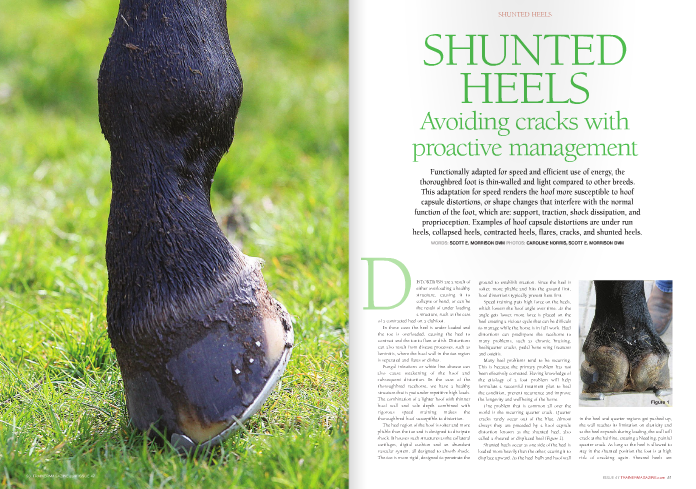
Shunted heels - Avoiding cracks with proactive management
Functionally adapted for speed and efficient use of energy, the thoroughbred foot is thin-walled and light compared to other breeds. This adaptation for speed renders the hoof more susceptible to hoof capsule distortions, or shape changes that interfere with the normal function of the foot, which are: support, traction, shock dissipation, and proprioception.
CLICK ON IMAGE TO READ ARTICLE
Streptococcus zooepidemicus - The bug that can place bets
The Horserace Betting Levy Board (HBLB) has invested over £7 million to protect racing and ensure horse welfare by disease surveillance and research on prevention of equine infections over the last decade. Infection with bacteria is one of the important causes. One bug in particular that can be found in many cases is Streptococcus zooepidemicus.
Respiratory disease affects a large proportion of young horses around the world, reducing performance with significant disruption to training and racing schedules. Inflammatory airway disease affects young horses in particular and it generally causes mucus in the trachea. Some estimates suggest that in British Flat racing yards, for every 100 horses, each month there will be nine cases.

Coughing and nasal discharge can last around eight weeks and some animals are affected again and again. All of which leads to significant cost to the racing industry. As a result, this problem has been a long-standing focus of attention for the Horserace Betting Levy Board’s (HBLB) veterinary research efforts.
Bacterial genetic code
One reason why bacteria from the same species might affect horses differently is that there are different strains within a bacterial species. This is rather like different breeds of horses – a Falabella pony is the same species as a thoroughbred – but it looks and acts very differently. All living things, from human to single-cell algae in the ocean, have a genetic code written in DNA. Understanding this genetic code can reveal how organisms live and function.
“In the same way as Strangles, a horse that has recovered from Streptococcus zooepidemicatus might no longer be outwardly affected itself but it may still carry the bug”
An HBLB-funded collaborative team working in Dr Andrew Waller’s lab at the Animal Health Trust and Professor Josh Slater’s lab at the Royal Veterinary College have set out to unlock the genetic make-up of different strains of Streptococcus zooepidemicus in order to understand better if some strains of this bacteria cause disease while others are relatively harmless. The researchers also looked at how different strains of Streptococcus interact with the horses’ immune system. The ulitmate goal of this research is to gain the knowledge which will lead to new vaccines.
A global research effort
The researchers started by developing a technique to produce a unique ‘genetic fingerprint’ with which to identify each different strain of the Streptococcus. They then tested samples from sick horses around the world and so far 318 different types of S. zooepidemicus have been identified with two particular strains being responsible for outbreaks of respiratory disease.
Insight from an ancient threat: Strangles
The researchers had some clues about what they might find in the samples from horses with Streptococcus zooepidemicus infection because they already had extensive experience in similar research in Strangles. Strangles is one of the oldest known, feared and most frequently reported infectious diseases of horses throughout the world. Typical signs of Strangles include abscessation of the lymph nodes in the head and neck, with swelling to such an extent that some horses are literally suffocated. It is caused by a relative of Streptococcus zooepidemicus, known as Streptotococcus equi. With Strangles, it is very clear that some recovered horses become carriers. Carriers show no outward signs and this hidden infection enables the bacteria to be spread around undetected.

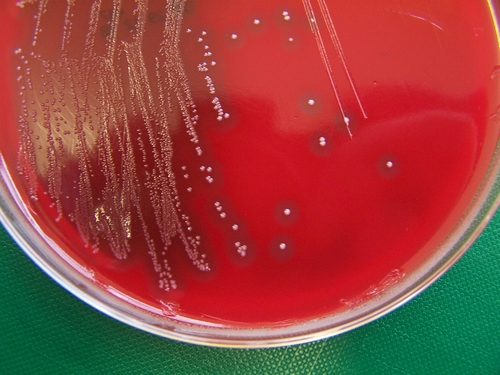
S. zooepidemicus colonies grown on a blood agar culture plate
Silent carriers lead to infection in youngsters
In the same way as Strangles, a horse that has recovered from Streptococcus zooepidemicatus might no longer be outwardly affected itself but it may still carry the bug. For example, the particular strain responsible for the outbreak of respiratory disease in Sweden was found in a healthy horse eight months after the horse made a full clinical recovery.
This persistence of S. zooepidemicus in thoroughbred racehorses that have recovered from respiratory disease allows transmission to susceptible animals and can occur when, for example, older recovered horses are mixed with the next year’s intake of young horses. It is likely that immunity to one strain of Streptococcus does not fully protect a horse from all the other strains, so young horses can often succumb to a succession of respiratory infections as they gradually build up immunity to mix of Streptococcus zooepidemicus strains that persist in that particular yard.
Bacterial balancing acts
In order to be able persist in recovered horses Streptococcus zooepidemicus must be able to survive despite the fact it is being attacked by the horse’s immune response, and at the same time, the bug must be ready to infect a susceptible animal should the opportunity arise. S. zooepidemicus strains have proteins on their surface and some of these proteins inactivate the horse’s immune response. Other proteins enable the bacteria to stick to the internal surfaces of the horse in order to establish the infection, almost like an ice climber clinging to the surface of a glacier with the crampons on his boots. If he loses his crampons, he is in big trouble.
Thus, these surface proteins play key roles for the bacteria, but they are also a vunerable point and can be targeted by the horse’s immune response to disable the bacteria. Therefore, balancing the array of surface proteins displayed with the particular requirements of the bacteria at any given time is critical if the bacteria are to successfully establish an infection and transmit to a new susceptible animal.
THERE'S MORE TO READ ONLINE....
THIS ARTICLE FIRST APPEARED IN EUROPEAN TRAINER - ISSUE 47
TO READ THIS ARTICLE IN FULL - CLICK HERE
Author: Celia Marr, Andrew S. Waller & Josh Slater
Tongue-ties - their place in racing in 2014
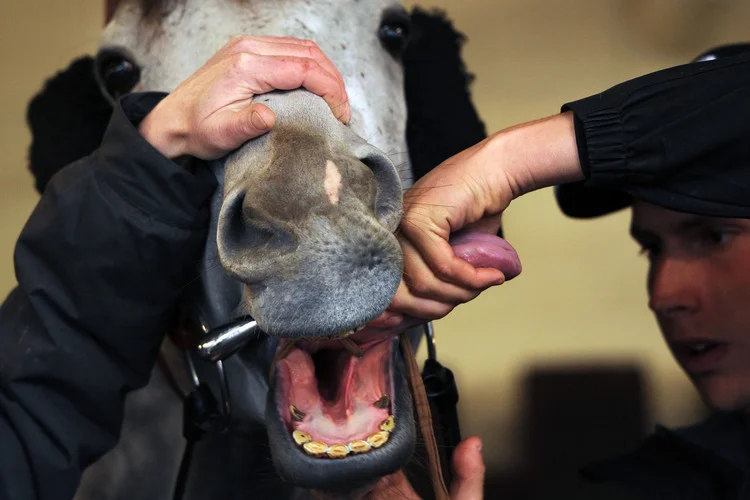
Tongue-ties (strips of material passed through the horse's mouth over the tongue and tied under the jaw) have been used for generations on racehorses worldwide as a method for the rider to retain control if his horse is prone to manoeuvering it's tongue over the bit. The use and efficacy of tongue-ties has spawned much debate and the Equine Veterinary Journal published reports in 2009 and 2013 evaluating use on racing performance and airway stability in thoroughbred racehorses.

CLICK ON IMAGE TO READ ARTICLE
Cardiac rhythm - new technology brings new insights
When a horse runs badly, after lameness and respiratory disease have been ruled out, the heart is usually the next suspect. A new study, published in the Equine Veterinary Journal, provides significant insights into cardiac rhythm abnormalities that can develop during and after racing in standardbreds.

CLICK ON IMAGE TO READ ARTICLE

The effects of routine morning exercise on muscle response in thoroughbreds
Timing is everything and nowhere is this more relevant than when preparing an elite equine athlete for a race. Here, Barbara Murphy reveals a fascinating insight into the circadian system of the racehorse and how timing daily exercise impacts equine performance.

CLICK ON IMAGE TO READ ARTICLE

To water or not to water?
Everyone wants to see a good covering of grass on a racecourse but the watering of tracks is a highly contentious issue, even though it's essential for growth. With opinion split as to whether natural firm summer ground should prevail or artificial watering should be employed, the final word comes down to the Racecourse Manager, the Clerk of the Course and their highly skilled team of groundsmen.

CLICK ON IMAGE TO READ ARTICLE

TRM Trainer of the Quarter - David Simcock
The TRM Trainer of the Quarter award has been won by David Simcock. Simcock and his team will receive a selection of products from the internationally-acclaimed range of TRM supplements worth €2,000, as well as a bottle of select Irish whiskey.

CLICK ON IMAGE TO READ ARTICLE