Terry Finley
Words - Bill Heller
“If horse racing was just about dollars and cents, very few people would be in this game because it’s a terrible investment,” West Point Thoroughbreds founder and CEO Terry Finley said.
Yet he has been passionately invested in Thoroughbreds for much of his life, bringing in more than 2,000 new owners through racing partnerships in West Point Thoroughbreds’ first 31 years.
His father, a chemistry teacher who served in the U.S. Navy during World War II, found relief from the demands of his job and raising seven children in Levittown, Pennsylvania, at the racetrack—first as a $2 bettor and then by getting involved in a partnership.
Terry was 10 years old. “I saw how much fun they had,” Terry said. “It was teachers, plumbers, state workers and the like. I saw how much fun and enjoyment a partnership could be.”
His six older siblings didn’t take to racing, giving Terry additional, much-appreciated time with his father. They forged a special bond through their love of horses and horse racing, frequently doing double-headers: Thoroughbreds in the afternoon and harness-breds at night.
Most people would be surprised to learn that Terry has waged his private battle with stuttering much of his life. He rarely stutters now, if at all, but it was bad enough as a senior in high school that he thought it cost him his appointment to West Point. It did not.
Terry graduated from West Point in the star-studded Class of 1986, which featured many high-profile graduates including former Secretary of Defense Mark Esper, former Secretary of State Mike Pompeo, and four of Terry’s closest friends: Steve Cannon, the former CEO of Mercedes Benz who is now a co-owner of the Atlanta Falcons; Joe DePinto, the long-tenured CEO of 7-Eleven Inc.; David Urban, a CNN political commentator and a powerful member of the Republican Party and former FBI agent Jim Diorio.
Working together, those five friends created the Johnny Mac Soldiers Fund named for their classmate, Col. John M. McHugh, a fatal victim of a suicide bomber in Kabul, Afghanistan, in 2010. The Fund helps the children and family of fallen soldiers with college costs. Through 2021, the Fund has awarded $25 million in scholarships to more than 3,500 college students all over the country.
After leaving the Army with the rank of Captain in November, 1994, Terry toiled in a job he hated, selling life insurance for a year and a half, before finally conceding to his life-long passion for horses.
Terry started West Point Thoroughbreds with a $6,500 claimer and now boasts 2017 Kentucky Derby winner Always Dreaming and Flightline, his undefeated four-year-old who is currently ranked fifth in the world after capturing the Gr. 1 Met Mile by six lengths.
Terry’s wife Debbie and their daughter Erin are key members of West Point Thoroughbreds’ corporate team.
Debbie and Terry met in pottery class in the 10th grade, started having dates at racetracks, and have been together ever since. Terry especially admires her tenacity as a mother, specifically helping their children, Erin and Ryan, secure the coaching they needed to pursue their passions. “She wouldn’t take `no’ for an answer,” Terry said proudly.
Erin didn’t let a horrific hand injury when she was four years old prevent her from continuing her riding lessons and becoming a top equestrian, frequently transitioning former West Point Thoroughbreds to a second career.
One can only imagine how difficult it was for Erin to deal with her injury growing up. Then one day at Saratoga, Terry ran into Steve Asmussen and noticed that Steve was also missing part of his thumb. Terry brought Erin to Steve, and they connected immediately when Steve reached out his damaged hand. “There was this mutual feeling that we’re not the only people in the world that had this type of accident.” Erin said.
Erin’s younger brother, Ryan, an All-American and professional soccer player, graduated from the prestigious Wharton School and will begin a business career with a consulting firm in Dallas in October.
Terry has been West Point’s general, deploying his Thoroughbreds around North America to one of a dozen top trainers, forming strategic alliances and relying on key officers, especially his wife and daughter, to oversee his troops day-to-day. Having been exposed to breakthrough technology in the Army, Terry has been ahead of the curve ever since, reflected in West Point’s website, television ads and customer service.
“He’s worked very hard at it,” his Kentucky-based trainer and buddy Dale Romans said. “I watched it from its infancy—Terry was smart enough to use the Internet and social media. I think he was the first one. He was very ahead of the curve. “
Along the way, West Point Thoroughbreds has taken care of its Thoroughbreds when their racing days were over, through its Congie DeVito Black and Gold Fund. Congie didn’t let his brittle bone disease prevent him from becoming Terry’s first employee after nagging him for months. Congie pioneered West Point’s technology—cutting-edge material at the time. “He was very valuable,” Terry said. “He was everything to our entire team.” Terry treated him accordingly, surprising Congie with an electric wheelchair and customized van that gave him mobility he’d never had his entire life. “It was the first time he could control his direction,” Terry said. “He did figure 8’s over and over. I’ve never seen a person happier or more content. He always wanted to run. This was the closest he could come. It was one of the proudest moments of my life.”
When Congie died in 2011 at the age of 35, he donated his two kidneys, saving two other lives. “The kidneys were his gift out the door,” his mother, Roberta, said. “He was the one who thought of it.”
While trying his best to avoid the spotlight, Terry has quietly become an industry leader. “Terry’s a straight-forward guy, very honest and cares about the sport,” former NFL linebacker Robert “Stonewall” Jackson, a partner on Always Dreaming, said. “He wants to do the right thing for the industry.”
He does so quietly. “It’s pretty remarkable,” his son Ryan said. “Other people—you can’t get to shut up. That’s something I learned from my dad: being humble.”
Erin calls her father “the definition of the American dream: serving your country and taking a risk. I am proud of him for not giving up with two kids and not a lot of financial backing, and grinding it out.”
Terry said, “It’s a labor of love. I get to live my dream: to win races.”
Advocating for Humane Education - the work being done to educate youngsters in equine welfare
Words - Bill Heller
How do you change culture? How do you ensure horses’ welfare? “Education is the answer,” Equine Advocates’ founder Susan Wagner said. “To me, it’s the only thing that changes the picture.”
She knows quite a bit about change. When Secretariat’s 1973 Triple Crown chase drew her to the racetrack for the first time, she witnessed his 31-length victory in the 1973 Belmont Stakes and was so dazzled that she quit her job and got a new one as a hotwalker on the backstretch the very next day. A myriad of jobs followed: working at Sagamore Farms in Maryland; writing for the Horsemen’s Journal; doing radio and TV work for the New York Racing Association and for Teletrack off-track betting in New Haven, Connecticut; and becoming the first female jockey agent in New York, representing George Martens, who won the 1981 Belmont Stakes on Summing to deny Pleasant Colony the Triple Crown. She then worked for New York Zoological Society and for Friends of Animals.
When she learned of horse slaughter in the United States, she and her sister Karen began Equine Advocates (EA) in 1996. They opened the Equine Advocate Farm and Sanctuary near Chatham, New York—40 miles southeast of Saratoga Springs—in late 2004. EA currently has 82 residents, including 19 Thoroughbreds. The newest horse, a wild Mustang mare named Onaqui, arrived from Utah on June 4.
In 2006, with the considerable help of longtime supporter and Thoroughbred owner and breeder Jeffrey Tucker, EA constructed a humane education center on the 140-acre farm to teach kids, preschool through college, about the humane treatment of horses. She was stunned two years later to learn that New York State has a law mandating humane education courses be taught at elementary schools. Section 809 of New York State Education Law mandates every elementary school in the state teach “the humane treatment and protection of animals and the importance of the part they play in the economy of nature as well as the necessity of controlling the proliferation of animals which are subsequently abandoned and caused to suffer extreme cruelty.” The law has been on the books since 1947, yet very few schools even know about it today.
Fifty-five years after the law was passed, the New York State Bar Association created the Committee on Animals and the Law to focus on legal issues regarding the interests of animals and to serve as a legal resource for humane-related issues pertaining to animals and “make a difference for both animals and people.”
Just like that law, few people are aware of that committee.
But at least New York State has a humane education mandate. Only eight of the other 49 states do: California, Florida, Illinois, Maine, New Jersey, Oregon, Pennsylvania and Washington.
“If any state should offer humane education, Kentucky immediately comes to mind since the breeding of horses for racing is what that state is most famous for,” Wagner said.
“There’s been a law since 1947, but it hasn’t been implemented,” retired Brooklyn elementary school teacher Sheila Schwartz said. “There’s no one around to see that it’s being done.”
She said she was “shocked” when she learned about the state law from the ASPCA in 1980. She began teaching it immediately and continued to do so until she retired in 2014. She created a humane education curriculum in 1985, and served as the chairman of the United Federation of Teachers Humane Education program from 1989 through 2014. “We were a support group,” she said. “Most of the teachers didn’t want to start a program.”
Asked to guess what percentage of schools have programs now, she replied, “I’d be surprised it is more than two to five percent.”
PETA noted: “Under New York State’s current education laws, elementary schools are required to provide instruction in the humane treatment and protection of animals. Unfortunately, many educators are not even aware of this requirement, and compliance is inconsistent.”
Teachers that do want to start humane education courses have a valuable resource in Humane Education Advocates Reaching Teachers (H.E.A.R.T), which offers full-service humane education programs in New York City, Chicago and Indianapolis and is accessible online. Its mission is “to develop a generation of compassionate youth who create positive change for animals, people and the natural world.”
What have all these kids who didn’t have humane education classes been missing? “Humane education gives them another way to view animals,” Schwartz said. “I think it makes them empathetic to animals and to each other. When I did the program, we would have them role playing. What are the alternatives?”
Susan Wagner has made a career of finding alternatives for horses. Yet she is realistic: “We can’t rescue every horse. So the best thing we can do is teach young people the tools to rescue them on their own in addition to being able to report animal abuse to the authorities. One of our main issues is to eliminate horses being treated poorly.”
Yet she and Michele Jacobs, the humane education teacher she hired last November, do not indoctrinate their students. “We don’t tell these kids what they should think,” Wagner said. “We show photos of a horse pulling a carriage in a busy city and a horse in a pasture pulling a carriage in a field. We ask the kids, ``What do you see? What do you feel?’ Then we get them to talk about horses. We tell them the different types of horses and what they are used for. There are ways to handle a horse properly. We’re very careful not to tell them what is right or what is wrong. They look at the pictures and they decide.”
Then they get to tour Susan’s farm. Horses meant to be slaughtered and/or have suffered abuse are now living like kings and queens in oversized paddocks, receiving excellent care and huge doses of love and carrots from a steady stream of visitors. Each horse’s story is posted just outside their paddock. They come to Susan when she calls their names. The bond she enjoys with them is obvious.
In 2019, the last full year of activity before the two-year pandemic, more than 800 students from nearby schools enjoyed the EA’s classes and tours. “It’s great for these kids,” Wagner said. “They love it. Some bring their parents back on open-house days.”
Michele, who began riding lessons when she was four, said. “It’s wonderful working here. I had teaching jobs all over the area, and I’ve always wanted a job working with horses.” Now she’s doing both.
She, too, was unaware of the state law: “I did not know about it. I don’t know why schools aren’t doing programs.”
Her programs at EA are geared to “inspire a new love of equines by thinking for themselves,” Michele said. “We talk about taking care of the horses. The younger ones’ reactions are curiosity. They want to know more about the animal. I had third and fifth grade students last week,” Michele said. ”They all sat down right away. They were very interested. They asked very intelligent questions. Even the third-graders were all over about horses having feelings. Their faces lit up. Another time, we had a three-year-old with one of the horses. It was her first time seeing a horse—a huge animal. The way she looked at him and touched him was beautiful.”
Michele’s three kids, 11-year-old Benjamin, 13-year-old Matthew and 16-year-old Caleb, have all been to Susan’s farm. “I’m very passionate about horses, seeing their expressions,” Benjamin said. “I like petting them. I want to help my mom with humane education. It’s definitely not right to treat horses badly. A lot of other animals, too. I want to learn about it.”
Matthew, who helps his mom take care of their own horse, said, “I just think they’re really cool animals. I think it’s very important because if you treat them the wrong way, you’re not going to live a happy life. I believe the animals have feelings, too.”
Caleb, their 16-year-old brother, has done a 10-hour volunteering stint at EA and plans on doing it again as a part of his school’s mandated policy of volunteer work. “I think the farm is really beautiful,” he said. “I know they treat their horses and other animals very well. I think what they are doing is excellent.”
Other kids of Caleb's age are happy participants at EA, too. Danielle Melino, who lives in Austerlitz, 15 minutes from EA, is a high school agriculture teacher at Housatonic Valley High School in Connecticut (EA is close to the New York-Connecticut state line). “We were the first post-COVID class to visit the farm,” she said. “It was probably the best field trip I’ve taken with my kids in years. We heard from Michele, Susan and volunteers. My students were blown away. They learned about a lot of topics: PMU (pregnant mares’ urine used to treat menopause), wild Mustangs, horse slaughter, carriage horses and camp horses. We learned about the history of the organization. I always tell my students these horses couldn’t ask for a better setting and better care on these beautiful grounds.”
She was so impressed with EA’s program that she reached out to another high school who also visited the farm, and also brought her 4-H class there. “I think humane education should be in every school,” Danielle said.
Daniela Caschera teaches preschool for three- and four-year-olds kids at Albany Academy, where Michele had taught. Her kids did a zoom with Michele. “She had left a bucket of items before we did the zoom,” Caschera said. “We guessed what they might be used for. Then, when she zoomed, she talked about those items: a horseshoe, some food, a brush, a file for teeth.
“They were so excited. One of my students, Leon Carey, then visited the farm with his parents. He loves animals. His father is a vet. His grandfather has a reindeer farm in Corning.”
Daniela was appreciative of having a zoom with Michele available during the pandemic: “With COVID, it was a way to introduce something new to the kids. My kids were very engaged, for three- and four-year-olds. They asked a lot of questions. After that, Michele gave us part of a tour.”
One moment stood out for Daniela: “We were talking about horses sleeping standing up. One of my little girls asked why. She’s the youngest person in my class. And she told her mom why horses sleep standing up. It stuck.”
Daniela intends to spend a whole week next year focused on horses as part of her curriculum.
Ray Whelihan, an associate professor at the State University of New York – Cobleskill, teaches an animal science class. He’s been visiting Susan’s farm for a decade. “Susan is a key part of the course,” he said. “She zoomed during COVID. It is such a professional organization over there. She gives extraordinary care.”
Susan has been working with Ray to create an individual course focusing solely on horses and/or a course of equine ethics.
“We desperately need humane education because kids are the future horse caregivers in America,” Wagner said. “I think every state should have humane education because every state has horses. For states with major horse racing and breeding, humane education should be compulsory because there are so many more horses bred. It’s important to make sure that every horse bred to race, whether or not he races, has a soft landing. Humane euthanasia should be considered a last resource to make sure the horses don’t fall through the cracks and end up being slaughtered.”
Classes and tours are just part of EA’s humane education program. Its Kid’s Corner is part of its Fun From Home program. There are equine-themed puzzles, quizzes, mazes and games, and video tours of the farm.
Brand new are the Equine Readers Club, offered online, once a month on Saturdays at noon, which are available on Facebook and YouTube; and “Live at Lunchtime” on Wednesdays is also available on those two platforms.
Following a two-year absence during the pandemic, EA scheduled seven open houses in 2022. The first was on May 14 and the last will be on November 5.
EA plans to expand its humane education program, hoping to reach as many children as possible. “I think it’s something that people don’t know about—how bad horses can be treated and how bad they are treated,” Caleb Jacobs said. “They should be treated like a dog and a cat. I think more people should know about it.”
#Soundbites - How are you complying with HISA regulations, and what additional steps are you taking to be compliant?
Words - Bill Heller
Michael Matz
I don’t think we have any choice. It is what it is, and you have to do it. It’s extra work, but it makes a fair playing field. This is what we have to do. I’m sure there are a lot of glitches that will have to be worked out. We just have to comply. I hope it makes a big difference. With the bunch of people caught (cheating), it should have been done a long time ago.
Richard Mandela
I’m lucky I’ve got my son helping. He showed me yesterday what we will be doing: a lot of recording information—we’re already doing at Santa Anita, ever since a couple years ago when we had problems with horses breaking down. It’s a great improvement, but it involves a lot of recording, inspections, checking, double checking, triple checking. It’s a pain in the neck, but it’s working.
Dale Romans
I’m going to hire a person to do all the HISA stuff. I’m going to put him on staff. I can’t do it myself. I’m going to have an open mind about HISA, but I think there’s going to be some unnecessary repetitive work. They’ll have to figure that out.
Bruce Levine
Bruce Levine
I haven’t registered yet (as of June 9). I’m going to look at it next week. My wife will do that for me. I’m all for uniform rules, but some of the smaller tracks may have a problem. It’d be nice to have uniform rules. I just don’t know how much horse knowledge they have. They should have had people on the backstretch asking questions.
Joe Sharp
Basically, it’s been a learning process for everybody. We’re trying to follow the guidelines that they’re giving us. It seems all the kinks haven’t been worked out yet. We’re waiting for changes in a couple of things. We’re registered and trying to sort through what they’re asking. There’s a little lack of clarity in some areas. I think we’re all trying to do the right thing.
Mike Stidham
First of all, I’m complying by just filling out the forms for myself and my horses. It’s quite a bit of data and a lot of paperwork. Everything they’re asking trainers to do has to be documented—what we did, what the vets did. I think there’s a redundancy. Whether or not this is the answer to solve many of the problems of the industry remains to be seen. We’re all going to find out after a period of time.
Wayne Catalano
I don’t know what to think, to tell you the truth. We’ll do whatever we have to do. I don’t know what difference it’s going to make. People can get around a lot of things.
Pat Kelly
I don’t think we need it. The little guys don’t need it. I only have two horses. We’ve already done a lot of this with the National THA (National Thoroughbred Horsemen’s Association). They want people to do all this, but there’s no funding for it. It’s another layer of government bureaucracy we don’t need. I just don’t see everyone doing this by July 1. They may have to push the date back. I’ll sign up if I have to.
Ron Ellis
It’s not a great thing when government gets involved. It seems like a lot of unnecessary red tape. My owners are grumbling. They all have to do paperwork. We’ll see how it works out.
Antonio Sano trainer of Preakness contender - Simplification
This article was first published ahead of the 2017 Kentucky Derby - when Calder was still open for training.
We’re republishing it ahead of the 2022 Preakness Stakes - where Sano will start Simplification for owner Tami Bobo.
————————————————————————————————-
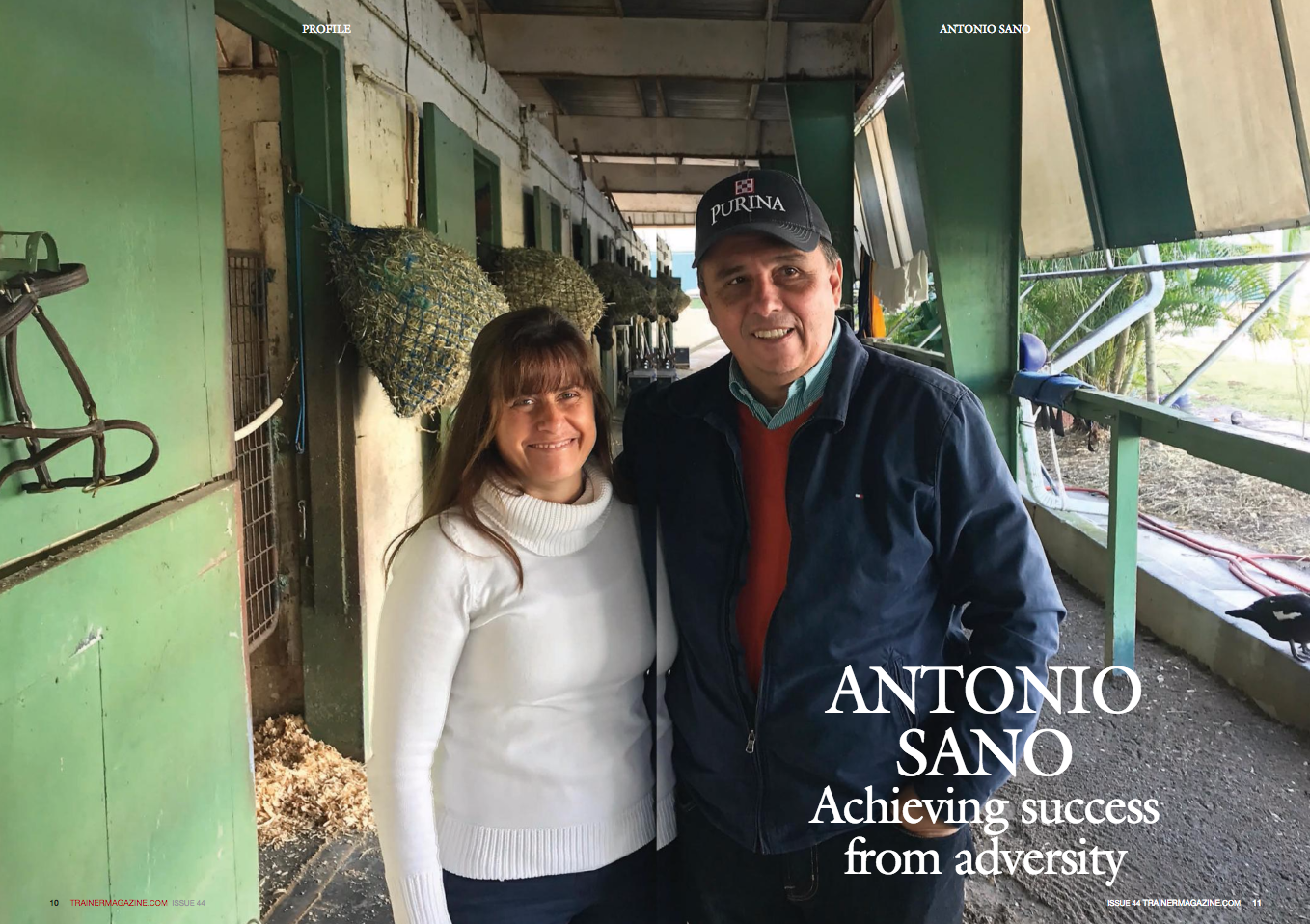
Antonio Sano is an early riser and according to his wife Maria Christina, not the greatest of sleepers in any instance. Up at 3:50 every morning come rain or shine, Sano can be found splitting time between his barns at Calder and Gulfstream Park. Between the two locations, he’s got roughly 70 horses in his care.
Assistant trainer Jesus “Chino” Prada
The two- and three-year-old are based at Calder, and the older horses are some 10 miles away at Gulfstream. “I like the track [at Calder] for the babies. It’s a good track, deep sand, and when it rains it drains, while over at the other place, it can take two days to clear.” Assistant trainer Jesus “Chino” Prada, who has been an integral member of the team since Sano started training in the U.S., chips in: “Gulfstream is great for racing, but here is the best for training.”
Sano might not yet be a household name across North America, but in his native Venezuela, the man’s a legend. He trained no less than 3,338 winners on his home soil, and it was only thanks to a kidnapping in 2009 that lasted longer than a month that he quit training in the country. The kidnapping -- his second -- resulted in the father-of-three doing what was best for his family, which was to remove them from the danger that his success was creating.
Sano is a third-generation trainer. “My father, grandfather, and uncle all worked with horses,” he recounts. “My father right now is 88 years old. He arrived from Italy when he was just 16 and was working with horses. They came from Sicily. In fact, my whole family is from there, including my wife!”
After graduating from college with a degree in engineering, the magnetic pull to the racetrack was too great, and Sano went to work as an assistant trainer Julio Ayala to enhance what knowledge and skills had been passed down to him from his father and grandfather.
Eventually (March, 1988) setting up on his own, Sano ended up training in Venezuela for 23 years, earning the trainers’ championship title 19 times and winning an average of 150 races annually, with three year-end win tallies in excess of 200. That’s no mean feat when you consider that racing only takes place twice a week in the major city of Valencia, where Sano was based.
In Venezuela, according to Sano, the pedigrees of the horses he trained were a little different than what he works with in the U.S., and so was the daily training regime. “I had 160 horses in my barn and worked the horses in four groups. Riders here take the horses to the track every 45 minutes and come back. There 4 sets of 40 horses each. Every rider work on 2 horses per set. I had the privilege to count with 20 riders at that time. We would take them all to the track at 6 A.M. At 6:45 A.M., the second set would be ready, the third by 7:30 A.M., and the last before 8:30 A.M.”
After first going from Venezuela to Italy, Sano and his family moved to the U.S. in March of 2010. They had visited the country before without spending any time at the racetrack, preferring the great vacationing opportunities that Florida offers with a young family in tow.
Well known for his training of staying types, Sano found the transition to training the speed-bred horses of the U.S. “Each horse is different, but I’ve learned more from others around me here in the U.S. than I ever learned in Venezuela,” he says -- modest words, perhaps, for a trainer who is a master of his game. “But my focus is always on the way the horses finish.”
Prada has been a friend of Sano’s for over 40 years. They attended trainer school together, along with Enrique Torres.
Their teaming up in Florida may never have happened had Sano decided to move to Italy after the kidnapping. “Italy has beautiful people and great food, but the racing wasn’t for me. So I went to Florida and met Mike Antifantis (the racing secretary at Calder at the time), who gave me a couple of stalls. I then had to go back to Venezuela and close shop, giving all my horses away.”
March 22, 2010, was an important date in Sano’s and Prada’s lives. It marked the start of a new chapter, when they claimed their first horse for their fledgling operation. The numbers quickly grew from there. “Two horses became four, and quickly we had 10,” recounts Prada.
The stable ended its first season with 37 winners, including two in stakes races. Knowing very few people or being known to few was probably a good thing for Sano as he and Prada quietly went about building their business. And where resentment for the new man in town could have quickly grown, friendships flourished with other trainers. “They treated me well and with respect,” says Sano.
With a successful formula in place, Sano’s stable was able to gradually improve the quality of stock. Still, his patronage remains primarily from Venezuelan or other Latin American ownership interests; he hasn’t really caught on with American owners.
In 2004, Sano started to shift his focus away from claiming horses to buying yearlings, while still using the claiming philosophy of trading up purchases. This time last year, Sano had high hopes for a then-unraced Broken Vow filly named Amapola, who he had bought as a yearling for $25,000. Amapola crossed the wire first by nearly 10 lengths in her May, 2016, debut in track record time for four-and-a-half furlongs at Gulfstream, only to lose the race in the stewards room for drifting in at the start. She turned a lot of heads that day, and Sano parted with her for a substantial profit. “I sold her for the money,” he says.
As with most buyers at sales, pedigree and conformation are at the top of Sano’s list when studying a catalogue page, but for him the stride of the individual and the horse’s eye are the main factors to determine if he is going to raise his hand in the ring -- should the price fall in his preferred buying range of $5,000 to $50,000.
In 2015, Sano made a number of purchases at yearling sales, and came home from the Keeneland September sale with a good-looking son of first crop sire and Florida Derby winner Dialed In.
The sale of that colt, from the consignment of Jim and Pam Robinson’s Brandywine Farm, must have been a rather bittersweet moment for breeders Brandywine and Stephen Upchurch. The chestnut’s dam Unbridled Rage had died about a week and a half after he was born, and the newly orphaned foal was bottle-fed until a foster mare could be found.
Sano with Gunnevera
That colt, for which Sano had the winning bid at $16,000, was, of course, Gunnevera. And thanks to him, if Dialed In hadn’t already been a particular favorite of Sano’s, he certainly would be now.
After the sale at Keeneland, Gunnevera, along with the other Sano purchases, was sent to Classic Mile Park in Ocala, where he was broken by Julio Rada a classmate of Sano and Prada’s at the Venezuelan training school in 1988.
Gunnevera was showing potential at Classic Mile and by the time of his arrival at Calder, his reputation was growing. However, the faith shown in him by those who knew him best wasn’t being shared by everyone: the first-time owner who Sano had bought the horse for eventually got around to paying for the colt...but the check bounced.
The name “Gunnevera” has no real meaning. It’s a combination of place names and words favored by his ownership interests -- Jamie Diaz, originally from Spain but now in Miami; and Peacock Racing, a partnership of Venezuelans Guillermo Guerra and Guerra’s father-in-law Solomon Del-Valle, who ended up with the horse just six weeks before his first run.
Del-Valle’s friendship with Sano is deeper than most normal friendships, as it was he who helped Sano’s wife arrange and finance Sano’s release from his kidnappers. “I told him that we bought horses at the yearling sale and this was the best one, that I’m going to make him a champion.” Sano’s prophecy looks like it’s showing some promise, and Gunnevera’s success has gone someway toward repaying Del-Valle’s generosity to the Sano family over the years.
————————————————————————————————-
Fast forward to 2022 and Gunnevera stands as a stallion at Pleaseant Acres Stallions in Morriston, FL. He has earned his place in the stallion barn on the back of his race record - winning the Grade 2 Saratoga Special and the Grade 3 Delta Downs Jackpot at two. At three he won the Grade 2 Fountain of Youth, finished second in both the Grade 2 Holy Bull and the Grade 1 Travers and was a game third in the Grade 1 Florida Derby.
As a four year old he finished second in a pair of Grade 1’s - The Breeders’ Cup Classic and the Woodward Stakes and ran a gallant third in the Pegasus World Cup (Gr.1). At five, his third place finish in the Dubai World Cup (Gr.1) meant that he retired with earnings of over $5.5m and as such has become the highest ever earner to stand at stud in Florida.
Gunnevera was not his trainer’s first graded stakes winner; although none received anywhere near the level of acclaim as the son of Dialed In. Sano previously handled Devilish Lady, City of Weston, and Grand Tito to graded stakes wins.
Sano is the first to admit that nothing has compared to the Gunnevera success story and the national exposure he received. But how well does he react to the inevitable pressure? “I’ve never been in a situation like this before, but it’s a blessing,” he calmly says. For Maria Christina, it’s as if her husband’s life is going on just the same. “He never sleeps before any race, he’s always thinking about something.”
Come to think of it, Sano’s whole day and night seems to be taken up with work or thinking about horses. The work day often ends 16 hours after it began, giving Sano a little much-needed family time with his three children. His eldest son Alessandro is already following in the family business and now works as one of his father’s assistant trainers.
But what about time away from horses, does Sano take a vacation? “One week -- and I don’t relax,” he says. “He’s always on the phone to Chino and I say, ‘No phone, Tony, the horses won’t run faster with you not there,’” interjects Maria Christina.
“Twenty (five) years ago when Alessandro was born, I would never have thought that I would be where I am now,” says Sano.
“But Tony, you were scared to come here 20 years ago. There wasn't the opportunity we have here in Venezuela,” retorts Maria Christina.
So Venezuela’s loss is America’s gain, and this is one family truly living the American dream.
First published in North American Trainer issue 44 - May - July 2017
Buy this back issue here!
Brian Lynch - the Australian born trainer whose set to make a mark at Ellis Park this summer
By Ken Synder
“If you find something you love, you’ll never work a day in your life,” said trainer Brian Lynch. “I’ve been blessed to do a job that I have a passion for. I have fun with it.”
“Fun” is not a word often associated with training Thoroughbreds. The job, as everyone in racing knows and as Lynch noted, “is seven days a week, 365 days a year.” The word, however, crops up often for those who know Lynch.
“He’s fun to be around,” said Richard Budge, general manager at Margaux Farm, where many of Lynch’s horses have begun careers as yearlings.
Dermot Carty, a bloodstock agent who first met Lynch when he came to Canada in 2005, echoed Budge: “With Brian, he just makes it fun. He makes it enjoyable through the good times and the bad. He’s one of the few true characters in the business who actually puts enjoyment into horse racing.”
Greg Blasi, Churchill Downs outrider who knows Lynch away from the racetrack “cowboying” with him, (more on this later), expressed it most succinctly: “He’s a hoot.”
Of course, the most fun is trips to the winner’s circle, and Lynch has made plenty of those: 720 at press time and earnings just short of $47 million.
A native of Wagga Wagga in New South Wales, Australia, Lynch fits, perhaps, the profile of a stereotypical and classic “Aussie.”
“We have more of a laid-back attitude than Americans. It’s nothing to share a few beers with each other and have a good time…helps you make new friends, that’s for sure.”
What Lynch did before coming on the racetrack may explain also why racing is more fun to him than anything. He was a bull rider back home. In fact, he came to America in 1992 to join this country’s professional circuit with big purses after learning the trade locally. “They had a local rodeo back home, and it was a big thing. Not far from the racetrack was a horse trader who had some bucking horses and some bucking bulls; and I used to hang around his place a lot. That’s where I got the taste for jumping on bulls.”
The racetrack Lynch mentioned is an unusual triangular racecourse that was across the road from his home and where he got his start, filling water buckets and learning to ride as a boy. “I could ride from a young age. It wasn’t long before I graduated to galloping horses.
“I was always a little bit too big to be a jockey. I sort of found a lot of work helping on the wilder horses.” Apparently, it was experience sufficient to prepare him for something bigger and more dangerous…with horns.
Thoroughbreds sidetracked Lynch when he came to Southern California and a small farm near the border with Mexico. “There was a little Thoroughbred farm called Suncoast Thoroughbreds. I got a job breaking colts for them, and it wasn’t far from San Luis Rey.”
Lynch said he “annoyed” the stewards there till they gave him a trainer’s license. His start was with two horses at San Luis Rey.
That led to training for the Mabee family’s Golden Eagle Farm in Ramona in San Diego County.
“I kicked around California for a lot of years just with small numbers, just scratching out a living—selling, and running horses, and flipping horses. I was bringing some from Australia and moving them.”
His big break was training at Santa Anita and Del Mar where he met some important influences. “Most say they admire the Father, Son, and Holy Ghost. For me, it’s Ron McAnally, Jack Van Berg, and Bobby Frankel,” he said with a laugh.
When Frankel learned the Mabee family was going to downsize their Thoroughbred operation, he approached Lynch about joining his stable as an assistant. “He was starting to get more two-year-olds than he’d ever had. That’s when Chad [Brown] and I teamed up with horses for Bobby. Chad went to California, and I went to South Florida and Palm Meadows in the first year that it opened,” said Lynch.
“Bobby certainly wasn’t a textbook teacher,” Lynch said of the legendary New York trainer who died in 2009. “He wasn’t going to walk you through everything. He was a guy that if you were around him enough and you didn’t absorb anything from him or learn anything from him, then shame on you.”
Frankel, not known publicly as being chatty, was half of a truly odd couple with the amiable Aussie. Not just the experience, but the friendship is treasured by Lynch. “He had a heart of gold. He was a great guy to train horses for and just a wonderful human being.”
Lynch’s big break came when he moved to Canada to manage Frankel’s division at Woodbine in 2005. In 2006 he went out on his own, eventually becoming a private trainer for Frank Stronach.
Canada was very much to his liking; in both 2006 and 2007, his earnings topped $1 million before jumping to over $3 million in 2008. That year began his string of consecutive top 100 earning trainers in North America that continued through last year.
He is quick to credit owners for his success and consistency: “I’ve been very blessed to have long-term owners who like to play the game and who have always tried to work on finding the better horses. Fortunately enough, if you look back over the list, there’s been quite a few of them.”
Quite a few indeed. Lynch trained Clearly Now, who set the Belmont record for seven furlongs (1:19.96) in that track’s 2014 Sprint Championship, earning an Equibase speed figure of 122. (To give you an idea of how phenomenal the performance was, the next year’s Sprint Championship winner won in 1:22.57.) Other top horses include Grand Arch, owned by Jim and Susan Hill of Margaux Farm and winner of the Gr. 1 Shadwell Turf Mile Stakes at Keeneland in 2015; Oscar Performance, winner of the Breeders’ Cup Juvenile Turf at Santa Anita in 2016; and Heart to Heart, winner of two consecutive back-to-back Gr. 1 stakes in 2018 at Keeneland and Gulfstream Park. Most notable outside the U.S. was a win in Canada’s 2015 Queen’s Plate Stakes with Shaman Ghost.
While many trainers get labels for being good with two-year-olds, sprinters, etc., there is an enviable trademark for Lynch’s horses: long careers. “I’ve raced two- and three-year-olds and still have them around running Gr. 1’s and winning at six or seven.” Grand Arch raced till the ripe old age of seven and in stakes company, finishing his career in the Forbidden Apple Stakes at Belmont. “Keep them in good form and you’ll have them still around when they’re older,” said Lynch who also points to “patient owners” like the Hills, willing to give their horses a break as a necessary ingredient in managing racing careers.
If there is a label, Lynch is unaware of it. When it was pointed out that in the past five years he had started more horses on the turf than on dirt, his response elicited another Lynch trademark: humor. “Probably because they were too slow for the dirt.
“I guess I primarily grew up training horses and riding horses to run on the turf down there [Australia], so I probably am influenced to run ‘em on the grass. I’m certainly not frightened by the dirt, by any means, but somehow, I ended up trying them on the grass. If they run well there, I’ll keep them on that surface.”
Brian Lynch with mentor D. Wayne Lucas
As intent as he is on enjoying himself and bringing enjoyment to others in the game, he is “no-nonsense” as a trainer—a euphemism not used by Carty to describe Lynch. “He can figure out in a very short period of time if a horse has or does not have any talent. He’s not one of those bull***t trainers who tells people that, ‘yes, yes, it’s going to get better’ and in his heart and soul, he knows it’s just for a day rate. He’s not interested in the day rate. He’s interested in developing and making great racehorses.”
Asked about his success and consistency, Lynch responded with characteristic modesty and self-deprecation: “One thing I’ve learned about training horses over the years is I’ve gotten very good at delivering bad news. That’s what you seem to do a lot.”
Unlike many high-profile trainers with multiple divisions and large strings of horses who are more business people than trainers, Lynch’s focus is the barn first, and then business. “It’s switch on, switch off,” said Carty. “Clients will feel good and enjoy themselves at the races with Lynch. But when he goes back to that barn and those horses, he switches to Brian Lynch who looks after the horses, making sure they’re ok.
“He’s there first thing in the morning, and following the races, he goes over and checks every stall and goes through it. He’s not one who would just leave it to the help,” said Carty.
Richard Budge offered another perspective on Lynch. “I would say he’s unique in the fact he’s willing to roll the dice in a stakes race with a horse that may be an outsider.”
Brian Lynch with groom Juan Garcia
A case in point was a recent start by Phantom Currency (yet another Hills-owned horse) in the Gr. 3 Kitten’s Joy Appleton Stakes at Gulfstream in April. The horse was coming off a 13-month layoff. While most trainers may have looked for an allowance race tune-up, Lynch went for the gold. The horse won, earning a very impressive 114 Equibase speed figure.
“If a horse is training well, he’ll ask, ‘Why not? Let’s give it a shot,’” added Budge.
“That would be a huge positive. We can be a little tentative about where to place them or put them. You never know if you could have run a stakes race when you run in an allowance.
That very question faces Lynch with his first potential Kentucky Derby starter, in Classic Causeway.
After two impressive wins—the first in the Gr. 3 Sam F. Davis Stakes in February and a month later in the Gr. 2 Lambholm South Tampa Bay Derby with identical and impressive Equibase speed figures of 104—the horse finished a mystifying last in the Florida Derby.
Classic Causeway, owned and bred by Clarke M. Cooper and Kentucky West Racing, is one of three foals from the final crop of Giant’s Causeway who died in 2018.
He made his debut at Saratoga last September and blew away the competition from gate to wire over seven furlongs, winning by six-and-a-half lengths. The horse entered the Derby picture with a third-place finish in the Gr. 1 Breeders’ Futurity in October at Keeneland and followed that with a second-place finish in the Gr. 2 Kentucky Jockey Club Stakes in November at Churchill Downs. His two wins at Tampa Bay Downs earned him qualifying points for one of the 20 spots in the gate the first Saturday in May.
Before the Florida Derby, Lynch had this to say about the son of the great Giant’s Causeway, known as the “Iron Horse” after winning five Gp. 1 races in just 11 weeks as a three-year-old. “You always hope that you come across one in your career that you can have a ‘kick at the can’ in the Derby, but fortunately this horse came into our stable, and he’s done everything we’ve asked of him. I think he’s just getting better, and we’re really excited to have him.”
louis rushlow
Whatever lies ahead, Lynch said he will “stop and smell the roses,” whether they’re draped across the withers of Classic Causeway at Churchill Downs or the figurative kind.
He embraces a positive attitude toward racing that most of us should emulate. “Racing is a game of ups and downs. You could be dodging missiles in Ukraine. You get over a loss, have a beer or soft drink, and move on.”
His idea of relaxation may be an indication of the kind of person Brian Lynch is. When Greg Blasi mentioned one day he and other outriders were going up to a farm east of Louisville to work cattle, the 57-year-old Lynch was quick to say to Blasi, “If you ever need some help, just let me know.”
He’s ridden with Blasi, and the others as many times as he’s had the opportunity, ever since. “He’s just a very good horseman, whether it’s on the back of a pony herding cows—just whatever,” said Blasi. “He used to gallop his own horses. He’s come up the hard way, and he tells stories about when he didn’t have a couple of nickels to rub together. Nothing was handed to him. I respect guys like that. There are a lot of people that didn’t have to struggle to get where they are.
“He’s also a lot of fun to be around.” Ah, there’s that word.
For a guy who’s ridden bucking broncos and bulls, you might expect a certain fearlessness. Not so: “I have one fear in life, and that is that there’s a good time going on somewhere and I’m not in the middle of it.”
Racehorse Bone Health: From a Nutritional Perspective
Strong, healthy bones are the foundation for racehorse soundness, but unfortunately skeletal injuries are an issue that every trainer will face. There are many factors involved in the production of strong bones; however, two key factors that we can influence are training and nutrition.
By Louise Jones
Every trainer knows how important exercise is to ‘condition’ the bones, and we are constantly striving to improve training programmes so that sufficient strain is applied to signal an increase in bone development, whilst not straining the bones to the point of fracture; this is a difficult balancing. Perhaps more fundamental to this is the role of diet in supporting bone density, strength and repair. Even minor nutrient deficiencies or imbalances can mean that the horse doesn’t receive the nutrients it requires for healthy bones and thus increases the risk of potential problems down the track.
Understanding how bone is formed and adapts in response to training, alongside the critical role optimal nutrition plays in these processes, can help to ensure skeletal soundness and minimise the risk of bone-related injuries.
Bone formation & remodelling
Bone formation occurs by a process of endochondral ossification; this is where soft cartilage cells are transformed into hard bone cells. Bone consists of three types of cells and an extracellular matrix. This extracellular matrix is made mainly from the protein collagen, which makes up to 30% of mature bone and is a key element in connective tissue and cartilage. The three types of cells in bone are:
Osteoblasts: These are the cells that lay down the extracellular matrix and are responsible for the growth and mineralisation/hardening of bone.
Osteoclasts: These cells are involved in the breakdown of bone, so that it can be replaced by new stronger bone.
Osteocytes: These cells work to maintain and strengthen when a bone requires modelling or remodelling.
Bone mineral content (BMC) is a measure of the amount of mineral in bone and is an accurate way of measuring the strength of a bone. Interestingly, about 70% of bone strength is due to its mineral content; calcium being the most notable and accounting for 35% of bone structure. A horse’s bones do not fully mature until they are about 5-6 years old. So, whilst a horse will have reached 94% of their mature height when they are a yearling, they will have only reached 76% of their total BMC.
Although it may seem like mature bone is inert, it is in fact a highly dynamic tissue, and BMC is constantly adapting in response to exercise and rest by a process called remodelling.zBone remodelling is a complex process involving several hormones and nutrients. Essentially when mature bone ages or is placed under stress, such as exercise, small amounts of damage occur. This results in the osteoclast cells removing the old or damaged bone tissue. In turn, this triggers osteoblasts and osteocytes to repair the bone by laying down collagen and minerals over the area, thus strengthening the bones. It’s estimated that 5% of the horse’s total bone mass is replaced (remodelled) each year. It should be noted that during the remodelling process, bone is in a weakened state. Therefore, if during this period, the load applied to the bones exceeds the rate at which they can adapt, injuries such as sore shins can occur.
Bone strength & exercise
When galloping, a horse places up to three times its body weight in force on the lower limbs. The more load or pressure put on a bone, the greater the bone remodelling that will need to take place. Ultimately, this will result in new, stronger bones being formed.
Studies have shown that correct exercise can increase bone density in the cannon bone, the knee and sesamoid bones; and this can help reduce the likelihood of skeletal injury. However, the intensity of training is key; low intensity exercise (trotting), whilst essential for muscle development, has been shown to only result in small change in cannon bone density. Whereas training at high speeds for a short amount of time (sprinting), rather than repetitive slow galloping, has shown to result in a significant increase in bone density. This is highlighted in a study using a treadmill where short periods of galloping at speeds over 27mph (43 km/hour) were associated with a 4-5% increase in the density of the cannon bone.
Whilst exercise clearly plays a pivotal role in bone density, doing too much too soon can be disastrous and result in issues such as:
Sore/buck shins: This is a common injury in young racehorses. It is caused by excessive pressure on the bones resulting in tiny fractures on the cannon bone, which may not have fully mineralised (strengthened and hardened). This results in the periosteum (a fibrous membrane of connective tissue covering the cannon bone) becoming inflamed.
Bone chips: Another common skeletal injury in racehorses, mostly seen in joints, particularly in the knee. This is when a tiny fracture occurs in the joint, weakening the bone and ultimately resulting in a ‘chip’ of the bone becoming separated.
When trying to maximise skeletal strength, periods of lower intensity exercise or rest are just as important as gallop work, as they give the bone a chance to remodel. However, prolonged rest will have a negative effect on skeletal health. Research has looked at the loss of BMC in the cannon bone when horses were placed on box-rest (with 30 minutes on the walker) and found overall BMC was reduced. Therefore, even horses returning to work after a short period of 1-2 weeks of box-rest could potentially have a significant decline in bone density and thus be at increased risk of skeletal injury once exercise recommences.
It’s also important to bear in mind that when a young horse starts training, it is normally coming from a 12–24-hour turnout. This is where the horse has the ability to gallop and play. However, once training begins, they are typically stabled from long hours with short intervals of low intensity training. Consequently, bone demineralisation can occur. In addition, during this early stage of training, bone will undergo a significant degree of remodelling in response to exercise. Initially this process makes the bone more porous and fragile before it regains its strength. As a result, research has shown that horses can have reduced bone density during the first few months of training, with bones being at their weakest and the horse more prone to issues such as sore shins between day 45–75 of training.
It should be noted that even when training is carried out slowly, conditions such as sore shins can still happen as bone remodelling occurs at different rates in every horse and is influenced by factors such as track surface and design. While there is some information on exercise and bone development from which to make inferences, a definitive answer as to the perfect amount of exercise to support optimal bone development has not yet been found.
Nutrition & bone health
Exercise is essential to bone health, but nutrition plays an equally important role. Bone is continuously being strengthened, repaired and replaced. And if we can aid bone remodelling with good nutrition, we can decrease the likelihood of skeletal injury. The essential nutrients for bone health are protein, minerals and vitamins, including calcium (Ca), phosphorus (P), zinc (Zn) copper (Cu), vitamins A, D and K.
Protein: Collagen is a protein and forms the bony matrix on which minerals are deposited. Feeding sufficient high-quality protein, rich in essential amino acids such as lysine and methionine, is therefore a key factor in the development of strong healthy bones. When selecting an appropriate feed for horses in training, both the level and quality of the protein it provides should be carefully considered; not all protein is equal.
Calcium & Phosphorus: It is well documented that these essential minerals are the foundation of strong and healthy bones, making up 70% of the BMC. The ratio of calcium and phosphorus in the diet is also very important for bone mineralisation. This is because imbalances in the Ca:P ratio can result in the removal of calcium from the skeleton and may lead to bone demineralisation. The minimum Ca:P ratio in the diet should be 1.5:1, with the ideal ratio being at least 2:1 for young horses. It is important to note that adding other feedstuffs such as chaffs or cereals to the horse’s feed can alter the Ca:P ratio in the overall diet. For example, adding oats, which are high in phosphorus, will reduce the calcium to phosphorus ratio and this may adversely affect calcium absorption. On the other hand, including some alfalfa, which is high in calcium, can help to increase the Ca:P ratio if required.
Copper & Zinc: Copper is an important mineral for bone, joint and connective tissue development. Lysyl oxidase is an enzyme that requires copper. It is responsible for cross-linking of collagen, and therefore copper plays an important role in the formation of new bone which requires a collagen matrix. Similarly, zinc is integrally involved in cartilage turnover; and research has shown that horses supplemented with zinc, as part of a complete mineral package, have increased bone mineral density compared to horses fed an unsupplemented diet. Copper and zinc are frequently found to be low in forage and therefore must be provided in the form of a hard feed or supplement.
Vitamins: A number of vitamins play essential roles in skeletal health. For example, vitamin A is involved in the development of osteoblasts—the cells responsible for laying down new bone—whilst vitamin D is needed for calcium absorption. More recent research has also shown that feeding vitamin K improves the production of osteocalcin, the hormone responsible for facilitating bone metabolism and mineralisation. Furthermore, research in two-year-old thoroughbreds suggests that feeding vitamin K may help increase bone mineral density and thus potentially be beneficial for decreasing the incidence of sore shins. Although standard feed manufactures include vitamin A and D in their feeds, a few also now include vitamin K.
Supplementation for bone health
Young horses in training, those recovering from injury or returning to work following a rest will benefit from additional nutritional support targeted at maintaining improving bone health. In these situations, supplementing with elevated levels of calcium and phosphorus will help improve bone health. Look for a supplement containing collagen, which is rich in type I and II collagen, proteoglycans and glycosaminoglycans—all of which aid the bone remodelling process and help to maintain bone health. Choosing a supplement that also contains chelated copper and zinc, as well as vitamins A and D, will also help support bone mineralisation.
In summary, skeletal injuries have a huge adverse effect on the racing industry and are a common cause of lost training days. Undoubtedly, adapting our training regimes, modifying our gallops and improving our management practices will all help to reduce the risk of bone-related injuries. Equally, the role of nutrition in bone health should not be overlooked. A balanced diet, rich in nutrients, minerals and vitamins, can contribute significantly to bone density and strength. Proper nutrition is an essential parameter of skeletal health, participating in both the prevention and treatment of bone diseases. To achieve a strong, sound skeleton, you must feed the bones.
The Importance of forage testing
Forage (hay/haylage) is an important source of nutrients for horses in training. However, the levels of minerals such as calcium, phosphorus and copper present can vary enormously and depend on factors such as the species of grass and the land on which it was grown. It is recommended that you regularly test the nutritional value of your forage. This will highlight any mineral excess/deficiencies and allow for the ratios of certain minerals such as calcium and phosphorus to be assessed. In most cases, any issues identified can be corrected through using an appropriate hard feed and/or supplement.
Marketing racing - the efforts being made by tracks across North America
By Ken Synder
At some point in time—70 years or so ago in the 1950s—the decision was made by the “powers that were” in horse racing to not broadcast races on the burgeoning medium of television. There was a fear that it would keep fans home watching racing on TV rather than at the racetrack. The decision, of course, backfired. On-track attendance diminished in a sport that had historically been part of a “Big Three,” which included baseball and boxing.
In one of those strange twists of history, the decision also succeeded many years later in driving the biggest part of racing’s fan base to… guess what? Television. Today, TV networks like TVG broadcast racing from around the country, and even the world, to viewers at home with Advance Deposit Wagering accounts.
Things, obviously, have changed and changed hugely. But some things haven’t. The following newspaper headline, provided by Aidan Butler, chief operating officer of 1/ST Racing and president of 1/ST Content, is as true then as it is now: “No young people come racing anymore.” When was it written? The 1930s.
Young people and equally, if not more importantly, new owners don’t “come racing anymore.”
Ironically, television is the lifeline for the sport and perhaps the “tip of the spear” for bringing in those missing young people and new owners.
In 2019, at one of the sport’s major venues, Santa Anita, there were 13 racing fatalities on the dirt surface. This may have been the nadir for horse racing, threatening the very existence of the sport in California with potential effects rippling to racetracks across America and those involved in breeding and sales in Kentucky and Florida. But in a state with the most virulent cancel culture, Santa Anita—specifically the Stronach Group and 1/ST Racing—“canceled the cancelers.” In 2020, there were zero racing fatalities on the dirt surface.
What do animal welfare and safety have to do with marketing? It’s elementary: Marketing begins with a product. “The best thing we’ve got is the horses above anything else,” said Butler.
“The world is changing. Do people want to be involved or watch a sport that involves animals? There’s not one group now that doesn’t have an outlook toward the animal welfare and the care of the animals to make it safer.”
He offers a brutal assessment of the past, which may account for racing’s journey to some kind of abyss in 2019. “We’ve inherited an old-fashioned model where maybe it [safety] once wasn’t the core focus.”
“The culture now in California, particularly at Santa Anita, is one that, if anything goes wrong, everybody is horrified. Everybody sees that there’s not going to be a future. For years, when something went wrong, it was an accepted thing.”
The safety of horse and rider is part of a big jigsaw puzzle, he said, but perhaps it is the most important piece in marketing a sport perceived negatively by many. He recalled a dinner in California with someone who visibly winced when informed Butler was part of the racing industry. “He said, ‘You’ve been having a lot of injured horses, right?’” Butler conceded that yes, that was the case in 2019 but then went through changes that produced dramatic improvements—most critically vet inspections during training hours—to get across that positive animal welfare, born out statistically at Santa Anita, has never been higher.
“In 30 minutes, he couldn’t wait to come out to the track,” said Butler, adding with a laugh, “It’s going to take a long time to go through everybody in California over dinner.”
Of course, that’s where marketing in the traditional sense takes over, but not all in the traditional mediums of radio, TV and newspaper. For younger potential fans, “the first touchpoint these days is digital,” said David Wilson 1/ST’s chief marketing officer. “It’s on the iPhone or smartphone. Having strong social media is really our opportunity to cultivate our community, connect with them and inspire them to come to our tracks.
“It’s about the convergence of sports, entertainment and technology.” Wilson believes the task is creating narratives and stories that will capture the imagination of potential younger fans who have had little or no exposure to horse racing.
Part of that too, according to Wilson, is marketing to younger fans in audiences not previously targeted. “We need to look at how we are addressing women in the sport. How are we addressing African-American and Latino communities? How are we making sure that any minorities have opportunities not only to work within our companies but to feel represented? We make very conscious efforts that if we want to be a modern company, we want to address all of our customers, and all of our customers are diverse. Our marketing and our social platforms and the inspiration between the sport and entertainment all need to reflect that.”
Traditional markets as well are being looked at in new ways. “Your owners bring other people. These are potentially new owners and it’s grassroots, but it is something that’s been overlooked.”
To show appreciation to owners, all 1/ST race tracks make “best turned-out” awards every day—something routine in the UK and Ireland but novel in the U.S., except for major race days. Champagne toasts after every win are also standard at tracks.
“It’s so difficult, especially during some of the big meets, to get a winner; and you have to try and bend over backward to show the owners that you are really thankful for their participation,” said Butler.
For bettors and others who love horses or simply want a day at the races, one task for racing marketers is how do you add to weekday attendance on, say, a Wednesday afternoon at Gulfstream Park in the blazing summer heat? “There is really no easy answer,” Butler admits, but there is effort. Gulfstream is attracting people to the track for business lunches with food and beverages on par with the best restaurants and a backdrop the restaurants, of course, can’t offer: horses.
Gulfstream is also exploring the engineering for lighting the racetrack for night racing, which should boost on-track attendance on those days that normally don’t draw a lot of fans while also beating the Florida heat.
1/ST is not the only racetrack seeking enhanced owner-engagement and new fans, especially in the wake of COVID-19. Some tracks are also doing things to combat unique obstacles.
Canada’s Woodbine Racetrack in Toronto—the premier racing venue in Canada—is challenged by a dearth of owners. “We don’t have tax benefits for owners like you get in the States,” said Martha Wakeley, who manages horsemen concierge services and is also manager of Racing Operations. The biggest hindrance, however, is a population base generally without a family background in racing unlike the U.S., where racing is bequeathed to succeeding generations in places like Kentucky.
COVID, oddly enough, offered Woodbine an opportunity to evaluate the owner experience. Because COVID allowed only owners on track during lockdowns, management was able to see and define needs in hospitality and customer service that had, perhaps, gone unnoticed before. Wakely called it a “silver lining” that came out of the pandemic. “We opened an exclusive lounge just for owners and trainers and their guests,” she said, noting that most trainers at Woodbine are also owners.
The goal with owners is to recognize their importance and to make them feel special. Part of that, too, is for guests of owners to see that their hosts and hostesses are very important to Woodbine. Wakely stated something that is obvious but still often overlooked: “Without the owners, we don’t have a job.”
The track has invested much time and travel in marketing to owners as well as everyday race fans. Hospitality teams from Woodbine have visited Santa Anita, Saratoga, Keeneland and Churchill Downs to study and replicate what works at U.S. tracks.
Woodbine may, however, exceed the U.S. customer experience with concierge services beyond the racetrack. “We have looked at groups coming in for stakes races and being available to book golf tee times and tickets to the theater,” said Wakely. “We want to be able to offer all that to make it a whole weekend experience.”
The experience at Keeneland Race Course in Lexington, Kentucky is well-known; it is the “Fenway Park” of American racing—the required destination for “racing as it was meant to be,” to quote a marketing theme from years back. It is arguably the most picturesque and bucolic in the world. It is also not lacking for patrons. In the last pre-COVID year, 2019, Keeneland’s daily attendance average was just over 15,000 for the spring/April meet and was slightly higher in the fall/October meet.
So what do you do when you don’t lack for owners and, most critically, racing fans? In the case of Keeneland, they have written the proverbial book on corporate sponsorships. Two sponsors, Toyota and Maker’s Mark bourbon, have surpassed 25 years with Keeneland. Two other sponsors—Rood & Riddle Equine Hospital and Darley—will reach the 20-year mark with Keeneland this year.
“Sponsorships are incredibly valuable to Keeneland, as they provide important funding for our racing purses, our investments in fan education, advancements in safety and integrity initiatives, philanthropic initiatives for our sport and the central Kentucky community…and the list goes on and on,” said Christa Marillia, Keeneland vice-president and chief marketing officer.
In Lexington, local horse farms like Claiborne Farm, Coolmore, and the aforementioned Darley also sponsor premier stakes races, essentially investing in their own industry. “They buy and sell horses at our auctions, compete on our racetrack, and understand and appreciate the full circle of Keeneland’s business model,” Marillia said.
NYRA & Fox Sports host and paddock analyst Maggue Wolfendale (L) with host and reporter Acacia Courtney (R)
In an irony of ironies, racing beyond Triple Crown races and the TVG network catering to ADW accountholders has made its way to national telecasts regularly. “America’s Day at the Races,” produced by NYRA and airing on Fox network channels FS1 and FS2, features live racing on Saturdays and Sundays. The impetus for NYRA was entry into the ADW market, a revenue stream already flowing for Twin Spires, Express Bet and TVG. “We really were playing catchup so we thought we needed a TV strategy,” said Tony Allevato, chief revenue officer for NYRA and president of NYRA Bets.
“Our original concept was we would pick up selected dates during the year and put them on Fox regional networks—Fox Sports West, Fox Sports Ohio. We put together a pilot and showed it to Fox. They loved it,” said Allevato. Instead of a regional strategy, however, the pilot spurred Fox to suggest a show on FS2, broadcasting nationally.
The first production was a daily show from Saratoga, two hours a day and produced by NYRA’s TV department with input from Fox that amounted to 80 hours the first year.
“We got a fantastic reaction from the industry,” said Allevato. Broadcast hours were added, and Fox acquired equity with NYRA, which gave the network a slice of the ADW wagering. “We’ve provided an extra revenue stream for the telecast. Not only is there the traditional advertising and sponsorship revenue, but you also have wagering dollars coming in; and it’s become a win-win for both of us. For Fox, they’re incentivized to give us the most distribution possible.”
Distribution included the recent Arkansas Derby, broadcast on FS1 as part of “America’s Day.” “We have a couple of shows that will be on Fox [the main network] this year, which will be over a million viewers for each one of those. That’s more eyeballs watching horse racing, more wagering, more account signups, more fans. It’s really almost like we’re creating a new ecosystem to help grow the sport,” said Allevato.
Growth is aimed at more than just ADW accounts, he added. “Even though the sport has really gone to online betting, our goal is to get people to come to the track. That’s our number-one goal. We believe once you come to the track, you will become a fan for life.”
“America’s Day” content is aimed at driving live attendance at racetracks. “The stories are all there: Within every race, there’s an owner, there’s a trainer, there’s a jockey, there’s a groom, there’s the pace of the race, there’s the favorite.”
NYRA doesn’t forget marketing to owners either, according to Allevato. “One of the rules for our show is we must interview one owner at a minimum, and that doesn’t mean just for a million-dollar race; it can be for a ten-thousand dollar race.
Allevato, too, points with pride to production values that rival, if not surpass, that of other sports. “When we’re covering a race in New York, we’ll have 35 cameras on a certain select day, compared to a college basketball game with seven cameras. That is a real big-time production.
NYRA & Fox Sports TV analysts Andy Serling (L) and Anthony Stabile (R)
“With the Arkansas Derby, we had three people at Aqueduct contributing remotely and six announcers at Oaklawn Park.
“We believe horse racing is our sport. We want people flipping through the channels, land on a Fox Sports 2 or FS1, see “America’s Day at the Races,” and go, ‘Wow, this is major league!’ We don’t ever want to come across as a second-tier product.”
Can all of this be “the start of something big,” to borrow from the song title? Combined with the Horseracing Integrity and Safety Act potentially providing central governance, successful marketing aimed at improving on-track owner-trainer-fan experiences, and NYRA’s venture into national television the impact, are promising. Can it take racing back to its preeminent days in the first half of the 20th century, when it was one of the three biggest sports in the land? There is more competition for sports fans than in the ‘50s.
If “something big” isn’t starting, however, there’s a better-than-average chance racing may be in store for something bigger at least.
Jeff Drown
By Bill Heller
Highly successful Minnesota businessman Jeff Drown admitted that he didn’t like what he was seeing, watching his Kentucky Derby hopeful Zandon in the Gr. 1 Blue Grass Stakes at Keeneland April 9th. “When we were three-eighths out and dead last, I was wondering what was going on. That didn’t seem like the plan.”
But Zandon’s jockey, Flavien Prat, wasn’t panicking. And Zandon weaved through the horses in front him, found a seam and blew past Smile Happy to win by 2 ½ lengths, giving Jeff his first starter in the Run for the Roses on the first Saturday in May. That could give his trainer, Chad Brown, his first Derby victory. “Chad had him ready to go; he was high on him last fall and this spring. We’ve had high expectations for him all along.”
Drown was thrilled to share the Blue Grass victory with his mother and father, his wife Jill, and their five children. “It was fantastic; they had an absolute blast. Jill really likes it. She has a lot of fun with it.“
After the race, Drown was asked how many horses he owns. “I say, ‘Not enough.’ My wife says, ‘Too many.’”
Jeff Drown leads in Zandon after winning the 2022 Blue Grass Stakes
Having his father with him at the Blue Grass was special to Jeff. He got introduced to racing through his father and his friends when he tagged along for trips to Canterbury Park. “Lots of fun,” Jeff said. Years later, he got a group of friends together to buy a racehorse. “We had a little luck with it. I said, ‘Boy, this is fun. Let’s try again.’”
Drown’s ongoing success in business has allowed him to get into Thoroughbred ownership.
He is the founder and CEO of Lyon Contracting Inc., and co-owner of Trident Development, LLC. Both businesses are in St. Paul, where Jeff attended college at St. Cloud State University, earning a bachelor’s degree in business management and real estate.
“I owned real estate before I got out of college. I bought a bunch of student apartments near college at St. Cloud State. Back then, the market was really depressed. I bought them and managed them. They became valuable, and I sold them. Then I bought an apartment building. Then I built a small one, and we kept getting bigger and bigger.”
He began Lyon Contracting in 2000, and it is now one of the region’s largest real estate developers providing premium design and building services, general contracting and construction management services. The company has now expanded into North and South Dakota, Wisconsin and Iowa. Trident Development owns several of the developments Lyon Contracting has built.
Asked of his love for Thoroughbreds, Drown said, “They’re fantastic animals, fun to be around, fun to watch race. It’s no different than being in business. You have to build a solid team. It starts with (bloodstock agent) Mike Ryan. Go out and find these horses to buy. Get them broken. From there, it’s finding the right trainer.”
Zandon, ridden by Flavien Prat, wins the 2022 Blue Grass Stakes at Keeneland Racecourse
He thanks Mike for introducing him to Chad. Jeff and Chad’s first home run together was Structor, who sold for $850,000 as a two-year-old to Jeff and his partner, Don Rachel. Structor was three of four, taking the 2019 Breeders’ Cup Juvenile Turf and earning $710,880. “We hoped to bring him back to run in the Derby, but he had a slight injury and a breathing issue,” Drown said. “He went to stud in Japan.”
Zandon is also three-for-four and has earned $713,000. That number could grow quickly if he fares well in the Derby and the Triple Crown.
Jeff Drown celebrates Zandon’s Blue Grass win
Ironically, he could be one of two Minnesota-owned Derby starters beginning with the letter Z. Zosos, who finished second in the $1 million Louisiana Derby to Epicenter, is owned by Barry and Joni Butzow of Eden Prairie.
Drown wouldn’t trade his chances in the Kentucky Derby with anybody. “It’s my first Derby,” he said. “It’s very exciting. There’s no doubt. You see these two-year-olds prepping and you wonder, ‘Can they make the Derby? Can they make the Oaks?’ There’s a lot of enjoyment taking a horse from a yearling being broken to watch him train and grow up and see the talent develop. It’s just a lot of fun.”
Preakness Stakes - Owner Profile - Tami Bobo - Simplification
By Bill Heller
Having loved, ridden and worked with horses for 46 of her 48 years, and having dealt with Arabians, Quarter Horses and Thoroughbreds, you’d think Tami Bobo would have picked up all the equine knowledge she’ll ever need. Wrong.
Asked if she is still learning, Tami said, “One hundred percent, if you just watch them. I learn every day from horses. I love to learn, so I enjoy it. Most recently, I’ve been learning about this industry. It’s fascinating. Not being born into it, I wasn’t exposed to people approaching you wanting to buy your horses.”
The most inquiries have been about one horse, Simplification, who will take Tami and Simplification’s trainer, Antonio Sano, to the Preakness Stakes off a solid dirt record of three victories, one second, two thirds and a fourth placed finish last time out in the Kentucky Derby. “My hat’s off to Antonio, managing a staff, trying to execute a plan,” Tami said. “Most recently, my learning is how to manage a Kentucky Derby contender.”
Now the learning journey moves on to Baltimore where Simplification will break from the #1 hole in the 2022 Preakness Stakes.
She may not have been born into horse racing, but she didn’t miss by much. “I have pictures of me on a horse when I was less than two-years-old,” she said. “My family moved to Ocala when I was eight years old. I showed horses all over the country.”
Working at one point as a single mother, she had to hustle to make a living with horses. “Quarter Horses were keeping me whole,” she said. “I was teaching riding lessons and pinhooking Quarter Horses. I did very well pinhooking, but the profit with Quarter Horses is small. It kept food on the table.”
Asked how she has dealt with different breeds, she said, “I think at the end of the day, it’s horsemanship. You are either a horseman or you’re not. If you know horses and pay attention, they will tell you what they need. Then you address any issues. There’s an idea that horses aren’t intelligent. It’s a misconception. Horses are extremely intelligent. They have to have intelligence and the mindset to race.”
Simplification, jockey Javier Castellano, and Tami Bobo celebrate after winning the Mucho Macho Man Stakes at Gulfstream Park, 2022
In 2010, Bobo switched from Quarter Horses to Thoroughbreds and is still enjoying the wisdom of that decision. And the first Thoroughbred she bought was Take Charge Indy, a phenomenally bred colt by A.P. Indy out of multiple graded-stakes winner Take Charge Lady, whose victories included the Gr. 1 Ashland and Spinster Stakes.
Take Charge Indy was entered in the 2010 Keeneland September Yearling Sale, but failed to reach the $80,000 reserve price because of a conformation issue and a short stride. Bobo saw a great opportunity and took it, believing the colt could overcome his deficiencies over time.
And that’s exactly what he did under the astute handling of trainer Patrick Byrne. Take Charge Indy won the Gr. 1 Florida Derby by a length under Calvin Borel. That earned a spot in the starting gate for the Kentucky Derby, but Take Charge Indy couldn’t keep up, finishing 19th of 20 by 50 lengths.
Borel originally believed the horse had bled, but veterinarians discovered he had chipped a bone in his left front ankle. He underwent surgery and during his recovery was sold to WinStar Farm and Chuck and Maribeth Sandford.
He then finished third in the Gr. 2 Fayette, second by a length in the Gr. 1 Clark Handicap, third in the Gr. 1 Donn Handicap, and second in the Gr. 3 Skip Away Stakes before winning the Gr. 2 Alysheba Stakes by six lengths under Rosie Napravnik.
Simplification will take Tami Bobo and trainer Antonio Sano to the Kentucky Derby off a solid dirt record of 3 victories, 1 second and 2 thirds in 6 starts
For his career, he had three wins, four seconds and two thirds from 14 starts with earnings topping $1.1 million. He has also proven to be a good stallion, standing for $12,5000 at WinStar Farm in 2022 after having sired 586 winners with earnings of just under $19 million. Not a bad racing/stud career for a yearling that nobody but Tami wanted.
Six years ago, Tami and her husband Fernando De Jesus purchased Plumley Farm in Ocala and renamed it First Finds. “We have a weanling, yearlings and pinhooking operation,” Tami said. “We do an average of about 20 pinhooks every year. We do small numbers, so we’re hands-on every day.”
Of course they are. They’re still learning.
Clint & Mark Cornett
White Abarrio with Tyler Gaffalioneup beats the previously undefeated Charge It, to win the 2022 Florida Derby at Gulfstream Park
By Bill Heller
Some rules are more flexible than others. Clint Cornett’s rule isn’t one of them. “I always said I wouldn’t go to the Kentucky Derby unless I had a horse in the starting gate,” he said. “It was a personal rule. My wife used to laugh at me and say, `We’re never going to the Derby.’”
They are now one step closer, thanks to White Abarrio’s victory in the Gr. 1 Florida Derby April 2nd.
Clint, the founder and CEO of Valutrac Software in Flower Mound, Texas, started going to the races in the late 1980s. “We’d drive down from Dallas to Louisiana Downs in high school,” he said. “I really enjoyed it. It was exciting. I loved the horses. I loved the sport.”
In the early 2000s, he and his brother Mark, who now owns a roofing and construction business in Naples, Florida, formed Turf Express. “My brother started it and pulled me into it,” Clint said.
In 2010, Clint got out of racing to focus on his new company, Valutrac, and his family—wife Danielle, who used to go to the races at Lone Star Park, and their children, Whitney and Cameron, now 30 and 28, respectively.
Clint & Mark Cornett
Mark stayed in the game as a bloodstock agent and put together two ownership groups of a pair of 2010 Eclipse Champions: Blind Luck and Dubai Majesty. “Blind Luck—she was a great mare, wasn’t she?” Mark said. No argument there. The incredibly game mare never finished out of the money in 21 career starts, posting 12 victories, seven seconds and two thirds while earning more than $3.2 million. She was the Champion Three-Year-Old Filly. Dubai Majesty, named the Champion Female Sprinter, won 12 of 34 starts with seven seconds, six thirds and earnings topping $1.5 million.
In the summer of 2021, Clint called Mark and told him he was ready to return to racing, telling him, “My goal is to find a horse to go to the Kentucky Derby with.” Clint asked Mark to find a two-year-old prospect, “I trusted his expertise,” Clint said.
They created C2 Racing Stable, LLC, on August 30, 2021. Clint is the operating manager and Mark the racing manager and bloodstock agent. Mark didn’t waste any time finding a Kentucky Derby prospect, though their first purchase, Beloved Warrior, was a bust.
On September 21st, at Gulfstream Park, just three weeks after forming C2 Racing Stable, Mark watched La Milagrosa Racing’s two-year-old gray colt White Abarrio, who went off at 12-1 for trainer Carlos Perez, win his debut by 6 ¾ lengths. “He checked every box,” Mark said. “This horse had a presence about himself. I called Carlos. He had already received four or five calls. He said they wanted to keep a piece of the horse. I said, `No problem.’”
Clint and Mark purchased the colt and gave him to trainer Saffie Joseph, who has done wonders with him. White Abarrio followed a neck allowance victory in his debut for his new connections with a troubled-trip third by six lengths in the Gr. 2 Kentucky Jockey Club Stakes at Churchill Downs in his final start as a two-year-old. “He was behind a wall of horses,” Mark said. “He was third, dropped back to fifth or sixth, and when he finally got a little daylight to run, he came running.”
Clint said, “We were obviously disappointed he didn’t win, but it was his first time shipping. When he got bottled up, he could have just quit. It showed he wanted to compete.”
It also gave White Abarrio a race over the track. “When our ownership group won the Kentucky Oaks with Blind Lucky, I didn’t go to the Derby the next day,” Mark said. “I didn’t have any interest. I didn’t have a horse in the race.”
Until now.
Tyler Gaffalione, White Abarrio and groom celebrate after the 2022 Florida Derby win
The brothers and Joseph gave White Abarrio a needed break and laid out a plan to get to the Kentucky Derby through Florida: the Gr. 3 Holy Bull Stakes and the Gr. 1 Florida Derby, both at Gulfstream Park. White Abarrio won the Holy Bull by 4 ½ lengths over Simplification. When Simplification then won the Gr. 2 Fountain of Youth Stakes by 3 ½ lengths, it said volumes about White Abarrio’s Holy Bull victory.”
In the Florida Derby April 2nd, White Abarrio beat previously undefeated Charge It by 1 ¼ lengths. Simplification finished third, another length back.
So, guess who’s going to the Kentucky Derby with a colt who has four wins and a troubled third in five career starts? White Abarrio is certainly one of the top contenders.
“It’s very surreal,” Clint said.
Mark said, “Right now, I’m going over a million different things. I’m looking at the competition. Doing research. People want to buy him. Stallion farms are calling. It’s going to be a full-time job to get to the Derby.”
It’s a race the brothers have been waiting for their entire lives.
Jerry Crawford - Donegal Racing
Mo Donegal,, ridden by Joel Rosario, beating Early Voting by a neck to capture the Gr2. Wood Memorial Stakes (2022), earning 100 Kentucky Derby points
By Bill Heller
With an old-school racing background from visits to Ak-Sar-Ben, a new-school expertise based on algorithms, and a unique approach to partnerships, Jerry Crawford has had amazing success with Donegal Racing. Mo Donegal, who bravely collared loose-on-the-lead Early Voting to win the Gr. 2 Wood Memorial by a neck and earn a starting spot in the Kentucky Derby, is his newest star.
Mo Donegal will attempt to become Donegal’s seventh Gr. 1 stakes winner since it began in 2008 and improve on the third-place Kentucky Derby finishes by Donegal’s Paddy O’ Prado in 2010 and Dullahan in 2012. In 2015, Keen Ice finished seventh in the Derby, third in the Belmont Stakes and first in the Travers Stakes, when he defeated Triple Crown Champion American Pharoah in one of the Graveyard of Champions’ most stunning upsets.
Jerry Crawford
Jerry has also had success using algorithms to connect on 34 Pick Sixes, though none recently. “I think I jinxed myself,” he said. Most of the scores were with partners; and he calls one of them—his close friend Ray Smith—a “good handicapper.”
Jerry has been a practicing attorney for 47 years and Chairman of the Board of Trustees at his alma mater, McCallister College in St. Paul, Minnesota. He founded and owned a successful minor league basketball team, the Iowa Energy, which won the 2011 NBA Development League Finals, two games to one, over the Rio Grande Valley Vipers. The Minnesota Timberwolves bought the team in 2017 and renamed it the Iowa Wolves.
Asked about his roots in horse racing, Crawford referenced Ak-Sar-Ben, which is Nebraska spelled backwards. “It was magnificent; it was like a less well-heeled Saratoga. Big racing plant. Routinely drew 20,000 plus on the weekends. It was racing from yesteryear. Horses would run once a week. I enjoyed it immensely.”
He said the inspiration for owning Thoroughbreds came from losing his Derby wagers every year: “My son, Conor and I—he was quite young—we were trying to figure out why we never won when we bet on the Kentucky Derby. We started with algorithms. What we discovered was we still couldn’t pick the winners. But if you choose one horse out of five, your odds get better.”
In 2008, he decided that the horrible state of the economy was an opportunity. “When the stock market collapsed, people stopped buying cars, houses and race horses,” he said. “I told my wife Linda I was going to the yearling sale at Keeneland. I’m going to take $300,000 and buy a horse to run in the Triple Crown. She grudgingly signed off on it.”
But instead of one horse, he bought eight. And instead of spending $300,000, it was $410,00. “I’m flying home in alimony-prevention mode,” he said. “But I had friends who had said they would go in with me. I found seven partners.”
And they experienced immediate success with Dale Romans-trained Paddy O’ Prado. He finished third in the 2010 Derby on the way to capturing five graded turf stakes, earning $1.7 million off five victories, one second and three thirds from 34 starts. Dullahan, who won three of 18 starts with two seconds and four thirds, also earned more than $1.7 million. Finnegan’s Wake made just under $1.6 million off eight victories, four seconds and four thirds in 37 starts. Arklow topped $2.9 million thanks to nine wins, eight seconds and two thirds in 36 races.
Every year, Jerry buys eight to 12 yearlings, and his partners share all of them. “This way, if you have a good horse, everybody’s in on it,” he said.
Donegal’s Keen Ice upsets Triple Crown winner American Pharoah to win the 2015 Travers Stakes
Keen Ice, who made more than $3.4 million with three wins, four seconds and five thirds in 24 starts, gave Jerry and his partners the thrill of a lifetime when he defeated American Pharoah by three-quarters of a length in the Travers. “It was an electric moment. The crowd, understandably, was stunned silent. People couldn’t believe what they saw. Larry Collmus had a great call—‘Keen Ice has got him.’ The crowd, once it caught their breath, was very appreciative. At the press conference, I thanked the Zayat team (American Pharoah’s owners) because they brought their horse here to race. They were true sportsmen. They could have ducked the race.”
Instead, Donegal Racing celebrated. “There were a lot of people involved in Donegal Racing there,” Crawford said.
Now Mo Donegal gets his chance to shine in Louisville on the first Saturday in May. The Wood gave him a record of three victories and a pair of thirds in five starts. He showed a lot of class running down Early Voting. “I think, in order to win, Mo Donegal had to be much the best. I was there all day Friday and Saturday, and not one horse closed against the bias until we did. We thought there was going to be a speed duel.”
There wasn’t because Morello broke slow, leaving Early Voting unpressured on the front end. “He was loose on the lead, and Mo Donegal still won,” Jerry said. “I think he’s awfully good.”
He’ll have a great time finding out just how good he is.
Mo Donegal, ridden by Joel Rosario, and connections celebrate after winning the Gr2. Wood Memorial Stakes at Aqueduct Racetrack, 2022
International Travel
Traveling equines currently enjoy safer, more comfortable travels whether being hauled by truck or flying the friendly skies. However, due to unavoidable circumstances and worldwide government regulations, shipping companies, trainers and owners are road-weary and jet-lagged.
by Annie Lambert
Since terrorists attacked New York City on September 11, 2001, security measures on all forms of transportation have been stringent, especially for aircraft. The COVID-19 pandemic breaking out in late 2019 raised anxiety and stirred fears, adding even more government regulations to human and animal transport.
Whether you are shipping horses domestically across the United States, internationally to Europe and other far away destinations or between the European Union and Great Britain, nothing is easy. In fact, it has become a paper-heavy, logistical nightmare.
Four-Footed Freight
H.E. “Tex” Sutton worked around the racetrack at an assortment of jobs from a very young age. He began booking horses to ship on railcars in 1954, continuing until prohibitive costs caused him to venture into equine air transport. Tex died long ago, but Tex Sutton Equine Air Transportation is still operating.
In May 2021, the company was unable to renew the lease on their Boeing 727 (cleverly dubbed Air Horse One). After searching unsuccessfully for another aircraft for their equine charters, the strictly domestic company was obliged to book their clients with Federal Express. FedEx bought out one of the original equine freight haulers, Flying Tiger, in 1988.
Airlines all gave the company’s current owner, Rob Clark, the same excuse: They simply didn’t have any extra planes. Any and all aircraft were needed to ship freight. The pandemic had caused a backup in supply chains by truck, sea and air.
“We are still flying as busy as ever,” pointed out Greg Otteson, Sutton sales manager. “We are in between [charter] airplanes right now, so we’re operating using the FedEx system.”
Supply chain woes have scrambled equine transport around the world. Throughout the pandemic, fewer passenger flights caused the freight cargo, normally in the belly of those planes, to be routed to freight-only carriers. The demand for cargo space remains very high.
Kevin Needham
Kevin Needham, managing director of BBA Shipping & Transport Ltd in Newmarket, England, has not noticed any waning demand in shipping horses worldwide. He has experienced many challenges in getting horses from Point A to Point B.
“It’s a definite pandemic consequence,” Needham explained. “Before COVID, people flew around the world really quite regularly and freely in wide-bodied passenger jets. When you’re on an airplane, you sit on the top part of a massive cigar tube; the area below is for freight—full of cargo.”
“When people couldn’t travel, the passenger flights couldn’t travel, [and] the cargo that went in the bellies of those passenger flights got over to the freighter network,” he added. “Flying horses relies on the freighter network because we need the headroom that’s on the main deck. With the complete shutdown in the passenger network, all that freight is going to the freight network.
“Plus, a lot of freight was pulled out of circulation by ridiculous government contracts being paid millions of dollars to fly 50 tons of rubber gloves from China to San Diego, [for example]. They are not in the marketplace, so all the freight rates went up. So, while the numbers of horses stayed relatively stable, the routes they were traveling and the costs to the owners became considerably more expensive.”
Bus Route
Scarlette Gotwals, Brook Ledge
Brook Ledge Horse Transportation has been hauling equines around the United States for more than 55 years. Scarlette Gotwals, DVM, their operations manager, now oversees domestic and international air flights in addition to ground trucking via their wholly owned subsidiary, Horse America.
Brook Ledge Horse Transportation has been hauling Equines around the USA for 55 years
Brook Ledge began using FedEx in 2016. They ship an elite clientele, including many horses on the Kentucky Derby trail, often one or two horses at a time. Unless there are enough horses to charter an entire plane, the equines go where the plane goes, not the other way around. There are few, if any, direct flights.
“FedEx has a published route list,” Gotwals explained. “It is like a bus schedule; you can’t pick your time or route. You have to go when their schedule goes. For example, Tex Sutton [charters] could fly into Ocala Airfield, right next to Ocala Breeders’ Sale, but the closest FedEx [destination] is Orlando [80 miles away].”
These rigid schedules force equine transporters to be creative when planning travel. Finding trips with minimal highway trucking, pre- and post-flight, can be a challenge.
“If you want to go from Gulfstream [Florida] to Oaklawn Park [Arkansas] to run, you basically fly to Memphis, then truck the three hours down to Oaklawn,” Gotwals said. “If you want to go to Belmont [New York], the plane lands in Newark, New Jersey, [over 40 miles away].”
Canada has not reopened to U.S. flights post-pandemic as yet, so Gotwals pointed out horses first fly into airports near the border, then have an initial three-day quarantine, get Canadian papers and finish the trip by truck.
Otteson qualified that Tex Sutton horses going to Vancouver fly into Seattle; those heading to Calgary fly into Great Falls, Montana; and horses traveling to Toronto usually fly into Detroit or Buffalo.
The good news, according to Dr. Gotwals, is how improved ground-trucking horses has become. A lot more is known in keeping horses comfortable and healthy over long hauls. Brook Ledge has transported horses in box stalls from Ocala to California for a number of years.
“When air flights started,” the veterinarian remarked, “we were not as advanced as to how we handled horses on the trucks.” “We’ve learned a lot and there have been published studies. For example, horses do much better when they are loose in a box and able to put their heads down.”
Paperwork Chaos
James Luck
James Luck, the brother of NBC racing analyst Nick Luck, is a co-founder of LG Bloodstock along with partner Lucy Greayer in Berkshire, England. Luck identified a shortage of aircraft and fewer straight-through flights to the United States, but cited his biggest problems presently stem from inter-European travel. Great Britain’s break from the European Union created massive regulation and paperwork.
“With the UK no longer part of the EU, you can’t get anything done over here; it’s ten times as hard as it used to be,” Luck stated. “We have literally ten times as much paperwork as we used to have.
“At the moment, if we want to schedule horses on a flight to New York, we have to truck them from the UK to Liege, Belgium, for a flight to JFK. In the old days, that was a[n] EU paper, one piece of paper to get us to Belgium, and U.S. papers. We stable overnight in Belgium, and off we go. It is now a total of 64 pieces of paper to get that horse to Belgium.”
There are also border control posts and an extensive number of tariffs, taxes and fees when moving goods, including livestock, in and out of the UK. Some of these fees, depending on the owner’s status, would be refunded upon return—not to mention veterinary inspections. As Luck said, “The bureaucracy of the paperwork is unbelievable.”
The stacks of documentation required has doubled Luck’s staffing levels since BREXIT.
“The paperwork all this entails is mind-boggling,” he reiterated. “The bureaucracy and red tape has gone up 20-fold. It is making anyone’s job very, very difficult. And, if a horse gets to [the border check] and there is one digit wrong on one microchip number on 64 pieces of paper, the vet will send that horse home, back to the UK.”
Needham agrees with Luck’s contempt for the added paperwork.
“[BREXIT] made for more paperwork on the European end,” he acknowledged. “They started to treat the UK as if it were the U.S. or Canada. We’ve become a sort of foreign country as far as the EU is concerned.”
Flying Grooms
Needham also cited the COVI pandemic as a source for many of his shipping woes. Different governments panicked in different ways, many with differing restrictions. Equine handlers, called “flying grooms,” became stigmatized by nationality.
“There wasn’t a problem with the horses; it was the problem with the people accompanying the horses,” he noted. “We have this ridiculous situation where, if you have a U.S. passport, you can get into the U.S.; but if you had any other passport, obviously you were a COVID risk, because holding a piece of paper in your hand affects the way a virus can infect you.
“The freighters have to come over with U.S. grooms with the horses, and then the grooms go back to the states. It is a similar situation when flying horses to Hong Kong. Because Hong Kong is now a part of China, it has a zero COVID policy. Foreign people aren’t allowed in, even airline pilots, without two weeks in quarantine. The grooms have to go in on the plane, the horses get off, then the grooms come back out on the same plane they went in on.”
Needham mentioned that Korean International races have been lost because South Korea is another country that has gone with zero COVID regulations. He doesn’t hold much hope that international shipping will ever get back to the days when things were easier to organize.
“In Ireland, France and the UK, we’re racing quite normally and have been for a good while,” he said. “I think that situation is going to stabilize quite quickly. There were plenty of horses in the [2021] Breeders’ Cup. Getting horses to North America is no more complex than it was, and there is an appetite for it.”
Horses must fly in the accompaniment of FedEx-approved flying grooms. Getting approved is a lengthy, in-depth process. The airline requires a minimum of two grooms, whether you are shipping one horse or nine, according to Gotwals.
“The flight grooms that we use have been flying for probably 30 years and are professional handlers,” Gotwals said. “It is about a six- to eight-week process to have a flying groom approved. They have to have an expensive security threat assessment, which is a TSA high-level clearance with background and criminal checks. Unless you have a specific groom that is going to fly with horses three to four times a year, FedEx is not interested in getting them approved.”
Flight Plan
Horsemen and shipping companies continue to plow through paperwork, staff COVID testing and route changes. Other big hits to equine travel plans, however, are inflation and the rapidly rising fuel prices worldwide.
Gotwals opined that she couldn’t imagine it will be long before FedEx adds a fuel surcharge, especially if oil remains over $100 per barrel.
“Everybody is having to add surcharges,” she said. “A tractor-trailer gets five to five-and-a-half-miles to the gallon. When you start to increase prices by a dollar to three dollars a gallon, it means every five miles is an additional three dollars. It adds up very quickly.”
Luck has navigated the pandemic changes but now winces at the energy crisis enveloping Europe.
“The clients are being hit by another whammy, in that fuel prices are going through the roof,” Luck said. “It is literally costing me double to fill up my car. It’s the same with aircraft; it is costing a lot more to purchase aviation fuel. Therefore, it is costing a lot more to fly horses. We’ve recently been hit by every airline we use with substantial rate increases across the board.
Shipping companies seem to agree that demanding regulations and rising costs could somewhat chill equine movement. They also agree it is essential to Thoroughbred racing that equines remain mobile.
“We are a resilient industry,” Luck opined. “We’ve been through a lot of things. I remember after the terrible events of 9/11, we had horses stuck in the UK; it was an awful long time before we could get those horses going again. We’ve been through disease outbreaks and more. But fundamentally, horses will still need to be moved.”
Earle Mack - The Eclipse Award winning humanitarian philanthropist
By Bill Heller
Many people wonder what they can do to help people in need. Other people just do it. That’s how Earle Mack, who received an Eclipse Award of Merit earlier this year for his contributions to Thoroughbred racing, has fashioned his life. So, at the age of 83, he flew from his home in Palm Beach, Florida, to the Hungary/Ukraine border to deliver food and clothing to desperate Ukrainian refugees who fled their homes to escape the carnage of Vladmir Putin’s Russian thugs.
“I’m going to the front,” he declared in early March. “I woke up and said, `I have to do my part.’”
He’s always done more than his part. Besides being an extremely successful businessman, he was the United States Ambassador to Finland. An Army veteran, he is helping veterans with PTSD through a unique equine program. He supports the arts. He is an active political advocate. And he has enjoyed international success with his Thoroughbreds—breeding and/or racing 25 stakes winners, including 1993 Canadian Triple Crown Winner and Canadian Horse of the Year Peteski, a horse he purchased from Barry Schwartz; $3.6 million winner Manighar, the first horse to win the Australian Cup, Ranvet Stakes and BMW Cup; and 2002 Brazilian Triple Crown winner Roxinho. Two of his major winners in the U.S. were November Snow and Mr. Light. And he founded the Man o’ War Project, which helps veterans with PTSD via equine-assisted therapy.
“I love my country,” he said. “I love the arts. And horse racing is in my blood.”
Literally, Ukraine is in his blood. He discovered through Ancestry.com that he is two-thirds Ukrainian. “My great grandfather fled Ukraine to go to Poland,” he said.
So he had to go to Ukraine.
“He’s an extraordinary man,” owner-breeder Barry Schwartz, the former CEO of the New York Racing Association and the co-founder and CEO of Calvin Klein, Inc., said. “I’ve known [Earle] a very, very long time. He loves the horse business. He’s extremely philanthropic. I’ve been on the board with him for the Cardozo Law School at Yeshiva University [where Earle served as chairman for 14 years]. I get to see a different side of him. He’s smart. He’s articulate. He’s a class act.”
In early March, Mack, a trustee of the Appeal Conscience Foundation, called owner/breeder Peter Brant (a fellow member of that foundation) and former New York State Governor George Pataki (whose parents are Hungarian) to head to one of the most dangerous locations on the planet. Brant supplied the plane. His wife, Stephanie (Seymour), brought 40 big duffle bags of clothing, “She spent over $30,000 buying the clothes,” Mack said. “I took clothes off my racks. I brought all the fruit that we could find and a couple boxes of chocolate.”
The delegation landed on March 10th, two weeks after Russia’s unprovoked invasion of Ukraine, and began an unforgettable experience. Displaying yet another talent, he wrote about his trip in an op-ed published by The Hill, an American newspaper and top political website, on March 16th:
“How would you feel, in this day and age, if you were fleeing your home with only the few things you could carry in freezing winds and winter temperatures? How would you feel sitting in your car for 17 hours, waiting to cross a border, all the while worried that the sound in the sky above might be a missile or bomb bringing certain death? How would you feel trapped in your basement or a public bomb shelter, food and water running out, afraid to leave and face death? How would you feel if your city was under attack and you watched as civilians were shot up close by Russian soldiers and neighborhoods were rubbled from faraway artillery? How would you feel leaving your fathers, husbands and brothers behind to fight against impossible odds?
“This is what I have wondered, listening to heartbreaking stories that have brought me to tears, told by Ukrainian refugees on my recent trip to the Hungarian border and into the Ukrainian city of Mukachevo, where hundreds of thousands have fled the war with Vladmir Putin’s Russia.”
Mack went on to share his experience of Ukraine, “Ukraine has cold winds. Thirty-five feels like 15. Lots of hills and farmland. Peter and his 17-year-old daughter stayed at the border. We went into Mukachevo, a city of about 20,000 to 25,000 people. At that point—two weeks into the war—there were more than 500,000 people in that area, hoping that there’s something to go back to.
“We went into a children’s hospital ward filled with children. We looked at a COVID ward with kids lying down. We went into a school converted into a dormitory. We saw all these kids, ages two to eight with their mothers. Men, 16 to 65, weren’t allowed to cross the border. The kids were crying. Not much to eat. We brought in the fruit. We brought in the chocolate.
“I started handing out the chocolates. These kids ate all the chocolate. I have the empty box. I put it on one of the six-year-old kid’s head and started singing, `No more chocolates; no more chocolates.’ That kid takes the empty box and puts it on another kid’s head. They’re all singing, ‘No more chocolates; no more chocolates.’ When I was leaving, the director of the center came running after me and said this is the first time they laughed in two weeks.”
Mack wrote of this bittersweet moment in his story in The Hill: “As we prepared to leave, there was a 12-year-old girl who literally begged me to take her with us. I can’t describe how hard it was to walk away from this young girl whose life is forever changed.”
This from a man whose life is forever changing.
Terry Finley, the CEO of West Point Thoroughbreds, said, “Although we’ve never owned a horse together, we try to make a point to spend a couple of races at Saratoga, just the two of us in the box. I pick his brain. He’s such a good person. He’s got a world of knowledge. He’s a fun guy. He’s a caring guy—as cool a guy as there is in the industry.”
Peter Brant, Earle Mack, Lily Brant, Christopher Brant & Karen Dresbach (executive vice president of the appeal of Conscience Foundation) before boarding a plane loaded with medical supplies, food, clothing and other essentials for Ukrainian refugees arriving in Hungary
One of four boys born in New York City, Earle’s father, H. Bert Mack, founded The Mack Company, a real estate development company. Earle was a senior partner of The Mack Company and a founding board member of the merged Mack-Cali Realty Corporation. He has served as the chairman and CEO of the New York State Council on the Arts for three years and produced a number of plays and movies. His political action included an unsuccessful attempt to draft Paul Ryan as the 2016 GOP presidential candidate.
His entry into horse racing was rather circuitous. He learned to ride at the Sleepy Hollow Country Club in North Tarrytown, N.Y. “All the juniors and seniors were allowed to use the trails at Sleepy Hollow County Club,” he said. “I was 16, 17. I got to ride on the course. That’s how I learned to ride.”
Just after graduating college, he returned to Sleepy Hollow. “One day, I was dismounting; the riding master who taught me how to ride came over to me and said, `I’m very sorry to tell you this, but my wife has cancer and needs surgery. I need $2,500 to pay for surgery.’ He owned a horse who won a race up in Canada.”
Mack went inside with him to examine the horse’s papers. “I said, ‘I’m buying a $5,000 horse for $2,500’; I bought it on the spot. I thought this sounds like a good deal. The horse’s name was Secret Star. He stayed in Canada and raced at Bluebonnets and Greenwood. The horse won about $20,000.”
Flush with excitement, Mack bought four horses from George Kellow. “They did well. I said, ‘This game is easy.’”
He laughs now—well aware how difficult racing can be. That point was driven home in the late 1960s after Mack had graduated from Drexel University with a Bachelor’s Degree in Science and Fordham School of Law. He served in the U.S. Army Infantry as a second lieutenant in active duty in 1959 and as a first lieutenant of the Infantry and Military Police on reserve duty from 1960–1968.
In the late 1960s, he was struggling with his Thoroughbreds. “My horses weren’t doing that well,” he said. “I bought two seasons to Northern Dancer. His stud fee was $10,000 Canadian. When the stud fee came due, I didn’t have the money to pay for it. I walked over to my dad’s office. I said, ‘I need a loan.’ He said, `No, you’re in the wrong business. Get out of that business.’”
Mack walked back to his office. “I started to think, ‘How am I going to get this money?’ Twenty minutes later, my father threw a check on my desk. Then he got down on his knees, and he said, ‘Son, sell your horses. Get out of this business. You’re not going to make money in this business.’”
He might have had a good thought. “The two Northern Dancers never amounted to anything,” Mack said.
That seemed like the perfect time to follow his father’s advice and give up on racing. But Mack stayed. “I just loved the business; I loved being there. I loved the horse. I loved the people. I just loved it—that’s why. I still love the sport. I love to go to the track. I love to support the sport. I love to help any way I can. I’ve given my time and my efforts to our industry.”
That list is long: Board of Trustees member of the New York Racing Association 1990-2004; chairman of the New York State Racing Commission (1983–89); member of the New York State Thoroughbred Racing Commission (1983–1989); member of the Board of Directors of the New York State Thoroughbred Breeding and Development Corp (1983–89); and senior advisor on racing and breeding to Governor Mario Cuomo and Pataki.
The Earle Mack Thoroughbred Champion Award has been presented annually since 2011 to an individual for outstanding efforts and influence on Thoroughbred racehorse welfare, safety and retirement.
He has been a long-time backer of The Thoroughbred Retirement Foundation and the Grayson Jockey Club Research Foundation.
In 2011, he established the Earle Mack Thoroughbred Retirement Foundation Award. The first three winners were Frank Stronach, Dinny Phipps and famed chef Bobby Flay.
His brother Bill, the past chairman of the Guggenheim Museum and Guggenheim Foundation, also owned horses, including $900,000 earner Grand Slam and $500,000 earner Strong Mandate. But he did better with investments in art. “He bought art; I bought horses,” Earle said. “Guess who did better? Much better.”
But who’s had more fun? Mack bought Peteski, a son of 1978 Triple Crown Champion Affirmed out of the Nureyev mare Vive for $150,000 from Barry Schwartz after the horse made his lone start as a two-year-old, finishing fifth in an Ontario-bred maiden race on November 14, 1992.
Earle Mack, Barry Irwin, jockey Jamie Soencer and Team Valor connections celebrate Spanish Mission winning the $1 million Jockey Club Derby Invitational Stakes at Belmont Park in 2019
After buying Peteski, Mack sent the horse to American and Canadian Hall of Famer Roger Attfield. Peteski and Attfield put together an unbelievable run: seven victories, two seconds and one third in 10 starts, finishing with career earnings of more than $1.2 million.
Mack told the Thoroughbred Times in October 1993, “Bloodstock agent Patrick Lawley-Wakelin originally called the horse to my attention. I’d always liked Affirmed as a stallion and together with my connections, we thoroughly checked the horse out before I bought him. I was lucky to get him. There were other people trying, too, but I had long standing Canadian relations and was able to move fast. They knew I was a serious player.”
All Peteski did was win the Canadian Triple Crown, taking the Queen’s Plate by six lengths; the Prince of Wales by four lengths and the Breeders by six. He followed that with a 4 ½ length victory in the Gr. 2 Molson Million. In his final start, Peteski finished third by a head as the 7-10 favorite in the Gr. 1 Super Derby at Louisiana Downs.
“The thrills he’s given me are something money can’t buy,” Mack told Thoroughbred Times. “One of the reasons for staying in Canada for the Triple Crown was because of the wonderful and nostalgic feelings of my youthful days spent racing there. This is the greatest horse I’ve ever owned.”
Earle with jockey Gerald Mosse at Newbury Racecourse in 2019
Mack would race many other good horses, but the ones who may have had the greatest impact are the anonymous ones he helped locate who participated in the Man o’ War Project—perhaps Mack’s greatest gift. In 2015, out of his concern about the mental health crisis facing veterans, he created and sponsored the Man o’ War Project at Columbia University’s Irving Medical Center to explore the use of and scientifically evaluate equine-assisted therapy to help veterans suffering from PTSD or other mental health problems. Long-term goals are to test that treatment with other populations. Immediate results have been very promising.
There is a sad reality about veterans: more die from suicide than enemy fire. The project was the first university-led research study to examine the effectiveness of equine-assisted therapy in treating veterans with PTSD.
“My love for the horse and my great respect and empathy for our soldiers bravely fighting every day for our country and not getting the proper treatment led me to do this,” Mack said. “Soldiers come home with the strain of their service on the battlefield. The suicides are facts. There was no science or methodology proving that equine-assisted therapy (EAT) could actually and effectively treat veterans with PTSD. All reports were anecdotal.”
The project was led by co-directors Dr. Prudence Fisher, an associate professor of clinical psychiatric social work at Columbia University and an expert in PTSD in youth; and Dr. Yuval Veria, a veteran of the Israeli Armed Forces who is a professor of medical psychology at Columbia and director of trauma and PTSD at New York State Psychiatric Institute.
After a pilot study of eight veterans lasting eight weeks in 2016, 40 veterans participated in a 2017 study also lasting eight weeks. Each participant underwent interviews before, during and after the treatment period and received follow-up evaluations for three months post-treatment to determine if any structural changes were occurring in the brain. Each weekly session lasted 90 minutes with five horses, using the same two horses per each treatment group. The veterans started by observing the horses and slowly building on their interactions from hand-walking the horses, grooming them and doing group exercises.
“We take a team approach to the treatment,” Fisher said. “We have trained mental health professionals, social workers, equine specialists and a horse wrangler for an extra set of eyes to ensure safety during each session.”
Marine Sergeant Mathew Ryba at the Bergen Equestrian Center
The results have been highly encouraging. A 2021 article in the Journal of Clinical Psychiatry concluded “EAT-PTSD shows promise as a potential new intervention for veterans with PTSD. It appears safe, feasible and clinically viable. These preliminary results encourage examination of EAT-PTSD in larger, randomized controlled trials.”
Mack was ecstatic: “This is a scientific breakthrough. You could see the changes. It’s drug free. Before, you had to take more and more and more drugs. Before you know it, you’re hitting your family.”
The Man o’ War project works. It helps. It could possibly help a lot of people besides veterans. That would be the biggest victory of Mack’s remarkable life.
“That would be my Triple Crown,” he said.
Mack was asked how he does what he does in so many varied arenas. “Pure tenacity, drive and 24/7 devotion to the things that were important to me and public service,” he replied. “I’ve devoted my life to public service, my business, horses and the arts.”
And now, to Ukraine. Lord bless him for that.
Where are they now? Where are trainers, who once called Arlington Park their summer home, going?
By Ken Snyder
In real estate, there’s an old saying that the three most important factors are location, location, location. It has become a factor in horse racing too, at least in the Midwest. For last year’s Arlington trainers, the search for the right race, however, is not to be found in a condition book but on a map. Trainers Chris Davis and Larry Rivelli are part of the involuntary exodus from the now-closed Chicago racing institution.
Five years ago, Davis, then stabled at Keeneland in Lexington, Kentucky and racing in one of the country’s toughest meets in April and October, met with his owners with what turned out to be a sound idea: move their horses to Arlington. “You have to put your horses where they can win,” he told them.
The move worked. Davis’s stable progressed to finish in the top five in earnings the past two meets at Arlington.
Today, ironically, Davis was back in Lexington this spring in the wake of Arlington’s closing, stabling again at Keeneland. If earnings are any indication, Davis is better prepared to take on the top horses and trainers at the prestigious spring and fall meets at Keeneland. Last year, his earnings surpassed $1.3 million. “The talent level in my barn is significantly higher than it was five years ago; there’s no question. And I have more liberty about where I run them.”
For Rivelli, who is moving to Hawthorne Race Course on Chicago’s south side, he was the perennial meet leader at Arlington in wins and earnings (nine straight titles through 2021). The loss of training and racing there is acute on an emotional level.
“It was a beautiful facility…like going to a birthday party every day when you ran horses and won–such a great place to be.” On a professional level, that would mean birthday candles by the gross; his 230 starters last year at Arlington won at an astonishing 37% rate.
While Davis is, again, a Chicago native and also the son of parents who trained horses for over 30 years in the “Chicagoland” area, he is going home, if not professionally then personally. (He lives in Lexington.) Rivelli is adding 30+ miles to a daily commute.
So where will other Arlington trainers go?
It is almost a certainty that some will make a move north to Canterbury Park in Shakopee, Minnesota, thanks to incentives. Arlington trainers who raced in Illinois during 2021 or this year can earn a $1,000-bonus if they race in May and if they have not raced at Canterbury previously. That $1,000 is in addition to another $1,000 paid to all trainers—Canterbury veterans included—for May starts. Bonuses are on top of any purse money earned, and the meet starts May 18.
Additionally, Canterbury is offering a travel loan program for up to $25,000 per owner or a maximum of $1,500 per horse. This is for stables shipping in from anywhere outside Minnesota. Loan and stall applications were due on April 4.
“Chicago familiarity would obviously draw more eyes to Canterbury Park’s product and hopefully increase exposure and wagering interest,” said Andrew Offerman, senior vice-president of operations at Canterbury.
For trainers, Offerman points to Canterbury’s turf course. “I think it is probably the best or as good of a turf course as you can find in the Midwest.
“If you’ve been competitive in Illinois, you should definitely be competitive in Minnesota,” he added.
Indiana Downs in Shelbyville near Indianapolis would seem to be a natural draw for Arlington trainers except for one critical factor: stalls. Chris Polzin, racing secretary, has 10 Arlington trainers coming in, but there isn’t room for more. Polzin had applications for stalls for 1,856 horses last year but only 1,150 stalls.
“The trainers we’re getting from Arlington, I think, will have a positive effect on us. If they have better horses, we can fill better races…Ingrid Mason—those kinds of people,” he said.
FanDuel Sportsbook and Horse Racing in Collinsville in southern Illinois will certainly draw trainers as well with races (and bonuses) for Illinois-breds.
Chris Davis, a Chicago native and also the son of parents who trained horses for 30 years in the ‘Chicagoland’ area, he is going home. If not professionally, but personally (he lives in Lexington)
For Davis, the biggest loss from Arlington’s closing will be felt by owners. “The majority of my clients are from the Chicago area. They had a lot of fun going out to the races. They used to come to the races, come to the barn afterward and see their horses. They were hands-on and really enjoyed being around the barn atmosphere rather than just ‘Let me know when they’re running.’
“They took enjoyment bringing friends to the barn and saying, ‘This is my horse.’”
The closing of Arlington is a mixed bag for Rivelli. Hawthorne is “not as appealing to the eye but has purses this year bigger than Arlington’s, which were pretty significantly higher than they were last year.
“We’re going to be probably with the same company running for a lot more money. So, it’s not too bad. It’s just the actual facility itself and the memories of Arlington. We already miss it, and it’s not even time to be back there yet.”
Rivelli’s decision was made for him, in part, by his barn help. “We wouldn’t have a problem going anywhere. It’s just that I’ve got help that’s been with me for 20 years. You hate to uproot them from their families and their houses and where they live; and everything gets to be tougher now.
“I’m fortunate to have great help. We’ve been together a long time, and that’s a big part of our success.”
With change being the one constant in life, Offerman thinks the closing of Arlington may not be the last major event to happen in the Midwest racing scene in the near future. “We have to see what happens in Chicago’s marketplace, what happens with their [Hawthorne’s] casino build-out, and what Hawthorne winds up doing,” he said. Included, too, in all the possible scenarios, is another racetrack being built in Chicago, according to Rivelli.
The one given that all parties agree on is that Arlington is irreplaceable.
“The grandstand itself is on par with any in the world, not just in the U.S.,” said Davis.
Hawthorne Racecourse has increased purses, a larger horse population and the return of a spring stakes schedule this year
The recent announcement that Churchill Downs will host the “Arlington Million” in a special one-day event on August 13 this year is met with subdued interest by Davis. “It would be like moving the Santa Anita Derby to Gulfstream. It wouldn’t be the same kind of race,” he said.
As for Arlington as a whole, he imagines how hometown Louisville trainers like Greg Foley, Brad Cox and Dale Romans would feel if Churchill Downs shut down. “It is absolutely a blow,” he said.
A long-held personal goal for Davis was to win the Arlington Million. He admits, however, he’d still love to win it, even at Churchill Downs.
The big winner in the Arlington closing is horse-van operators. Davis has plans to send some horses this year to Ellis Park for their summer meet, Churchill Downs (“if they’re good enough to run there”), and Indiana Downs.
Davis sees a similarity between Keeneland and a location on the mid-Atlantic racing circuit where trainers in, say, Maryland can pick and choose races at Laurel, Penn National, Charlestown, Mountaineer, and as far north as Monmouth. “With the money getting as good as it is in Kentucky and the option of running at multiple tracks within an hour, two hours, three hours, away, it’s a big draw for the Midwest. You have the option to pick your races and cherry-pick the best spots. You’re not just tied to the toughest of the tough.”
He also will leave horses in South Florida, where he has been based this winter.
Rivelli, too, has a small string earmarked for Keeneland this April. “I have 10 stalls there, and I’ll ship back and forth. It’s only a four-hour ship back to Hawthorne.”
Also based in South Florida in the winter, like Davis, Rivelli shipped some horses from there to Kentucky in March to get them acclimated to an unpredictable climate, much different from the high temperatures and humidity of South Florida.
It gets more complicated for Rivelli compared to Davis, due to Hawthorne closing after June 25 and not reopening until September 23. He will base operations at various times during the shutdown at Colonial Downs in Kent, Virginia; Churchill Downs; and Ellis Park in Henderson, Kentucky.
A rendering of what Hawthorne Racecourse will look like after the development project is complete
Staying at home at Hawthorne for Rivelli, even with the shutdown, has its advantages. “The purses at Hawthorne are bigger than Indiana, and the competition is going to be less. I’m not too proud to run at Hawthorne for $50,000 purses—believe me.”
Rivelli probably has the most reason for optimism given his domination at Arlington.
“We breed a lot of Illinois-breds so we have bonuses. We should be ok,” he said, perhaps understanding things considerably.
There’s no question that going from The Bart—immortalized in a statue with John Henry at Million—to the Bears—Chicago’s woeful NFL team who bought Arlington—is a bitter pill to swallow for all in racing.
The only upside at racetracks from Minnesota to Kentucky to Florida will be barns better stocked with horses who normally would be at Arlington. But racing in the Midwest, and really everywhere in this country, won’t be the same.
Equality - How inclusive is racing?
Man o' War and groom Will Harbut with sportscatser Clem McCarthy
By Bill Heller
Gauging inclusiveness in Thoroughbred racing depends on where you look.
While backstretches are teeming with minority grooms, hotwalkers and exercise riders, there are few Black trainers and/or Black jockeys. Black owners are a small group, too. Black racing officials or Black people in racing’s front offices or upper management are as common as unicorns.
Progress comes slowly.
In the 2018 Breeders’ Cup Classic, Uriah St. Lewis, a native of Trinidad, became the first Black trainer to start a horse in the 34-year-history of the Breeders’ Cup. His horse, Discreet Lover, finished eighth. “I’ve been all over the country,” the Parx-based, 64-year-old trainer said. “Being a Black man is tough. As a Black trainer, it’s hard.”
It used to be hard on Black owners. Greg Harbut, who has a rich family history in racing, knows.
His great grandfather, Will Harbut, was a racing celebrity as the groom of Man o’ War for more than 15 years, appearing with his great horse on the cover of the Saturday Evening Post. “It was very uncommon for an African-American man to receive that kind of notoriety,” Greg said. “What he did before Man o’ War was he broke and trained draft horses. Then he’d lease them out to African-American farmers. He became known as a horse whisperer. He was sought out by the Riddle family to work with Man o’ War because he was such a high-strung horse. He [Will] didn’t really go looking for a job. The job came looking for him. He was one of 10 children. Eight went to college and became professionals—very unheard of then. I’m very proud of him.”
Greg’s grandfather, Tom Harbut, was the groom of 1953 Kentucky Derby winner Dark Star. Yet in the 1962 Derby, he was not allowed to have his name in the track program as the owner of Touch Bar. And he wasn’t allowed to watch his horse finish 11th because the stands were for whites only. “He went to the grave very bitter about it,” Greg said.
But in the 2020 Kentucky Derby, Greg’s ownership group—The Scherr Boys—was listed as the owner of Necker Island in the track program. And Greg was allowed to see his horse—who was claimed for $100,000 2 ½ months earlier—finish ninth of 15.
Kendrick Carmouche
In May, 2021, Kendrick Carmouche became the first Black jockey to ride in the Kentucky Derby in eight years. Black riders dominated the early history of the Derby, winning 15 of the first 28 runnings before being shunned and forced to travel abroad to continue their careers.
One can only marvel how Cheryl White, a Black woman, was able to win 226 races after becoming the first African-American female jockey in June 1971. She then became the first woman to serve as a California steward.
In the first Kentucky Derby in 1875, 13 of the 15 horses were ridden by Black jockeys including Oliver Lewis, who rode the winner Aristides. Aristides was trained by Ansel Williamson, a legendary Black Hall of Fame trainer. The former slave also won the 1875 Belmont Stakes and the Travers Stakes in 1866 and 1873. He also trained the undefeated three-year-old champion male Norfolk and undefeated Asteroid.
George Leonard III and California Angel
Last November, George Leonard III became the first American-born Black trainer to start a horse in the Breeders’ Cup's 37-year history. That he did so with California Angel, a filly he purchased for $5,550, is a testament to his horsemanship. However, there were erroneous published reports citing Leonard as the first Black trainer in the Breeders’ Cup. Uriah St. Lewis was.
There is such a long way to go.
Asked about Black people in racing, New York trainer Charlie Baker, a native of Jamaica who has made a career at the toughest level of racing in the country, said, “It’s most definitely a small group. It’s been that way forever. I’m looking around. I see a lot of Black grooms, a lot of Black exercise riders, but no Black trainers. My dad worked as an exercise rider under Allen Jerkens. My dad was telling me that there were a lot of good Black horsemen who were grooms. It seemed like no one was getting promoted to be a trainer. No one was moving up the ladder.”
One who has, as an executive, is Najja Thompson, who worked for the New York Racing Association in the marketing department before being named the executive director of the New York Thoroughbred Breeders in December 2020. Asked if he sees himself as a pioneer, he said, “I want to help another person of color find a role. I don’t ever want to be comfortable being the only Black person in the room. When we talk about diversity and inclusion, we have to be very careful that it’s not just for show.”
Jason Wilson, who has frequently spoken at the annual Jockey Club’s Round Table in Saratoga Springs, has a unique perspective on that because he came into racing from a non-racing background and quickly worked his way up. After working for the Jockey Club, he served as president and chief operating officer for Equibase for six years. On March 19, 2021, he was named COO of 1/ST CONTENT, charged with developing content platforms for Thoroughbred racing for Belinda Stronach’s tracks. “It’s very much driven by Belinda’s vision of creating the modern racing entity,” he said. “How do you present the sport overall?”
After graduating from Princeton, UCLA Law School and Columbia Business School, he thought his future was in finance. “I was working on Wall Street in 2009, and I was looking into doing something different,” he said. “I was recruited into The Jockey Club through a headhunter in 2010. This was before Twitter. No iPads. Even the world we live in now didn’t really exist. But you could see it coming.”
How does racing fit into this new world? How does it become inclusive? Begin by being realistic. “If you open this magazine and start looking through the pages, you can come to your own conclusion,” Jason said. “There hasn’t been a part of my life not touched by racism. I don’t think racing is exclusive, but I think that racing hasn’t spent a lot of time trying to figure out what inclusion means.
“I go to places, and I’m the only African American there. There aren’t a lot, even in the pipeline. We’re trying to rectify that. It’s just a fact of life. I’ve worked in law firms, in investment banks. There are more African Americans in other businesses. It’s disappointing. There are a couple of things going on. These positions don’t turn over very much. There’s not an opportunity to even break in. And, frankly, we do a really bad job of bringing people outside the industry into the industry in general. Belinda has talked a lot about what it means to be a modern racing organization. Part of that is making sure you have an inclusive environment.”
Jason referred to the studies conducted by McKinsey & Company. “The 2011 study found that only 14 percent of the general public feels that racing was for “someone like me” compared to 74 percent for other sports,” Jason said. “For persons of color, that is reinforced when you walk into meetings, go to the track and see images in the media that are overwhelmingly predominantly white. We need to be international in our approach to address this dynamic.”
Subsequent McKinsey & Company’s reports in 2015, 2018 and 2020 document the plusses of inclusion: “Our latest report shows that the business case for diversity, equity and inclusion is stronger than ever. Taking a closer look at diversity winners reveals what can drive real progress.”
After studying more than 1,000 large companies in 15 countries, the report said, “The most diverse companies are now more likely than ever to outperform less diverse peers on profitability. The representation of ethnic minorities on United Kingdom and United States executive teams stood at only 13 percent in 2019—up from seven percent in 2014.”
Minorities in horseracing executive teams aren’t in the same zip code of 13 percent. Ditto for trainers, jockeys, owners and stewards.
Uriah St. Lewis owns all 28 of his horses stabled at Parx, with his wife, Amanda and their 27-year-old son, Uriah Junior; they are strictly a family operation. “They both help me,” Uriah said. “She is a registered nurse and comes to the barn on weekends. My son finished college, but he was always dedicated like his mother. He and I never missed a day of school for life: perfect attendance.”
Uriah came to the United States when he was 15. He went to a computer school and fixed computers for tote companies in the late 1970s and early ‘80s. “I decided I wanted to be a trainer,” he said. “I went to Oklahoma and bought a farm.” He was lucky to run into a Black trainer, Robert Hayes. “He taught me everything,” Uriah said. “He had patience. I started from scratch. I stayed with him for two to three years, and I branched out on my own, starting in 1987. I thought it was easy. It looks easy until you have to do everything.”
He began training at Parx in 1989, and is still there. Roughly 15 years ago, he decided to stop training for other owners. “I decided if I’m going to make a mistake, I’ll make it myself,” he said.
Uriah St. Lewis Jr. & Uriah St. Lewis with Discreet Lover, ridden by Manny Franco, after winning the 2018 Jockey Club Gold Cup
He has become renowned for springing huge upsets in graded stakes. Discreet Lover earned his berth in the 2018 Breeders’ Cup Classic by winning the Gr. 1 Jockey Club Gold Cup at odds of 45-1. More recently, his horse Forewarned won the Queens County Stakes at 42-1 last December 19th, then won the $150,000 Excelsior Handicap at 9-2 on April 2nd.
“Our family sits down in the evenings and figures out where the horses are going next,” he said. “Sometimes we agree; sometimes we disagree; but it’s a family affair. It’s a lot of hard work, but it pays off.”
But only if there’s an opportunity to get into the game. “I think there’s been progress,” Charlie Baker said. “There are more guys coming in.”
After coming to America from Jamaica, Charlie began training at Finger Lakes in 1987. “I saw an opportunity to be a trainer there,” he said. “I got my training license in ’97. I stayed at Finger Lakes.”
In 2010, Charlie took a deep breath and headed for New York, where he has thrived. He recorded his 18th consecutive year of more than $1 million in earnings in 2021. His horses have made more than $37 million, and he’s recorded 1,747 victories off a gaudy 22 win percentage.
Yet he assumes nothing. “It’s always a grind, trying to get that horse, trying to achieve,” he said. “I’m always paying attention. It’s a tough business.”
He prefers no other. He relishes every trip to the winner’s circle. “It’s the greatest,” he said. “It doesn’t matter what race. You can win the cheapest race on the program, and it still feels good. A win is a win. A small win is just as important as a big one. It’s an uplifting feeling.”
George Leonard III, a native of Louisiana, got that uplifting feeling at last year’s Breeders’ Cup despite California Angel’s 11th place finish in the Breeders’ Cup Juvenile Turf Filly. “It was a life-changing experience,” he said. “For me, it wasn’t about color; it was about watching my work come together. I enjoy racing. I’m thrilled to do it. I was treated like a king by everybody. I loved it. I can only hope I can get back there.”
The son of a trainer, he fell in love with horses when he was four or five. He now has a stable of 30, racing in Indiana, Kentucky, Louisiana and Ohio.
Asked about inclusion, he said, “I don’t think there’s a lot of prejudice in racing. A lot of people don’t get opportunities.”
He made the most of his: “I love what I do. It’s the only way I can work seven days a week, 365 days. I don’t feel like I’ve worked a day in my life. It’s hard work sometimes, but I love what I do.”
So does Greg Harbut, who is a realist but also an optimist, committed to making his world of racing more inclusive.
“Race relations in America are not great,” he said. “It’s no secret. We’ve made progress, but there’s so much work that still has to be done.”
He’s doing more than his share.
The native of Lexington worked as a teenager at WinStar, then got a job with trainer Tom Amoss the day after he graduated high school. “I didn’t have any experience,” Greg said. “I contacted several trainers. He was the one who got back to me. I was able to shadow him and his assistant. It was a great opportunity to get my hands on horses.”
Evangeline Downs jockeys, 1978
“The golden rule in my barn was and will always be, ‘if you take care of me, I’ll take care of you,’” Tom said. “My assistant, Shane Jolivette, is Black and he was with me for over 20 years before taking another job. In all my time in the Midwest, I’ve never seen anything that would suggest being Black, Asian or anything else has any bearing on a job position. Greg was a quality guy. He worked hard. He was smart. I was lucky to have him.”
Greg became the first Black person and one of only two to be accepted into the Godolphin Flying Start Program that specializes in international racing and breeding.
Greg Harbut
He didn’t complete the program but returned to Lexington and created Harbut Bloodstock in 2010. He has enjoyed considerable success, but he wanted to do more.
With his partner, Ray Daniels, Greg began Living the Dream Stables in 2019 to promote minority owners. “It’s not exclusively minorities, but minorities are a majority,” Greg said.
Daniels, a Lexington, Kentucky-based entrepreneur and business and community leader, has spent 26 years in various corporate positions for Waffle House. He founded Equity Solutions Group in 2017 to focus on more inclusive opportunities for minority companies. Daniels put together the syndicate group for Necker Island, who is still going strongly as a five-year-old. He won an allowance race/optional $80,000 claimer at Oaklawn Park, February 21st—his sixth career victory in 21 starts with one second, four thirds and earnings topping $630,000.
In partnership with Agave Racing Stable, Living the Dream Stables have Miss Bigly, who finished second in the Gr. 1 Beholder Mile at Santa Anita March 5th. She has won eight of 27 career starts with four seconds, eight thirds and earnings of nearly $750,000.
In 2021, Greg and Ray established the Ed Brown Society to promote minority participation in Thoroughbred racing while honoring Hall of Famer Ed Brown. “He was sold on the courthouse steps as a slave,” Greg said. “He studied under Anson Williamson, one of the first Black trainers. Ed Brown went on to be a very prolific jockey, a very prolific trainer and a very successful owner with multiple champions—one of the wealthiest African-Americans in the country.”
Born in 1850, he became a Belmont Stakes winning jockey in 1876 with Kingfisher, a Kentucky Derby-winning trainer in 1877 with Baden-Baden and the owner of several top Thoroughbreds during the last decade of the 19th Century. He died in 1906.
Thanks to Greg, his name will live on by introducing young minority college students to Thoroughbred racing. On January 25th, the Ed Brown Society announced a unique partnership with 1/ST’s home track, Gulfstream Park. Two selected interns from the University of Kentucky were chosen as the first recipients of the program. “It’s time for a new generation to come in and lead the way and also to celebrate the rich history of African Americans in the sport,” 1/ST’s Vice President of Communications Tiffani Steer said.
1/ST committed $150,000 to the program, covering all costs for several years so selected students can have a paid internship within the racing industry. “I feel excited for the students,” Ray said.
The first two recipients, both equine science majors at the University of Kentucky, are Charles Churchill and Deja Robinson. “This is supposed to show other students, especially students of color, that there is a place for you in the industry,” Churchill said. Of the coincidence of his name and the track of that name, he said, “I think my personality adds to the name Churchill rather than Churchill Downs defining who I am.”
Other minority interns will be selected from other colleges and universities in coming years.
“This is a wonderful industry,” Greg said. “I’m very proud of this industry. A lot of minorities don’t know about racing. We want to change that narrative. Racing can be inclusive.”
Jason Wilson is working hand-in-hand with Greg and Roy not only with the Ed Brown Society but other programs, too. “It’s not just from an employee perspective,” Jason said. “How do we increase the number of owners? LTD (Living the Dream) Stables is doing hospitality at our events, providing tools for them to navigate around the racetrack and give them a positive experience. We want to make sure to do whatever we can. We want to do more for the Ed Brown Society.
“I spent a weekend with LTD at Santa Anita, and the amount of love that was shown to these guys was very impressive—from the fans, from the racetrack. It was wonderful to see. It was very much a family-feel. That’s the way it should be. It was heartening to see that level of support.”
Jason was asked what will happen if he is successful with all his objectives. “If I do my job tremendously well, North American racing will grow,” he said. “You will have a higher level of engagement across a broader fan base. You’ll have robust international distribution, an entertainment option that is comparable to other sports and other entertainment options.”
Will inclusion be better? The bar has been set so low, how could it not improve?
But real inclusion in all facets of racing remains a distant destination.
Christopher Duncan, a native of Jamaica who ran in the Olympics and is only in his second full year of training in Florida, said, “I don’t really see many other Black trainers. It’s shocking. But it’s not too late. It’s never too late.”
A 1864 painting by Edward Troye depicts Asteroid with trainer Ansel Williamson (R), unidenified groom, and jockey Edward Brown (L, kneeling)
What's that noise? An overview of exercise-induced upper airway disorders
by Kate Allen and Geoffrey Lane
The majority of upper airway (‘wind’) disorders affect the regions of the pharynx and larynx. Most of these conditions are only present during exercise, when the upper airway is exposed to large changes in pressures associated with increased breathing rate and effort. This is the reason why performing endoscopy at rest may not give an accurate diagnosis. Endoscopy during strenuous exercise (overground endoscopy) has become key for veterinary surgeons to be able to give an accurate interpretation of upper airway function.
There are many different forms of upper airway disorders. They occur when part of the pharynx or larynx collapses into the airway, causing an obstruction to airflow. This obstruction causes turbulence to airflow, which in turn creates the abnormal noise. Observations of upper airway function during exercise enable veterinary surgeons to estimate the impact of the abnormalities with respect to race performance. Generally speaking, the more the structure collapses and the more the airway is narrowed, the greater the detrimental effect to performance. The mechanisms by which upper airway disorders affect performance are surprisingly complex, but in brief they influence the amount of air the horse can breathe in and also how hard the horse has to work to get that air into the lungs.
A full understanding of an individual horse’s upper airway function allows targeted treatments to be performed. Although the more common treatments have been included here for completeness, it is important for you to discuss individual horses with your own veterinary surgeon.
Understanding the anatomy is the first step to interpreting upper airway function during exercise. When looking at an endoscopic image, the left side of the horse is on the right side of the image as we look at it, and vice versa (figure 1).
Figure 1: Most disorders of the upper airway are named according to the structure that is collapsing. Therefore, understanding the anatomy of the airway will help to understand the individual conditions.
← Horse’s RIGHT side : Horse’s LEFT side →
Fig 2a
Fig 2b
With good upper airway function, we are looking for full abduction (which means opening) of the arytenoid cartilages while the vocal cords and aryepiglottic folds remain stable, and the epiglottis retains a curved shape; the soft palate and pharyngeal walls also remain stable. This gives a wide opening called the rima glottidis for air to enter the lungs (Figure 2 a, b, c).
Figure 2 a, b, Images showing good upper airway function.
Palatal instability and dorsal displacement of the soft palate
In the normal horse, the soft palate is positioned beneath the epiglottis. Palatal instability comprises billowing movement of the soft palate and often coincides with flattening of the shape of the epiglottis. The appearance of palatal instability can differ between horses (Figure 3 a, b, c). Palatal instability often causes an inspiratory noise.
Fig 3a
Fig 3b
Fig 3c
Figure 3 a, b, c: Images showing different types of palatal instability.
Dorsal displacement of the soft palate (DDSP) occurs when the free border of the soft palate becomes displaced and comes to lie above the epiglottis (Figure 4 a, b, c). In this displaced position, there is a substantial obstruction of the rima glottidis. Sudden onset ‘gurgling’ expiratory noises are characteristic of DDSP. Palatal instability almost invariably precedes DDSP, and it is thought these conditions may arise through weakness of the muscles within the palate itself.
Fig 4a
Fig 4b
Figure 4 a, b : Images showing dorsal displacement of the soft palate (DDSP). The epiglottis is no longer visible as the soft palate is now positioned on top of it.
Thus, in younger racehorses, palatal instability and DDSP will often improve with fitness and maturity. In the UK, the two most commonly performed surgical treatments are soft palate cautery and laryngeal tie-forward. The purpose of the soft palate cautery is to induce scar tissue to tighten the soft palate. The tie-forward has a different rationale. In some horses, the larynx slips backward just prior to DDSP, therefore the tie-forward holds the larynx in a more forward position, thereby inhibiting displacement.
Arytenoid cartilage collapse
This condition is also called recurrent laryngeal neuropathy, laryngeal hemiplegia or laryngeal paralysis because it is caused by nerve damage to the muscles of the larynx. During exercise, we observe collapse of the arytenoid cartilage almost always on the left side. In the context of sales, most trainers are familiar with laryngeal function grading applied during resting endoscopy. The purpose of this is to predict what is likely to happen to arytenoid function during exercise. During exercise, arytenoid function is typically graded as A, B or C where A is full abduction, B is partial collapse and C is complete collapse (Figure 5 a, b, c). The majority of horses with grade 1 or 2 laryngeal function at rest have grade A function during exercise (96% and 88% respectively). Arytenoid cartilage collapse causes a harsh inspiratory noise, often termed ‘roaring’.
Fig 5a
Fig 5b
Fig 5c
Figure 5 a, b, c: Images from 3 different racehorses, showing the variations in position of the left arytenoid. The first image shows a good position, followed by horses with increasing severity of collapse. In the last image, there is virtually no opening remaining for airflow.
Arytenoid cartilage collapse occurs when the nerve supply to the left side of the larynx is damaged. The most frequent surgery to improve complete collapse is a ‘tie-back’, which fixes the collapsing left side into a semi-open position. The potential limitation of this surgery is that if the arytenoid is fixed open, it cannot close to protect the rima glottidis during swallowing. Therefore, horses that have had a tie-back are susceptible to inhaling food into the lower airways leading to coughing. The tie-back is associated with a higher risk of complications than all other upper airway surgeries. More recently a nerve grafting surgery has been developed in which a normal local nerve is detached from a local muscle and then implanted into the laryngeal muscles. This avoids the potential complications of food inhalation but does take a few months to take effect. Both of these surgeries can be combined with ‘Hobday’ surgery.
Arytenoid Subluxation
This condition seems to be observed with increasing frequency. We see it most commonly in young flat racehorses; it is far less common in National Hunt horses, which probably reflects maturity of the laryngeal structures. One arytenoid subluxates or slips underneath the other arytenoid (Figure 6 a and b). The full name for this condition is ventromedial luxation of the apex of the corniculate process of the arytenoid cartilage (VLACPA). This condition appears to lead to instability of several other areas of the larynx, most commonly the vocal cords and aryepiglottic folds (Figure 7 a and b). There is limited scientific evidence for the best way to manage this disorder, and at present there is no effective surgical treatment. The instability within the larynx can be exacerbated the more the horse is exercised, therefore limiting the intensity of training to allow the larynx to mature may be recommended.
Fig 6a
Fig 6b
Figure 6 a and b: Images to show a closeup of the arytenoid cartilages. The image on the left is normal, and the two arytenoid cartilages meet in the middle. The image on the right shows that one side of the larynx has subluxated or slipped underneath the other side.
Fig 7a
Fig 7b
Figure 7 and b: Images to show arytenoid subluxation which has led to aryepiglottic fold collapse and vocal cord collapse.
Vocal cord collapse
Vocal cord collapse is often described as mild, moderate or severe, and typically causes a high-pitched inspiratory ‘whistle’ noise. Vocal cord collapse will almost always occur if arytenoid cartilage collapse occurs (Figure 8) but can also occur without arytenoid cartilage collapse (Figure 9). The traditional treatment for vocal cord collapse is the ‘Hobday’ procedure, which aims to remove the mucosal pocket to the side of the vocal cord along with the cord itself.
Figure 8: Image showing left arytenoid cartilage collapse with vocal cord collapse.
Figure 9: Image showing severe bilateral vocal cord collapse.
Aryepiglottic fold collapse
Aryepiglottic fold collapse is when the folds of tissue on the side of the larynx get sucked into the airway (Figure 10 a , b, c). This condition also causes a high-pitched inspiratory noise. It is typically graded as mild, moderate and severe. It most often occurs in conjunction with other conditions that alter the normal conformation of the arytenoid or epiglottis (i.e., palatal instability, arytenoid subluxation, arytenoid cartilage collapse). Treatment aims to remove a section of the folds.
Fig 10a
Fig 10b
Fig 10c
Figure 10 a, b, c: Images showing aryepiglottic fold collapse.
Pharyngeal wall collapse
Pharyngeal wall collapse is when the roof or sides of the pharynx collapse, which tends to obscure the larynx from clear view (Figure 11 a and b). It occurs more commonly in sport horses than racehorses due to head and neck position; the more flexed the head and neck position, the harder it is for the walls to remain stable. The time that we most often observe it in racehorses is at the start of the gallops if they are restrained, and often it will improve as the horse is able to extend its head and neck. This condition also causes a coarse inspiratory noise.
Fig 11a
Fig 11b
Figure 11 a and b: Images showing pharyngeal wall collapse.
Epiglottic entrapment
Although included here for completeness, epiglottic entrapment can usually be diagnosed during a resting endoscopic examination, particularly if the horse is triggered to swallow. The epiglottis becomes enveloped in the excess tissue that should lie underneath it (Figure 12 a and b). Sometimes the epiglottis remains entrapped, but sometimes it will entrap and release on its own which can make the diagnosis more difficult. The noise caused by epiglottic entrapment can vary, depending on the thickness of the entrapping tissue and whether DDSP occurs concurrently. Treatment involves releasing or resecting the excessive tissue.
Fig 12a
Fig 12b
Figure 12 a and b: Images showing epiglottic entrapment in two different horses. The image on the right shows an epiglottic entrapment that is more long standing, and the tissue has become swollen and ulcerated.
The disorders outlined above are described as if they are isolated single entities, but it is commonplace for horses to sustain complex collapse, which means collapse of multiple structures at the same time. Other less common disorders are epiglottic retroversion (when the epiglottis flips up to cover the rima glottidis), and cricotracheal membrane collapse (when there is collapse between the larynx and the trachea). On occasion obstructions to breathing can also occur in the nasal passages and the trachea (i.e., masses, ethmoid haematoma, sinusitis), but are far less common than those of the pharynx and larynx.
Looking forward it is unlikely that any new conditions remain to be discovered. Research now centres around better understanding of the causes of these disorders and how best to prevent and treat them. A particular area of investigation amongst several research groups is understanding how to train the upper airway muscles more appropriately to reduce the prevalence of these disorders and to investigate methods to strengthen the muscles. This would have the potential to reduce the number of horses needing surgical treatments.
#Soundbites - How much do you rely on veterinarians’ input for day-to-day decisions?
By Bill Heller
Mark Hennig
I wouldn’t say I rely on them on a day-to-day basis. We evaluate horses after a workout. But day to day, there seems to be a horse we want to look at. If a rider has any kind of negative comment, we make a point of going over those horses at the end of the morning. And we also go over the previous day's workers. We do have vets if there is a soundness issue or a horse needs scoping.
Tim Hills
I’m married to a vet, Laine, so I very much respect their opinions. I’m not old-school. They only get a vet when the horse is near death.
Ron Moquett
Very little after what I’ve seen over the years. When I first started, the vets and blacksmiths weren’t allowed on the track until after the break. I use them for preventive stuff, taking care of the joints, because we’re asking these horses to do strenuous things. Other than that, I don’t rely on them at all.
Bret Calhoun
We use them when things get beyond our control—things like X-rays, ultrasound, scoping, things like that. Obviously we depend on them quite a bit for that. As far as day to day, we know our horses better than them. We see them every day. When there’s a change in them, obviously I bring them [vets] in for consultation. We use them for routine stuff like Lasix medications. Other than that, we don’t use them that much.
Mike Maker
Basically, we use a veterinarian as far as illness and lameness, and that’s about it.
Cliff Sise Jr.
I go over the horses myself pretty good. But sometimes a veterinarian’s suggestions are good, too. We have to rely on them in California. They check them for workouts; they check them for races. So we rely on a good vet.
Mark Glatt
How much do I rely on them? Because of the rules now, the veterinarians are heavily involved. Most of these horses are checked twice a week.
Eoin Harty
It all depends. You might go through a period where you only have a vet come to scope or vaccinate a horse. Then you go through a rash of bad luck, and you might have a veterinarian come for seven, eight days in a row. But the more experience you have, the less you rely on veterinarians. You see so much over the years. You can’t buy that education.
Alan Balch - Past is prologue?
By Alan F. Balch
Just over 35 years ago – when I was entrenched in California track management – I spoke publicly, and much more vehemently in our private executive confines, about my belief that the racing industry should invest heavily in research and development to meet the competitive challenges to come.
While we could still afford to do it.
What I had to say then was met with shaking heads, laughter, rolling eyes, and then confined to the round file. As this essay undoubtedly will be, too.
But the fact of the matter is that the future of racing then appeared dubious to me, even while on the crest of the wave we were riding in the mid-1980s. The California State Lottery had been approved by the voters in November 1984, and its first tickets were sold in October 1985. The United States Supreme Court upheld native American tribal sovereignty over the states in 1986, and by 1988 their gaming was beginning in several jurisdictions via compacts with state governments. Satellite and intertrack wagering throughout California were well underway, and national simulcasting between jurisdictions was “old” then by comparison.
At that point, we certainly couldn’t have envisioned all the ramifications of the Internet revolution; web browsing began about 1990. Amazon was founded in 1994. Websites became prolific. My own marketing agency even had a Cool Site of the Day on the World Wide Web, and our client Del Mar developed one of racing’s first websites.
In short, it was no secret in 1985, and increasingly understood thereafter, that traditional gaming enterprises, and horse racing in particular, were going to be subject to greater competition than ever before, on a wider and deeper scale. Shouldn’t we then have been sparing no effort to determine how we were going to innovate and compete in the evolving world?
I remember citing Ted Levitt’s landmark work entitled “Marketing Myopia,” which pointed out the obvious (every successful business was once a growth enterprise) to demonstrate the not-so-obvious. What happened to the vastly successful railroads, for example? Well, they kept on insisting they were still in the railroad business (as opposed to defining the transportation business they were actually in, with all its other opportunities) until they were out of business almost entirely.
Just think about that for a moment. And apply it to horse racing.
In some ways, it’s a testament to racing’s strength as a sporting proposition that it has survived at all, or as well as it has, given the onslaught of competition and our continuing ignorance of potential opportunities.
One of my favorite corporate stories is American Totalisator Company, now AmTote. Imagine what a revolutionary step it was in 1933 to be able instantaneously to calculate and display odds and payoffs, illuminated electronically via giant Tote boards to tens of thousands of bettors! Based on the Straus patents, it’s no wonder that company had virtually no competition in American racing by 1940, when our sport was far and away this country’s biggest, most successful, and richest of all. And is that possibly why Straus’ own myopia about what his company was really doing left the door open to its competitor IBM and every other technology enterprise since then?
Technology now literally rules the world, and racing is becoming increasingly insignificant, a micro-market compared to its position 90 years ago.
My original racing mentor at Santa Anita, Robert Strub, used to warn all of us, “we don’t want to go the way of the buggy whip.” And that’s what originally got me interested in industry, product, and brand life-cycles. But heading a public company, as he and his Board did, also caused them to focus more on earnings-per-share-this-quarter, rather than assessing or investing in nebulous future opportunities. And confronting the real threats we faced, covert and overt. We didn’t have the discipline to do either.
So, rather than having had a coordinated industry approach developed decades ago to revolutionize betting on the races in America, we now have three behemoths – NYRA, Churchill, and 1/ST Racing/Stronach – battling each other. They use outmoded ground rules, competing for horses now that foal crops are again at 1965 levels, while field sizes and starts per horse are at or near historic lows.
Here on the island of California, decreasing field size is leading to increasing competitive disadvantage in the national betting picture. There’s so much hand-wringing you can practically hear it. Rather than address these complex issues jointly among all organizational stakeholders, with some modicum of sophistication applied to objective data, our ongoing internal blame game has reached unprecedented heights of popularity. Even though it’s never been a laggard in the ratings.
The advent of the new Horseracing Integrity and Safety Authority [HISA] may level the national competitive plane somewhat in California’s favor, once our safety protocols become widely observed. But the fundamental structural problems will remain.
California trainers, owners, tracks, regulators, and key legislators, urgently need to understand and brainstorm the situation we face, together, the same way, at the same time, with the same data. No idea should be off the table. Sophisticated purse redistribution and participation incentives, based on level of competition, field size, field content, and surface, should head the list . . . along with potential realignment of racing schedules to fit the horse populations available, joined with robust recruitment programs . . . and critically needed capital improvements at Santa Anita and Golden Gate Fields particularly.
We’ve suffered from a California version of myopia for just short of a century now . . . isn’t it about time to open all our eyes, together?
John Alexander Ortiz - the trainer of Barber Road - has plenty to look forward to.
MY WAY
By Ken Snyder
John Alexander Ortiz has two favorite memories from his first Oaklawn Park meet in 2017: listening to Frank Sinatra’s signature song, “My Way,” on the eight-hour drive back to Lexington from Hot Springs, Arkansas after the meet and getting some advice that he has never forgotten.
“Steve Asmussen and I were in a race together. He ran third and I ran fourth; and [as] we were walking back to check our horses after the race, we happened to walk side by side. Steve and I didn’t really know each other that well at the time, but I like to talk a lot, so I asked him, ‘What advice would you give a young trainer?’ He looked at me and said, ‘Stick to your guns. Nobody knows your horses better than you do. Don’t let anybody else tell you where to run them. Don’t change your system. Be who you are.’”
Ortiz may have also interspersed “My Way” with whistling a happy tune on the way home. He saddled eight winners in 46 starts at Oaklawn, for a 17%-win percentage. That’s very respectable for a trainer in only his first full year on the racetrack. He went on to earn $688,013 for the year—an enviable figure for any new trainer.
“His way” and the advice he got at Oaklawn also produced impressive results this past year: $2,614,398 compared to $1,094,092 in 2020. Surpassing even that accomplishment, perhaps, is an innovation in barn management that may have other trainers shaking their head in amazement, others pretending they didn’t hear about it, and still more near Ortiz’s barn keeping a close watch on their own barn help.
“I quit paying the help by the number of horses that grooms were taking care of. Instead, I gave everybody a yearly salary. If you’re doing six horses, or seven or eight, or four horses, you’re going to get a yearly salary—the same paycheck,” he said.
The salaried system solved a chronic short-term problem of finding barn help and the long-term problem--equally, if not more importantly—of keeping barn help.
The closure of Churchill Downs this past summer for the new turf track installation was the time for Ortiz to launch his system. He is based in Lexington and had stabled during summers at Churchill Downs. Barn help didn’t want to travel to Colonial Downs in Virginia where Ortiz and many other trainers had to locate. “We went there with 27 horses and only two grooms. We didn’t have any hotwalkers,” he said. Aside from the horses, the barn was Ortiz, three exercise riders, an assistant trainer, a foreman and the two grooms.
With all-hands-on-deck required, the traditional pay structure of pay-per-head went out the proverbial window followed by job descriptions.
Ortiz described the new system as “a test run that was scary.
“Nobody was assigned a specific horse. My brother [Daniel, Ortiz’s assistant trainer] and the grooms would walk down the line and muck stalls together. Daniel and the exercise riders would walk hots, help catch horses and fill the water buckets.
“When everybody was secure in knowing they were going to get paid a certain amount, they were happy to do whatever it took to get the job done.”
The system continued for a variety of reasons, primarily among them that it worked. The barn workers loved it. It also solved issues and problems that have always existed in racetrack barns.
“Normally, a groom gets a job taking care of five, six, seven horses; and they get paid by the head. Usually, it’s about $110, $120 per head per week. I realized that there was a lot of juggling keeping track of it—how many horses this guy did, how many horses that guy did—and you can get a little bit of jealousy: ‘Why is that guy grooming four horses, and he’s grooming seven?’” said Ortiz.
The same check for grooms eliminates all that,” he said. Likewise, all hotwalkers, exercise riders, foremen and assistant trainers are paid the same.
John and Daniel Ortiz
Salaries also minimize one hiring obstacle: Ortiz has had to turn away people who have told him, “If I can’t groom seven horses, I can’t work for you.”
Post-Colonial Downs, and with a full complement of help, the system and benefits from it continued. “With a salary, they’re willing to help me do extra things they normally haven’t had time for or don’t want to do because ‘it’s not my job.’ Those words don’t exist in my barn,” said Ortiz.
He freely admits he is “over-paying” barn help. “I’ve had grooms make up to $1,200 a week in pay. If they want to do laundry, I’ll tack on $200, do night watch: $200, walk a horse over and back for a race: $40.
Workers traveling with Ortiz from meet to meet can make the following annually: exercise riders: $40,000 to $42,000; grooms and foremen: $34,000 to $36,000; and hotwalkers: $24,000 to $26,000.
“Not only do they have a good yearly salary, but at the end of the year, I gave everybody a bonus. I know how hard everybody worked last year. I know how hard they worked for me.”
The key question—Are you getting it back in win totals and earnings?--prompts an instant answer from Ortiz: “One-hundred percent, yes.”
The exact number, of course, is incalculable.
“I want to believe we’re having a lot more success because everybody in my barn is a happy worker. Everybody wants to see us succeed. They support me because I support them. I think that’s where I get the biggest return.”
“Success” in 2021 is understating it. The increase from 2020 was just short of a whopping 139 percent—more than enough to take on higher barn pay.
If any other trainer has paid salaries rather than weekly, by-the-head wages, the affable Ortiz hasn’t heard of it. “It makes more sense to me to have reliable help than a bunch of people randomly here, coming in to get a paycheck. When everybody is secure financially, people seem to concentrate on what they’re doing.”
The change in how he paid help also comes from experience. Since being on the racetrack, Ortiz (not related to jockeys José and Irad Ortiz, as he is often asked) has worked every job in the barn including exercise rider. He knows well the ups and downs of financial fortune and constant worry about finances. “Hard-working people—the ones that really put their blood, sweat and tears into this—deserve to be secure financially. They have families.” Losing horses from the barn through a claim, for example, and the pay that goes with it, he added, is the “one thing that scares the help on the ground.”
John Ortiz and Sandra Washington, barn foreman
Ortiz is the son of former jockey Carlos Ortiz, who rode in Colombia before moving with his family to the U.S. to ride here. Embarking on a career in 1988, Ortiz rode at New York and mid-Atlantic tracks. A spill that broke his femur ended his jockey career but led to exercise riding for Bill Mott for 15 years. Working for Mott brought his son John into contact with the legendary trainer.
As a small boy, he would accompany his father to the racetrack. “I was introduced to racehorses through Bill’s barn,” Ortiz recalled.
“One summer at my dad’s birthday barbecue with trainers, jockeys, agents, etc., we were sharing horse stories, and Bill Mott looked at me across a table and asked, ‘What are you doing this summer? Why don’t you come and work for me?’”
Ortiz was 15 years old and walked hots for Mott that summer as well as on weekends. He said he fell in love with racetrack barns that summer, but with “an itch to ride horses like my dad. Bill got me on my first racehorse.”
He also wanted to know everything about barn operations—the foundation for his career as a trainer. Even though he did not groom horses, he talked to those who did to learn everything he could about it. “I was always interested in becoming a trainer. Even if I was a jockey, I knew it wouldn’t be long term because of my weight.”
As a kind of “plan B” to a jockey career, Ortiz spent a year at a trade school learning to be an auto mechanic. Jobs, however, were scarce after his training.
“My family moved to Ocala in Florida. I stayed back, and I couldn’t find a job as a mechanic. My dad said, ‘I left the helmet. I left some boots and the vest. Put ‘em on and go freelance. If you want to stay in New York, find your way.’”
“I breezed my first horse for Dominic Galluscio. He taught me how to breeze and gave me an opportunity.”
When Mott returned to New York from a winter in Florida in 2006, Ortiz went to work for him as a foreman and exercise rider. “I loved working for him. I learned horsemanship, which is rare nowadays,” he said.
As important as Mott was to him, his former assistant trainer, Leana Willaford, was the most important influence. “Being under Leana, I learned all the tricks of the trade. I still use techniques and knowledge she gave me, and I’m forever grateful for that.”
In 2008, Ortiz went to work for Graham Motion at Palm Meadows in Florida and Fair Hills in Maryland and got his assistant’s license under the British trainer. From Motion, he said “I learned organization…what it takes to run a barn.
“Everybody had a task, and it was all charted. How he ran his barn was like a business. Everything I do is on the computer, on a chart.”
After a year-and-a-half with Motion, Ortiz went to work as an assistant for Kellyn Gorder. “I’ve worked for some really great trainers—Bill Mott and Graham Motion—but working for Kellyn was the best experience in my lifetime.
David Vincente
“I got to experience a new side of horses: the yearlings, the two-year-olds, and working for farms like WinStar, Dixiana and Three Chimneys.
“I was able to see horses coming off rehab and how to develop the babies. That was one of the key elements that I learned from Kellyn.”
The best thing he ever learned from Gorder, however, may have been something intangible that he carried into his own stable and that may have been a contributor to a switch to paying salaries to barn help. “We would disagree on stuff, but he told me one day, if we didn’t disagree, we weren’t working together. His ideas became my ideas and my ideas became his; and again, that’s where I developed a mentality that this is a team effort.
“It’s not about my name on a big board across my barn.” He means that literally.
“My logo isn’t letters of my name; it’s two lines, two slashes. My hotwalkers, my grooms, my riders, my foreman Sandra Washington, assistant trainers Lindsey Reynolds, Felipe Nichols, and Daniel Ortiz—we all work here in parallel with each other. We don’t cross each other. I’m one of the green stripes, they’re the other, and we’re always side by side.”
Five years after the advice from Steve Asmussen, Ortiz refers to it often. “In 2021, there was a little dry spell in the summertime. I’m walking with my head down kicking rocks and thinking, ‘What am I doing wrong? I gotta change the feed program? We gotta’ do something.’ And then that’s when Steve’s advice popped up in my head: ‘Don’t change anything; stick to your guns.’
“I stuck to what we were doing. It wasn’t that we were having a slow summer. We were having a successful summer, hitting the board in $100,000 races. We weren’t winning that much, but we were in the right races.”
Asmussen’s counsel came to mind again more recently. Mucho, who came to Ortiz’s barn in 2021, had never won at a distance over six furlongs and had never raced longer than seven. “I put him in a mile race [the Fifth Season Stakes at Oaklawn on January 15 of this year], and I had a lot of people ask me why I’m stretching him out. ‘You shouldn’t do that; he’s a sprinter.’ No, I’m sticking with my guns. ‘He’s going to go two turns.’ The horse got beat by a neck. I knew my horse. That’s where I was reminded of what Steve told me.”
Mucho, by the way, earned $335,090 in 2021 in 10 starts for Ortiz after earning $350,829 in three years over 19 starts.” The right races, indeed.
The goals? “This year at Oaklawn is to always win a couple more than the year before. We won 15 last year. This year, we’re looking at 20.
“We’re also going to focus on the Breeders’ Cup. That’s the main goal.”
Right now, Ortiz also has a horse on the Derby trail—Barber Road—who at time of writing, has now finished second in three straight stakes races, including an impressive late running performance in the Gr. 3 Southwest Stakes at Oaklawn Park in late January. “Pretty good for a $15,000 weanling,” said Ortiz.
Could Ortiz be singing “My Way” again after this year’s Kentucky Derby or Breeders’ Cup? We shall see.
Diversification of the Thoroughbred Sire Lines
By Nancy Sexton
From the time the breeding of racehorses became a more commercial pursuit, bloodlines have ebbed and flowed freely across differing racing jurisdictions. The export of various high-profile horses out of Britain to North America during the first half of the 20th century added weight to the development of the American Thoroughbred, giving it a foundation from which to flourish. And when more American-breds came to be imported back into Europe, the British and Irish Thoroughbreds benefitted as well.
All the while, it stands to reason that some sire lines will strengthen and some will die out. Some of those that lose their vigor in one nation might thrive in another. Others will merely be overwhelmed by a more dominant line, as was the case with game-changer Northern Dancer.
A glance at the leading North American sires’ list from 1972 reveals quite how much the Thoroughbred has changed in 50 years. Round Table, Claiborne Farm’s brilliant son of Princequillo, sat at the top with approximately $2 million in earnings ahead of Hamburg Place’s T V Lark, a son of the Nasrullah stallion Indian Hemp. Princequillo and Nasrullah, both of whom stood under Claiborne management, were dominant influences of their day but interestingly each of the top five stallions that year—Herbager, Beau Gar and Count Fleet completed the quintet—represented different sire lines.
Is today’s Thoroughbred a melting pot of fewer viable lines? The 2021 North American champion sires’ table would suggest that might be the case—its top ten containing four male line descendants of Northern Dancer (Into Mischief, Ghostzapper, Paynter and Hard Spun) and four belonging to Mr Prospector (Curlin, Speightstown, Munnings and Twirling Candy).
Of course, given how each surviving branch of Northern Dancer and Mr. Prospector has evolved over time erodes the importance of comparing different representatives; Into Mischief, as a great-grandson of Storm Cat via Harlan’s Holiday, is a very different beast to Awesome Again’s son Ghostzapper as is Curlin to Speightstown and his son Munnings.
Conspicuous by its absence, though, is representation from the once vibrant Hail To Reason line, its most high-profile representative being the veteran More Than Ready in 26th place. Caro’s line is prominent via the deeds of top ten stallion Uncle Mo, although whether that horse can be classed as a typical representative of that line is a moot point. The In Reality sire line, which traces back to Man O’War, remains relevant primarily through Tiznow. However, it doesn’t take too much imagination to envisage it petering out in the near future, much like that belonging to Princequillo, Ribot, Buckpasser and Bull Lea before it.
In Europe, the situation is much the same, dominated by Northern Dancer influences descending from Sadler’s Wells, in particular Galileo, and Danzig, who is at his strongest via Danehill and Green Desert. The outlier at the top end of the market is Mr. Prospector’s great-grandson Dubawi.
Sadly, those lines descending from the likes of Mill Reef, the last British-based champion sire prior to Frankel, Blushing Groom and Sharpen Up today hang by a thread. Others, such as Dante and Habitat, have more or less died out across Europe.
Fiona Craig (right) with Molyglare Stud’s Eva-Maria Bucher-Haefner.
“It has definitely changed,” says Fiona Craig, advisor to the Irish-based Moyglare Stud Farm. “Success breeds success, so to some degree the situation is maybe better because of the dominance of the more successful bloodlines. However, as a result, we may well all lose some of the genetic variation that is so vital for the vigor of a bloodline. It is difficult to fully evaluate at this point as it may take another 50 years to see the effect of the current concentration of bloodlines.”
Duncan Taylor of Taylor Made Sales goes far back into the 20th century, pointing to the success of the Phalaris sire line, and its subsequent concentration, as a catalyst for the current situation.
“From 1956, the leading sire by earnings for each year since tells the story of the Thoroughbred breed and its evolution,” he says. “Speed has been the centerpiece of the story. During this 65-year period, the leading sire list has been topped on only eight occasions by stallions from sire lines other than the Phalaris paternal line. Princequillo (1957 and 1958), Ambiorix (1961), Round Table (1972), Dr. Fager (1977), Nodouble (1980), His Majesty (1982) and Broad Brush (1994) are those eight sires.
“Every other time it has been led by a Phalaris line stallion—Northern Dancer, Mr. Prospector, Bold Ruler and Hail To Reason. If you look back at the leading sires list by earnings for 2021, you see that all bar one of the top 50 stallions traces back to Phalaris: 19 of the 50 trace through Mr. Prospector, 16 through Northern Dancer, 11 through Bold Ruler, two through Hail To Reason and one through Caro. Only the In Reality line, represented through Tiznow [in 45th], does not trace back to Phalaris.”
Taylor adds: “Phalaris was a modest racehorse at stamina distance. As a four-year-old, his trainer [George Lambton] turned to sprint races where he won seven of nine starts and was ultimately crowned England’s Champion Sprinter. As a five-year-old, he became known for his ability to carry more weight than his competitors, doing so with brilliant speed. He went on to become a leading sire of two-year-olds in 1925, 1926 and 1927. He was Champion sire in England in 1925 and 1928.
Duncan Taylor
“What I see in Phalaris and what I have learned about the customers that create the “bullseye market” for buying a yearling in America are very similar. Our horse-buying customers want early two-year-old performers with speed, and they like it when the horse can go on and race at three. They would love for that fast two-year-old to be able to go on and win up to a mile-and-a-quarter at three. Phalaris and his offspring have delivered the speed necessary to put most of the other sire lines out of business. You will still see these other sire lines in pedigrees, but not as the paternal sire line.”
Globalization
Whatever way you look at it, globalization of the business has also been a driving force. On the one hand, it has allowed international breeders access to different bloodlines. On the other hand, it has been a major factor in the commercialism of the industry; once breeding racehorses became big business, fashion gained a new importance.
“The pendulum swings back and forth,” says Dermot Carty, director of sales at Adena Springs in Canada. “For example, one of the biggest influences during the 1930s and 40s was Hyperion. His son Khaled came to America and with success; another son Star Kingdom was successful in Australia; and then Aristophanes stood in South America where he sired Forli, who then came back to stand in Kentucky.
“With the international economics of the 1940s, 50s, 60s, there was a huge movement of horses, mostly back into North America. Then it went the other way—the Sangster group and the Maktoum family were driving forces into sending those bloodlines back to Europe. And all the while, Japan has been importing a lot of bloodlines and with great success—that was obviously how they came to have Sunday Silence.”
Headley Bell of Mill Ridge Farm in Kentucky concurs.
Headley Bell of Mill Ridge Farm, Kentucky
“My grandfather [Hal Price Headley] imported Order out of England and from him bred [champion] Ornament,” he says. “Then he bought Pharamond from Lord Derby and imported him to stand in Kentucky, where he sired champion Menow [sire of champion Tom Fool, in turn the sire of Buckpasser].
“We go through these different phases, and we get these cycles. You look at what John Gaines did at Gainesway, Leslie Combs at Spendthrift and before that Bull Hancock at Claiborne. They tapped into the British Stud Book and reaped the rewards—and that was a long time ago.”
Such cycles have underpinned the development of the breed, initially allowing for more variety. When Never Say Die won the 1954 Epsom Derby under Lester Piggott, he became the first American-bred winner of the race since Iroquois in 1881.
Columnist Frank Jennings, writing at the time in the Thoroughbred Record, noted that: “Never Say Die did a great deal toward changing this thought [that an American-bred would not be able to win the Epsom Derby] and at the same time provided a fine example of the fact that American bloodlines, when properly blended with those of foreign lands, can hold their own in the top company of the world.”
Just over 40 years later, the race boasted a further 11 American-bred winners as well another, Nijinsky, who had been bred in Canada.
“Properly blended” is a key phrase in Jennings’ text, with the industry’s global nature allowing for differing lines to blend in elsewhere to the point that it's not uncommon nowadays for a horse’s background to host European, North American, Japanese and/or Australian-bred names.
“It is important not to underestimate just how much the mare population matters to a stallion,” says Bell, “and how he might blend. We stood Diesis at Mill Ridge Farm—he was a champion two-year-old in Britain by Sharpen Up; and when he came here, he was provided with those American speed mares. And it clicked; it worked for him.”
As Carty notes, Adena Springs’ stalwart Silent Name is another fine advertisement for a Thoroughbred melting pot. One of the first sons of Japanese supersire Sunday Silence to stand outside Japan, the Gr. 2 winner is a proven Gr. 1 stallion and sits perennially among the leading Canadian sires.
“Silent Name was bred in Japan by the Wertheimer brothers from an European pedigree that had heavy doses of North American influences,” he says. “He’s out of a mare by Danehill, and his second dam is by Blushing Groom. You’ve got Raja Baba, a son of Bold Ruler, in there, too. So it’s a really international pedigree.
“To build this kind of family requires the ability to think long term, and it’s a long process. Credit to the Wertheimer brothers as they had the vision and sight to send mares to Japan and tap into these different bloodlines. Credit to the Wildenstein family and Maria Niarchos for doing the same as well.”
Contraction
Are we closing in on a situation where the breed might be contracting too much?
“Any answer will be determined on what you are trying to breed,” says Craig. “A sound racehorse with a turn of foot or successful sales horse? Do you prefer to out-cross bloodlines, or are you happy to concentrate on currently successful bloodlines to meet market fashion and sell well?
“For me, primarily trying to breed racehorses, I find it increasingly restrictive simply because so many of the broodmares are by or out of the current stallions. That is an increasing problem, and I see the same in yearlings at sales.
“We can make statistics to say anything, but what they do show is that speed is essential for a racehorse. But class speed. Sadly we are now in a world where cheap speed sells, and class stamina is overlooked or not wanted at the sales.”
The power of the commercial market is certainly a factor.
As Bell notes, most breeders are in the position of having “to play the commercial card.”
“The reduction of the foal crop is also something that’s at play here,” he says. “When you’re going down from 35,000 foals to 19,000, you’re going to get limitations. So we’re playing with the cards that we’re dealt.”
Away from commercial dictations, the shift can also be attributed to the overwhelming influence of Northern Dancer, a great-great-grandson of Phalaris.
Bred by E.P. Taylor, it is part of racing folklore how the late May-foaled Northern Dancer was shunned by buyers on account of his size as a yearling yet went on to win the Kentucky Derby in record time several weeks short of his actual third birthday.
Northern Dancer was sired by a horse, Nearctic, whose female family had been imported by Taylor out of Britain in the early 1950s. At stud, he wasted little time in transcending the gap between North America and Europe, with the deeds of his second-crop son, 1970 Triple Crown winner Nijinsky, prompting a heightened interest in the stallion that was subsequently justified through the likes of Sadler’s Wells, El Gran Senor, The Minstrel, Secreto, Lyphard and Nureyev.
Today, the breed is awash with Northern Dancer, particularly in Europe.
“You look at the role that Northern Dancer played,” says Bell. “He’s by far the most significant. And we’re now seeing Northern Dancer on Northern Dancer work. Delving further in, Danzig on Danzig is more prevalent and can work. Sadler’s Wells on Sadler’s Wells can also work, as we saw with Enable [who was inbred 3x2 to the stallion].”
The idea of major breeders experimenting by doubling up on bloodlines is nothing new.
Ultimus, an unraced but successful sire bred in 1906 by James Keene, was inbred 2x2 to Domino. In Europe, the breeding empire belonging to Marcel Boussac rested primarily upon the influences of his stallions Asterus, Teddy, Pharis and Tourbillon. Indeed, his 1949 Arc heroine Coronation was inbred 2x2 to Tourbillon.
More recently in Australasia, Danehill has become so powerful that in some cases it is hard to get away from his influence. To date, there are no fewer than 15,400 foals inbred to Danehill worldwide—310 of whom are stakes winners. While the list contains various Australian heavyweights such as Verry Elleegant, Farnan, Alizee and Bivouac, it is also interesting to note the number of Australasian farms who market their stallions as being free of Danehill blood when the opportunities arise.
Yet while history tells us that some people will never hold back from multiplying on lines, surely the concentration of today’s sirelines poses some quandaries for breeders.
While Round Table was the North American champion sire of 1972, his place was taken 10 years later by His Majesty, a son of Ribot. By 1992, Northern Dancer was changing the landscape; Danzig was champion in America while in Europe, Sadler’s Wells was in the midst of a championship run that would come to consist of a record 14 sires’ titles. Sadler’s Wells’ own son El Prado broke through with his own American sires’ championship in 2002, and remains a firm influence today via Kitten’s Joy and Medaglia d’Oro.
At the same time, the faster and more precocious Storm Cat, a grandson of Northern Dancer via Storm Bird, was gaining traction on both sides of the Atlantic that would come to be reflected in the successes of Into Mischief, Giant’s Causeway and Scat Daddy—all of whom remain extremely powerful and commercial forces in 2022.
Meanwhile, the Mr. Prospector sire line flourished, whether it be through the likes of Gone West (sire of Elusive Quality, Zafonic, Speightstown and Mr. Greeley), Forty Niner (sire of Distorted Humor and End Sweep), Smart Strike (sire of Curlin) or Fappiano, who has become an increasingly powerful force via Unbridled and Candy Ride.
The Seattle Slew line has consolidated its place as one of America’s best, notably through A.P. Indy and his son Pulpit, who has been so ably represented in recent years by Tapit.
However, all this has come at the expense of other sire lines. Granted, not all of them possessed the vigor to remain relevant. But others were popular and successful options of their time and merely fell foul of commercial desires.
For instance, would Sunday Silence have been so successful had he stood in Kentucky? As it was, Arthur Hancock of Stone Farm attempted to stand his Kentucky Derby winner but support for the horse—one who had been unsold at $17,000 as a yearling and in possession of a light female pedigree—was underwhelming; and he was sold to Japan, where he became an incredible success. While his blood today saturates the breed in Japan, Kentucky options belonging to his sire Halo are limited.
Other causes include a combination of geography, value and circumstances, says Craig.
Ribot at Darby Dan Farm, 1960
“Horses were at one time mainly bred to be raced by their breeders,” she says. “The public sales market was to dispose of those that were not wanted. Mares also often visited stallions that were local and then with time and travel, they went further afield; and a center such as Newmarket began to develop for breeding as much as racing.
“Walter Haefner [Moyglare Stud Farm founder] was one of the first breeders to ship mares by air to Kentucky. He was very wealthy and loved U.S. racing. He sent two mares from Ireland in 1968, primarily to breed to Sea Bird and Ribot. Irish Lass produced Irish Bird, the dam of Assert and Bikala, to Sea Bird. Another mare, White Paper, produced Gp. 1 winner Carwhite to Caro.”
Craig touches upon the wealth of European runners available in America at that time, with Nureyev, Lyphard, Riverman, Irish River, Blushing Groom, The Minstrel, El Gran Senor, Storm Bird, Sir Ivor and Vaguely Noble, among those to leave a lasting impact alongside Sea Bird, Ribot and Caro.
“Many of the top European stallion prospects were abruptly sent to the U.S. in the 1970s due to fear of equine abortion [prompted by the contagious equine metritis (CEM) outbreak in 1977],” she says.
“Comparing stud fees and yearling values in the 1950s and 60s to those at the end of the 1970s and onward shows a vast change, maybe originating in the U.S. as a result of CEM and the flight of leading stallions from Europe, [which] then migrated quickly back to Europe.
“I will always remember attending a Matchmaker seasons and shares auction in the old Radisson in downtown Kentucky in the late 1980s and watching a Northern Dancer season make $1 million. Big business arrived into breeding and as a result into sales, and as we all know, much of this current industry is dictated by fashion. Traditional owner/breeders continued but increasingly found the associated stud fee and broodmare costs limiting.
“Commercial breeders are guided by fashion, and so stallions have to fit the commercial parameters in order to get enough mares; and currently early success and speed are everything. Proven, fast, good looking and recognizable—that doesn't leave many spots for the tough old stallions doing it the hard way. Would Persian Bold have made a stallion now? Would Broad Brush? Both were more than able to get a higher percentage of top performers than the speedy two-year-old performer that gets three times the number of mares.
“And with increased commerciality and 'fashion' came numbers. Fashion and commercial aspects meant that everyone [wanted] to breed their mares to the same sire or sire line, and others were ignored.”
She adds: “Yes, we need the class stamina lines of Roberto, we need Halo, we need Princequillo and Ribot. But they are not flashy or speedy, and sadly not fashionable. Hence the demand is poor, and so those sire lines fade into history.”
Craig laments the contraction of the Grey Sovereign line: “There was a brilliance to those, also temperament, but they worked on all surfaces and in different countries.” Similarly, she is disappointed to witness the contraction of that belonging to Never Bend, a “line of class and brilliance” that supplied Mill Reef and Riverman.
For Headley Bell, use of the Roberto sire line has yielded great rewards.
“Hail To Reason and his son Roberto is such a powerful line,” he says. “I’ve played Roberto and I used Dynaformer a lot with success—our client Lael Stable bred [Kentucky Derby winner] Barbaro by him. I played Halo, more recently through his grandson Hat Trick, the sire of Win Win Win [a Gr. 1-winning homebred for Live Oak Plantation].
“I was also a big Stop The Music player back in the day, although he was different to most Hail To Reasons; he was typey with more speed.”
Of course, the subject of bloodlines isn’t as cut and dry as favoring one sire line over the next. Each stallion represents a blend of influences and as such, opportunities are there to be tapped into.
“Ribot and Roberto remain influential,” says Bell. “In Reality, Relaunch, Fappiano—they are all common threads as well. The Rough N’ Tumble line has been hugely influential—we see him today playing an important role through his son Dr. Fager, the damsire of Fappiano. And that pays tribute to John Nerud and those Tartan Farm families. They bred all those good horses: In Reality, Dr. Fager, Unbridled, Quiet American; and they remain relevant today.”
Independently, Craig was also quick to pay tribute to the impact left by Nerud.
“Tapit is the Bold Ruler - Seattle Slew line, but maybe his real success is due to those tough old Tartan Farm bloodlines,” she says, alluding to the fact that Tapit’s dam, Tap Your Heels, is a daughter of Unbridled (bred on the Fappiano - Dr. Fager cross) and also inbred twice to In Reality.
There is an argument to think that the health of the Thoroughbred is not going to benefit from the current situation. Sure, North America is home to an array of accomplished sires, but at the same time, the variety of several decades ago—an era when some would argue that the breed was sounder and more durable—is lacking.
While Northern Dancer and Mr. Prospector cast a shadow over the top echelons of the 2021 champion sires’ list, there is also a similarity to the next big names, among them runaway champion first-crop sire Gun Runner who represents a fusion of Fappiano, to whom he is inbred, and Storm Cat. Another successful freshman, Practical Joke, represents Into Mischief over Distorted Humor and therefore broadly speaking, Storm Cat over Mr. Prospector.
“It is both a luxury and expensive to be an owner/breeder now,” says Craig. "Most breeding is trial and error. For sure, you can afford to take a few chances—breed to Saxon Warrior or Study Of Man [both sons of Deep Impact based in Europe], keep a few mares in the U.S. or Australia to try to use more of a variety of sire lines, but it is a challenge. There are limited options, and I think we are breeding a lot of slower horses as a result. We are moving inwards not outwards.”