

#Soundbites - Is there too much racing?

By Bill Heller
Once upon a time, racing in most locations had an off-season. That created anticipation for its return. In the Northeast, when racing only lasted from March through November, you actually missed it in the off months, and you got really pumped up for its return. Those days are long gone.
Racing these days is year-round, and some tracks offer massive cards on Saturdays, as many as 14 races a day instead of eight or nine.
So we asked trainers: Is there too much racing?
*********************************************
Bob Hess Jr.
I don’t think there’s too much racing. But I think nowadays, eight, nine races a day with huge fields is ideal, not 12. I think the average person doesn’t want to be stuck there for more than three hours. In terms of promoting it with young people, eight would be ideal. Again, they don’t want to be stuck there. They get bored.
***************************************
Al Stall
I would say, no, there’s not too much racing. The foal crop is going down, so maybe that will inspire us. There are less opportunities. It could change if we wanted to do it. Cards at Gulfstream Park wear you out with 12 or 13 races. But you don’t have to stay the whole card. Young people now, there’s so much more to do. I would love to be able to educate them about our game.
****************************************
Bill Mott
I think the boutique meets seem to do the best. Longer meets—they never seem to end. People get bored. I think you wear people out with 14 races a day. Eight or nine is enough. I understand what they’re thinking, These guys aren’t stupid. And they look at the numbers. Most places need five days a week. Different people who work around the track need it. You can’t have a full-time employee and race two days a week. It makes no sense. But Instead of running 11, 12 or 14 races, you should run eight or nine. There’s going to be hard-core gamblers who would sit there for 12 hours, but I think they wear other gamblers out. I think they’re wearing people out.
*****************************************
Graham Motion
I think there is too much racing. Look, every race office in the country is looking for horses. I believe that less racing would bring a better product for the bettors. I think less racing, at the end of the day… it’s just common sense to me. People want to see good racing and good fields. Twelve races a day—it’s way too much for everybody, bettors, horsemen and their employees. It’s very stressful for everybody. When your boys are at the track at 4:30 in the morning and still there at 6:30 or 7 or 8 (pm), I think it wears on everybody. Probably the gamblers as well. Jockeys begin at 5:30 in the morning, and they’re there until 7 or 8 (pm). How could a jockey be at his absolute best the entire day? They’ve got to be sharp, thinking quickly and making decisions. How can you keep doing that at 7 o’clock in the evening if you’ve been there all day?
TO READ MORE —
BUY THIS ISSUE IN PRINT OR DOWNLOAD -
Triple Crown 2019, issue 52 (PRINT)
$6.95
Triple Crown 2019, issue 52 (DOWNLOAD)
$3.99
WHY NOT SUBSCRIBE?
DON'T MISS OUT AND SUBSCRIBE TO RECEIVE THE NEXT FOUR ISSUES!
Print & Online Subscription
From $24.95
Alan Balch - Compete!
Not too long after this esteemed magazine published my last essay, one of my "admirers" contacted me with her own opinions.

“You’re so smug and condescending,” she said. And went on to berate me for “never” doing anything except calling attention to problems, “never” offering solutions, “never” recognizing that it’s a far, far different world now than in my relative youth. And I’m “always snarky” besides.
I now rise to the challenge of trying to put some (more) solutions out there, in a little better detail than I’ve been able to do before, so fixated have I been on the problems we’re facing and their contexts.
A leading executive of The Stronach Group, one of the three principal behemoths controlling American racing these days (the other two being New York Racing Association and Churchill Downs), was quoted as saying that “there is about $11 to $12 billion bet annually,” and that the national total has not been growing, even though Gulfstream’s handle has. “It’s our job to get that money and lift the handle at Stronach tracks.”
There, succinctly, is the problematic perspective of our leaders. They are concentrating on what’s called racing’s market share – one small segment of a total market – and their own respective shares of that segment, instead of on growing the racing market’s total overall. The broader American gaming market is far, far bigger than just racing’s share. According to Casino City Press, annual U.S. gaming revenue (not handle, mind you) is around $106.4 billion. Across the U.S. and Canada, race and sports wagering revenue (again, not handle) is only 2.25% of the total, and declined by 4.5% in the last year. All other sectors rose . . . they are casino and card room gaming, lotteries, and tribal gaming, along with on-line and charitable gaming.
What I have previously referred to as “positive competition” among racing’s ownership oligarchs is essential for our future, and essential for true growth. That word – oligarch – has really negative connotations these days, owing to our toxic politics. But I’m using it in its literal, non-pejorative sense – government by the few. Racing worldwide has always been an oligopoly (yes, always). It’s just that now there even fewer oligarchs than ever before.
Consider that in California over the last half-century, our previous oligopoly has contracted drastically. All Harness racing is now controlled by one association, and a separate one controls Quarter Horses. One additional entity controls two-thirds of Southern California Thoroughbred racing as well as eighty percent of it in Northern California. That doesn’t leave much for the couple of other oligarchs here!
This transition in contemporary American racing to an ever narrower oligopoly has taken place throughout the continent, owing to economic circumstances including vast and ever-increasing competition for the gaming dollar as well as skyrocketing real estate values in urban markets. No secret there. And no judgment, either . . . business decisions must be made on the basis of facts and return on investment, not emotion. Like “love of sport.”
So here’s what must be done to have a prosperous future: our remaining racing oligarchs must invest heavily in marketing for future growth, and not just scrap over their relative shares of a contracting market segment. They can do both, simultaneously. They must do so now, while they can still afford it. Strategically. Their forebears should have been doing this for at least the last 25 years; if they had, we would have more of them left today.
There’s one and only one way to grow: compete. Compete in the open marketplace for more of the total gaming market. Since we have the best game of all, this seems elementary to me – but we also have the highest fixed costs of any sector of the gaming market. So we have to do much better, smarter, more efficient marketing than our competitors.
Yes, we have to manage our properties properly, including catering. But success at marketing racing is not dependent on that! Or on “special events.” In fact, the total market for restaurants and entertainment is even more enormous than the gaming market, so the thought that accentuating anything other than the gaming aspect of the racing experience is likely to succeed is . . . uh . . . foolish.
Our superior gaming product is now constantly available in essentially all households, via telephone and television. That’s a relatively recent development. But I would venture to say that not even 5% of total households are even aware that they could bet the races that way if they wanted to, let alone know how to do it.
There’s only one way to change that: hard-nosed, hard-sell, aggressive marketing . . . especially intensive (and expensive) mass-media advertising. The days are long gone when the on-track experience had to somehow be “protected” from cannibalization. Even though we need more than $2 bet away from the track to make up for $1 lost at the track, advertising must be developed and pursued that reaches the masses with a message stimulating interest in our sport, and the betting that fuels it, both at the track and away from it, simultaneously. Growing our share of the total gaming market.
Wave after wave of new gaming competition has washed over racing in the last 30 years, as we have stood relatively still; the sports betting and cloud-based gaming breakers are rushing toward us. Our remaining racing leviathans now must each open their wallets wide and invest whatever it takes to advertise our game intensively and ingeniously, mainly through television, throughout America.
Competing that way among themselves – both to our existing and vast potential new markets – is the only productive way forward.
BUY THIS ISSUE IN PRINT OR DOWNLOAD -
Spring 2019, issue 51 (PRINT)
$6.95
Spring 2019, issue 51 (DOWNLOAD)
$3.99
WHY NOT SUBSCRIBE?
DON'T MISS OUT AND SUBSCRIBE TO RECEIVE THE NEXT FOUR ISSUES!
Print & Online Subscription
$24.95
Trainer of the Quarter - Simon Callaghan

By Bill Heller
Almost as if it were her New Year’s resolution to atone for her fourth-place finish as the favorite in the Gr1 Breeders’ Cup Juvenile Filly at Churchill Downs, November 2, Kaleem Shah’s three-year-old filly Bellafina delivered a jaw-dropping, 8 ½ length victory in the Gr2 Santa Ynez Stakes at Santa Anita, January 6, confirming her trainer Simon Callaghan’s faith in her. “It was a relief more than anything,” Callaghan said. “I knew in my mind that the Breeders’ Cup wasn’t her race. For some reason, she didn’t run her “A” race. You can’t win a Breeders’ Cup race without an “A” performance.”
Bellafina has had several A’s, posting four victories in her first six starts, including two Gr1 stakes and a pair of Gr2’s. “We’ve always felt from Day 1 that she could be potentially really good,” Callaghan said. “She’s the best filly I’ve trained.”
With her resounding victory in her three-year-old debut, she is back on track to tackle the Gr1 Santa Anita Oaks and the Gr1 Kentucky Oaks as Callaghan continues to prosper at the young training age of 35. His age is misleading. He has been living with horses his entire life—the son of a successful trainer growing up in the unique horse hub of Newmarket, England. “By the time I was 12, I knew what I wanted to do,” Callaghan said. “I was really passionate about it. It’s very special to see a horse out there trying, running in a race.”
His father, Neville, trained for 37 years before retiring in 2007. “He taught me not to cut any corner,” Callaghan said. “Feed them well. Get good help. He took a lot of pride in how his horses looked.”
After working for trainer Richard Hannon in England, Callaghan got two gigs with Todd Pletcher in America. “He’s extremely dedicated, very hard-working,” Callaghan said. “His horses looked fantastic. Obviously, he’s a very intelligent man. He just doesn’t miss anything. His attention to detail is second to none.”

Bellafina with Flavien Prat wins the Santa Ynez Stakes at Santa Anita Park on January 06, 2019 in Arcadia, California
Callaghan opened his own stable in England at the age of 24, but soon set his sights on America. “One of my clients, Anthony Ramsden, pitched the idea of me working there,” Callaghan said. “I spoke a lot with other clients I had, Michael Tabor and Coolmore, and they were much behind me. I felt I was so young at the time (26), if it didn’t work out, I could come back to England. In England, unless you had support from the top owners, it was very hard to come up with Gr1 horses. That’s what I always wanted to do: get horses to win at the top level. That was easier to do in America.”
And he has done it, quickly becoming a force at Santa Anita, where he keeps a stable of 50. His horses have earned more than $1 million for eight straight years and topped $2 million three times in 2015, 2017 and 2018. In 2015, his Firing Line finished second by one length to eventual Triple Crown Champion American Pharoah in the Gr1 Kentucky Derby.
Dubawi Heights gave Callaghan his first two Gr1 stakes victories in the Gamely Stakes at Hollywood Park and Santa Anita’s Yellow Ribbon Stakes. Slim Shadey won three stakes on turf and triple stakes winner Taris earned more than $1 million.
“We’re lucky we can have a living working around horses,” Callaghan said. “When you go out there and train a winner, it’s satisfying and rewarding.”
Bellafina may give him his most satisfying and rewarding year yet. After she won the Santa Ynez Stakes, Callaghan sent out a tweet: “Great start to 2019!”
BUY THIS ISSUE IN PRINT OR DOWNLOAD -
Spring 2019, issue 51 (PRINT)
$6.95
Spring 2019, issue 51 (DOWNLOAD)
$3.99
WHY NOT SUBSCRIBE?
DON'T MISS OUT AND SUBSCRIBE TO RECEIVE THE NEXT FOUR ISSUES!
Print & Online Subscription
$24.95
The importance of good nutrition for your staff

By Lissa Oliver
Unique to the racing industry is the daily need for staff to meet required maximum weights. Many in racing already believe they understand nutrition and the best methods to make weight, using tried and tested practices that have been in common use for decades. The perceived success of such practices leads to an attitude of ‘it works for me’ and a reluctance to change or adopt new suggestions, and few consider the future consequences on health in later years.
Dehydrating and starvation to make weight is commonplace, and long periods in saunas and salt baths, laxatives and self-induced vomiting are familiar practices. The health implications associated with these include poor bone density, hormonal issues and impaired mood profile. Despite increased awareness of these problems, they remain as common globally as they were thirty years ago.

To help address this, the UK based Racing Foundation awarded a grant of just over £200,000 ($260,000) to support a ground-breaking, nutritional intervention programme developed over three years by a specialist team at the Research Institute of Sport and Exercise Sciences at Liverpool John Moores University. The team is led by former jockey, Dr George Wilson, and includes the head of nutrition for cycling’s Team Sky, Dr James Morton, and Daniel Martin, a doctoral researcher and high-performance nutritionist for the Professional Jockeys Association.
Dr Wilson has already spent seven years (part-funded by the Sheikh Mansoor Racing Festival) researching the serious health implications of extreme weight-making practises in jockeys and has designed healthier, alternative weight-making programmes. In addition to offering the facilities at the University to measure bone and body composition, hydration, metabolism and provide strength and fitness assessments, he also works with racing organisations to provide workshops, tests, presentations and bespoke advice. He is in the ideal situation to conduct research into the health issues faced by racing staff, having ridden as a steeplechase jockey in his younger days.
“For my first ride as a conditional (bug) jockey at Southwell in 1985, I lost a stone (14 lbs) in five days to make 10st (140 lbs) minimum weight, felt awful and, given the occupational risks, I shouldn’t have been near a horse, let alone riding in a race,” he reflects on his experience. He later rode as an amateur mostly in point-to-points and hunter chases when weight became a problem. “Having ridden over jumps, I fully empathise with staff and understand the need for, and risks from, dehydration and starvation. Riding out stable staff are weighed in some yards and most vacancies are advertised with a maximum weight, so making weight is not just a problem for jockeys but also for a lot of racing staff.
“I was aware that not a lot had changed since my own time in yards in the 1980s and 1990s and so I decided to do my doctorate in the effects of common weight-making practices such as dehydration and nutrition (or lack of!). In 2009 I started my first research and have now had 11 papers published.”
Currently, Dr Wilson is studying the effects of diet, dehydration and bone health of jockeys, but, as he recognises, comparisons of bone density between standard 12st (168 lb) athletes and 9st, (126 lb), jockeys may have potential flaws given jockeys are an atypical population, being much smaller athletes. Furthermore, unlike other athletes, jockeys don’t tend to perform substantial hard surface training that helps maintain healthy bone metabolism.
Assisting Dr Wilson is Daniel Martin, and their paper, Qualitative Research in Sport, Exercise and Health (31 August 2017), is the first body of research to investigate the opinions and practices of racehorse trainers in relation to rider welfare. Disappointingly for the researchers, from over 400 invitations, only five trainers expressed an interest to take part, something that certainly needs addressing.

A reluctance to face up to industry problems isn’t new and is not confined to trainers. “When I first went to the British racing industry authorities and said I wanted to do this, they originally didn’t offer any help,” he reveals. “There appeared to be a reluctance to accept that the current services and advice to help riders, particularly with weight-management, were clearly not working. Therefore, I just ‘kicked on’ with my research, and because jockeys had not received the sports science support in the past, they flocked to LJMU to undergo the testing and receive bespoke weight-management programmes.
“Thankfully, now everyone is aware of the issues and have embraced the research findings on healthier weight-management practices, and it appears we are all singing from the same hymn sheet. Indeed, Dr Jerry Hill, the Chief Medical Advisor at the British Horseracing Authority, is a collaborator on some of my recent published research and we have some other research projects we are currently working on together.”
Even so, it is an industry culturally-driven and based on the shared knowledge and experience of its senior professionals, which can represent an obstacle to Dr Wilson and his team when some of that knowledge is outdated and incorrect. As Martin explains within one of the published papers, “If apprentice and conditional jockeys can carry some knowledge of evidence-based practices and the dangers of traditional methods into their early careers, there will be less of a reliance on seeking advice from senior jockeys. Similarly, over time the ‘new’ practices will hopefully supersede the current archaic medley of dehydrative methods.”
It certainly behoves trainers to ensure that younger staff members are set good examples and it isn’t asking too much of their time or level of expertise to provide suitable meals, in yards where catering is offered. Where meals are not provided, posters and literature should be made available to display in the yard to help encourage awareness of a good diet.
TO READ MORE —
BUY THIS ISSUE IN PRINT OR DOWNLOAD -
Breeders’ Cup 2018, issue 50 (PRINT)
$6.95
Pre Breeders’ Cup 2018, issue 50 (DOWNLOAD)
$3.99
WHY NOT SUBSCRIBE?
DON'T MISS OUT AND SUBSCRIBE TO RECEIVE THE NEXT FOUR ISSUES!
Print & Online Subscription
$24.95
PA Sire Power
By Jennifer Poorman
AIROFORCE
A multiple graded stakes winner and Breeders’ Cup placed at 2, Airoforce joins the roster at Cabin Creek Farm in Bernville for his second season. His 2019 fee is $2,000 live foal. A son of Travers Stakes-Gr1 winner Colonel John, the gray/roan five-year-old is the first foal for the multiple stakes-placed Cuvee mare Chocolate Pop. He sold for $350,000 as a two-year-old at the Ocala April sale, and won three of his four starts that fall. After breaking his maiden by daylight first time out, Airoforce won the Gr3 Dixiana Bourbon Stakes at a mile and a sixteenth on the turf and headed to the Breeders’ Cup Juvenile Turf-Gr1 as the favorite. He missed by a neck to Hit It a Bomb.
The final race of his juvenile season was against a high-powered field that included Gun Runner, Mor Spirit, Mo Tom and Tom’s Ready sent out for the Kentucky Jockey Club Stakes-Gr2 at Churchill Downs. He scored by nearly two lengths over Mor Spirit, with Gun Runner fourth. Airoforce added two seconds in graded turf stakes to his record at 3—finishing a nose back of Camelot Kitten in the National Museum of Racing Hall of Fame-Gr2 and missing to Catch a Glimpse, while finishing ahead of Oscar Nominated, in the Penn Mile-Gr3. He retired with earnings of $679,130 while first or second in six of his 12 starts. Airoforce is from the family of champions West Coast and Caressing, millionaire and three-time Gr1 winner Sea Cadet. He stood his first season in 2018 in Indiana.
DOLPHUS
Dolphus, a half-brother to Hall of Famer Rachel Alexandra, will stand his first season in 2019 at the newly established Cabin Creek Farm in Bernville. The five-year-old son of champion and leading sire Lookin At Lucky out of stakes winner Lotta Kim (by Roar) retires a graded stakes-placed winner of $211,060. In a 12-start career, Dolphus recorded four wins while racing at Aqueduct, Gulfstream Park and Fair Grounds. He added blacktype to the family when finishing second, missing by a neck, to Shaman Ghost in the mile and three-sixteenths Gr3 Pimlico Special. He was a winner first-time out at two at Fair Grounds going six furlongs, and took a seven-furlong Gulfstream Park allowance in 1:22.88 by nine and a quarter lengths.
Dolphus is one of five winners from as many starters for his dam, led by one of racing’s all-time greats, Horse of the Year Rachel Alexandra. An earner of $3,506,730, Rachel Alexandra was a champion 3-year-old filly during a year in which she defeated males in the Preakness Stakes-Gr1, Haskell Invitational-Gr1 and Woodward Stakes-Gr1, the latter against older males, and dominated fillies in the Kentucky Oaks-Gr1 and Mother Goose Stakes-Gr1. She is the dam of Gr1-winning juvenile filly Rachel’s Valentina. Second dam Kim’s Blues (by Cure the Blues) produced additional stakes winners High Blues and Lotta Rhythm. Owned by Dr. Dede McGehee, Dolphus will stand for a special introductory fee of $2,500 live foal, with special consideration to approved mares. Maria Vorhauer, former manager of Dana Point Farm, has taken the past year to get the Cabin Creek operation up and running. “I’m looking forward to the breeding season,” she said.
EASTWOOD
Eastwood was an $800,000 sales purchase at the 2013 Fasig-Tipton summer horses of racing age sale, the second highest-price of the sale, after posting eye-catching victories in his first two starts as a three-year-old. The strapping chestnut’s career debut was a six-furlong contest at Belmont Park, which he won by more than two lengths, followed by a gutsy allowance score at the same distance. Later in his career, Eastwood scored impressive victories in a pair of allowance contests at Saratoga and Keeneland.
Still running sound as a seven-year-old, he was runner up in the 2017 Gr3 Los Angeles Stakes at Santa Anita Park, defeating Kentuckian and Grazen Sky. Eastwood retired from racing with earnings of $265,545 in a dozen starts. The first foal out of the Deputy Minister mare Fifth Avenue Ball, Eastwood was originally a $240,000 purchase at the Keeneland November breeding stock sale. Five of the first six foals out of the mare have sold at auction for six figures. “Speightstown is revealing himself as a sire of sires,” said Glenn Brok. “We’re excited about bringing this son of Speightstown to Pennsylvania.” Eastwood will stand for $2,500 live foal.
FLASHBACK
Flashback, a graded stakes-winning son of Tapit who previously stood at stud at Hill ‘N’ Dale Farm in Kentucky, has moved to Diamond B Farm in Mohrsville for the upcoming breeding season. His fee is $3,500 live foal, with special consideration to mares foaling in the state. Campaigned by Gary and Mary West, the gray won the Gr2 Robert B. Lewis Stakes and was second in the Gr1 Santa Anita Derby (to Goldencents) and Gr2 San Felipe in his first three stakes appearances, all at a mile or more over a three-month span in early 2013. In seven starts, he ran six times in stakes, also finishing second in the seven-furlong Damascus Stakes at Santa Anita and third in Churchill Downs’ Ack Ack Handicap-Gr3 at one mile, and finished fourth in the Gr1 Malibu Stakes to retire with earnings of $405,730.
Flashback, now eight, has first-crop runners at the races this year and ranks in the top 15 among the nation’s freshman sires. His runners include Gr1 performer Boujie Girl, third in the Del Mar Debutante Stakes-Gr1 and Gr2 Sorrento Stakes, as well as Tripwire, second by only a half-length in the Gr3 Grey Stakes in his second start, and seven other winners. Flashback is a full brother to multiple Gr1 winner Zazu ($691,985, Las Virgenes S-Gr1, Lady’s Secret S-Gr1, etc.), who is the dam of group placed Arusha. Their dam, the winning Mr. Greeley mare Rhumb Line, also produced stakes winners Corinthian’s Jewel and group-placed Art Princess. Both Zazu and Rhumb Line were million-dollar broodmares, selling for $2.1 million and $2 million respectively.
HOPPERTUNITY
Multiple Gr1 winner and multimillionaire Hoppertunity will enter stud in 2019 at Northview PA in Peach Bottom. With career earnings of $4,712,625, the seven-year-old becomes the richest horse ever to stand his first season in the Mid-Atlantic region. His stud fee is $5,000 live foal, with shares and lifetime breeding rights being offered. In a career that spanned five seasons and 34 starts, Hoppertunity had 22 top-three finishes while consistently racing at the highest level from coast to coast. His nine stakes wins were all graded, with Gr1 scores in the historic Jockey Club Gold Cup at Belmont Park and Churchill Downs’ Clark Handicap.
He made two trips to Dubai and hit the board in the 2016 Dubai World Cup-Gr1 when third behind California Chrome. He won the San Antonio Stakes-Gr2 twice at Santa Anita and the Brooklyn Invitational Stakes-Gr2 at Belmont. Hoppertunity recorded his first stakes win in the Gr2 Rebel Stakes at Oaklawn Park before finishing second to California Chrome in the Santa Anita Derby-Gr1 next out. He went into Derby Week at Churchill Downs as the second choice for the Kentucky Derby-Gr1 until a foot issue forced his defection two days before the race. He returned at the end of the year to nail down the Clark Handicap over older horses. “I could go on and on about his racing statistics, but everyone can look them up,” said Northview’s general manager David Wade. “What most haven’t seen yet is this horse. I went to Santa Anita to inspect him for purchase, and I thought they had brought me the wrong one. How could a horse that’s run 34 times—31 of them stakes races—have legs this clean and joints this tight?”
Hoppertunity was trained throughout his career by Bob Baffert for Karl Watson, Mike Pegram and Paul Weitman. The bay recorded 15 triple-digit Beyer Speed Figures, and only twice in his career was he worse than fourth. He won at distances up to a mile and a half, broke his maiden at one mile at Santa Anita, and faced the best runners in training year after year. “Speed, class, stamina, and soundness will make you a multimillionaire in this business. Hoppertunity has them all,” said Baffert.
A son of Gr1-winning Any Given Saturday from the male line of Forty Niner, Hoppertunity is out of the graded stakes-placed Unaccounted For mare Refugee. He is a half-brother to Gr1 Del Mar Debutante and Gr1 Chandelier winner Executiveprivilege, an earner of $999,000 from 10 starts. Refugee’s weanling filly by Tapit sold for $1.3 million at the 2015 Keeneland November Breeding Stock sale. The mare has since had foals by War Front and American Pharoah. Hoppertunity’s third dam is champion and Hall of Famer Davona Dale, winner of the Filly Triple Crown of the Coaching Club American Oaks-Gr1, Mother Goose-Gr1 and Acorn-Gr1 as well as the Gr1 Kentucky Oaks, Fantasy and five other stakes. Her foals include Belmont Stakes-Gr1 placed Le Voyageur.
SMARTY JONES
One of Pennsylvania’s all-time greats, Smarty Jones, returns to the state of his birth for a second time to stand at stud, taking up residence at Rodney Eckenrode’s Equistar Farm in Annville for the 2019 season. His stud fee has been set at $3,500 live foal. The 2004 Kentucky Derby and Preakness winner stood in his home state from 2011-2015, first at Ghost Ridge Farms and then Northview Pa., before being relocated to Calumet Farm in Lexington, Ky. He has regularly shuttled to Uruguay since 2011, and was that country’s leading sire in 2017 when represented by champion two-year-old filly Bamba y Bamba. With 11 North American crops of racing age, Smarty Jones has sired earners of more than $38 million.
His 33 stakes winners include a dozen graded/group winners, including millionaire and four-time Singapore champion Better Life, Japanese millionaires Keiai Gerbera and Noble Jewelry, and Gr1-winning sprinter Centralinteligence. Smarty Jones has 2018 progeny earnings of more than $1.3 million (through late October). His current stakes winners are Pennsylvania-breds Midnight Poker and Someday Jones. Bred by Roy and Pat Chapman and campaigned in the name of their Someday Farm, Smarty Jones was undefeated in his first eight starts, earned a $5 million bonus from Oaklawn Park for winning the track’s traditional Kentucky Derby preps, the Rebel Stakes and Arkansas Derby-Gr2, plus the Kentucky Derby-Gr1, and finished second in his only loss, the Belmont Stakes-Gr1, his final start. The son of Elusive Quality and Smile’s stakes-winning daughter I’ll Get Along retired with earnings of $7,613,155 and remains the richest Pennsylvania-bred of all time.
SOCIAL INCLUSION
Social Inclusion, an impressive track record-breaker and classic performer, will stand at Glenn and Becky Brok’s Diamond B Farm near Mohrsville, Pa., for the 2019 breeding season. Social Inclusion, who will stand for $5,000 live foal, is one of the fastest sons of the exceptional stallion Pioneerof the Nile, who also sired Triple Crown winner American Pharoah. Social Inclusion and American Pharoah are his track record-setting sons. Demonstrating pure, raw talent in his first two starts, he broke his maiden first time out by 7½ lengths, going six furlongs in 1:09.35 at Gulfstream Park. Next out in open allowance company, he won in wire-to-wire fashion, defeating future champion older horse Honor Code by 10 lengths and covering 1 1 ⁄16 miles in a track record 1:40.97. Social Inclusion followed with third-place finishes in the Gr1 Wood Memorial (won by Wicked Strong), Gr1 Preakness Stakes (won by California Chrome), and Gr2 Woody Stephens (won by Bayern). He completed his racing career with earnings of $450,800.
Social Inclusion relocates from John and Susan Sykes’ Woodford Thoroughbreds near Ocala, Fla. He is out of the Gr2 stakes-placed Saint Ballado mare Saint Bernadette, and a full brother to 2018 stakes-placed Road to Damascus. His first foals arrived this year. “He was a super impressive racehorse. . . we are always trying to get good sire power in Pennsylvania, and I think we’ve succeeded in identifying a horse like him,” Brok said. “He’s got a great disposition. He’s a big horse, standing 16.3 hands; he’s got a lot of bone, with a big hip and shoulder. He’s built like a horse that can get you both speed and distance.”
WARRIOR’S REWARD
Young graded stakes sire Warrior’s Reward will be standing the 2019 season at Barbara and Chip Wheeler’s WynOaks Farm in Delta. The Gr1-winning sprinter by Medaglia d’Oro is currently ranked 38th in the nation on the leading general sires list, above any other Mid-Atlantic stallion. The 12-year-old dark bay will stand for $4,500 live foal in 2019, with special discounts for mares foaling in Pennsylvania. With five crops of racing age, Warrior’s Reward has sired 21 stakes winners, eight in 2018, led by graded winners Axelrod and Warrior’s Club, both entered in this year’s Breeders’ Cup. The three-year-old Axelrod takes aim at the $6 million Breeders’ Cup Classic-Gr1, drawing post 12 for the main event on the Saturday, Nov. 3 card at Churchill Downs. An earner of $732,925 from 10 starts, he goes into the Breeders’ Cup having won the Smarty Jones Stakes-Gr3 at Parx and the Indiana Derby-Gr3.
The swift Warrior’s Club, a career earner of $704,104 who captured this year’s Commonwealth Stakes-Gr3 at Keeneland and was second in Saratoga’s Gr1 Alfred G. Vanderbilt Handicap and the Gr2 Churchill Downs Stakes on Derby Day, will break from the four-post in the $2 million Breeders’ Cup Sprint-Gr1. Warrior’s Reward ranked in the top 10 in the nation as a first-crop sire, as well as on the second-crop and third-crop sire lists. He has total progeny earnings in excess of $16.8 million, with nearly $5 million in 2018. He is also the sire of 2018 stakes winners T Rex Express, who captured the West Virginia Breeders Classic Distaff in October; three-year olds Georgia’s Reward, winner of Oaklawn’s Rainbow Miss Stakes in five starts, and New York stakes winner Battle Station; Yockey’s Warrior, back-to-back winner of Fair Grounds’ Thanksgiving Handicap who captured the Duncan F. Kenner Stakes in his only start of 2018; Puerto Rican Gr2 winner Exclusivo and 15-time winner Medal of Courage.
Warrior’s Reward was the fastest three-year-old colt in his year, recording a 113 Beyer and winning at 7 furlongs at Churchill Downs in 1:21.60 over Munnings, Reynaldothewizard and Custom for Carlos, and finishing second or third in the Gr2 Jim Dandy, Gr2 Dwyer and Gr3 Northern Dancer Stakes that year. He returned at 4 to capture the Gr1 Carter in 1:21.62 for 7 furlongs and added graded placings in the Churchill Downs Stakes-Gr2 and Phoenix Stakes-Gr3 before retiring to stud with a record of four wins from 17 starts and earnings of $565,716. A son of champion sire Medaglia d’Oro out of a Seeking the Gold mare, Warrior’s Reward is from the family of Canadian Horse of the Year Catch a Glimpse, English champion Forest Flower, English classic-winning millionaire Night of Thunder, and Gr1 winner High Yield.
Photo credits: Kim Pratt, Jennifer Poorman, Eclipse Sportswire
BUY THIS ISSUE IN PRINT OR DOWNLOAD -
Spring 2019, issue 51 (PRINT)
$6.95
Spring 2019, issue 51 (DOWNLOAD)
$3.99
WHY NOT SUBSCRIBE?
DON'T MISS OUT AND SUBSCRIBE TO RECEIVE THE NEXT FOUR ISSUES!
Print & Online Subscription
$24.95
Personal preference - training from horseback or the ground

By Ed Golden
At 83, when many men his age are riding wheelchairs in assisted living facilities, Darrell Wayne Lukas is riding shotgun on a pony at Thoroughbred ports of call from coast to coast, sending his stalwarts through drills to compete at the game’s highest level.

Darrell Wayne Lukas accompanies Bravazo, ridden by Danielle Rosier
One of three children born to Czechoslovakian immigrants, Lukas began training quarter horses full time in 1967 at Park Jefferson in South Dakota. He came to California in 1972 and switched to Thoroughbred racing in 1978. Rather than train at ground level as most horsemen do, Lukas has called the shots on horseback lo these many years, winning the most prestigious races around the globe.
A native of Antigo, Wisconsin, he was an assistant basketball coach at the University of Wisconsin for two years and coached nine years at the high school level, earning a master’s degree in education at his alma mater before going from the hardwood to horses.
His innovations have become racing institutions, as his Thoroughbred charges have won nearly 4,800 races and earned some $280 million. They are second nature to him now.
“I’m on a horse every day for four to five hours,” said Lukas, who’s usually first in line. “I open the gate for the track crew every morning. I ride a good horse, and I make everybody who works for me ride one.
“My wife (Laurie) rides out most days. She’s got a good saddle horse. I make sure my number one assistant, Bas (Sebastian Nichols) rides, too.”
The Hall of Fame trainer is unwavering in his stance.
“I want to be close to my horses’ training, because I think most of the responses from the exercise rider and the horse are immediate on the pull up after the workout or the exercise,” Lukas said.
“I don’t want that response 20 minutes later as they walk leisurely back to the barn. I want it right there. If I’m working a horse five-eighths, and I have some question about its condition, I want to see how hard it’s breathing myself, before it gets back to the barn.
“I’ve always been on a pony when my horses train, ever since I started. I’ve never trained from the ground. If my assistants don’t know how to ride, they have to take riding lessons, and they’ve got to learn how to ride. I insist on them being on horseback.”
Wesley Ward, a former jockey and the 1984 Eclipse Award winner as the nation’s leading apprentice rider, is a landlubber these days as a trainer, yet has achieved plaudits on the international stage.
Wesley Ward
“I don’t think there’s any advantage at all on horseback,” said Ward, who turns 51 on March 3. “Look at (the late) Charlie Whittingham. “He’s the most accomplished trainer in history, I think, and he wasn’t on a pony . . . Everybody’s different. It’s just a matter of style. I can see more from the grandstand when the horses work.
“I like to see the entire view, and on a pony, you’re kind of restricted to ground level, so you can’t really tell how fast or how slow or how good they’re going.
“I like to step back and observe the big picture when my horses work. I can check on them up close when they’re at the barn. But all trainers are different. Some like to be close to their horses and see each and every stride. I’ve tried it both ways, and I like it better from an overview.”
Two-time Triple Crown-winning trainer Bob Baffert, himself a former rider, employs the innovative Dick Tracy method: two-way radio from the ground to maintain contact with his workers on the track.
Bob Baffert
“I used to train on horseback,” said Baffert, who celebrated his 66th birthday on Jan. 13, “but you can’t really see the whole deal when you’re sitting on the track. From the grandstand, you can see the horses’ legs better and you can pick up more.
“On horseback, you can’t tell how fast a horse is really going until it gets right up to you. That’s why I switched. I have at least one assistant with a radio who’s on horseback, and I can contact him if someone on the track has a problem.”
TO READ MORE —
BUY THIS ISSUE IN PRINT OR DOWNLOAD -
Breeders’ Cup 2018, issue 50 (PRINT)
$6.95
Pre Breeders’ Cup 2018, issue 50 (DOWNLOAD)
$3.99
WHY NOT SUBSCRIBE?
DON'T MISS OUT AND SUBSCRIBE TO RECEIVE THE NEXT FOUR ISSUES!
Print & Online Subscription
$24.95
Wobbler Syndrome and the thoroughbred


By Celia M. Marr
Wobbler syndrome, or spinal ataxia, affects around 2% of young Thoroughbreds. In Europe, the most common cause relates to narrowing of the cervical vertebral canal in combination with malformation of the cervical vertebrae. Narrowing in medical terminology is “stenosis,” and “myelopathy” implies pathology of the nervous tissue, hence the other name often used for this condition is cervical vertebral stenotic myelopathy (CVSM).
Wobbler syndrome was the topic of this summer’s Gerald Leigh Memorial Lectures, an event held at Palace House, Newmarket. Gerald Leigh was a very successful owner/breeder, and these annual lectures, now in their second year, honor Mr. Leigh's passion for the Thoroughbred and its health and welfare. The lectures are attended by vets, breeders and trainers, and this year because of the importance and impact of wobbler syndrome on Thoroughbred health, several individuals involved in Thoroughbred insurance were also able to participate.
Dr. Steve Reed, of Rood and Riddle Equine Hospital, Kentucky and international leader in the field of equine neurology gave an overview of wobbler syndrome. Affected horses are ataxic, which means that they have lost the unconscious mechanisms that control their limb position and movement. Young horses with CVSM will generally present for acute onset of ataxia or gait abnormalities, however, mild ataxia and clumsiness may often go unnoticed. Trainers often report affected horses are growing rapidly, well-fed, and large for their age. It is common for riders to describe an ataxic horse as weak or clumsy. Sometimes, a horse that has been training normally will suddenly become profoundly affected, losing coordination and walking as though they were drunk, or in the most severe cases stumbling and falling. Neurological deficits are present in all four limbs, and are usually, but not always more noticeable in the hindlimbs than the forelimbs. In horses with significant degenerative joint disease, lateral compression of the spinal cord may lead to asymmetry of the clinical signs.
When the horse is standing still, it may adopt an abnormal wide-based stance or have abnormal limb placement, and delayed positioning reflexes. At the walk, the CVSM horse’s forelimbs and hindlimbs may not be moving on the same track, and there can be exaggerated movement of the hindlimbs when the horse is circled. Detailed physical examination may reveal abrasions around the heels and inner aspect of the forelimbs due to interference and short, squared hooves due to toe-dragging. Many young horses affected with CVSM have concurrent signs of developmental orthopedic disease such as physitis or physeal enlargement of the long bones, joint effusion secondary to osteochondrosis, and flexural limb deformities.
Radiography is generally the first tool which is used to diagnose CVSM. Lateral radiographs of the cervical vertebrae, obtained in the standing horse, reveal some or all of five characteristic bony malformations of the cervical vertebrae: (1) “flare” of the caudal vertebral epiphysis of the vertebral body, (2) abnormal ossification of the articular processes, (3) malalignment between adjacent vertebrae, (4) extension of the dorsal laminae, and (5) degenerative joint disease of the articular processes. Radiographs are also measured to document the ratio between the spinal canal and the adjacent bones and identify sites where the spinal canal is narrowed.


Dr. Reed also highlighted myelography as the currently most definitive tool to confirm diagnosis of focal spinal cord compression and to identify the location and number of lesions. The experts presenting at the Gerald Leigh Memorial Lectures agreed that myelography is essential if surgical treatment is pursued. However, an important difference between the U.S. and Europe was highlighted by Prof. Richard Piercy of the Royal Veterinary College, University of London. In Europe, protozoal infection is very rare, whereas in U.S., equine protozoal myeloencephalitis can cause similar clinical signs to CVSM. Protozoal myeloencephalitis is diagnosed by laboratory testing of the cerebral spinal fluid, but there is also a need to rule out CVSM. Therefore, spinal fluid analysis and myelography tends to be performed more often in the U.S. Prof. Piercy pointed out that in the absence of this condition, vets in Europe are often more confident to reach a definitive diagnosis of CVSM based on clinical signs and standing lateral radiographs.
Figure 4
Dr. Reed went on to discuss medical therapy in horses with CVSM, which is aimed at reducing cell swelling and edema formation with subsequent reduction of the compression on the spinal cord. In the immediate period following an acute onset of neurologic disease, anti-inflammatory therapy is important. Thereafter, depending on the type of CVSM and the age of the horse, different therapeutic options exist. A diet that is aimed at reducing protein and carbohydrate intake and, thus, reducing growth will allow the vertebral canal to “catch up”. The three most important nutritional factors appear to be excessive dietary digestible energy, excessive dietary phosphorus, and dietary copper deficiency. However, it is important that restricted diets are carefully managed with professional supervision. Dietary supplementation with vitamin E/selenium is also recommended. In adult horses, the options for medical therapy are restricted to stabilizing a horse with acute neurological deterioration and injecting the articular joints in an attempt to reduce soft tissue swelling and stabilize or prevent further bony proliferation.
The aim of surgical treatment is to stop the repetitive trauma to the spinal cord, which is caused by narrowing of the vertebral canal, and thereby, to allow the inflammation in and around the spinal cord to resolve. Surgical treatment of CVSM is controversial, mainly due to concerns regarding safety of the horse after surgery and potential heritability of the disease. Ventral interbody fusion through the use of a stainless steel “basket” is currently the most commonly used surgery for CVSM. The prognosis of horses following surgical treatment depends on the age of the horse, the grade of neurological deficits that were present prior to surgery, the time the horse has demonstrated neurologic disease for, the number of compressed sites, the severity of the lesions, and the post-operative complications encountered. Following surgery, an improvement of 1-2 out of 5 grades is expected, although some affected horses improve more than 3 grades.
Whether horses are treated medically, surgically or not treated (i.e., just turned out), the response and the prognosis depend on the age of the horse, the severity of the neurological deficits, the duration of neurological signs, and what level of performance is expected from the horse. Without treatment the prognosis in all types of CVSM is poor, as there is continued damage to the cervical spinal cord with an increasing chance of severe cord damage.
TO READ MORE —
BUY THIS ISSUE IN PRINT OR DOWNLOAD -
Spring 2019, issue 51 (PRINT)
$6.95
Spring 2019, issue 51 (DOWNLOAD)
$3.99
WHY NOT SUBSCRIBE?
DON'T MISS OUT AND SUBSCRIBE TO RECEIVE THE NEXT FOUR ISSUES!
Print & Online Subscription
$24.95
State of Minnesota racing and breeding
By Ted Grevelis
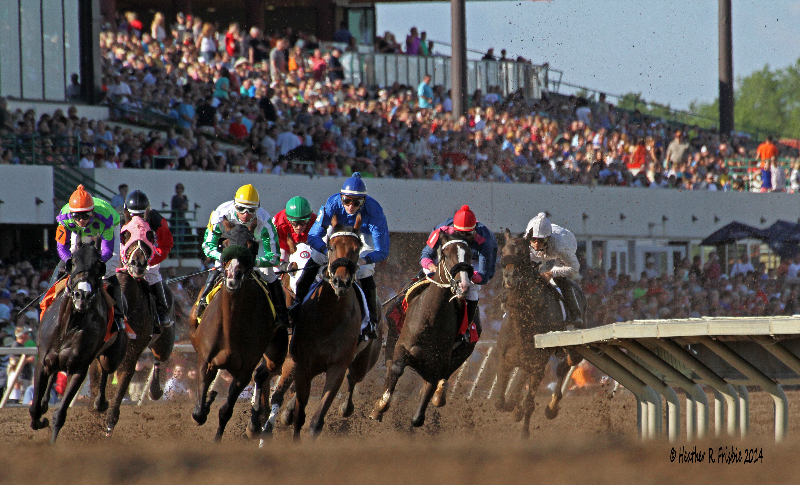
When the gates open for Canterbury Park’s first race on May 3, 2019, it will mark the 25th season of operation under public ownership led by the Sampson and Schenian families. Minnesota racing was down and out for the count after debuting in 1985 at then-Canterbury Downs with much fanfare and seam-bursting crowds. Through management changes and the development of Native American gaming just down the street at Little Six and then Mystic Lake, the track spiraled downward into unprofitability before being mothballed by Ladbrokes in 1993.
In 1994, Curtis Sampson and Dale Schenian stepped in, reopened the racetrack and began the great Minnesota racing turnaround. One of Curtis’ sons, Randy, is the track’s current CEO and president while another son, Russell, runs the family’s racing and breeding operation.
“That’s the only reason this racetrack is here,” said Andrew Offerman, Canterbury’s Senior Director of Racing. “Horsemen bought it because this is what they wanted to do. There are certainly still differences of opinion between management and horsemen on what should be done on some issues, but the differences are so minor compared to what faces other places because of the people that are here running things.”
Kay King
“We are fortunate here in Minnesota,” said Kay King, Executive Director of the Minnesota Thoroughbred Association, “that track management, the HBPA, owners, trainers—everyone can work together on a common cause. There is not the friction that you hear about elsewhere. I have people from other states tell me that they can’t believe that the MTA and the MQHRA work together on issues and put on a barbeque for backside workers together because in their states the Thoroughbred and quarter horse folks couldn’t get along long enough to do that.”
The track still had to compete with Native interests as well as stiff competition for the recreation dollar in the Minneapolis/St. Paul metropolitan area.
In 2012, the Shakopee Mdewakanton Sioux Community (SMSC)—proprietors of Little Six and Mystic Lake Casinos—and the track entered into an historic joint marketing agreement, leaving their animus in the past and moving into the future as partners.
The agreement provided the purse account with $75 million over ten years. The track and SMSC agreed to work together to promote the region and resist the expansion of gaming. The pair teamed with the nearby Renaissance Festival and Valleyfair Amusement Park to market themselves as River South, an area in the south metro to stay and play.
Thanks to the agreement, purses have increased substantially. In 2011, the year prior to the agreement, total purse distribution equaled $6,172,707. For the 2018 meet, that amount nearly doubled, rising to $13,316,050.
Because some of the money from the SMSC agreement has been dedicated to the Minnesota-bred stakes program, breeding is also on the upswing. The year prior to the SMSC agreement, the foal crop was 153 registered foals. The 2013 crop—the first post agreement—jumped to 253 registered foals. The number since then has remained relatively steady with quality increasing every year.
The only requirement to have a Minnesota-bred foal is the mare has to be in the state by March 15 prior to foaling.
The tentative 2019 Canterbury Park Stakes schedule features 18 state-bred stakes with over $1.3 million up for grabs.
It is not only the owners of Minnesota-breds that are making money, but their breeders as well. While purse supplements for Minnesota-breds totaled $325,435 in 2018, breeder awards increased 4% over 2017 to $460,595, while stallion awards increased 2% to $85,527. Total added money, either breeding or racing, was $871,557 for 2018.
“I think you’re going to see some phenomenal pedigrees this year,” said Dave Dayon, owner of Wood-N-Wind Farm, a leading breeding and foaling farm in Minnesota. “We have a Quality Road and an Orb from this year, and I just got the list for 2019 that are coming in for Lothenbach Stables: we’ll have a Kitten’s Joy, two Malibu Moons, a Speightstown and others—and I have 14 mares from him this season.”
Dean Benson
Breeder Dean Benson of Wood Mere Farm foaled out an American Pharoah colt earlier this year—the first time a Triple Crown winner has sired a Minnesota-bred.
“My client was very involved in Illinois, but he was seeing what has happened to that program so he decided to get involved in Minnesota,” said Benson. “And he did it in a big way.”
The increase in Minnesota-bred quality has also made its way into the sales ring.
The market for quality-bred horses is better than it has ever been. The 2018 MTA yearling sale had a six-figure horse for the first time in its history. The pairing of Discreet Cat and Gypsy Melody—a six-figure earning, stakes-winning mare—produced a colt that sold for $100,000 to Novogratz Racing Stable.
“I have a client who had a Quality Road,” said Benson. “He foaled in Kentucky but ended up being bought back in a Kentucky sale. If he had bred and sold him up here, I know he would have piqued the interest of the big owners, and he would have got the money for him.”
“Over the last few years we are slowly starting to see an increase in buyers here at our sale,” said King. “We’re starting to see buyers who realize that a Minnesota-bred can bring money. There was always that ‘glass ceiling’ of around $50,000, which was as high as folks would go for a Minnesota-bred. This year we shattered that with three of the forty horses sold, bringing more than $50,000 including the $100,000 gelding.”
King and her husband bred the sales topper from 2017, an Astrology colt out of former Minnesota champion Bella Notte named Notte Oscura, which sold for $37,000 to Paul Schaffer. Schaffer turned around and did what was thought to be impossible: he pin-hooked the Minnesota-bred in the 2018 April OBS Sale for $160,000.

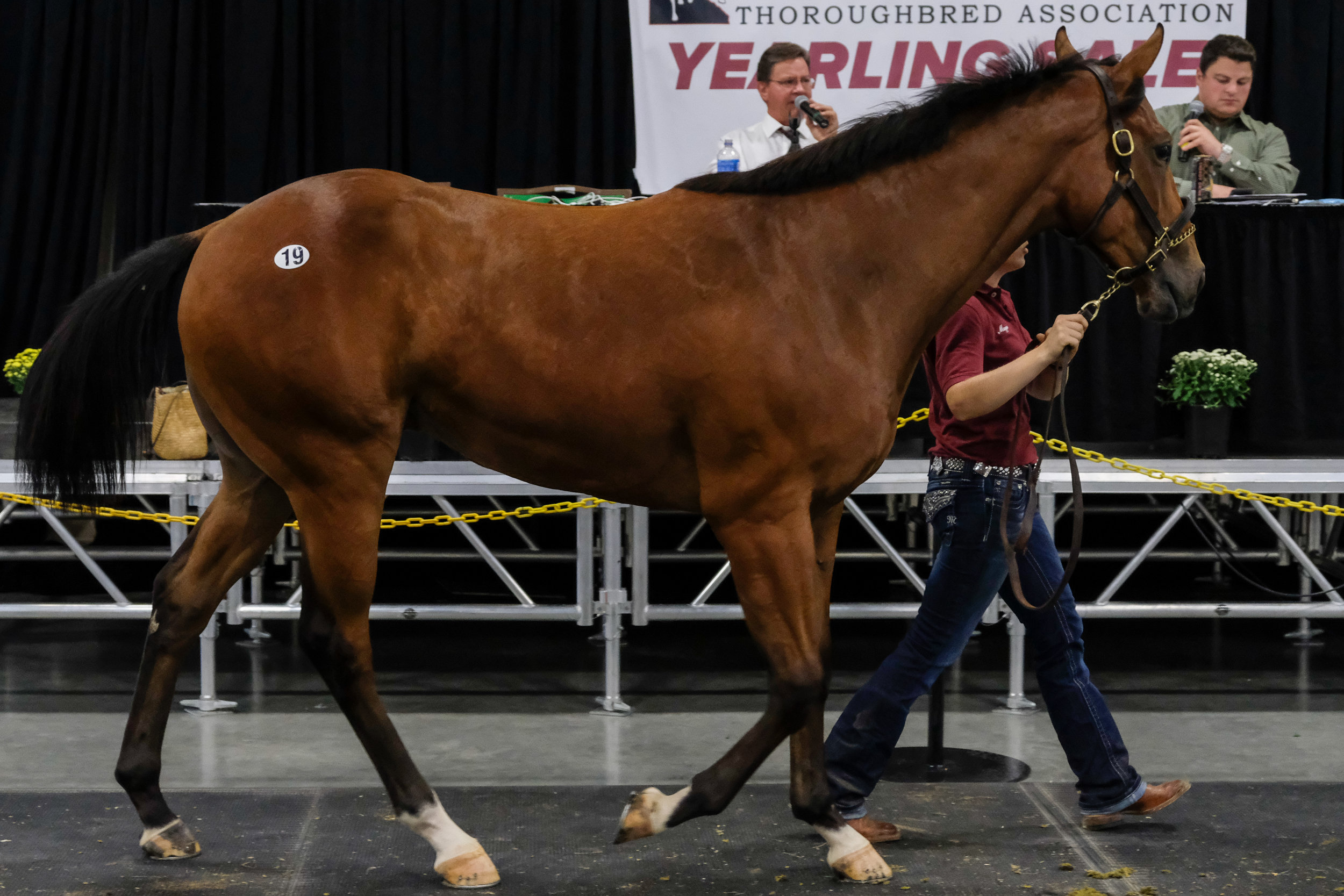
In the October 2017 Fasig-Tipton yearling sale, a Minnesota-bred yearling became the highest priced gelding ever sold at auction. The son of Maclean’s Music and Mesa Mirage, bred by Almar Farms, brought $200,000. The yearling, subsequently named Mister Banjoman, won this year’s Shakopee Juvenile, a $75,000 unrestricted stakes race and finished the season with two wins and a second in four starts, only faltering in his turf debut in the Indian Summer Stakes at Keeneland.
Mr Jagermeister
Mr. Jagermeister, a Minnesota-bred and owned by trainer Valorie Lund and her sisters, has won seven of twelve starts, amassed $308,975 and finished second in the Prairie Gold Juvenile at Prairie Meadows and the Bachelor Stakes at Oaklawn.
“People are seeing that there is value to Minnesota-bred horses,” said King. “People are making wise breeding decisions.”
Quality pedigree Minnesota-breds are selling for considerably more money than ever—locally and around the country—and competing favorably against all comers.
TO READ MORE —
BUY THIS ISSUE IN PRINT OR DOWNLOAD -
Spring 2019, issue 51 (PRINT)
$6.95
Spring 2019, issue 51 (DOWNLOAD)
$3.99
WHY NOT SUBSCRIBE?
DON'T MISS OUT AND SUBSCRIBE TO RECEIVE THE NEXT FOUR ISSUES!
Print & Online Subscription
$24.95
Exercising Horse Sense Part I: Avoiding Grey Areas When Hiring Exercise Riders

By Peter J. Sacopulos
This is the first article in a two-part series on managing your legal and tax liabilities when hiring exercise riders. It examines recent accidents involving riders, how to ensure a rider’s status as an independent contractor, and hiring basics. Part II will focus on available insurance protection for trainers and riders, as well as proper safety regulations, procedures and equipment, and equine liability laws.
A Series Of Tragic Events
Shortly before 6:00 a.m. on November 11, 2018, Odanis Acuna, a long-time exercise rider at Churchill Downs, was taking two-year-old New York Harbor through a routine workout. Acuna was breezing the unraced colt when it suddenly broke down, sending both horse and rider crashing to the ground. The track’s EMTs responded quickly, but Acuna had sustained catastrophic head and neck injuries in the fall. He died shortly after their arrival. Odanis “Cuba” Acuna was admired for his horse skills, work ethic, upbeat personality and devotion to his family. He was 42 years old at the time of his death.
An exercise rider
The tragedy was one in a number of recent accidents involving exercise riders. Just 14 months earlier, Darren Fortune was killed when a horse he was exercising bolted after gallop at Woodbine in Toronto. Like Acuna, 43-year-old Darren Fortune was a highly seasoned pro who impressed many with his horse skills, people skills and work ethic. In addition to his morning sessions as an exercise rider, he worked as an outrider at Woodbine. Witnesses have stated that Fortune’s actions during the mishap that took his life very likely prevented other riders from being killed or injured.
Kellie Hedges, another highly experienced exercise rider who had also served an outrider, was severely injured while working at Belterra Park near Cincinnati, Ohio. On the morning of June 26, 2018, the horse Hedges was breezing fell forward, threw Hedges, rolled over her, then rose and sped off down the track. Two outriders eventually intercepted the runaway horse—a filly that, remarkably, was not hurt in the incident. Meanwhile, the severely injured Hedges lay on the track in a daze. The Paulick Report and local news coverage reported no outrider attended to Hedges while she was down. According to Hedges, the “clear the track” alert siren sounded only briefly, and Hedges says other riders and horses returned to the track and continued to work while she lay immobile.
Track-based EMTs appeared slow to respond to Hedges accident, and track security staff demanded Hedges exit the ambulance and be taken to track offices in order to verify her license. Eventually loaded onto another ambulance, Hedges was taken to the local hospital. After she arrived, emergency room physicians had her rushed to Cincinnati Medical Center, where she underwent emergency surgery to save a broken leg. Surgeries for other injuries followed. It is unclear if Kellie Hedges will ever ride again. Belterra has drawn sharp criticism for how the incident was handled.
Questions You Must Ask
As of this writing, none of the incidents mentioned above have resulted in a lawsuit being filed. But others have. All pose a series of questions that you should be asking yourself. As a trainer, do you know what your liability would be if an exercise rider you hired were injured or killed while working one of your horses? If a horse you are training were injured or killed while being exercised? If another horse or rider were injured or killed in an accident involving a horse you are training?
On an even more basic level, do you know how to ensure that a rider who works for you is viewed by the IRS and other government entities as an independent contractor, rather than an employee who adds to your tax and liability burdens? Are you familiar with the requirements for protective gear for riders? Or are you aware of the safety guidelines every exercise rider should be operating under on a daily basis?
The answer to any one of these questions could dramatically impact your ability to earn a living as a trainer, especially if something goes wrong. This article is designed to provide you with broad, general advice about such issues. Remember, regulations vary widely. You should seek professional legal and insurance advice when dealing with the specific needs of your business.
Employee vs. Independent Contractor
Under U.S. labor and tax laws, the IRS and other government entities draw a distinction between employees and independent contractors. State and local laws and tax regulations may also apply. Both an employee and an independent contractor may perform tasks for a company. But legally speaking, each is a distinctly different type of worker.
In North America, an employer is responsible for specific payments toward an employee’s Social Security, unemployment insurance and Medicare funding. Often, employers are also responsible for an employee’s worker compensation insurance funding and certain aspects of offering or providing employee health insurance. The employer is also responsible for payroll reporting to the employee and the IRS. At the end of each calendar year, the employer must provide each employee and the IRS with a completed W-2 form. Employees may work for an employer on a full-time or part-time basis, and the number of hours worked may affect certain aspects of what the government requires the employer to fund or provide on an employee’s behalf.
In short, an employee works for a business or organization. By contrast, an independent contractor performs work for an individual, business or organization but works for himself or herself as an independent business. This means that independent contractors are responsible for their own Social Security and Medicare funding (paid as self-employment taxes) as well as certain other payments. Independent contractors are also responsible for seeking out and paying for their own health insurance, retirement funding, disability insurance, and so forth. Any business that uses an independent contractor must pay the contractor for satisfactory work. The business must also provide a completed Form 1099 to both the independent contractor and the IRS if the business pays the independent contractor more than $600 in a calendar year. (Note: Independent contractors are also commonly referred to as freelancers, contract workers or contract laborers.)
So why doesn’t every business simply declare its employees to be independent contractors and save big on tax payments, perks and paperwork? Because the determination is not strictly up to the employer. Laws, tax regulations and guidelines apply, playing an essential role in determining which workers are employees and which workers are independent contractors. Failing to follow the rules invites major trouble, especially if an employer tries to commit fraud by passing off employees as independent contractors. Doing so can lead to a nightmare of make-up payments and paperwork, as well as severe tax penalties and criminal prosecution.
Categories to Consider…
TO READ MORE —
BUY THIS ISSUE IN PRINT OR DOWNLOAD -
Spring 2019, issue 51 (PRINT)
$6.95
Spring 2019, issue 51 (DOWNLOAD)
$3.99
WHY NOT SUBSCRIBE?
DON'T MISS OUT AND SUBSCRIBE TO RECEIVE THE NEXT FOUR ISSUES!
Print & Online Subscription
$24.95
Ulcer medication: are the products different?

By Celia M. Marr
Stomach Ulcers Are Not All the Same
Racehorse trainers and their vets first began to be aware of stomach ulcers over 20 years ago. The reasons why we became aware of ulcers are related to technological advances, which produced endoscopes long enough to get into the equine stomach. At that time, scopes were typically about eight feet long and were most effective in examining the upper area of the stomach, which is called the squamous portion. Once this technology became available, it was quickly appreciated that it is very common for racehorses to have ulcers in the squamous portion of the stomach.
Figure 1
The equine stomach has two main areas: the squamous portion and the glandular portion. The stomach sits more or less in the middle of the horse, immediately behind the diaphragm and in front of and above the large colon. Imagine the stomach as a large balloon with the esophagus—the gullet—entering halfway up the front side and slightly to the left of the balloon-shaped stomach and the exit point also coming out the front side but slightly lower and to the right side. The tissue around the exit—the pylorus—and the lower one-third, the glandular portion, has a completely different lining to the top two-thirds, the squamous portion.
The stomach produces acid to start the digestive process. Ulceration of the squamous portion is caused by this acid. Like the human esophagus, the lining of the squamous portion has very limited defenses against acid. But, the acid is actually produced in the lower, glandular portion. The position of the stomach is between the diaphragm, which moves backwards as the horse breathes in and the heavy large intestine which tends to push forwards as the horse moves. During exercise, liquid acid produced at the bottom of the stomach is squeezed upwards onto the vulnerable squamous lining. It makes sense then that the medications used to treat squamous ulcers are aimed at blocking acid production.
Lesions in the glandular portion of the stomach are less common than squamous ulcers. The acid-producing glandular portion has natural defenses against acid damage including a layer of mucus and local production of buffering compounds. At this point, we actually know relatively little about the causes of glandular disease, but it is becoming increasingly obvious that disease in the glandular portion is very different from squamous disease. Often, it is more difficult to treat.
Figure 2
Stomach ulcers can cause a wide range of clinical signs. Some horses seem relatively unaffected by fairly severe ulcers, but other horses will often been off their feed, lose weight, and have poor coat quality. Some will show signs of abdominal discomfort, particularly shortly after eating. Other horses may be irritable—they can grind their teeth or they may resent being girthed. Additional signs of pain include an anxious facial expression, with ears back and clenching of the jaw and facial muscles and a tendency to stand with their head carried a little low.
Assessing Ulcers
Ulcers can only be diagnosed with endoscopy. A grading system has been established for squamous ulcers, which is useful in making an initial assessment and in documenting response to treatment.
Grade 0 = normal intact squamous lining
Grade 1 = mild patches of reddening
Grade 2 = small single or multiple ulcers
Grade 3 = large single or multiple ulcers
Grade 4 = extensive, often merging with areas of deep ulceration

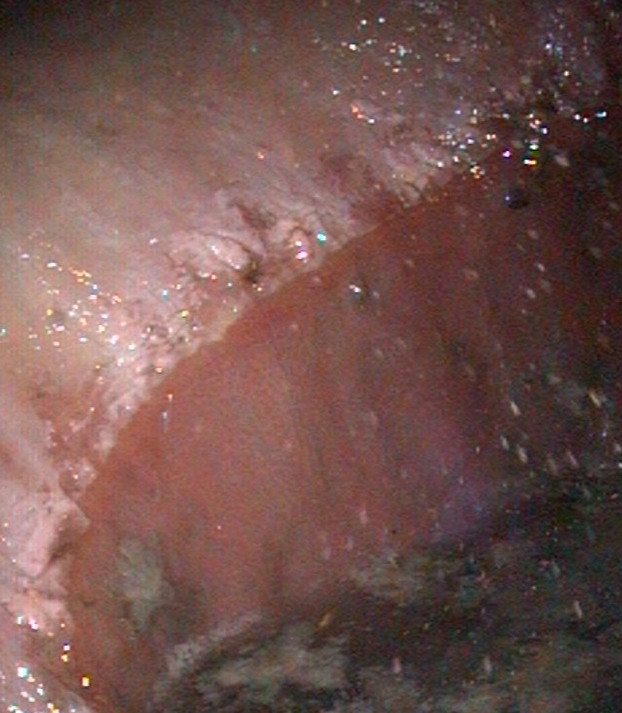


Although it is used for research purposes, this grading system does not translate very well to glandular ulcers where typically, lesions are described in terms of their severity (mild, moderate or severe), distribution (focal, multifocal or diffuse), thickness (flat, depressed, raised or nodular) and appearance (reddening, hemorrhagic or fibrinosuppurative). Fibrinosuppurative suggests that inflammatory cells or pus has formed in the area. Focal reddening can be quite common in the absence of any clinical signs. Nodular and fibrinosuppurative lesions may be more difficult to treat than flat or reddened lesions. Where the significance of lesions is questionable, it can be helpful to treat the ulcers and repeat the endoscopic examination to determine whether the clinical signs resolve along with the ulcers.


Medications for Squamous Ulcers
Because of the prevalence and importance of gastric ulcers, Equine Veterinary Journal publishes numerous research articles seeking to optimize treatment. The most commonly used drug for treatment of squamous ulcers is omeprazole. A key feature of products for horses is that the drug must be buffered in order to reach the small intestine, from where it is absorbed into the bloodstream in order to be effective. Until recently only one brand was available, but there are now several preparations on the market and researchers have been seeking to show whether new medicines are as effective as the original brand. There is limited information comparing the new products, and this information is essential to determine whether the new, and often cheaper, products should be used. A team of researchers formed from Charles Sturt University in Australia and Louisiana State University has compared two omeprazole products given orally. A study reported by Dr. Raidal and her colleagues, showed that not only were plasma concentrations of omeprazole similar with both products, but importantly, the research also showed that gastric pH was similar with both products, and both products reduced summed squamous ulcer scores. Both the products tested in this trial are available in Australia and, although products on the market in other regions have been shown to achieve similar plasma concentrations and it is therefore reasonable to assume that they will be beneficial, as yet, not all of them have been tested to show whether products are equally effective in reducing ulcer scores in large-scale clinical trials. Trainers should discuss this issue with their vets when deciding which specific ulcer product they plan to use in their horses.
Avoiding drugs altogether and replacing this with a natural remedy is appealing. There is a plethora of nutraceuticals around and anecdotally, horse owners believe they may be effective. One such option is aloe vera that has antioxidant, anti-inflammatory and mucus stimulatory effects, which might be beneficial in a horse’s stomach. Another research group from Australia, this time based in Adelaide, has looked at the effectiveness of aloe vera in treating squamous ulcers and found that, although 56% of horses treated with aloe vera improved and 17% resolved after 28 days, this is compared to 85% improvement and 75% resolution in horses given omeprazole. Therefore, Dr. Bush and her colleagues from Adelaide concluded treatment with aloe vera was inferior to treatment with omeprazole.
Medications for Glandular Ulcers….
TO READ MORE —
BUY THIS ISSUE IN PRINT OR DOWNLOAD -
Spring 2019, issue 51 (PRINT)
$6.95
Spring 2019, issue 51 (DOWNLOAD)
$3.99
WHY NOT SUBSCRIBE?
DON'T MISS OUT AND SUBSCRIBE TO RECEIVE THE NEXT FOUR ISSUES!
Print & Online Subscription
$24.95
Profile: David Duggan

By Giles Anderson
Golden Gate Fields is one of North America’s fastest growing racetracks in terms of handle growth. But that’s only part of the story as Giles Anderson found out when he recently sat down with Golden Gate Fields General Manager and Vice President David Duggan.
GA: You’ve been at Golden Gate Fields now for nearly eighteen months, running the track since October 2017. The figures from your first winter/spring meet were up massively, and then the summer meet was up 29%. What have you done to achieve such staggering growth?
DD: We made a lot of changes. It became quite a fast-moving, changing environment. What we discovered was that we have a lot of people who've been here for many, many years, but there hadn't been any adrenaline shot given to the place for quite some time, so we did change it, but it wasn't necessarily all down to me. There was a lot of people involved in this, and I was keen to have a younger crew in the management of the facility. They're great at connecting and they understand what their friends and colleagues are thinking, and they tell me. I feel all the talk about getting the young people in, and we have an aging demographic that follows horse racing. The only way to connect with young people and the millennials, and all these different groups that people are putting together now, is to listen to young people and that's what we have.
We've spent a lot of time since I came here, both myself and Cynthia Sidle—my special operations manager in San Francisco. We speak to and go and shake hands and meet lots of different groups. We've made a very big effort in Chinatown because I obviously know the Asian market quite well. We take bus loads of them to come out here on a Saturday to see us. We've spent a lot of time with the LGBTQ community and we've had some very, very successful events with them as well and indeed the Hispanic population which is very, very big in the city. We have a specific Latin festival here in the summer which is very, very well patronized as well.
What we've discovered is we can sit and hope people are going to come. In the greater majority of time, we've actually had to go out and get the people and bring them here. There's so much talk that the world of horse racing has become very, very small through various means, but there's so much talk about attracting younger people, getting younger people to come to the races. That's all very well, but you've got to be proactive and you have to do something about it.
If you make the effort to get people and bring them to the racetrack, they will come back.

But was the handle growth mainly off track—is that where the growth was coming from?
We worked hard with the racing office to increase the field size, therefore a lot of eyes around the country were on us. We also paid particular attention to the post times because on a weekend in particular, it can become quite a congested program because you have action on the East Coast, you have action on the West Coast, and you have action in Florida. It's very important to keep an eye on when everybody's coming out of the starting gate. We're very keen, and we watch them very carefully and we get a lot of help. If we need to move or wait a couple of minutes until somebody finishes, that's what we did.
When we looked at the figures, it was evident that we were clashing with bigger meetings; it was the “clash of the Titans” really. We were going off at the same time as Saratoga or Keeneland or Belmont, and we were going to lose every time. It was like a heavyweight mismatched boxing match.
We had to adjust that and that was a big help, but export was great and amazingly enough of our own track figure—people betting on us, on the facility, etc. was very good too with the increased attendance, but our figures across the board were good.
What's your average field size been?
Our average field size has jumped. I think we're about a 7.2 and we're heading in the direction of 7.4 at the moment. That's a big, big jump from early sizes (late 5’s).
You’re in a unique position having the only artificial surface on the west coast. That must be a big strength for you?
Although we've got lots of different artificial surfaces worldwide, the Tapeta track is sensational. We've got a beautiful, beautiful turf track here. It's very mature and it really is tremendous. In fact Tom Queally, who was Sir Henry Cecil's jockey, was here for a season last year, and he said it rode as good a turf track as any.
When we do have to come off the turf, when we have heavy rain and we go onto the Tapeta, it's a very seamless transition and we get very few scratches. It takes the weather really well. It really is a great all-weather surface. I know Tapeta and Michael Dickinson won't thank me for saying all-weather, but it is Tapeta surface; but it's extremely durable, very kind and it's got a great cushion on it. The equine injuries are way, way down and there's very little attrition off it. It's really a wonderful surface.
The horsemen love it. It's great to train on and it's very durable. I think that's the key. There's a lot of horses out there in the morning. It's very easy to maintain as well. Once you follow the guidelines as set out by the manufacturers, it really is terrific.
What's your stabling capacity?
Well, we can hold something in the region of 1,400 horses. I think we've got 1,350 odd at the moment, so we're very, very full. A lot of that credit goes to Patrick Mackey and his racing team down there. Patrick and I went out and we went to the East Coast. We went to tracks that would have similar surfaces to us, and we got some trainers to come here from there.
It's not as easy. We haven't got a great pool of horses around us so we have to go and get them, but we're very full at the moment. We've also got some excellent trainers.
Last summer, the Northern California off track wagering deal was seemingly threatening the future structure of racing in this part of the state. Has any progress been made?
Very often in California it's a place of political influence, and sentiment outweighs economic reality, which in itself is puzzling, but that's California. It's a very different state. It's a very heavily regulated state, and that transcends down to horse racing as well and the administration of horse racing.
Tim Ritvo is very keen to provide a better grounding for our trainers with regards to what they get back and the purse money gets back. That's an ongoing situation at the moment and that'll continue to play out, I would imagine, well into 2019.

We'd love to be year round. We always put in our application for as many dates as we can possibly have. It's a shame in many respects that we don't race in the summer because we've got such a fabulous turf track that holds its moisture so well; and we'd love to be racing on the turf, but we don't for the greater part of June and July, and we start back in August. It's regrettable but it is the way it is. Hopefully one day the time will come when we can race in the summer.
Where do you see the role of the fair meets?
I think the fairs are part of the fabric of Californian society and there's no denying that. Whether they continue to exist in the current format, it will be interesting to see how that plays out. But they've been here a lot longer than me, and they probably will continue to be here a lot longer than me. We do our very best to accommodate them. The majority of the horses that are stabled at Golden Gate Fields race indeed at the fairs. I think there will come a time where perhaps economic reality will outweigh political sentiment. It's important to recognize at the very least that they are part of the fabric of our society in California.
Looking ahead for the coming year, what are your aspirations for the track?…
TO READ MORE —
BUY THIS ISSUE IN PRINT OR DOWNLOAD -
Spring 2019, issue 51 (PRINT)
$6.95
Spring 2019, issue 51 (DOWNLOAD)
$3.99
WHY NOT SUBSCRIBE?
DON'T MISS OUT AND SUBSCRIBE TO RECEIVE THE NEXT FOUR ISSUES!
Print & Online Subscription
$24.95
An introduction to the functional aspects of conformation
By Judy Wardrope
The first in a series of articles which set out different ways to examine a horse’s conformation affects their running style.

Tiznow

Lady Eli

Unnamed horse
Why is one horse a sprinter and another a stayer? Why is one sibling a star and another a disappointment? Why does one horse stay sound and another does not? Over the course of the next few issues, we will delve into the mechanics of the racehorse to discern the answer to these questions and others. We will be learning by example, and we will be using objective terminology as well as repeatable measures. This knowledge can be applied to the selection of racing prospects, to the consideration of distance or surface preferences and, of course, to mating choices.
Introducing a different way of looking at things requires some forethought. Questions need to be addressed in order to provide educational value for the audience. How does one organize the information, and how does one back up the information? In the case of equine functionality in racing, which horses will provide the best corroborative visuals?
After considerable thought, these three horses were selected: Tiznow (Horse #1) twice won the Breeders’ Cup Classic (1¼ miles) ; Lady Eli (Horse #2) won the Juvenile Fillies Turf and was twice second in the Filly and Mare Turf (13/8 miles); while our third example (Horse #3) did not earn enough to pay his way on the track. Let’s see if we can explain the commonalities and the differences so that we can apply that knowledge in the future.
Factors for Athleticism
If we consider the horse’s hindquarters to be the motor, then we should consider the connection between hindquarters and body to be the horse’s transmission. Like in a vehicle, if the motor is strong, but the transmission is weak, the horse will either have to protect the transmission or damage it.
According to Dr. Hilary M. Clayton (BVMS, PhD, MRCVS), the hind limb rotates around the hip joint in the walk and trot and around the lumbosacral joint in the canter and gallop. “The lumbosacral joint is the only part of the vertebral column between the base of the neck and the tail that allows a significant amount of flexion [rounding] and extension [hollowing] of the back. At all the other vertebral joints, the amount of motion is much smaller. Moving the point of rotation from the hip joint to the lumbosacral joint increases the effective length of the hind limbs and, therefore, increases stride length.” From a functional perspective, that explains why a canter or gallop is loftier in the forehand than the walk or the trot.
In order to establish an objective measure, I use the lumbosacral (LS) gap, which is located just in front of the high point of the croup. This is where the articulation of the spine changes just in front of the sacrum, and it is where the majority of the up and down motion along the spine occurs. The closer a line drawn from the top point of one hip to the top point of the other hip comes to bisecting this palpable gap, the stronger the horse’s transmission. In other words, the stronger the horse’s coupling.
We can see that the first two horses have an LS gap (just in front of the high point of the croup as indicated) that is essentially in line with a line drawn from the top of one hip to the top of the opposing hip. This gives them the ability to transfer their power both upward (lifting of the forehand) and forward (allowing for full extension of the forehand and the hindquarters). Horse #3 shows an LS gap considerably rearward of the top of his hip, making him less able to transfer his power and setting him up for a sore back.
You may also notice that all three of these sample horses display an ilium side (point of hip to point of buttock), which is the same length as the femur side (point of buttock to stifle protrusion)—meaning that they produce similar types of power from the rear spring as it coils and releases when in stride. We can examine the variances in these measures in more detail in future articles, when we start to delve into various ranges of motion as well as other factors for soundness or injury.
Factors for Distance Preferences
The hindquarters of Horse #1 and Horse #2 also differ from that of Horse #3 based on the location of the stifle protrusion (not the actual patella, but the visible protrusion that one can watch go through its range of motion as the horse moves). The differences in stifle placement equate with range of motion of the hind leg, stride length and, to some degree, stride rate.
When it comes to the stifle placement for a champion at classic distances, we can see just how far below sheath level Tiznow’s stifle protrusion is and we can equate that to Lady Eli’s as well, even though she doesn’t have a sheath. Horse #3 has a stifle placement that is higher than the other two horses, more in keeping with the placement of a miler (at the bottom of or just below the bottom of the sheath). Sprinters tend to have stifle placement that is above that of milers.


The most efficient racehorses have a range of motion of the forehand that corresponds to the range of motion of the hindquarters. That may seem like stating the obvious, but not all horses have strides that match fore and aft. We have seen those horses that “climb” in the front as well as those that seem to “bounce” higher in the rump. In both cases, a mismatch of strides is often the cause.
For simplicity, let’s say the horse has to generate power from his hindquarters, transfer that power upward and forward through the spine as well as extend his front end at the same stride rate created by the hindquarters for efficiency. He/she has to maintain the same rate in the forequarters and the hindquarters.
One of the things we seldom think about is that horses have to move the front quarters at the same stride rate created by the hindquarters, but they do not necessarily have to be built to have the same stride lengths and turnover rates front and back.
If a horse has to significantly adjust the stride length fore or aft, he/she is likely not going to win in top company, especially racing. And for those horses that can adapt to slight discrepancies, a strong LS placement is paramount.
A car with different sized tires in the front than in the back will travel at a constant speed, but the smaller tires will rotate faster than the larger ones. A horse can’t do that, though; he/she has to compensate to bring the front and rear into the same stride rate.
TO READ MORE —
BUY THIS ISSUE IN PRINT OR DOWNLOAD -
Spring 2019, issue 51 (PRINT)
$6.95
Pre Breeders’ Cup 2018, issue 50 (DOWNLOAD)
$3.99
WHY NOT SUBSCRIBE?
DON'T MISS OUT AND SUBSCRIBE TO RECEIVE THE NEXT FOUR ISSUES!
Print & Online Subscription
$24.95
Changing hemispheres

By Jeff Lowe
For as long as racehorses have been moved from one hemisphere to the other, the effect of crossing the equator has been an age-old mystery. How much recovery time a horse generally needs, and why, is still a complex issue for American trainers who regularly find success with horses from the Southern Hemisphere.
Hall of Fame trainers Richard Mandella and Ron McAnally follow a similar timetable before they generally feel comfortable sending a horse from the Southern Hemisphere to the races. Mandella, who has a long list of South American stars like Bal a Bali, Redattore, Gentlemen, Sandpit and Siphon accentuating his career highlights, suggested that four months is an ideal amount of time once a horse arrives to the United States before his or her first race. McAnally, with a roll call from Argentina that includes Candy Ride, Different, Paseana, Festin and Bayakoa, operates with a ballpark estimate of four to six months.


"I could not tell you why they need that long," McAnally said. "It would take God almighty upstairs to answer that.
“I just know that with a horse like Candy Ride, he had about six months once he got here and he was ready to go; he won an allowance on the dirt at Hollywood Park, then he won a nine-furlong Gr2 on the turf at Hollywood Park, and he won the Pacific Classic [a $1-million Gr1] going a mile and a quarter at Del Mar.”
Mandella's and McAnally's calendar does fly in the face of the schedule of a giant gelding who helped blaze the trail from the Southern Hemisphere to the U.S. Australian legend Phar Lap traveled 10,000 miles by ship to San Francisco in the winter bridging 1931 and '32, arriving January 15. He promptly ran away with the Aqua Caliente Handicap in Mexico just two months later, setting a track record before mysteriously dying that April.
Likewise, with the shoe on the other foot, horses from Europe regularly trek to Australia for prestigious races. Godolphin Racing's Cross Counter arrived "Down Under" last September 8 from England and came away with a victory in the Gp1 Melbourne Cup two months later. European shippers have won the Melbourne Cup five times in the last nine editions.
Black Caviar wins the Gp1 Diamond Jubilee Stakes at Ascot
Heading the other way, horses from Australia have been successful right off the bat in Europe, with the prolific sprinter Black Caviar as perhaps the most notable example. She won the Gp1 Diamond Jubilee Stakes at Royal Ascot just six weeks after prevailing in the Gp1 Goodwood in Adelaide, Australia. Aidan O’Brien’s spectacular success from his Ballydoyle base in Ireland has featured a few imports from Australian and New Zealand, among them a top-caliber sprinter in Starspangledbanner and a 10-furlong specialist in So You Think.
Starspangledbanner, like Black Caviar, scored in the 2006 edition of the Gp1 Golden Jubilee at Royal Ascot, just a couple months after arriving from Australia. Conversely, So You Think had six months in between his final start “Down Under” and his European debut in Ireland.
“It all depends on the individual horse and how they adapt,” O’Brien said. “No doubt, when they don’t have to stop training and can continue exercise in quarantine, [it] is a big help.”
Mandella suggested that a break is often necessary for a Southern Hemisphere horse to adjust to its new environment and build back up after a long season back home. The differences in the U.S. include the makeup of the racetracks, as some dirt tracks in South America are much harder than the sandy loam in place at Santa Anita and elsewhere in the states. South American imports also have to adjust to wearing a saddle in their training each day, whereas back home they usually would only be ridden with a saddle in workouts and races.
"I let them down and bring them back easy and by the time I get them ready it's about four months, and I think that works real well," Mandella said. "Generally they have done quite a bit to earn the chance to come here, so they are due [for some time off], but the difference in the environment and the training is probably the biggest change, and you have to kind of re-train them to our style of training with saddles every day, traffic they have to face—those kind of things that we have at our American racetracks."
TO READ MORE —
BUY THIS ISSUE IN PRINT OR DOWNLOAD -
Spring 2019, issue 51 (PRINT)
$6.95
Spring 2019, issue 51 (DOWNLOAD)
$3.99
Add to cart
WHY NOT SUBSCRIBE?
DON'T MISS OUT AND SUBSCRIBE TO RECEIVE THE NEXT FOUR ISSUES!
Print & Online Subscription
$24.95
Andrew Lerner - a young trainer on the up
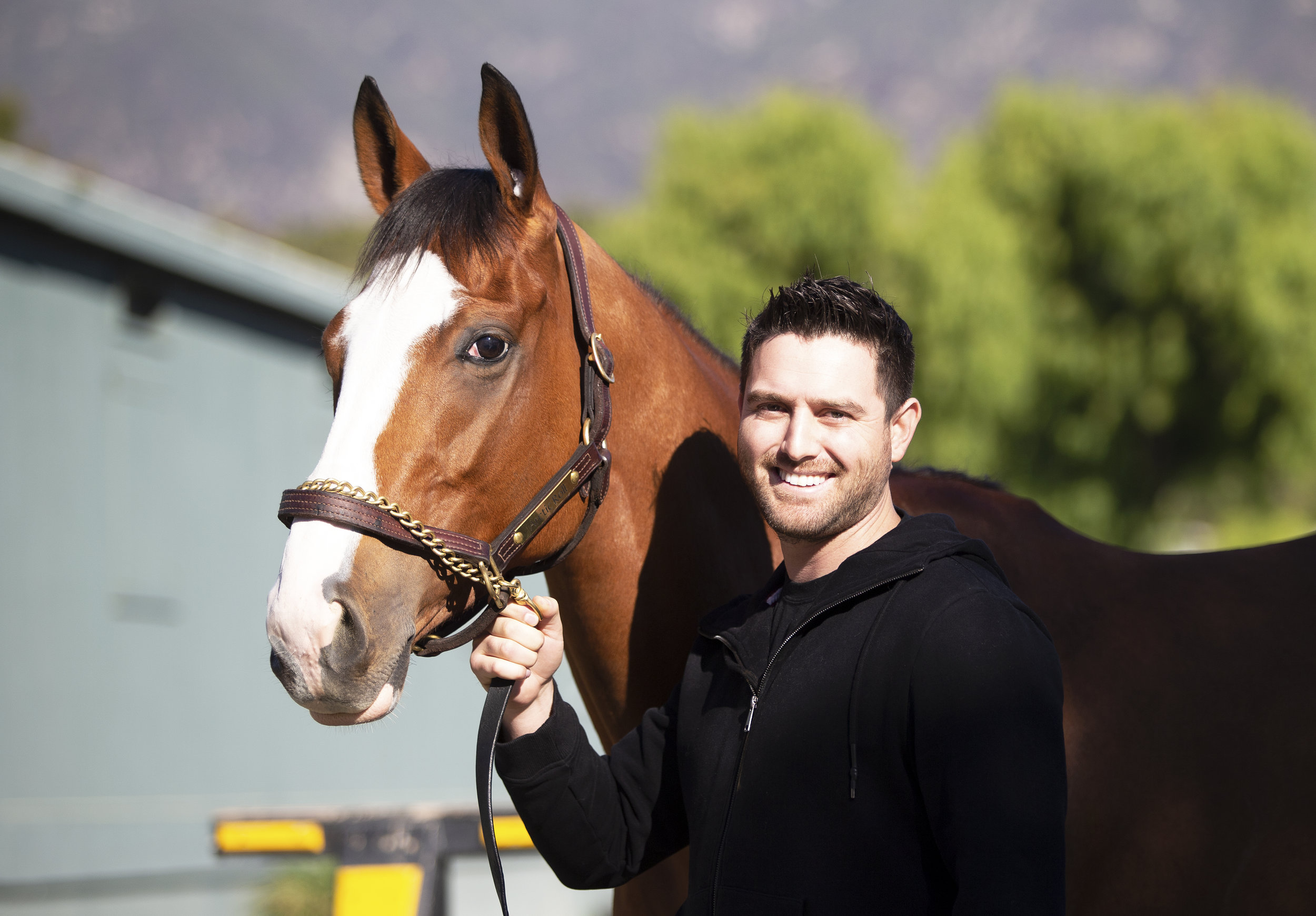
By Ed Golden
Andrew Lerner looks like he just stepped off the pages of GQ.
At 29, six feet tall, 180 pounds and hazel eyes, he oozes subtle masculinity and innate innocence, bearing the attributes of an NFL tight end.
Picture Superman and Clark Kent or Butch Cassidy and the Sundance Kid.
But beneath that demure demeanor lies his true countenance, horse trainer, body and soul.
It was not a matter of if, but when it would happen.
“I created a couple of businesses that fortunately did well, and that put me in a position to buy some horses,” Lerner said. “I sent them to trainer Mike Pender with the caveat that I wanted to learn to train.
“I started a company with a friend of mine in 2012 and we did well; I sold half of it, not for a fortune, but for enough where I was able to buy a horse named Be a Lady and give it to Pender.
“That’s how it all began. She’s still racing.
“I told Mike I wanted to learn how to train, came out every morning at 4:30, shadowed his grooms and hot walkers for about a year and a half, then decided I wanted to learn how to ride, not at the track but somewhere else, just to get an idea of what the jocks and exercise riders were talking about when they got off a horse and told us how it went.
“I wanted to understand first-hand what they were explaining, more than just hearing their words. After that, it took me about six months to get my trainer’s license in March of last year.
“It was a small stable initially, just me, a groom and two horses. Now we’re up to about 22 head.”
Lerner came to Pender’s barn every morning, not with a chip on his shoulder but a thirst for knowledge.
Thus, Pender readily recognized that Lerner would triumph against the odds. His acuity was ever present.
“He won a race with the first horse we claimed together, and we were off and running,” said Pender, 52, a Los Angeles native whose major stakes winners in a career approaching 15 years include Jeranimo and Ultimate Eagle.

“When he told me he wanted to train, I asked why he would do such a crazy thing, and he was emphatic. He said he wanted to, and I knew how he felt because I had been in his shoes at one time.
“I told him he was going to fail more than he’d succeed and tried to talk him out of it, but he stood his ground. Even after I told him the only way to succeed was through hard work and spending a lot of money—some of it coming out of his own pocket when owners don’t pay and walk away leaving you high and dry with a $10,000 feed bill—he remained firm.
“He gave the right answers to all my questions, but most importantly, he showed up every morning. I’ve had a lot of guys walk through my doors saying they want to become trainers, and I feel a responsibility for them to achieve that goal, because it’s trainers who bring in new owners.
TO READ MORE —
BUY THIS ISSUE IN PRINT OR DOWNLOAD -
Spring 2019, issue 51 (PRINT)
$6.95
Spring 2019, issue 51 (DOWNLOAD)
$3.99
Add to cart
WHY NOT SUBSCRIBE?
DON'T MISS OUT AND SUBSCRIBE TO RECEIVE THE NEXT FOUR ISSUES!
Print & Online Subscription
$24.95
Add to cart
In conversation with Jim Lawson - Mr Woodbine

By Giles Anderson
Jim Lawson has literally grown up with Woodbine Racetrack, he was born in the same year that the track opened in 1956. Today Lawson assumes the roles of CEO of Woodbine Entertainment Group, Chairman of Ontario Racing, as well as chairing the board of governors of the Canadian Football League. He recently sat down with Giles Anderson to discuss the future direction and goals for racing and the Woodbine facility in the years to come.
It would be fair to say that you came to racing through a sporting injury and looking back your career may have well evolved on ice.
Yes, I played US College Hockey at Brown University in Rhode Island. By 1978 I was drafted by the Montreal Canadiens. I left school early, I had enough credits to graduate but had an injury-prone two and a half years in their organisation, with many issues. Ultimately, I retired and went to law school, and when I went to law school, like a lot of people, I thought ‘wouldn't it be great if I could do sports law, or be a player agent, or whatever?’ And of course you soon realise that you need that foundation of law and legal contracts, so I ended up doing commercial law for the most part.
So here I am, 30 years later, being in a position where I am with the Canadian Football League. Even though I was a hockey player, I always had a passion regarding football and horse racing. My dad had Thoroughbred horses from the time I was six or seven years old, so I used to come out here 1965, 1966, when I was 10 years old. He ran a modest stable, but a successful stable. He was a great student of the game and I think he won 67 stakes races here with a very modest stable over the years and he's in the Canadian Horse Racing Hall of Fame.
So I spent my early years around Woodbine and also studying bloodlines.
So how did you end up working for Woodbine?
Mostly because of the clients through my work at a major downtown Toronto law firm and as I'd spent a lot time around Woodbine, the board was aware of me. They initially asked me to come on the board to look after the 700 acres of land that they had here. So I joined the board and then I evolved into being chairman of the board in 2012.
Then in 2015, when the CEO stepped down, the board asked me to step in and, here I am. I've gone from chairman to CEO here now, but I have a big background, as I said, in horse racing and a big part of what we're doing today is real estate development.
How many teams make up the Canadian Football League?
There are nine teams. We're looking to expand it, Halifax to be a tenth team, but there are currently five teams in the west and four teams in the east. Montreal, and Toronto, and Hamilton and Ottawa and as I said, potentially an expansion team in Halifax, so a lot of teams across the country.
“THE BIGGEST CHALLENGE WE HAVE IS TWO-FOLD AND THEY’RE RELATED. AND THAT IS AN AGEING DEMOGRAPHIC IN BOTH SPORTS.”
Why do you think has there not been as much expansion in the last five years as much as there has been of teams in soccer?
Well, that's a good question. In football, the biggest, I think, single achievement is the renewal of capital investment in the stadiums, which has been a big plus. There's been a completely renovated stadium in Toronto, a brand new stadium in Hamilton, a completely renovated stadium in Ottawa, a new stadium in Saskatchewan, a new stadium in Winnipeg. So the biggest achievement, I think, is the reinvestment of capital to keep the league in good shape in the sense that it's very much a gate-driven league as opposed to many other sports, which are television revenue driven. We do have the television contract with TSN and we have good ratings on the sports network, which is a Bell Globe Media property. But I think the biggest thing that the league has done is reinvested itself and set itself up for a strong future.
Do you see a big crossover from what you’ve learned about football into racing?
The biggest challenge we have is two-fold and they're related. And that is an ageing demographic in both sports. Our core customer is probably that 50-year-old to 70-year-old male. I think we're doing a good job in horse racing because of our food and beverage experience and the cost of having a good experience here. We're making great strides in bringing up that younger customer. But our real core wagering customer fits in that 50 to 70-year-old demographic.



Woodbine’s vision for the future
The same is true in the Canadian Football League, it may well be true in the golf world and the tennis world, and so that is a real challenge to see and it is actually of interest for me to see how both organizations from the marketing partnerships approach that. And then secondly the challenge in both sports has been the consumption of the sport and what I mean is that the Canadian Football League is a gate-driven league, while in order to get people interested in horseracing, you really need to get them here and see the horses and feel the horses and just the excitement.
In both cases now, in a large part on the football side the evolution, it's not just overnight, it's the last 15, 20, 25 years depending on your measure of the large screen TVs that sit in everyone's den or family room. People want to consume sports in luxury, and television has done a great job with production, with slow motion and replays and analysis and making that television experience so great, so that a lot of people would rather than sitting out in colder weather, they'd rather sit in home in the comforts of their den or family room, watching television on a big screen TV. The same thing for horse racing, really. We have, for business purposes, made it very accessible to wager on horse racing through the internet. People don't have to come out here any more and that's a challenge.
So we've got a couple of sports there where, because of technological advances and just raising the level the game of how we distribute our content in both cases, you're challenged in terms of getting people interested. People are only going to invest in horses if they are out here and they get the excitement of the game. We need new owners, we need new breeders and you're not going to get that from people who are gambling over the internet, you're going to get that from people who come out here and say, "Wow, I love this, wouldn't it be fun to own a horse."
And the same with football, you need to get them out to the game to experience it and meet the players and see the players. One of the challenges with football, especially in Canada with so many sports coming - soccer has grown huge, or European football, shall we say - I think that one of the things we need to do with football is to get youth playing it and the likelihood of that happening is if they can get out to the games and feel the excitement, and watch it and meet the players.
TO READ MORE —
BUY THIS ISSUE IN PRINT OR DOWNLOAD -
Breeders’ Cup 2018, issue 50 (PRINT)
$6.95
Pre Breeders’ Cup 2018, issue 50 (DOWNLOAD)
$3.99
WHY NOT SUBSCRIBE?
DON'T MISS OUT AND SUBSCRIBE TO RECEIVE THE NEXT FOUR ISSUES!
Print & Online Subscription
$24.95
Osteochondrosis - genetic causes and early diagnosis

By Celia M. Marr
Osteochondrosis (OC) is a common lesion in young horses affecting the growing cartilage of the articular/epiphyseal complex of predisposed joints at specific predilection sites. In the young Thoroughbred, it commonly affects the stifles, hocks and fetlocks. As this condition has such important impact on soundness across many horse breeds, it is commonly discussed in Equine Veterinary Journal. Four recent articles covered causes of the disease, its genetic aspects, and a new and very practical approach to early diagnosis through ultrasound screening programs on stud farms.

OC is a disease of joint cartilage. Cartilage covers the ends of bones in joints, and healthy cartilage is central to unrestricted joint movement. With OC, abnormal cartilage can be thickened, collapsed, or progress to cartilage flaps or osteochondral fragments separated from the subchondral bone leading to osteochondrosis dissecans (OCD). OC and OCD can be regarded as a spectrum rather than two discrete conditions.
Certain joints are prone to OC and OCD, and there is some variation between breeds on which joints have the highest prevalence. In Australian Thoroughbreds, 10% of yearlings had stifle OC, 8% had fetlock OC, and 6% had hock OC. The prevalence data may seem very high, but Thoroughbred breeders may take some comfort in learning that similar, and indeed slightly higher prevalences, are reported in the warmblood breeds, Standardbreds, and Scandinavian and French trotters. Heavy horse breeds have the highest prevalences.
In an article discussing progress in OC/OCD research, Professor Rene Van Weeren concludes that the clinical relevance of OC is man made. In feral horses, where there is no human influence on mating pairings, OC does occur but at much lower prevalence than in horse breeds selected for sports or racing. Similarly, in pony breeds where factors other than speed and size are desirable characteristics, OC is also rare. These facts suggest that sports and racehorse breeders have inadvertently introduced a trait for OC along with other desired traits. There is a strong link between height and OC, suggesting that one of the desired traits with unintended consequences is height. This is of particular relevance in sports horses: the Dutch warmblood has become taller at a rate of approximately 1 mm per year over the past decades, which might not seem much but it is still an inch in 25 years. Van Weeren points out that if the two-hands tall Eohippus or Hyracotherium and the browsing forest-dweller with which equine evolution started some 65 millions of years ago had evolved at this speed, the average horse would now have stood a staggering 40 miles at the withers.
Drs. Naccache, Metzger and Distal, based at the Institute for Animal Breeding and Genetics in Hannover, Germany, have worked extensively on heritability and the genetic aspects of OC in horses. Their work has shown that there is not one single gene involved. In fact, genes located on not less than 20 of the 33 chromosomes of the horse are relevant to OC.
These researchers use whole genome scanning—otherwise known as genome-wide association studies, or GWAS. This approach has only been possible since the equine genome was mapped. GWAS look at the entire genetic map to detect differences between subjects with and without a particular trait or disease. Millions of genetic variants can be read at the same time to identify genetic variants that are associated with the disease of interest. Based on the number of genetic markers already found in warmblood OC, it is unlikely that a simple single-gene test will prove to be useful for screening young Thoroughbreds for OC.
TO READ MORE —
BUY THIS ISSUE IN PRINT OR DOWNLOAD -
Breeders’ Cup 2018, issue 50 (PRINT)
$6.95
Pre Breeders’ Cup 2018, issue 50 (DOWNLOAD)
$3.99
WHY NOT SUBSCRIBE?
DON'T MISS OUT AND SUBSCRIBE TO RECEIVE THE NEXT FOUR ISSUES!
Print & Online Subscription
$24.95
Racing To Comply: How The New GDPR Internet Privacy Rules Affect Trainers And Other Equine Professionals

By Peter Sacopulos
The Great Privacy Policy Alert
As the summer of 2018 began, every company doing business on the internet appeared to have developed a new user privacy policy overnight. Service providers, search engines, social media platforms, news sites, online retailers and others bombarded Americans with emails and pop-ups, urging users to review the new policies immediately and adjust their personal privacy settings accordingly. There is no official count of how many consumers dutifully clicked on links, doggedly read new rules, and deliberately updated their individual privacy preferences, or how many simply shrugged, ignored the alerts, and went on with their online lives.
Some who wondered what all the fuss was about may have thought the new privacy policies had something to do with recent headlines about corporate data breaches. Others may have associated them with the fallout of 2016’s US presidential election and UK Brexit referendum, after which reports emerged of foreign meddling online and a political consulting firm stealthily collecting data from tens of millions of Facebook users without their permission. (Criminal investigations are ongoing.) But many internet users knew the truth: the renewed focus on privacy was far from sudden and was the result of a European Union law known as the General Data Protection Regulation, that had been passed in 2016 and took effect on May 25, 2018.
The General Data Protection Regulation
Even though it is a European law, the General Data Protection Regulation (or GDPR) has implications for Americans who use the internet to conduct their business. Horse trainers and other equine professionals are no exception. This article will address the basics of GDPR, how it affects American businesses, and the primary steps your business should take to achieve and maintain GDPR compliance. Make no mistake, spending the time and effort to do so now will go a long way toward avoiding legal headaches and financial penalties in the future.
Privacy policies exist to protect personal data. Personal data is defined by the European Union as: “…any information that relates to an identified or identifiable individual….” It includes: “…Different pieces of information, which collected together, can lead to the identification of a particular person….” In short, any form or combination of information that can tell others who you are is personal data. In the US, personal data is also referred to as personally identifiable information (PII) or sensitive personal information (SPI).
Personal data typically includes information that can allow others to locate, contact or monitor you. Examples of personal data include your first and last name, home address, email address, telephone number as well as an identification card number, such as your social security number, driver’s license number or passport number. In the digital age, it can also take far more subtle forms, including some you may not have even realized, such as your Internet Protocol (IP) address, your mobile phone location data or a “cookie” ID on your computer. Personal data does not include anonymous information, such as that found in statistics.
The Big Question
The General Data Protection Regulation is based on the answer to this increasingly important question: Who owns an individual’s personal digital data?
In the United States, the answer to that question is still being debated and, some privacy advocates would go so far as to say, avoided. But the countries that make up the European Union (EU) and the European Economic Area (EEA) have determined that, when their citizens are concerned, every individual owns his or her personal data, wherever it may appear online and however it may be gathered and used by others. The GDPR enshrines this principle of personal data ownership in law. It grants specific data privacy rights to individuals and sets out rules that businesses must follow when dealing with a consumer’s data. It mandates harsh financial penalties for businesses that violate those rules, along with strict notification standards whenever a business suffers a data breach.
The American Question
The first question most Americans will ask about the GDPR is obvious. Why would an American citizen doing business in the United States need to worry about complying with a European law?
Like nearly all businesses in the digital age, the vast majority of the Thoroughbred racing community routinely conducts business on the internet. And therein lies the answer to the American GDPR compliance riddle. The web truly is worldwide and that means your website, and any and all social media platforms you use (such as Facebook, Instagram, YouTube, Snapchat, Twitter and any Thoroughbred-biz-specific websites and platforms), are as easily accessed in Europe as they are in America. In the course of conducting business online, you can come into contact with a European citizen as easily as you do an American citizen.
The General Data Protection Regulation clearly states that when any business entity, based in any location, deals with a European citizen’s data, GDPR rules apply. But there are some important exceptions. If a European citizen’s data is collected while the individual is not physically in Europe, that data is not governed by the GDPR. If, for example, a German visiting America takes an online marketing survey while in New York and offers up personal information in the process, only American regulations regarding the use of that data would apply.
The GDPR also takes intentionality into account. Basic, broad-based, generic marketing materials are exempt from the law. If an Italian citizen who has in interest in Thoroughbred training happens across the English-language website of an American horse trainer whose services are only offered in the US, the GDPR does not come into play. But if an American trainer’s site appears to target European citizens, gathers information on them, or seeks to do business with them, GDPR rules do apply.
TO READ MORE —
BUY THIS ISSUE IN PRINT OR DOWNLOAD -
Breeders’ Cup 2018, issue 50 (PRINT)
$6.95
Pre Breeders’ Cup 2018, issue 50 (DOWNLOAD)
$3.99
WHY NOT SUBSCRIBE?
DON'T MISS OUT AND SUBSCRIBE TO RECEIVE THE NEXT FOUR ISSUES!
Print & Online Subscription
$24.95
Ride & Guide - our guide to what horses can run in

By Annie Lambert
Bits and related training accessories are not all they depend on, however. The talented exercise riders they hire represent the hands using those bits, an important factor in the process.
Whatever bits and riggings a trainer prefers, they have a logical reason as to why their choices work within their program. A lot of that reasoning is chalked up to trial and error experiences.
Bit Bias
Some bits are legal for training and racing while others are not allowed in the afternoons. The most recognizable of the morning-only headgear would be the hackamore. Using a hackamore requires approval from officials.
California trainer Danny Hendricks’ father and uncle, Lee and Byron Hendricks respectfully, toured the rodeo circuit with specialty acts, trick riding and Roman jumping over automobiles. They were superior horsemen that began retraining incorrigible racehorses. The brothers introduced many bits that race trackers had not yet explored. Danny was too young to remember those bits, but did inherit the Hendricks’ talent.
“I had a filly for Dick [Richard Mandella] way back that wouldn’t take a bit, she’d just over flex,” he explained. “If you just touched her she’d put her nose to her chest and go straight back. I put a halter on her with a chifney, so it just hung there, put reins on the halter and started galloping her. It took months before she’d finally take that bit.”

The fat, egg butt snaffle is popular with many trainers as is the standard ring bit
The majority of trainers shrug off which bits are not allowed in the afternoons as they are not devices they’d think of using anyway. In fact, most trainers never ponder “illegal” bits.
Based in Southern California, Hall of Famer Richard Mandella personally feels it’s easy to make too much out of bits. He prefers to keep it simple where possible and to change bits occasionally, “so you put pressure on a different part of the mouth.”
“I don’t want to hear a horse has to have a D bit every day or a ring bit every day,” Mandella offered. Adding with a chuckle, “It’s good to change what you’re doing to their mouth, which usually isn’t good with race horses.”
Mandella learned a lot from a Vaquero horseman, Jimmy Flores, a successful stock horse trainer. His father was shoeing horses for Flores, who encouraged Mandella, then eight or nine years old, to hack his show horses around.
“Jimmy would put a hackamore on them, to get the bit out of their mouth,” Mandella recalled. “He said to me once, ‘You don’t keep your foot on the brake of your car, you’ll wear the brakes out.’ He was a great horseman.”
Trainer Michael Stidham introduced Mandella to the Houghton bit, which originally came from the harness horse industry.
“The Houghton has little extensions on the sides and it is like power steering,” Mandella said. “As severe as it looks, it’s not hard to ride. We’ve had a lot of luck with horses getting in or out, it corrects them.”
David Hofmans, a multiple graded stakes winning trainer, did not come from a horse background. He fell in love with the business when introduced to the backside by Gary Jones and went to work for Jones’ father, Farrell, shortly after.
One of many well-used tack combinations is a figure 8 over the rubber-mouthed ring bit
“We’re always trying something different if there is a problem,” Hofmans said of his tack options. “I use the same variety of ring bits and D bits with most of our horses. We use a martingale, noseband and sometimes a shadow roll. If you have a problem you try something different, but if everything is okay, you stick with what works.”
Michael McCarthy spent many years working for Todd Pletcher before moving his base to California. When it comes to bits, he hasn’t varied much from his former boss. McCarthy reminded, “When the horses are comfortable, the riders are more relaxed and everybody gets along better.”
“Most horses here just wear a plain old, thick D bit,” he said from his barn at California’s Del Mar meet. “Some of the horses get a little bit more aggressive in the morning, so they wear a rubber ring bit. In the afternoons, if we have one that has a tendency to pull, we may put a ring bit with no prongs.”
McCarthy discovered the Houghton bit in Pletcher’s where they used it on Cowboy Cal, winner of the 2009 Strub Stakes at Santa Anita. He uses the Houghton sparingly to help horses steer proficiently.
Louisiana horseman Eric Guillot said from his Saratoga office that he uses whatever bit a horse needs – a lot of different equipment combinations.
“I use a D bit with a figure 8 and, when I need to steer them, a ring bit with figure 8 or sometimes I use a ring bit with no noseband at all,” he offered. “Sometimes I use a cage bit and I might use a brush [bit burr] when a horse gets in and out. Really, every situation requires a different kind of bit.”
TO READ MORE —
BUY THIS ISSUE IN PRINT OR DOWNLOAD -
Breeders’ Cup 2018, issue 50 (PRINT)
$6.95
Pre Breeders’ Cup 2018, issue 50 (DOWNLOAD)
$3.99
WHY NOT SUBSCRIBE?
DON'T MISS OUT AND SUBSCRIBE TO RECEIVE THE NEXT FOUR ISSUES!
Print & Online Subscription
$24.95
Unravelling ulceration - The causes, treatment and prevention for squamous vs. glandular gastric ulceration

By Emma Hardy, PhD
Gastric ulcers remain a common condition facing competition horses. This poses an ongoing and persistent challenge to trainers who face the negative effects of ulcers in terms of training and performance. To address the issue, the typical trainer spends a small fortune on scores of omeprazole and other ulcer remedies, only to find the problem isn’t resolved or simply comes back.
Meanwhile, researchers have been testing the very notion of “what is an ulcer?” The data casts doubt on whether go-to treatment approaches will actually work. A look at what the research now tells us about equine gastric ulcers may provide some new guidance for how best to address this nearly ubiquitous concern.
The two faces of gastric ulceration
While many people think of gastric ulcers as one specific disease, equine vets and researchers refer to gastric ulcers as a “syndrome” (Equine Gastric Ulcer Syndrome, or EGUS). The medical definition of a syndrome describes a set of symptoms and signs that together represent a disease process. In practical terms, this means that ulcers are really a clinical signs—truly a symptom—of underlying disease conditions.
A few years ago, articles began to appear in the scientific press highlighting differences in the healing of ulcers in two distinct regions of the stomach—the upper “squamous” area on the one hand, as compared to the lower “glandular” portion on the other. In recent years, researchers in Australia published a series of articles (Sykes et al, 2014) to “clarify the distinction between diseases in different regions of the stomach” (i.e., to describe the differences between ulcers in the squamous area of the stomach from those in the lower glandular area). The articles described significant differences between the two conditions, including prevalence, risk factors and response to treatment.
An example of a cherry ulcer
Squamous gastric ulceration
The upper region of the stomach is minimally protected from the corrosive effects of stomach acids. As such, squamous gastric ulceration (i.e., ulcers in the upper region of the stomach) is believed to result from the increased exposure to acid and other contents of the stomach. Ulcers in the squamous region are also more common, affecting upwards of 70% of Thoroughbred racehorses, as demonstrated in multiple studies over the past 20 years.
Glandular gastric ulceration
By contrast, ulcers in the lower glandular region of the stomach are believed to arise from a different set of conditions. The lower portion of the stomach is composed of numerous cell types including those that secrete gastric acid. Because horses secrete stomach acid continuously, the mucosal lining in this lower portion of the stomach is in direct contact with stomach acid at all times.
The lower portion of the stomach is also better protected—the glandular mucosa is lined with a thick layer of mucus that offers natural protection from acid. It is believed that glandular ulceration results from the breakdown of this protective lining. Although no research has conclusively shown exactly how this defence mechanism breaks down in horses, research in humans shows NSAID (non-steroidal anti-inflammatory drugs) use and bacterial agents are contributors.
Based on this, equine squamous gastric ulceration (ESGUS) is a specific condition distinct from equine glandular gastric ulceration (EGGUS).
Beyond the stomach….
TO READ MORE —
BUY THIS ISSUE IN PRINT OR DOWNLOAD -
Breeders’ Cup 2018, issue 50 (PRINT)
$6.95
Pre Breeders’ Cup 2018, issue 50 (DOWNLOAD)
$3.99
WHY NOT SUBSCRIBE?
DON'T MISS OUT AND SUBSCRIBE TO RECEIVE THE NEXT FOUR ISSUES!
Print & Online Subscription
$24.95
Trainer Profile - Bill Mott

By Andrew Champagne
Some trainers start their careers with dreams of winning a garland of roses, or a gigantic trophy.
Hall of Fame trainer Bill Mott’s first big prizes, though, were substantially smaller.
“When I was 15, I got my first horse to train, which my father purchased for $320,” Mott recalled. “I put the horse in training. We ran her at a small fair meet in South Dakota, and she dead-heated for the win the first time I ever ran her.”
“The purse was $500, and we had to split 60% down the middle. I also won a blanket and a cooler. Because it was a dead heat, we flipped a coin.”
Mott still has the blanket and cooler from that race, and over the past 50 years, he’s added plenty of other pieces of hardware to his ever-growing trophy case. His career is one built on simple values instilled in him by some of the top horsemen in the Midwest during the 1970s, a group that included Keith Asmussen, Bob Irwin, and Hall of Fame conditioner Jack Van Berg.
“The major lesson I learned is, just show up and work,” Mott said. “The Asmussens were a hard-working family, and of course you can see what they’ve produced. Van Berg was the same. You worked hard, and you were a part of everything that went on. If you were interested, you were going to learn something.”

Riley Mott and Elate
After several years of honing his craft as an assistant, Mott went out on his own in 1978. When asked about obstacles he had to overcome as a new head trainer, he was quick to thank Van Berg and an assortment of owners that helped him get off on the right foot.
“Jack had given me a big opportunity, and I had owners that came to me,” Mott explained. “I didn’t go out and hustle any horses or try to recruit anyone. Everything just fell into place. I showed up for work and things kept happening. My phone was ringing, and people were wanting to send me horses.”
Less than 10 years later, a son of Nureyev found his way into Mott’s barn thanks to owner Allen Paulson, and he would help shine a light on his conditioner’s world-class talents. His name was Theatrical, and while he had won several stakes races in Europe, it wasn’t until he came to the United States that he achieved his greatest success.
Theatrical won seven of nine races in 1987, including that year’s Breeders’ Cup Turf at Hollywood Park. In total, his campaign included six Grade 1 victories, and he was crowned as that year’s Champion Grass Horse.
“Theatrical was my first champion, my first Breeders’ Cup winner,” Mott said. “He let everyone know that I could train a good horse, that I could train a Grade 1 winner, that I could train a champion. Theatrical being owned by Allen Paulson is the reason I got Cigar.”
Six and a half years after Theatrical walked off the racetrack for the final time, Cigar was transferred to Mott’s care. He had started his career in California for trainer Alex Hassinger, but was sent east at the recommendation of Dr. Steve Allday following double knee surgery.
“I remember getting on him when we took him to Belmont,” Mott recalled. “One morning, we went to the training track. I galloped him, and I remember going back to the barn and just raving about this horse. The adrenaline had kicked in, and I was spouting off. I said, ‘this horse is like a machine.’
“I’d been on a lot of good horses, and I know what most good horses feel like. There’s a difference. You can sometimes feel that special horse underneath you. He was one of those.”
TO READ MORE —
BUY THIS ISSUE IN PRINT OR DOWNLOAD -
Breeders’ Cup 2018, issue 50 (PRINT)
$6.95
Pre Breeders’ Cup 2018, issue 50 (DOWNLOAD)
$3.99
WHY NOT SUBSCRIBE?
DON'T MISS OUT AND SUBSCRIBE TO RECEIVE THE NEXT FOUR ISSUES!
Print & Online Subscription
$24.95