
Hard work ethic gives Mike Puype his reward

Hard work never scared Mike Puype. When he was 11, he had his own newspaper delivery route in Phoenix.While Puype earned a degree in business at Arizona State, he worked three jobs simultaneously, including training a couple of horses at Turf Paradise.He has never slowed down, helping to explain his rise to the top echelon on the Southern California circuit.
By Steve Schuelein
First Published (02 February 2011 - Issue Number: Issue 19)
Arnold Kirkpatrick Column - Variations on a theme

It’s a theme older than Aesop, who used it as the basis of his fable of The Four Oxen and the Tiger. It has been repeated frequently throughout the ages – as a foundation of the American Revolution, from George Washington to Patrick Henry, who cited it as the fundamental truth in last public speech, a fierce denunciation of the Kentucky Resolution – to today when, in a charming bit of irony, it appears on the state seal of Kentucky: “United we stand, Divided we fall”
By Arnold Kirkpatrick
First Published (02 February 2011 - Issue Number: Issue 19)
TRM Trainer of the Quarter - Chris Englehart

The TRM Trainer of the Quarter award has been won by Chris Englehart. Englehart and his team will receive a selection of products from the internationally-acclaimed range of TRM supplements, as well as a bottle of fine Irish whiskey.
By Frances J Karon
First Published (02 February 2011 - Issue 19)

Al Stall Jr - the trainer of Blame and a trainer to follow this fall

These days, Al Stall Jr.’s barn is awash with the sweet smell of success. Blame it on Blame. If you want to get literal about it, the scent is coming from the bale-sized hay steamer by the office, where the warm mist creeping out the sides of the box indicates that it’s removing dust and allergens from the hay that is specifically fed to Grade 1 winner Blame. But you wouldn’t be wrong to look down this shedrow accentuated by the bright, historic colors of Claiborne Farm, broken by the occasional head poking over the webbing, and think there’s something more magical in the air than the effects of a hay steamer at work.
By Frances J Karon
First Published (19 October 2010 - Issue Number: 18)
Weight allowance – do fillies and mares get a raw deal?

How many would disagree if I said that the weight-for- age scales currently being used in horseracing is full of flaws? How many would disagree if I said that these scales, meant to give horses of different ages an equal chance, in many cases do exactly the opposite? Quite a few, I suspect, since I heard no protesting voices after looking into this matter in a previous Trainer article. Protesting voices are not in short supply in horseracing circles. So, will there be any when I share the essence of my more recent ponderings that the current system of filly and mare allowances leaves a lot to be desired? Let's find out, says Geir Stabell
By Geir Stabell
First Published (21 October 2010 - Issue Number: 18)
Vibration therapy, whereby the horse’s whole body receives massaging vibrations

Vibration therapy, whereby the horse’s whole body receives massaging vibrations, has been found to be an effective way of not only speeding up the healing process but of preventing injuries.
First Published (21 October 2010 - Issue Number: 18)
Kinsale King raises Carl O’Callaghan to global prominence

When trainer Carl O'Callaghan returned to Hollywood Park from England with sprinter Kinsale King in July, a surprise gift awaited them. Three six-packs of Guinness ale and a cooler sat in O'Callaghans stable office in Barn 53 North with a note from Joshua Christian, racing program manager for Breeders Cup Limited:
Danielle Hodsdon - the leading steeplechase rider in profile
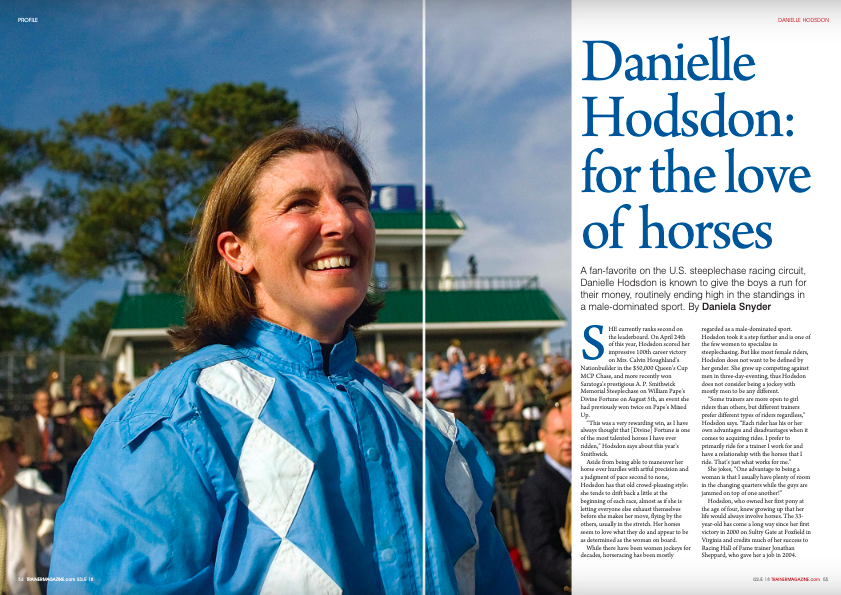
A fan-favorite on the U.S. steeplechase racing circuit, Danielle Hodsdon is known to give the boys a run for their money, routinely ending high in the standings in a male-dominated sport.
By Daniela Snyder
First Published (20 October 2010 - Issue Number: 18)
Can nutrition give horses that first-class travel experience?

While transporting horses by road to the local racecourse or by air to another part of the world is now a routine affair, the end result can still be stressful enough to have a detrimental effect on a horse’s health and performance on the racetrack. Catherine Dunnett Bsc, Phd looks at ways nutrition can help the horse have a more comfortable experience.
By Catherine Dunnett Bsc, Phd
First Published (20 October 2010 - Issue Number: 18)
Should medication-free horses be given preferential treatment?

From next year, any trainer who has violated rules regarding use or possession of Class 1 drugs over the past twelve months, will be barred from having runners at the Breeders’ Cup races, it was announced following a Breeders’ Cup board meeting in September, says Geir Stabell.
By Geir Stabell
First Published (20 October 2010 - Issue Number: 18)
State incentives: giving racing a ray of hope

Racing loves to denigrate its own status, crying impotently about its woes by calling itself a dying industry and thus fulfilling a self-induced anti- popularity campaign. While its popularity will never rival football, the industry is far from dying. It is, however, the only business that exists at the mercy of government, and this relationship is more often antagonistic than supportive.
By K.T Donovan
First Published (20 October 2010 - Issue Number: 18)
Recurrent airway obstruction in racehorses

The old name for it is “broken wind,” we used to call it COPD (Chronic Obstructive Pulmonary Disease), we refer to it more commonly as “heaves,” and the most recent term that was adopted by vets and scientists who were studying it is Recurrent Airway Obstruction (RAO). Many of these terms are still in common use, and different groups of people involved with horses will possibly recognize the different terms for what is exactly the same condition.
By Dr David Marlin
First Published (20 October 2010 - Issue 18)
Cancer in the racehorse
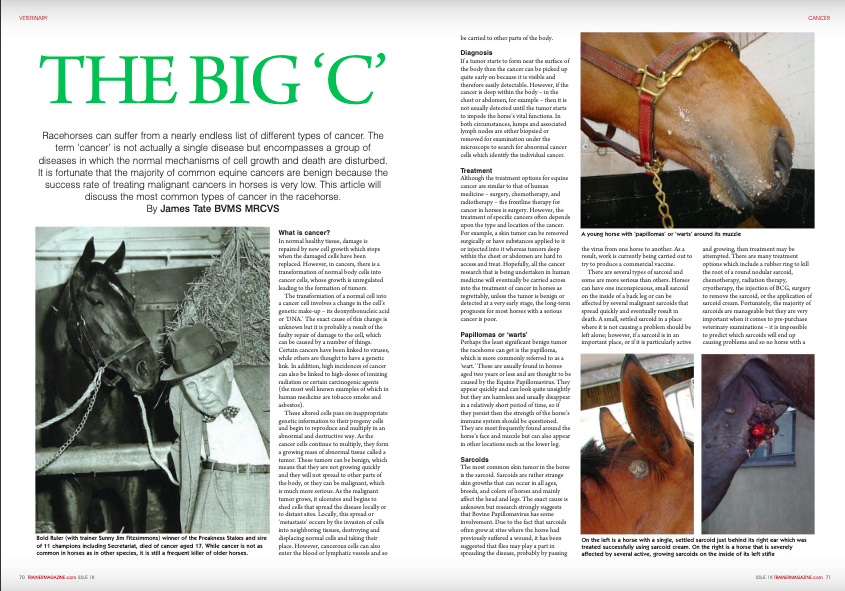
Racehorses can suffer from a nearly endless list of different types of cancer. The term ‘cancer’ is not actually a single disease but encompasses a group of diseases in which the normal mechanisms of cell growth and death are disturbed. It is fortunate that the majority of common equine cancers are benign because the success rate of treating malignant cancers in horses is very low. This article will discuss the most common types of cancer in the racehorse.
By James Tate BVMS MRCVS
First Published (20 October 2010 - Issue 18)
Arnold Kirkpatrick Column - Pain and Suffrage

Ok, even in view of the fact that I had very little to do with the thing as a whole, I have to say the last issue of North American Trainer may have the best ever. Not only did it have a wonderful picture of Linda Rice – who is not only beautiful but a superb trainer - on the cover, but it also had the first of what promises to be a series of excellent articles from my friend Alan Balch, who has taken over as Executive Director of the California Thoroughbred Trainers.
First Published (20 October 2010 - Issue Number: 18)
Alan Balch - Back to the future
In 1971, when I first joined the staff at Santa Anita right out of graduate school, the term "marketing" had never been applied to racing, anywhere in the world. I was handed the title of Director of Public Relations, and had been coming to the office for just a couple of weeks when Hollywood Park drew over 70,000 fans for its card on Memorial Day.
Alan F. Balch - CTT Executive Director (20 October 2010 - Issue 18)
Calvin Borel - the Kentucky Derby winning jockey in profile

Calvin Borel’s portrayal on the mural of Kentucky Derby-winning jockeys at Churchill Downs, painted by the renowned artist Pierre “Peb” Bellocq, had already undergone minor surgery in 2009, when the jockey followed up a 2007 Derby on Street Sense with a win aboard Mine That Bird. His caricature was modified to hold up two fingers, but in 2010, after Super Saver charged up the rail to give Borel his third Derby, Peb rearranged his left hand to show three fingers.
By Frances Karon
First Published (21 July 2010 - Issue Number: 17)
Linda Rice - a racehorse trainer making her mark on the big stage

If you win the training title at Saratoga, people will notice you. Linda Rice, catapulted into national recognition when she became the first woman to achieve this coveted honor in 2009, has been turning the heads of those in the know for many years now.
By Kathleen Donovan
FIrst Published (21 July 2010 - Issue Number: 17)
Working the Kinesio tape therapy magic on equine athletes

In a sport where everyone is looking for an edge, the latest for Thoroughbreds may be Kinesio tape. It is the same tape seen on tennis star Serena Williams, soccer player David Beckham, any number of University of Connecticut basketball players, and many others. It creates a lifting effect on the skin of humans and horses alike to improve circulation, relieve pain, and, depending on its application, relax or stimulate muscles.
By Ken Snyder
First Published (21 July 2010 - Issue Number: 17)
Keeping it in the family - can a horse's family traits be used to a trainer's advantage?

It’s the same story at every dinner party, writes Frances J. Karon. A stranger will invariably ask, “What do you do?”, as if the response will somehow explain the very essence of one’s being. Similarly, the first question we have for the owner or trainer who tells us he has a nice yearling on the farm is, “What’s it by?”
By Frances Karon
First Published (21 July 2010 - Issue Number: 17)