
Ontario Breeding
By Alex Campbell

The Ontario breeding industry has experienced a number of twists and turns since the provincial government canceled the lucrative slots-at-racetracks program back in 2013. Prior to the cancelation of the program, the once robust industry had years where more than 1,600 mares were bred in the province, according to numbers published by The Jockey Club. In 2018, that number was down to 733.
While the cancelation of the program has impacted the majority of the province’s breeders, well-known breeding operations in Ontario have experienced success through all of the uncertainty. Sam-Son Farm won back-to-back Sovereign Awards as Canada’s top breeder in 2013 and 2014, while Frank Stronach’s Adena Springs won three straight Sovereign Awards between 2015 and 2017 when they bred two Queen’s Plate winners in that time, including Shaman Ghost in 2015 and Holy Helena in 2017.
Along with these big operations, several other commercial breeders are also experiencing success, not only in Ontario but throughout North America and internationally as well. Ivan Dalos’ Tall Oaks Farm bred two Gr1 winners in 2018, including full brothers Channel Maker, who won the Joe Hirsch Turf Classic at Belmont Park, and Johnny Bear, who won the Gr1 Northern Dancer Turf Stakes at Woodbine for the second consecutive year. In addition, Dalos also bred Avie’s Flatter, Canada’s champion two-year-old in 2018; dam In Return, who produced Channel Maker; and Johnny Bear, which was Canada’s Outstanding Broodmare. As a result, Tall Oaks Farm won its first Sovereign Award for Outstanding Breeder in 2018 as well.
Horses bred by David Anderson’s Anderson Farms and Sean and Dorothy Fitzhenry also were big winners at last year’s Sovereign Awards. Anderson bred Queen’s Plate winner and 2018 Canadian Horse of the Year, Wonder Gadot, while Fitzhenry’s homebred, Mr Havercamp, was named champion older male and champion male turf horse. Both Anderson and Fitzhenry have also had success selling horses internationally, primarily at Keeneland. In 2017, Anderson sold Ontario-bred yearling, Sergei Prokofiev—a son of Scat Daddy—to Coolmore for $1.1 million. One of Fitzhenry’s success stories is that of Marketing Mix, who he sold for $150,000 to Glen Hill Farm at the 2009 Keeneland September Yearling Sale. Marketing Mix went on to win the Wonder Where Stakes at Woodbine as a three-year-old in 2011, and captured two Gr1 victories later on in her career in the 2012 Rodeo Drive Stakes at Santa Anita and the 2013 Gamely Stakes at Hollywood Park.
For Anderson, commercial breeding is all he’s ever known. The son of the late Canadian Horse Racing Hall of Fame inductee, Robert Anderson, David Anderson grew up around horses at his father’s farm in St. Thomas, Ontario. In the 1970s and 1980s, Anderson Farms was one of the biggest breeders and consignors in the province, breeding several graded stakes winners. In fact, in 1985, Anderson Farms was the leading consignor at both the Saratoga and Keeneland yearling sales.
“That’s what my father established years ago, and that’s what I grew up with was breeding and selling at all of the international sales,” David Anderson said. “We haven’t diverted from that philosophy in nearly 50 years. It’s what I learned growing up, and I try to buy the best quality mares that I can and breed to the best quality sires that I can.”

David Anderson (blue suit) with Peter Berringer
While Anderson closely watched his father build up the Thoroughbred side of the business, he got experience of his own breeding Standardbreds. After all, the farm’s location in Southwestern Ontario is in the heart of Standardbred racing in the province. Anderson said the Standardbred business had a number of success stories spanning more than a decade: breeding champions such as Pampered Princess, Southwind Allaire, Cabrini Hanover, and The Pres.
In 2010, Robert Anderson passed away from a heart attack, and the farm was taken over by David Anderson and his sister, Jessica Buckley, who is the current president of Woodbine Mohawk Park. Anderson went on to buy Buckley out of her share of the farm and took on full control. He also decided he wanted to focus exclusively on Thoroughbred breeding and racing.
“After my Dad died I decided I wanted to jump back into the Thoroughbreds,” he said. “I sold all the Standardbreds and put everything I had back into Thoroughbreds. I came full circle back to my roots, and this is where I really love it.”
It’s been a long-term project for Anderson to get the farm to where it is today. After taking control of the farm, Anderson sold off all of his father’s mares—with the exception of one—and began to build the business back up. Anderson said his broodmare band currently sits between 25 and 30, which is where he wants to keep it.
Fitzhenry, on the other hand, took a much different path to his current standing in the Thoroughbred breeding industry. Fitzhenry said his start in Thoroughbred racing came through a horse owned by friends Debbie and Dennis Brown. Fitzhenry and his wife, Dorothy, would follow the Brown’s horse, No Comprende, who won seven of his 30 starts in his career, including the Gr3 Woodbine Slots Cup Handicap in 2003.
The Fitzhenrys decided they wanted to get involved in ownership themselves and partnered with the Browns on a couple of horses. The more Fitzhenry got involved, the more the breeding industry appealed to him.
TO READ MORE - BUY THIS ISSUE IN PRINT OR DOWNLOAD
ISSUE 54 (PRINT)
$6.95
ISSUE 54 (DIGITAL)
$3.99
WHY NOT SUBSCRIBE?
DON'T MISS OUT AND SUBSCRIBE TO RECEIVE THE NEXT FOUR ISSUES!
Four issue subscription - PRINT & ONLINE - ONLY $24.9
Pedigree vs Conformation

By Judy Wardrope
What are the factors people consider when assessing a potential racehorse? In part, it depends on their intentions. Different choices may be made if the horse or offspring is intended for their own use or how the horse or offspring might sell.
And when a horse gets to the track, what factors help a trainer decide on a particular distance or surface to try? Most of the trainers I interviewed say that they usually look at who the sire is when trying to determine distance and/or surface preferences.
Trainer Mark Frostad said, “I look at the pedigree more than the individual regarding distance and surface.”
Richard Mandella says that his determining factors are “conformation, style of action, pedigree and the old standby, trial and error.”
Roger Attfield says, “It is extremely hard to tell turf versus dirt. I’ve watched horses all my life and I’ve tried to figure it out. I can tell when I start breezing them. I had a half-sister [to Perfect Soul], who was stakes-placed, and she couldn’t handle the turf one iota. I had the full brother…also turf. Approval could win on the dirt, but as soon as he stepped on the turf, he was dynamite.”
What about when planning a potential breeding for a mare or a stallion? Is conformation more important than pedigree? Or does pedigree have more influence than conformation? How much of a role does marketing play in the selections?
Although ancestry and conformation do go together, the correlation is complicated. For example, top basketball players tend not to come from families of short people, but most NBA stars do not have siblings who are star players. The rule holds for other athletes, including gymnasts. But what would you get if you crossed a basketball player with a gymnast?
Pedigree is not an absolute despite what marketing campaigns may lead you to believe. Look at human families—maybe even your own. Are you built like all of your siblings, do you all have the same talents? And what about your cousins? Are you all built alike and of equal talent?
When it comes to Thoroughbred horses, you will find that only the very top sires boast a percentage of stakes winners nearing 15%. If one assumes that a stakes winner is the goal of most breeders, then that would indicate at least an 85% failure rate.
When breeding horses or selecting potential racehorses, the cross might look good on paper or in our imaginations, but what are the odds that the offspring would be able to perform to expectations if it was not built to be a success at the track? Looking at the big picture, one has to wonder what we are doing to the gene pool if we only breed for marketability.
To get a better understanding, let’s look at four horses. Three of our sample horses have strong catalog pages, but did they run according to their pedigrees or according to the mechanics of their construction? Furthermore, did the horse with the humdrum catalog page have a humdrum racing career?
Ocean Colors
PEDIGREE
She is by Orientate, a campion sprinter of $1,716,950 (including a win in the Breeders' Cup Sprint [Gr1], who sired numerous stakes horses and was the broodmare sire of champions.
Her dam, Winning Colors, earned $1,526,837, was the champion three-year-old filly and beat the boys in the Kentucky Derby [Gr1] and the Santa Anita Derby [Gr1]. She was a proven classic-distance racehorse.
Winning Colors was the dam of 10 registered foals, 9 to race, 6 winners, including Ocean Colors and Golden Colors (a stakes-placed winner in Japan, who produced Cheerful Smile, a stakes winner of $1,878,158 in North America), and she is ancestor to other black-type runners.
CONFORMATION
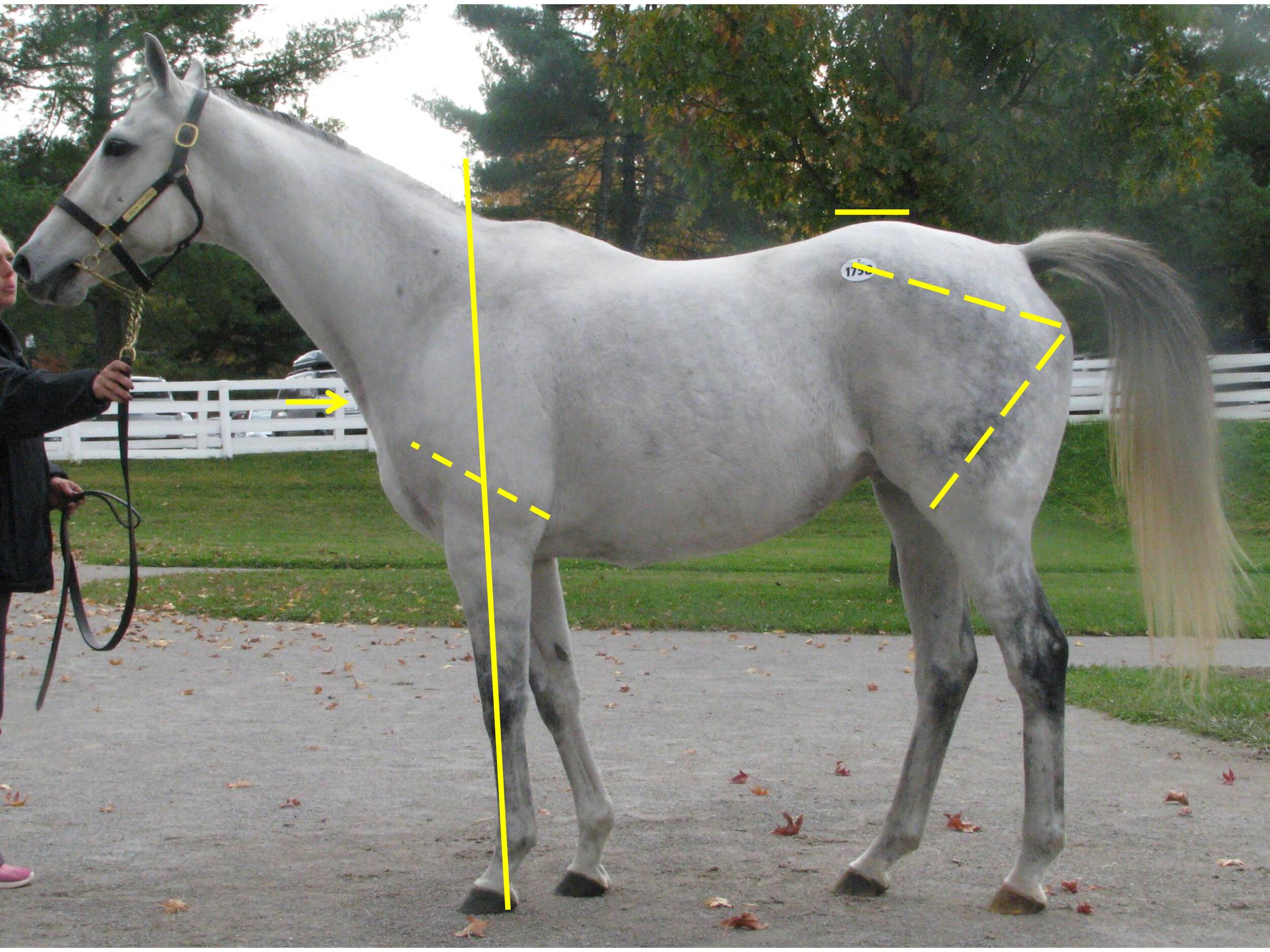
Her lumbosacral gap (LS), which is just in front of the high point of croup and functions like the horse's transmission, is considerably rearward of ideal. This constitutes a significant difference when compared to either of her athletic parents.
The rear triangle is equal on the ilium side (point of hip to point of buttock) and femur side (point of buttock to stifle protrusion), and her stifle is well below where the bottom of the sheath would be if she were male. In essence these would contribute to the long, ground-covering stride seen in distance horses like her dam.
Her pillar of support (a line extending through the natural groove in her forearm) emerges well in front of her withers for some lightness to the forehand and into the rear quarter of the hoof for added soundness.
Her base of neck is neither high nor low when compared to her point of shoulder, meaning that placement neither added nor subtracted weight on the forehand.
Because her humerus (elbow to point of shoulder) is not as long as one would expect for a range of motion that would match that of her hindquarters, she likely resembles her sprinter lines in this area. Although I never saw her race, I strongly suspect that her gait was not smooth. In order to compensate for a shorter stride in the front than in the back, she probably wanted to suspend the forehand while her hindquarters went through the full range of motion. Unfortunately, she is not strong enough in the LS to effectively use that method of compensating.
RECORDS
Her race record shows her as a stakes-placed mare and winner of $127,093 but closer examination shows that the stakes race was not graded with a small purse and that her three wins, two seconds and three thirds were not in top company.
While valuable on paper as a broodmare, and despite being mated to some top stallions early in her breeding career, she failed to produce a quality racehorse. Naturally her value dropped significantly until she sold in November 2018 for $20,000 in foal to Anchor Down.
Sequoyah

PEDIGREE
His sire, A.P. Indy earned $2,979,815, won the Breeders’ Cup Classic and the Belmont Stakes plus was the Eclipse Champion three-year-old and Horse of the Year. He was also a top sire of stakes horses as well as a noted sire of sires.
His dam, Chilukki, earned more than $1.2 million, was the Eclipse Champion two-year-old filly, was second in the Breeders’ Cup Juvenile Fillies, and set track records at Churchill Downs for both 4.5 furlongs and a mile. Her sire won the Breeders’ Cup Sprint and equaled a track record for 7 furlongs.
CONFORMATION
His LS is 1.5” (by actual palpation) rearward of ideal and just at the outer limits of the athletic range.
His rear triangle is slightly shorter on the femur side (point of hip to stifle protrusion), which not only decreases the range of motion of the rear leg by changing the stride’s ellipse, but it adds stress to the hind leg from hock down.
The stifle placement (well below sheath level) would indicate a preference for distances around 10 furlongs (similar to his sire’s), except for the short femur.
His pillar of support does emerge in front of the withers, but the bottom of the line emerges behind the heel, making him susceptible to injury to the suspensory apparatus of the foreleg (tendons and ligaments).
His humerus is of medium length and is moderately angled and would represent a range of motion that would match the hindquarters. However, the tightness of his elbow (note the circled muscling over the elbow) would likely prevent him from using the full range of motion. He would stop the motion before the elbow contacted his ribs; thus, the development of that particular muscle as a brake and a reduction in stride length. His base of neck was well above point of shoulder, which adds some lightness to his forehand.
RECORDS
He was injured in his only start and had zero earnings. He did go to stud based on his pedigree, but was not a success. He sired one stakes winner of note, a gelding out of a stakes-winning Smart Strike daughter, who won at distances from 7 to 9 furlongs.
TO READ MORE —
BUY THIS ISSUE IN PRINT OR DOWNLOAD -
SUMMER SALES 2019, ISSUE 53 (PRINT)
$6.95
SUMMER SALES 2019, ISSUE 53 (DIGITAL)
$3.99
WHY NOT SUBSCRIBE?
DON'T MISS OUT AND SUBSCRIBE TO RECEIVE THE NEXT FOUR ISSUES!
PRINT & ONLINE SUBSCRIPTION
$24.95
Determining distance preferences

By Judy Wardrope
If we watch an international athletic track meet, we can easily discern structural differences in the athletes for various events. The body proportions differ (e.g., the shot putter has a much lower center of gravity than the high jumper). And, as we get more specific, we can even see that the sprinters differ from the middle-distance runners, who also differ from the long-distance runners. This is especially true at the upper level of sport. While all are built efficiently for their particular distance, those efficiencies differ from distance to distance.
We would not expect a marathon runner to win a sprint at the Olympics, would we? Why not? Likely because that marathon runner would be at a mechanical disadvantage for short distances no matter how athletic or how fit he or she was. Like humans, horses are best at the distances in which they are mechanically efficient. The more fitness a horse has, the better it will do, but horses, like humans, are always best at the distance that suits their underlying structure.
In this article we will look at horses that are built to run classic distances, horses that are built to be milers and horses that are built to sprint. We will not only examine them for distance preferences based on structure, we will also look at points for athleticism and soundness because those are also important factors in being a superior racehorse.
Justify
Although only started six times—all as a three-year-old—he was undefeated, earned $3,798,000 and won the Triple Crown. Many race fans were looking forward to him running in the Breeders’ Cup Classic, but that was not to be.
The 16.3+ hand stallion was photographed in November 2018 at Ashford Stud in Kentucky, where I was told that the injury that halted his race career was to his right hind fetlock.
He is an imposing figure, and it is obvious that he is built to specialize in classic distance races. His lumbosacral (LS) gap, which is just in front of the high point of croup, is bisected by a line drawn from the top of one hip to the top of the other. This means he was able to transfer his power upward and forward without undue strain on his back. In other words, he is strongly coupled or had a good transmission, which is a definite factor for athleticism.
The rear triangle is of equal length on the ilium side (from top of hip to point of buttock) and the femur side (point of buttock to stifle protrusion), meaning that his rear spring matched and did not impede the natural range of motion of the hind leg. And what gave him such a great range of motion? A stifle protrusion that is well below sheath level. His hind leg was capable of reaching well under him and extending well back through the natural range of motion, providing a ground-covering stride.
A line extend up and down through the naturally occurring groove in his forearm (a.k.a. the pillar of support) emerges well in front of his withers—a factor for lightness of the forehand—and into the rear quarter of his hoof—a factor for soundness.
Considering that all parts from the top of the scapula to the knee function as one apparatus, we can see that when the top of his scapula rotates back, his point of shoulder rises, his elbow comes forward and his forearm follows, giving him excellent reach through the forequarters. This means that both his hindquarters and his forequarters had matching ranges of motion. That equates with efficiency of stride.
The rise of the humerus from elbow to point of shoulder gave him another factor for lightness of the forehand, and a base of neck well above the resulting high point of shoulder added yet another factor for lightness.
From a structural perspective, he was designed to excel at classic distances and stay relatively sound. My only knock against him, and it is a purely personal one based on observation regarding longevity, is that I tend to avoid horses whose fetlocks have a roundish appearance.
California Chrome
He won the first two legs of the Triple Crown among other Gr1 wins and was third in the Breeders’ Cup Classic at three. He was second in the Dubai World Cup (Gr1) at four and won it at five, then was second in the Breeders’ Cup Classic that same year. His racing career ended after a lone start at six. His totals: 27 starts, 16 wins and $14,752,650 in earnings.
He was photographed at Santa Anita Park the day after the 2016 Classic as he was preparing to ship out, which is why his legs are wrapped.
Although most people may not see California Chrome as resembling Justify, when we examine the underlying structure, we find that the two horses are remarkably similar.
Both have an LS gap that is in line from hip to hip, both are equal on the ilium and femur sides of the rear triangle, both have similar stifle placement (classic distance), both have a pillar of support that goes with lightness and soundness, and both have a humerus of similar length as well as a base of neck well above the point of shoulder. There is a slight difference in the rise of the humerus, with Justify having a steeper rise from elbow to point of shoulder.
I Want Revenge
He won the Gotham Stakes (Gr3) by 8 ½ lengths in record time plus the Wood Memorial (Gr1) as a three-year-old and was angled towards the Kentucky Derby, where he was the morning-line favorite; but injury to the right front fetlock forced him out of work for over a year. His final start, as a six-year-old, was in an ungraded stakes race that saw him finish second. His best races were at distances just over a mile, and he earned $928,000 from 14 starts.
He was photographed at the Keeneland Sale in November 2018, shortly before his untimely death due to a virus.
His LS placement provided him with strength and athleticism, and like the previous two horses, he displayed equal length in the ilium and femur sides of the rear triangle. However, his stifle protrusion is not as low as either of the classic winners. The level is just below the bottom of his sheath, which equates with a slightly shorter range of motion and a slightly quicker stride rate.
TO READ MORE —
BUY THIS ISSUE IN PRINT OR DOWNLOAD -
Triple Crown 2019, issue 52 (PRINT)
$6.95
Triple Crown 2019, issue 52 (DOWNLOAD)
$3.99
WHY NOT SUBSCRIBE?
DON'T MISS OUT AND SUBSCRIBE TO RECEIVE THE NEXT FOUR ISSUES!
Print & Online Subscription
From $24.95
PHBA - Mick Ruis and his secret stallions

By Emily Shields
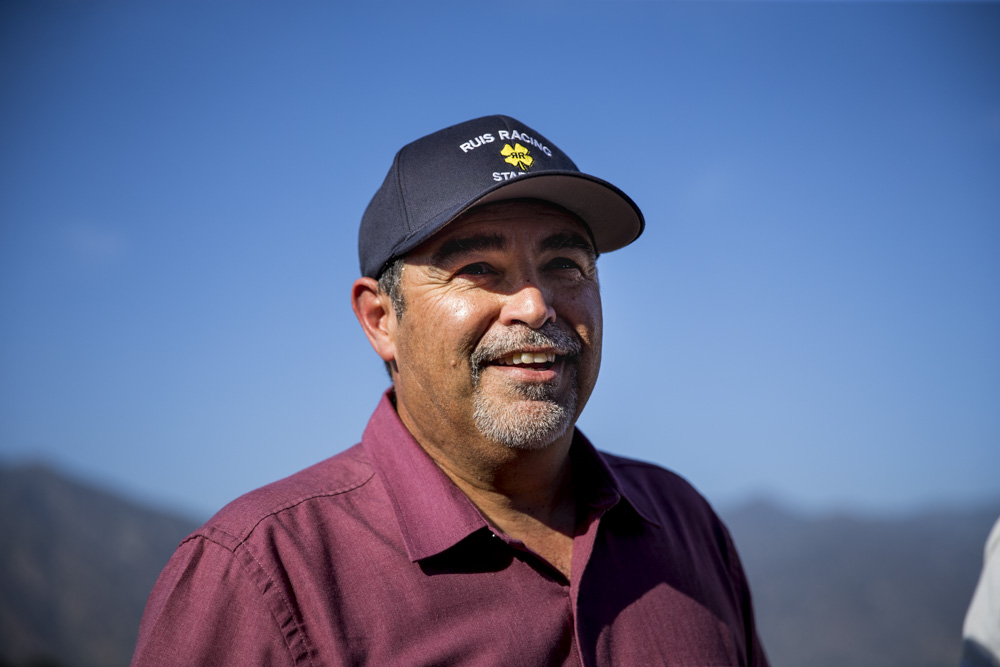
Long-time horseman Mick Ruis was not only born and raised in California, but he also has homes there. He originally planned on having his broodmares and stallions there, too, but the lure of the Pennsylvania breeding program was too strong.
“When I found out about the program, it was a no brainer,” Ruis said. “I had to make a decision, and the decision was that I wanted to be a Pennsylvania breeder.”
What makes the program so appealing?
“The incentives they give make it a clear choice, business-wise,” Ruis explained. “And there are three tracks in the state and another seven or eight nearby you can run at. It made sense to spend more time on the East Coast.”
One of Ruis’ first Pennsylvania experiences came with The Critical Way, a PA-bred by Tizway bred by Blackstone Farm. In 2017, The Critical Way won the $100,000 Danzig Stakes in just his second start, shipping in from Santa Anita to score. “That’s what started me on it,” Ruis said. “There’s a lot of good races where you can make good money for a Pennsylvania-bred. I’m excited about that.”
Blackstone Farm, an operation shared by partners Christian Black, Mark Weissman, and Douglas Black, recently had a banner runner with Pennsylvania-bred Tom’s Ready, a millionaire who retired after the 2017 season. Blackstone sold him for $145,000 as a yearling. The farm is going to be an important part of Ruis’ expansion into the Keystone State. Ruis shipped 18 mares into the Pine Grove outfit, as well as two young stallions. Eleven of the mares were bred in California and will foal in Pennsylvania this spring.
And with the two stallions, War Envoy and Saburo, Ruis has much to anticipate.
War Envoy, by War Front – La Conseillante, by Elusive Quality, is royally bred. His dam was a stakes winner in France; she went on to produce a $750,000 yearling in Falaise—now an unraced sophomore—a $300,000 broodmare in Beychevelle, and a $150,000 juvenile in Kate’s Winnie. War Envoy himself won twice in 26 starts but earned $494,781 racing against some of the best of his generation. He started his career in England and Ireland, placing in multiple graded stakes, then came to America for the 2014 Breeders’ Cup Juvenile Turf (Gr1) at Santa Anita. War Envoy actually went favored that day, but finished well back.
After returning to Europe, War Envoy won a handicap at Ascot before moving to the United States permanently in 2015. He contested the Sandy Lane Barbados Gold Cup (Gr1) in Barbados and finished third, then later was one of the runners in the inaugural Pegasus World Cup Invitational (Gr1). War Envoy was retired in 2017 with 10 top three finishes to his name.
Saburo, a $600,000 juvenile, is by Medaglia d’Oro and out of the stakes placed Lemon Drop Kid mare Kid Majic. She produced 2015 Sovereign Award Champion Older Mare and Champion Female Sprinter Miss Mischief, a graded stakes winner of over half a million dollars. Second dam Call Her Magic, by Caller I.D., won eight of 14 starts, including two stakes races. She is also the dam of J P’s Gusto, a lightning-fast juvenile who won the Del Mar Futurity (Gr1) and $811,760. He ultimately sired Puerto Rican Gr1 winner Remember Willy and dual stakes placed Epic Journey.
TO READ MORE —
BUY THIS ISSUE IN PRINT OR DOWNLOAD -
Triple Crown 2019, issue 52 (PRINT)
$6.95
Triple Crown 2019, issue 52 (DOWNLOAD)
$3.99
WHY NOT SUBSCRIBE?
DON'T MISS OUT AND SUBSCRIBE TO RECEIVE THE NEXT FOUR ISSUES!
Print & Online Subscription
From $24.95
Meet the stallion - Red Vine

Renowned Olympic gold medallist Bode Miller, a former skier, has a dream: to return the Mid-Atlantic horse industry to its former glory.
“Pennsylvania and Maryland were the powerhouses of the sport 150 years ago,” Miller explained. “People think breeding is a pipe dream, but I really believe in him.”
The “him” in question is Red Vine, Miller’s stallion standing at Barbara Rickline’s Xanthus Farm in Gettysburg. He has the tools to make it as a stud: pedigree, race record, and demeanor, and those connected with him are pleased with the early results.
Trained by Christophe Clement for Jon and Sarah Kelly, Red Vine earned $775,915 on the track, and although he never obtained a signature graded stakes victory, he knocked heads with some of the best of his generation and finished in the top three 19 times from 23 starts. He broke his maiden going a mile on the grass at Del Mar, won a turf allowance at Keeneland, and won twice on the dirt at Aqueduct before winning the Majestic Light Stakes, also on dirt, at Monmouth Park. Other notable performances for Red Vine were a behind Beholder at Del Mar in the Grade 1 TVG Pacific Classic; a second, by less than two lengths, in the Grade 2 Kelso Handicap at Belmont; a second in the Grade 3 Salvator Mile; and a third in a hotly contested Grade 1 Las Vegas Breeders’ Cup Dirt Mile at Keeneland, all in 2015. Red Vine wrapped up his stellar season that year by narrowly missing to Belmont Stakes winner Tonalist in the Grade 1 Cigar Mile.
Miller purchased Red Vine for $25,000 out of the 2017 Keeneland January Horses of All Ages Sale. It was the bay’s pedigree that intrigued him, as sire Candy Ride went unbeaten in six career starts and has developed into a tremendous sire. “We already know Candy Ride has great stuff,” Miller said, “and it’s been cool to see (2017 Horse of the Year) Gun Runner have great success.”
Red Vine is out of the winning Storm Creek mare Murky Waters, who has produced three winners from four starters to date. She is a half-sister to the El Prado sire Fort Prado, a multiple graded stakes winner of more than $1.2 million; and the stakes-winning Giant’s Causeway horse Cammack.
Miller himself has four broodmares, three of whom have visited Red Vine. “That’s the part of breeding that can sink the ship,” Miller said. “I’d be in bankruptcy if I tried to support him all by myself, but that’s the advantage of having lots of people becoming strong believers in him.”
Miller is also fond of homebred runners. “It’s exciting because I find homebreds inspirational,” he said. “It’s different when you’ve been a part of it the whole time watching the foals grow up and develop, versus buying a horse out of the sale.”
Red Vine’s first foals are on the ground this spring, and farm owner Rickline likes what she sees. “I’ve been very pleased. They are all well balanced, athletic, correct, and a good size. They all look nice from a variety of different kinds of mares.”
Red Vine will see between 65 and 70 mares in 2018, slightly up from his numbers in his first season. “He’s getting his mares in foal and everything has gone according to plan,” Rickline said. “We have no problems with him, because he’s real kind, easy to work with, and a fast learner.”
“Being an athlete,” Miller said, “I view horses as athletes. Red Vine’s style was so similar to that of Candy Ride. But he’s also got the intangible things that can make a stallion: attitude and personality. We’ve had good local support, and we appreciate the people that are taking a chance with him. I believe we have a really good shot to hit with Red Vine.”


A.P. INDY His influence on the racehorses of today

CLICK ON IMAGE ABOVE TO READ THE ARTICLE
This article appeared in North American Trainer - issue 40 (May to July 2016)
TAPIT - the leading stallion of his generation

CLICK ON IMAGE ABOVE TO READ THE ARTICLE
This article appeared in North American Trainer - issue 40 (May to July 2016)
SERENA’S SONG Enjoying an honourable retirement

CLICK ON IMAGE ABOVE TO READ THE ARTICLE
This article appeared in North American Trainer - issue 40 (May to July 2016)
Genetic Testing - the benefit of creating a genetic passport for your thoroughbred

CLICK ON IMAGE ABOVE TO READ ONLINE!



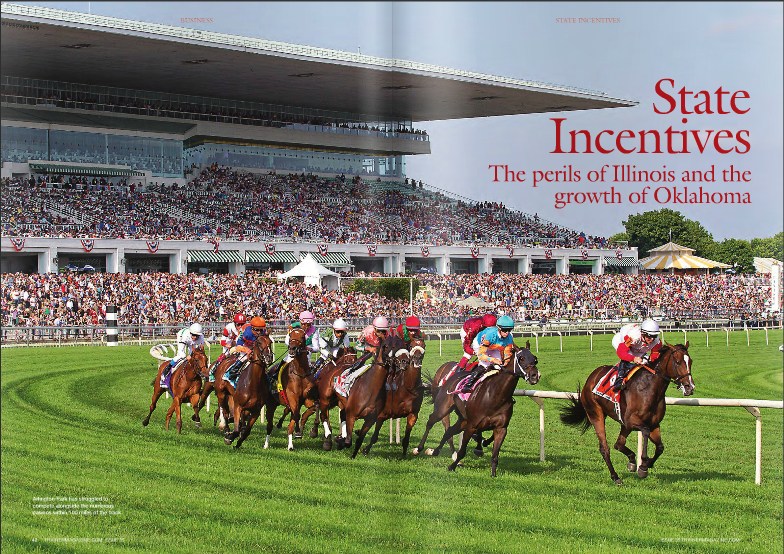
State Incentives 2015
This magazine has examined the correlation between slots revenue and a healthy racing industry. Slots are not enough without a strong breeding incentive program to produce long-term results, and marketing innovations to keep the racetrack as patron-friendly as a modern casino. What happens when one of those three legs is missing?
CLICK IMAGE TO READ FULL ARTICLE
State Awards - state of hope?

CLICK ON THE IMAGE TO READ ONLINE
THIS ARTICLE FIRST APPEARED IN - NORTH AMERICAN TRAINER - ISSUE 31
Northern Farm - Japanese vision continuing to scale new heights

CLICK ON IMAGE TO READ ARTICLE
THIS ARTICLE FIRST APPEARED IN - NORTH AMERICAN TRAINER - ISSUE 29
The rise of the Japanese racehorse

CLICK ON IMAGE TO READ ARTICLE
THIS ARTICLE FIRST APPEARED IN - NORTH AMERICAN TRAINER - ISSUE 29
Standardbreds v Thoroughbreds
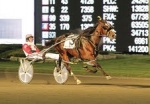
In the past 40 years, Standardbreds have closed the equivalent of 40 lengths on Thoroughbreds. Dig a little deeper and you’ll find that Thoroughbreds aren’t racing that much faster than they did 100 years ago. Thoroughbreds and Standardbreds share their ancestry. All Standardbreds trace their pedigrees to the imported English stallion Messenger, who was brought to America in 1788.
BILL HELLER (February 1st 2012 - Issue 23)
State incentives: giving racing a ray of hope

Racing loves to denigrate its own status, crying impotently about its woes by calling itself a dying industry and thus fulfilling a self-induced anti- popularity campaign. While its popularity will never rival football, the industry is far from dying. It is, however, the only business that exists at the mercy of government, and this relationship is more often antagonistic than supportive.
By K.T Donovan
First Published (20 October 2010 - Issue Number: 18)