
Does the lunar cycle affect horses' performance?
Ken Snyder interviews Dr Barbara Murphy
Moon myths demystified: Lunar phases and a full moon are credited with impacting births, violence, you name it. But there is no hard data to support it, especially effects on humans. Horses? Yes and no.
“According to the available research, moonlight has very little impact on them,” said Dr. Barbara Murphy, Associate Professor of Equine Science at University College-Dublin and the Founder and Chief Scientific Officer for Equilume. The company researched and produced lighting for horses to maximize fertility, performance, and health.
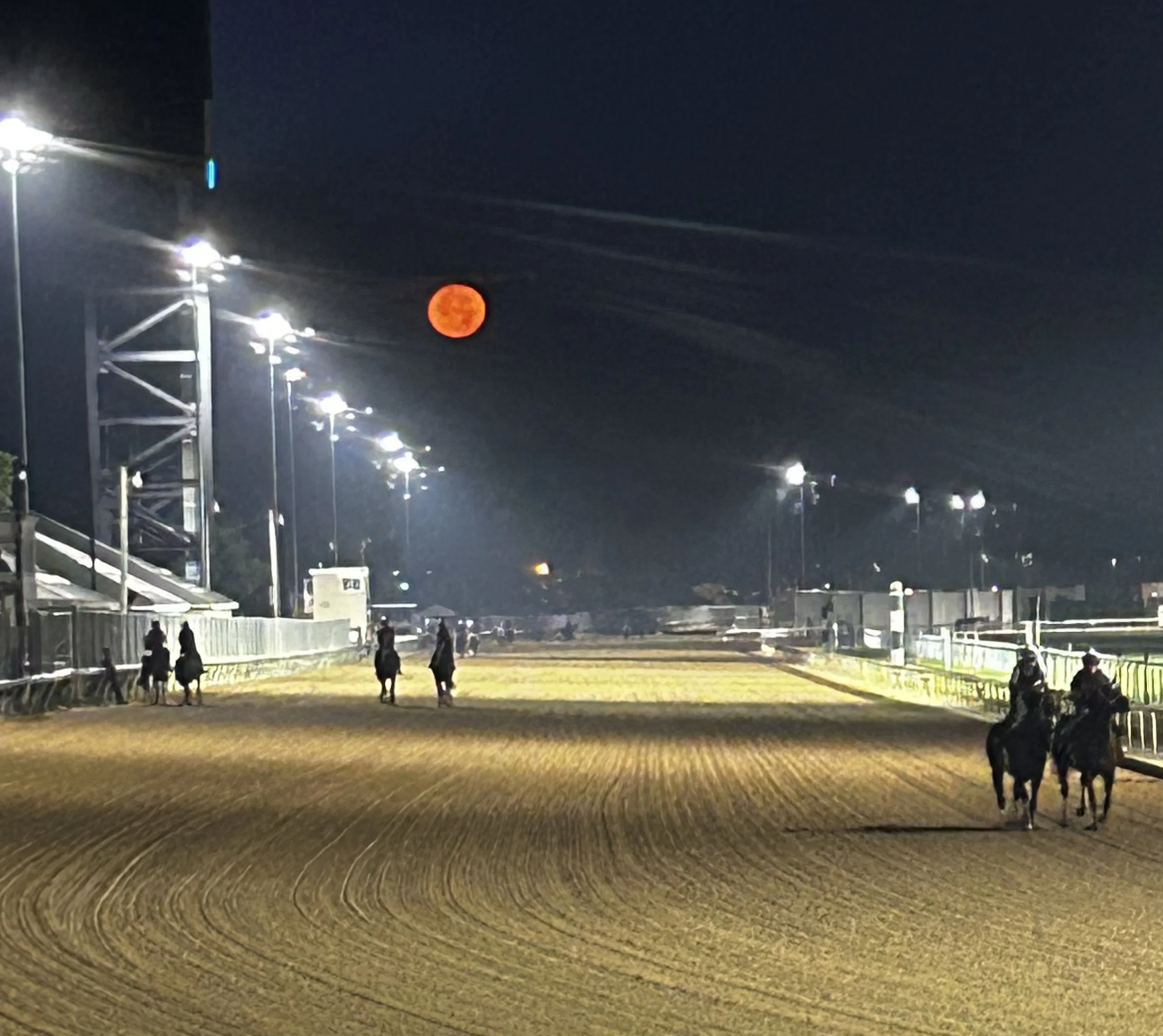
There is one thing: “A retrospective study in Thoroughbreds was done, which showed that peak conception rates occurred during or immediately after a full moon,” said Murphy.
She offers, however, an explanation drawing on common sense plus knowledge of light and its effects. “Horses in the wild tend to be more reproductively active at dawn and dusk. That's around the time they can still see what they're doing, and predators aren't as prevalent at that time. Plus, it’s often when stallion testosterone levels are highest in spring.”
Just as Thoroughbred mares instinctively foal at night as a defense against predators (even though they are ensconced in perfectly safe barns), a full moon in the wild provides enough light to breed when there is less risk of predators. Instinct continues.
There is another factor at work too, according to Murphy. “It's the quality of daylight and the normal absence of light at night.”
White light or regular daylight comprise multiple wavelengths of different colors. Blue wavelengths in light optimally suppress melatonin to regulate sleep-wake cycles and make daylight essentially a time of wakefulness. Melatonin in the body is a hormone that rises in the evening and falls in the morning. It basically tells us it’s time for rest and recovery.
“Blue light is usually absent at night, facilitating sleep, but moonlight has some blue light in it when there is a full moon. The blue light itself makes them [horses] more alert and more active around that time.”
There is much more known, however, about blue light and its documented impact on horse foaling, behavior, and overall health.
Manipulating light, of course, has long been a practice in Thoroughbred horse breeding to create a false spring for mares to foal early. “You want them under an extended duration of light around Thanksgiving or the first of December. That turns on all their reproduction and growth hormones in time for when we want them in the breeding barn,” Murphy said. This light essentially tricks the mare into thinking spring is here and they begin entering heat cycles.
Murphy recommends practices that have produced astonishing results. One is maintaining consistency with the duration of light. Sixteen hours is optimal. Nature takes care of some but not all of that.
Research as part of Murphy’s study for a PhD at the University of Kentucky introduced her to transitioning to another kind of light to ensure horses receive maximum benefits of nighttime rest. “We were trying to take blood samples from horses at night. My professor at the time told me, ‘Whatever you do, Barbara, be very careful and only use dim red light to collect your samples at night.’ Red light won’t disrupt the effects of melatonin, giving horses a full night’s rest and uninterrupted growth for the foal. In short, uninterrupted night darkness in nature should be duplicated or mimicked with stabled horses.
Murphy went back to Ireland and developed a red light for stables similar to that used in developing photographs. “What it means is the stable staff can go in and check the horses. They can put on bandages, they can take a temperature, they can feed them without disrupting their circadian rhythm.”
Light quality is also important. “Daylight is about one thousand times or more intense than what we normally need in a stable. Most good LED lights now have some blue component, which is great, and they should be left on during the day and not turned off in the middle of the day when they're finished exercising or coming in from turn-out. However, to be used effectively, they should ideally be on a timer, have a high blue component and transition gradually to red light or darkness at night”.
A study conducted by an Ocala trainer involved 200 horses, half of whom were put under blue enriched light by day on a timer and a dimmed red light at night. The study was to see the impact on horses before a breeze-up sale in Florida. With horses under blue and red light there was, what the trainer reported as “an incredible difference in the muscling that was put on by the horses, their coats, their condition, their training, and trainability.”
“There was a massive difference in the quality of the scopes,” she added. “Most notable according to the trainer was an absence of pharyngitis.”
A number of other studies investigating the benefits of light, this time for pregnant mares, were carried out in Kildare in Ireland, Brandenburg in Germany and Lexington, Kentucky. Results were reported in the scientific journals Theriogenology, Domestic Animal Endocrinology and The Equine Veterinary Journal. One studied 46 Quarter Horse mares at a research farm in Kentucky. Nineteen mares were fitted with commercially available blue-light masks identical to blinkers used for some horses in races, but with a blinker over just one eye delivering blue light to extend dusk until 11 pm nightly. In total, “daylight” was extended to 16 hours. A second group of 27 horses, matched for age and expected foaling dates to the first group, did not receive additional blue light.
The 19 horses foaled babies with an average weight just over 104 pounds (good for a Quarter Horse baby). Foals from the other 27 horses without blue light had an average weight of just under 96 pounds. In another study, after foaling, researchers discovered in blood samples from one-day old “blue light babies” evidence of a better immune system. “The foals got to their feet fifteen minutes faster if the mare had been exposed to blue light for that last one hundred days before foaling, which was fascinating, because the foals were stronger, more mature,” Murphy said.
The greatest benefit, however, may be in ensuring a normal gestation period of 335 days for horse breeders with mares receiving added blue light. Twenty percent of Thoroughbred mares go longer than 355 days. In a Kildare study, mares without added light had an average gestation length of 350 days. Mares equipped with a blue-light mask in those final three months of pregnancy shortened gestation by almost 14 days to foal close to their due dates. Clearly, careful practices using light can mean important gains for breeding efficiencies.
“The German study found that the mare's follicles post-foaling were bigger. Also, ‘the foal heat ovulation,’ which is the first ovulation that the mare has after she foals, occurred five days sooner, and indicated better post-foaling fertility.
“If a mare conceives in February during the start of the breeding season, and she's due to foal in the subsequent January, she needs to see long days of light again in December. Normally in nature, when a mare foals in April or May, which is the natural breeding season, she would have received the long daylight signal for the final months of her pregnancy.”
In a presentation to the International Society for Equine Reproduction (ISER) Murphy expanded on findings from studies to note that ideal exposure to daytime blue light positively impacts circadian rhythms (biological processes with a 24-hour period). Pre-foaling applications of blue light showed a bevy of benefits in post-foaling fertility, an earlier return to estrus post-foaling, improved colostrum, high foal immunity, and improved first-service conception rates in older mares to name only a few of the benefits.
It could be, perhaps, expected that added blue-light has bearing on stallions and their year-round fertility. A research study resulted in higher testosterone levels through a breeding season, higher sperm produced earlier in the breeding season, and increased semen volume.
Murphy laments the lack of understanding and application in some facets of the industry about light cycles. “I just wish more people would appreciate the power of the light they expose their horses to, and the timing of it.
“The final three months of gestation is the fastest growing time of a horse’s entire life, and the light we give to the pregnant mare controls how the foal develops.” This is also true for horses in training in order to achieve those marginal gains and all of their organs working together in synchrony. “If you have a strong, light-dark cycle, every single aspect of their physiology works better. They're getting more nutrition from their food, they're putting on more muscle, they’re healthier.”
That’s not saying all breeders and farms aren’t aware of a blue light regimen and its benefits. “If you drive around the Bluegrass you'll see them from December on, the little blue lights in the field from the blinkers. The light mask has been fourteen years on the market now, it’s pretty established, but there are some left still to be convinced” Murphy said.
Her company was the first to manipulate a mare’s cycle with a head piece. “I originally developed it in order that the horses could be turned out more and be more active and less stressed and exercised yet still meet our timelines for reproduction.”
Murphy looked, too, at light therapy within stables when horses are brought in after turnout. Her challenge was “provide them with light that's similar to nature and have the same effect--the long daylight, delivered consistently, with optimum wavelengths similar to nature.”
The important thing, Murphy said, is an uninterrupted rest period at night. Just as with humans, sleep interruptions deprive one of sufficient rest to enable us—horses and humans—to be at our best. “White light abruptly turned on at night is a stressor to horses and plays havoc with their internal rhythms. So think before you flick the switch!” she says.