
How stud farms determine stallion fees
Article by Jennifer Kelly
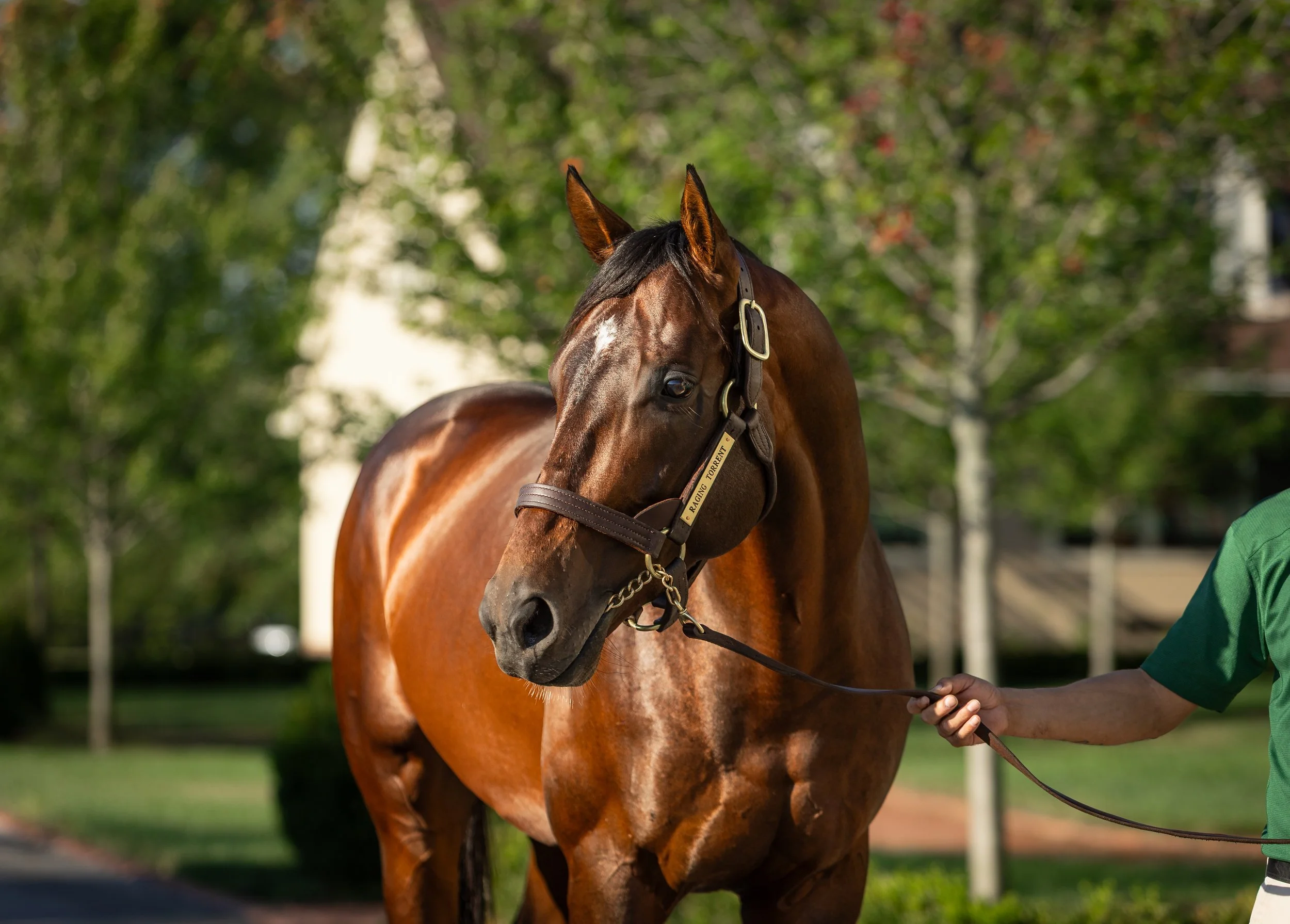
The end of the year brings magical seasons like the Breeders’ Cup, winter holidays, and in horse racing, a cascade of retirements as prospective stallions and broodmares exit their careers on the track for the next phase. This is when the sport goes from wagering on races that last minutes to one that lasts years, a bet, a wager that pedigrees, physical attributes, and on-track performances will translate to the breeding shed.
That wager hinges on a mix of knowns and unknowns; a test of how to transition a stallion from athlete to producer, balancing husbandry and business acumen, aided by tax incentives and the lure of opportunity in an ever-evolving marketplace.
*************************************************************
The first Thoroughbred stallion imported to the United States was Bulle Rock, a son of the Darley Arabian out of a Byerley Turk mare, who arrived in Virginia in 1730. A century later, Glencoe, broodmare sire of Kentucky and Asteroid, landed on American soil in 1836. In those early eras, transporting horses was a challenge, so a stallion would stand in one location, servicing mare from the immediate area before being moved to a different farm the following season.
As transportation improved, the process reversed. An owner could keep their stallion at their farm, inviting broodmares to come to him. Sole owners and breeders like Samuel Riddle, who stood Man o’ War, could control the size of their stallions’ books and the quality of the mares admitted to the breeding shed. Income from stud fees went directly to the owner, along with the tax burden.
As stallion prices rose, sharing financial responsibility – i.e., purchase price, veterinary care, board, fertility insurance – became appealing. Syndicates allowed partners to share costs while also ensuring sustained demand for that sire’s services. Shareholders, often broodmare owners themselves, could use their breeding rights or sell them and later decide to retain and race the foal in their colors or sell it to recoup some of their expenses.
One of the earliest syndicates came in 1925, when Arthur B. Hancock of Virginia’s Ellerslie and Kentucky’s Claiborne Farm joined forces with William Woodward, Marshall Field III, and Robert Fairbairn, all of whom had breeding programs of their own, to purchase Sir Gallahad III, a stakes winner in England and France. The group pooled $125,000 to bring the son of Teddy to Claiborne, where he went on to sire Triple Crown winner Gallant Fox along with classic winners like Gallahadion, High Quest, and Hoop Jr.
By the 1950s, syndicates had become more common as breeding in the United States started shifting toward farms standing multiple stallions, often owned by groups of up to 40 shareholders. That number, said Headley Bell of Mill Ridge Farm, was based on the idea that “if a stallion were turned out in a herd of mares, that 40 would be a natural herd for them.”
“Horses stood on syndicate agreements, which were very refreshing in that there generally were 40 or 45 shares in a horse, and breeders were limited to one Northern Hemisphere season,” said Michael Hernon of Hernon Bloodstock, who recruited Tapit for Gainesway Farm. “Now, this would be horses like Nijinsky, Mr. Prospector, Danzig, and the like. Because of the limitation in the supply of the product and the success of those horses in the commercial market, their fees became quite significant. But that resulted from the fact that the supply was so controlled. Over time, somewhat regrettably, we started to move away from syndicate agreements.”
Today, syndicates remain a viable way to launch a new stallion, but outright ownership by major breeders like Coolmore and Spendthrift, has become more common. With previous owners often retaining a share, these arrangements—combined with the commercial market’s expansion—have fueled book sizes that now exceed 200 mares. The Jockey Club’s 2024 Report of Mares Bred listed ten stallions that covered 200+ mares.
In 2025, commercial consideration drives much of the decision making. Farms that bring on new stallions choose between syndication or outright ownership, reflecting an industry increasingly oriented toward breeding to sell.
*************************************************************
At Fasig-Tipton’s The Saratoga Select Yearling Sale in August and then the Keeneland September Yearling Sale, the top sellers came from established stallions Gun Runner and Into Mischief. First-crop sires like Flightline, Life Is Good, and Mandaloun also made headlines, each with yearlings selling for seven figures, led by 2022 Horse of the Year Flightline with 10 total. Flightline also commanded $2.5 million for a share at the 2024 Keeneland Championship Sale at Del Mar, underscoring how lucrative new stallions can be.
With stallion ownership generally falling into the categories of syndication or sole ownership, breeders no longer need to stand and support stallions entirely on their own. Sole ownership allows breeders like Spendthrift to control a stallion’s book and retain the earnings, though it also carries the preponderance of the risk.
“We generally own a stallion outright,” said Ned Toffey, Spendthrift’s general manager. “Very often, the people who've raced a horse are interested in retaining some percentage. That's generally something that remains on the table for us. But the majority of our stallions, we own all or most of.”
For farms like Claiborne, syndication remains the preferred model: “It's a lot of money to bring in these high-dollar stallions, and we can't do it all ourselves,” observed Claiborne president Walker Hancock. “We rely on some great shareholders and syndicate members to help us stand the horse and make the purchase possible. It has evolved over the years. This year, we did our first 50-share syndicate, which we've never done before.”
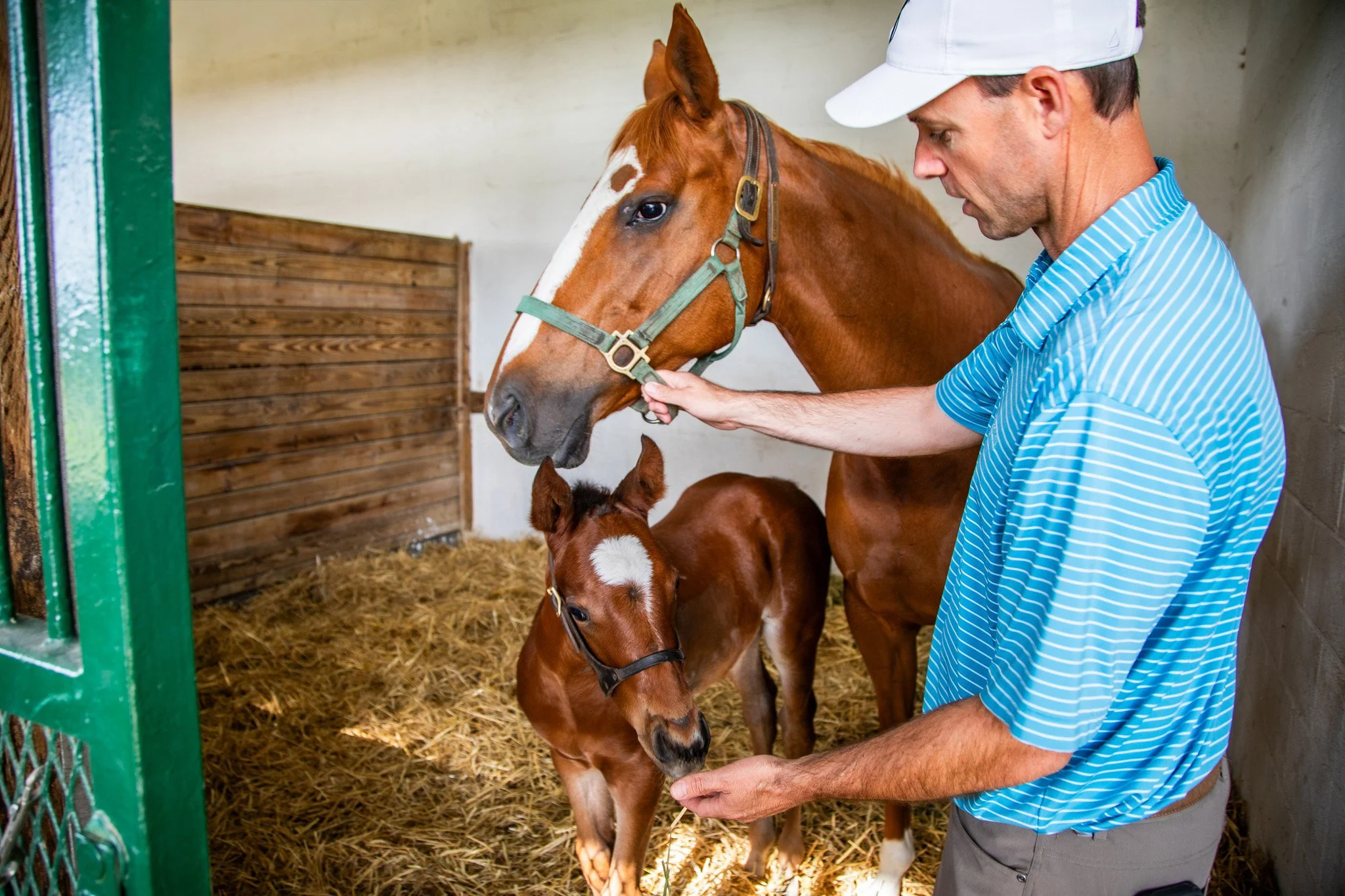
Ocala Stud favors partnerships over syndication. “We like to partner. We have syndicated horses in the past, but it's been a long time since we've done so,” said David O’Farrell, Ocala Stud’s general manager. “As the Florida Breeding Program has waned over the years, we just feel like there's fewer people that would be willing to participate in a syndicate. It's worked better for us to have partnerships, whether it be four or five different partners that invest in a stallion and then support the horse with mares.”
Regardless of the ownership structure, adding a new stallion relies on two factors: the stars of the racing year and the relationships each farm has nurtured over time. This process can begin months or even years before a potential stallion retires from racing. As Hernon observed, “lately, the demand for a young, appealing horse starts coming into focus earlier, and the horse starts to be pursued from that point of view. Then, conversely, some of them might come down to a career-ending injury that forces the horse to come out of training.”
The challenge remains identifying stallions whose on-track appeal will translate to the breeding shed. As Mill Ridge’s Headley Bell put it, “now you're starting a whole another purpose for this horse and you're redefining what this horse is going to look like. If we believe in him and in his potential as a stallion, we have to give him the best chance. As in, it's not just buying that horse, it's will the market support the horse so people will send mares?”
What are farms looking for in a potential stallion? Hernon identified four factors: “the pedigree, the physical, the performance, and those combined will lead you to the price. And then, of course, the stud fee will ultimately be determined by how much is paid for the horse. The farm has to try and structure the deal whereby they can get enough representation of mares underneath the horse to give them a chance and try and recapture their expenditure before the horse becomes exposed with his first couple of crops on the racetrack.”
Farms must consider not only who is available in a given year, but also who is already in the shedrow.
“We probably wouldn't go after two sires of the same caliber, like the same distance, same surface, same sire line, so we do try and differentiate between that,” noted Hancock.
Sequel Stallions’ Becky Thomas looks for “a sire line that I respect. Our last stallion that we brought to market was Honest Mischief, of course. He’s the leading sire of his group. I try to model our program up of what I feel like is brilliance. At some point in time, I want to see that you displayed something that was different than a lot of the other stallions.”
For programs like O’Farrell’s, a stallion is just the beginning of their investment. They maintain a broodmare band of about 50, raise the resulting foals through their two-year-old year, sell them essentially as ready-made racehorses.
“It really comes down to, do we feel like we can get a runner? And do we feel like that we can market these horses at the two-year-old sales in three years? It’s a huge investment for us, carrying them to the two-year-old sales,” O’Farrell shared. “You've got a significant amount of investment in that broodmare, and so you better believe in the stallion because you're carrying the output for so long.”
Once a farm identifies a candidate, the challenge is turning successful racehorse into a successful stallion and doing it quickly enough to ensure long-term commercial viability.
*************************************************************
Farms take different approaches to ensure a prospect transitions into a pro. For Spendthrift, “our goal is to add at least one, if not several, stallions every year. That's basically because we understand that the simple odds are that most stallions are not going to be successful,” Toffey said. “Our mindset is that we have to continually try to bring in new horses to continue to build the roster and to replace the ones that are not making the grade.”
Other farms, especially regional ones like Ocala Stud, do not add a new name every year. “We’re not always in the market for a new stallion because we can't justify bringing one in and standing them for enough money,” O’Farrell observed. “It's hard to justify it from a stud fee perspective. When we look at stallions, rather than doing the math of seeing what it would take to get out in three years, our philosophy is more, would we be willing to breed 15 good mares to the stallion in the first two years?”
Bringing on a new stallion carries significant costs, including fertility insurance, board, veterinary care, and marketing. Such a significant investment requires the stud fee be calculated carefully. Price the stallion too high and breeders may shy away; too low, and it can signal a lack of confidence. “The objective of every farm is to get mares to the stallion. When you set the stud fees, you’re basically taking a wild guess,” O’Farrell explained. “Obviously, it comes down to what you paid for the horse. Not that you need to get that money back in three years, but you need to price him to where you feel like he can be competitive.”
The stud fee also affects long-term viability. “It's become expensive now to board a horse and pay the insurance and the associated vet work. We're in a different world now. The in-vogue stallions are highly in demand and they're going to cost a lot of money,” Hernon observed. “It's a catch-22 because the farms who buy them, based on purchase price and the demand and the competition for said horses, will determine a high dollar value on the horse to secure them. Consequently, the farm has to breed a significant number in order to make the figures work, and recapture most of their investment.”
Setting that fee is not formulaic; it is nuanced. “It's not just one or two Grade 1s equals X stud fee,” Toffey observed. “What did they do at two? What did they do at three? How did they win their races? Who did they beat? Who is the sire? What is the female family? How did they win their races? Were they the favorite every time or were they 20 to 1 and came out of nowhere? There's a lot of variables that go into building it.”
For farms like Mill Ridge and their stallion Oscar Performance, a horse that the Amermans bred and raised at the farm, Bell emphasized collaboration. “We've got to do this together. Our objective isn't to make him worth the most valuable today. We have to make him valuable down the road. In order to do that, we're going to have to be reasonable in how we price this horse because those 20 shareholders end up being your partners. You're asking them not to support this horse in the first year; you're really trying to provide incentives to them to support them in the first through fourth year, at least.”
Spendthrift and similar stud farms take a proactive approach when it comes to promoting new stallions because perception drives demand. “Since a huge percentage of the breeding market today are commercial breeders, when they look at a horse, they got to feel like, ‘This is a horse that I can use and have some success with,’” Toffey shared. “Either it's going to work well with my mare, it looks the part, or ‘Hey, look, people are really going want to buy these horses, buy this horse's offspring, so they're going to be commercially viable.’”
Commercial viability often comes before racing ability. Buyers, whether mare owners, pinhookers, or racing managers, rely on tangible factors like pedigree and physical attributes when deciding whether to invest in a stallion’s progeny. Bringing on a new stallion means not only covering the costs of a mature horse but also attracting customers for his services—that is marketing.
For a horse like Flightline, an undefeated Horse of the Year, marketing is easier. For others, farms use in-house marketing teams or public relations firms.
“Every horse has strengths and weaknesses, and we, go back to the old expression, accentuate the positive. We want to look at what messages will resonate with breeders,” Toffey said. Spendthrift brands each stallion individually, developing logos and merchandise, as do other farms like Claiborne and Lane’s End.
Other breeders take a lighter approach. “Our philosophy is, if you stand horses, if you stand a quality stallion at the right price, that is going to be the best advertisement,” O’Farrell observed.
Marketing, along with the stud fee, ultimately affects book size. In 2024, 64 first-year sires covered a minimum of five mares, with four—Gunite, Elite Power, Pappacap, and Taiba—servicing 200 or more. That’s just 6% of the total. Other stallions with large books, like Justify, Gun Runner, and Vekoma, had multiple breeding seasons under their belts. Book size reflects more than stud fee; it also depends on the stallion himself.
“Horses, like people, are different. They're made different. They have different characters, different DNA. They're not all equal on the racetrack, and they're certainly not all equal in the breeding shed,” Hernon observed. “Horses have different levels of libido and fertility, and some have a limitation in the number of mares they can comfortably breed in a season. Newer stallions, they don't know what they're doing, and they have to be taught.”
While breeding a mare may seem an instinctual undertaking for a horse, in reality it is a skill no different than teaching a horse to accept a rider and then to race. Farms may limit a new stallion’s book to allow them a chance to learn. Overbreeding a horse can be as problematic as over racing, because it can affect their confidence and create challenges for a stallion manager.
“Often, what we do with our first-year horses is we start them a little bit lower to make sure that they can handle [the job.] Not every horse can handle 180, or 160, or 150. So the first year, we're going to try to keep them down below 200,” Toffey observed. “There's some things we can do to estimate those things beforehand, but you really never know until you get into breeding season. It's a case-by-case basis.”
Some farms maintain each stallion’s book at a set level but have adjusted over the past 25 years to remain competitive. “We used to cap it at 140, but we felt like our stallions were at a bit of a competitive disadvantage with other people breeding theirs to 250 plus,” Claiborne’s Hancock shared. “In order to keep up, we have raised our book size to about 175, 180. Now, I don't anticipate going over that. I think our stallions can comfortably handle breeding that many mares.”
A farm’s book policy can influence where a stallion stands or where breeders send their mares. “Breeders will just have to choose what farm policy of numbers of mares on the book that they're comfortable with, and that can predetermine their choice as to stallion and where they might breed,” Hernon observed.
Technology has also reshaped book management. Broodmare managers have tools like drugs to help a mare ovulate at a more ideal time and ultrasounds able to show finer details, enabling veterinarians to gauge the size of an ovarian follicle and predict more precisely when a mare might be ready to breed. Whereas in previous decades, a mare might need to be covered twice to ensure that they catch, such advances can increase the chance a stallion impregnates them on one.
“We're now able to do book sizes with the assumption that mares don't need to be doubled. Whereas it used to be not uncommon to have to double a mare on a heat cycle. Now it still happens, but it's rare that we have to double a mare. That alone opens up so many more spots. We're able to be way more efficient with the use of a stallion,” Toffey said.
Even after identifying a stallion prospect, negotiating a deal, setting a stud fee, and filling the book, doing it outside Kentucky, which remains the heart of American breeding, can be challenging, even in established regions like California, Florida, and New York.
*************************************************************
Even generations of experience in the sport does not insulate a farm from the realities of the modern bloodstock marketplace. David O’Farrell, the third generation at Ocala Stud, acknowledges the challenges: “Look, there's no question that Kentucky is the center of commerce in the Thoroughbred world and will be for a very long time. It's getting tougher in the so-called regional markets. But I do think there's a very good opportunity in places like Florida, where people that are investing and doing business have the opportunity to win these [breeder] awards, even though they might not be as lucrative in Kentucky.”
Becky Thomas of New York’s Sequel Stallions takes a similar approach: “Our stallions in New York cannot compete with the stud fees that Journalism and Sovereignty are going to demand. So we do not compete at that level, and most people in Kentucky cannot compete at that level. We try to be competitive with our like class level.”
For Rocky Savio of Savio-Cannon Thoroughbreds, moving their stallion Smooth Like Strait, from Kentucky to California might go against conventional wisdom, but the move was strategic. The stallion’s foals can be raced at his owners’ home tracks, as well as take advantage of the California-bred incentive program.
“We feel familiar with this scene. Michael [Cannon] and I have been going to Del Mar for the past 30 years of our lives, and Smooth Like Strait did most of his racing and winning on the West Coast. He's a California horse,” Savio shared.
In September, the California Thoroughbred Breeders’ Association announced a bonus increase for Cal-bred winners of maiden special weight races at 4 ½ furlongs and longer in both restricted and open company, adding $2,500 to both bonus for races at Santa Anita and Del Mar. Starting with the 2026 crop, the CTBA also instituted a $1,000 bonus for each registered state-bred foal up to 25 foals per CTBA member breeder. Additionally, the organization provides a transportation reimbursement up to $3,000 for mares 12 years old or younger purchased for $20,000 or more out of state and then bred to a California stallion.
“Obviously, another reason why we're going to California is for the Cal-bred bonuses.
That's why we made the move,” Savio shared. “I know everyone's moving the other way, and we're going against the grain of what's actually happening. But I think there's something left there that is beneficial to an owner.”
Regional programs in California, New York, and Florida offer awards for breeders and stallion owners, plus stakes races restricted to state-breds. The New York Racing Association is even moving toward full purse parity for state-bred races by 2027, while Florida adds incentives for state-breds at select out-of-state tracks in 2026.
Even with these incentives, programs like Sequel and Ocala Stud must compete with Kentucky, especially given the commercial market growth. As such, stud fees have to be competitive in states where the margins are slimmer and even a thousand dollars can make or break a stallion’s season.
“You have to understand your market. If they're not selling, then you've got a price that is too high. If they're selling too much, then you've got a price that’s too low. So you have to feel the market out a little bit. And it's incredible how much a $1,000 price point makes a difference in a market like Florida,” said O’Farrell.
Thomas sees that “New York is somewhat of an island, but really, we are part of an international business. I don't want to bring stallions to market that I don't feel like have a domestic as well as international feel if they hit. I mean, there's no stallion that's popular past the freshman year unless they hit.” Because it remains a top-tier racing hub, owners still flock to the Empire State to compete in its lucrative and famed tests. With the coming purse parity and the new Belmont Park, breeding, selling, and racing in New York is full of financial opportunity beyond purses.
Additionally, as O’Farrell points out, for regional farms like his to send mares out of state is not cost effective.
“That's what's killing the business in the regional markets, in my opinion,” O’Farrell said. Everybody wants to access the Kentucky stallions. But when you have a farm and you have to pay somebody else to care for your horses and you don't have control over them, it's a huge problem. It makes it harder to be a breeder when you're also paying another farm to take care of your mares.”
With that in mind, collaboration between racetracks and breeders is key to regional markets, “They need the product. We need the races. So it is very much a partnership,” said Thomas. “And I think we, on both sides, need to continue to be excellent partners and grow the program.”
“Those factors are extremely significant because we need a breeder base far beyond what you see in Kentucky because there's a lot of our commercial New York breeders that breed outside of New York as they have resident mares, and they're still a registered New York bred as long as you follow the rules of the program. We don't just compete within New York; we compete within the whole domestic market.”
Regional breeders still feel pressure to compete with Bluegrass stallions, balancing stud fees and acquisitions to stay viable. That means sending mares to Kentucky despite the costs, “something that's not talked about enough,” O’Farrell said. “I think that you have to find a way to lessen the burden for people who have farms in these regional markets to access those types of stallions. Because there's no question, the industry has gone more towards a flight to quality. You’ve got to let people want to try to improve their breeding programs, but you can't have it so burdensome to where they have to pay for their farm and pay for other people's farms, too.”
As Savio observed, “our industry is filled with guys like Michael and I, people with one or two stallions, trying to make the right decisions. Once you get to the middle and the bottom of the sport, it's just people trying to make the right decisions. Not everybody's a Gun Runner or an Into Mischief, or even some of those top 25 horses. Everybody else is fighting for the same dollar. And it's very hard.”
Those decisions can make or break farms in regional markets, especially in light of the stiff competition they face in the ever-present and all-encompassing commercial markets. State breeding programs and federal benefits like bonus depreciation help breeders like the O’Farrells, Rocky Savio, Michael Cannon, and others stay close to home and still compete across the country.
*************************************************************
The 2025 Keeneland September Yearling Sale capped a blockbuster year for bloodstock. Fasig-Tipton’s Saratoga Select Sale posted 25 seven-figure yearlings out of 166 sold, while Keeneland saw 57 seven-figure yearlings among 3,076 lots. Saratoga grossed a record $100,715,000, up 22.6% from 2024, while Keeneland hit $531,634,400, up 24% from its 2024 record.
One factor driving this year’s records includes recent legislation which reinstated bonus depreciation, a tax benefit that the federal government had been phasing out until this past July.
“Depreciation is just a fancy term for when I can write off or deduct the purchase price of assets that I buy and I use in my business,” said accountant Jen Shah.
In the long run, this 100% bonus depreciation means that a farm can write off that expenditure the same year, thus reducing their tax burden. That means more cash in their pocket to spend, which means more capital to burn. But the deduction only comes that first year, so “you have more cash in your pocket sooner because you've reduced your tax burden” so long as that horse is available for whatever purpose the buyer intends, in this case, for stallion services.
“It doesn't have to necessarily be bred, but the horse has to be available to be bred. Now, you would never breed a horse in the fall in the Northern Hemisphere, but it does have to be retired from racing before year end in order for you to say that that horse is placed in service,” Shah shared. The goal of this tax benefit is to encourage investment in American assets. In this case, that includes stallion prospects.
As Headley Bell points out, the federal government was already a willing partner to the sport, but these changes give breeders something they always need more of: time.
“Uncle Sam is really our best partner. If you look at the business, in my opinion, the depreciation and things we have are extraordinary,” Bell observed. “Because it's a hard business, you have to demonstrate that you are trying to run it as a business in order to take advantage of it. But it allows you to buy time and offset other income or revenue, so you have to try to position yourself to get lucky. You can't just keep on going down that road of losing money, so this allows you to buy time. And in this business, buying time is the best thing you can do.”
As Hernon pointed out, the end result is that “people are willing to pay more money for what is perceived to be good prospect. And there's a lot of money that's come into the market.” With so much liquidity, “people are more aggressive spending this year under the current tax law situation. Now, if that remains constant, that's to be determined.”
Another issue at the heart of these recent record sales is the concentration of sire power to a vaunted few, which narrows the genetic diversity of the Thoroughbred. The origin story of the breed starts with the Byerley Turk, the Darley Arabian, and the Godolphin Arabian. Through selective breeding first in England and then here, both the Byerley Turk and Godolphin Arabian lines are on the outside looking in, with the Darley Arabian line becoming most prominent in the United States. Some of this shift comes from the influence of the commercial market on breeding in the last 25-50 years.
“We have two sports today. We've got racing and we have sales, and each are highly addictive. There's a huge amount of a drama attached to both spheres, and the sales are like the gladiator's ring, I suppose. It's highly charged,” pedigree expert and author Suzi Prichard Jones observed. “Owners probably get to play more of a role in the whole sales saga than they do on the race course. There's intrigue. ‘Who's on this horse? Who's bidding? So and so looked at it. We'll bid this much.’ It's a game, and It's very addictive. People are breeding horses and buying horses accordingly.”
Often the reason why certain lines dominate over others is directly related to results on the racetrack as well as intangibles like temperament. Certain sire lines, most notably the Byerley Turk, were known for an abundance of spirit, which has led some breeders to prefer horses who are easier to handle. However, the long-term effects of allowing the commercial marketplace to inform breeding choices are still unknown.
“The reason these horses are commercial is because they've bred successful racehorses and they're producing successful racehorses,” said Prichard Jones. “Nobody's doing anything wrong. But when you take a deeper dive, and you look at the genetics and the pedigrees behind them all, you have to raise the question, is this a good thing?”
“If we need that diversity, then we're going to find out to our detriment in 20 years’ time, because then every Thoroughbred will be descended from Phalaris, who was a horse born in 1913. It's going to be interesting just to see how it goes.”
This focus on the commercial is a pivot from the sport’s origins, where families with names like Whitney, Woodward, and Stanley were able to breed to race, their eye on the results on the racetrack rather than the results in the sales ring. This shift has pushed the issue of genetic diversity in the Thoroughbred to the side, with the issue of pedigrees focused more on the productive sire lines rather than the overall genetic health of the breed.
“There are very few people who actually make money in this game. For a lot, it's a lifestyle. They just keep their heads above water. Maybe one year you have a good year, the next two or three years, you just eke along, and then you have a really bad year, and then maybe you have a really good year again,” Prichard Jones observed. “And that's how it goes. We love these horses dearly and we're addicted to them. This is a dreamer's game.”
*************************************************************
Breeding is not for the faint of heart. Declining foal crops, shrinking markets, and high expenses challenge even experienced operations.
“That's the challenge of today’s ‘commercial market.’ These stallions are getting so many mares in the first year that it's harder for these other potential stallions to get enough mares to be able to give them a chance,” Bell said. “That's the crossroads we are today, the commercial market driving these stallions.”
With more than half of all foals born in the United States going through the auction ring, the pressure to produce horses that offer breeders high returns in sales makes bringing a new stallion to market a gamble not everyone can afford. As with any given race day, when even a longshot has a chance to win, predicting which stallions will hit and which will miss is often the biggest bet.
“Mr. Hughes used to love to say about this game, ‘Nobody knows.’ I think it's particularly true about standing stallions,” Spendthrift’s Toffey observed. “I don't think there's any better illustration than that.”
The Long Game - what can be done to bolster the “staying” division?
Words - Annie Lambert

North American distance races appear to have an ever-shrinking number of entries. The pool of horses willing and able to run a route of ground has slowly contracted. Finding a reason as to why, however, does not have a singular answer.
The Jockey Club statistics expose a downward trend in foals produced in the United States. The mid-1980s saw the high point with the 1985 foal crop exceeding 50,000 registered foals. But since that peak, the numbers have slipped. The economic downturn in 2008 caused many breeders to sell off or curtail breeding operations, which led to the number of foals falling from around 32,000 in 2008 to just over 17,000 in 2021.
That stunning 45% decline of potential runners could explain smaller fields, but not necessarily a loss of distance runners. Or could it?
Fewer horses to enter races with certain conditions revolves into a vicious circle; when racing secretaries cannot fill longer races, for example, they will inevitably offer fewer of them.
It does not come across as though lagging purses are the biggest culprits, but it may be that breeders are looking toward pedigrees that produce runners with more speed than endurance. Do sprinters provide a faster return? Economics usually proves a strong motivator, especially in such a competitive industry as Thoroughbred horse racing.
Fewer breeders breeding fewer Thoroughbreds in general, plus more commercial breeders seeking speed that sells, could be a major factor.
One thing for certain is that no one can offer a definitive answer as to why it is difficult to fill races at classic distances. Solutions to the problem are also elusive. Those within the Thoroughbred racing industry will only offer personal hypotheses.
Nature, Nurture & Breeding
The modern Thoroughbred’s ancestry traces back to foundation sires imported to Europe around the turn of the 17th century. The Darley Arabian, the Godolphin Arabian and the Byerly Turk, from the Mediterranean Middle East, were crossed on native English equines. The result was a horse that could carry weight while sustaining speed over extended distances.
The foundation Thoroughbred originated in Great Britain with its genetic origin being Arabian, which might suggest endurance. Generations of selective breeding have sped up the North American Thoroughbred. Study condition books from any racecourse, and you’ll find only a small percentage of distance races— those being one mile and one eighth or further.
When it comes to breeding, experts often disagree on the heritability factor of genes—heritability being a measurement of how completely a trait is passed down through the genes.

E. Gus Cothran, PhD, was formerly a research professor with the University of Kentucky’s Department of Veterinary Science. The emeritus professor is currently an advisor and consultant to the Department of Veterinary Integrative Biosciences (VIBS) at Texas A&M University in College Station, Texas. The retired professor believes racing performance has a heritability of 30–35%. The remaining 65–70% he attributes to non-inherited factors, the likes of training, nutrition and health care.
“Very few people understand heritability,” Cothran said. “It’s the trait itself that has the heritability of roughly a third. That means that about 30% of what causes the trait is genetic, and the rest of it is environmental. It has to do with training and upbringing; about a third is nature and two-thirds nurture.”
Having a low genetic contribution to the trait means it will be more difficult to select for thorough breeding, according to Cothran. A complicated trait is probably made up of multiple genes having to interact. For example, there are multiple genes that would contribute to speed.
“Typical animal improvement breeding practices, which means you pick the animals that have the traits you desire to the highest degree you can find, breed them together and hope they will produce individuals that are equal or better than the parents,” Cothran explained. “And you’d have to do that probably several generations to make a large improvement, if it is even possible.”
“There may be one gene that has a maximum contribution to speed, one form of it, [for example] a particular gene with muscle characteristics,” the professor added. “But by itself, it is only going to make up a little bit of the total package of the speed.”
Andy Havens, founder of Havens Bloodstock Agency, Inc. in California, sees the trend toward speed; but he believes his ideas as to why things have changed are merely guesses as there are no statistics to back up the ideas.
“I think the phenomenon is real,” Havens said of vanishing distance horses. “For a number of years and for a number of reasons the trend has turned more toward speed-oriented racing on the dirt, going away from the European type distance horses. Most of the races, other than Del Mar, that were longer races have been shortened.”
A Turn of Foot

California-based, multiple-graded stakes-winning trainer Leonard Powell believes a lot of breeders are looking toward marketing their equine product. Since speed sells, there may be fewer classic-distance horses being produced. Powell hails from a racing family in France, riding races and training there prior to relocating to the United States. He has had plenty of experience with route horses.
“We run all day in Europe and have one pace, and it isn’t that way here,” Powell pointed out. “We bring middle-distance horses here; you want a horse that has a turn of foot. He can go a mile, mile and one eighth. With tactical speed, you can be in a good spot.”
Powell noted that the racing office has trouble filling races going one mile and one eighth or further. Those races might draw five or six horses on a good draw, but if they drop the race back to one mile and one sixteenth, it will have a full field.
Jeff Mullins is based at Santa Anita and recently set up an annex stable at Gulfstream Park. He was hoping the condition book in Florida would provide more opportunities, and larger purses, for his distance runners; that turned out not to be the case.
“A lot of those [classic distance] horses have gone elsewhere, where there is more money,” Mullins opined. “If you go to Churchill or Keeneland or Oaklawn, those purses are higher than California.”
Mullins, with career earnings approaching $55 million, has won graded stakes with imported horses, the likes of Itsinthepost (FR), Battle of Hastings (GB) and River Boyne (IRE). He and his customers choose European horses for their surface preferences as much as their running distances.
“We purchase some sprinters and some distance horses—it just depends on the horse,” he said. “The main thing that we look for over there are horses that like firm ground.”
According to Mullins, there are not enough distance horses in California to fill those races, but “there are not enough horses in California period.”
It’s Not Just Canada
Scott Lane, racing secretary at Woodbine in Ontario, Canada, was quick to point out that a lack of entries in stayer races was not solely a Canadian problem.
“It’s a North American issue,” he lamented, “not just a Woodbine issue.”
Lane did not have an “expert reason” why the problem exists, but thought there were many more stallions with shorter-distance pedigrees.
“You see a lot of middle-distance, milers now that are the vast percentage of the sires available in North America,” he pointed out. “You just don’t see many of those classic-distance horses that are going to stud, horses that race at a mile and a half and a mile and three quarters. You don’t see many of those turned into studs. That could be a reason why.”
Havens, a leader in bloodstock sales in California for over 30 years, would agree with Lane’s opinion on North American stallions. Very few stallions that are primarily distance horses seem popular with breeders.
“All I can really say is, it’s a function of selecting the stallions that we like,” Havens offered. “I think the choices of stallions that we go to stud with are speed oriented horses that like to run early. We like those really hot, brilliant horses that are precocious enough as two-year-olds to get enough experience to run in the classics [at three].”
Lane, who has written Woodbine’s condition book since 2019, leaned away from blaming North American purse structures. He cited Gulfstream’s $3 Million Pegasus World Cup (Gr. 1), as a case in point. In the field of nine, only first placed Life Is Good (Into Mischief) and runner up Knicks Go (Paynter) had won Gr. 1 stakes. The balance of the field, although most were graded stakes placed, had not.
“We have two Gr. 1’s [at Woodbine] going a mile and a half on the turf that we’ve seen very difficult to fill over the last couple of years, unless we get some European interest,” Lane cited. “With the [pandemic] travel restrictions we had to modify those races a little bit.
“For the Valedictory Stakes (Gr. 3) we cut back from a mile and three quarters to a mile and a half. The Singspiel Stakes (Gr. 3) used to be at a mile and a half and is now a mile and three eighths. We’ve modified our distances to try and suit some of the handicap horses that [normally] go a route of ground at a mile and a sixteenth to a mile and a quarter to try and help fill longer races.”
Those changes, and other distance race changes around North America, may prove a lack of quantity and quality of horses for the stayer divisions everywhere. Many more horses are bred to sprint or run middle distances, according to Lane.
“We never have problems filling Woodbine races from five furlongs up to seven furlongs,” he noted. “You start getting to a mile and a sixteenth, we still have a lot of interest for those races. A mile and a quarter and over, we don’t have as many of those horses with the classic pedigree, so to say, anymore. We definitely see the farther you go, the less and less pool of horses you have to pick from. It’s just the way it is now.”
Texas Hold ‘Em
Texas Thoroughbred racing has had its ups and downs for decades but is ascending in recent years with popular racetracks, high-value incentive programs and prospering horse auctions. Ken Carson is the general manager of Valor Farm in Pilot Point, Texas, which was founded by Dorothy and Clarence Scharbauer who campaigned 1987 Kentucky Derby and Preakness winner Alysheba (Alydar). Their son, Doug Scharbauer, now owns the farm.

Carson, who has been on the Texas Thoroughbred Association board for nearly 30 years, agrees breeding trends are at least partially responsible for decreasing distance horse numbers. He does, however, have a lot of clients that breed to race.
Although Carson is a Texas native, he spent a decade or more in Kentucky working many facets of the racing industry, including five years as pedigree consultant at Three Chimneys Farm in Versailles. Carson believes commercial breeders have contributed in part to the vanishing distance horse pool.
“The market drives the bus,” Carson voiced. “The speedier horses sell better; they look better at the sales, and you don’t wait as long on them. I’m not saying it’s right, but I think that’s driving a lot of it. The two-year-old in training sales—they work an eighth real fast, and they bring the big dough.”
Conformation traits of speedier pedigrees tend to portray a more precocious individual. They appear balanced as though they are mature and grown into their frame, even as a two-year-old. Distance horses are often rangier, long-bodied with leaner muscle leaving their overall look as not being finished, which they are not. It will usually take that immature looking distance-bred horse longer to mature physically as well. Thus, the economics of a quick return are diminished.
Carson has no doubt there are still North American mare owners breeding to increase those classic distance horses—even in Texas. After many years of deflated numbers, The Jockey Club report of the number of mares bred shows Texas annual foal numbers are rising.
Most acknowledge the trend toward fewer stayers is real. It seems to have crept into the industry slowly, but does anyone truly care? It would not seem so.
“I don’t think it is a planned influence,” Havens opined of the shorter-faster phenomenon. “I don’t know if anybody really thinks it’s a problem.”

Hybrid Stayers
With a shortage of distance horses in North America—those running one mile and one eighth or further—steeplechase horses occasionally take to the flat track to help alleviate the problem.
Scott Lane, racing secretary at Woodbine in Ontario, Canada, said the hybrids are “few and far between now,” but they can help to fill a race now and again.
“[Trainer] Jonathan Sheppard comes to mind as one that would have some of those hybrid horses,” Lane pointed out. “They’d see a flat race at Delaware, then go to Saratoga and run over the hurdles. You do see some horses that race here through the years that transition to the hurdles afterwards. Some of the United States interest will buy these horses that are no longer competing at Woodbine and transition them into the U.S. hurdle races during the summer months.
“They have extensive hunt meet racing from July through October with races in Virginia and Maryland; and I think probably South Carolina and Pennsylvania. The top ones run in Saratoga in the summer.”