
BACK ON TRACK - THE LENGTHS RACETRACKS ARE GOING TO IN ORDER TO ENHANCE THE LIVE, IN-PERSON RACETRACK EXPERIENCE
WORDS - JENNIFER KELLYAs racetracks like Oaklawn Park, Del Mar, and others have seen an uptick in their on-track attendance, taking a look at the practices that have brought both new and core fans back for more reveals potential strategies for growing turnout everywhere.
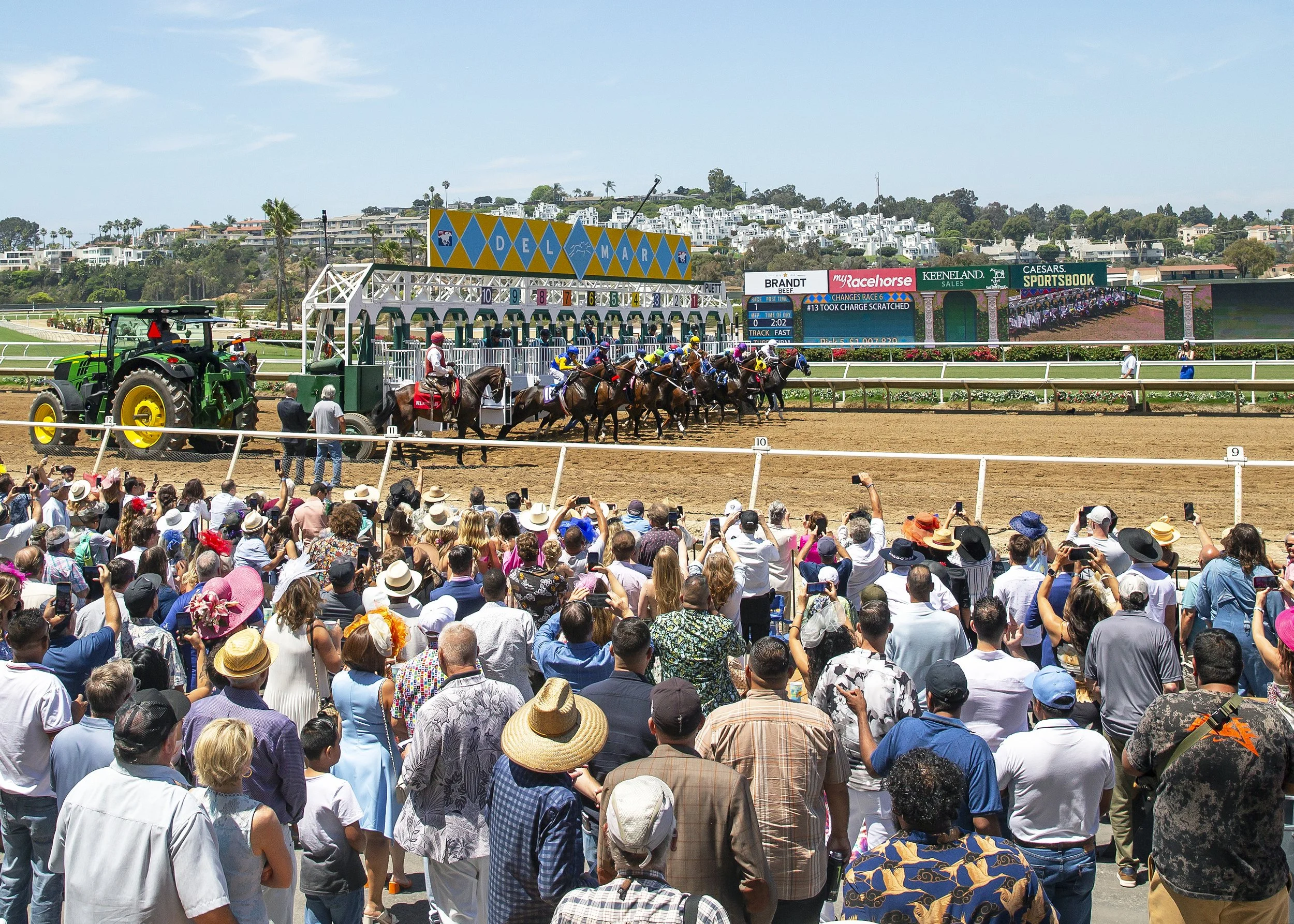
From its height in the 1950s and 1960s-on-track attendance peaked at 42,839,379 in 1969-racing has seen its share of trackside fans shrink. Competition from other sports, available via television and other access points, as well as the growth in alternate forms of gambling like casinos and lotteries, and the advent of off- track betting via simulcasting and advanced deposit wagering services (ADWs) have diverted people and their discretionary income away from the ovals. By 2019, on-track numbers for the sport's big days, like the Kentucky Derby, which averages around 150,000 annually, remained strong, but attendance overall had dropped to 8-10 million. Yet wagering handle has stayed steady, with off-track betting at simulcasting locations and via ADWS bringing in the majority of the sport's income.
However, for racetracks, encouraging fans to attend (and wager) in person is more profitable overall than other sources. "Every dollar bet at the track is way more valuable to the track than anything away from the track. In fact, the further away you get from the track, the less productive it is for the track," said Alan Balch, Executive Director of California Thoroughbred Trainers and former Senior Vice President of Marketing at Santa Anita Park.
"With on-track betting, the wagered dollar does not have to be shared with so many other constituencies. The further you get away from the track, the more people are taking their cut along the way."
Thus, racetracks needed to prioritize attracting fans for a day at the races, but also those who wanted to wager off-track, while also competing with growing options for spending both free time and discretionary income. It was an across-the-board conundrum for all forms of entertainment, not just horse racing. Then 2020 happened.
The COVID-19 pandemic presented a unique challenge for racetracks everywhere: a sport already experiencing a decline in attendance had to adapt to a period where that element of their business was not an option. Would this be temporary, lasting only days or weeks, or would this stretch on for months and potentially have long-term deleterious effects?
With even its core supporters unable to be on track, the emphasis shifted even more to the convenience of wagering at home. While teaching fans, from the casual to the committed, to bet on their phones or their computers sustained them through the uncertainties of the pandemic, that shift also presented another set of challenges when the world was able to welcome fans back to the in-person experience once again: how to bring back the social experience of a day at the races in a post-COVID economy, where previous methods of outreach have given way to new ones as people shift how they prioritize and consume entertainment.
Not only is racing competing with the National Football League, Major League Baseball, the National Basketball Association, the National Hockey League, Major League Soccer, and their offshoots for in-person attendance, but also for media time. Fans can watch most of those sports on broadcast television on a regular basis, especially if professional sports teams are local to them, but their exposure to racing on major networks is limited to the three Triple Crown races and the Breeders' Cup.
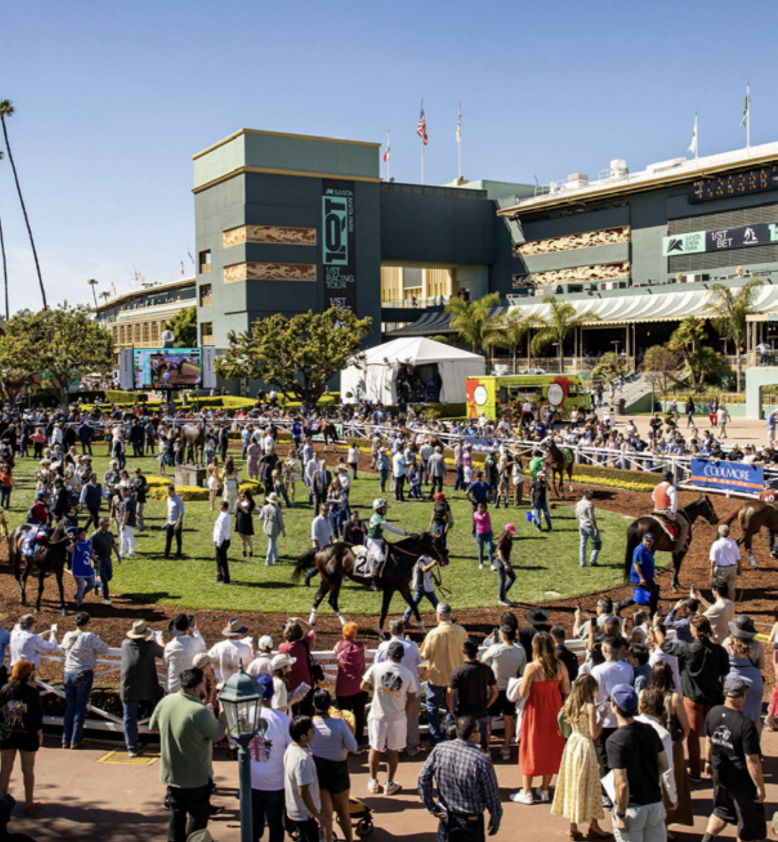
Santa Anita
With cable or other paid services, fans can see racing via Fox Sports or Fan Duel. Streaming services increase access even more, but they also require a recurring subscription. Social media can play a role in attracting viewers, but a user's algorithm is going to target their interests, making it more challenging for racetracks to reach newer customers if they have not already indicated interest in racing. For racing to compete, it requires racetracks to buy in to what fans expect to a degree they may not have in previous eras.
"If you're going to try to motivate people to attend something, you have to have all the cylinders in the marketing engine working together. And that requires real investment, money investment, people investment, and experience investment," Balch observed.
"Any place where there's racing is a very competitive environment because there's a lot of entities competing for attention. And you can't compete for attention if you don't invest in it."
For Churchill Downs, which has properties in both major metropolitan areas and more rural settings, the competition for network time requires flexibility in a cutthroat sports media landscape. "Quite honestly, it's difficult to make inroads with some of the major sports franchises from my experience. In America, football is king and we have to figure out ways to work around their scheduling," said Gary Palmisano, Vice President of Racing. "It's up to the track to find ways to fit events around games."
With competition for both fans' attention and dollars evolving, racetracks must stay on top of what works now rather than falling back on past successes. The recent growth at tracks like Oaklawn and Del Mar offers the sport a blueprint for reviving the on-track experience for the sport's core and bringing in new faces everywhere.
Peruse a sports bucket list and you will find the signature big days of any sport: the Super Bowl, World Series, tennis's Grand Slams, The Masters, and the Kentucky Derby. Racing has cultivated an enduring audience for the Run for the Roses, but that singular day is built on the hundreds of race cards in between those big days.
Because the on-track experience yields more money for racetracks, both from wagering and from admission, food and beverage, and more, refocusing on the day at the races experience is a necessity for the sport's long-term health. "I'm a big believer in the live racing experience. ADW and simulcasting are where the super majority of the handle comes from, but if we don't have live racing, how are we going to create the future fans to do simulcast and ADW and come to our big days?" said Damon Thayer, former Kentucky state senator and senior advisor to the Thoroughbred Racing Initiative.
As the sport's most recognizable brand, Churchill Downs emphasizes investment in its properties, whether in metro areas like Louisville or New Orleans or more rural locations like New Kent, Virginia, and Florence, Kentucky, as one way to bring fans back for a day at the races. "We work very hard at all of our properties to improve the overall racing experience for fans and the horsemen," Palmisano shared. "Whether that be from capital projects enhancing the physical plant or strategic initiatives to better the racing product on the track itself. We are constantly innovating and trying to create new experiences whenever we can."
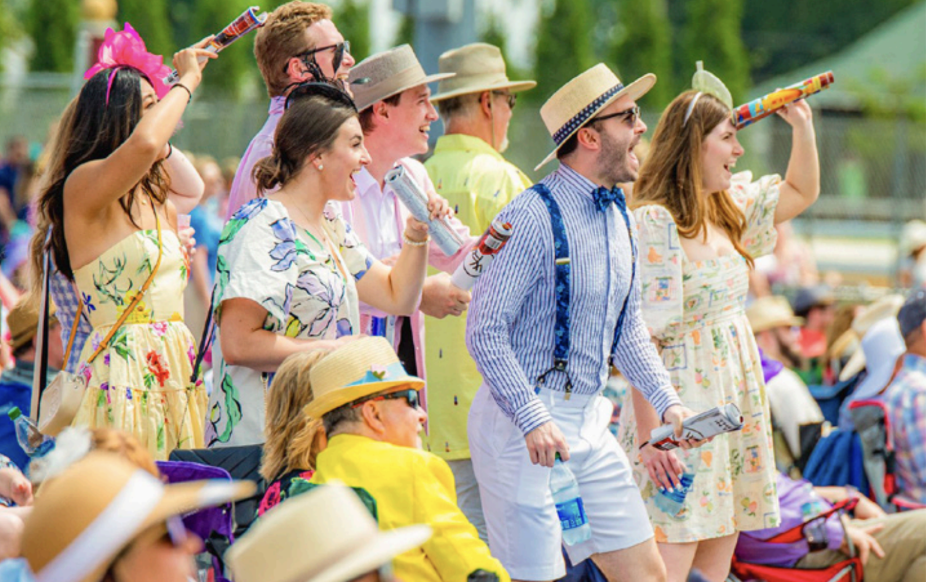
Colonial Downs
To do that, Churchill Downs Incorporated, the parent company behind its various Standardbred and Thoroughbred properties, will add new events to its traditional calendar in order to extend the opportunities to attract new and core fans: "In 2025 we created a brand-new Kentucky Derby prep race in March at Colonial Downs. Colonial's racing season is traditionally in July and August, so we had to create an experience from scratch. Over 8,000 people attended and we're nearly sold out again in 2026.
That's just one example of our efforts to think outside the box and push ourselves to improve." On top of looking for opportunities to add new must-see events, cultivating the experience of a weekday at the races is about "selling the sport of horse racing. It's not to gouge them with an expensive soda or hot dog," said Louis Cella, President of Oaklawn Racing and Casino, "It's the experiential part of the sport, which is so great. And if you can get them with that, they'll go all day long."
In areas like Los Angeles, where the options for entertainment include multiple sports teams, museums, the film and television industry, and more, Santa Anita Park works to hold its own with both its core fans and those new to the sport. "One way we do this is by cultivating and rewarding our core, by rewarding them with gifts, or free play, or special offers for free admission," said Andrew Arthur, the track's Senior Director of Marketing. "Our other attraction strategy is to bring new fans into racing, which I'm sure is something that you're more interested in. And how we do that is we add extra experiences."
The classic racetrack incorporates a wide- ranging calendar of events, including corgi races, special food and beverage vendors, and on-track attractions like its annual calendar giveaway on opening day, traditionally the day after Christmas. Additionally, they have wagering ambassadors who interact with newer fans one-on-one, taking them on tours of the track and teaching them about how racing and wagering work.
"We focus our marketing around our big days and then have a steady flow of marketing to promote those other smaller events that I talked about. And then our on-track experience, the wager investors, try to convert them into longer fans." Arthur added. "Once we get those customers, then we start getting them into our email funnels and our texting funnels and doing our best to make an offer to them to come back."
Located in San Diego, the Pacific Ocean a hop and a skip away, Del Mar faces similar challenges and yet has seen a similar increase in on-track attendance. "There's so much to do. We have a ton of competition in the area, especially during the summer," said Erin Bailey, the track's Vice President of Marketing. "You've got the beaches, the Padres, and more. So we firmly believe that we have to have a reason for people to choose us over all those other things."
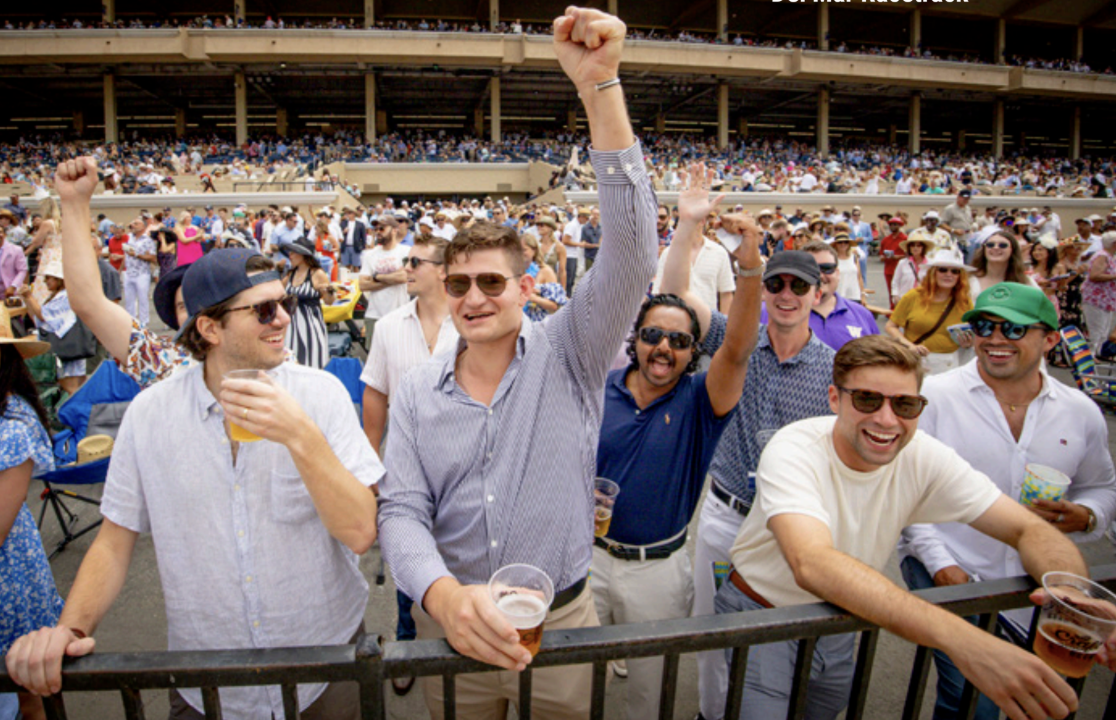
Del Mar Racetrack
To do that, Del Mar emphasizes affordability and familiarity. "You can get in for $8, and you can bring a picnic, and you don't even have to buy our food and beverage," Bailey said. "You can bring in your own food, and you can just post up trackside on the apron or wherever you might want to land. If you want to have a very financially efficient day, you absolutely can."
Additionally, "we [at Del Mar] really work hard to find these familiar things to bring people to. So on Saturdays, for example, we will have a lifestyle event like a food or wine festival or a trackside bourbon tasting while also watching world-class racing. We use a lot of those types of experiences to bring people out, to get them with something that they already are doing and are used to."
While Oaklawn Park may not face the same competition for fans, its location inside a national park an hour outside of Little Rock, Arkansas, may not seem like a natural racing destination, but the Cella family's emphasis on customer service has helped make this century-old racetrack a destination for fans from all over the region. "There is a reason we average over 10,000 people a day, over a 65- day meet. And that is because we appreciate and we do everything in our power to help the fan," said Cella, who is the fourth generation of his family to helm Oaklawn. "The reason that's so important is you sell them the product of horse racing, and that's our business, selling the sport of horse racing, not gambling."
"And when we're successful at that, guess what? They're going to come back, they're going to place two bucks to show on the favorite, they're going to buy a hot dog, and all the other areas will start being successful."
Oaklawn does that through incentives like free admission, inexpensive programs, and on-track wagering benefits like their Show Bet Bonus, which rewards fans who place wagers at Oaklawn rather than through an ADW or off- track betting service. Like Santa Anita, the track also has ambassadors that wander through each day's crowd, offering answers to any questions fans may have and engaging with the public directly, reinforcing the track's emphasis on customer service. Additionally, Oaklawn's approach to concessions underscores its commitment to making the on-track experience an affordable one.
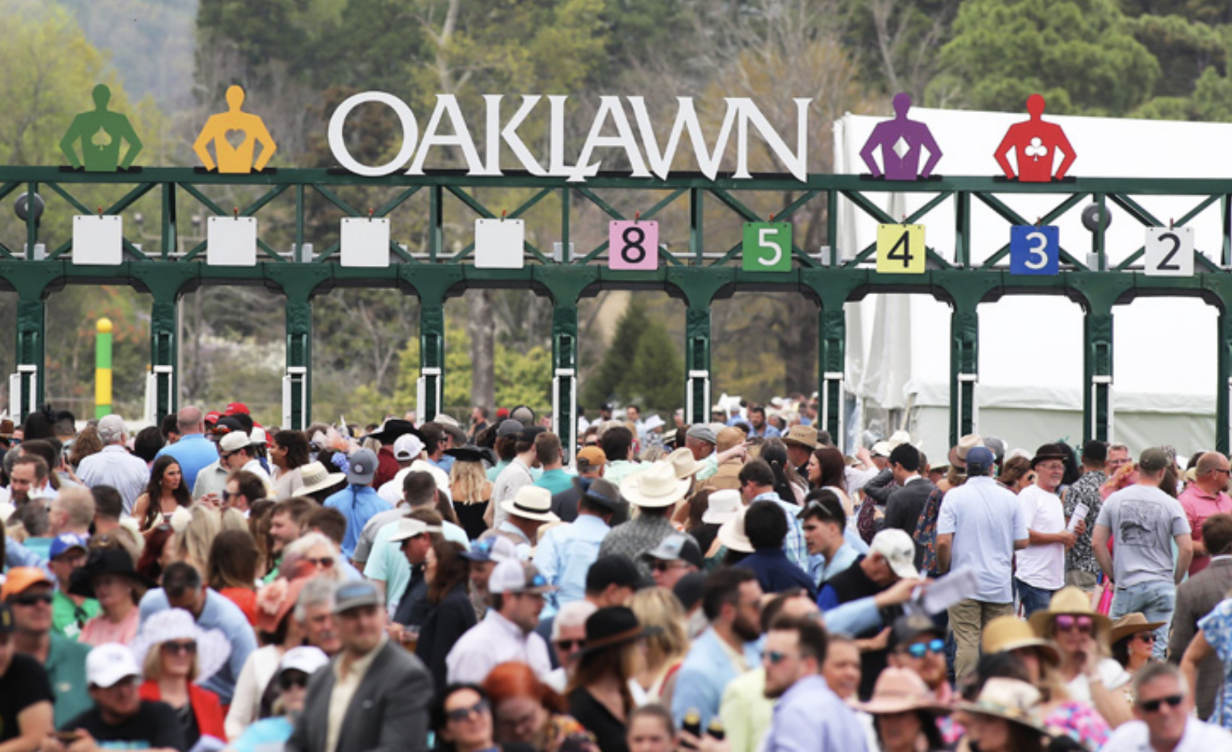
"Fans will never have to buy a $12 beer at Oaklawn. We are proud that it is affordable for families to bring the kids. We own our food and beverage vendors across the entire plant. And because we own it, we do not view food and beverage as a profit center. We view it as breaking even," Cella said. "If we break even, we can pass those savings on to our fans. So they come over and over and over because they know they're not going to be nickel and dimed at the concession stand. It's a very different view of a racetrack, especially on track."
That affordability is key to bringing fans back for the on-track experience as Nick Tammaro, Sam Houston’s Player Development Manager and track announcer, emphasizes: “One thing that I think we’re trying to capitalize on, that we could do better, everybody could do better, is that the entertainment dollar right now in this country is spread so thin because everything is so expensive. If we’re able to get people to understand that you could come out and bring your family of four and watch live racing and get a decent seat to do so and feed them for 60 bucks, in an area like Houston, that’s a good deal.”
Compare that cost to other major sports and racing’s advantage as an affordable sporting and social experience stands out. For the same family of four to attend an NFL game, including tickets, parking, and concessions, can cost from $600 to over $2,000. An MLB game could run $150-$300, while an NBA game might cost upwards of $1,000, and an NHL game hovers around $400-$500 on average. Those prices make a day at the races a much more affordable option, but as Balch points out, tracks have to invest in the marketing necessary to share that advantage.
“My opinion, number one, is that the most important thing is for track management and ownership to view marketing as an investment and not an expense. That is the critical component of getting people to come to the track,” he said.
Alongside marketing must come hospitality, including food, beverage, and facilities, the tangibles that help people create the social experience of a day at the races.
“The thing is, the consumer who spends discretionary money on sports and entertainment, they expect a certain level of hospitality when it comes to food and drink and seats and the overall experience,” Thayer observed. “That’s something racetracks are going to have to be cognizant of moving forward, especially if you’re trying to get 20-somethings and 30-somethings to come to the races. Those kinds of fans have high expectations.”
“The biggest salespeople for any entity, including a racetrack, are satisfied customers,”
Balch echoed. “People who go home from a day at the races and tell their neighbors, ‘We just went to the races today. We had a great time out there. God, it’s the most beautiful place. Oh, you’ve never been? Oh, really? Yeah. Let’s go together. I mean, that’s when you get your existing customers to be your sales force.’”
With that in mind, what can racetracks do in the 21st century to bring both new and core fans back for a day at the races?
“I fully subscribe to the idea that if you give people something known, something comfortable, something that they’re used to, and if you put that experience trackside, they want to stay. They want to experience what you have to offer in a day at the races,” Del Mar’s
Bailey said. Bring what fans enjoy about their social experiences—good food, comfortable settings, the sports and entertainment they seek out—and then put all of that within the setting of a racetrack, and a day at the races becomes a viable part of a fan’s sporting life. How a particular location can do that will depend on how much their operators are willing to invest in their individual communities. Though racing may be as simple as several horses competing over dirt or grass, a universal pursuit that transcends location and language, getting fans in the door means understanding what works locally and that takes investment.
“I firmly believe that you can’t create a new fan without them experiencing the actual life at the racetrack,” Tammaro said. “I will die on the hill that I’ve never taken anybody to the racetrack, and they haven’t had a good time.”
“Racetracks are fan incubator sites, and not only is it important to attract fans for today and that they have a good time, but also to create the fans of tomorrow,” Thayer observed.
“We’re also developing profits for the track operator and building purse money for the horsemen,” both important parts of keeping the sport going.
“We have to admit that most people are not walking out of there having won a bundle of money. But if they’ve had fun, that’s the thing. That’s what we’re selling. We’re selling fun, we’re selling entertainment, we’re selling a social experience that people at all different levels have,” Balch said. “And that’s, again, that’s another great aspect of the racetrack. Going to the races is fun.”
To do that means putting fans, both potential and existing, first. “If you build it, [they] will come,” the voice says in the movie Field of Dreams, and indeed the main character’s efforts are rewarded with a transformative experience, one that endures long past the film’s end. It is a lesson that racing can embrace not simply in the short term, but for years to come, no matter how much the cultural landscape changes: build a familiar and welcoming space, one where people want to congregate, with the elements that make them feel at home, and they will come back again and again.
How each racetrack will achieve that is a conversation the sport must continue to have with not only fans, but also with each other. The question is, how much is the industry willing to do to make that happen?
Andrea Young - Sam Houston Racecourse - Business Snapshot
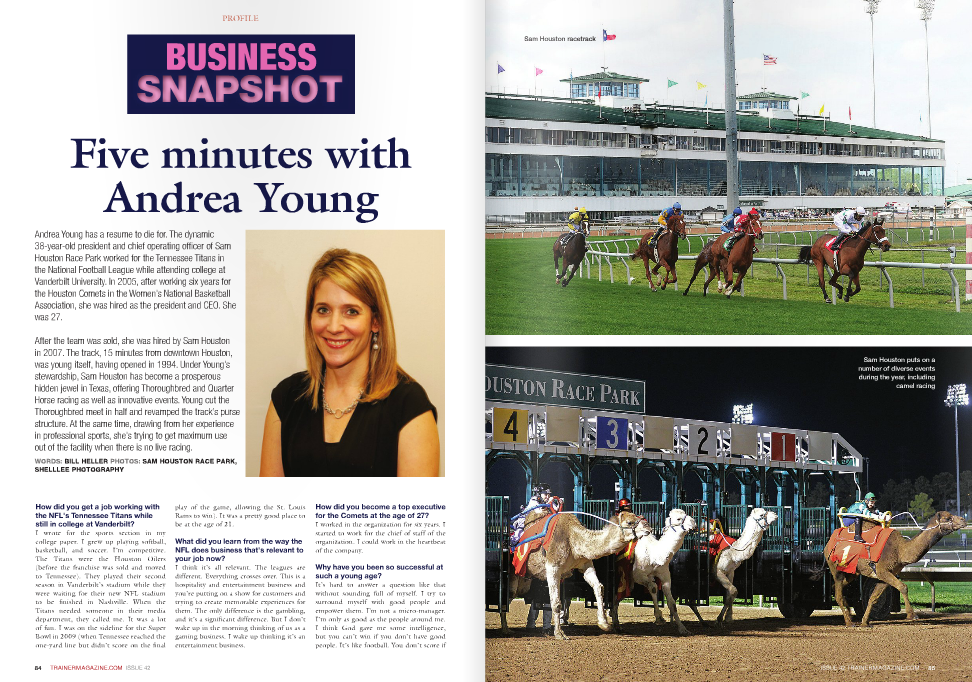
CLICK ON THE IMAGE ABOVE TO READ ONLINE
First published in North American Trainer issue 42 - November '16 to January '17