
PA-SIRED IS THE WAY TO GO
WORDS - AVERIE LEVANTI When breeders make decisions about where to breed a mare, the difference between a PA-Sired PA-Bred and a non-PA-Sired PA-Bred can feel subtle on paper. On the racetrack, however, that decision has very real financial consequences. In Pennsylvania, the numbers make a compelling case that PA-Sired is the way to go.
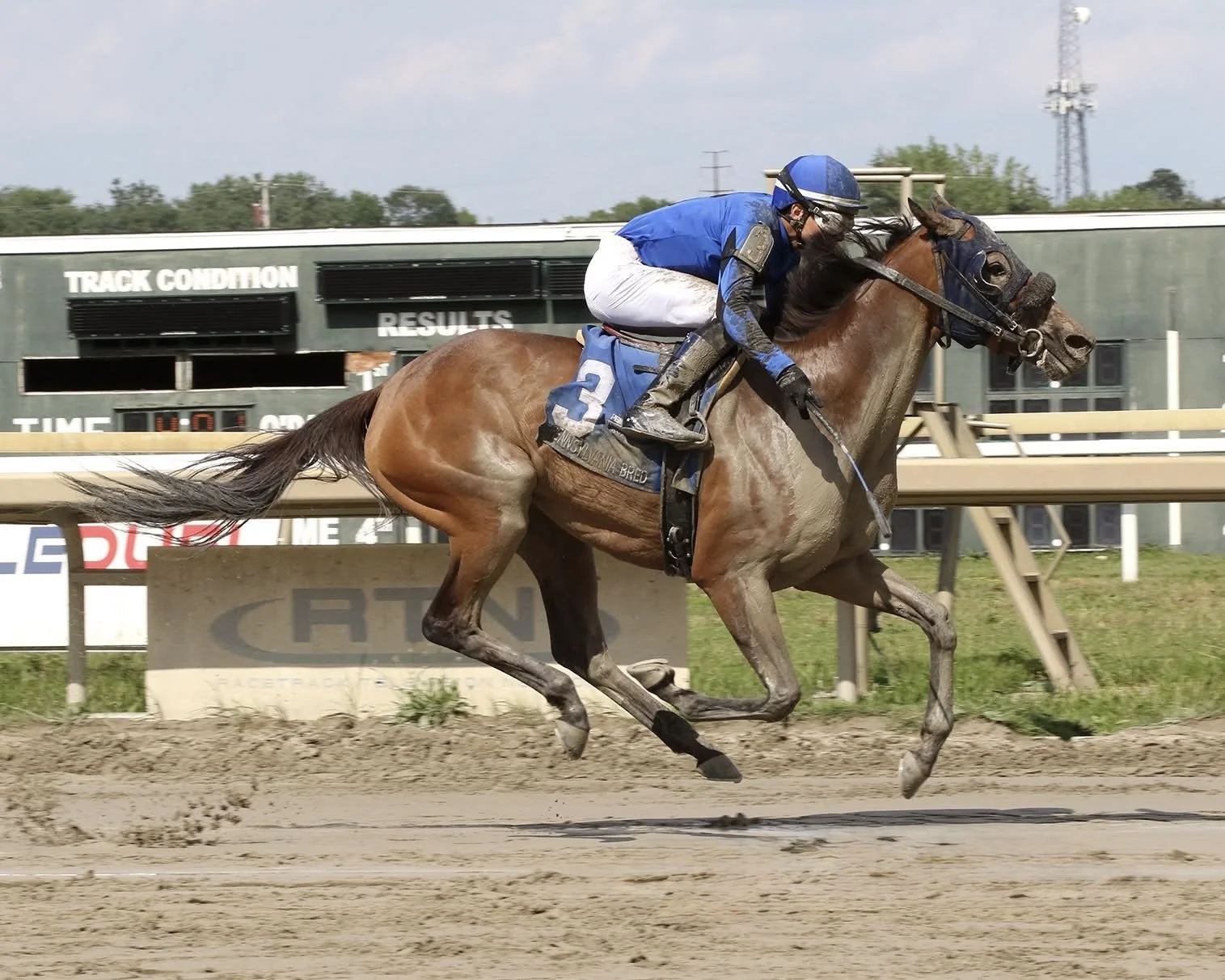
Pachelbel, with Jorge Vargas Jr. up, wins for the third time in 2025 at Parx Racing, July 2025.
The breeder of a registered PA-Bred receives an award whenever that PA-Bred finishes first, second or third in any pari-mutuel race run in the state. For PA-Breds sired by registered Pennsylvania stallions, the breeder award amounts to 40% of the purse earned. For PA-Breds sired by out- of-state stallions, the award is 20%. That single distinction, 40% versus 20%, creates a significant earning gap that compounds over the course of a horse's career.
Owners benefit as well through Pennsylvania's Owner Bonus program, which rewards the owners of PA-Breds finishing first, second or third in designated races at Parx Racing, Penn National and Presque Isle Downs. Owner bonuses are a percentage of the purse share, are considered part of a horse's official earnings and are deposited directly into owners' accounts when purses are released. Owner bonus percentages vary by track, with Parx Racing currently offering a 40% owner bonus, Presque Isle Downs 30% and Penn National 25%.
To illustrate how quickly the difference adds up, consider a $50,000 maiden special weight race at Parx Racing. A non- PA-Bred winner earns 60% of the purse, or $30,000, which is the full extent of the earnings tied to that victory. A PA-Bred that is not PA-Sired earns the same $30,000 purse share, plus a 40% owner bonus paid by the track, which equals $12,000. In addition, the breeder earns 20% of the purse share with the owner bonus, or $8,400, bringing the total earnings tied to that single win to $50,400.
A PA-Sired PA-Bred earns even more. The owner again earns the same $42,000. But the breeder awards increase to 40% of the purse share, bringing the total to $58,800 for the same $50,000 race. Stallion awards further increase the return for eligible Pennsylvania stallions.
That gap widens over time, particularly for breeders. The breeder of record remains the same no matter who subsequently owns the horse, meaning breeder awards continue for the life of the runner as long as it competes in Pennsylvania. Stallion awards are earned when a registered PA-Bred by a registered Pennsylvania stallion finishes first, second or third in the state and also remains tied to the stallion's ownership at the time of conception.
“HIGHER BREEDER AWARDS, STACKED BONUSES, STALLION INCENTIVES, AND ADDED CONDITION FLEXIBILITY ALL POINT TO THE SAME CONCLUSION: PA-SIRED PAYS.”
Beyond the raw earnings, PA-Breds also enjoy structural advantages within the racing program itself. After breaking a maiden, PA-Breds have access to allowance races restricted to Pennsylvania-Breds. It is important to note that clearing a condition in a restricted PA-Bred allowance does not count toward that same condition in an open allowance. A PA-Bred can win a non-winners of two races condition in a restricted race and still remain eligible for the open non-winners of two allowance, with the same structure applying at the non-winners of three level.
That advantage is illustrated clearly by Pachelbel, a daughter of Hoppertunity, who was standing in Pennsylvania at the time of her conception, making her a PA-Sired PA-Bred. Racing exclusively at Parx Racing in 2025, she benefited from the track's 40% PA-Bred owner bonus and the full PA-Sired breeder award structure.
Pachelbel won five races during the year, progressing through starter and allowance company. Because the allowance races she won earlier in the season were not restricted to PA-Breds, she later remained eligible for a non-winners of two races other than allowance written exclusively for PA-Breds, giving her an additional opportunity to earn at the same condition level. She also finished second in the $75,000 Disco Chick Stakes, a race restricted to PA-Sired PA-Breds.
On the racetrack alone, without awards or bonuses, Pachelbel earned $274,170 in 2025. According to the PHBA's most recent update, her season also generated $105,911.20 in breeder awards, $60,208 in owner bonuses and $26,477.80 in stallion awards. Combined, those incentives added $132,389 in addition to her regular purse earnings, bringing her total 2025 earnings to $406,559 and placing her atop the Pennsylvania Breeding Fund leaderboard.
Had Pachelbel not been PA-bred, her total earnings for the year would fall from $274,170 to $199,112, a difference of $75,058, in addition to forfeiting the $132,389 in additional awards.
When viewed race by race, the difference between PA-Sired and non-PA-Sired may appear incremental. But over the course of a season, and especially over the course of a career, the advantage becomes unmistakable. Higher breeder awards, stacked bonuses, stallion incentives and added condition flexibility all point to the same conclusion. For breeders and owners alike, PA- Sired is the way to go.