
JONATHAN THOMAS - THE ART OF WINNING SMALL
HOW FEWER HORSES & SHARPER FOCUS PLACE HIM AMONG RACING'S ELITE
WORDS - ALICIA HUGHES It is said that numbers tell a story. And when it comes to the yarns weaved in competitive landscapes, the Thoroughbred industry relies as heavily as any sporting realm on metrics and percentages when it comes to anointing their most successful participants.
As with most narratives, though, context is a key part of interpreting raw data. In the case of trainer Jonathan Thomas, the framing of said figures is a necessity to appreciate the full scope of his professional standing.
Technically, the Grade 1 winning conditioner represents one of the smaller barns across North America with his horse population ranging between 15-25 head over the past season. His overall tallies are often dwarfed by many of his brethren as he has had more than 200 starts in a year just once since going out on his own compare that with the fact Hall of Famer Steve Asmussen saddled more than 120 runners in the first few weeks of 2026 alone.
When viewed through a frame of reference, however, Thomas looms pretty large whenever he and his protégés arrive on racing's most prominent stages. From 16 individual starters in stakes races in 2025, 10 individual winners were produced. His six graded stakes victories during that time equaled his career- high mark established one year prior and were more than even some Breeders' Cup winning conditioners were able to boast over that 12-month span.
In terms of delivering when it counts, there aren't many trainers Thomas takes a backseat to as he has won at or above a 20% clip nearly the entirety of his career, including a 28%-win rate in stakes races alone in 2025. As the calendar year came to a close, his barn fittingly uncorked another reminder of that fact when he sent out Augustin Stables' Ambaya to victory in the Gr. 1 American Oaks on the December 28th card at Santa Anita Park.
If Thoroughbred racing had pound for pound rankings, there is little doubt Thomas would be in contention for a top spot - which begs the query as to why, when his numbers clearly tell the story of a high-level skillset, the amount of horses in his care continue to deem him one of Thoroughbred racing's best kept secrets.
"It's a good question," Thomas said during a break in his shopping attempts at the 2026 Keeneland January Horses of All Ages Sale. "We're always trying to stay a step ahead and add quality to the tilt. I will say I think we're all better off with quality so if it's a difference of having 25 quality animals versus 50 or 75 that are struggling...I'd much prefer the lower numbers.
"I'm happiest when I can be present with the bulk of my animals... so it might be just the way I've constructed it through osmosis. But certainly, our doors are open and we're always welcoming new participants and clients with the hope that we can get our hands on horses that we can play at the high end with."
Working hands on with bloodstock has been a lifelong objective for Thomas, a native of Virginia whose career path has gone from steeplechase jockey to assistant trainer to the helmsman of his own barn that, while compact in numbers, lacks for little in the way of accolades. That he has been able to make the most of the opportunities which have come his way is little shock to those who have spent time in his thoughtful orbit, especially given that he honed his trade working for the likes of such all-times as Hall of Fame trainer Todd Pletcher and the late Christophe Clement along the way.
He didn't necessarily target making his living as a trainer while growing up on the famed Rokeby Farm, but Thomas knew his avocation of being around horses would ultimately turn into his vocation. When his career as a steeplechase rider was cut short in 2000 due to a frightening injury that left him having to relearn how to walk, he pivoted his professional path but not his passion.
"Working with horses, it's all I've ever done. I've never earned a living any other way," Thomas said. "I don't know that I was that specific where I was going to be a trainer, but I really enjoy the horses themselves. I felt like if I could work with the right people, the right caliber of horse, I would be happy in a lot of different facets.
"I think because I've been around racing since I was little, it was the easiest thing for me to kind of do. But I knew I would never do anything that didn't involve horses."
It has been nearly a decade since Thomas formally hung out his own shingle on the nation's backstretches and featured in his more than 300 career victories are 55 stakes triumphs and counting. His career shift came about a bit fortuitously as Thomas joined John and Leslie Malone's Bridlewood Farm 2013 as the trainer for the Ocala, Fla.-based operation after spending several years working for the now eight-time Eclipse Award winning Pletcher.
It was a move prompted in large part because of his ability to bring out the best in the horses he is trusted with caring for.
"It came about organically, and, in retrospect, I probably could have done a better job with it because I wasn't expecting it," Thomas said of the decision to go out on his own. "I was breaking horses I was running against with horses I was training...so it was kind of odd."
► Praise be
Thomas' presence at the 2026 Keeneland January Horses of All Ages Sale represented an anniversary of sorts as ten years earlier, he altered his career trajectory by purchasing a bay son of More Than Ready for $170,000 on behalf of owner Robert LaPenta. Though he was working for Bridlewood, he was allowed to take on outside clients, and there was something about the ridgling, later named Catholic Boy, that struck him as he was prepping youngsters on the property.
Two years later, the short yearling Thomas had picked out was dragging him to the mountain top under his own banner. After signaling his quality with multiple graded stakes wins during his juvenile season, Catholic Boy anointed himself one of the most versatile runners of his generation when he annexed the 2018 Travers Stakes (Gr.1) on the heels of taking the Belmont Derby Invitational (Gr.1) on turf one race prior.
"This is something they should make a movie about," LaPenta said of Thomas after that Travers triumph. "A trainer who has never won a graded stakes race bought a horse for us. (Catholic Boy) was not considered to be an 'A' horse at Bridlewood and Jonathan kept saying 'There is something about him I like' and I said 'Okay, now you're going to have a chance to prove it'. And he did."
At the time of Catholic Boy's Travers victory, Thomas was still breaking horses like future Grade 1 winner Maxfield and was obligated to about 150 yearlings that were coming into Bridlewood. After bringing his freshly minted dual Grade 1 winner back with him to Florida and honing him for a 4-year- old campaign that would produce the sixth graded stakes of his career, Thomas decided to go all in on his solo training career. "I was actually very happy with what I was doing in Ocala at the time. So, it's kind of (Catholic Boy's) fault, really," Thomas laughed. "I went on a road trip for, it seemed like two years. But even though it was early in my training career I was ready for it, because we handled horses like that all the time with Todd (Pletcher). So, the only difference is it's your name and your colors and your webbing."
Among the many lessons Thomas came to appreciate from his time working with Pletcher was how diligent preparation can help dull the nerves. The unshakable demeanor his former boss is famous for is something Thomas said comes from an inner confidence of knowing the work has been done to the best of its ability and the outcome is out of one's control.
“Todd was the best person for me ever to work for because he could win six grade ones in a weekend, and he was Todd,” Thomas said. “He just went about his business and did the best he could. It's like, 'I've done what I can do, so it's up to the horse now.' I was very lucky to be around that.”
Though he admits to being a bit more “manic” internally than his champion mentor, Thomas too is one who rarely misses a dot on his checklist, as his high percentages testify to. While his equine head count has waned from its peak of more than 50 horses at one point, quality is an intangible that continues to find him. Perhaps no area is that more evident than in his pairing with the inimitable owner George Strawbridge Jr. whose Augustin Stables has become the backbone of Thomas' current reality.
True horsemen tend to find each other no matter their proximity, and such is the case with Thomas landing Strawbridge as his main client. Thomas first came onto Strawbridge's radar back in his steeplechase days when he rode a couple horses for him, and that relationship grew more roots when Thomas started breaking some of Strawbridge's equine talent at Bridlewood.
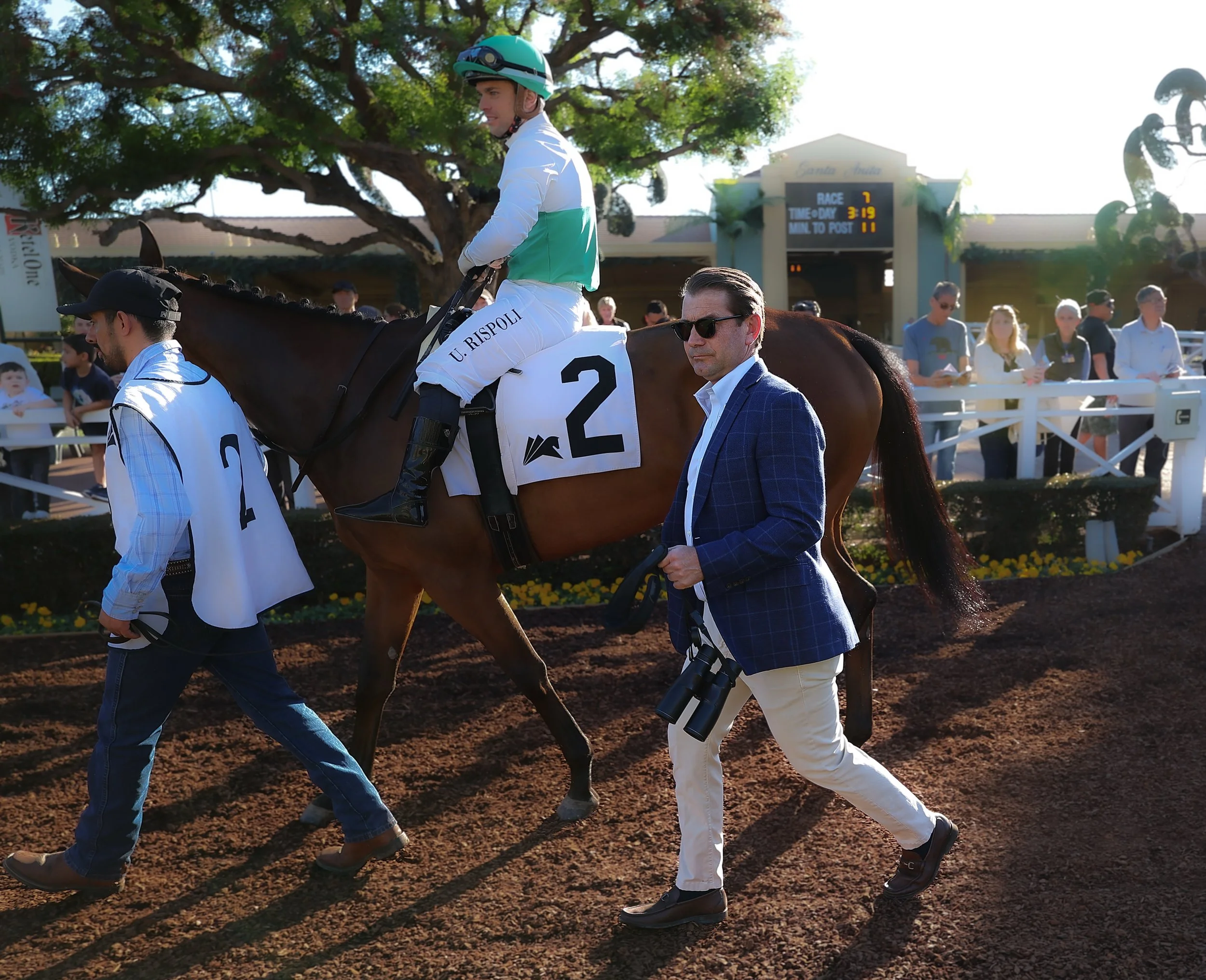
When Thomas went full time into his training career, Strawbridge continued to showcase his faith in his horsemanship by sending the brunt of his bloodstock Thomas' way. In addition to seeing Ambaya give Thomas his first Grade 1 win since Catholic Boy's Travers, the pairing has also yielded such success stories as graded stakes winners Mrs. Astor, Will Then, and Truly Quality. Those trio of graded performers in particular were responsible for an especially powerful display at Del Mar in November 2024 when each scored graded victories during a seven-day span.
“He gave me a really big push...and we've been very fortunate where every year is getting a little bit better than the next,” Thomas said of Strawbridge. “We've done very well together. He has great pedigrees and he's a horseman, so those horses are bred to race. They are given every opportunity to become the best racehorses. You're leaning on decades of thought and work and families. A lot of thought has gone into it and we're the beneficiaries of that.”
The support of a patient, breed-to-race owner is a unicorn of sorts in today's current racing landscape, a privilege Thomas doesn't take for granted. Testing as the ebbs and flows of the industry's whims can be, he can look back at one of the darkest times of his career to remind himself that he isn't defined by setbacks.
► Rebuilding after a fall
There was a time, Thomas recalls, when if the only thing he did to make money was climb into a saddle each day, he would be content to say he wasn't working a day in his life. After a fall in 2000 during a steeplechase event left him with a severe spinal injury, all of that got taken away, leaving him at age 19 wondering what kind of future he could make for himself.
“It was a scary time mainly because you're losing your identity,” Thomas recalled. “[For] everybody in this business at some level, it's not a job, it's a lifestyle. You're giving yourself a lot of sweat equity and blood equity and emotional equity. I was 19 and doing well and when that got taken away, I was a pretty lost guy for a little while. I didn't know what I was going to do.”
What he did was lean into what he knew, that when given the proper resources and enough opportunity, he could make himself stand out even against the most accomplished of peers. Since shifting his winter base to California a few years ago, he had made a habit of doing just that as 10 of his last 12 graded wins have come on the West Coast.
In an ideal world, he would love to grow his cliental to at least double its current level, a sustainable but manageable amount that would still allow him to be the hands-on force he desires. Such a boost is something that could also allow him to add some diversity to his barn by gaining some classic-type dirt runners in his program.
“Contrary to what my stats read, I love dirt racing,” he said. “We've won a Travers, we've won a Remsen. I would really like to figure out how to ramp up the dirt aspect. I'm not saying I'm trying to make my barn more commercial, but I'd like to make it a little more attractive to the bigger entities to where our name is in the hat for some of the bigger horses.”
Though he jokes he is not great at advertising himself, a commonality throughout Thomas' career is he has been broadcasting the ability of himself and his team for going on a decade.
They may not be as gaudy as some of his comrades, but his numbers do in fact speak for themselves, detailing to all who pay heed that there was a reason he burst onto the scene in such a high-level fashion.
“We love what we do. I'm very picky about my crew but we've got an excellent team,” Thomas said. “I'd love to have 50-60 horses, that would be great. But more important than that, it's about the right client coming in, the right quality coming in so we can continue to try and chip away at the top tier of racing.”