
Why is Horseracing travel overlooked?
Words - Dr. Paull KhanIn this issue, we pay homage to the pleasures of racing-based travel and shine a light on the potential that exists to harness and amplify the often neglected appeal of racing tourism.
Many readers of this magazine will vouch for the fact that attending race meetings around the world is one of the most exhilarating and culturally rich travel experiences available today. Certainly, the EMHF has afforded its members the opportunity to take in some fabulous trips to experience racing in wonderfully diverse, characterful and beautiful places across our region - as I hope this article will amply demonstrate. However, despite all this, racing seems to have 'fallen between the cracks' when it comes to tourism.
If one looks to equestrian tourism, there is a specialist European Federation dedicated to its promotion – the Fédération Internationale de Tourisme Équestre. FITE is a fellow member of the European Horse Network, alongside the EMHF, and does a sterling job, but racing does not figure in its work.
FITE concentrates on horseback riding holidays (treks, trail-rides, horse safaris, etc.). And, while it also promotes travel to attend sporting events, those events comprise disciplines like dressage, show jumping and eventing (reflecting its close association with the FEI (Federation Equestre Internationale)). Racing does not get a look in.
OK. So if we don't fit in there, what about sport tourism? Here again, there are active organisations banging the drum for this. United Nations Tourism actively supports sport tourism as a key sector of sustainable travel.
Additionally, the International Sports Travel Agencies Association (ISTAA) represents specialised agencies in the sports travel industry. Both organisations cover a broad spectrum of sport tourism, including travel for events like the Olympics, marathons, football matches, and adventure sports. But horseracing, despite its heritage and spectacle, is absent from these conversations. Which begs the question: why has racing been overlooked? Perhaps it is partly to do with ethical concerns around animal welfare and the use of animals in sport. Perhaps it is because journeying to watch the races tends to be associated in people's minds with luxury leisure travel (rather than an activity for the masses). It could be said to be in part because our sport lacks the global participation model of, say, football or athletics. But then the same could be said about motor racing, and that hasn't stopped UN Tourism forming an association on sustainable sports tourism with the FIA (Federation Internationale de l'Automobile).
This omission of racing is not just puzzling it's a missed opportunity. Horseracing travel deserves recognition as a legitimate, vibrant, culturally significant form of tourism.
So what can racing do to join the party?
I suggest, quite a lot. First, we need to be upbeat and unapologetic about the unique appeal and characteristics of our sport, as well as its scale and diversity. Racecourses are often set in breathtaking landscapes, steeped in local heritage, and deeply woven into the social fabric of their communities. Racing tourism is not simply about betting or sport; it is about tradition, identity and shared celebration. And when well-publicised, it brings prosperity to the regions that host it.
This column will return to the theme in the future. For now, you are invited to consider planning your future leisure breaks around one or more of the following racecourses, in all of which racing and travel intertwine, and which have proved spectacular venues at which to host EMHF events. Remember - these are but a handful: beautiful racecourses in interesting places abound across our region for inspiration, check out www.euromedracing.eu and click on an EMHF member country for a map of its racetracks.
► VELIEFENDI for ISTANBUL
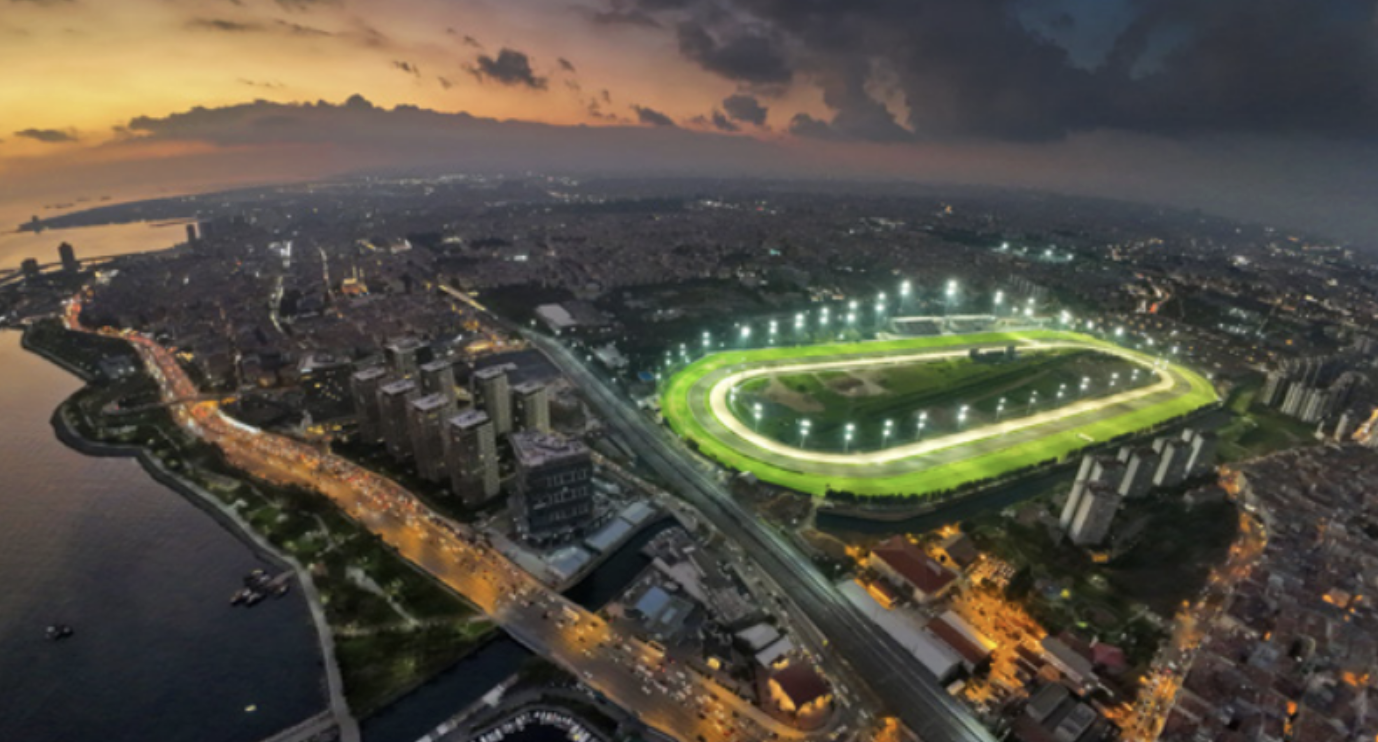
VELIEFENDI by night
Istanbul has earned a reputation as one of the most exhilarating cities in the world. Its harbour, the Golden Horn, is right up there in terms of beauty - Europe's riposte to San Francisco, Sydney or Hong Kong - and is the world's largest natural harbour, to boot.
Veliefendi is not just a racecourse; it's Istanbul catching its breath. In the bustle of Bakırköy, on the City's European side, the track opens like a green lung - 600 acres and home to more than 4,300 trees and plants representing 99 tree species. Founded in 1912, it has grown into a place where joggers, families and schoolchildren mingle with thoroughbreds, a reminder that racing here is woven into everyday life.
In racing terms, Turkey has been one of the success stories of the EuroMed region and the sport plays a significant role in the social life of its residents, with the Gazi Derby (last Sunday of June) attracting a crowd of 65,000. You are never far away from the next meeting at Veliefendi, where they race on Wednesdays and Saturdays in the winter and Wednesdays, Fridays and Sundays in summer. September's International Racing Festival crowns the season, when Istanbul's cosmopolitan energy spills onto the turf.
SEE: Visit the Koç Museum, one of Istanbul's most significant museums, which currently hosts the "Horse Power" exhibition featuring pieces from the Turkish Jockey Club Museum. Watch or join early-morning rowing sessions along the historic Golden Horn. Explore Chora Mosque, the Ecumenical Patriarchate, the Iron Church and the colorful streets of Balat.
STAY: The Bakırköy coastal area offers several high-quality accommodation options, including: JW Marriott Marmara Sea, Hyatt Regency Istanbul Ataköy, Sheraton Ataköy and Polat Renaissance Istanbul Hotels.
EAT & DRINK: If rooftop bars are your bag (as they are mine), there are few with finer views than 360 Istanbul. Other excellent drink and cocktail destinations include Gizia Brasserie, Ferida and Muutto. Fişekhane, a 19th-century ammunition-production complex, has recently been restored and transformed into a lifestyle destination featuring luxury residences, restaurants, bars and shops in a historic setting. The Atakoy Marina is not only a docking area for boats but also a dining destination, especially known for its seafood restaurants. Beyti is a Michelin-listed restaurant with over 50 years of history, specialising in traditional meat dishes.
► SANLUCAR de BARRAMEDA and ZAHARA de las ATUNES for SPAIN'S COSTA DE LA LUZ
Regular readers of this column will have detected a passion for beach racing. Choosing an example for a racing break was a hard choice, as all would fit the bill, but I have plumped for two tracks on the Andalucian coast.
If Spain can be considered the global capital of beach racing, then Sanlucar de Barrameda is its Daddy, having started way back on August 31st, 1845. Within an hour's drive is Zahara de los Atunes. Both offer never-forgotten beach racing experiences Sanlucar with a hint of sophistication, Zahara more homespun and raw. Your choice may be date-dependent - Sanlucar races in two three-day bursts in August, while Zahara has but a single day's racing in late October (next year's fixtures will be available soon at www.euromedracing.eu/beach-racing).
At Sanlucar, expect crowds of 15,000 or so and a lively atmosphere. Basic entry is free, but there is also a paid, grandstand area at the finish, housing the betting outlets. Children run their own 'betting stalls', improvised and colourful, while the last race dissolves into a sunset that paints the Atlantic gold.
SEE: Sanlucar lies on the left bank of the mouth of the River Guadalquivir, across from the Doñana National Park one of Europe's most beautiful and important wetlands. In addition, it has a peculiarity that makes this national park very special: in just one day you can see very different ecosystems: marshland, lagoons, pine groves, aloe vera, moving dunes, cliffs, 30 kilometres of unspoilt white beaches.
The beaches are a core pull of the region and include jewels such as Bajo de Guía, La Calzada, Las Piletas and La Jara. The town's attractions include the 15th Century Castle of Santiago, Church of Nuestra Señora de la O, Palace of the Infantes of Orleans and Borbon (City Hall), Palace of Dukes of Sidonia (municipal archives) and 16th Century Convent of Santo Domingo.
Within an hour's drive, a visit is highly recommended to the hilltop town of Vejer de la Frontera one of the most celebrated of Andalucia's Pueblos Blancos, famed for their dazzling white lime-washed buildings. Hotel V is a classy boutique Hotel with commanding views.
STAY: The town boats several good Hotels, such as the Albariza Boutique, Casa de la Jara, Casa Palacio, Guadalquivir, Maciá Doñana and Palacio Marqués de Arizón.
EAT & DRINK: Local cuisine is rich and largely fish- and seafood- based. Aside from Restaurants such as Avante, Bota Punta, Casa Bigote, El Colorao and El Espejo and great tapas bars like Asa Balbino, Casa Damián, Félix, La Espuela, La Herrería de Paco, Los Aparceros, and Taberna der Guerrita, spare some time for the real local feel of the chiringuitos - beach bars/restaurants like Alfonsito, El Inesperado, La Orilla, V Centenario and Ramiro.
Try the local salty manzanillo sherry in wine cellars Argüeso, Barbadillo (Barrio Alto) and La Gitana.
► Zahara de los Atunes, Europe's most recent beach racecourse, is to be found 100km south of Sanlucar.
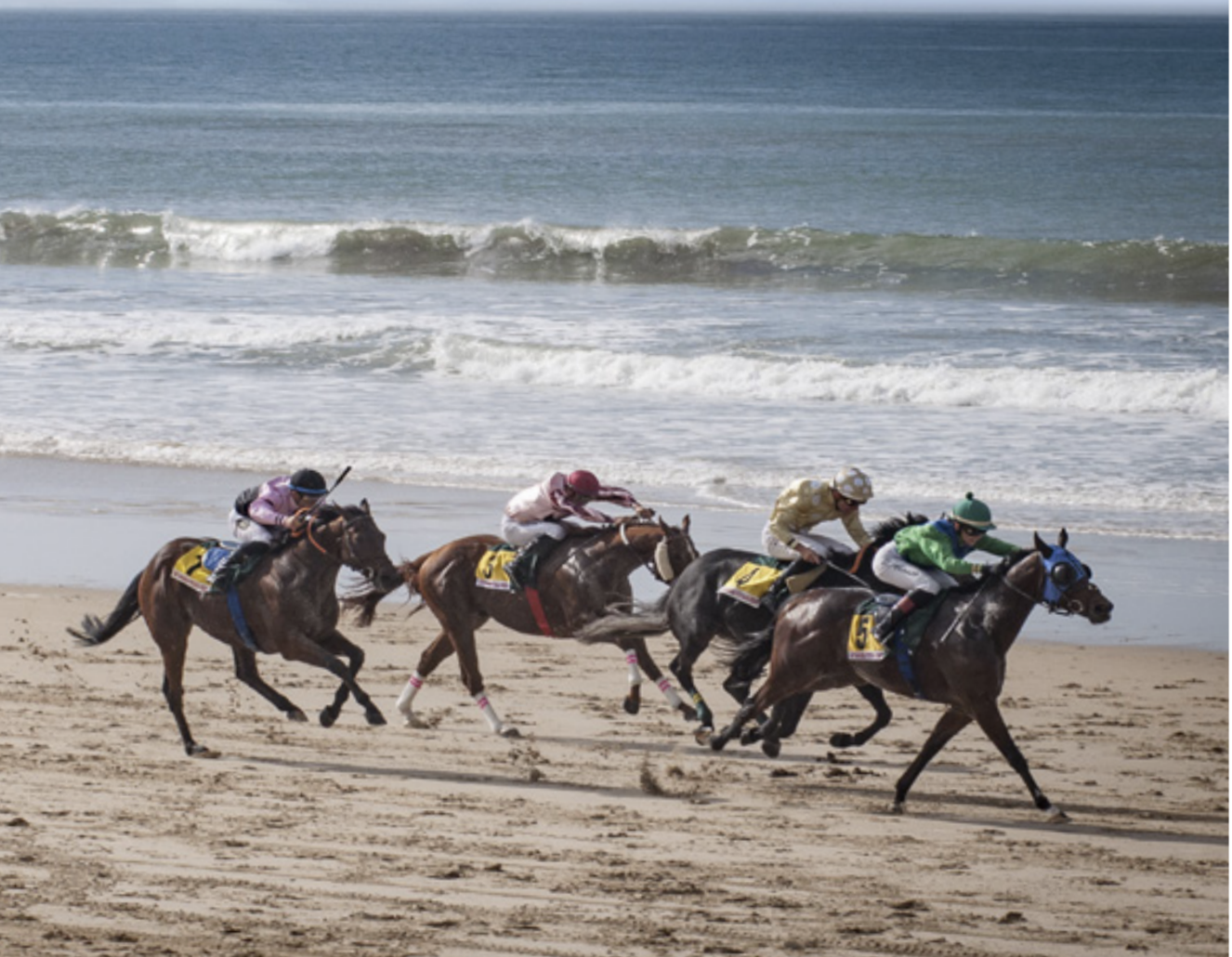
Zahara de los Atunes
SEE: Far enough south, in fact, that one can sight Africa from its Camarinal lighthouse. The small town boasts 15th-century walls and the Palace of Las Pilas. In those days, this huge construction played three very distinct roles: it was a fortress, a palace and a place where tuna was chopped up, salted and prepared. It was also the residence of visiting noblemen and kings, who came to Zahara de los Atunes to see the the labyrinthine almadraba fishing nets, designed specifically to catch Atlantic bluefin tuna the creature that lends the town its name and that still influences its every aspect.
The coastline is wild, golden and largely untouched, its long sandy beaches flanked on one side by dunes and low vegetation and, on the other, by the dramatic Atlantic Ocean. Tarifa, at the southernmost tip-tippet of Spain, within sight of Morocco, is much more than a surfer's paradise.
The racing is woven into a long weekend of culture and sport, with the Jazzahara Festival and fast and furious Horseball tournaments.
STAY: It is well worth choosing a Swim Up Room at the Zahara Beach and Spa.
EAT & DRINK: Tuna is prepared in every way possible and features on virtually every menu, whether in Restaurants (La Taberna del Campero or Casa Blas), Tapas Bars (CerveZahara, La Taberna de Zahara) or Chiringitos (Pez Limon, El Pescador and Breeza).
► KINCSEM PARK for BUDAPEST
Budapest has the easy charm of a capital that celebrates both opera and ruin bars. Hungary's only Thoroughbred track, Kincsem Park, sits so close to Budapest's heart that combining racing with all its other delights is easy. A frequent subway service takes you right to the track. Entry is free and booking a table at the Panorama Restaurant strongly advised. The racing season runs from late-March to late-November. In 2026, all gallop races will be held on Sundays, with Saturdays reserved for trotting and greyhounds. Key Thoroughbred racing dates in 2026: 10 May National Prize, 5 July Hungarian Derby, 6 September International Kincsem Race Day, 11 October Hungarian St. Leger, 8 November Ferenc Farkas-Jockey Club Prize.
Next year happens to be the 150th anniversary year of Kisbér, the only Epsom Derby winner from Hungary.
Kincsem Park is racing as Budapest itself elegant yet unpretentious, steeped in history but alive with modern rhythm.
SEE: Hop on the funicular to Buda Castle with its panoramic views. The Fisherman's Bastion whose stunning Romanesque terrace gazes over the Danube.
On the west side, walk along Váci Street for shopping and cafés, explore Heroes' Square opening onto the City Park where Vajdahunyad Castle is home to the Agricultural Museum, exhibiting Kincsem's and Imperial's skeleton and other horse racing mementoes.
The Hungarian State Opera offers guided tours, or take in the Liszt Academy-A stunning Art Nouveau concert hall offering guided tours.
STAY: Expo Tower by Mellow Mood Hotels is a 5-minute walk to the track. Downtown, consider the elegant Matild Palace or, for iconic Art Nouveau, the Four Seasons, Gresham Palace. Hotel Clark more boutique and for adults-only has great views over the Chain Bridge.
EAT & DRINK: Simaliba Belvárosi Csárda for traditional Hungarian cuisine, Fausto's Ristorante for fine-dining. A38 Ship, moored on the river, offers music lovers a unique atmosphere. For a refined take on the ruin bar, try Extra Budapest in the Jewish Quarter.
► ST. MORITZ for the ENGADINE VALLEY
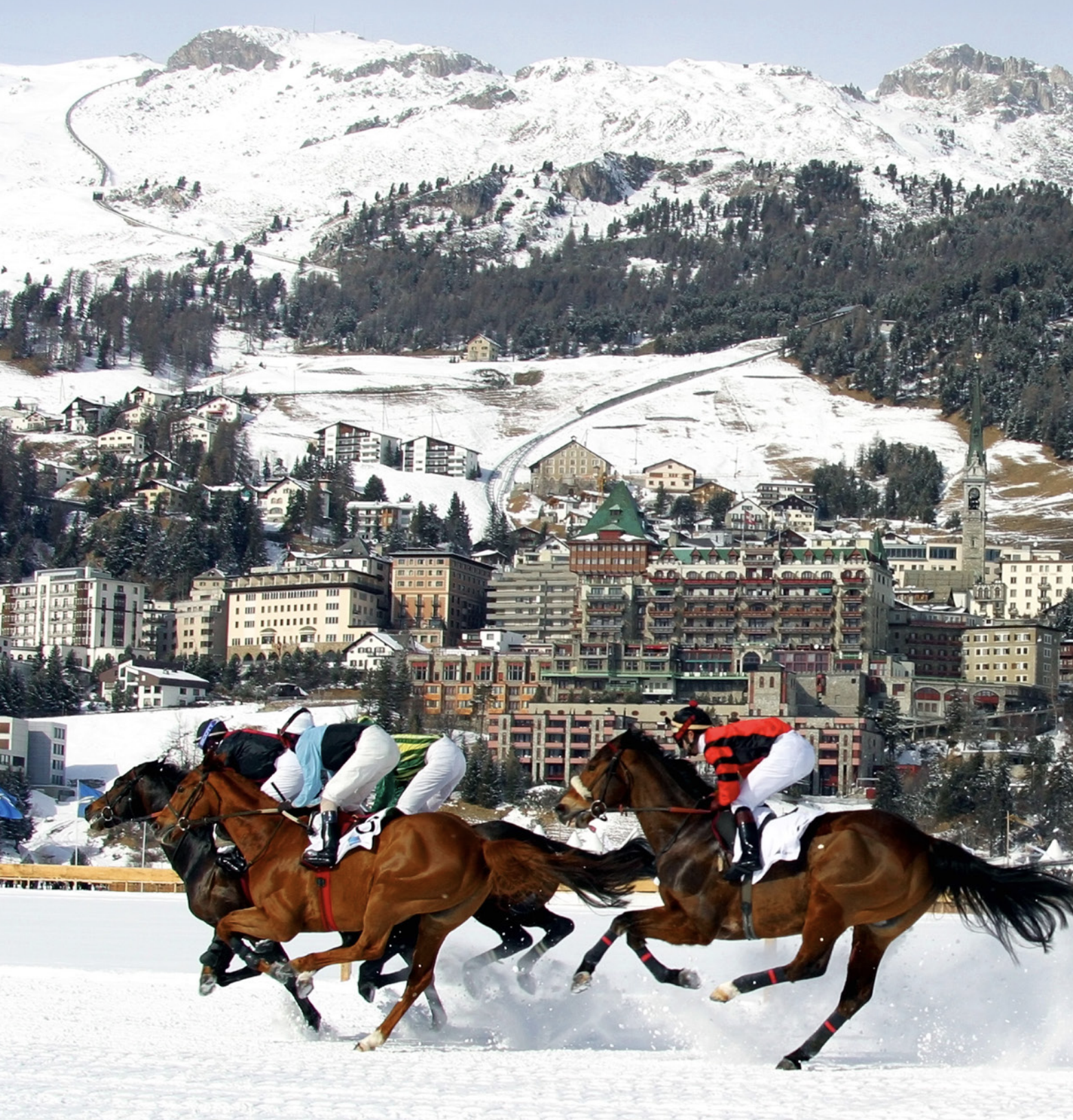
St. Moritz wears its glamour lightly, as if winter itself were a couture season. The 'White Turf' must be near the top of any league table of racefans' bucket lists. On the frozen lake, White Turf unfolds like theatre: gallop races, trotting, and the surreal spectacle of skijoring, where horses tow skiers across the ice. The tented village hums with champagne chatter. The day to be there is the last of the three Sunday fixtures - in 2026, February 8th, 15th and 22nd - which features the Grand Prix. While it's a few years since the prize went abroad, you are still likely to see some international participation.
SEE: There's really only one way to arrive into St. Moritz the spectacular Bernina Express, one of the world's most dramatic mountain railways, which climbs nearly 2,000 feet from Tirano in Italy, taming steep gradients without the use of rack-and-pinion systems just adhesion rail. From its panoramic carriages with huge windows, you'll see fabulous scenery glaciers, alpine lakes and the famous Lanswasser Viaduct.
A paradise for skiers with three world class ski areas and 87 pistes. Corvatsch offers the longest floodlit piste and features night skiing under the early hours every Friday. The Chesa Futura is a weird and wonderful striking Norman Foster-designed building. Take the funicular up to the Photo Spot Chantarella for views back over the town and surrounding mountains.
Further afield, the Engadine Valley, in which St. Moritz sits, features many beautiful villages such as Pontresina (famous for glacier access), Zuoz and Zernez for the Swiss National Park. Perched above the nearby Bregaglia Valley, the views from Soglio are stunning.
STAY: The Kulm Hotel is the oldest in town, having been founded in 1856, and is the birthplace of winter tourism in the Alps. Badrutt's Palace Hotel, a symbol of Belle Epoque glamour with its turreted façade overlooking the lake. Carlton Hotel, more intimate and perched above the lake with panoramic views. Or, further afield, the 'fairy-tale castle of the Alps - Suvretta House.
EAT & DRINK: Da Vittorio in the Carlton Hotel is Michelin-starred. Hauser's for fondue or rosti. Bar Hemingway's Club for cocktails and a literary vibe. Pavarotti Wine Bar, with its expansive décor and relaxed feel, for Italian cuisine.
► MAIA RACECOURSE for the SOUTH TYROL
Merano feels like a threshold - Italian, yet threaded with German language and Alpine rhythm. The Maia Racecourse lies just beyond the spa town's thermal baths. The soaring mountain backdrop rivals any racecourse in the world.
This year, racing starts on Sunday 12th of April and continues every Sunday until the end of June, starting again on July 19th and culminating in the Gran Premio the 28th of June; then there will be a stop of 3 weeks until Sunday 19th of July and so on to the Gran Premio at the end of September. Outside of Britain, Ireland and France, jump racing is not exactly thriving in Europe, but the Gran Premio di Merano is a welcome exception.
SEE: The thermal baths - Terme Merano - are central in Merano, central, both geographically and culturally. Great, well-tended walks abound, and within a very short time of setting off from the town, one can be high above the river, maybe en route to a nearby castle or village. Seasoned hikers may prefer the Merano 2000 hiking area, to which one can grab a cable car from the town.
If there is an event at the Kurhaus, located in the heart of Merano, it is well worth checking out this striking symbol of the Belle Époque.
STAY: Art Nouveau is very much in evidence, which might sway you towards a stay in one of the iconic Hotels such as the Meranahof, Europa Splendid or Adria.
EAT & DRINK: Trattoria Flora is a stylish Italian Restaurant-bar set in a 14th century courthouse. The Schloss Rametz can be found in a historic castle, for refined cuisine and fine wines. Vicolo is popular for aperitifs and, for a riverside bar with live music and cocktails, try Gigis.
► Conclusion
The promotion and development of racing tourism is, of course, not only a worthwhile goal because it provides great pleasure for the participants over and above that, each of the above racing events is a significant contributor to its local economy. Nowhere is this more evident than in the case of Zahara de los Atunes. The race meeting was established with the express intention of extending the town's holiday season which previously petered out some weeks before the end-October/early- November date chosen for the fixture. And it worked, with Restaurants and Hotels now staying open and busy throughout October.
The vignettes above are not just travel notes; they are evidence. Racing tourism is heritage tourism, cultural tourism, community tourism. It is a way to enrich holiday seasons, sustain local economies, and celebrate traditions that deserve their place on the global stage.
The message is clear: if well-publicised and supported, horseracing tourism can bring joy to the traveller and prosperity to the regions that host it. It is time to bring racing travel into the spotlight it deserves.