Betting on Racing’s Future
Are European governments fully recognising the economic value of racing and how can the betting landscape evolve beyond 2026?
Words - Mark Rowntree
With a close-linked relationship to gambling, horse racing has been drawn into increasingly vociferous political discussions. Across Europe and beyond, the impact of ever stricter regulation, coupled with increased taxation, provides a more challenging landscape to navigate.
Sweden has some of the most draconian gambling policies in Europe, with the last land-based casino there set to close in January 2026. Meanwhile, i the United Kingdom, the Gambling Commission is clear that it views gambling “as a leisure activity that needs strict regulation to protect vulnerable people / children from harm.”
Funding for horse racing in the UK stems from levy and media rights payments, so most within the British horseracing industry breathed a huge sigh of relief in November 2025, when the Chancellor Rachel Reeves announced in her Budget that the rate of duty for betting on horse racing would remain unchanged at 15%. The British Horseracing Authority (BHA) eager to hail their “Axe The Racing Tax” campaign as a rip-roaring success.
However, the other side is that the current Labour Government chose to focus their attention on the gambling industry instead to generate increased revenue from taxation, nominating social responsibilities as a key driver. The Remote Gaming Duty (RGD) – the tax on profits from online slots and casino games – rose from 21% to 40%, and the tax for online betting on other sports rose from 15% to 25%. With British horse racing so heavily dependent on bookmakers for sponsorship and wider exposure, and bookmakers struggling to ‘balance the books,’ the negative kickback from these decisions is immediately obvious.
Nevertheless, to overcome any threat, one must be prepared to ‘think outside of the box’ and be willing to adapt to the new less familiar, or more challenging, environment. Horse Racing and the wider gambling industry must adopt similar attitudes to make progress through turbulent times. So how does the sport and the gambling industry make these positive moves?
Now is the time for innovative thinkers to step forward.
In many jurisdictions, betting via Tote pools is commonplace, with the World Tote Association (WoTA) stating in Martin Purbrick’s ‘Tote Betting And Horse Racing: Tax, Responsible Gambling, And The Contribution to Society’ report, that evidence from 77 jurisdictions highlights how pool betting can best help to ensure a successful future for horseracing around the globe.
The World Tote Association – counting 24 tote operators representing a turnover of more than €30 billion, and 10 Associate members – is in their own words “responsible for bringing together Tote/parimutuel betting operators from around the world to promote and support the horseracing industry in a socially responsible and sustainable manner”.
The key findings of that WoTA report identifying that Tote betting can make a significant contribution to society, is inherently different from fixed odds betting, and is fundamental to the economic structure of horse racing. However, Tote betting does suffer from some structural tax problems, and increasing the taxation rate on betting, does not inversely reduce problem gambling.
The Hong Kong Jockey Club (HKJC) Chief Executive Winfried Engelbrecht-Bresges was quoted in the Racing Post (on 17th September 2025) referencing similar obstacles when discussing the growth of pool betting, principally the World Pool, “We [the HKJC] had to demonstrate in Hong Kong that the expansion in the number of gaming opportunities would not lead to gambling harm.”
World Pool, self-labelled as “an innovative version of international commingling”, aims to bring the world’s finest racing to a global audience, hosting races, or fixtures worldwide, including in Hong Kong, Dubai, Saudi Arabia, South Africa, New Zealand, the United Kingdom, Ireland, and Germany.
Tim Carroll, an experienced punter who works in the media as a broadcaster and writer, is a staunch advocate for Hong Kong pool betting,
“The set up in Hong Kong is great for the owner, trainer, jockey, and punter. Everything you need is there, horse weights, every single piece of work is documented, vet records, barrier trial replays etc, and it’s all free. It is so positive for the punter, and, from that perspective, Hong Kong is the best place to bet in the world.”
“The Hong Kong Jockey Club pools (including World Pool) are strong in terms of liquidity and cater for recreational punters, more serious individual players, and the larger high-staking syndicates.”
Carroll, who also speaks positively about fixed odds betting from more traditional bookmakers in the UK, reflected on his recent visit to Australia for the Melbourne Cup when discussing the popularity of the Totalisator Agency Board (TAB). Across Australian states many pubs, bars, and hotels offer on-premises betting facilities, usually through dedicated areas known as TABs, which operate in a comparable way to the Pari-Mutuel in France.
“There is a lot of racing there and if someone wants to put a large bet on a horse, the bet will be taken on the Tote. That has been the case for years. However, you do need liquidity in those pools and Australia doesn’t have the same degree of liquidity as in Hong Kong or with the World Pool. It does exist for feature races such as the Melbourne Cup, the Caulfield Cup, and the Golden Slipper, with many of those now also covered by the World Pool, but for many of the other day-to-day fixtures, a large five-figure bet can distort the true price of a horse.”
“The best example of this I can think of is when the Japanese champion, Deep Impact, contested the 2006 Prix de l’Arc de Triomphe there was a weight of loyal money from Japanese punters who poured millions into the parimutuel pool which saw the horse go off at 1.5 on the French tote when he was priced up at 9-4 with the [UK] firms.”
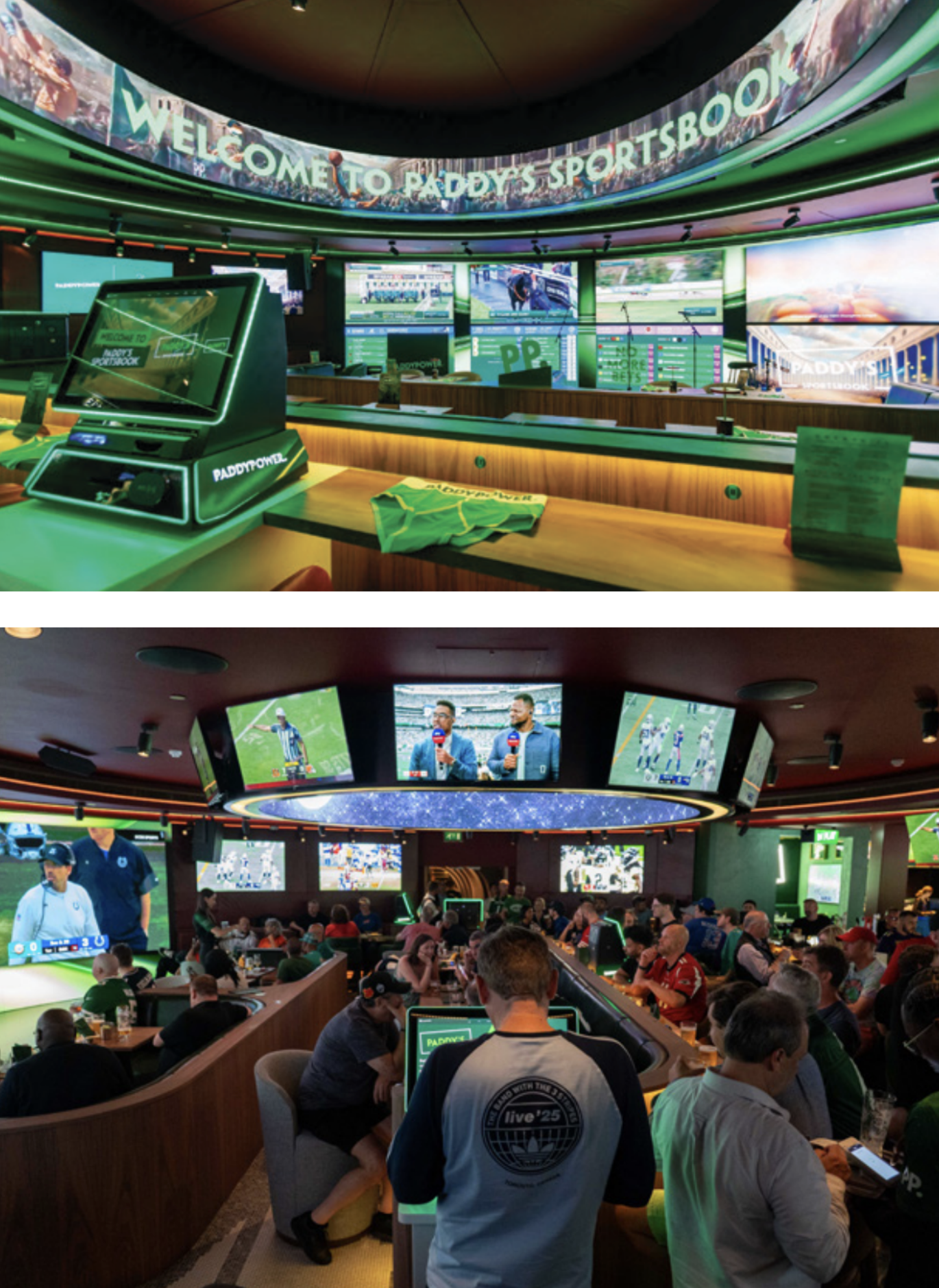
Sports-style bars are far less common in the UK and Ireland, although Paddy’s Sportsbook has recently opened a sizeable facility in the Hippodrome Casino in Central London, the first of its kind in Europe.
Sports-style bars are far less common in the UK and Ireland, although Paddy’s Sportsbook has recently introduced a sizeable facility in the Hippodrome Casino in Central London. Carroll is a massive fan of the facilities in his native Australia, highlighting their direct benefits to horse racing,
“I like the fact that in Australia you see horse racing in just about every pub or club. It doesn’t matter where you go, people are watching racing, so they become accustomed to it.”
“Because it is in an environment where you have Mums and Dads (and even kids), it has more of a sports club atmosphere, alongside the pooltables and dart boards. It has a nice appeal about it socially with horse racing or greyhound racing enjoyed by a sizable proportion of people.”
“For example, I’ll be there with my wife, she might have a couple of bets, whereas I’ll be taking more of an interest, but later in the afternoon we’ll go and sit down and have dinner in the pub. It’s a nice environment which sells the industry. I’ve been living in the UK for so long you tend to forget but, being back there recently, I feel that the buy-in from the public for horse racing and gambling is far better over in Australia.”
To some extent, the United Kingdom has been left trailing in the wake of other countries like Hong Kong, France, and Australia. The mainstream bookmakers – all left feeling incredibly deflated from tax increases on their businesses, premises overheads skyrocketing, and fees rising for various media rights packages.
Meanwhile, it is also a known fact that the pub trade is struggling across the UK, with figures for the British Beer and Pub Association (BBPA) expecting to see a pub closing every single day in 2025.
Acknowledging that there are likely to be significant political hurdles and perhaps even religious considerations to overcome, you can’t help but ponder the prospective added-value from the establishment of horse racing-related betting – either through pools or bookmakers – within those UK pubs and clubs which are continuing to perform above expectations.
For example, the J.D. Wetherspoon chain has over 800 locations across the UK, in addition to having over fifty hotels. Their founder Tim Martin is so often an outspoken Government critic, and unafraid to challenge/question the status quo. There are other similar pub groups – i.e. Greene King – who could also feasibly be willing to enter negotiations.
Such expansion, or even a simple modernisation exercise, could represent a win, win scenario for major bookmakers, or indeed for Britbet, the UK pool host and operator for 19 British racecourses.
Rob Waterhouse, a bookmaker, and the husband of legendary Australian trainer Gai Waterhouse also speaks with conviction about the issues facing the horse racing industry worldwide, condemning the constant barrage of negativity towards gambling,
“It’s a constant problem in this woke world, isn’t it? I suppose what I would say is that I think that it is a marvelous thing that the working man can have a bet and do the form, putting some intellectual exercise into finding a winner, which is perhaps his only opportunity in life to do so. It is very much part of the sport.”
“The problem is that in this world we live in, more and more money is being spent on social welfare and, as such, that money must come from somewhere, so gambling, of all sins, is an easy target. It’s a great shame.”
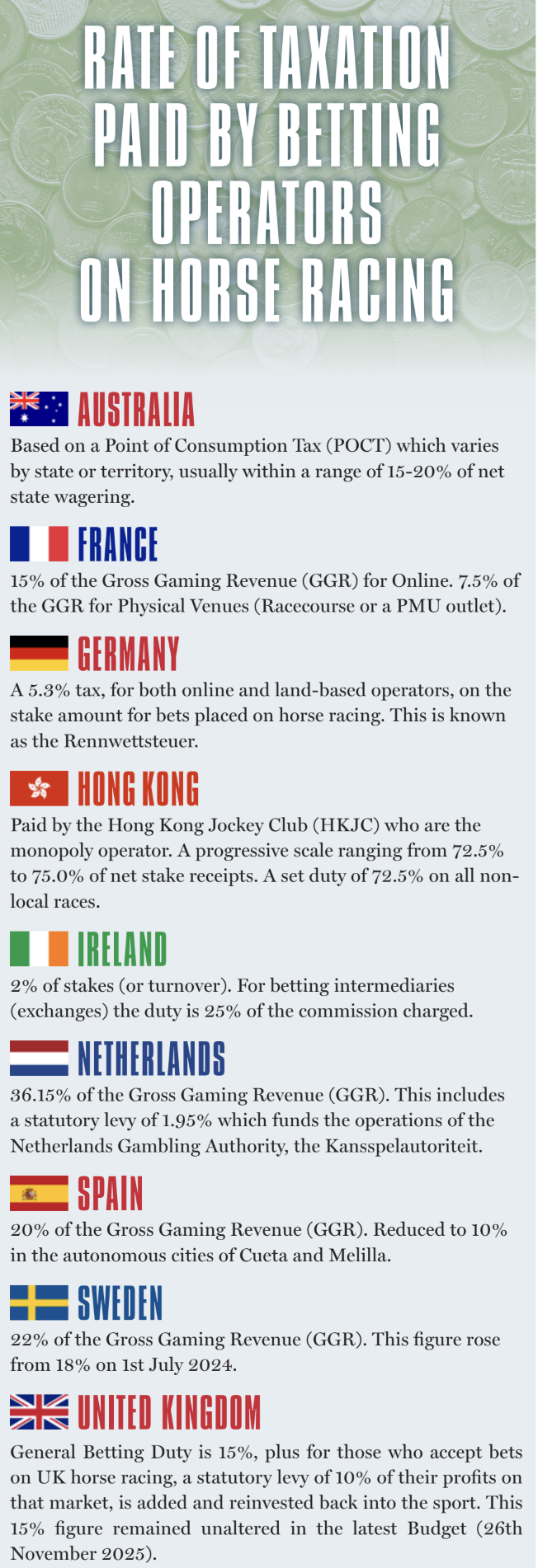
Although undeniable that strict regulations and major tax hikes – those taxes as high as 36.15% of Gross Gaming Revenue (GGR) in the Netherlands – are serving to punish the bookmaking industry, Waterhouse recognises that the ‘cost of living crisis’ has also had a direct impact on the habits of punters.
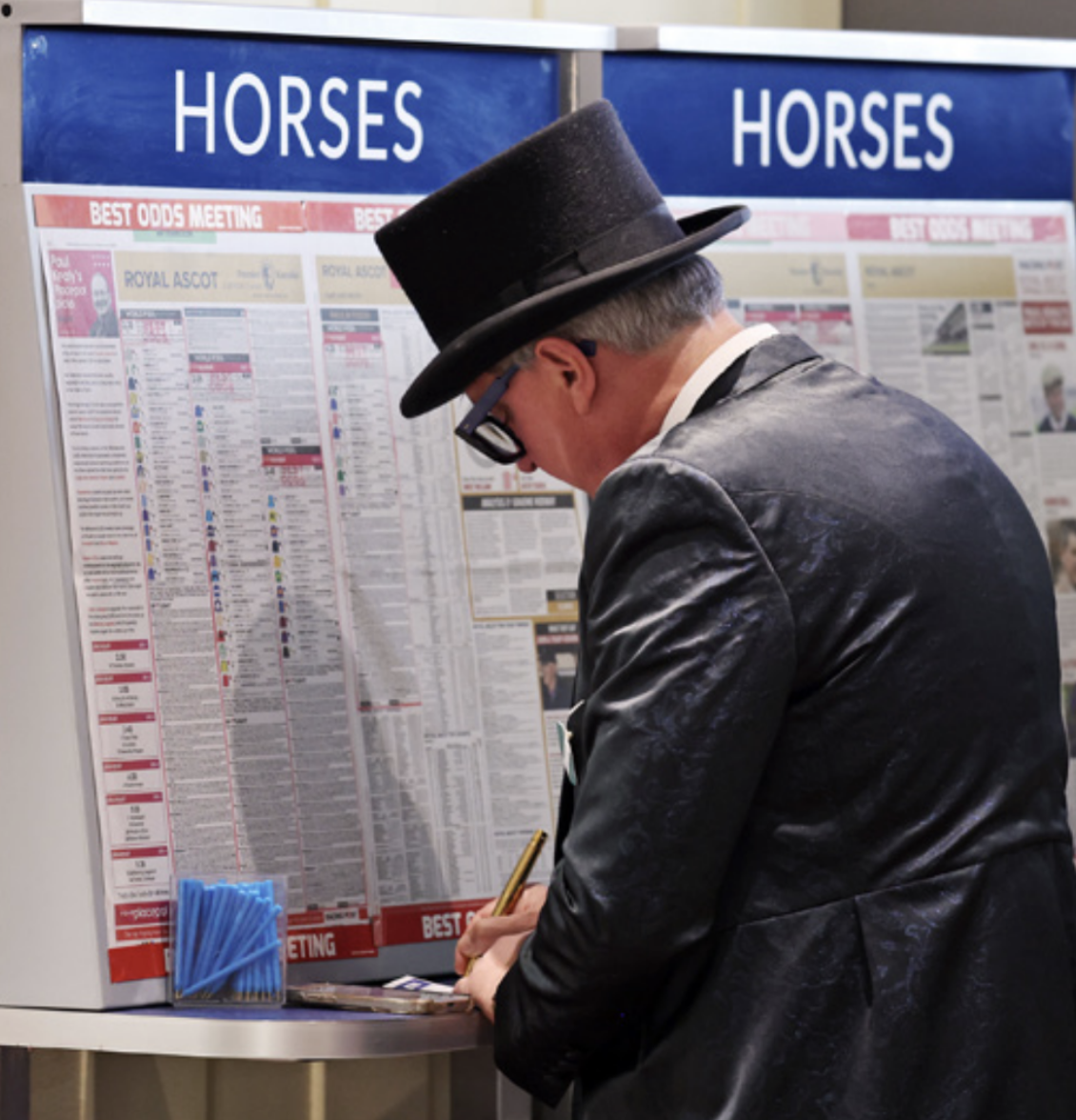
“In addition to betting on-course at Royal Ascot, I also bet in Sydney, in Melbourne, and in other places around Australia, and there is no doubt that cash has disappeared from people’s pockets.”
In stark contrast to this overall gloomy economic outlook, racecourse attendances are holding up well across Australia, with similar trends developing in the UK.
Nevertheless, this doesn’t always correlate with increased turnover for the traditional on-course bookmakers, with the ‘type of customers’ attending, and the recent emergence of ‘in-house’ bookmakers’ directly impacting on the volume of business.
Waterhouse has witnessed this shift of clientele stating, “as a bookmaker, I’d rather have ‘racing people’ at a meeting rather than people who are going to party and drink champagne” but he goes way further in condemning the ‘lack of value’ offered by ‘in-house’ bookmakers.
“The UK isn’t my country, but I do think that it is wrong that racecourses are bringing in their own ‘in-house’ bookmakers, or Tote systems. These operators are charging huge overrounds, which is so mean on the punters. I think the punters get a bad deal from [some] racecourses. It is wrong that they should do it. To me, it is almost stealing from the punters, so it is very bad.”
Despite these challenges, the primary focus for Waterhouse remains his profitable betting shops and on-course business, the online market now seen as being of little added value.
“Our turnovers have dropped but thankfully, the taxes are quite low for on-course bookmakers in Australia, as is the case in the UK. I have been involved with three online businesses, and I’ve sold all three. They [the Government] just keep on increasing the taxes on online businesses to the point where it’s just not profitable, so that brings great sadness.”
On-course bookmakers have next to nothing to fear from either black-market operators, or the ever more stringent affordability checks placed on customers by licensed and regulated online operators. Waterhouse is eager to promote the benefits of betting on track.
“In Australia there has been a rise [in black-market operators], with several people advertising themselves as bookmakers but they don’t have a license and have invariably taken the lot and not paid winning punters. I don’t speak with authority, but I suspect there will be a lot of people ringing their on-course bookmakers to bet because their taxes are lower.”
“As I understand it, in England, if you go into a betting shop there and want £100 on a horse, they’ll ask you to prove that you can afford it, requesting your bank records and proof of income and whatever else. It all seems very strange.”
So, with every single dimension of the bookmaking industry across Europe, Australia, and beyond, under threat, and the average yearling price in Australia for 2025 around A$149,000, ownership viewed by Rob Waterhouse as being “too expensive for the average person”, where do we go for a solution?
As Waterhouse correctly identifies, “Horse Racing is one of those great things where everyone can start a conversation about horses, or what have you backed here, or are you winning? It’s easy to start a conversation in relation to horse racing.”
For me, as the author of this report and as an enthusiastic devotee to horse racing, it is these channels of dialogue that remain key. It is essential that those who elect to devote their working lives to bookmaking, or the wider horse racing industry, remain united to the cause for the sport to thrive. It is simple; now isn’t the time for division, or worse, for self-preservation.
The key decision makers require foresight and a brave, bold new vision. There are a multitude of opportunities for horse racing and bookmaking to flourish as a collective force. Industry leaders in Britain, Ireland, France, Germany, Spain, Sweden, Australia, and wherever else, need to brace for a fierce political battle and, like their counterparts in Hong Kong, shift the narrative from a ‘risk of harm and addiction’ to focus on showcasing opportunities for growth and investment. With risk comes opportunity, and so often fortune favours the brave.