
From growth to performance - the musculoskeletal and neural development during the transition from yearling to 2yo
WORDS: ÅSA BECKMAN► Nothing happens until it is experienced
We can plan, measure, and structure training down to the smallest detail. However, for the horse, reality begins the moment it passes through the horse's consciousness. Every movement, contact, and environmental change is evaluated through the question 'Am I safe?'.
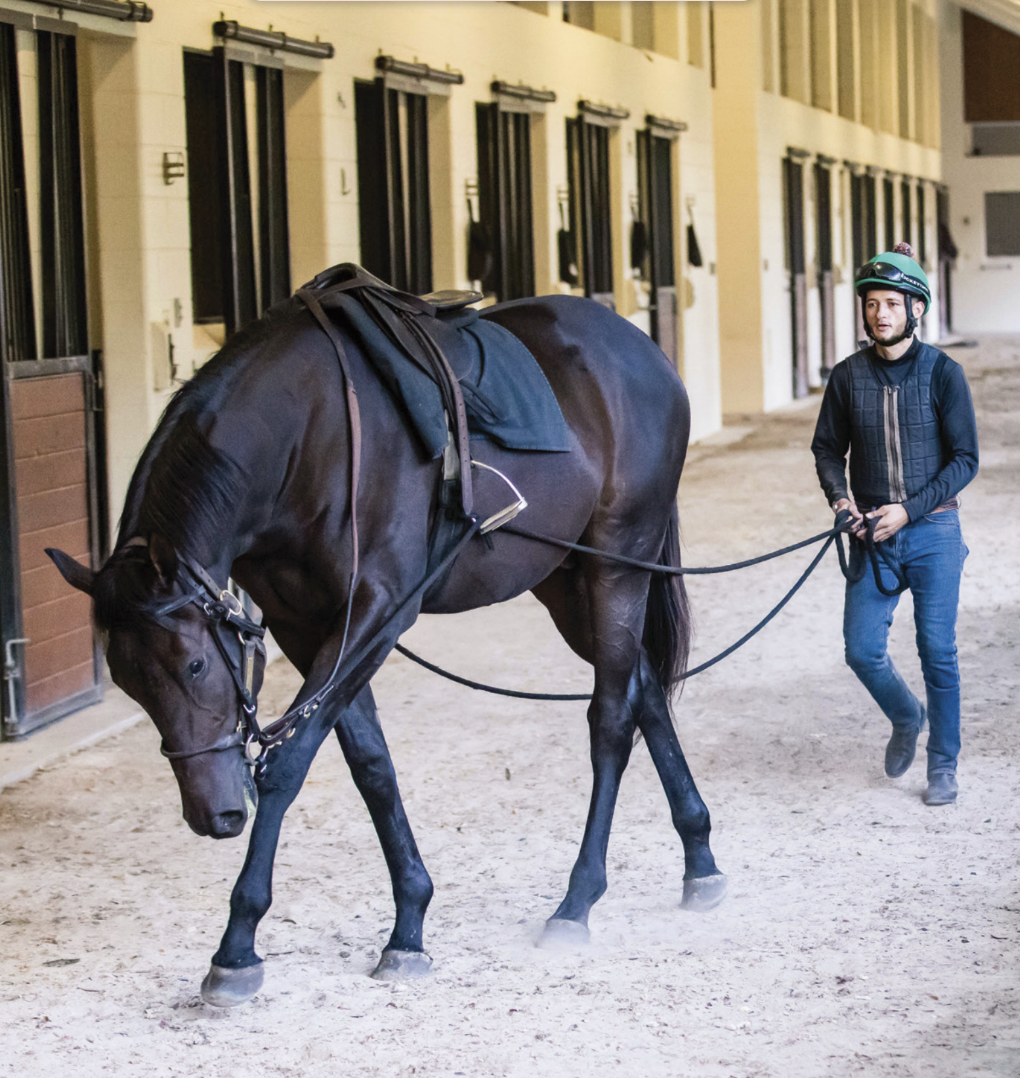
For horses, as prey animals, safety is not abstract; it is a biological necessity that determines whether the body can relax, learn, and adapt, or redirect energy toward flight and defense. Unlike humans, horses are unaware of what will happen next in their lives. Every new situation, routine, or training exercise is experienced in real time. This places the responsibility on humans to create conditions in which horses can face the unknown without losing their inner balance.
Training begins here, long before the first jog on the gallops, in the mutual experience of safety, and in our capacity to see the horse's vulnerability as an opportunity for trust and learning.
► The Horse as a complex system
A horse is not a machine; it is a living, self-organizing system. Billions of cells, tissues, and nerve signals interact in a continuous flow of information. There is no central conductor controlling every movement, the order emerges from the interaction.
In a complex system, the whole is always greater than the sum of its parts. A change in one part of the body, whether physical or emotional, affects the whole body. When the horse feels safe and present, not only does its behavior change, but also its muscle tension, fascia, breathing rhythm, and heart rate will change.
Therefore, training is not just about muscles, endurance, or technique. Every sensory input such as sound, smell, or the presence of a human nearby, contributes to the system's adaptation and learning. Horses organize themselves in relation to everything they experience.
► The Trainer in the system
When a young horse enters training, it encounters not only a new environment but also an entire system of humans, routines, and expectations. At the centre is the trainer, who weaves together the visible and invisible, the measurable and intuitive.
The horse selection process often combines explicit knowledge and tacit experience. Conformation, pedigree, and movement can be described in words, but often something intangible a gut feeling or subtle observation - determines suitability. This is the same type of knowledge that allows an experienced trainer to sense a problem before any measurement confirms it.
The stable itself is a complex system, where the rhythm of routines creates security. Feeding, turnout, cleaning, and training schedules all influence the horse's physiology and mental state. A disruption in daily flow can immediately be noticed in subtle behavioral cues, such as worried looks, changed eating patterns, or an unusual gait.
The trainer's role extends beyond planning workouts and races. It is about coordinating a network of specialists veterinarians, farriers, equine therapists, dentists, nutritionists and owners - all viewing the horse from different angles. Every voice must harmonize in a living dialogue, with the horse's response as the final authority.
► Planning as communication
When a young horse starts training, every day is an opportunity to shape both body and trust. However, training is not simply filling the schedule with time on the gallops; it is about 'communicating with the horse's nervous system and tissues through movement, rest, and experience'.
The trainer's plan is, in effect, a language. Each exercise, from warm-up to gallop - signals to the horse: 'This is safe, this is a learning opportunity.'. The pace, surface, rhythm, and pauses all convey messages to the body.
Daily planning must also allow for such variations. The body and fascia of a young horse respond to nuances, such as the slope of the track, rhythm of the gallop, and the impact of the hand. Combining fixed routines with thoughtful variations ensures both security and adaptive development.
Planning thus becomes more than logistics - it becomes 'a way to speak to the horse's body'.
► Body adaptation
Tacit knowledge or intuition? As an example.
A trainer and work rider have just been talking about tying-up and how fortunate they'd been not to have horses affected. It was time for a colt's first serious workout. Afterwards, the rider was reasonably satisfied, but when the horse was hosed down back at the stable, he was markedly lame in his right hind leg.
Had he tied up after all? Was their discussion beforehand an intuitive knowing of what was going to happen?. The veterinarian was called and found the hamstrings extremely tight.
The horse was treated, but bloodwork ruled out tying-up. Instead, he was suffering from edema, as his body had failed to circulate extracellular fluid effectively back through the lymphatic system. This was causing swelling and resulted in lameness. Another experience was added to the trainer's overall knowledge.
During half a year the same colt's wither and croup heights were measured. He remained slightly overbuilt growing noticeably taller as the season went on. Measuring methods only provided an indication of growth, but initial assumptions - that the scapula and humerus, as well as the ilium and femur, would lengthen during this phase - proved incorrect.
Interestingly, the scapula and ilium had roughly the same dimensions, contributing to a harmonious conformation. During this time, the horse grew approximately 3 cm at the withers and 5 cm at the croup, although identifying the precise growth zones involved remains challenging.
Fascia does not simply cover the body, it envelops and integrates bones, muscles, tendons, and the nervous system forming a continuous sensory and mechanical network that both supports and communicates throughout the organism. During the first year of training, the young horse undergoes profound whole-body adaptation.
Far more than muscles are changing: connective tissues, cartilage, bones, and neural pathways are all being shaped by experience. Developing a future athlete (both in body and mindset) offers little margin for poorly timed mistakes.
The fascial system, the body's connective-tissue continuum, serves simultaneously as structural support and as a sensory communication pathway. Richly innervated, it perceives tension, pressure, vibration, and subtle shifts in load. It reorganizes itself according to the movement patterns the horse uses most.
Training that offers variation, rhythm, balance, and emotional safety allows the fascial-neural network to 'learn' efficient patterns, improving coordination while reducing the risk of overload.
The nervous system adapts just as dynamically as the tissues it governs. In young horses, neural circuits for balance, proprioception, arousal regulation, and motor control are still developing. Each novel experience surfaces, environments, speed, handling - shapes synaptic pathways.
When early training is predictable, calm, and well-timed, the sympathetic and parasympathetic branches learn to shift smoothly between alertness and relaxation. This supports better movement quality, quicker recovery, and a 'trainable' mindset.
Conversely, inconsistent or overly stressful experiences can reinforce defensive patterns that later appear as tension, poor coordination, or behavioral resistance.
Cartilage develops within a critical window early in life. Extensive turnout with other foals offers the varied play, loading patterns, and social engagement that cartilage needs to mature properly. This window, closing around the foal's first year, has long-term consequences for cartilage quality and joint health. By the time a yearling enters training, that phase is already behind them.
Tendons and ligaments reach near-complete development around two years of age. After this point, their capacity for adaptation is slower. Too much load too early can create micro- injuries that become chronic; too little movement results in weakness and reduced elasticity. Well-designed early training - short gallops, varied surfaces, progressive strength work encourages healthy remodeling and resilience.
Bones respond actively to mechanical stress. Early, moderate-intensity movement walking, trotting, playful acceleration, short gallops strengthens bones without overloading growth plates or joints. Throughout life, bones, muscles, fascia, and neural pathways remodel continuously in response to use. Inactivity drives loss; appropriate load drives growth, coordination, and resilience.
As the body adapts to the physical demands of early training, it does so not through isolated muscle growth, but through the reorganization of the entire support system. This principle becomes clearer when viewed through the lens of biotensegrity, which refers to the body's dynamic architecture.
► Biotensegrity - the body's dynamic architecture
The young horse's body can be understood as a living structure organized according to the principle of biotensegrity, that is, biological tension and structural integrity. In this model, the body is not held up by rigid levers and hinges, but by a 'field of continuous tension' in which every element influences the whole. Muscles, tendons, ligaments, and fascia interact in a constantly adjusting balance between tension and compression.
As the horse begins training, the tension patterns within this network shifts. Fascial fibres align along lines of force, and bones and joints adapt not in isolation but in relation to how the entire system learns to distribute load.
A small imbalance, a single-sided movement habit, or a moment of stiffness doesn't just affect one tendon or joint, it subtly reshapes the whole pattern of support that holds the body together.
Biotensegrity also offers a way to understand how the body organises through movement and learning. Each time a young horse plays, moves freely, or works under saddle, the tissues recalibrate their tension levels.
The nervous system continuously reads and responds to these changes, refining coordination and timing. Training is not only about muscle strength; it is about a 'system-wide conversation between tissue, movement, and perception'.
This process is particularly vivid in young Thoroughbreds. The body is still growing, the connective tissues are maturing, and every training session represents a small renegotiation of internal balance. A trainer who views the horse through the lens of biotensegrity notices subtle shifts, a change in posture, a new ease in a turn, or a fleeting asymmetry as signs of the living network reorganizing itself toward greater coherence.
This constant reorganization of the body's internal tension field is mirrored by equally fine-tuned adjustments within the nervous system. Just as the tissues learn to balance mechanical forces, the brain and autonomic system learn to balance arousal and calm - shaping how the young horse meets the world.
► Arousal - the nervous system balance
For a horse to learn and adapt optimally, it must be in a state of 'arousal' a level of nervous system activation that is alert but not overwhelming.
Arousal is the balance between the 'sympathetic (go)' and 'parasympathetic (rest)' systems.
Too much arousal → tension, poor coordination, impaired learning, flight mode
Too little arousal → low alertness, impaired learning, shut down
Moderate arousal → optimal attention, readiness, adaptive learning
Trainers can influence arousal through environment, intensity, variation, and recovery of the training. Observing subtle cues, such as ears, posture, and sweat helps assess whether the horse is within the functional window. Each exercise, gallop, or rest period is a signal to fascia, muscles, and the nervous system about what is safe and learnable.
► Summary - building the foundation for a career
The first year in training is about preparing for maximum performance - how to build a horse that wants to win, with soundness that lasts.
The trainer is a coordinator, communicator, and observer within complex systems. The conductor who coordinates balance between activity and recovery. Challenges and safety are crucial. Experience, nervous system responses, fascia, and tendon adaptation together form a horse that can perform and remain healthy throughout its career.
By respecting this balance and guiding the horse through safe, structured, and varied experiences, the trainer lays the foundation for a successful, sustainable, and rewarding racing career.
This way training becomes a fulfilling partnership between human and horse.
References:
• Clayton, H. M. (1991). 'Conditioning sport horses'. Sport Horse Publications. Langevin, H. M. (2006). 'Connective tissue: A body-wide signaling network?' Medical Hypotheses, 66(6), 1074-1077. https://doi.org/10.1016/j. mehy.2005.12.032.
• Levin, S. M. (2002). 'The tensegrity-truss as a model for spine mechanics': Biotensegrity. Journal of Mechanics in Medicine and Biology, 2(3/4), 375-388. Luomala, T., & Pihlman, M. (2016). 'A practical guide to fascial manipulation: An evidence- and clinical-based approach'. Elsevier Health Sciences.
• Peters, S. (n.d.). Horse Brain Science [Web resource / podcast]. Benias, P. C., et al. (2018). Structure and distribution of an unrecognized interstitium in human tissues'. Scientific Reports, 8, 4947. https://doi. org/10.1038/s41598-018-23062-6.
• Theise, N. D. (2023). 'Notes on Complexity: A Scientific Theory of Connection, Consciousness, and Being'. Spiegel & Grau.

Focus on two-year-olds – is the programme working?
Author - Lissa Oliver
We are living in an age of consumerism and disposable products, instant gratification the main aim for many. Now it seems that mentality is spilling over into horse racing. The two-year-old thoroughbred is fighting more than one battle—the balance of precocity over physical development, tough opposition on the racetrack, even tougher opposition in the marketplace competing against the ready-made horse in training, and the ultimate challenge of the limitation of the two-year-old racing programme.
If the trainer had more say in the programme, there would appear to be a consensus of agreement on how the juvenile programme might look. Whether French, German, British or Irish, there are similar needs to assist the average two-year-old to progress and go forward at three. But as Dominik Moser highlights, the programme and framing of races may not be the only contentious issue.
“I think we are beginning to lose the point of why we do this—why we breed and race horses,” Moser says. “In Germany, still, we have a big family line; the pedigree is why we race. My father was a jockey, and I come from the breeding side. I see how much time and luck it takes to bring a horse to the racetrack, and our breeders understand that. We breed for more than one season of racing.
“I want every horse to be a good broodmare or stallion, and this is my job; but the new generation focuses more on a fast return of investment rather than achieving black type performance with a horse. We have auction races with big prize money for two-year-olds, so the new generation of owners can get their money back quickly and buy a new horse and a future career is not important. It doesn’t matter to them if the horse breaks down; they can just buy a new one.”
Breeding for precocity—or as some would say, for the sales ring—is not a new problem and has been an increasing concern in recent years. But surprisingly, the two-year-old programme doesn’t seem to be catering to the young speedsters either. By mid-summer, the two-year-old sprinter is beginning to run out of opportunities, and this seems to be an issue across the board throughout Europe.
“I would say we’re reasonably happy with the two-year-old programme in Ireland, although the more you get into the season, the fewer the opportunities at 5f (1000m) and 6f (1200m), which is something we keep a careful eye on,” says Michael Grassick, CEO of the IRTA. “Where those races are staged, they attract fewer runners, so it’s hard to argue a stronger need for them.”

Willie McCreery takes that further, arguing, “In Ireland, they don’t cater for sprinters at all. I would love our two-year-olds to have more sprint options at the end of the year. We cater a lot for the top-quality horses—the ones with the big pedigrees who cost big money and will make up into Derby types.”
There is a similar situation in France, Gina Rarick pointing out, “The whole programme is geared to precocious youngsters and speed, but then there are not enough races to place them in. The two-year-olds from Britain and Ireland come over and win all the top two-year-old races because France Galop is not giving us a programme. The early horse has got enough options at the start of the season, but some that are only starting now have no races at their optimum distance.
“The biggest problem for two-year-olds is if they can’t run over 7f (1400m) by September, then basically they’re screwed. There is almost nothing for them at 5f (1000m)—maybe a few 6f (1200m) races for horses that have not run before. It’s really hard to find a race for them over a shorter distance, especially within a reasonable travel distance from the yard.”
Gavin Hernon agrees, pointing out, “There are races there for the sprinter, but from 1 September to the end of November, there are only two conditions races on a straight track and only five races under 1400m (7f). I think there will be more focus put on those opportunities in the future—it’s part of the France Galop plan. The programme is good for the mile to 2400m (12f) two-year-old, but people don’t buy those horses. Even in August, we’re already having 1800m (9f) maidens, and in September we have 2000m (10f) races.”
In Germany, the later spring and later foals dictate the programme to an extent, with two-year-olds not starting until May, and many of them the middle-distance three-year-old in the making, around which the programme is designed. However, the programme is not the biggest difficulty German trainers are facing.
“We can’t start our two-year-olds earlier than May, and nearly 20% of our two-year-olds in training start,” explains Dominik Moser. “I don’t mind this. I like to protect them, and I’m not under pressure from my owners. They’re not thinking about a two-year-old career; they prefer to wait for the big races for three- and four-year-olds.

CLICK HERE to return to issue contents.
BUY THIS ISSUE IN PRINT OR DOWNLOAD
4 x print issue and online subscription to European Trainer & online North American Trainer. Access to all digital back issues of both editions.
Your subscription will start with the October - December 2025 issue - published at the end of September.
If you wish to receive a copy of the most recent issue, please select this as an additional order.